
Psalms 68:7

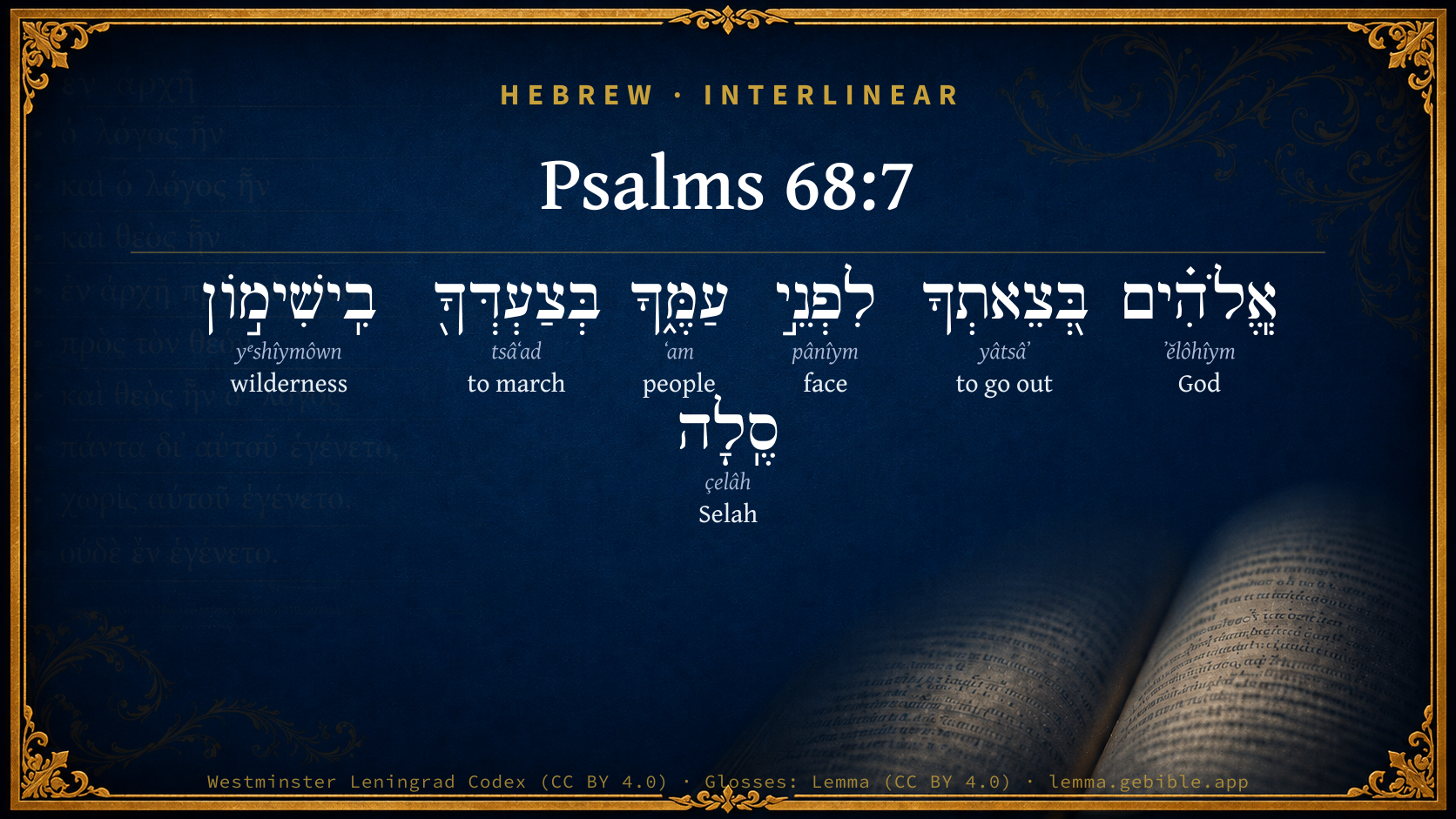
Hebrew (Westminster Leningrad Codex) Psalms 68:7 appears in the Hebrew Old Testament. The text above is from the Westminster Leningrad Codex. Each word links to its Strong’s number, a concise gloss, and parsing drawn from the Open Scriptures Hebrew Bible morphology. Click any word for its full Brown-Driver-Briggs (BDB) entry.
Download image
Cite this verse

Psalms 68:7 (World English Bible). Public Domain. Lemma interlinear Bible study tool, https://lemma.gebible.app/v/psalms/68/7.

Show BibTeX & RIS
BibTeX
RIS
English Translation
God, when you went forth before your people, When you marched through the wilderness... Selah.
World English Bible · Public Domain
Download a study sheet

One document with this verse’s original text, its word-by-word gloss line, the meaning frame, cross-references with their text, attributed commentary, and full source and license credits — printable, and it pastes into notes with its structure intact.

This verse Autodidact and up

Study sheet (.html) Plain text (.txt)

A passage Seminary Student

Up to 50 verses in one chapter. A passage sheet keeps up to 6 commentary sources and 12 cross-references per verse, in the order this page ranks them, and says so on the sheet whenever that leaves anything out. Ask for a single verse and you get the Autodidact verse sheet above.

Everything on this page stays free to read, with no account — the sheet is a download of what is already on screen, not access to it.

Want to remove ads? Support Godless Engineer
Compare translations 3

The same verse in 3 English versions, stacked beneath the original-language interlinear above. Click any original word for its lexicon entry.

Each is an independent rendering of the whole verse — the interlinear is not word-aligned to these translations.

Highlighted words mark where these versions differ — a whole-verse word diff, not a word-by-word alignment.

  • World English Bible Public Domain
    God, when you went forth before your people, When you marched through the wilderness... Selah.
  • King James Version Public Domain
    O God, when thou wentest forth before thy people, when thou didst march through the wilderness; Selah:
  • unfoldingWord Literal Text CC BY-SA 4.0
    God, when you went out to the face of your people, when you marched in the wilderness, Selah

unfoldingWord Literal Text — © unfoldingWord, licensed CC BY-SA 4.0. Word-aligned USFM3 via Door43 (git.door43.org/unfoldingWord/en_ult).

Versions to compare (up to 4)

3 of 4 selected

Show all 18 translations

Every available English version of this verse, each an independent rendering of the whole verse.

  • World English Bible Public Domain
    God, when you went forth before your people, When you marched through the wilderness... Selah.
  • Berean Standard Bible Public Domain
    O God, when You went out before Your people, when You marched through the wasteland, Selah
  • Majority Standard Bible Public Domain
    O God, when You went out before Your people, when You marched through the wasteland, Selah
  • King James Version Public Domain
    O God, when thou wentest forth before thy people, when thou didst march through the wilderness; Selah:
  • American Standard Version (1901) Public Domain
    O God, when thou wentest forth before thy people, When thou didst march through the wilderness; Selah
  • Revised Version (1885) Public Domain
    O God, when thou wentest forth before thy people, when thou didst march through the wilderness; Selah
  • Geneva Bible (1599) Public Domain
    O God, when thou wentest forth before thy people: when thou wentest through the wildernesse, (Selah)
  • Douay-Rheims (1899) Public Domain
    God who maketh men of one manner to dwell in a house: Who bringeth out them that were bound in strength; in like manner them that provoke, that dwell in sepulchres.
  • Young's Literal Translation Public Domain
    O God, in Thy going forth before Thy people, In Thy stepping through the wilderness, Selah.
  • Literal Standard Version CC BY-SA 4.0
    O God, in Your going forth before Your people, || In Your stepping through the wilderness, Selah.
  • Unlocked Literal Bible CC BY-SA 4.0
    God, when you went out before your people, when you marched through the wilderness, Selah
  • unfoldingWord Literal Text CC BY-SA 4.0
    God, when you went out to the face of your people, when you marched in the wilderness, Selah
  • Darby Bible Public Domain
    O God, when thou wentest forth before thy people, when thou didst march through the wilderness -- (Selah) --
  • World Messianic Bible Public Domain
    God, when you went out before your people, when you marched through the wilderness... Selah.
  • Webster's Bible Public Domain
    \\68:6\\God setteth the solitary in families: he bringeth out those who are bound with chains: but the rebellious dwell in a dry land.
  • Free Bible Version CC BY-SA 4.0
    God, when you led your people out, when you marched through the desert, Selah,
  • Bible in Basic English Public Domain
    O God, when you went out before your people, wandering through the waste land; (Selah.)
  • JPS Tanakh (1917) Public Domain
    (68-8) O God, when Thou wentest forth before Thy people, when Thou didst march through the wilderness; Selah

Literal Standard Version (2020), Covenant Press — licensed CC BY-SA 4.0. Text via the HelloAO Bible API (eBible.org). Unlocked Literal Bible (unfoldingWord) — licensed CC BY-SA 4.0. Text via the HelloAO Bible API (eBible.org). unfoldingWord Literal Text — © unfoldingWord, licensed CC BY-SA 4.0. Word-aligned USFM3 via Door43 (git.door43.org/unfoldingWord/en_ult). Free Bible Version, Dr. Jonathan Gallagher — licensed CC BY-SA 4.0. Text via the HelloAO Bible API (eBible.org).

Word by word

More ways to search: Search by grammar → Find every occurrence → Compare this word →

Practice this passage: Drill this verse → Learn its vocabulary →

בְּצַעְדְּךָ֖
tsâʻad
H6805
“in/at · to march · you”
Preposition + Verb, Qal, Infinitive Construct + Suffix, Personal, 2nd Person, Masculine, Singular
Part of Speech
Preposition + Verb
Stem
Qal
Form
Infinitive Construct
Full BDB Definition

Origin: a primitive root

TWOT: 1943

to step, march, stride - (Qal) to step, march - (Hiphil) to cause to march
  1. אֱֽלֹהִ֗ים ʼĕlôhîym H430 “God(s)” Noun, Common, Masculine, Plural, Absolute
  2. בְּ֭צֵאתְךָ yâtsâʼ H3318 “in/at · to go out · you” Preposition + Verb, Qal, Infinitive Construct + Suffix, Personal, 2nd Person, Masculine, Singular
  3. לִפְנֵ֣י pânîym H6440 “to/for · face(s) of” Preposition + Noun, Common, Both, Plural, Construct
  4. עַמֶּ֑ךָ ʻam H5971 “people · your” Noun, Common, Masculine, Singular, Construct + Suffix, Personal, 2nd Person, Masculine, Singular
  5. בִֽישִׁימ֣וֹן yᵉshîymôwn H3452 “in/at · wilderness” Preposition + Noun, Common, Masculine, Singular, Absolute
  6. סֶֽלָה çelâh H5542 “Selah” Particle, Interjection

About this verse

These counts appear in no published source. They are computed here, from the morphology-tagged text and Lemma’s own curated glosses. What Lemma adds →

7
words
7
distinct lemmas
Wisdom
section

Notable vocabulary

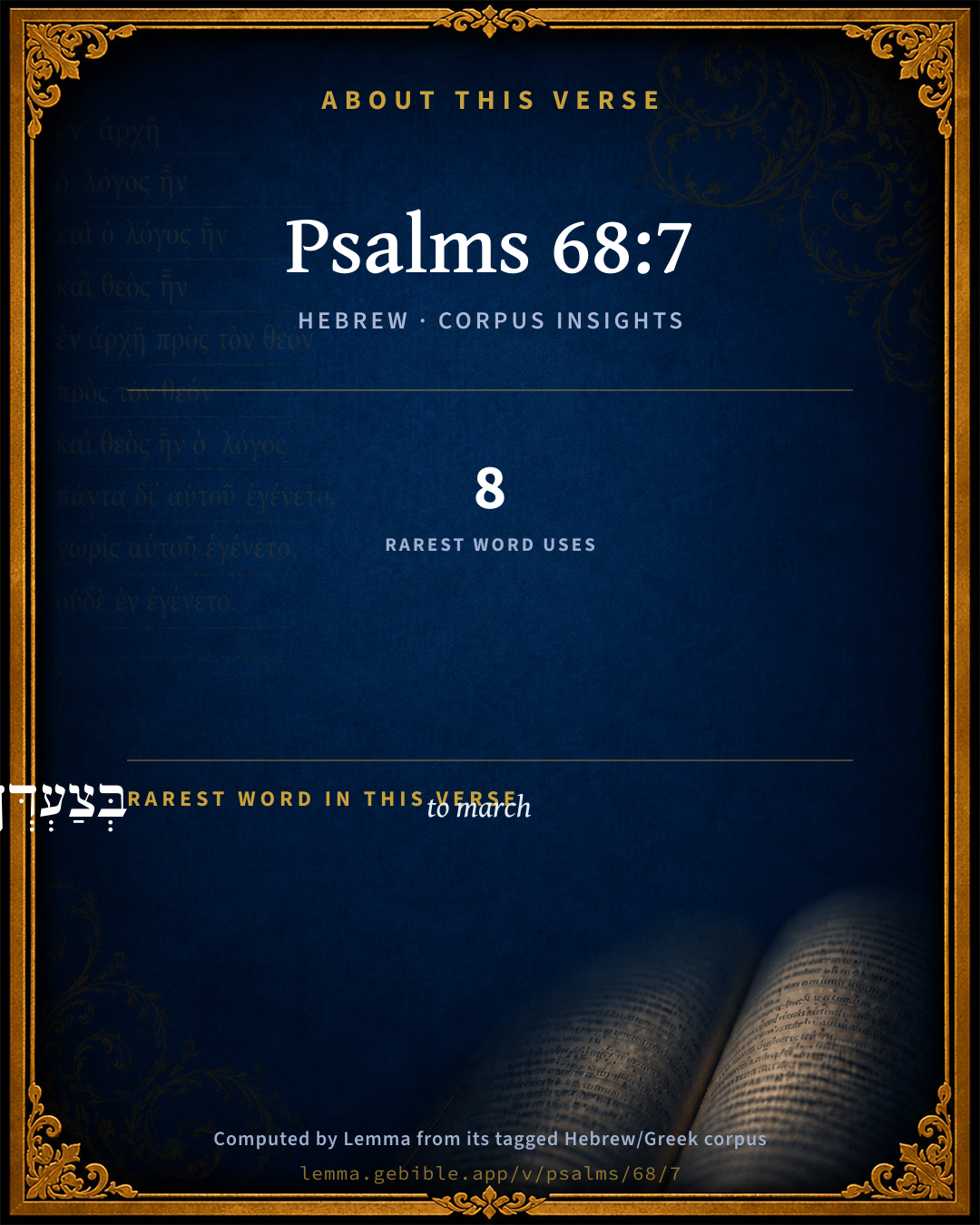
The rarest word here is בְּצַעְדְּךָ֖ to march H6805 — appearing just 8 times in the whole Hebrew Bible.

Shared distinctive vocabulary

בְּצַעְדְּךָ֖ to march H6805 occurs in 8 verses of the Hebrew Bible. Also found in:

Grammatical profile

  • 2 verbs
  • 4 nouns
  • 1 particle

Verb forms

  • בְּ֭צֵאתְךָ Qal · Infinitive Construct
  • בְּצַעְדְּךָ֖ Qal · Infinitive Construct

Hebrew & Septuagint length

In English translation the verse runs 15 words from the Hebrew and 16 from the Septuagint (LXX English) — closely comparable.

A rough comparison of the two English renderings, which tokenize alike — not a word-level alignment.

Word counts can differ between the Hebrew and the Greek without any difference in meaning — e.g. the Hebrew direct-object marker אֵת has no separate Greek word, and Greek often adds the article ὁ.

Cross-references

7

Topical passages linked to Psalms 68:7 in the Treasury of Scripture Knowledge — connected by theme and wording, ordered by reader-vote popularity; previews shown in the World English Bible.

  • Exodus 13:21 Yahweh went before them by day in a pillar of cloud, to lead them on their way, and by night in a pillar of fire, to give them light, that they might go by day and by night:
  • Judges 5:4 Yahweh, when you went forth out of Seir, When you marched out of the field of Edom, The earth trembled, the sky also dropped, Yes, the clouds dropped water.
  • Judges 4:14 Deborah said to Barak, Up; for this is the day in which Yahweh has delivered Sisera into your hand; hasn't Yahweh gone out before you? So Barak went down from Mount Tabor, and ten thousand men after him.
  • Habakkuk 3:12–13 You marched through the land in wrath. You threshed the nations in anger.
  • Deuteronomy 4:34 Or has God tried to go and take him a nation from the midst of [another] nation, by trials, by signs, and by wonders, and by war, and by a mighty hand, and by an outstretched arm, and by great terrors, according to all that Yahweh your God did for you in Egypt before your eyes?
  • Psalms 114:1–8 When Israel went forth out of Egypt, The house of Jacob from a people of foreign language;
  • Micah 2:13 He who breaks open the way goes up before them. They break through the gate, and go out. And their king passes on before them, With Yahweh at their head."

Cross-references courtesy of OpenBible.info (CC BY 4.0).

Hebrew and Greek witnesses Masoretic Hebrew ↔ Greek Septuagint

The same verse in the two great witnesses to the Old Testament, shown verse-for-verse.

You’re reading Greek Psalm 67 (Hebrew Psalm 68). The Septuagint counts the superscription, so verse numbers can differ from the Hebrew — chapter-level alignment, not verse-by-verse. Numbering follows Rahlfs.

These are two independent witnesses, not word-aligned to each other, and the Septuagint is shown in lemma (dictionary) form.

Hebrew Psalms 68:7 Masoretic · Westminster Leningrad Codex

אֱֽלֹהִ֗ים בְּ֭צֵאתְךָ לִפְנֵ֣י עַמֶּ֑ךָ בְּצַעְדְּךָ֖ בִֽישִׁימ֣וֹן סֶֽלָה

God, when you went forth before your people, When you marched through the wilderness... Selah.

World English Bible · Public Domain

Greek LXX Greek Psalm 67:7 Septuagint · lemma form

ὁ θεός καταοἰκίζω μονότροπος ἐν οἶκος ἐκἄγω πεδάω ἐν ἀνδρεῖος ὁμοίως ὁ παραπικραίνω ὁ καταοἰκέω ἐν τάφος

O God, when you went forth before your people, when you went through the wilderness; Pause:

LXX2012 (modern English Septuagint) · Public Domain

On this verse, Keil & Delitzsch discusses the Septuagint’s reading. Read the note in Commentary ↓

Hebrew: Westminster Leningrad Codex (CC BY 4.0). Greek: Septuagint (public domain); English from LXX2012 (modern English Septuagint) (Public Domain). How the Septuagint differs from the Hebrew →

Commentary

Notes on Psalms 68:7 from classic Christian and Jewish commentators (each source and its license shown beneath its notes). The classic Christian expositions comment on the surrounding passage and are grouped to its opening verse, so a note may address several verses; the Jewish commentaries on the Tanakh (Rashi and others) are per-verse, so they appear only where the commentator wrote on this verse.

Lemma curates 59 commentaries, every one of them public domain or Creative Commons licensed, each selected and text-cleaned for this edition rather than reprinted as found. About our sources →

Matthew Henry's Commentary

The psalmist here, having occasion to give God thanks for the great things he had done for him and his people of late, takes occasion thence to praise him for what he had done for their fathers in the days of old. Fresh mercies should put us in mind of former mercies and revive our grateful sense of them. Let it never be forgotten,

I. That God himself was the guide of Israel through the wilderness; when he had brought them out of their chains he did not leave them in the dry land, but he himself went before them in a march through the wilderness, Psa 68:7. It was not a journey, but a march, for they went as soldiers, as an army with banners. The Egyptians promised themselves that the wilderness had shut them in, but they were deceived; God's Israel, having him for their leader, marched through the wilderness and were not lost in it. Note, If God bring his people into a wilderness, he will be sure to go before them in it and bring them out of it. Sol 8:5.

II. That he manifested his glorious presence with them at Mount Sinai, Psa 68:8. Never did any people see the glory of God, nor hear his voice, as Israel did, Deu 4:32, Deu 4:33. Never had any people such an excellent law given them, so expounded, so enforced. Then the earth shook, and the neighbouring countries, it is likely, felt the shock; terrible thunders there were, accompanied no doubt with thunder-showers, in which the heavens seemed to drop; while the divine doctrine dropped as the rain, Deu 32:2. Sinai itself, that vast mountain, that long ridge of mountains, was moved at the presence of God; see Jdg 5:4, Jdg 5:5; Deu 33:2; Hab 3:3. This terrible appearance of the Divine Majesty, as it would possess them with a fear and dread of him, so it would encourage their faith in him and dependence upon him. Whatever mountains of difficulty lay in the way of their happy settlement, he that could move Sinai itself could remove them, could get over them.

III. That he provided very comfortably for them both in the wilderness and in Canaan (Psa 68:9, Psa 68:10): Thou didst send a plentiful rain and hast prepared of thy goodness for the poor. This may refer, 1. To the victualling of their camp with manna in the wilderness, which was rained upon them, as were also the quails (Psa 78:24, Psa 78:27), and it might be fitly called a rain of liberality or munificence, for it was a memorable instance of the divine bounty. This confirmed the camp of Israel (here called God's inheritance, because he had chosen them to be a peculiar treasure to himself) when it was weary and ready to perish: this confirmed their faith, and was a standing proof of God's power and goodness. Even in the wilderness God found a comfortable dwelling for Israel, which was his congregation. Or, 2. To the seasonable supplies granted them in Canaan, that land flowing with mild and honey, which is said to drink water of the rain of heaven, Deu 11:11. When sometimes that fruitful land was ready to be turned into barrenness, for the iniquity of those that dwelt therein, God, in judgment, remembered mercy, and sent them a plentiful rain, which refreshed it again, so that the congregation of Israel dwelt therein, and there was provision enough, even to satisfy their poor with bread. This looks further to the spiritual provision made for God's Israel; the Spirit of grace and the gospel of grace are the plentiful rain with which God confirms his inheritance, and from which their fruit is found, Isa 45:8. Christ himself is this rain, Psa 72:6. He shall come as showers that water the earth.

IV. That he often gave them victory over their enemies; armies, and kings of armies, appeared against them, from their first coming into Canaan, and all along in the times of the judges, till David's days, but, first or last, they gained their point against them, Psa 68:11, Psa 68:12, Psa 68:14. Observe here, 1. That God was their commander-in-chief: The Lord gave the word, as general of their armies. He raised up judges for them, gave them their commissions and instructions, and assured them of success. God spoke in his holiness, and then Gilead is mine. 2. That they had prophets, as God's messengers, to make known his mind to them. God gave them his word (the word of the Lord came unto them) and then great was the company of the preachers - prophets and prophetesses, for the word is feminine. When God has messages to send he will not want messengers. Or perhaps it may allude to the women's joining in the triumph when the victory was obtained, as was usual (Exo 15:20, Sa1 18:7), in which they took notice of the word of God, triumphing in that as much as in his works. 3. That their enemies were defeated, and put to confusion: Kings of armies did flee, did flee with the greatest terror and precipitation imaginable, did not fight and flee, but flee and flee, retired without striking a stroke; they fled apace, fled and never rallied again. 4. That they were enriched with the plunder of the field: She that tarried at home divided the spoil. Not only the men, the soldiers that abode by the stuff, who were, by a statute of distributions, to share the prey (Sa1 30:24), but even the women that tarried at home had a share, which intimates the abundance of spoil that should be taken. 5. That these great things which God did for them were sanctified to them and contributed to their reformation (Psa 68:14): When the Almighty scattered kings for her (for the church) she was white as snow in Salmon, purified and refined by the mercies of God; when the host went forth against the enemy they kept themselves from every wicked thing, and so the host returned victorious, and Israel by the victory were confirmed in their purity and piety. This account of Israel's victories is applicable to the victories obtained by the exalted Redeemer for those that are his, over death and hell. By the resurrection of Christ our spiritual enemies were made to flee, their power was broken, and they were for ever disabled to hurt any of God's people. This victory was first notified by the women (the she-publishers) to the disciples (Mat 28:7) and by them it was preached to all the world, while believers that tarry at home, that did not themselves contribute any thing towards it, enjoy the benefit of it, and divide the spoil.

V. That from a low and despised condition they had been advanced to splendour and prosperity. When they were bond-slaves in Egypt, and afterwards when they were oppressed sometimes by one potent neighbour and sometimes by another, they did, as it were, lie among the pots or rubbish, as despised broken vessels, or as vessels in which there was no pleasure - they were black, and dirty, and discoloured. But God, at length, delivered them from the pots (Psa 81:6), and in David's time they were in a fair way to be one of the most prosperous kingdoms in the world, amiable in the eyes of all about them, like the wings of a dove covered with silver, Psa 68:13. "And so," says Dr. Hammond, "under Christ's kingdom, the heathen idolaters that were brought to the basest and most despicable condition of any creatures, worshipping wood and stone, and given up to the vilest lusts, should from that detestable condition be advanced to the service of Christ, and the practice of all Christian virtues, the greatest inward beauties in the world." It may be applied also to the deliverance of the church out of a suffering state and the comforts of particular believers after their despondencies.

Matthew Henry's Commentary on the Whole Bible (1708–1710) — public domain (CC PDM 1.0). Text via the HelloAO Bible API.

Trapp's Complete Commentary

John Trapp

Psa 68:7 O God, when thou wentest forth before thy people, when thou didst march through the wilderness; Selah:

Ver. 7. O God, when thou wentest forth before thy people] Here the former benefits of God to his people are recited, et additis miris coloribus depicta potius quam descripta, and rather depainted out in lively colours than described. We must stir up ourselves to thankfulness for what God hath done for our forefathers; neither must the memory of his mercies ever grow stale with us.

John Trapp, A Commentary or Exposition upon All the Books of the Old and New Testament (1647–1656) — public domain. Text from a community e-Sword module.

The Biblical Illustrator

Joseph S. Exell

Psa_68:7-18

O God, when Thou wentest forth before Thy people, when Thou didst march through the wilderness.

The progress of humanity

I. It commences with the Divinely terrible (Psa_68:7-8). As a rule, if not always, the very first step of the soul on its moral march is preceded by visions of God that startle and alarm. God seems to enwrap the soul in blackness and darkness and tempests, to roll thunders and flash lightnings on the conscience, as on Sinai of old; so that the soul cries out, Lord, what shall I do to be saved? (Isaiah; St. Paul; people on day of Pentecost.)

II. It proceeds under the leadership of God Himself.

1. He supplied Israels needs (Psa_68:9).

2. He conquered their enemies (Psa_68:11-12). And this is what God is always doing for His people. No moral progress can we make unless He leads us on, supplying our needs and striking down our foes.

III. Every stage conducts to higher privileges. Three stages in the march of the Hebrews are indicated here. From Egypt they advanced to the wilderness, and the wilderness, with all its trials and inconveniences, was better than the land of despotism. From the wilderness they entered Canaan. Every stage that a man reaches in moral progress is better than the preceding. He moves on from strength to strength, from glory to glory. The glories reached are nothing to be compared to the glories yet to be enjoyed. (Homilist.)

The Biblical Illustrator, edited by Joseph S. Exell (c. 1880s–1900s) — public domain. Text from a community e-Sword module.

The Treasury of David

Charles H. Spurgeon

Ver. 7. O God, when thou wentest forth before thy people. What a sweetly suitable association, "thou" and "thy people; "--thou before, and thy people following! The Lord went before, and, therefore, whether the Red Sea or burning sand lay in the way, it mattered not; the pillar of cloud and fire always led them by a right way.

When thou didst march through the wilderness. He was the Commander in chief of Israel, from whom they received all orders, and the march was therefore his march. "His stately step the region drear beheld." We may speak, if we will, of the "wanderings of the children of Israel, "but we must not think them purposeless strayings, they were in reality a well arranged and well considered march.

SELAH. This seems an odd place for a musical pause or direction, but it is better to break a sentence than spoil praise. The sense is about to be superlatively grand, and, therefore, the selah intimates the fact to the players and singers, that they may with suitable solemnity perform their parts. It is never untimely to remind a congregation that the worship of God should be thoughtfully and heartily presented.

None.

Ver. 7-8.

I. God has his seasons for delivering his people from

their troubles: When thou, etc.

II. His deliverance is complete: The earth shook, etc.;

all things gave way before him.

III. The deliverance is greater for the delay.

1. It is so in itself.

2. It is more prized: as in the case of Job, Abraham, Israel at the Red Sea, Daniel, his three companions, etc. G. R.

Ver. 7-9.

I. The presence of God in his church.

1. His preeminence: "before."

2. As covenant God of Israel.

3. As active and making active.

4. His rule within: they follow.

5. His design without: marching for war. II. The blessed consequences.

1. The most stolid shake.

2. The lofty bow.

3. Difficulties removed: "Sinai."

4. Blessings plenteous.

5. Church revived.

Psalms 68:8*

Ver. 7-8. See Psalms on "Ps 68:7" for further information.

Ver. 7-9. See Psalms on "Ps 68:7" for further information.

Psalms 68:9*

Ver. 7-9. See Psalms on "Ps 68:7" for further information.

Charles H. Spurgeon's The Treasury of David (1869–1885) — public domain. Psalms only. Text from a community e-Sword/MySword module.

Joseph Benson's Commentary

Psa 68:7-8. O God, when thou wentest forth before thy people — In the cloudy pillar, as their captain, leading them out of Egypt; the earth shook — Or, trembled, that is, either the inhabitants of those parts of the earth, according to Exo 15:14; or the earth itself, through an earthquake, as a token of God’s dreadful presence, as seems to be intimated, Psa 114:5-7. The heavens also dropped — Dissolved into showers, as the consequence of those mighty thunders and lightnings, which also bespoke his presence, and of the thick cloud that covered the mount. Even Sinai itself, &c. — Shook, or dropped, for either verb may be supplied from the former clause, there being no verb in the Hebrew text of this clause. Sinai was even melted, or dissolved with fear. It is a poetical representation of the terribleness of God’s appearance. Dr. Chandler supposes that this part of the Psalm, from Psa 68:7 to the 14th, was sung just as the procession began, and the Levites moved along with the ark, placed by its staves on their shoulders.

Joseph Benson's Commentary on the Old and New Testaments (1811–1818) — public domain. Text from a community e-Sword module.

Whedon's Commentary on the Bible

Daniel D. Whedon

7. Wentest forth… didst march—Military phrases, specially denoting the going forth to battle, Psa_44:9; Hab_3:13; Num_27:17. The triumphal march of Psa_68:4 is resumed, and the proper theme of the psalm is here taken up, which is, to show that God, who has always acted as the captain and leader of his people, disposing every thing concerning them by his supreme command, has now directed the settlement of the ark at Zion. See Psa_68:15-16. Psa_68:7-9 are a quotation from Jdg_5:4-5.

Wilderness—The desert of Sinai, which Moses calls “the waste, howling wilderness.” Deu_32:10. In Jdg_5:4 the desert of Sinai and the Arabah south of the Dead Sea, (Psa_68:4,) are both mentioned.

Daniel D. Whedon (gen. ed.), Commentary on the Old and New Testaments (1874–1909) — public domain. Text from a community e-Sword module.

Keil & Delitzsch

C. F. Keil & F. Delitzsch

In Psa 68:7. the poet repeats the words of Deborah (Jdg 5:4.), and her words again go back to Deu 33:2, cf. Exo 19:15.; on the other hand, our Psalm is the original to Hab. 3. The martial verb יצא represents Elohim as, coming forth from His heavenly dwelling-place (Isa 26:21), He places Himself at the head of Israel. The stately verb צעד represents Him as He accompanies the hosts of His people with the step of a hero confident of victory; and the terrible name for the wilderness, ישׁימון, is designedly chosen in order to express the contrast between the scene of action and that which they beheld at that time. The verb to זה סיני is easily supplied; Dachselt's rendering according to the accents is correct: hic mons Sinai (sc. in specie ita tremuit). The description fixes our attention upon Sinai as the central point of all revelations of God during the period of deliverance by the hand of Moses, as being the scene of the most gloriously of them all (vid., on Hab. p. 136f.). The majestic phenomena which proclaimed the nearness of God are distributed over the whole journeying, but most gloriously concentrated themselves at the giving of the Law of Sinai. The earth trembled throughout the extended circuit of this vast granite range, and the heavens dropped, inasmuch as the darkness of thunder clouds rested upon Sinai, pierced by incessant lightnings (Ex. 19). There, as the original passages describe it, Jahve met His people; He came from the east, His people from the west; there they found themselves together, and shaking the earth, breaking through the heavens, He gave them a pledge of the omnipotence which should henceforth defend and guide them. The poet has a purpose in view in calling Elohim in this passage "the God of Israel;" the covenant relationship of God to Israel dates from Sinai, and from this period onwards, by reason of the Tra, He became Israel's King (Deu 33:5). Since the statement of a fact of earlier history has preceded, and since the preterites alternate with them, the futures that follow in Psa 68:10, Psa 68:11 are to be understood as referring to the synchronous past; but hardly so that Psa 68:10 should refer to the miraculous supply of food, and more especially the rain of manna, during the journeyings through the wilderness. The giving of the Law from Sinai has a view to Israel being a settled, stationary people, and the deliverance out of the land of bondage only finds its completion in the taking and maintaining possession of the Land of Promise. Accordingly Psa 68:10, Psa 68:11 refer to the blessing and protection of the people who had taken up their abode there.

The נחלהּ of God (genit. auctoris, as in 2 Macc. 2:4) is the land assigned by Him to Israel as an inheritance; and גּשׁם נדבות an emblem of the abundance of gifts which God has showered down upon the land since Israel took up its abode in it. נדבה is the name given to a deed and gift springing from an inward impulse, and in this instance the intensive idea of richness and superabundance is associated therewith by means of the plural; גּשׁם נדבות is a shower-like abundance of good gifts descending from above. The Hiphil הניף here governs a double accusative, like the Kal in Pro 7:17, in so far, that is, as נחלתך is drawn to Psa 68:10; for the accentuation, in opposition to the Targum, takes נחלתך ונלאה together: Thine inheritance and that the parched one (Waw epexeget. as in Sa1 28:3; Amo 3:11; Amo 4:10). But this "and that" is devoid of aim; why should it not at once be read הנּלאה? The rendering of Bttcher, "Thy sickened and wearied," is inadmissible, too, according to the present pointing; for it ought to be נחלתך or נחלתך. And with a suffix this Niphal becomes ambiguous, and more especially so in this connection, where the thought of נחלה, an inherited possession, a heritage, lies so naturally at hand. נחלתך is therefore to be drawn to Psa 68:10, and Psa 68:10 must begin with ונלאה, as in the lxx, καὶ ἠσθένησε σὺ δὲ κατεερτίσω αὐτήν. It is true נלאה is not a hypothetical preteriet equivalent to ונלאתה; but, as is frequently the case with the anarthrous participle (Ew. 341, b), it has the value of a hypothetical clause: "and if it (Israel's inheritance) were in a parched, exhausted condition (cf. the cognate root להה, Gen 47:13), then hast Thou always made it again firm" (Psa 8:4; Psa 15:1-5 :17), i.e., strengthened, enlivened it. Even here the idea of the inhabitants is closely associated with the land itself; in Psa 68:11 they are more especially thought of: "They creatures dwelt therein." Nearly all modern expositors take חיּה either according to Sa2 23:11, Sa2 23:13 (cf. Ch1 11:15), in the signification tent-circle, ring-camp (root חו, Arab. ḥw, to move in a circle, to encircle, to compass), or in the signification of Arab. ḥayy (from Arab. ḥayiya = חיי, חיה), a race or tribe, i.e., a collection of living beings (cf. חיּי, Sa1 18:18). But the Asaphic character of this Psalm, which is also manifest in other points, is opposed to this rendering. This style of Psalm is fond of the comparison of Israel to a flock, so that also in Psa 74:19 חית עניין signifies nothing else than "the creatures [Getheir, collective] of Thy poor, Thy poor creatures." This use of חיה is certainly peculiar; but not so remarkable as if by the "creatures of God" we had to understand, with Hupfeld, the quails (Ex. 16). The avoiding of בּהמה on account of the idea of brutum (Psa 73:22) which is inseparable from this word, is sufficient to account for it; in חיה, ζῷον, there is merely the notion of moving life. We therefore are to explain it according to Mic 7:14, where Israel is called a flock dwelling in a wood in the midst of Carmel: God brought it to pass, that the flock of Israel, although sorely persecuted, nevertheless continued to inhabit the land. בּהּ, as in Mic 7:15, refers to Canaan. עני in Psa 68:11 is the ecclesia pressa surrounded by foes on every side: Thou didst prepare for Thy poor with Thy goodness, Elohim, i.e., Thou didst regale or entertain Thy poor people with Thy possessions and Thy blessings. הכין ל, as in Gen 43:16; Ch1 12:39, to make ready to eat, and therefore to entertain; טובה as in Psa 65:12, טוּב ה, Jer 31:12. It would be quite inadmissible, because tautological, to refer תּכין to the land according to Psa 65:10 (Ewald), or even to the desert (Olshausen), which the description has now left far behind.

Keil & Delitzsch — Biblical Commentary on the Old Testament (1861–1891) — public domain (CC PDM 1.0). Text via the HelloAO Bible API. (Old Testament only.)

J. A. Alexander on Psalms

Joseph Addison Alexander

8. (Psa 68:7). O God, in thy going out before thy people, in thy marching through the wilderness. Selah. The sentence is completed in the next verse, being here divided by a pause of solemn and admiring recollection. The general description of the foregoing verses is now confirmed and illustrated by a reference to the exodus from Egypt, and the journey through the wilderness. Before thy people, in the pillar of cloud, as their guide and their commander. Thy marching, literally thy stepping, treading, or more exactly still, thy step or tread. To make the allusion still more pointed, the word for wilderness is not the one commonly so rendered, but one borrowed from Deu 32:10.

Joseph Addison Alexander, The Psalms Translated and Explained (1850) — public domain. Text from a community e-Sword module.

Geneva Bible (1599)

Geneva Bible translators

He teacheth that God’s favor peculiarly belongeth to his Church, as appeareth by their wonderful deliverance out of Egypt.

Geneva Bible (1599) marginal notes — public domain. Text via Bolls.life.

Jamieson, Fausset & Brown

Robert Jamieson, A. R. Fausset & David Brown

(Compare Exo 19:16-18).

thou wentest--in the pillar of fire.

thou didst march--literally, "in Thy tread," Thy majestic movement.

Jamieson, Fausset & Brown — Commentary Critical and Explanatory on the Whole Bible (1871) — public domain (CC PDM 1.0). Text via the HelloAO Bible API.

Adam Clarke's Commentary

Verse 7. O God, when thou wentest forth] This and the following verse most manifestly refer to the passage of the Israelites through the wilderness.

Adam Clarke's Commentary on the Bible (1810–1826) — public domain. Text from a community e-Sword/MySword module.

John Calvin's Commentaries

7 O God! when thou wentest forth before thy people, etc. The Psalmist now proceeds to show that the Divine goodness is principally displayed in the Church, which God has selected as the great theater where his fatherly care may be manifested. What follows is evidently added with the view of leading the posterity of Abraham, as the Lord’s chosen people, to apply the observations which had been just made to themselves. The deliverance from Egypt having been the chief and lasting pledge of the Divine favor, which practically ratified their adoption under the patriarch, he briefly adverts to that event. He would intimate that in that remarkable exodus, proof had been given to all succeeding ages of the love which God entertained for his Church. Why were so many miracles wrought? why were heaven and earth put into commotion? why were the mountains made to tremble? but that all might recognize the power of God as allied with the deliverance of his people. He represents God as having been their leader in conducting them forth. And this not merely in reference to their passage of the Red Sea, but their journeys so long as they wandered in the wilderness. When he speaks of the earth being moved, he would not seem to allude entirely to what occurred upon the promulgation of the law, but to the fact that, throughout all their progress, the course of nature was repeatedly altered, as if the very elements had trembled at the presence of the Lord. It was upon Mount Sinai, however, that God issued the chief displays of his awful power; it was there that thunders were heard in heaven, and the air was filled with lightnings; and, accordingly, it is mentioned here by name as having presented the most glorious spectacle of the Divine majesty which was ever beheld. Some read, This Sinai, etc., connecting the pronoun זה, zeh, with the mountain here named; but it is much more emphatical to join it with the preceding clause, and to read, the heavens dropped at the presence of This God; David meaning to commend the excellency of the God of Israel. The expression is one frequently used by the prophets to denote that the God worshipped by the posterity of Abraham was the true God, and the religion delivered in his law no delusion, as in Isaiah 25:9, “This, this is our God, and he will save us.” To establish the Lord’s people in their faith, David leads them, as it were, into the very presence of God; indicates that they were left to no such vague uncertainties as the heathen; and indirectly censures the folly of the world in forsaking the knowledge of the true God, and fashioning imaginary deities of its own, of wood and stone, of gold and silver.

John Calvin's Commentaries (1540-1563) — public domain. Text from the Calvin Translation Society English edition (1840s-50s) via the Christian Classics Ethereal Library (ccel.org). Calvin's coverage is partial (roughly two-thirds of the Bible); uncommented books and verses are honest gaps, never fabricated. The 19th-century editor's footnotes and remarks are omitted so the notes are faithfully Calvin's own voice.

The Cambridge Bible for Schools and Colleges

gen. ed. J. J. S. Perowne

7, 8. These verses are borrowed, with some omissions and alterations, from the Song of Deborah (Jdg_5:4-5):

“Jehovah, when thou wentest forth out of Seir,

When thou didst march out of the field of Edom,

The earth trembled, the heavens also dropped,

Yea, the clouds dropped water;

The mountains quaked at the presence of God,

Even yon Sinai at the presence of Jehovah, the God of Israel.”

When God brought Israel out of Egypt, He “went before them … to lead them in the way” (Exo_13:21 f.; cp. Mic_2:13), and in the great Theophany of Sinai the mystery and marvel of His self-revelation were concentrated. Earthquake and storm are the symbols of His Presence and Power. See Exo_19:16 ff., and cp. Psa_18:7 ff.; Hab_3:3 ff.

Three times in this Psalm (7, 19, 32) Selah occurs not at the close of a stanza, but after the first verse of a stanza. If the text is right, it would seem that a musical interlude was employed to enforce the thought with which the stanza begins.

7–10. The Exodus from Egypt and the Entry into Canaan.

7–18. After this general introduction the Psalmist proceeds to review the past history of Israel in proof of God’s victorious power and of His gracious love towards His people.

The Cambridge Bible for Schools and Colleges (gen. ed. J. J. S. Perowne; Cambridge University Press, 1878–1918) — public domain. Text from a community e-Sword module.

John Gill's Exposition

O God, when thou wentest forth before thy people,.... In the pillar of cloud, and in the pillar of fire, as the Targum adds; and this divine Person was the Son of God, the Angel of his presence, in whom his name was, even his name JAH or Jehovah before mentioned;

when thou didst march through the wilderness; at the head of the Israelites, leading, guiding, and directing them; providing for them all things necessary, and protecting them against their enemies. And so Christ goes before his people, as they pass through the wilderness of this world; and does the like good offices for them, until he, as the great Captain of their salvation, brings them safe to glory: for what is here said is taken notice of as a resemblance of what he now does, or has done, under the Gospel dispensation, to which this psalm belongs; particularly of his marching through the wilderness of the Gentile world, in the ministry of the word by his apostles, wherein he went forth conquering and to conquer.

Selah; on this word; see Gill on Psa 3:2.

John Gill's Exposition of the Whole Bible (1746–1763) — public domain (CC PDM 1.0). Text via the HelloAO Bible API.

Albert Barnes' Notes on the Bible

O God, when thou wentest forth before thy people ... - That is, in conducting them through the desert to the promised land. The statement in regard to the paternal character of God in the previous verses is here illustrated by his guiding his own people, when fleeing from a land of oppression, through the barren desert - and his interpositions there in their behalf. All that had been said of him in the previous verses is here confirmed by the provision which he made for their needs in their perilous journey through the wilderness.

Albert Barnes' Notes on the Bible (1834–1885) — public domain. Text from a community e-Sword/MySword module.

Matthew Poole's English Annotations

In the cloudy pillar, as their Captain leading them out of Egypt.

Matthew Poole's English Annotations on the Holy Bible (1683–1685) — public domain. Text from a community e-Sword/MySword module.

The Pulpit Commentary

Vers. 7-10. In the central portion of the psalm, from ver. 7 to ver. 28, God is praised for his doings in connection with the history of Israel; and, first of all, in the present passage, for his doings at Sinai and in the wilderness.

O God, when thou wentest forth before thy people. (see Exo_13:20-22) The present verse and the next are an echo of the Song of Deborah, (Jud_1:5:4, 5) "Lord, when thou wentest out of Seir, when thou marchedst out of the field of Edom, the earth trembled, and the heavens dropped, the clouds also dropped water; the mountains melted from before the Lord, even that Sinai from before the Lord God of Israel." When thou didst march through the wilderness. The entire march from Etham to Pisgah is in the poet"s mind; but he can touch only certain features of it. And first, the scene at Sinai.

The Pulpit Commentary (1880–1919), ed. H.D.M. Spence-Jones & Joseph S. Exell — public domain. Text from a community e-Sword module.

John Wesley's Explanatory Notes

Wentest - In the cloudy pillar, as their captain leading them up out of Egypt.

John Wesley, Explanatory Notes Upon the Whole Bible (1754–1765) — public domain. Text via the GEBible commentary corpus.

unfoldingWord translationNotes

Door43 World Missions Community

General Information:

David begins to tell the story of God leading the Israelites through the desert to Mt. Sinai.

when you went out ... when you marched through

These two phrases refer to the same event. (See: Parallelism)

you went out before your people

"you led your people"

when you marched through the wilderness

God is spoken of as if he was a soldier marching ahead of the people of Israel. (See: Metaphor)

the heavens also dropped rain ... God's presence

"God caused it to rain"

in the presence of God

This idiom here refers to God's appearance before the Israelites. AT: "when God appeared to the Israelites" (See: Parallelism)

translationWords

people of God

desert

selah

heaven

Sinai

Israel

unfoldingWord translationNotes — © Distant Shores Media and the Door43 World Missions Community, licensed CC BY-SA 4.0. Source: git.door43.org/Door43/en_tn.

Rashi

Rabbi Shlomo Yitzchaki (Rashi)

settles the solitary in a house Israel, who were spread out. He gathered together each one from the place where he was lost and settled them in a complete household and a complete nation.

He takes the prisoners out at the most opportune time He took Israel out of Egypt in the month that is best suited for travelers, neither hot nor cold.

but the rebellious The Egyptians.

dwell in an arid land Their land remained arid and thirsty. I found [this].

Rashi on the Tanakh — English translations: “The Judaica Press complete Tanach with Rashi, translated by A. J. Rosenberg” (CC BY 4.0); “Pentateuch with Rashi's commentary by M. Rosenbaum and A.M. Silbermann, 1929-1934” (public domain); “The Metsudah Tanach series, Lakewood, N.J” (CC BY 4.0); and “The Book of Joshua, Metsudah Publications, 1997” (CC BY 4.0). Text via Sefaria.

Lesson kit

Teaching starters — assembled from the data on this page, not authored interpretation. Every prompt links to the verse data it draws on. Edit before teaching.

Psalms, in the Wisdom, opens this verse with 7 words (7 distinct Hebrew lemmas). Its most distinctive word is tsâʻad (“to march”). A historical commentator’s framing appears above. Read the whole chapter for the surrounding context.

Discussion questions

  1. What does “to march” (tsâʻad) contribute to the verse as a whole?
  2. How does Genesis 49:22, which shares the word «to march», read alongside this verse?
  3. These translations render this verse differently. What is at stake in choosing one wording over another?
  4. «בְּ֭צֵאתְךָ» is a Qal Infinitive Construct verb. How does that grammatical form shape the action described?
  5. Compare how Matthew Henry's Commentary and Trapp's Complete Commentary read this verse. Where do they agree or differ?

Things to notice

Reading settings

Reading text

Shown beneath each verse's original-language words.

Old Testament
Old Testament edition

Read the OT as the Masoretic Hebrew (MT) or the Greek Septuagint (LXX).

English shown for the Greek Septuagint (in the Hebrew ↔ Greek comparison).

Comparing translations? Open the Compare panel on any verse page to stack up to four side by side.