
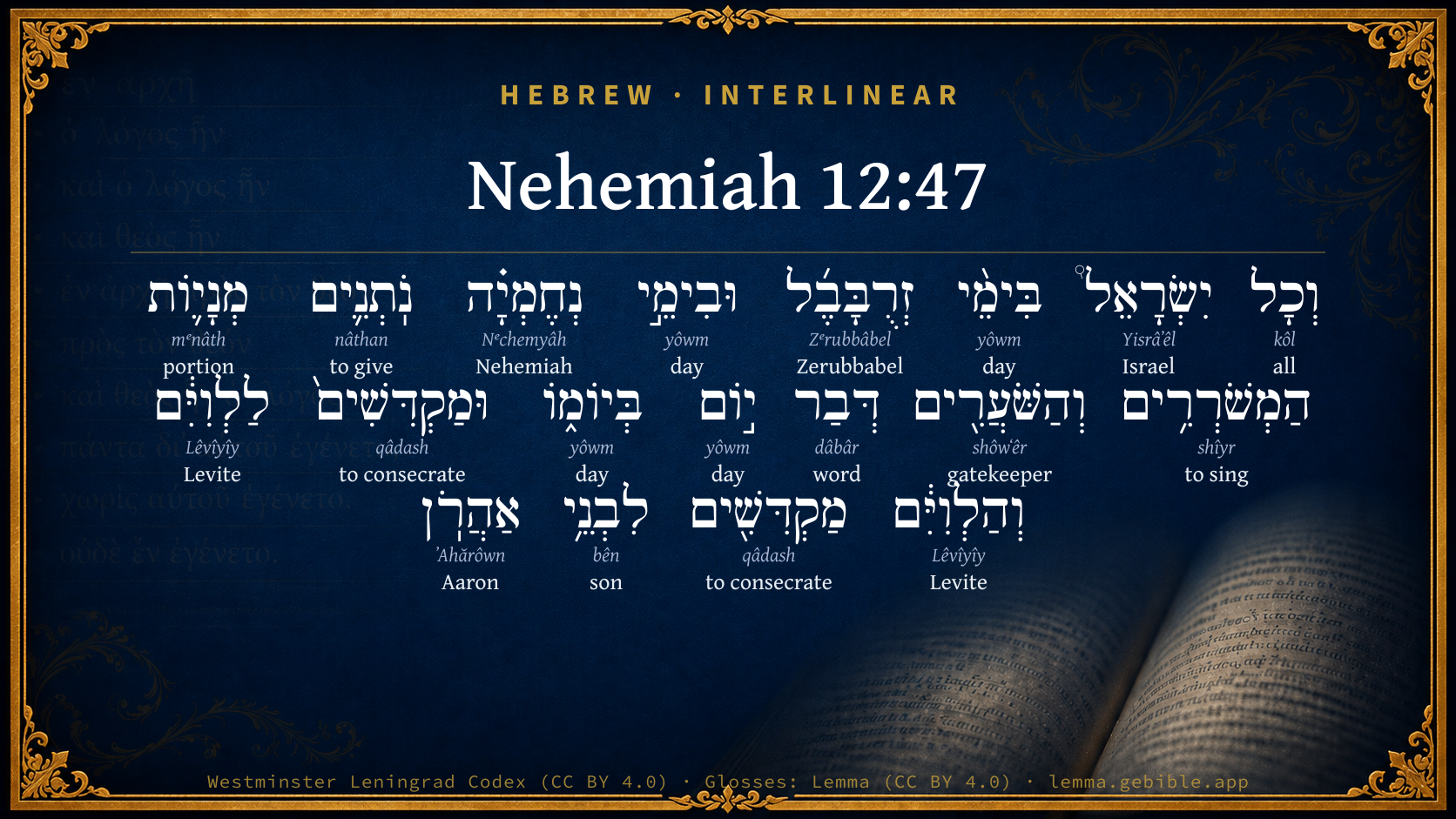
Nehemiah 12:47

Hebrew (Westminster Leningrad Codex) Nehemiah 12:47 appears in the Hebrew Old Testament. The text above is from the Westminster Leningrad Codex. Each word links to its Strong’s number, a concise gloss, and parsing drawn from the Open Scriptures Hebrew Bible morphology. Click any word for its full Brown-Driver-Briggs (BDB) entry.
Download image
Cite this verse

Nehemiah 12:47 (World English Bible). Public Domain. Lemma interlinear Bible study tool, https://lemma.gebible.app/v/nehemiah/12/47.

Show BibTeX & RIS
BibTeX
RIS
English Translation
All Israel in the days of Zerubbabel, and in the days of Nehemiah, gave the portions of the singers and the porters, as every day required: and they set apart [that which was] for the Levites; and the Levites set apart [that which was] for the sons of Aaron.
World English Bible · Public Domain
Download a study sheet

One document with this verse’s original text, its word-by-word gloss line, the meaning frame, cross-references with their text, attributed commentary, and full source and license credits — printable, and it pastes into notes with its structure intact.

This verse Autodidact and up

Study sheet (.html) Plain text (.txt)

A passage Seminary Student

Up to 50 verses in one chapter. A passage sheet keeps up to 6 commentary sources and 12 cross-references per verse, in the order this page ranks them, and says so on the sheet whenever that leaves anything out. Ask for a single verse and you get the Autodidact verse sheet above.

Everything on this page stays free to read, with no account — the sheet is a download of what is already on screen, not access to it.

Want to remove ads? Support Godless Engineer
Compare translations 3

The same verse in 3 English versions, stacked beneath the original-language interlinear above. Click any original word for its lexicon entry.

Each is an independent rendering of the whole verse — the interlinear is not word-aligned to these translations.

Highlighted words mark where these versions differ — a whole-verse word diff, not a word-by-word alignment.

  • World English Bible Public Domain
    All Israel in the days of Zerubbabel, and in the days of Nehemiah, gave the portions of the singers and the porters, as every day required: and they set apart [that which was] for the Levites; and the Levites set apart [that which was] for the sons of Aaron.
  • King James Version Public Domain
    And all Israel in the days of Zerubbabel, and in the days of Nehemiah, gave the portions of the singers and the porters, every day his portion: and they sanctified holy things unto the Levites; and the Levites sanctified them unto the children of Aaron.
  • unfoldingWord Literal Text CC BY-SA 4.0
    And in the days of Zerubbabel and in the days of Nehemiah, all Israel was giving the portions of the ones who sang and the gatekeepers, as a daily matter in its day. And they were consecrating for the Levites, and the Levites were consecrating for the sons of Aaron.

unfoldingWord Literal Text — © unfoldingWord, licensed CC BY-SA 4.0. Word-aligned USFM3 via Door43 (git.door43.org/unfoldingWord/en_ult).

Versions to compare (up to 4)

3 of 4 selected

Show all 17 translations

Every available English version of this verse, each an independent rendering of the whole verse.

  • World English Bible Public Domain
    All Israel in the days of Zerubbabel, and in the days of Nehemiah, gave the portions of the singers and the porters, as every day required: and they set apart [that which was] for the Levites; and the Levites set apart [that which was] for the sons of Aaron.
  • Berean Standard Bible Public Domain
    So in the days of Zerubbabel and Nehemiah, all Israel contributed the daily portions for the singers and gatekeepers. They also set aside daily portions for the Levites, and the Levites set aside daily portions for the descendants of Aaron.
  • Majority Standard Bible Public Domain
    So in the days of Zerubbabel and Nehemiah, all Israel contributed the daily portions for the singers and gatekeepers. They also set aside daily portions for the Levites, and the Levites set aside daily portions for the descendants of Aaron.
  • King James Version Public Domain
    And all Israel in the days of Zerubbabel, and in the days of Nehemiah, gave the portions of the singers and the porters, every day his portion: and they sanctified holy things unto the Levites; and the Levites sanctified them unto the children of Aaron.
  • American Standard Version (1901) Public Domain
    And all Israel in the days of Zerubbabel, and in the days of Nehemiah, gave the portions of the singers and the porters, as every day required: and they set apart `that which was' for the Levites; and the Levites set apart `that which was' for the sons of Aaron.
  • Revised Version (1885) Public Domain
    And all Israel in the days of Zerubbabel, and in the days of Nehemiah, gave the portions of the singers and the porters, as every day required: and they sanctified for the Levites; and the Levites sanctified for the sons of Aaron.
  • Geneva Bible (1599) Public Domain
    And in the dayes of Zerubbabel, and in the dayes of Nehemiah did al Israel giue portions vnto the singers and porters, euerie day his portion, and they gaue the holy things vnto the Leuites, and the Leuites gaue the holy things vnto the sonnes of Aaron.
  • Young's Literal Translation Public Domain
    And all Israel in the days of Zerubbabel, and in the days of Nehemiah, are giving the portions of the singers, and of the gatekeepers, the matter of a day in its day, and are sanctifying to the Levites, and the Levites are sanctifying to the sons of Aaron.
  • Literal Standard Version CC BY-SA 4.0
    And all Israel in the days of Zerubbabel, and in the days of Nehemiah, are giving the portions of the singers, and of the gatekeepers, the matter of a day in its day, and are sanctifying to the Levites, and the Levites are sanctifying to the sons of Aaron.
  • Unlocked Literal Bible CC BY-SA 4.0
    In the days of Zerubbabel and in the days of Nehemiah, all Israel gave the daily portions for the singers and the gatekeepers. They set aside the portion that was for the Levites, and the Levites set aside a portion for the descendants of Aaron.
  • unfoldingWord Literal Text CC BY-SA 4.0
    And in the days of Zerubbabel and in the days of Nehemiah, all Israel was giving the portions of the ones who sang and the gatekeepers, as a daily matter in its day. And they were consecrating for the Levites, and the Levites were consecrating for the sons of Aaron.
  • Darby Bible Public Domain
    And all Israel, in the days of Zerubbabel and in the days of Nehemiah, gave the portions of the singers and the doorkeepers, every day what was needed, and they consecrated things for the Levites; and the Levites consecrated for the children of Aaron.
  • World Messianic Bible Public Domain
    All Israel in the days of Zerubbabel and in the days of Nehemiah gave the portions of the singers and the gatekeepers, as every day required; and they set apart that which was for the Levites; and the Levites set apart that which was for the sons of Aaron.
  • Webster's Bible Public Domain
    And all Israel in the days of Zerubbabel, and in the days of Nehemiah, gave the portions of the singers and the porters, every day his portion: and they sanctified holy things to the Levites; and the Levites sanctified them to the children of Aaron.
  • Free Bible Version CC BY-SA 4.0
    So in the time of Zerubbabel and of Nehemiah, everyone in Israel provided the daily food allowances for the singers and the gatekeepers. They also made sure to provide for the other Levites, and the Levites gave a share of this to the descendants of Aaron.
  • Bible in Basic English Public Domain
    And all Israel in the days of Zerubbabel and in the days of Nehemiah gave what was needed by the music-makers and the door-keepers day by day: and they made the offerings holy for the Levites; and the Levites did the same for the sons of Aaron.
  • JPS Tanakh (1917) Public Domain
    And all Israel in the days of Zerubbabel, and in the days of Nehemiah, gave the portions of the singers and the porters, as every day required; and they hallowed for the Levites; and the Levites hallowed for the sons of Aaron.

Literal Standard Version (2020), Covenant Press — licensed CC BY-SA 4.0. Text via the HelloAO Bible API (eBible.org). Unlocked Literal Bible (unfoldingWord) — licensed CC BY-SA 4.0. Text via the HelloAO Bible API (eBible.org). unfoldingWord Literal Text — © unfoldingWord, licensed CC BY-SA 4.0. Word-aligned USFM3 via Door43 (git.door43.org/unfoldingWord/en_ult). Free Bible Version, Dr. Jonathan Gallagher — licensed CC BY-SA 4.0. Text via the HelloAO Bible API (eBible.org).

Word by word

More ways to search: Search by grammar → Find every occurrence → Compare this word →

Practice this passage: Drill this verse → Learn its vocabulary →

מְנָי֛וֹת
mᵉnâth
H4521
“portions of”
Noun, Common, Feminine, Plural, Construct
Part of Speech
Noun
Type
Common
Gender
Feminine
Number
Plural
State
Construct
Full BDB Definition

Origin: from H4487

TWOT: 1213d

portion
  1. וְכָל kôl H3605 “and · all of” Conjunction + Noun, Common, Masculine, Singular, Construct
  2. יִשְׂרָאֵל֩ Yisrâʼêl H3478 “Israel” Noun, Proper
  3. בִּימֵ֨י yôwm H3117 “in/at · days of” Preposition + Noun, Common, Masculine, Plural, Construct
  4. זְרֻבָּבֶ֜ל Zᵉrubbâbel H2216 “Zerubbabel” Noun, Proper
  5. וּבִימֵ֣י yôwm H3117 “and · in/at · days of” Conjunction + Preposition + Noun, Common, Masculine, Plural, Construct
  6. נְחֶמְיָ֗ה Nᵉchemyâh H5166 “Nehemiah” Noun, Proper
  7. נֹֽתְנִ֛ים nâthan H5414 “giving” Verb, Qal, Participle Active, Masculine, Plural, Absolute
  8. הַמְשֹׁרְרִ֥ים shîyr H7891 “the · singing” Particle, Definite Article + Verb, Polel, Participle Active, Masculine, Plural, Absolute
  9. וְהַשֹּׁעֲרִ֖ים shôwʻêr H7778 “and · the · gatekeepers” Conjunction + Particle, Definite Article + Noun, Common, Masculine, Plural, Absolute
  10. דְּבַר dâbâr H1697 “word of” Noun, Common, Masculine, Singular, Construct
  11. י֣וֹם yôwm H3117 “day” Noun, Common, Masculine, Singular, Absolute
  12. בְּיוֹמ֑וֹ yôwm H3117 “in/at · day · his” Preposition + Noun, Common, Masculine, Singular, Construct + Suffix, Personal, 3rd Person, Masculine, Singular
  13. וּמַקְדִּשִׁים֙ qâdash H6942 “and · consecrating” Conjunction + Verb, Hiphil, Participle Active, Masculine, Plural, Absolute
  14. לַלְוִיִּ֔ם Lêvîyîy H3881 “to/for the · Levites” Preposition, Determined + Noun, Gentilic, Masculine, Plural, Absolute
  15. וְהַלְוִיִּ֔ם Lêvîyîy H3881 “and · the · Levites” Conjunction + Particle, Definite Article + Noun, Gentilic, Masculine, Plural, Absolute
  16. מַקְדִּשִׁ֖ים qâdash H6942 “consecrating” Verb, Hiphil, Participle Active, Masculine, Plural, Absolute
  17. לִבְנֵ֥י bên H1121 “to/for · sons of” Preposition + Noun, Common, Masculine, Plural, Construct
  18. אַהֲרֹֽן ʼAhărôwn H175 “Aaron” Noun, Proper

About this verse

These counts appear in no published source. They are computed here, from the morphology-tagged text and Lemma’s own curated glosses. What Lemma adds →

19
words
14
distinct lemmas
Historical
section

Notable vocabulary

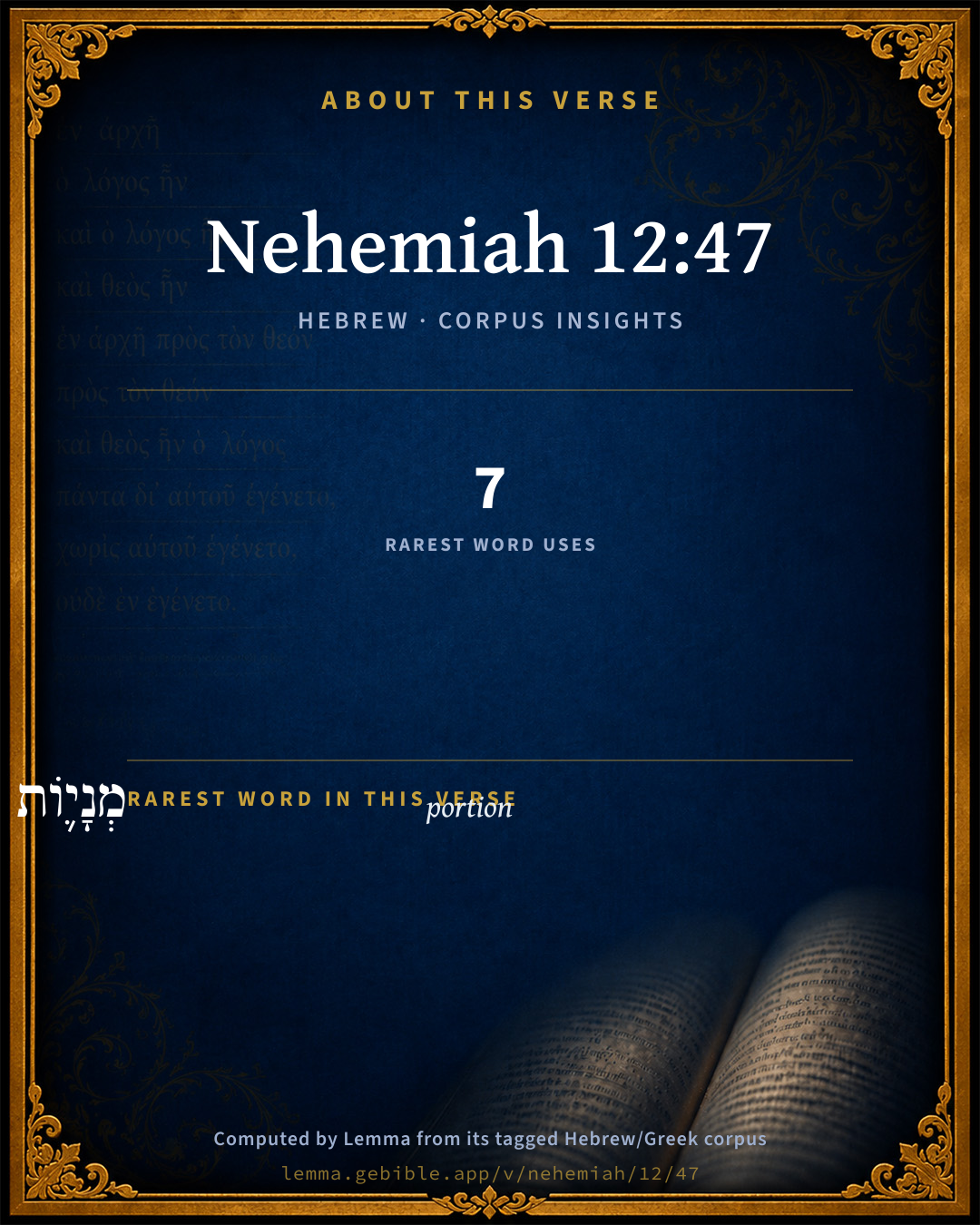
The rarest word here is מְנָי֛וֹת portion H4521 — appearing just 7 times in the whole Hebrew Bible.

Shared distinctive vocabulary

מְנָי֛וֹת portion H4521 occurs in 7 verses of the Hebrew Bible. Also found in:

Grammatical profile

  • 4 verbs
  • 15 nouns

Verb forms

  • נֹֽתְנִ֛ים Qal · Participle Active
  • הַמְשֹׁרְרִ֥ים Polel · Participle Active
  • וּמַקְדִּשִׁים֙ Hiphil · Participle Active
  • מַקְדִּשִׁ֖ים Hiphil · Participle Active

Repetition

Words recur within this verse — often emphatic in Hebrew:

  • בִּימֵ֨י day H3117 ×4
  • וּמַקְדִּשִׁים֙ to consecrate H6942 ×2
  • לַלְוִיִּ֔ם Levite H3881 ×2

Cross-references

10

Topical passages linked to Nehemiah 12:47 in the Treasury of Scripture Knowledge — connected by theme and wording, ordered by reader-vote popularity; previews shown in the World English Bible.

  • Numbers 18:21–29 To the children of Levi, behold, I have given all the tithe in Israel for an inheritance, in return for their service which they serve, even the service of the tent of meeting.
  • 2 Chronicles 31:5–6 As soon as the commandment came abroad, the children of Israel gave in abundance the first fruits of grain, new wine, and oil, and honey, and of all the increase of the field; and the tithe of all things brought they in abundantly.
  • Nehemiah 10:35–39 and to bring the first fruits of our ground, and the first fruits of all fruit of all manner of trees, year by year, to the house of Yahweh;
  • Nehemiah 11:23 For there was a commandment from the king concerning them, and a settled provision for the singers, as every day required.
  • Nehemiah 12:1 Now these are the priests and the Levites who went up with Zerubbabel the son of Shealtiel, and Jeshua: Seraiah, Jeremiah, Ezra,
  • Nehemiah 12:12 In the days of Joiakim were priests, heads of fathers' [houses]: of Seraiah, Meraiah; of Jeremiah, Hananiah;
  • Nehemiah 12:26 These were in the days of Joiakim the son of Jeshua, the son of Jozadak, and in the days of Nehemiah the governor, and of Ezra the priest the scribe.
  • Nehemiah 13:10–12 I perceived that the portions of the Levites had not been given them; so that the Levites and the singers, who did the work, were fled everyone to his field.
  • Malachi 3:8–10 Will a man rob God? Yet you rob me! But you say, 'How have we robbed you?' In tithes and offerings.
  • Galatians 6:6 But let him who is taught in the word share all good things with him who teaches.

Cross-references courtesy of OpenBible.info (CC BY 4.0).

Hebrew and Greek witnesses Masoretic Hebrew ↔ Greek Septuagint

The same verse in the two great witnesses to the Old Testament, shown verse-for-verse.

These are two independent witnesses, not word-aligned to each other, and the Septuagint is shown in lemma (dictionary) form.

Hebrew Nehemiah 12:47 Masoretic · Westminster Leningrad Codex

וְכָל יִשְׂרָאֵל֩ בִּימֵ֨י זְרֻבָּבֶ֜ל וּבִימֵ֣י נְחֶמְיָ֗ה נֹֽתְנִ֛ים מְנָי֛וֹת הַמְשֹׁרְרִ֥ים וְהַשֹּׁעֲרִ֖ים דְּבַר י֣וֹם בְּיוֹמ֑וֹ וּמַקְדִּשִׁים֙ לַלְוִיִּ֔ם וְהַלְוִיִּ֔ם מַקְדִּשִׁ֖ים לִבְנֵ֥י אַהֲרֹֽן

All Israel in the days of Zerubbabel, and in the days of Nehemiah, gave the portions of the singers and the porters, as every day required: and they set apart [that which was] for the Levites; and the Levites set apart [that which was] for the sons of Aaron.

World English Bible · Public Domain

Greek LXX Structure differs

The Septuagint has no separate book of Nehemiah. Its Greek text is the second half of Esdras B (2 Esdras), chapters 11–23; Ezra is the first half (1–10).

A verse-for-verse comparison isn’t shown here because the chapters and verses don’t line up. Switch to the LXX edition with the MT / LXX toggle above to read the Greek directly.

Hebrew: Westminster Leningrad Codex (CC BY 4.0). Greek: Septuagint (public domain); English from a public-domain English Septuagint. How the Septuagint differs from the Hebrew →

Commentary

Notes on Nehemiah 12:47 from classic Christian and Jewish commentators (each source and its license shown beneath its notes). The classic Christian expositions comment on the surrounding passage and are grouped to its opening verse, so a note may address several verses; the Jewish commentaries on the Tanakh (Rashi and others) are per-verse, so they appear only where the commentator wrote on this verse.

Lemma curates 59 commentaries, every one of them public domain or Creative Commons licensed, each selected and text-cleaned for this edition rather than reprinted as found. About our sources →

Joseph Benson's Commentary

Neh 12:47. They sanctified holy things unto the Levites — They set apart the first-fruits and tithes from their own share, and devoted them to the use of the Levites. And so did the Levites by the tithe of tithes. Thus they all conscientiously paid their dues, and did not profane those things which God had sanctified, nor take them unto their own common use. When what is contributed for the support of religion is given with an eye to God, it is sanctified, and will cause the blessing to rest upon the house, and all that is therein.

Joseph Benson's Commentary on the Old and New Testaments (1811–1818) — public domain. Text from a community e-Sword module.

Tyndale Open Study Notes

Tyndale Open Resources

12:47 From the time of the first returnees to Jerusalem in the days of Zerubbabel in 538 BC (Ezra 3:1) until the time of Nehemiah around 445 BC, Israelites brought food for those working at the Temple. Most of the Levites lived in cities around the country; they collected the tithe and brought a tenth of what they received to the Temple in Jerusalem to support its ministry (see Neh 10:38-39).

Tyndale Open Study Notes — © Tyndale Open Resources, licensed CC BY-SA 4.0. Text via the HelloAO Bible API.

Geneva Bible (1599)

Geneva Bible translators

That is, the tenth part of the tithes.

Geneva Bible (1599) marginal notes — public domain. Text via Bolls.life.

Jamieson, Fausset & Brown

Robert Jamieson, A. R. Fausset & David Brown

all Israel . . . sanctified holy things unto the Levites,--&c. The people, selecting the tithes and first-fruits, devoted them to the use of the Levites, to whom they belonged by appointment of the law. The Levites acted in the same way with the tithes due from them to the priests. Thus all classes of the people displayed a conscientious fidelity in paying the dues to the temple and the servants of God who were appointed to minister in it.

Next: Nehemiah Chapter 13

Jamieson, Fausset & Brown — Commentary Critical and Explanatory on the Whole Bible (1871) — public domain (CC PDM 1.0). Text via the HelloAO Bible API.

Adam Clarke's Commentary

Verse 47. All Israel - gave the portions of the singers] The singers and the porters were supported by the people at large; and each of these had their portions served out to them daily.

And they sanctified - unto the Levites] The things which were provided for sacred uses were delivered by the people to the Levites, and the Levites presented them to the priests.

The children of Aaron.] This may refer principally to the tithes which the people brought to the Levites; the tithe or tenth of which the Levites gave to the priests. The presenting these tithes is termed sanctifying them; that is, dedicating them to those sacred or ecclesiastical uses for which they were designed: this is a very general meaning of the word sanctify in Scripture.

Adam Clarke's Commentary on the Bible (1810–1826) — public domain. Text from a community e-Sword/MySword module.

Ellicott's Commentary for English Readers

(47) The Levites.—Between the people and the priests came the Levites, who received the tithe and gave the priests their “tithe of the tithe” (Num_18:26).

A Bible Commentary for English Readers, edited by Charles John Ellicott (1878–1897) — public domain. Text from a community e-Sword module.

The Cambridge Bible for Schools and Colleges

gen. ed. J. J. S. Perowne

47. in the days of Zerubbabel, and in the days of Nehemiah] The mention of Nehemiah in the 3rd person along with Zerubbabel is an almost convincing proof that the sentence was not from the hand of Nehemiah; but that it was written (probably by the Chronicler) at a considerable interval of time since Nehemiah’s death. The two men are here mentioned as the two heroes of their generation, under whom Israel was loyal to their Temple.

gave … sanctified] The participles in the Heb. show the continuous habit.

every day his portion] R.V. as every day required. In Neh_11:23, we are told a daily provision for the singers was one of the commands of the Persian king: but there was also doubtless a regular daily payment on their behalf made by the people.

sanctified holy things unto the Levites] R.V. sanctified for the Levites. ‘They sanctified,’ i.e. all Israel (not ‘the singers and the porters’) set apart for the use of those who served God. The word ‘sanctify’ is therefore equivalent to ‘devote’ or dedicate in this connexion: cf. Lev_27:14; Lev_27:16 sqq. ‘sanctify a house … a field;’ 1Ch_26:27 ‘Out of the spoil won in battles did they dedicate to repair the house of the Lord.’ There is no idea of a succession of ritual acts of consecration.

the children of Aaron] This expression only occurs in our books here and Neh_10:38. In neither passage have we the words of Nehemiah himself but of the Compiler, who was probably also the Chronicler, with whom the term is a favourite one for ‘the priesthood,’ e.g. 2Ch_13:9-10; 2Ch_31:19; 2Ch_35:14.

The sanctifying of Israel for the Levites consisted in the payment of the tithes to the house of Levi; the sanctifying on the part of the Levites for the priests, in the payment of ‘the tithe of the tithes’ (see Neh_10:38) in accordance with Num_18:26.

The Cambridge Bible for Schools and Colleges (gen. ed. J. J. S. Perowne; Cambridge University Press, 1878–1918) — public domain. Text from a community e-Sword module.

Albert Barnes' Notes on the Bible

The intention is to compare the religious activity and strictness of Nehemiah’s time with that which had prevailed under Zerubbabel, as described by Ezra Ezr 6:16, Ezr 6:22. It is implied that the intermediate period had been a time of laxity.

They sanctified holy things ... - i. e, “the people paid their tithes regularly to the Levites, and the Levites paid the tithe of the tithes to the priests.”

Albert Barnes' Notes on the Bible (1834–1885) — public domain. Text from a community e-Sword/MySword module.

Matthew Poole's English Annotations

They sanctified holy things, i.e. they sequestered or set apart the first-fruits and tithes from their own share, and devoted them to the use of the Levites, to whom they belonged. And so did the Levites by the tithe of the tithes. Thus they all conscientiously paid their dues to God, or his assigns, and did not profane, those things which God had sanctified, nor take them to their own common use, as divers ungodly or covetous persons had formerly used to do when they had opportunity.

Matthew Poole's English Annotations on the Holy Bible (1683–1685) — public domain. Text from a community e-Sword/MySword module.

Whedon's Commentary on the Bible

Daniel D. Whedon

47. Gave the portions — The tithes and other contributions necessary for the support of the singers and porters.

They sanctified holy things unto the Levites — They set apart, as things consecrated to holy uses, the portions designed for the Levites. Instead of holy things it is better simply to substitute them, referring to the portions just named.

And the Levites sanctified them unto the children of Aaron — The Levites were required to give a tithe of the tithes (compare Neh_10:38) to the priests, here called sons of Aaron. So of all the tithes committed to them they set apart a tenth for the priests. “Ye also shall offer a heave offering unto the Lord of all your tithes,” etc. See the law in Num_18:26-29.

Daniel D. Whedon (gen. ed.), Commentary on the Old and New Testaments (1874–1909) — public domain. Text from a community e-Sword module.

The Pulpit Commentary

In the days of Zerubbabel, and in the days of Nehemiah. i.e. "In the days of Nehemiah, no less than in those of Zerubbabel." Gave the portions. Paid their tithes, and other dues, regularly, so that the portions were forthcoming. Every day his portion. Compare Neh_11:23. They sanctified holy things unto the Levites. They, i.e. the people, "set apart" for the Levites all that the law required; and the Levites set apart for the priests their due share tithe of the tithe". (Num_18:26)

The Pulpit Commentary (1880–1919), ed. H.D.M. Spence-Jones & Joseph S. Exell — public domain. Text from a community e-Sword module.

John Wesley's Explanatory Notes

Sanctified - They set apart the first-fruits and tithes from their own share, and devoted them to the use of the Levites. And so did the Levites by the tithe of the tithes. Thus they all conscientiously paid their dues, and did not profane those things which God had sanctified, nor take them into their own common use. When what is contributed for the support of religion, is given with an eye to God, it is sanctified, and will cause the blessing to rest upon the house, and all that is therein.

John Wesley, Explanatory Notes Upon the Whole Bible (1754–1765) — public domain. Text via the GEBible commentary corpus.

Rashi

Rabbi Shlomo Yitzchaki (Rashi)

the portions Heb. מְנָיוֹת, like מָנוֹת.

and they consecrated [them] for the Levites And they would give the tithe to the Levites, who would take the tithe from the tithe and give it to the priests.

Rashi on the Tanakh — English translations: “The Judaica Press complete Tanach with Rashi, translated by A. J. Rosenberg” (CC BY 4.0); “Pentateuch with Rashi's commentary by M. Rosenbaum and A.M. Silbermann, 1929-1934” (public domain); “The Metsudah Tanach series, Lakewood, N.J” (CC BY 4.0); and “The Book of Joshua, Metsudah Publications, 1997” (CC BY 4.0). Text via Sefaria.

Lesson kit

Teaching starters — assembled from the data on this page, not authored interpretation. Every prompt links to the verse data it draws on. Edit before teaching.

Nehemiah, in the Historical, opens this verse with 19 words (14 distinct Hebrew lemmas). Its most distinctive word is mᵉnâth (“portion”). A historical commentator’s framing appears above. Read the whole chapter for the surrounding context.

Discussion questions

  1. The word mᵉnâth carries the sense “portion.” How does it shape the verse?
  2. How does 2 Chronicles 31:3, which shares the word «portion», read alongside this verse?
  3. What does the repetition of “day” (4× in this one verse) do in this verse?
  4. These translations render this verse differently; the difference is in the English rendering, not the original. What questions does that raise?
  5. «נֹֽתְנִ֛ים» is a Qal Participle Active verb. How does that grammatical form shape the action described?
  6. Compare how Joseph Benson's Commentary and Tyndale Open Study Notes read this verse. Where do they agree or differ?

Things to notice

Reading settings

Reading text

Shown beneath each verse's original-language words.

Old Testament
Old Testament edition

Read the OT as the Masoretic Hebrew (MT) or the Greek Septuagint (LXX).

English shown for the Greek Septuagint (in the Hebrew ↔ Greek comparison).

Comparing translations? Open the Compare panel on any verse page to stack up to four side by side.