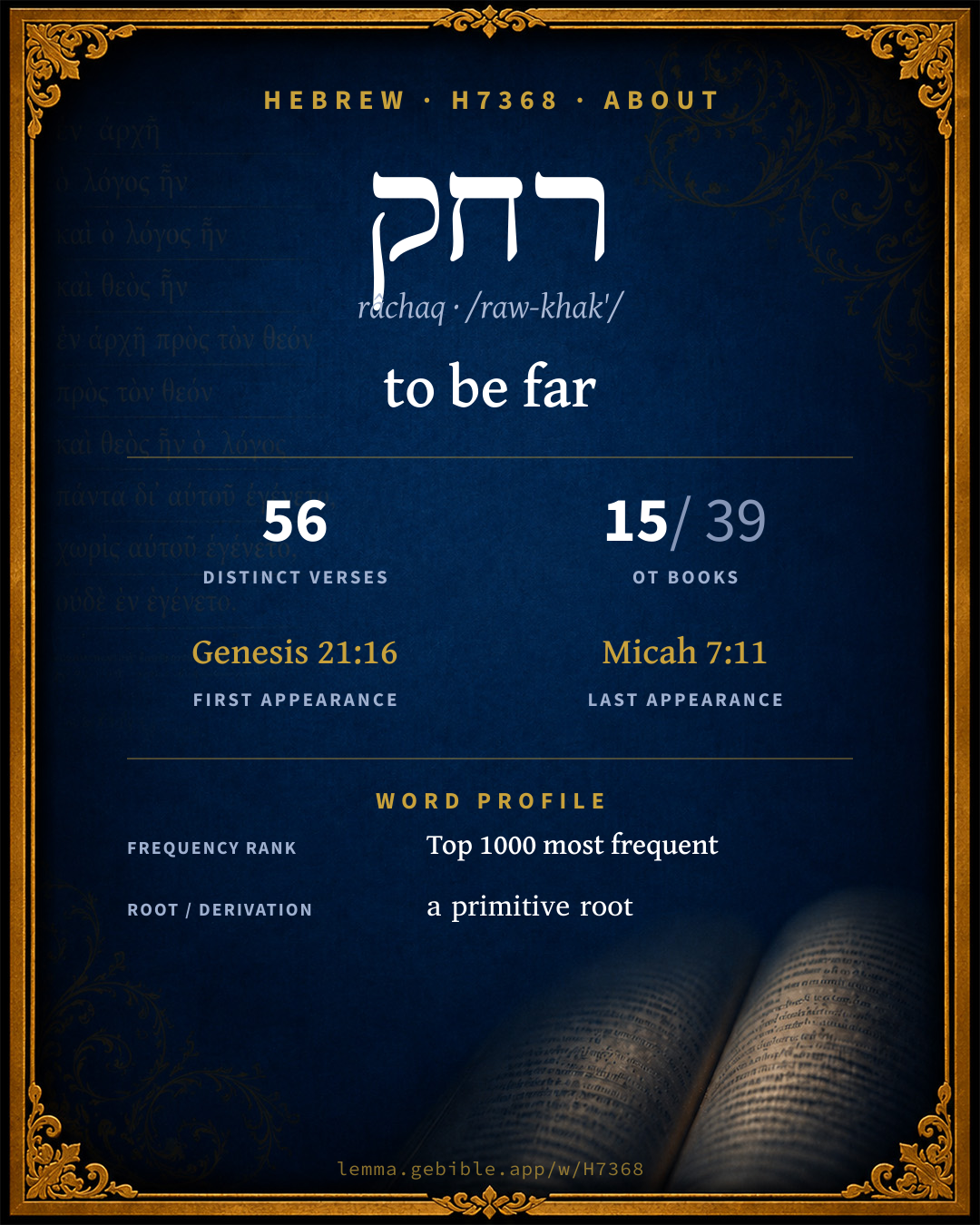
רָחַק
to be far
‘to be far’ is one of 3 main senses fuller range ↓
Full lexicon entry — Brown-Driver-Briggs (BDB)
From Brown-Driver-Briggs (BDB)
Where this word appears
See every Qal verb in the Hebrew Bible →
Grammar key — what these labels mean
Part of speech
- Verb
- An action or state-of-being word.
Stem
- Qal
- The basic, simple active stem — the plain form of the verb (“he wrote”).
- Hiphil
- The causative active stem (“he caused / brought about”). Here: ‘dir. caus. make’
- Piel
- An intensive or resultative active stem.
Form
- Imperfect
- An incomplete, ongoing, or future action (“he will / would write”).
- Jussive
- A third- or second-person volitional form expressing wish or command (“let him write”).
- Perfect
- A completed action or state — Hebrew marks aspect (completeness) more than strict tense (“he wrote”).
- Infinitive Absolute
- An unbound verbal noun, often intensifying or standing in for a finite verb.
- Imperative
- A direct command (“write!”).
- Infinitive Construct
- A bound verbal noun, frequently with prepositions (“to write / in writing”).
- Sequential Perfect
- A perfect with prefixed waw continuing a preceding imperfect or command (waw-consecutive perfect).
- Sequential Imperfect
- An imperfect with prefixed waw — the standard past-narrative form (waw-consecutive imperfect).
Person
- 3rd Person
- The one spoken about (“he / she / it / they”).
- 2nd Person
- The one addressed (“you”).
- 1st Person
- The speaker (“I / we”).
Gender
- Masculine
- Grammatically masculine.
- Common
- Either gender — not distinguished for this form.
- Feminine
- Grammatically feminine.
Number
- Singular
- One.
- Plural
- More than one (in Hebrew, generally three or more).
Grammatical forms 29 distinct
- Verb, Qal, Imperfect, 3rd Person, Masculine, Singular 5 times (9%)
- Verb, Qal, Jussive, 2nd Person, Masculine, Singular 5 times (9%)
- Verb, Qal, Perfect, 3rd Person, Common, Plural 5 times (9%)
- Verb, Hiphil, Imperative, 2nd Person, Masculine, Singular 5 times (9%)
- Verb, Hiphil, Infinitive Absolute 4 times (7%)
- Verb, Qal, Infinitive Construct 3 times (5%)
- Verb, Qal, Perfect, 3rd Person, Feminine, Singular 3 times (5%)
- Verb, Hiphil, Imperfect, 1st Person, Common, Singular 2 times (3%)
+21 more forms (26 occurrences)
Parsed forms decoded from the imported morphology (morphhb / Westminster Leningrad Codex — WLC text public domain, morphhb tagging CC BY 4.0), counted across 58 parsed occurrences — not distinct verses.
Every verse where H7368 appears — 56 distinct verses across 15 books. Click any verse to open its interlinear word-by-word view. Verse text shown in the World English Bible for context — . Each verse’s Hebrew form is shown with its reference; the English is not keyword-highlighted, since the data carries no word-level English alignment. Use “Compare translations” on any verse to read it across multiple English versions. This concordance covers the Hebrew Bible; Septuagint (Greek Old Testament) occurrences are not indexed here.
Genesis 2 verses
- Genesis 21:16 הַרְחֵק֙ Hiphil inf.abs She went and sat down opposite him, a good way off, about a bow shot away. For she said, "Don't let me see the death of the child." She sat over against him, and lifted up her voice, and wept.
- Genesis 44:4 הִרְחִיקוּ֒ Hiphil pf 3cp When they had gone out of the city, and were not yet far off, Joseph said to his steward, "Up, follow after the men. When you overtake them, ask them, 'Why have you rewarded evil for good?
Exodus 3 verses
- Exodus 8:28 הַרְחֵ֥ק תַרְחִ֖יקוּ Hiphil inf.abs Hiphil impf 2mp Pharaoh said, "I will let you go, that you may sacrifice to Yahweh your God in the wilderness, only you shall not go very far away. Pray for me."
- Exodus 23:7 תִּרְחָ֑ק Qal impf 2ms "Keep far from a false charge, and don't kill the innocent and righteous: for I will not justify the wicked.
- Exodus 33:7 הַרְחֵק֙ Hiphil inf.abs Now Moses used to take the tent and to pitch it outside the camp, far away from the camp, and he called it "The tent of meeting." It happened that everyone who sought Yahweh went out to the tent of meeting, which was outside the camp.
Deuteronomy 2 verses
- Deuteronomy 12:21 יִרְחַ֨ק Qal impf 3ms If the place which Yahweh your God shall choose, to put his name there, be too far from you, then you shall kill of your herd and of your flock, which Yahweh has given you, as I have commanded you; and you may eat within your gates, after all the desire of your soul.
- Deuteronomy 14:24 יִרְחַ֤ק Qal impf 3ms If the way be too long for you, so that you are not able to carry it, because the place is too far from you, which Yahweh your God shall choose, to set his name there, when Yahweh your God shall bless you;
Joshua 2 verses
- Joshua 3:16 הַרְחֵ֨ק Hiphil inf.abs that the waters which came down from above stood, and rose up in one heap, a great way off, at Adam, the city that is beside Zarethan; and those that went down toward the sea of the Arabah, even the Salt Sea, were wholly cut off: and the people passed over right against Jericho.
- Joshua 8:4 תַּרְחִ֥יקוּ Hiphil juss 2mp He commanded them, saying, Behold, you shall lie in ambush against the city, behind the city; don't go very far from the city, but be all ready:
Judges 1 verse
Job 8 verses
- Job 5:4 יִרְחֲק֣וּ Qal impf 3mp His children are far from safety, They are crushed in the gate. Neither is there any to deliver them,
- Job 11:14 הַרְחִיקֵ֑/הוּ Hiphil impv 2ms + sfx pers 3ms If iniquity is in your hand, put it far away, Don't let unrighteousness dwell in your tents.
- Job 13:21 הַרְחַ֑ק Hiphil impv 2ms Withdraw your hand far from me; And don't let your terror make me afraid.
- Job 19:13 הִרְחִ֑יק Hiphil pf 3ms "He has put my brothers far from me. My acquaintances are wholly estranged from me.
- Job 21:16 רָ֣חֲקָה Qal pf 3fs Behold, their prosperity is not in their hand: The counsel of the wicked is far from me.
- Job 22:18 רָ֣חֲקָה Qal pf 3fs Yet he filled their houses with good things, But the counsel of the wicked is far from me.
- Job 22:23 תַּרְחִ֥יק Hiphil impf 2ms If you return to the Almighty, you shall be built up, If you put away unrighteousness far from your tents.
- Job 30:10 רָ֣חֲקוּ Qal pf 3cp They abhor me, they stand aloof from me, And don't hesitate to spit in my face.
Psalms 11 verses
- Psalms 22:11 תִּרְחַ֣ק Qal juss 2ms Don't be far from me, for trouble is near. For there is none to help.
- Psalms 22:19 תִּרְחָ֑ק Qal juss 2ms But don't be far off, Yahweh. You are my help: hurry to help me.
- Psalms 35:22 תִּרְחַ֥ק Qal juss 2ms You have seen it, Yahweh. Don't keep silent. Lord, don't be far from me.
- Psalms 38:21 תִּרְחַ֥ק Qal juss 2ms Don't forsake me, Yahweh. My God, don't be far from me.
- Psalms 55:7 אַרְחִ֣יק Hiphil impf 1cs Behold, then I would wander far off. I would lodge in the wilderness." Selah.
- Psalms 71:12 תִּרְחַ֣ק Qal juss 2ms God, don't be far from me. My God, hurry to help me.
- Psalms 88:8 הִרְחַ֥קְתָּ Hiphil pf 2ms You have taken my friends from me. You have made me an abomination to them. I am confined, and I can't escape.
- Psalms 88:18 הִרְחַ֣קְתָּ Hiphil pf 2ms You have put lover and friend far from me, And my friends into darkness.
- Psalms 103:12 כִּ/רְחֹ֣ק הִֽרְחִ֥יק prep + Qal inf.cs Hiphil pf 3ms As far as the east is from the west, So far has he removed our transgressions from us.
- Psalms 109:17 וַ/תִּרְחַ֥ק conj + Qal wimpf 3fs Yes, he loved cursing, and it came to him. He didn't delight in blessing, and it was far from him.
- Psalms 119:150 רָחָֽקוּ Qal pf 3cp They draw near who follow after wickedness. They are far from your law.
Proverbs 6 verses
- Proverbs 4:24 הַרְחֵ֥ק Hiphil impv 2ms Put away from yourself a perverse mouth. Put corrupt lips far from you.
- Proverbs 5:8 הַרְחֵ֣ק Hiphil impv 2ms Remove your way far from her. Don't come near the door of her house,
- Proverbs 19:7 רָחֲק֣וּ Qal pf 3cp All the relatives of the poor shun him: How much more do his friends avoid him! He pursues them with pleas, but they are gone.
- Proverbs 22:5 יִרְחַ֥ק Qal impf 3ms Thorns and snares are in the path of the wicked: Whoever guards his soul stays from them.
- Proverbs 22:15 יַרְחִיקֶ֥/נָּה Hiphil impf 3ms + sfx pers 3fs Folly is bound up in the heart of a child: The rod of discipline drives it far from him.
- Proverbs 30:8 הַרְחֵ֬ק Hiphil impv 2ms Remove far from me falsehood and lies. Give me neither poverty nor riches. Feed me with the food that is needful for me;
Ecclesiastes 2 verses
- Ecclesiastes 3:5 לִ/רְחֹ֥ק prep + Qal inf.cs A time to cast away stones, And a time to gather stones together; A time to embrace, And a time to refrain from embracing;
- Ecclesiastes 12:6 ירחק Qal impf 3ms Before the silver cord is severed, Or the golden bowl is broken, Or the pitcher is broken at the spring, Or the wheel broken at the cistern,
Isaiah 8 verses
- Isaiah 6:12 וְ/רִחַ֥ק conj + Piel wpf 3ms And Yahweh has removed men far away, And the forsaken places are many in the midst of the land.
- Isaiah 26:15 רִחַ֖קְתָּ Piel pf 2ms You have increased the nation, O Yahweh, you have increased the nation; you are glorified; you have enlarged all the borders of the land.
- Isaiah 29:13 רִחַ֣ק Piel pf 3ms The Lord said, Because this people draw near [to me], and with their mouth and with their lips to honor me, but have removed their heart far from me, and their fear of me is a commandment of men which has been taught [them];
- Isaiah 46:13 תִרְחָ֔ק Qal impf 3fs I bring near my righteousness, it shall not be far off, and my salvation shall not wait; and I will place salvation in Zion for Israel my glory.
- Isaiah 49:19 וְ/רָחֲק֖וּ conj + Qal wpf 3cp For, as for your waste and your desolate places, and your land that has been destroyed, surely now shall you be too small for the inhabitants, and those who swallowed you up shall be far away.
- Isaiah 54:14 רַחֲקִ֤י Qal impv 2fs In righteousness shall you be established: you shall be far from oppression, for you shall not be afraid; and from terror, for it shall not come near you.
- Isaiah 59:9 רָחַ֤ק Qal pf 3ms Therefore is justice far from us, neither does righteousness overtake us: we look for light, but, behold, darkness; for brightness, but we walk in obscurity.
- Isaiah 59:11 רָחֲקָ֥ה Qal pf 3fs We roar all like bears, and moan sore like doves: we look for justice, but there is none; for salvation, but it is far off from us.
Jeremiah 2 verses
- Jeremiah 2:5 רָחֲק֖וּ Qal pf 3cp thus says Yahweh, What unrighteousness have your fathers found in me, that they have gone far from me, and have walked after vanity, and are become vain?
- Jeremiah 27:10 הַרְחִ֤יק Hiphil inf.cs for they prophesy a lie to you, to remove you far from your land, and that I should drive you out, and you should perish.
Lamentations 1 verse
Ezekiel 5 verses
- Ezekiel 8:6 לְ/רָֽחֳקָה֙ prep + Qal inf.cs He said to me, Son of man, see you what they do? even the great abominations that the house of Israel do commit here, that I should go far off from my sanctuary? but you shall again see yet other great abominations.
- Ezekiel 11:15 רַֽחֲקוּ֙ Qal impv 2mp Son of man, your brothers, even your brothers, the men of your relatives, and all the house of Israel, all of them, [are they] to whom the inhabitants of Jerusalem have said, Get you far from Yahweh; to us is this land given for a possession.
- Ezekiel 11:16 הִרְחַקְתִּי/ם֙ Hiphil pf 1cs + sfx pers 3mp Therefore say, Thus says the Lord Yahweh: Whereas I have removed them far off among the nations, and whereas I have scattered them among the countries, yet will I be to them a sanctuary for a little while in the countries where they are come.
- Ezekiel 43:9 יְרַחֲק֧וּ Piel juss 3mp Now let them put away their prostitution, and the dead bodies of their kings, far from me; and I will dwell in the midst of them forever.
- Ezekiel 44:10 רָֽחֲקוּ֙ Qal pf 3cp But the Levites who went far from me, when Israel went astray, who went astray from me after their idols, they shall bear their iniquity.
Joel 2 verses
- Joel 2:20 אַרְחִ֣יק Hiphil impf 1cs But I will remove the northern army far away from you, And will drive it into a barren and desolate land, Its front into the eastern sea, And its back into the western sea; And its stench will come up, And its bad smell will rise." Surely he has done great things.
- Joel 3:6 הַרְחִיקָ֖/ם Hiphil inf.cs + sfx pers 3mp And have sold the children of Judah and the children of Jerusalem to the sons of the Greeks, That you may remove them far from their border.
Micah 1 verse
About this entry
At a glance — auto-summarized from this page’s data, not written by a person. Every figure links to its source below. This summary describes the numbers; it doesn’t interpret them.
The Hebrew word רחק centers on the idea of “to be far.” Where the King James Version says “far,” newer translations reach for “be far” (unfoldingWord Literal Text); the renderings breakdown has the detail. The Hebrew Bible uses it across 56 verses — moderately common. First canonically at Genesis 21:16, it enters the text early. Its meaning spans more than one sense — see its full sense range. Dig into 56-verse concordance and the renderings breakdown below.
Gloss history
Strong's 1890 vs modern scholarship
About this word
Strong's H7368 catalogs a Hebrew word from the Hebrew Old Testament.
These counts are not copied from any lexicon or concordance. They are computed here, from the morphology-tagged Hebrew Old Testament. What Lemma adds →
- 56
- distinct verses
- The word appears in 56 distinct verses.
- 15 / 39
- OT books
- The word appears in 15 of 39 Old Testament books.
- #658
- by frequency
- Top 1000 most frequent Hebrew words (rank 658 of 8,640 Hebrew words by occurrence).
View all 56 occurrences in the concordance →
By section of the Old Testament
By traditional corpus
Conventional, traditional groupings — biblical authorship is debated, so this is a traditional corpus grouping, not an authorship claim. Each share is this word’s portion of its verses in that division of the Hebrew canon. Each figure is a share of the word’s 56 distinct verses.
- Writings (Ketuvim) 28 verses · 50%
- Prophets (Nevi'im) 21 verses · 38%
- Torah (Pentateuch) 7 verses · 13%
How translations render this word
Counts come from each version’s own published word-to-Strong’s tagging or interlinear alignment — an approximate guide to how each version renders this word, not a word-level alignment the data otherwise carries. Because each total is that version’s own tagged count, the per-version totals vary from one another and need not match the appearance or distinct-verse counts above. These counts may also differ from a printed concordance because Lemma counts each distinctly tagged rendering and does not collapse phrase taggings into a single head-word total. This is a fixed set of word-tagged versions (KJV, ASV, BSB, ULT) and does not change with the reading translation you choose elsewhere. Each version’s license is shown beside its name below (and on Sources).
- King James Version: Far 10×, Be not far 4×, Is far 3×
- American Standard Version: Far 9×, Me 3×, Be not far 2×
- Berean Standard Bible: Far 10×, Far away 3×, Are far 2×
- unfoldingWord Literal Text: Be far 7×, Do 5×, Is far 4×
King James Version Public Domain
Renders H7368 across 66 tagged occurrences — most commonly:
Plus 41 renderings that appear only once — usually multi-word phrases or single function words the recovered tagging swept in, not distinct renderings. Not rendered by a distinct English word in 1 further occurrence.
American Standard Version Public Domain
Renders H7368 across 66 tagged occurrences — most commonly:
Plus 46 renderings that appear only once — usually multi-word phrases or single function words the recovered tagging swept in, not distinct renderings.
Berean Standard Bible Public Domain
Renders H7368 across 57 tagged occurrences — most commonly:
Plus 36 renderings that appear only once — usually multi-word phrases or single function words the recovered tagging swept in, not distinct renderings. Not rendered by a distinct English word in 1 further occurrence.
unfoldingWord Literal Text CC BY-SA 4.0
Renders H7368 across 77 tagged occurrences — most commonly:
Plus other, less common renderings. Plus 40 renderings that appear only once — usually multi-word phrases or single function words the recovered tagging swept in, not distinct renderings.
Senses in the full BDB
Hebrew verbs can shift meaning by stem (binyan): Qal is the basic action, Niphal is often passive or reflexive, Piel often intensifies or makes it factitive, and Hiphil is typically causative. The senses below are grouped under the stem BDB assigns to each.
What do BDB’s symbols mean?
BDB uses these scholarly abbreviations:
| Symbol | Meaning |
|---|---|
| 𝔊 | the Septuagint (the ancient Greek translation, LXX) |
| 𝔙 | the Vulgate (the Latin translation) |
| 𝔖 | the Syriac version (the Peshitta) |
| 𝔗 | the Targum (the Aramaic translation) |
| ψ | the Psalms |
| √ | root (the underlying root or stem) |
| ‖ | parallel passage (a synonymous or contrasted parallel) |
| † | the dagger: every passage where the word occurs is cited |
The 5 senses and sub-senses the full Brown-Driver-Briggs lexicon distinguishes for this word, in lexicon order (not ranked by frequency), with BDB’s own verbatim wording and sub-sense lettering. Shown in Hebrew script with BDB’s own scholarly abbreviations. The condensed entry is in the Lexicon Entry tab. See also the Forms in the corpus table below.
Qal
- Pf. 3 ms. ר׳ Is 59:9; La 1:16, etc.; Impf. 3 ms. יִרְחַק Dt 12:21 +, etc.; Imv. fs. רַחֲקִי Is 54:14, mpl. רַחֲקוּ Ez 11:15 רָֽחֲקוּ Ra Hi Sm Co Toy Krae; Inf. cstr. רְחֹק ψ 103:12 Ec 3:5, לְרָֽחֳקָה Ez 8:6;—be far, distant: c. מִן pers., of place Dt 12:21; 14:24, of pers., = neglect, abandon, Pr 19:7; Jb 30:10; in ψψ, of י׳, ψ 22:12, 20 (מִן pers. om), 35:22; 38:22; 71:12; of utter absence, or non-existence La 1:16, cf. Is 49:19 (abs.), subj. justice Is 59:9 (opp. הִשִּׂיג), cf. v 11 (‖ אַיִן), subj. blessing ψ 109:17; subj. עֲצַת רְשָׁעִים Jb 21:16; 22:18; c. מֵעַל pers. (י׳), of Isr. (fig.) Je 2:5, cf. Ez 44:10; = far from (land of) י׳ 11:15 (v. supr.; Krae ins. אֶרֶץ); c. מֵעַל loc. Ez 8:6 (of י׳), מִן loc. (E. from W.) ψ 103:12; c. מִן rei (fig.): תּוֹרָֽתְךָ 119:150 (opp. קרב); מִיֶּשַׁע Jb 5:4, מִעשֶׁק Is 54:14, cf. Pr 22:5; = wholly abstain from Ex 23:7 (E), so (מן inf.) Ec 3:5; abs. of י׳’s righteousness, with ref. to time Is 46:13 (‖ אחר; opp. קרב).—יִרְחַק־חֹק Mi 7:11 boundary shall become distant, i.e. territory be enlarged (? crpt., cf. We Now); ירחק חֶבֶל הַכֶּסֶף Kt Ec 12:6 be removed? Qr יֵרָתֵק be joined? 𝔊 ἀνατραπῇ, 𝔙 rumpatur, cf. 𝔖, read prob. יִנָּתֵק Pfannk Thes Ew De Siegf BuhlLex. e.g. Isaiah 59:9
Piel
- Pf. 3 ms. רִחַק Is 6:12, of י׳, send far away, acc. pers.; of people, לִבּוֹ ר׳ 29:13, c. מִן of י׳; 2 ms. רִחַקְתָּ 26:15 thou hast far extended (c. acc.) all the ends (boundaries) of the land; Impf. 3 mpl. יְרַחֲקוּ אֶת־זְנוּתָם Ez 43:9. e.g. Isaiah 6:12
Hiphil
- Pf. 3 ms. הִרִחִיק Jb 19:13 ψ 103:12, 1 s. sf. הִרְחַקְתִּים Ez 11:16, etc.; Impf. 3 ms. sf. יַרְהִיקֶנָּה Pr 22:15, 2 ms. תַּרְהִיק Jb 22:23, etc.; Imv. ms. הַרְהֵק Pr 4:24 + 2 times, הַרְחַ֑ק Jb 13:21, sf. הַרְחִיקֵהוּ 11:14; Inf. abs. הַרְחֵק Gn 21:16 +, cstr. הַרְחִיק Je 27:10, sf. הַרְחִיקָם Jo 4:6;— e.g. Job 19:13
- 1. dir. caus. make, or exhibit, distance, be gone far, subj. pers.: Gn 44:4 (J), c. מִן loc. Jos 8:4 (JE), Ju 18:22; sq. inf. cstr. הַרְחֵק לֹא תַר׳ לָלֶכֶת Ex 8:24 (J), cf. ψ 55:8; Inf. abs. as adv. = at a distance Gn 21:16 (E), c. מִן loc. Ex 33:7 (E), Jos 3:16 (JE; הַר׳ מְאֹד מִן, Qr; > Kt ב for מן). e.g. Genesis 44:4
- 2. indir. caus. remove, put far away, c. acc. pers. + מֵעַל of land Je 27:10, cf. Jo 4:6, + מֵעַל pers. Jb 19:13 and (acc. הַצְּפוֹנִי) Jo 2:20, + מִן pers. ψ 88:9, 19; + בַּגּוֹיִם Ez 11:16; c. acc. כַּף + מֵעַל pers. Jb 13:21, c. acc. דֶּרֶךְ + id. Pr 5:8; c. acc. of sin + מִן pers. 4:24; Jb 11:14 (מִן pers. om.); Pr 22:15; 30:8 ψ 103:12; + מִן loc. Jb 22:23. e.g. Jeremiah 27:10
Senses from the full Brown-Driver-Briggs lexicon (Brown, Driver, Briggs; Oxford 1906 — public domain), digitized via Sefaria, supplemented by the OpenScriptures HebrewLexicon (CC BY 4.0). Full attribution on Sources.
Word origin
vb. be, or become, far, distant (NH = BH; Assyrian especially adj. rûḳu, far; cf. Arabic رَحِيقٌ choice wine (i.e. from a distance) Frä 158; Ethiopic ርሕቀ: be far, Sab. רחק CISiv, nos. 95, 98; Aramaic רְחֵיק, רְחַק, and (often in der. spec. and deriv.) ܪܚܶܩ );—
— Brown-Driver-Briggs (Oxford 1906, public domain), digitized via Sefaria, supplemented by the OpenScriptures HebrewLexicon (CC BY 4.0). See Sources.
Origin: a primitive root
Jastrow Dictionary
A second Hebrew/Aramaic lexicon for comparison, covering Aramaic and post-biblical (Talmudic, Targumic, Midrashic) usage that the biblical-Hebrew BDB does not. Matched by lemma rather than by Strong’s number, so a lemma may carry more than one Jastrow headword (shown separately below), and the entries cover usage well beyond the Bible.
רָחַק
- (b. h.) to be distant, far, removed. Y’lamd. to Num. X, 29, quot. in Ar. (ref. to Ps. LXXIII, 27) מי שרוֹחֵק הק"בה וכ׳ (ed. Koh. שׁמִתְרַחֵק) he who keeps away from the Lord, so as not to repent. Sifré Num. 131 כרְחוֹק מזרח וכ׳ as far as the east is removed from the west; a. e. e.g. Psalms 73:27
- to remove; to alienate; to reject, expel; to loathe. B. Kam. 24ᵃ top, a. e. ר׳ נגיחותיו if the ox did his gorings in intervals (of three days), opp. קירב. Ib. רִיחֲקָה ראיותיה, v. רְאִיָּה. Yalk. Ps. 809 (ref. to Ps. l. c.) זה … שׁרִחֲקוּ את הקץ this alludes to Balaam and his associates, who put far off the end (the day of judgment, Num. XXIV, 17), opp. קרבו. Ber. 60ᵇ ורַחֲקֵנִי מאדם רע וכ׳ keep me far from a bad man and a bad associate. Eduy. V, 7 מעשיך יקרבוך ומעשיך יְרַחֲקוּךָ thy own doings will bring thee near (win thee friends), and thy own doings will alienate thee. Ib. VIII, 7 לרַחֵק, v. קָרֵב; a. fr.—Part. pass. מְרוּחָק; pl. מְרוּחָקִים, מְרוּחָקִין. Ib. המר׳ בזרוע, v. קָרֵב. Ber. 63ᵇ שלא היה מר׳ וכ׳ which was only twelve miles off. e.g. Numbers 24:17
- same. Sifré Num. 94 מַרְחִיקִים, v. קָרֵב. B. Bath. II, 5 מַרְחִיקִין את הסולם וכ׳ (neighbors) must keep a ladder removed from the (neighbor’s) dove-cote four cubits. Ib. 4 אלא אם כן ה׳ ממנו וכ׳ unless he places (the wall) at a distance of four cubits. Ib. 18ᵇ על המזיק להַרְחִיק את עצמו it is the duty of him who causes the damage to remove himself; (oth. opin.) על הניזק להרחיק וכ׳ he who is injured must remove himself. Ber. I, 1 כדי להרחיק וכ׳ in order to keep men away (prevent them) from sin. Snh. 103ᵇ שהִרְחִיקָה וכ׳, v. לְגִימָה. Ib. מַרְחֶקֶת וכ׳ estranges those who are near (related) &c.; a. fr.—2) to keep aloof, stay away. Ab. I, 7 הַרְחֵק משכן רע keep aloof from a bad neighbor; a. e.—[Y. Ber. I, 2ᵈ bot. והרחיק על פתחו וכ׳, read: והִרְתִּיק, v. רָתַק.]
- to remove one’s self; to become a stranger. Yeb. 109ᵃ לעולם ידבק … ויִתְרַחֵק וכ׳ man should always cling to three things, and keep aloof from three things. Snh. III, 4 קרוב ונ׳, v. קָרוֹב. Ber. 34ᵇ (ref. to Is. LVII, 19) שהיה קרוב … ונ׳ וכ׳ who came near committing a sin, and withdrew himself from it. Y’lamd. l. c., v. supra; a. e. e.g. Isaiah 57:19
רִחֵק
- Targ. Prov. XIX, 7. Targ. Ps. CIII, 12. Ib. LIII, 2. Targ. Job XXI, 16; a. fr.
- 1. to remove; to reject, loathe. Targ. Ps. CIII, 12. Targ. Ex. XXXIII, 7. Targ. Is. VI, 12. Targ. Job XXXIII, 20 (Ms. Pa.); a. fr.
- 2. to be removed. Gitt. 58ᵃ כמה מַרְחִיקְנָא וכ׳ how far am I (in my studies) from that place (the passage quoted)?
- to remove, keep off; to loathe, abominate; to make abominable. Targ. Job XI, 14. Targ. Am. VI, 3 מר׳ יום (ed. Lag. מיום, corr. acc.; h. text מנדים). Targ. Jer. II, 37 (h. text מאס). Targ. Deut. VII, 26 (h. text תעב). Targ. Job IX, 31; a. fr.—Part. pass. מְרָחַק. Targ. Mal. I, 7 (h. text מגאל).—Sabb. 128ᵇ טמאה לא מְרַחֲקָא וולדא ואי מרחקא וכ׳ an unclean animal (after giving birth) does not keep its young off, and if it does, it does not allow them to come near again (stimulation of the maternal instinct does not avail, v. רָחַם). Snh. 29ᵃ משום דמְרָחֲקָא דעתיה (an enemy cannot be witness,) because his mind is estranged (hostile), opp. מקרבא; Yalk. Num. 788; a. e.—V. מְרָחַק, מְרַחַקְתָּא.
A Dictionary of the Targumim, the Talmud Babli and Yerushalmi, and the Midrashic Literature (Marcus Jastrow; London, Luzac, 1903) — Public Domain. Digitized via Sefaria. Digitized via Sefaria. Full attribution on Sources.
Forms in the corpus
The 51 distinct written forms H7368 takes in the Hebrew Bible, most frequent first — each parse links to that stem’s occurrences in the concordance. Hebrew forms include their vowel points and cantillation, so a single lemma takes many written forms.
Same root — word family
Other BDB entries built from the same root as H7368, grouped by Strong’s listed origin. These share a root / origin per the lexicon — not necessarily a shared meaning. Each links to that word’s own entry.
Derived from this word
Compare all same-root words → They share a root, not necessarily a meaning.
Septuagint verse parallels
This word appears in 49 verses that also exist in the Greek Old Testament (Septuagint), out of the 56 Hebrew verses it occurs in. You can read those verses in Greek by switching the Old Testament edition to the Septuagint.
Read these verses in the Septuagint
- Genesis 21:16
- Exodus 8:28
- Deuteronomy 12:21
- Joshua 3:16
- Judges 18:22
- Job 5:4
- Psalms 55:7
- Proverbs 4:24
- Ecclesiastes 3:5
- Isaiah 6:12
- Jeremiah 2:5
- Lamentations 1:16
This is a verse-level parallel only — the same verses exist in both the Hebrew and Greek Old Testaments. No word-level Hebrew↔Greek correspondence is claimed: the data carries no such alignment, so no Greek word is shown as this Hebrew word’s translation. Coverage is not total — the Septuagint omits the deuterocanon and renumbers the Psalms, so some Hebrew verses have no direct Greek parallel.