
Job 19:13

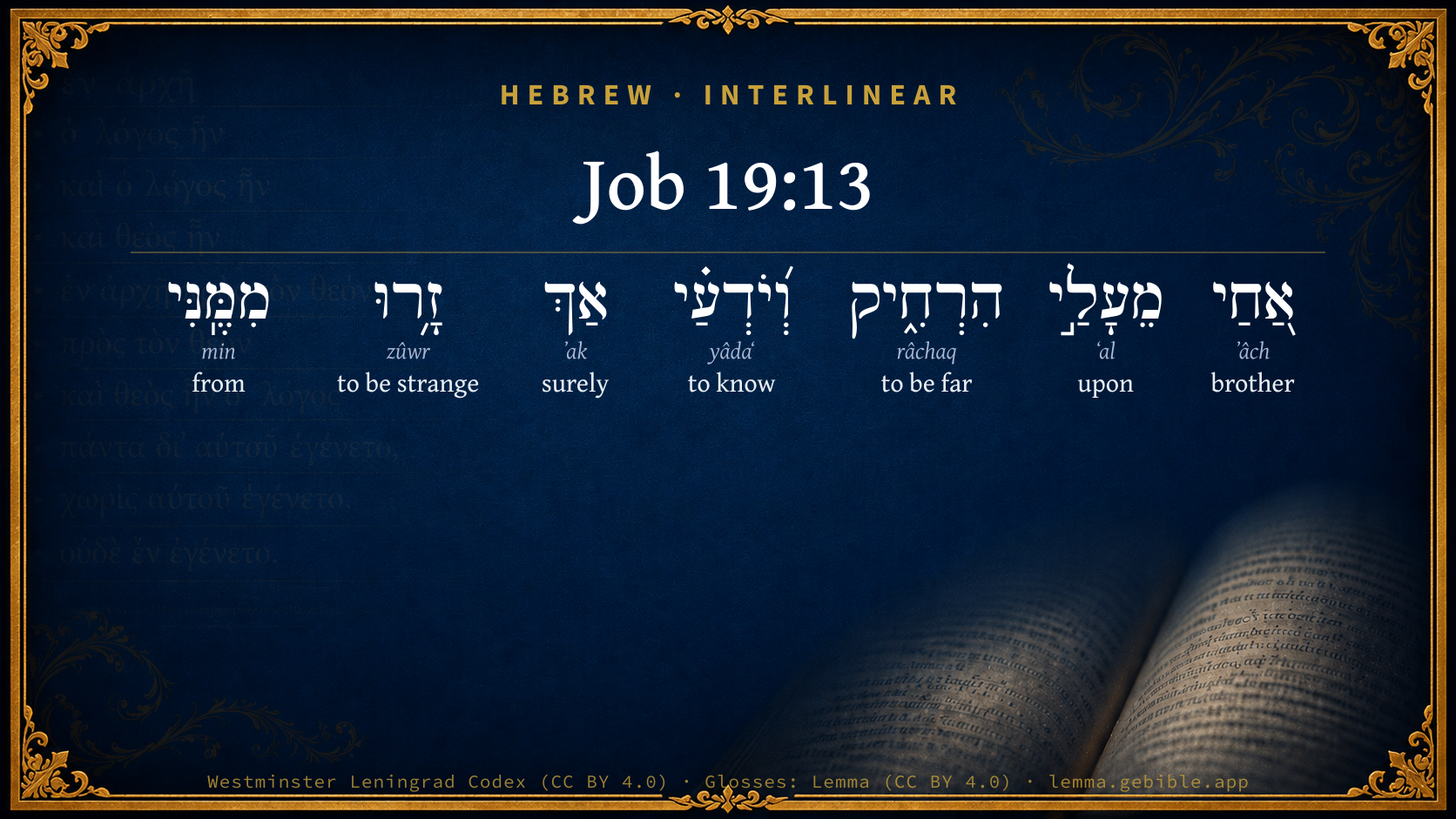
Hebrew (Westminster Leningrad Codex) Job 19:13 appears in the Hebrew Old Testament. The text above is from the Westminster Leningrad Codex. Each word links to its Strong’s number, a concise gloss, and parsing drawn from the Open Scriptures Hebrew Bible morphology. Click any word for its full Brown-Driver-Briggs (BDB) entry.
Download image
Cite this verse

Job 19:13 (World English Bible). Public Domain. Lemma interlinear Bible study tool, https://lemma.gebible.app/v/job/19/13.

Show BibTeX & RIS
BibTeX
RIS
English Translation
"He has put my brothers far from me. My acquaintances are wholly estranged from me.
World English Bible · Public Domain
Download a study sheet

One document with this verse’s original text, its word-by-word gloss line, the meaning frame, cross-references with their text, attributed commentary, and full source and license credits — printable, and it pastes into notes with its structure intact.

This verse Autodidact and up

Study sheet (.html) Plain text (.txt)

A passage Seminary Student

Up to 50 verses in one chapter. A passage sheet keeps up to 6 commentary sources and 12 cross-references per verse, in the order this page ranks them, and says so on the sheet whenever that leaves anything out. Ask for a single verse and you get the Autodidact verse sheet above.

Everything on this page stays free to read, with no account — the sheet is a download of what is already on screen, not access to it.

Want to remove ads? Support Godless Engineer
Compare translations 3

The same verse in 3 English versions, stacked beneath the original-language interlinear above. Click any original word for its lexicon entry.

Each is an independent rendering of the whole verse — the interlinear is not word-aligned to these translations.

Highlighted words mark where these versions differ — a whole-verse word diff, not a word-by-word alignment.

  • World English Bible Public Domain
    "He has put my brothers far from me. My acquaintances are wholly estranged from me.
  • King James Version Public Domain
    He hath put my brethren far from me, and mine acquaintance are verily estranged from me.
  • unfoldingWord Literal Text CC BY-SA 4.0
    He has put my brothers far from me, and my acquaintances indeed have turned away from me.

unfoldingWord Literal Text — © unfoldingWord, licensed CC BY-SA 4.0. Word-aligned USFM3 via Door43 (git.door43.org/unfoldingWord/en_ult).

Versions to compare (up to 4)

3 of 4 selected

Show all 18 translations

Every available English version of this verse, each an independent rendering of the whole verse.

  • World English Bible Public Domain
    "He has put my brothers far from me. My acquaintances are wholly estranged from me.
  • Berean Standard Bible Public Domain
    He has removed my brothers from me; my acquaintances have abandoned me.
  • Majority Standard Bible Public Domain
    He has removed my brothers from me; my acquaintances have abandoned me.
  • King James Version Public Domain
    He hath put my brethren far from me, and mine acquaintance are verily estranged from me.
  • American Standard Version (1901) Public Domain
    He hath put my brethren far from me, And mine acquaintance are wholly estranged from me.
  • Revised Version (1885) Public Domain
    He hath put my brethren far from me, and mine acquaintance are wholly estranged from me.
  • Geneva Bible (1599) Public Domain
    He hath remooued my brethre farre from me, and also mine acquaintance were strangers vnto me.
  • Douay-Rheims (1899) Public Domain
    He hath put my brethren far from me, and my acquaintance like strangers have departed from me.
  • Young's Literal Translation Public Domain
    My brethren from me He hath put far off, And mine acquaintances surely Have been estranged from me.
  • Literal Standard Version CC BY-SA 4.0
    He has put my brothers far off from me, || And my acquaintances have surely been estranged from me.
  • Unlocked Literal Bible CC BY-SA 4.0
    He has put my brothers far from me; my acquaintances are wholly alienated from me.
  • unfoldingWord Literal Text CC BY-SA 4.0
    He has put my brothers far from me, and my acquaintances indeed have turned away from me.
  • Darby Bible Public Domain
    He hath put my brethren far from me, and mine acquaintance are quite estranged from me.
  • World Messianic Bible Public Domain
    “He has put my brothers far from me. My acquaintances are wholly estranged from me.
  • Webster's Bible Public Domain
    He hath put my brethren far from me, and my acquaintance are verily estranged from me.
  • Free Bible Version CC BY-SA 4.0
    He has driven my brothers far away from me; all my former friends are estranged from me.
  • Bible in Basic English Public Domain
    He has taken my brothers far away from me; they have seen my fate and have become strange to me.
  • JPS Tanakh (1917) Public Domain
    He hath put my brethren far from me, and mine acquaintance are wholly estranged from me.

Literal Standard Version (2020), Covenant Press — licensed CC BY-SA 4.0. Text via the HelloAO Bible API (eBible.org). Unlocked Literal Bible (unfoldingWord) — licensed CC BY-SA 4.0. Text via the HelloAO Bible API (eBible.org). unfoldingWord Literal Text — © unfoldingWord, licensed CC BY-SA 4.0. Word-aligned USFM3 via Door43 (git.door43.org/unfoldingWord/en_ult). Free Bible Version, Dr. Jonathan Gallagher — licensed CC BY-SA 4.0. Text via the HelloAO Bible API (eBible.org).

Word by word

More ways to search: Search by grammar → Find every occurrence → Compare this word →

Practice this passage: Drill this verse → Learn its vocabulary →

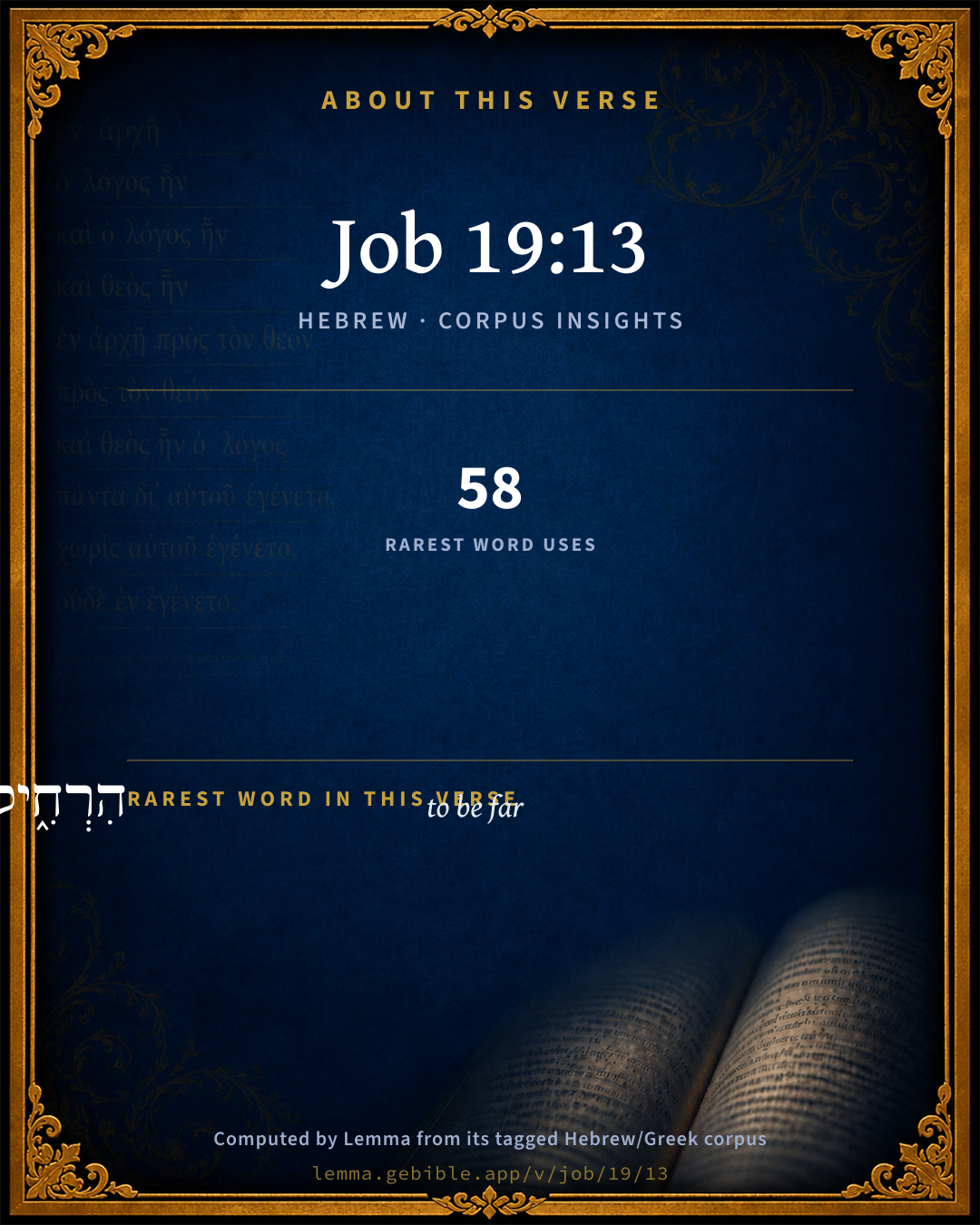
הִרְחִ֑יק
râchaq
H7368
“to be far”
Verb, Hiphil, Perfect, 3rd Person, Masculine, Singular
Part of Speech
Verb
Stem
Hiphil
Form
Perfect
Person
3rd Person
Gender
Masculine
Number
Singular
Full BDB Definition

Origin: a primitive root

TWOT: 2151

to be or become far, be or become distant, be removed, go far away (verb) - (Qal) to be far, be distant - (Piel) to send far away, extend - (Hiphil) - to make or exhibit distance, be gone far - to remove, put far away - (Niphal) loose (verb) - at a distance (verbal infinitive [as adverb])
  1. אַ֭חַי ʼâch H251 “brothers · my” Noun, Common, Masculine, Plural, Construct + Suffix, Personal, 1st Person, Common, Singular
  2. מֵעָלַ֣י ʻal H5921 “from · upon · me” Preposition + Preposition + Suffix, Personal, 1st Person, Common, Singular
  3. וְ֝יֹדְעַ֗י yâdaʻ H3045 “and · knowing · me” Conjunction + Verb, Qal, Participle Active, Masculine, Plural, Construct + Suffix, Personal, 1st Person, Common, Singular
  4. אַךְ ʼak H389 “surely” Particle, Accusative
  5. זָ֥רוּ zûwr H2114 “to be strange” Verb, Qal, Perfect, 3rd Person, Common, Plural
  6. מִמֶּֽנִּי min H4480 “from · me” Preposition + Suffix, Personal, 1st Person, Common, Singular

About this verse

These counts appear in no published source. They are computed here, from the morphology-tagged text and Lemma’s own curated glosses. What Lemma adds →

7
words
7
distinct lemmas
Wisdom
section

Shared distinctive vocabulary

הִרְחִ֑יק to be far H7368 occurs in 56 verses of the Hebrew Bible. Also found in:

Grammatical profile

  • 3 verbs
  • 1 noun
  • 2 prepositions
  • 1 particle

Verb forms

  • הִרְחִ֑יק Hiphil · Perfect
  • וְ֝יֹדְעַ֗י Qal · Participle Active
  • זָ֥רוּ Qal · Perfect

Hebrew & Septuagint length

In English translation the verse runs 15 words from the Hebrew and 20 from the Septuagint (LXX English) — closely comparable.

A rough comparison of the two English renderings, which tokenize alike — not a word-level alignment.

Word counts can differ between the Hebrew and the Greek without any difference in meaning — e.g. the Hebrew direct-object marker אֵת has no separate Greek word, and Greek often adds the article ὁ.

Cross-references

10

Topical passages linked to Job 19:13 in the Treasury of Scripture Knowledge — connected by theme and wording, ordered by reader-vote popularity; previews shown in the World English Bible.

  • Psalms 88:8 You have taken my friends from me. You have made me an abomination to them. I am confined, and I can't escape.
  • Psalms 69:8 I have become a stranger to my brothers, An alien to my mother's children.
  • Psalms 88:18 You have put lover and friend far from me, And my friends into darkness.
  • Psalms 31:11 Because of all my adversaries I have become utterly contemptible to my neighbors, A fear to my acquaintances. Those who saw me on the street fled from me.
  • Psalms 69:20 Reproach has broken my heart, and I am full of heaviness. I looked for some to take pity, but there was none; For comforters, but I found none.
  • Job 6:21–23 For now you are nothing. You see a terror, and are afraid.
  • Job 16:7 But now, God, you have surely worn me out. You have made desolate all my company.
  • Psalms 38:11 My lovers and my friends stand aloof from my plague. My kinsmen stand far away.
  • Matthew 26:56 But all this has happened, that the Scriptures of the prophets might be fulfilled." Then all the disciples left him, and fled.
  • 2 Timothy 4:16 At my first defense, no one came to help me, but all left me. May it not be held against them.

Cross-references courtesy of OpenBible.info (CC BY 4.0).

Hebrew and Greek witnesses Masoretic Hebrew ↔ Greek Septuagint

The same verse in the two great witnesses to the Old Testament, shown verse-for-verse.

These are two independent witnesses, not word-aligned to each other, and the Septuagint is shown in lemma (dictionary) form.

Hebrew Job 19:13 Masoretic · Westminster Leningrad Codex

אַ֭חַי מֵעָלַ֣י הִרְחִ֑יק וְ֝יֹדְעַ֗י אַךְ זָ֥רוּ מִמֶּֽנִּי

"He has put my brothers far from me. My acquaintances are wholly estranged from me.

World English Bible · Public Domain

Greek LXX Job 19:13 Septuagint · lemma form

ἀπό ἐγώ δέ ἀδελφός ἐγώ ἀποἵστημι γιγνώσκω ἀλλότριος ἤ ἐγώ φίλος δέ ἐγώ ἀνελεήμων γίγνομαι

My brethren have stood aloof from me; they have recognized strangers rather than me: and my friends have become pitiless.

LXX2012 (modern English Septuagint) · Public Domain

Hebrew: Westminster Leningrad Codex (CC BY 4.0). Greek: Septuagint (public domain); English from LXX2012 (modern English Septuagint) (Public Domain). How the Septuagint differs from the Hebrew →

Commentary

Notes on Job 19:13 from classic Christian and Jewish commentators (each source and its license shown beneath its notes). The classic Christian expositions comment on the surrounding passage and are grouped to its opening verse, so a note may address several verses; the Jewish commentaries on the Tanakh (Rashi and others) are per-verse, so they appear only where the commentator wrote on this verse.

Lemma curates 59 commentaries, every one of them public domain or Creative Commons licensed, each selected and text-cleaned for this edition rather than reprinted as found. About our sources →

Trapp's Complete Commentary

John Trapp

Job 19:13 He hath put my brethren far from me, and mine acquaintance are verily estranged from me.

Ver. 13. He hath put my brethren far from me] In their affections at least. Some stuck to him, but for a mischief, for they proved miserable comforters, as did likewise Peter to our Saviour, who fled not with the rest of the disciples, but better he had for any good he did him. "A brother is born for adversity," saith Solomon, Pro 17:17; and although at other times there may be some unkindness, fratrum concordia rara est, Harmonious amoung brothers is rare. yet in affliction and extremity good nature will work, and good blood will not belie itself. But Job’s brethren proved unkind, and grew out of kind; they got farthest from him when his enemies had besieged him. And all this befell him, not without the Lord. He hath put my brethren far from me; this was no small aggravation of the affliction, that God withdrew or withheld that assistance and influence that should have enlarged and united the hearts of his brethren unto him. See Psa 105:25.

And mine acquaintance are verily estranged from me] Those that formerly knew me thoroughly, and were as well known of me, mine intimate friends, who knew all my heart, are now truly as strange to me, as if there had never been any such matter of acquaintance, Noti mei (Vulgate). Necessarii mei (Tigur.). R. Solomon readeth it, They are cruel to me, Quasi esset scriptum aczaru. "All the brethren of the poor man hate him," saith Solomon, Pro 19:7, "how much more do his friends go far from him?" He pursueth them with words; yet they are lacking to him. This the heathen (as Ovid and others) heavily complain of. Aφιλον το δυστυχες (Thue.). Et cum fortuna statque caditque fides (Ovid.). Tempera si fuerint nubila, solus eris (Ibid.). In the river Araris there is reported to be a fish called Scolopidus, which at the waxing of the moon is as white as the driven snow, and at the waning thereof is as black as a burnt coal. A fit emblem of a false friend. "Wealth maketh many friends but the poor is separated from his neighbour," Pro 19:4, who therefore turneth from him as a stranger, if not against him as an enemy.

John Trapp, A Commentary or Exposition upon All the Books of the Old and New Testament (1647–1656) — public domain. Text from a community e-Sword module.

Joseph Benson's Commentary

Job 19:13. He hath put my brethren far from me, &c. — I looked for some support and comfort from my kindred and friends, but they were so astonished at the number and dreadfulness of my calamities that they fled from me as a man accursed of God: and as for my neighbours, who formerly much courted my acquaintance: they keep aloof from me, as if they had never known me. As we must see the hand of God in all the injuries we receive from our enemies, so likewise in all the slights and unkindnesses we receive from our friends.

Joseph Benson's Commentary on the Old and New Testaments (1811–1818) — public domain. Text from a community e-Sword module.

Whedon's Commentary on the Bible

Daniel D. Whedon

Second strophe — God’s treatment of Job has resulted in the alienation of his friends of every grade, so that the menials of his house now treat him with contempt, Job_19:13-20.

13. My brethren — Umbreit cites an Arabic proverb, “The brother — that is, the true friend — is only known in time of need.” Job specifies six different phases of friendship, or classes of friends, whom his sufferings had alienated: in general, his brethren, (Job_6:15;) his “knowers,” “confidants,” (acquaintance;) his kinsmen. “near ones,” (Psa_38:11 :) “those familiarly known,” (familiar friends,) Job_19:14; sojourners in his house, (Job_19:15;) and finally, bosom friends. (inward friends,) Job_19:19.

Daniel D. Whedon (gen. ed.), Commentary on the Old and New Testaments (1874–1909) — public domain. Text from a community e-Sword module.

Jamieson, Fausset & Brown

Robert Jamieson, A. R. Fausset & David Brown

brethren--nearest kinsmen, as distinguished from "acquaintance." So "kinsfolk" and "familiar friends" (Job 19:14) correspond in parallelism. The Arabic proverb is, "The brother, that is, the true friend, is only known in time of need."

estranged--literally, "turn away with disgust." Job again unconsciously uses language prefiguring the desertion of Jesus Christ (Job 16:10; Luk 23:49; Psa 38:11).

Jamieson, Fausset & Brown — Commentary Critical and Explanatory on the Whole Bible (1871) — public domain (CC PDM 1.0). Text via the HelloAO Bible API.

Ellicott's Commentary for English Readers

(13) He hath put my brethren far from me.—The Psalmist has apparently copied this in Psa_88:8. The sense of human desertion is hardly less terrible than that of being forsaken by God, and this has been added to him. It is not easy to read these sad complaints of Job without seeing how fitly they apply to the sorrows of the Man of sorrows. Those who, with the present writer, believe in the overruling presence of the Holy Ghost will adore His wisdom in this fitness; but at all events it shows how completely Christ entered into the very heart of human suffering, in that the deepest expressions of suffering inevitably remind us of Him, whether those expressions are met with in the Book of Job, in the Psalms of David, or in the Lamentations of Jeremiah.

A Bible Commentary for English Readers, edited by Charles John Ellicott (1878–1897) — public domain. Text from a community e-Sword module.

The Cambridge Bible for Schools and Colleges

gen. ed. J. J. S. Perowne

13–14. First, his relations outside his own immediate circle and his acquaintances stood aloof from him.

13–19. The estrangement and abhorrence of men.

Job’s complaint now is even more touching than before: God not only afflicted him with trouble but removed far from him all human sympathy. And there is something more breaking to the heart in the turning away of men from us than in the severest sufferings. It crushes us quite. We steel ourselves against it for a time and rise to it in bitterness and resentment, but gradually it breaks us and we are crushed at last. And this seems the way whether men frown on us with justice or no. And there came on Job when he contemplated his complete casting off by men, by his friends and his household and even by the little children, a complete break-down, and he cries, Pity me, O ye my friends (Job_19:21). This alienation of men was universal:—

The Cambridge Bible for Schools and Colleges (gen. ed. J. J. S. Perowne; Cambridge University Press, 1878–1918) — public domain. Text from a community e-Sword module.

John Gill's Exposition

My kinsfolk have failed,.... Or "ceased" (a), not to be, or that they were dead, which is sometimes the sense of the word; but they ceased from visiting him, or doing any good office for him; those that were "near" (b) him, as the word used signifies; that were near him in relation, and were often near him in place, in his own house, in company and conversation with him, now ceased to be near him in affection; or to come nigh him, to converse with him and comfort him, and sympathize with him, which might be expected from persons nearly related:

and my familiar friends have forgotten me; such as were well known to him, and he to them, and who not long ago were very loving and friendly to him, and very freely and familiarly conversed with him; but now they forgot him; the friendship that subsisted between them, the friendliness with which they had visited him, and the favours they had received from him; they so slighted and neglected him, that it seemed as if he was forgotten, as a dead man, out of mind; or as if they did not remember that there ever was, or at least that there now was, such a man in the world as Job: these could not be true friends; for "a friend loves at all times, and a brother is born for adversity", Pro 17:17; a real friend loves, and continues to love, in adversity as well as in prosperity; and such an one, who sometimes sticks closer to a man than a brother, is born and designed to be of service to him in a time of trouble; but so it was ordered by divine Providence, and according to the will of God, that Job should meet with such treatment from his brethren, relations, acquaintance, and familiar friends, for the trial of his faith and patience.

(a) "desierunt", Pagninus, Montanus, Vatablus, Mercerus, Drusius, Piscator, Schmidt, Michaelis; "cessant", Schultens. (b) "propinqui mei", Pagninus, Montanus, &c.

John Gill's Exposition of the Whole Bible (1746–1763) — public domain (CC PDM 1.0). Text via the HelloAO Bible API.

Albert Barnes' Notes on the Bible

He hath put my brethren - This is a new source of afflication that he had not adverted to before, that God had caused all his children to be estranged from him - a calamity which he regarded as the crown of all his woes. The word rendered “my brethren” (אחי 'âchāy) means means properly “my brothers” - but whether he means literally his brothers, or whether he designs it to be taken in a figuratie sense as denoting his intimate friends, or those of the same rank in life or calling, it is impossible now to determine.

And mine acquaintance - My friends - on whom I relied in time of calamity.

And verily estranged - They have forgotten me, and treat me as a stranger. What an accurate description is this of what often occurs! In prosperity a man will be surrounded by friends; but as soon as his prosperity is stripped away, and he is overwhelmed with calamity, they withdraw, and leave him to suffer alone. Proud of his acquaintance before, they now pass him by as a stranger, or treat him with cold civility, and when he “needs” their friendship, they are gone.

Albert Barnes' Notes on the Bible (1834–1885) — public domain. Text from a community e-Sword/MySword module.

Matthew Poole's English Annotations

My brethren, i.e. my kindred and friends, who might and should have supported and comforted me in my distress.

Far from me; either,

1. In place; because they feared or disdained, or at least neglected, to visit or succour me. Or,

2. In their affections, which are far from me, when their bodies are present with me, as I find in you. But this also I ascribe to God; he hath alienated your hearts from me.

Matthew Poole's English Annotations on the Holy Bible (1683–1685) — public domain. Text from a community e-Sword/MySword module.

The Pulpit Commentary

He hath put my brethren far from me. Job had actual "brothers", (Job_42:11) who forsook him and "dealt deceitfully" with (Job_6:15) during the time of his adversity, but were glad enough to return to him and "eat bread with him" in his later prosperous life. Their alienation from him during the period of his afflictions he here regards as among the trials laid upon him by God. Compare the similar woe of Job"s great Antitype. (Joh_5:5, "For neither did his brethren believe on him And mine acquaintance are verily estranged from me. (comp. Psa_38:11 Psa_69:9 Psa_88:8, Psa_88:18) The desertion of the afflicted by their fair-weather friends is a standing topic with the poets and moralists of all ages and nations. Job was not singular in this affliction.

The Pulpit Commentary (1880–1919), ed. H.D.M. Spence-Jones & Joseph S. Exell — public domain. Text from a community e-Sword module.

John Wesley's Explanatory Notes

Estranged - As we must eye the hand of God, in all the injuries we receive from our enemies, so likewise in all the slights and unkindnesses we receive from our friends.

John Wesley, Explanatory Notes Upon the Whole Bible (1754–1765) — public domain. Text via the GEBible commentary corpus.

unfoldingWord translationNotes

Door43 World Missions Community

General Information:

Job continues to speak to his three friends.

He has put my brothers far from me

Being "far from" someone represents being unwilling to relate to him or help him. AT: "God has caused my brothers to stay away from me" or "God caused my brothers to refuse to help me" (See: Metaphor)

my acquaintances are wholly alienated from me

This can be stated in active form. AT: "my acquaintances have alienated themselves from me" or "my friends treat me like a stranger" (See: Active or Passive)

My kinsfolk have failed me

"My relatives have left me without help"

my close friends

"my intimate friends"

have forgotten me

"have abandoned me" or "have neglected me." This means that they refuse to treat him according to how he and they had related to each other in the past. It implies that they abandoned him.

translationWords

brother

kin

unfoldingWord translationNotes — © Distant Shores Media and the Door43 World Missions Community, licensed CC BY-SA 4.0. Source: git.door43.org/Door43/en_tn.

Rashi

Rabbi Shlomo Yitzchaki (Rashi)

became strange Heb. אך זרו, an expression of cruelty.

Rashi on the Tanakh — English translations: “The Judaica Press complete Tanach with Rashi, translated by A. J. Rosenberg” (CC BY 4.0); “Pentateuch with Rashi's commentary by M. Rosenbaum and A.M. Silbermann, 1929-1934” (public domain); “The Metsudah Tanach series, Lakewood, N.J” (CC BY 4.0); and “The Book of Joshua, Metsudah Publications, 1997” (CC BY 4.0). Text via Sefaria.

Lesson kit

Teaching starters — assembled from the data on this page, not authored interpretation. Every prompt links to the verse data it draws on. Edit before teaching.

Job, in the Wisdom, opens this verse with 7 words (7 distinct Hebrew lemmas). Its most distinctive word is râchaq (“to be far”). A historical commentator’s framing appears above. Read the whole chapter for the surrounding context.

Discussion questions

  1. The word râchaq carries the sense “to be far.” How does it shape the verse?
  2. How does Genesis 21:16, which shares the word «to be far», read alongside this verse?
  3. These translations render this verse differently; the difference is in the English rendering, not the original. What questions does that raise?
  4. «הִרְחִ֑יק» is a Hiphil Perfect verb. How does that grammatical form shape the action described?
  5. Compare how Trapp's Complete Commentary and Joseph Benson's Commentary read this verse. Where do they agree or differ?

Things to notice

Reading settings

Reading text

Shown beneath each verse's original-language words.

Old Testament
Old Testament edition

Read the OT as the Masoretic Hebrew (MT) or the Greek Septuagint (LXX).

English shown for the Greek Septuagint (in the Hebrew ↔ Greek comparison).

Comparing translations? Open the Compare panel on any verse page to stack up to four side by side.