
Job 30:10

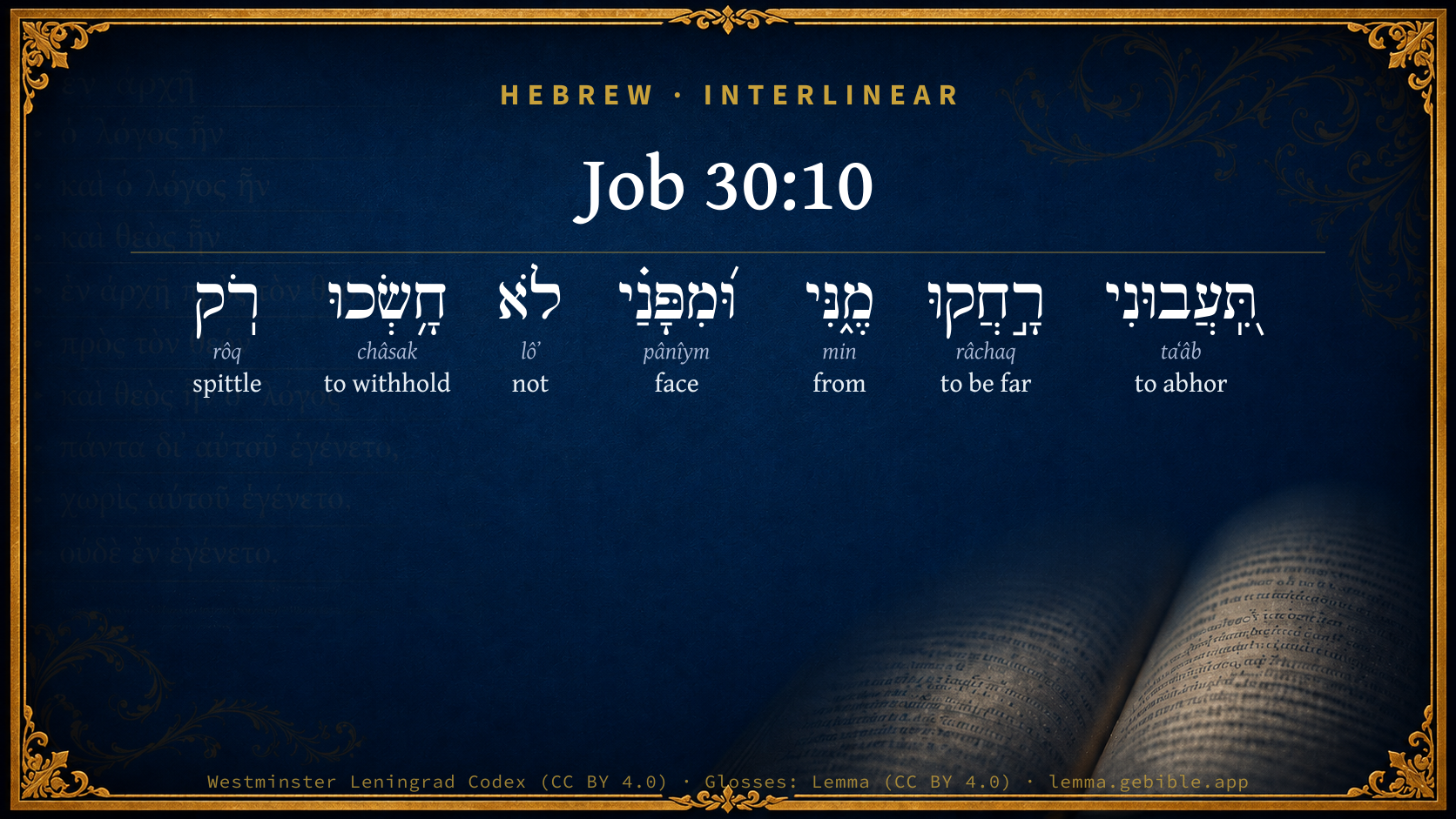
Hebrew (Westminster Leningrad Codex) Job 30:10 appears in the Hebrew Old Testament. The text above is from the Westminster Leningrad Codex. Each word links to its Strong’s number, a concise gloss, and parsing drawn from the Open Scriptures Hebrew Bible morphology. Click any word for its full Brown-Driver-Briggs (BDB) entry.
Download image
Cite this verse

Job 30:10 (World English Bible). Public Domain. Lemma interlinear Bible study tool, https://lemma.gebible.app/v/job/30/10.

Show BibTeX & RIS
BibTeX
RIS
English Translation
They abhor me, they stand aloof from me, And don't hesitate to spit in my face.
World English Bible · Public Domain
Download a study sheet

One document with this verse’s original text, its word-by-word gloss line, the meaning frame, cross-references with their text, attributed commentary, and full source and license credits — printable, and it pastes into notes with its structure intact.

This verse Autodidact and up

Study sheet (.html) Plain text (.txt)

A passage Seminary Student

Up to 50 verses in one chapter. A passage sheet keeps up to 6 commentary sources and 12 cross-references per verse, in the order this page ranks them, and says so on the sheet whenever that leaves anything out. Ask for a single verse and you get the Autodidact verse sheet above.

Everything on this page stays free to read, with no account — the sheet is a download of what is already on screen, not access to it.

Want to remove ads? Support Godless Engineer
Compare translations 3

The same verse in 3 English versions, stacked beneath the original-language interlinear above. Click any original word for its lexicon entry.

Each is an independent rendering of the whole verse — the interlinear is not word-aligned to these translations.

Highlighted words mark where these versions differ — a whole-verse word diff, not a word-by-word alignment.

  • World English Bible Public Domain
    They abhor me, they stand aloof from me, And don't hesitate to spit in my face.
  • King James Version Public Domain
    They abhor me, they flee far from me, and spare not to spit in my face.
  • unfoldingWord Literal Text CC BY-SA 4.0
    They abhor me, they stay away from me, but from my face they do not withhold spit.

unfoldingWord Literal Text — © unfoldingWord, licensed CC BY-SA 4.0. Word-aligned USFM3 via Door43 (git.door43.org/unfoldingWord/en_ult).

Versions to compare (up to 4)

3 of 4 selected

Show all 18 translations

Every available English version of this verse, each an independent rendering of the whole verse.

  • World English Bible Public Domain
    They abhor me, they stand aloof from me, And don't hesitate to spit in my face.
  • Berean Standard Bible Public Domain
    They abhor me and keep far from me; they do not hesitate to spit in my face.
  • Majority Standard Bible Public Domain
    They abhor me and keep far from me; they do not hesitate to spit in my face.
  • King James Version Public Domain
    They abhor me, they flee far from me, and spare not to spit in my face.
  • American Standard Version (1901) Public Domain
    They abhor me, they stand aloof from me, And spare not to spit in my face.
  • Revised Version (1885) Public Domain
    They abhor me, they stand aloof from me, and spare not to spit in my face.
  • Geneva Bible (1599) Public Domain
    They abhorre me, and flee farre from mee, and spare not to spit in my face.
  • Douay-Rheims (1899) Public Domain
    They abhor me, and flee far from me, and are not afraid to spit in my face.
  • Young's Literal Translation Public Domain
    They have abominated me, They have kept far from me, And from before me have not spared to spit.
  • Literal Standard Version CC BY-SA 4.0
    They have detested me, || They have kept far from me, || And from before me have not spared to spit.
  • Unlocked Literal Bible CC BY-SA 4.0
    They abhor me and stand far off from me; they do not refrain from spitting in my face.
  • unfoldingWord Literal Text CC BY-SA 4.0
    They abhor me, they stay away from me, but from my face they do not withhold spit.
  • Darby Bible Public Domain
    They abhor me, they stand aloof from me, yea, they spare not to spit in my face.
  • World Messianic Bible Public Domain
    They abhor me, they stand aloof from me, and don’t hesitate to spit in my face.
  • Webster's Bible Public Domain
    They abhor me, they flee far from me, and spare not to spit in my face.
  • Free Bible Version CC BY-SA 4.0
    They despise and shun me; they don't hesitate to spit in my face.
  • Bible in Basic English Public Domain
    I am disgusting to them; they keep away from me, and put marks of shame on me.
  • JPS Tanakh (1917) Public Domain
    They abhor me, they flee far from me, and spare not to spit in my face.

Literal Standard Version (2020), Covenant Press — licensed CC BY-SA 4.0. Text via the HelloAO Bible API (eBible.org). Unlocked Literal Bible (unfoldingWord) — licensed CC BY-SA 4.0. Text via the HelloAO Bible API (eBible.org). unfoldingWord Literal Text — © unfoldingWord, licensed CC BY-SA 4.0. Word-aligned USFM3 via Door43 (git.door43.org/unfoldingWord/en_ult). Free Bible Version, Dr. Jonathan Gallagher — licensed CC BY-SA 4.0. Text via the HelloAO Bible API (eBible.org).

Word by word

More ways to search: Search by grammar → Find every occurrence → Compare this word →

Practice this passage: Drill this verse → Learn its vocabulary →

About this verse

These counts appear in no published source. They are computed here, from the morphology-tagged text and Lemma’s own curated glosses. What Lemma adds →

7
words
7
distinct lemmas
Wisdom
section

Notable vocabulary

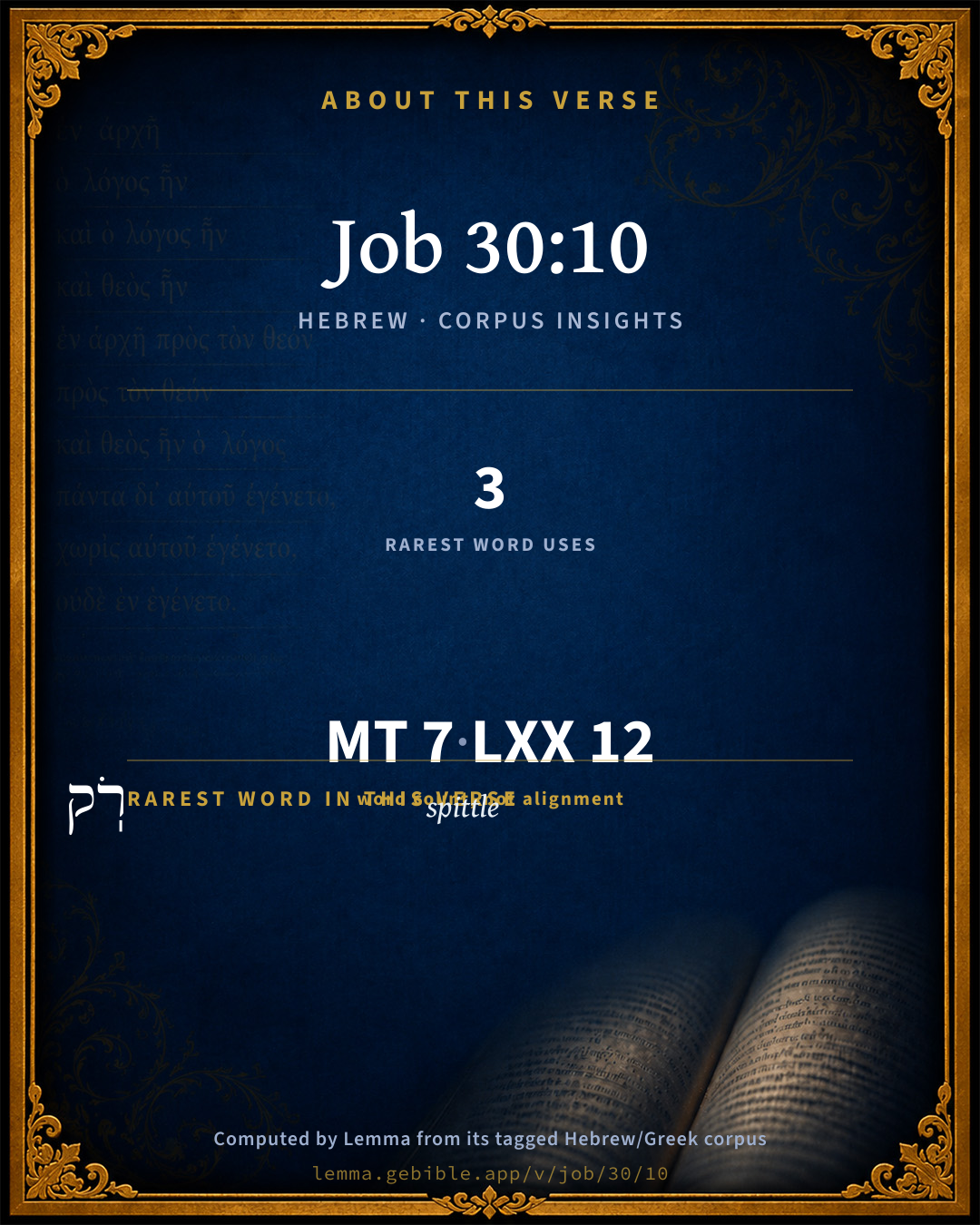
The rarest word here is רֹֽק spittle H7536 — appearing just 3 times in the whole Hebrew Bible.

Shared distinctive vocabulary

רֹֽק spittle H7536 occurs in 3 verses of the Hebrew Bible. Also found in:

Grammatical profile

  • 3 verbs
  • 2 nouns
  • 1 preposition
  • 1 particle

Verb forms

  • תִּֽ֭עֲבוּנִי Piel · Perfect
  • רָ֣חֲקוּ Qal · Perfect
  • חָ֥שְׂכוּ Qal · Perfect

Hebrew & Septuagint length

In English translation the verse runs 16 words from the Hebrew and 15 from the Septuagint (LXX English) — closely comparable.

A rough comparison of the two English renderings, which tokenize alike — not a word-level alignment.

Word counts can differ between the Hebrew and the Greek without any difference in meaning — e.g. the Hebrew direct-object marker אֵת has no separate Greek word, and Greek often adds the article ὁ.

In the original languages it is 7 Hebrew tokens and 12 Greek tokens — but the two are counted differently (Hebrew bundles its prefixes and suffixes into one token; the Greek is in lemma form), so that isn’t a like-for-like length.

Cross-references

13

Topical passages linked to Job 30:10 in the Treasury of Scripture Knowledge — connected by theme and wording, ordered by reader-vote popularity; previews shown in the World English Bible.

  • Isaiah 50:6 I gave my back to the strikers, and my cheeks to those who plucked off the hair; I didn't hide my face from shame and spitting.
  • Matthew 26:67 Then they spit in his face and beat him with their fists, and some slapped him,
  • Numbers 12:14 Yahweh said to Moses, If her father had but spit in her face, shouldn't she be ashamed seven days? let her be shut up outside of the camp seven days, and after that she shall be brought in again.
  • Psalms 88:8 You have taken my friends from me. You have made me an abomination to them. I am confined, and I can't escape.
  • Deuteronomy 25:9 then his brother's wife shall come to him in the presence of the elders, and loose his shoe from off his foot, and spit in his face; and she shall answer and say, So shall it be done to the man who does not build up his brother's house.
  • Matthew 27:30 They spat on him, and took the reed and struck him on the head.
  • Job 17:6 "But he has made me a byword of the people. They spit in my face.
  • Job 19:13–14 "He has put my brothers far from me. My acquaintances are wholly estranged from me.
  • Job 19:19 All my familiar friends abhor me. They whom I loved have turned against me.
  • Job 42:6 Therefore I abhor myself, And repent in dust and ashes."
  • Proverbs 19:7 All the relatives of the poor shun him: How much more do his friends avoid him! He pursues them with pleas, but they are gone.
  • Zechariah 11:8 I cut off the three shepherds in one month; for my soul was weary of them, and their soul also loathed me.
  • Matthew 26:56 But all this has happened, that the Scriptures of the prophets might be fulfilled." Then all the disciples left him, and fled.

Cross-references courtesy of OpenBible.info (CC BY 4.0).

Hebrew and Greek witnesses Masoretic Hebrew ↔ Greek Septuagint

The same verse in the two great witnesses to the Old Testament, shown verse-for-verse.

These are two independent witnesses, not word-aligned to each other, and the Septuagint is shown in lemma (dictionary) form.

Hebrew Job 30:10 Masoretic · Westminster Leningrad Codex

תִּֽ֭עֲבוּנִי רָ֣חֲקוּ מֶ֑נִּי וּ֝מִפָּנַ֗י לֹא חָ֥שְׂכוּ רֹֽק

They abhor me, they stand aloof from me, And don't hesitate to spit in my face.

World English Bible · Public Domain

Greek LXX Job 30:10 Septuagint · lemma form

βδελύσσω δέ ἐγώ ἀποἵστημι μακράν ἀπό δέ πρόσωπον ἐγώ οὐ φείδομαι πτύελος

And they stood aloof and abhorred me, and spared not to spit in my face.

LXX2012 (modern English Septuagint) · Public Domain

On this verse, The Pulpit Commentary discusses the Septuagint’s reading. Read the note in Commentary ↓

Hebrew: Westminster Leningrad Codex (CC BY 4.0). Greek: Septuagint (public domain); English from LXX2012 (modern English Septuagint) (Public Domain). How the Septuagint differs from the Hebrew →

Commentary

Notes on Job 30:10 from classic Christian and Jewish commentators (each source and its license shown beneath its notes). The classic Christian expositions comment on the surrounding passage and are grouped to its opening verse, so a note may address several verses; the Jewish commentaries on the Tanakh (Rashi and others) are per-verse, so they appear only where the commentator wrote on this verse.

Lemma curates 59 commentaries, every one of them public domain or Creative Commons licensed, each selected and text-cleaned for this edition rather than reprinted as found. About our sources →

Trapp's Complete Commentary

John Trapp

Job 30:10 They abhor me, they flee far from me, and spare not to spit in my face.

Ver. 10. They abhor me, they flee far from me] As if I were a leper or a bugbear, or that my breath were infectious; like that maid spoken of by Avicen, who, feeding upon poison, was herself healthy, yet infected others with her venomous breath. Job was wont to be honoured; now he is as much abhorred. People were used to hanging upon his lips for learned counsel, but they stand aloof, and keep at a distance. They looked upon that face of his as the face of an angel, which now, with utmost despite and detestation, they spit upon and spare not. At virtutes evertere non possunt, as Demetrius Phalereus said, when the Athenians threw down the many statues they had once erected in honour of him, But they cannot throw down my virtues and valiant acts, whereby I deserved those statues. Job was not without his cordial in this sad and sudden change of his condition. For, first, the bird in his own bosom sang sweetly still, as birds in the spring tune most melodiously when it rains most sadly. And, secondly, what if these miscreants prate against Job with malicious words, as Diotrephes did against Demetrius, 3Jn 1:9-13, yet it is enough for Job or Demetrius that they have a good report of all men; that is, of all good men, who indeed are the only men (because a good name only is a name, Ecc 7:1, and a good wife only a wife, Pro 18:22) to be reckoned on; and of the truth itself, that is more, Job 30:12.

And spare not to spit in my face] In signum videlicet maximi contemptus et indignationis (Junius), In token of greatest contempt and indignation, as Num 12:14 Isa 50:6 Deu 25:9. The face is the table of beauty or comeliness; and when it is spit upon it is made the seat of shame. Their words were, likely, such as the English barons here said of the popes that excommunicated them, Fie on such rascal ribalds, &c., Marcidi ribauldi (Mat. Paris,). Our Lord Christ also was spit upon in like manner, that he might cleanse our faces from the filth of sin, and make them shine with his beams, 1Jn 3:2.

John Trapp, A Commentary or Exposition upon All the Books of the Old and New Testament (1647–1656) — public domain. Text from a community e-Sword module.

Tyndale Open Study Notes

Tyndale Open Resources

30:10 won’t come near me: See also 19:13-15; cp. Ps 88:8; Prov 19:7; Matt 26:56. • To spit in someone’s face was to display revulsion or contempt (Deut 25:9; Isa 50:6; Matt 26:67; 27:30; Mark 14:65).

Tyndale Open Study Notes — © Tyndale Open Resources, licensed CC BY-SA 4.0. Text via the HelloAO Bible API.

Jamieson, Fausset & Brown

Robert Jamieson, A. R. Fausset & David Brown

in my face--rather, refrain not to spit in deliberate contempt before my face. To spit at all in presence of another is thought in the East insulting, much more so when done to mark "abhorrence." Compare the further insult to Jesus Christ (Isa 50:6; Mat 26:67).

Jamieson, Fausset & Brown — Commentary Critical and Explanatory on the Whole Bible (1871) — public domain (CC PDM 1.0). Text via the HelloAO Bible API.

Adam Clarke's Commentary

Verse 10. They abhor me] What a state must civil society be in when such indignities were permitted to be offered to the aged and afflicted!

Adam Clarke's Commentary on the Bible (1810–1826) — public domain. Text from a community e-Sword/MySword module.

John Gill's Exposition

They abhor me,.... As it is no wonder they should, since his inward and most intimate friends did, Job 19:19; they abhorred him, not for any evil in him; Job was ready enough to abhor that himself, and himself for it, as he did when sensible of it, Job 42:6; but for the good that was in him, spoken or done by him; which carried in it a reproof to them they could not bear; see Amo 5:10; they abhorred him also because of his present meanness and poverty, and because of his afflictions and distresses; and particularly the diseases of his body; so Christ was abhorred by the Scribes, Pharisees and elders of the people, the three shepherds his soul loathed, and their soul abhorred him for his meanness and for his ministry: and even by the whole nation of the Jews, by the body of the people, particularly when they preferred Barabbas, a thief and a murderer, to him, Mar 15:7; see Zac 11:8;

they flee from me; as from some hideous monster, or infectious person, as if he had the plague on him, or some nauseous disease, the stench of which they could not bear; so Christ his antitype was used by: his people; when they saw him in his afflictions they hid their faces from him, did not care to look at him, or come nigh him, Isa 53:3;

and spare not to spit in my face; not in his presence only, as some think, which is too low a sense, but literally and properly in his face, when they vouchsafed to come near him; in this opprobrious way they used him, than which nothing was a greater indignity and affront; and we need not scruple to interpret it in this sense of Job, since our Lord, whose type he was in this and other things, was so treated, Isa 50:6.

John Gill's Exposition of the Whole Bible (1746–1763) — public domain (CC PDM 1.0). Text via the HelloAO Bible API.

Albert Barnes' Notes on the Bible

They abhor me - Hebrew, They regard me as abominable.

They flee far from me - Even such an impious and low born race now will have nothing to do with me. They would consider it no honor to be associated with me, but keep as far from me as possible.

And spare not to spit in my face - Margin, “withhold not spittle from.” Noyes renders this “Before my face;” and so Luther Wemyss, Umbreit, and Prof. Lee. The Hebrew may mean either to spit in the face, or to spit “in the presence” of anyone. It is quite immaterial which interpretation is adopted, since in the view of Orientals the one was considered about the same as the other. In their notions of courtesy and urbanity, he commits an insult of the same kind who spits in the presence of another which he would if he spit on him. Are they not right? Should it not be so considered every where? Yet how different their views from the more refined notions of the civilized Occidentals! In America, more than in any other land, are offences of this kind frequent and gross. Of nothing do foreigners complain of us more, or with more justice; and much as we boast of our intelligence and refinement, we should gain much if in this respect we would sit down at the feet of a Bedouin Arab, and incorporate his views into our maxims of politeness.

Albert Barnes' Notes on the Bible (1834–1885) — public domain. Text from a community e-Sword/MySword module.

Haydock's Catholic Bible Commentary

Face. This most people explain literally; while some, (Calmet) as Job was herein a figure of Christ, (Menochius; Matthew xxvi.; Worthington) think that the expression denotes the utmost contempt; (St. Gregory, &c.) or that the people spit upon the ground (Calmet) for fear of contracting any infection; (Haydock) and because lepers were held in the utmost abhorrence. (Calmet)

George Leo Haydock (1774–1849), Haydock's Catholic Family Bible and Commentary, 1859 edition — public domain. Excludes Psalms (Douay-Rheims chapter numbering differs from Protestant) and Deuterocanonical books (Catholic canon only).

Matthew Poole's English Annotations

They flee far from me, in contempt of my person, and loathing of my sores.

Spare not to spit in my face; not literally, for they kept far from him, as he now said; but figuratively, i.e. they use all manner of contemptuous and reproachful expressions and carriages towards me, not only behind my back, but even to my face.

Matthew Poole's English Annotations on the Holy Bible (1683–1685) — public domain. Text from a community e-Sword/MySword module.

Whedon's Commentary on the Bible

Daniel D. Whedon

10. Spit in my face — Num_12:14; Deu_25:9; see also Job_17:6. Some improperly understand the grossly insulting act in this case to have been before, not into, the face. In the East, however, spitting in the presence of another is regarded as an outrage nearly as great as to spit upon him.

Daniel D. Whedon (gen. ed.), Commentary on the Old and New Testaments (1874–1909) — public domain. Text from a community e-Sword module.

The Pulpit Commentary

They abhor me, they flee far from me; rather, they abhor me, they stoat aloof from me (see the Revised Version). And spare not to spit in my face. This has generally been taken literally, as it seems to have been by the LXX But it, perhaps, means no more than that they did not refrain from spitting in Job"s presence (see Professor Lee"s "Book of Job," p. 422).

The Pulpit Commentary (1880–1919), ed. H.D.M. Spence-Jones & Joseph S. Exell — public domain. Text from a community e-Sword module.

John Wesley's Explanatory Notes

Spit - Not literally, for they kept far from him, but figuratively, they use all manner of reproachful expressions, even to my face. Herein, also we see a type of Christ, who was thus made a reproach of men, and despised of the people.

John Wesley, Explanatory Notes Upon the Whole Bible (1754–1765) — public domain. Text via the GEBible commentary corpus.

Lesson kit

Teaching starters — assembled from the data on this page, not authored interpretation. Every prompt links to the verse data it draws on. Edit before teaching.

Job, in the Wisdom, opens this verse with 7 words (7 distinct Hebrew lemmas). Its most distinctive word is rôq (“spittle”). A historical commentator’s framing appears above. Read the whole chapter for the surrounding context.

Discussion questions

  1. What does “spittle” (rôq) contribute to the verse as a whole?
  2. How does Job 7:19, which shares the word «spittle», read alongside this verse?
  3. These translations render this verse differently; the difference is in the English rendering, not the original. What questions does that raise?
  4. «תִּֽ֭עֲבוּנִי» is a Piel Perfect verb. How does that grammatical form shape the action described?
  5. Compare how Trapp's Complete Commentary and Tyndale Open Study Notes read this verse. Where do they agree or differ?

Things to notice

Reading settings

Reading text

Shown beneath each verse's original-language words.

Old Testament
Old Testament edition

Read the OT as the Masoretic Hebrew (MT) or the Greek Septuagint (LXX).

English shown for the Greek Septuagint (in the Hebrew ↔ Greek comparison).

Comparing translations? Open the Compare panel on any verse page to stack up to four side by side.