
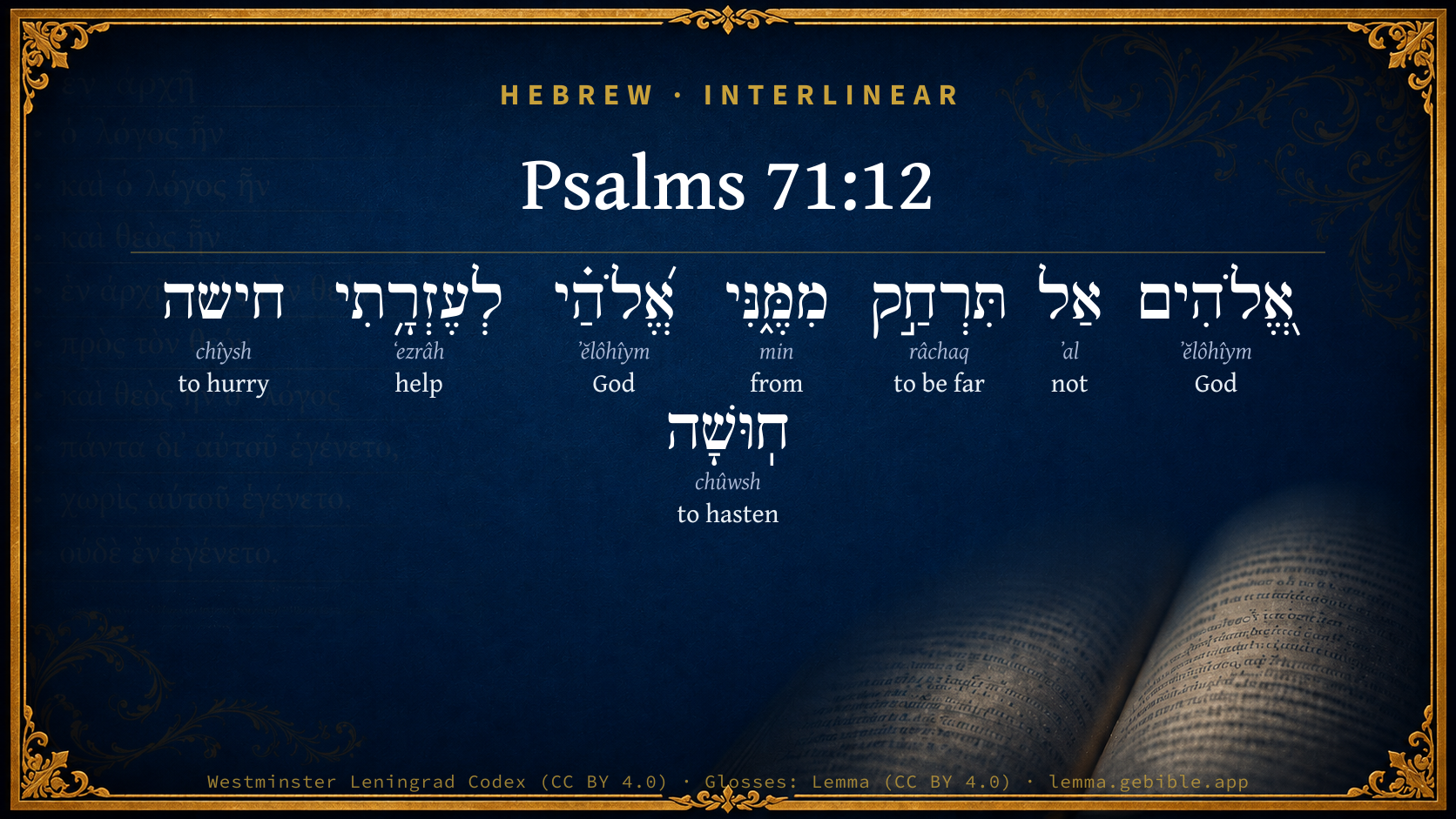
Psalms 71:12

Hebrew (Westminster Leningrad Codex) Psalms 71:12 appears in the Hebrew Old Testament. The text above is from the Westminster Leningrad Codex. Each word links to its Strong’s number, a concise gloss, and parsing drawn from the Open Scriptures Hebrew Bible morphology. Click any word for its full Brown-Driver-Briggs (BDB) entry.
Download image
Cite this verse

Psalms 71:12 (World English Bible). Public Domain. Lemma interlinear Bible study tool, https://lemma.gebible.app/v/psalms/71/12.

Show BibTeX & RIS
BibTeX
RIS
English Translation
God, don't be far from me. My God, hurry to help me.
World English Bible · Public Domain
Highlights
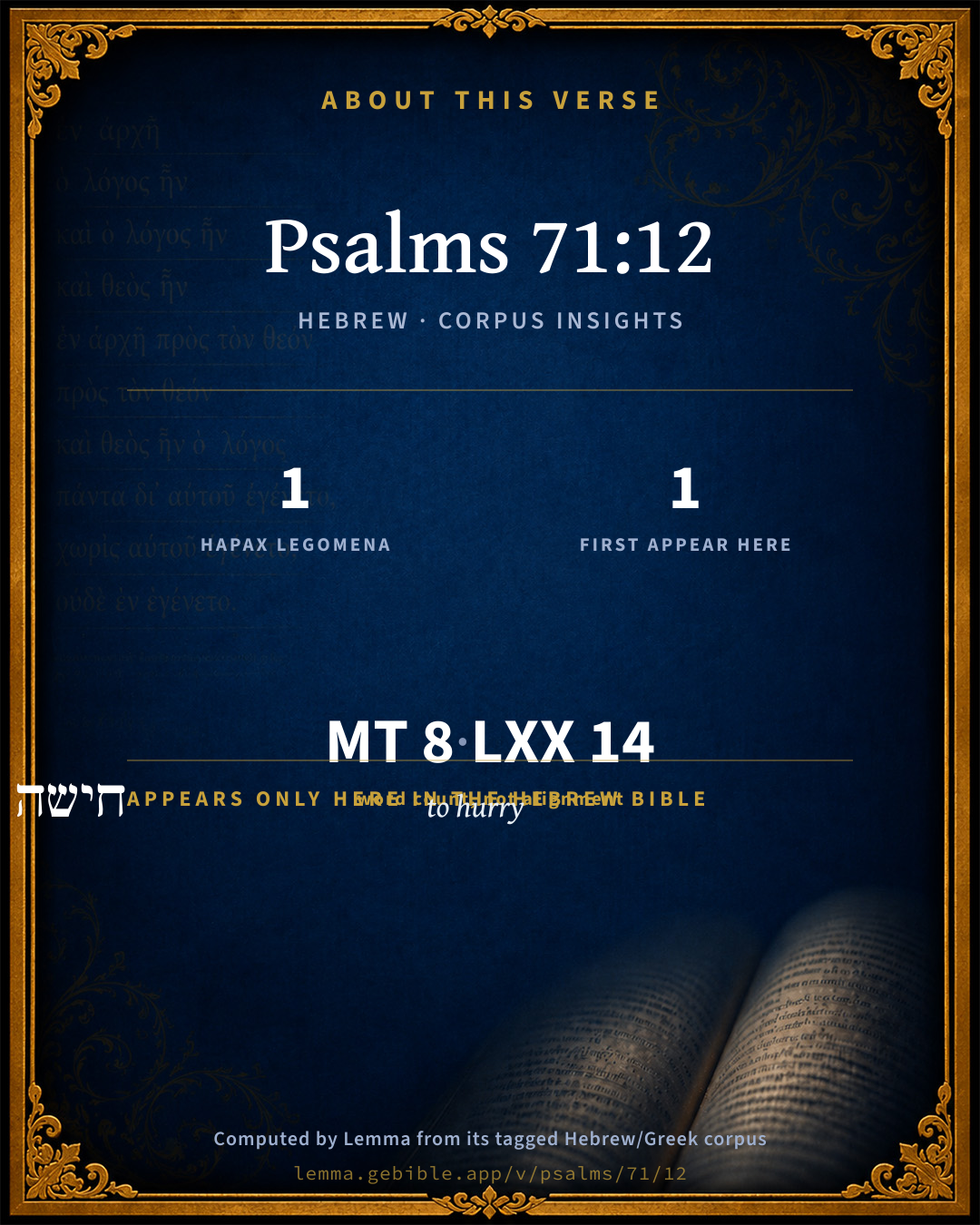
  • 1 hapax legomenon — only here in the Hebrew Bible
  • 1 first appearance in the Hebrew Bible
Full analysis ↓
Download a study sheet

One document with this verse’s original text, its word-by-word gloss line, the meaning frame, cross-references with their text, attributed commentary, and full source and license credits — printable, and it pastes into notes with its structure intact.

This verse Autodidact and up

Study sheet (.html) Plain text (.txt)

A passage Seminary Student

Up to 50 verses in one chapter. A passage sheet keeps up to 6 commentary sources and 12 cross-references per verse, in the order this page ranks them, and says so on the sheet whenever that leaves anything out. Ask for a single verse and you get the Autodidact verse sheet above.

Everything on this page stays free to read, with no account — the sheet is a download of what is already on screen, not access to it.

Want to remove ads? Support Godless Engineer
Compare translations 3

The same verse in 3 English versions, stacked beneath the original-language interlinear above. Click any original word for its lexicon entry.

Each is an independent rendering of the whole verse — the interlinear is not word-aligned to these translations.

Highlighted words mark where these versions differ — a whole-verse word diff, not a word-by-word alignment.

  • World English Bible Public Domain
    God, don't be far from me. My God, hurry to help me.
  • King James Version Public Domain
    O God, be not far from me: O my God, make haste for my help.
  • unfoldingWord Literal Text CC BY-SA 4.0
    God, may you not be far from me; my God, hasten to my help.

unfoldingWord Literal Text — © unfoldingWord, licensed CC BY-SA 4.0. Word-aligned USFM3 via Door43 (git.door43.org/unfoldingWord/en_ult).

Versions to compare (up to 4)

3 of 4 selected

Show all 18 translations

Every available English version of this verse, each an independent rendering of the whole verse.

  • World English Bible Public Domain
    God, don't be far from me. My God, hurry to help me.
  • Berean Standard Bible Public Domain
    Be not far from me, O God. Hurry, O my God, to help me.
  • Majority Standard Bible Public Domain
    Be not far from me, O God. Hurry, O my God, to help me.
  • King James Version Public Domain
    O God, be not far from me: O my God, make haste for my help.
  • American Standard Version (1901) Public Domain
    O God, be not far from me; O my God, make haste to help me.
  • Revised Version (1885) Public Domain
    O God, be not far from me: O my God, make haste to help me.
  • Geneva Bible (1599) Public Domain
    Goe not farre from me, O God: my God, haste thee to helpe me.
  • Douay-Rheims (1899) Public Domain
    O God, be not thou far from me: O my God, make haste to my help.
  • Young's Literal Translation Public Domain
    O God, be not far from me, O my God, for my help make haste.
  • Literal Standard Version CC BY-SA 4.0
    O God, do not be far from me, || O my God, make haste for my help.
  • Unlocked Literal Bible CC BY-SA 4.0
    God, do not be far from me; my God, hurry to help me.
  • unfoldingWord Literal Text CC BY-SA 4.0
    God, may you not be far from me; my God, hasten to my help.
  • Darby Bible Public Domain
    O God, be not far from me; my God, hasten to my help.
  • World Messianic Bible Public Domain
    God, don’t be far from me. My God, hurry to help me.
  • Webster's Bible Public Domain
    O God, be not far from me: O my God, make haste for my help.
  • Free Bible Version CC BY-SA 4.0
    God, please don't stay away from me. My God, hurry to help me!
  • Bible in Basic English Public Domain
    O God, be not far from me; O my God, come quickly to my help.
  • JPS Tanakh (1917) Public Domain
    O God, be not far from me; O my God, make haste to help me.

Literal Standard Version (2020), Covenant Press — licensed CC BY-SA 4.0. Text via the HelloAO Bible API (eBible.org). Unlocked Literal Bible (unfoldingWord) — licensed CC BY-SA 4.0. Text via the HelloAO Bible API (eBible.org). unfoldingWord Literal Text — © unfoldingWord, licensed CC BY-SA 4.0. Word-aligned USFM3 via Door43 (git.door43.org/unfoldingWord/en_ult). Free Bible Version, Dr. Jonathan Gallagher — licensed CC BY-SA 4.0. Text via the HelloAO Bible API (eBible.org).

Word by word

More ways to search: Search by grammar → Find every occurrence → Compare this word →

Practice this passage: Drill this verse → Learn its vocabulary →

About this verse

These counts appear in no published source. They are computed here, from the morphology-tagged text and Lemma’s own curated glosses. What Lemma adds →

8
words
7
distinct lemmas
Wisdom
section

Notable vocabulary

1 hapax legomenon — a word that appears only here in the entire Hebrew Bible:

  • חישה to hurry H2439

First appearance in Scripture

This word makes its first canonical appearance in the Hebrew Bible here:

  • חישה to hurry H2439

Shared distinctive vocabulary

חֽוּשָׁה to hasten H2363 occurs in 20 verses of the Hebrew Bible. Also found in:

Grammatical profile

  • 3 verbs
  • 3 nouns
  • 1 preposition
  • 1 particle

Verb forms

  • תִּרְחַ֣ק Qal · Jussive
  • חישה Qal · Imperative
  • חֽוּשָׁה Qal · Imperative

Repetition

A word recurs within this verse — often emphatic in Hebrew:

  • אֱ֭לֹהִים God H430 ×2

Hebrew & Septuagint length

In English translation the verse runs 12 words from the Hebrew and 15 from the Septuagint (LXX English) — closely comparable.

A rough comparison of the two English renderings, which tokenize alike — not a word-level alignment.

Word counts can differ between the Hebrew and the Greek without any difference in meaning — e.g. the Hebrew direct-object marker אֵת has no separate Greek word, and Greek often adds the article ὁ.

In the original languages it is 8 Hebrew tokens and 14 Greek tokens — but the two are counted differently (Hebrew bundles its prefixes and suffixes into one token; the Greek is in lemma form), so that isn’t a like-for-like length.

Cross-references

10

Topical passages linked to Psalms 71:12 in the Treasury of Scripture Knowledge — connected by theme and wording, ordered by reader-vote popularity; previews shown in the World English Bible.

  • Psalms 35:22 You have seen it, Yahweh. Don't keep silent. Lord, don't be far from me.
  • Psalms 38:21–22 Don't forsake me, Yahweh. My God, don't be far from me.
  • Psalms 22:11 Don't be far from me, for trouble is near. For there is none to help.
  • Psalms 10:1 Why do you stand far off, Yahweh? Why do you hide yourself in times of trouble?
  • Psalms 69:18 Draw near to my soul, and redeem it. Ransom me because of my enemies.
  • Psalms 70:5 But I am poor and needy. Come to me quickly, God. You are my help and my deliverer. Yahweh, don't delay.
  • Psalms 22:19 But don't be far off, Yahweh. You are my help: hurry to help me.
  • Psalms 40:13 Be pleased, Yahweh, to deliver me. Hurry to help me, Yahweh.
  • Psalms 70:1–2 Hurry, God, to deliver me. Come quickly to help me, Yahweh.
  • Psalms 143:7 Hurry to answer me, Yahweh. My spirit fails. Don't hide your face from me, So that I don't become like those who go down into the pit.

Cross-references courtesy of OpenBible.info (CC BY 4.0).

Hebrew and Greek witnesses Masoretic Hebrew ↔ Greek Septuagint

The same verse in the two great witnesses to the Old Testament, shown verse-for-verse.

You’re reading Greek Psalm 70 (Hebrew Psalm 71). The Septuagint counts the superscription, so verse numbers can differ from the Hebrew — chapter-level alignment, not verse-by-verse. Numbering follows Rahlfs.

These are two independent witnesses, not word-aligned to each other, and the Septuagint is shown in lemma (dictionary) form.

Hebrew Psalms 71:12 Masoretic · Westminster Leningrad Codex

אֱ֭לֹהִים אַל תִּרְחַ֣ק מִמֶּ֑נִּי אֱ֝לֹהַ֗י לְעֶזְרָ֥תִי חישה חֽוּשָׁה

God, don't be far from me. My God, hurry to help me.

World English Bible · Public Domain

Greek LXX Greek Psalm 70:12 Septuagint · lemma form

ὁ θεός μή μακρύνω ἀπό ἐγώ ὁ θεός ἐγώ εἰς ὁ βοήθεια ἐγώ προςἔχω

O God, go not far from me, O my God, draw near to my help.

LXX2012 (modern English Septuagint) · Public Domain

On this verse, The Cambridge Bible for Schools and Colleges discusses the Septuagint’s reading. Read the note in Commentary ↓

Hebrew: Westminster Leningrad Codex (CC BY 4.0). Greek: Septuagint (public domain); English from LXX2012 (modern English Septuagint) (Public Domain). How the Septuagint differs from the Hebrew →

Commentary

Notes on Psalms 71:12 from classic Christian and Jewish commentators (each source and its license shown beneath its notes). The classic Christian expositions comment on the surrounding passage and are grouped to its opening verse, so a note may address several verses; the Jewish commentaries on the Tanakh (Rashi and others) are per-verse, so they appear only where the commentator wrote on this verse.

Lemma curates 59 commentaries, every one of them public domain or Creative Commons licensed, each selected and text-cleaned for this edition rather than reprinted as found. About our sources →

Trapp's Complete Commentary

John Trapp

Psa 71:12 O God, be not far from me: O my God, make haste for my help.

Ver. 12. O God, be not far from me] The insolence of his enemies sets an edge upon his prayers Oratio sine malis est avis sine alis. Our Saviour in his agony prayed the more earnestly, Luk 22:44.

John Trapp, A Commentary or Exposition upon All the Books of the Old and New Testament (1647–1656) — public domain. Text from a community e-Sword module.

The Biblical Illustrator

Joseph S. Exell

Psa_71:12

O God, be not far from me.

God always near

A busy woman entered her room hastily as twilight shades were falling--went directly to her desk, turned on the gas, and began to write. Page after page she wrote. The solitude became oppressive: She wheeled her chair around, and with a shock of joyful surprise looked squarely into the face of her dearest friend, lying on the lounge at her side. Why, I didnt know you were here! she cried. Why didnt you speak to me? Because you were so busy. You didnt speak to me. So with Jesus--here all the time. The room is full of Him, always ready to greet us with a smile--but we are so busy. But when the solitude grows oppressive we suddenly turn, and lo, He is at our side. We speak to Him and He speaks to us, and the souls deepest yearnings are satisfied. (Christian Age.)

The Biblical Illustrator, edited by Joseph S. Exell (c. 1880s–1900s) — public domain. Text from a community e-Sword module.

J. A. Alexander on Psalms

Joseph Addison Alexander

Psa 71:12. 0 God, be not far from me; 0 my God, to (or for) my help hasten. Compare the similar expressions of Psa 22:19; Psa 35:22; Psa 38:21-22; Psa 40:13; Psa 70:1. The stronger expression my God, in the second clause, urges his covenant relation to God, as a reason for expecting to be heard.

Joseph Addison Alexander, The Psalms Translated and Explained (1850) — public domain. Text from a community e-Sword module.

Geneva Bible (1599)

Geneva Bible translators

In calling him his God, he putteth back the false reports of the adversaries, that said, God had forsaken him.

Geneva Bible (1599) marginal notes — public domain. Text via Bolls.life.

John Calvin's Commentaries

12. O God! be not far from me. It is scarcely possible to express how severe and hard a temptation it was to David, when he knew that the wicked entertained the persuasion that he was rejected of God. They did not without consideration circulate this report; but after having seemed wisely to weigh all circumstances, they gave their judgment on the point as of a thing which was placed beyond all dispute. It was therefore an evidence of heroic fortitude on the part of David, thus to rise superior to their perverse judgments, and, in the face of them all, to assure himself that God would be gracious to him, and to betake himself familiarly to him. Nor is it to be doubted that, in calling God his God, he makes use of this as a means of defending himself from this hard and grievous assault.

John Calvin's Commentaries (1540-1563) — public domain. Text from the Calvin Translation Society English edition (1840s-50s) via the Christian Classics Ethereal Library (ccel.org). Calvin's coverage is partial (roughly two-thirds of the Bible); uncommented books and verses are honest gaps, never fabricated. The 19th-century editor's footnotes and remarks are omitted so the notes are faithfully Calvin's own voice.

Ellicott's Commentary for English Readers

(12, 13) These verses recall Psa_22:11; Psa_35:4; Psa_35:26; Psa_38:21-22; Psa_40:13-14.

A Bible Commentary for English Readers, edited by Charles John Ellicott (1878–1897) — public domain. Text from a community e-Sword module.

The Cambridge Bible for Schools and Colleges

gen. ed. J. J. S. Perowne

12, 13. Reminiscences of Psa_35:22 b; Psa_40:13 b, 14 (Psa_70:1 b, 2): cp. Psa_22:11 a; Psa_38:21-22; Psa_35:4; Psa_35:26; Psa_109:29.

make haste for my help] R.V. make haste to help me.

let them be confounded] R.V. as in Psa_71:1, let them be ashamed.

consumed] Some editors would read dishonoured as in Psa_40:14, with some MSS. and the Syr. The Hebrew words differ in one letter only. But the LXX and Jer. support the M.T., for which cp. Psa_37:20.

The Cambridge Bible for Schools and Colleges (gen. ed. J. J. S. Perowne; Cambridge University Press, 1878–1918) — public domain. Text from a community e-Sword module.

John Gill's Exposition

O God, be not far from me,.... God is everywhere, at hand and afar off, with regard to his being, power, and providence; his glorious presence is in heaven, his gracious presence is with his people; but, when he hides his face, he seems to be at a distance; and this they cannot bear, and therefore deprecate it; see Psa 10:1;

O my God, make haste for my help; he knew that his help was in God, and that there was none for him elsewhere; and that he could help him when none else could, and was a present help in time of trouble; and it being such a time with him, and his case desperate, he desires the Lord that he would make haste; and he addresses him as his own God, the consideration of which encouraged his faith and hope in him, and carried in it an argument to help him; see Psa 119:94.

John Gill's Exposition of the Whole Bible (1746–1763) — public domain (CC PDM 1.0). Text via the HelloAO Bible API.

Albert Barnes' Notes on the Bible

O God, be not far from me - See the notes at Psa 22:11.

O my God, make haste for my help - See the notes at Psa 40:13.

Albert Barnes' Notes on the Bible (1834–1885) — public domain. Text from a community e-Sword/MySword module.

The Treasury of David

Charles H. Spurgeon

Ver. 12. O God, be not far from me. Nearness to God is our conscious security. A child in the dark is comforted by grasping its father's hand.

O my God, make haste for my help. To call God ours, as having entered into covenant with us, is a mighty plea in prayer, and a great stay to our faith. The cry of "make haste" has occurred many times in this portion of the Psalms, and it was evoked by the sore pressure of affliction. Sharp sorrows soon put an end to procrastinating prayers.

None.

Charles H. Spurgeon's The Treasury of David (1869–1885) — public domain. Psalms only. Text from a community e-Sword/MySword module.

Whedon's Commentary on the Bible

Daniel D. Whedon

12. Make haste for my help—David’s familiar cry in his deepest distresses, which identifies the occasion with Psa_70:1. See Psa_22:19

Daniel D. Whedon (gen. ed.), Commentary on the Old and New Testaments (1874–1909) — public domain. Text from a community e-Sword module.

The Pulpit Commentary

O God, be not far from me: O my God, make haste for my help. (comp. Psa_22:19 Psa_35:22)

The Pulpit Commentary (1880–1919), ed. H.D.M. Spence-Jones & Joseph S. Exell — public domain. Text from a community e-Sword module.

unfoldingWord translationNotes

Door43 World Missions Community

do not be far from me

Because Yahweh has not yet answered the writer's request, he speaks of Yahweh as if Yahweh were standing far away from the writer. (See: Metaphor)

hurry to help me

"help me soon"

Let them be put to shame and destroyed, those who are hostile to my life

"Let those who are hostile to my life be put to shame and destroyed"

Let them be put to shame and destroyed

This can be stated in active form. AT: "Put them to shame and destroy them" (See: Active or Passive)

those who are hostile to my life

The words "my life" represent the person. The idiom "hostile to my life" means that these are people who try to harm him by accusing him of wrongdoing. AT: "those who accuse me of doing wrong" (See: Synecdoche and Idiom)

let them be covered with rebuke and dishonor, those who seek my hurt

"let those who seek my hurt be covered with rebuke and dishonor"

let them be covered with rebuke and dishonor

This can be stated in active form. The abstract nouns "rebuke" and "dishonor" can be stated as verbs. AT: "may everyone rebuke them, and may no one honor them" (See: Active or Passive and Abstract Nouns)

those who seek my hurt

The noun "hurt" can be translated with a verb. AT: "those who are looking for ways to harm me" (See: Abstract Nouns)

translationWords

shame

consume

rebuke

dishonor

seek

wrong

unfoldingWord translationNotes — © Distant Shores Media and the Door43 World Missions Community, licensed CC BY-SA 4.0. Source: git.door43.org/Door43/en_tn.

Lesson kit

Teaching starters — assembled from the data on this page, not authored interpretation. Every prompt links to the verse data it draws on. Edit before teaching.

Psalms, in the Wisdom, opens this verse with 8 words (7 distinct Hebrew lemmas). Its most distinctive word is chîysh (“to hurry”). A historical commentator’s framing appears above. Read the whole chapter for the surrounding context.

Discussion questions

  1. How does “to hurry” (chîysh) shape what this verse is saying?
  2. 1 word here appears nowhere else in the Hebrew Bible. Why might the author reach for such rare wording?
  3. This is the first place “to hurry” appears in Scripture (first appears here). What does its debut here establish?
  4. How does Numbers 32:17, which shares the word «to hasten», read alongside this verse?
  5. What does the repetition of “God” (2× in this one verse) do in this verse?
  6. These translations render this verse differently. What is at stake in choosing one wording over another?
  7. «תִּרְחַ֣ק» is a Qal Jussive verb. How does that grammatical form shape the action described?
  8. Compare how Trapp's Complete Commentary and The Biblical Illustrator read this verse. Where do they agree or differ?

Things to notice

  • 1 word in this verse appears nowhere else in the Hebrew Bible.
  • 1 word makes its first canonical appearance in Scripture here.
  • This verse counts 8 Hebrew ↔ 14 Greek words.
  • These translations choose different wording for 8 words in this verse.
  • “God” occurs 2× in this single verse.

Reading settings

Reading text

Shown beneath each verse's original-language words.

Old Testament
Old Testament edition

Read the OT as the Masoretic Hebrew (MT) or the Greek Septuagint (LXX).

English shown for the Greek Septuagint (in the Hebrew ↔ Greek comparison).

Comparing translations? Open the Compare panel on any verse page to stack up to four side by side.