
Job 11:14

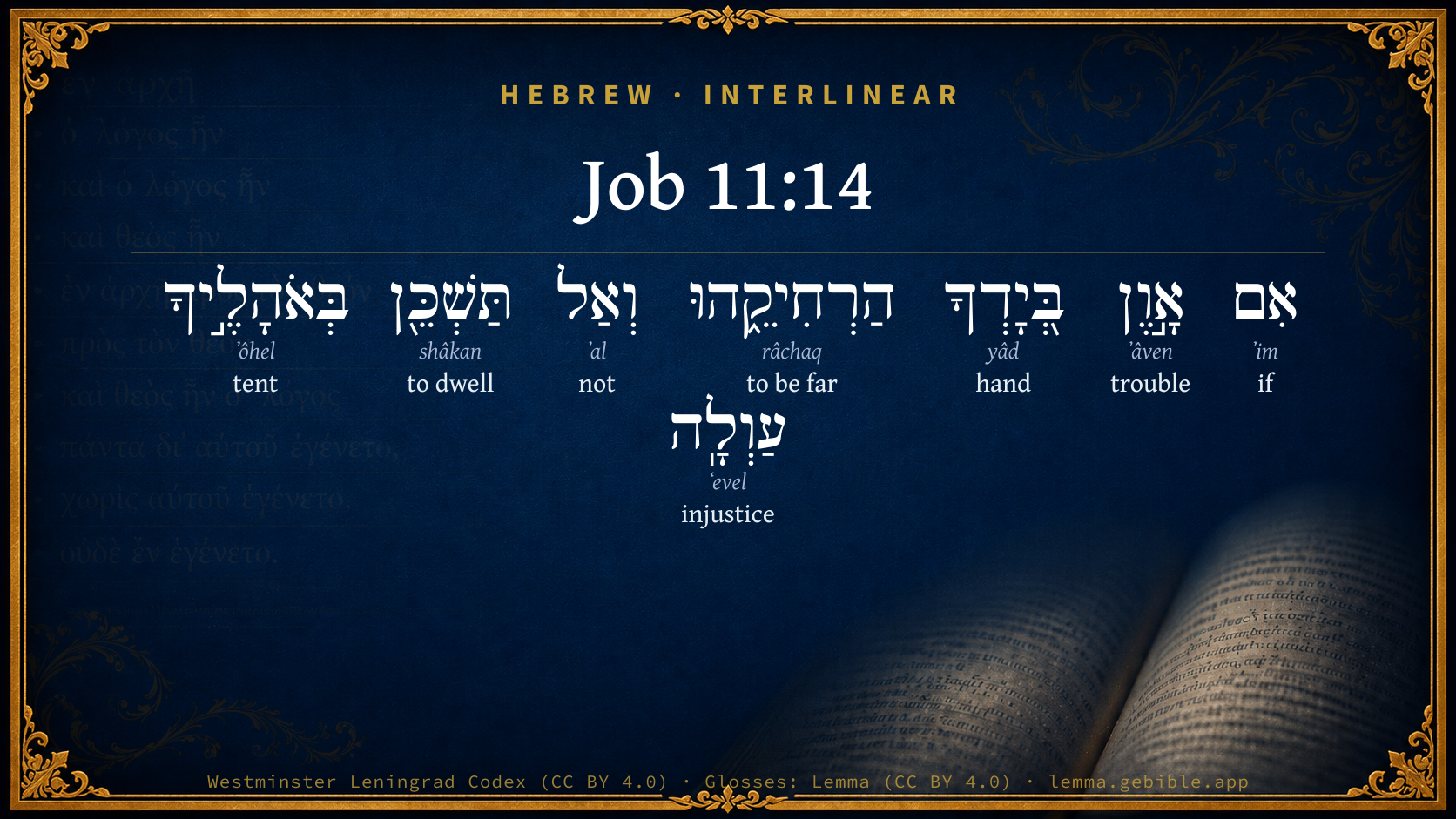
Hebrew (Westminster Leningrad Codex) Job 11:14 appears in the Hebrew Old Testament. The text above is from the Westminster Leningrad Codex. Each word links to its Strong’s number, a concise gloss, and parsing drawn from the Open Scriptures Hebrew Bible morphology. Click any word for its full Brown-Driver-Briggs (BDB) entry.
Download image
Cite this verse

Job 11:14 (World English Bible). Public Domain. Lemma interlinear Bible study tool, https://lemma.gebible.app/v/job/11/14.

Show BibTeX & RIS
BibTeX
RIS
English Translation
If iniquity is in your hand, put it far away, Don't let unrighteousness dwell in your tents.
World English Bible · Public Domain
Download a study sheet

One document with this verse’s original text, its word-by-word gloss line, the meaning frame, cross-references with their text, attributed commentary, and full source and license credits — printable, and it pastes into notes with its structure intact.

This verse Autodidact and up

Study sheet (.html) Plain text (.txt)

A passage Seminary Student

Up to 50 verses in one chapter. A passage sheet keeps up to 6 commentary sources and 12 cross-references per verse, in the order this page ranks them, and says so on the sheet whenever that leaves anything out. Ask for a single verse and you get the Autodidact verse sheet above.

Everything on this page stays free to read, with no account — the sheet is a download of what is already on screen, not access to it.

Want to remove ads? Support Godless Engineer
Compare translations 3

The same verse in 3 English versions, stacked beneath the original-language interlinear above. Click any original word for its lexicon entry.

Each is an independent rendering of the whole verse — the interlinear is not word-aligned to these translations.

Highlighted words mark where these versions differ — a whole-verse word diff, not a word-by-word alignment.

  • World English Bible Public Domain
    If iniquity is in your hand, put it far away, Don't let unrighteousness dwell in your tents.
  • King James Version Public Domain
    If iniquity be in thine hand, put it far away, and let not wickedness dwell in thy tabernacles.
  • unfoldingWord Literal Text CC BY-SA 4.0
    if iniquity in your hand, put it far away, and do not let unrighteousness dwell in your tents;

unfoldingWord Literal Text — © unfoldingWord, licensed CC BY-SA 4.0. Word-aligned USFM3 via Door43 (git.door43.org/unfoldingWord/en_ult).

Versions to compare (up to 4)

3 of 4 selected

Show all 18 translations

Every available English version of this verse, each an independent rendering of the whole verse.

  • World English Bible Public Domain
    If iniquity is in your hand, put it far away, Don't let unrighteousness dwell in your tents.
  • Berean Standard Bible Public Domain
    if you put away the iniquity in your hand, and allow no injustice to dwell in your tents,
  • Majority Standard Bible Public Domain
    if you put away the iniquity in your hand, and allow no injustice to dwell in your tents,
  • King James Version Public Domain
    If iniquity be in thine hand, put it far away, and let not wickedness dwell in thy tabernacles.
  • American Standard Version (1901) Public Domain
    If iniquity be in thy hand, put it far away, And let not unrighteousness dwell in thy tents.
  • Revised Version (1885) Public Domain
    If iniquity be in thine hand, put it far away, and let not unrighteousness dwell in thy tents;
  • Geneva Bible (1599) Public Domain
    If iniquitie be in thine hand, put it farre away, and let no wickednesse dwell in thy Tabernacle.
  • Douay-Rheims (1899) Public Domain
    If thou wilt put away from thee the iniquity that is in thy hand, and lot not injustice remain in thy tabernacle:
  • Young's Literal Translation Public Domain
    If iniquity `is' in thy hand, put it far off, And let not perverseness dwell in thy tents.
  • Literal Standard Version CC BY-SA 4.0
    If iniquity [is] in your hand, put it far off, || And do not let perverseness dwell in your tents.
  • Unlocked Literal Bible CC BY-SA 4.0
    suppose that iniquity were in your hand, but that then you put it far away from you, and did not let unrighteousness live in your tents.
  • unfoldingWord Literal Text CC BY-SA 4.0
    if iniquity in your hand, put it far away, and do not let unrighteousness dwell in your tents;
  • Darby Bible Public Domain
    If thou put far away the iniquity which is in thy hand, and let not wrong dwell in thy tents;
  • World Messianic Bible Public Domain
    If iniquity is in your hand, put it far away. Don’t let unrighteousness dwell in your tents.
  • Webster's Bible Public Domain
    If iniquity is in thy hand, put it far away, and let not wickedness dwell in thy tabernacles.
  • Free Bible Version CC BY-SA 4.0
    if you get rid of your sins and don't let wickedness continue in your life,
  • Bible in Basic English Public Domain
    If you put far away the evil of your hands, and let no wrongdoing have a place in your tent;
  • JPS Tanakh (1917) Public Domain
    If iniquity be in thy hand, put it far away, and let not unrighteousness dwell in thy tents —

Literal Standard Version (2020), Covenant Press — licensed CC BY-SA 4.0. Text via the HelloAO Bible API (eBible.org). Unlocked Literal Bible (unfoldingWord) — licensed CC BY-SA 4.0. Text via the HelloAO Bible API (eBible.org). unfoldingWord Literal Text — © unfoldingWord, licensed CC BY-SA 4.0. Word-aligned USFM3 via Door43 (git.door43.org/unfoldingWord/en_ult). Free Bible Version, Dr. Jonathan Gallagher — licensed CC BY-SA 4.0. Text via the HelloAO Bible API (eBible.org).

Word by word

More ways to search: Search by grammar → Find every occurrence → Compare this word →

Practice this passage: Drill this verse → Learn its vocabulary →

About this verse

These counts appear in no published source. They are computed here, from the morphology-tagged text and Lemma’s own curated glosses. What Lemma adds →

8
words
8
distinct lemmas
Wisdom
section

Shared distinctive vocabulary

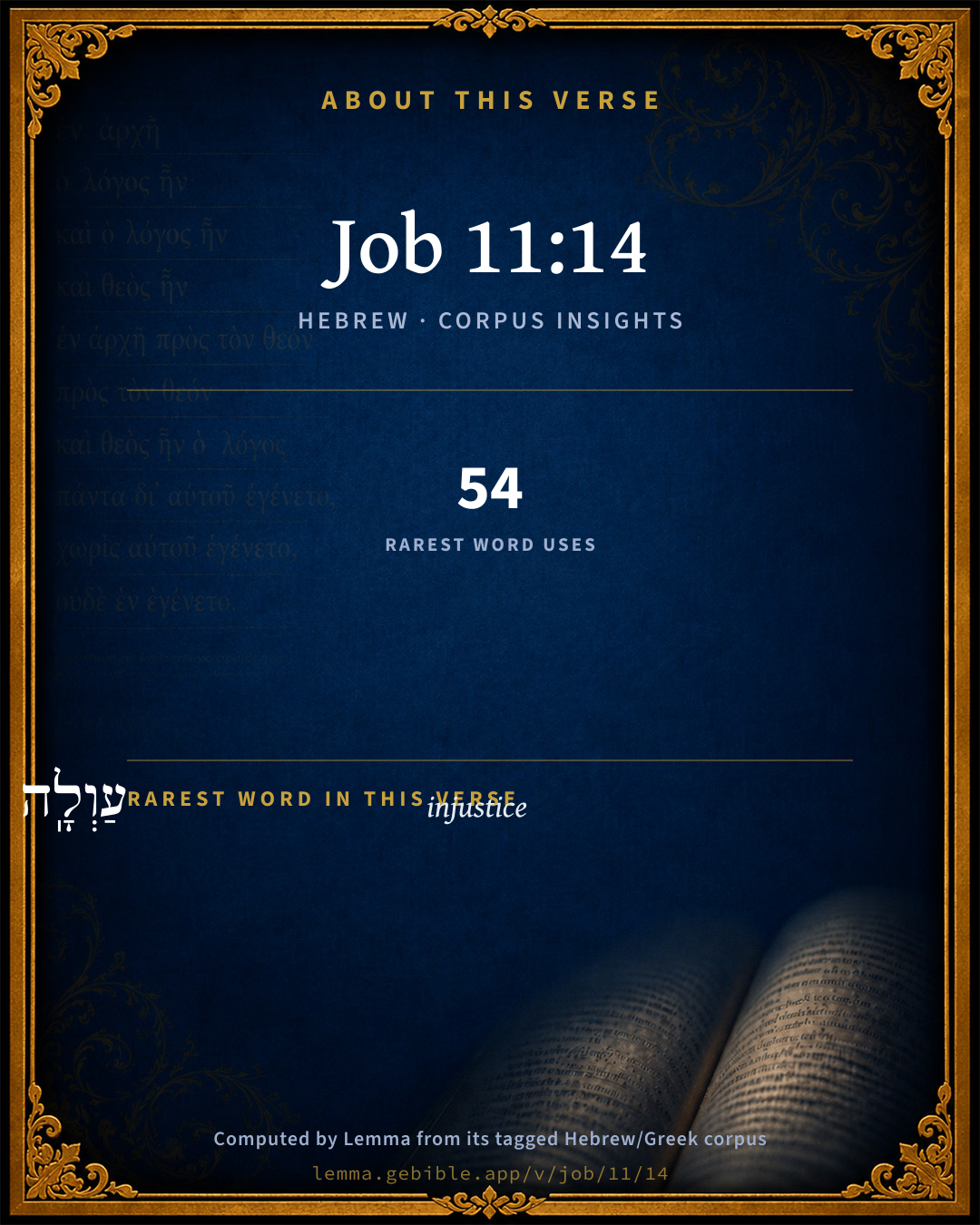
עַוְלָֽה injustice H5766 occurs in 51 verses of the Hebrew Bible. Also found in:

Grammatical profile

  • 2 verbs
  • 4 nouns
  • 1 conjunction
  • 1 particle

Verb forms

  • הַרְחִיקֵ֑הוּ Hiphil · Imperative
  • תַּשְׁכֵּ֖ן Hiphil · Jussive

Hebrew & Septuagint length

In English translation the verse runs 17 words from the Hebrew and 21 from the Septuagint (LXX English) — closely comparable.

A rough comparison of the two English renderings, which tokenize alike — not a word-level alignment.

Word counts can differ between the Hebrew and the Greek without any difference in meaning — e.g. the Hebrew direct-object marker אֵת has no separate Greek word, and Greek often adds the article ὁ.

Cross-references

9

Topical passages linked to Job 11:14 in the Treasury of Scripture Knowledge — connected by theme and wording, ordered by reader-vote popularity; previews shown in the World English Bible.

  • Job 22:23 If you return to the Almighty, you shall be built up, If you put away unrighteousness far from your tents.
  • Job 4:7 "Remember, now, whoever perished, being innocent? Or where were the upright cut off?
  • James 4:8 Draw near to God, and he will draw near to you. Cleanse your hands, you sinners; and purify your hearts, you double-minded.
  • Job 22:5 Isn't your wickedness great? Neither is there any end to your iniquities.
  • Job 34:32 Teach me that which I don't see. If I have done iniquity, I will do it no more'?
  • Psalms 101:2 I will be careful to live a blameless life. When will you come to me? I will walk within my house with a blameless heart.
  • Isaiah 1:15 When you spread forth your hands, I will hide my eyes from you; Yes, when you make many prayers, I will not hear. Your hands are full of blood.
  • Ezekiel 18:30–31 Therefore I will judge you, house of Israel, everyone according to his ways, says the Lord Yahweh. Return you, and turn yourselves from all your transgressions; so iniquity shall not be your ruin.
  • Zechariah 5:3–4 Then he said to me, "This is the curse that goes out over the surface of the whole land; for everyone who steals shall be cut off according to it on the one side; and everyone who swears falsely shall be cut off according to it on the other side.

Cross-references courtesy of OpenBible.info (CC BY 4.0).

Hebrew and Greek witnesses Masoretic Hebrew ↔ Greek Septuagint

The same verse in the two great witnesses to the Old Testament, shown verse-for-verse.

These are two independent witnesses, not word-aligned to each other, and the Septuagint is shown in lemma (dictionary) form.

Hebrew Job 11:14 Masoretic · Westminster Leningrad Codex

אִם אָ֣וֶן בְּ֭יָדְךָ הַרְחִיקֵ֑הוּ וְאַל תַּשְׁכֵּ֖ן בְּאֹהָלֶ֣יךָ עַוְלָֽה

If iniquity is in your hand, put it far away, Don't let unrighteousness dwell in your tents.

World English Bible · Public Domain

Greek LXX Job 11:14 Septuagint · lemma form

εἰ ἄνομος τις εἰμί ἐν χείρ σύ πόρρω ποιέω αὐτός ἀπό σύ ἀδικία δέ ἐν δίαιτα σύ μή αὐλίζω

if there is any iniquity in your hands, put it far from you, and let not unrighteousness lodge in your habitation.

LXX2012 (modern English Septuagint) · Public Domain

Hebrew: Westminster Leningrad Codex (CC BY 4.0). Greek: Septuagint (public domain); English from LXX2012 (modern English Septuagint) (Public Domain). How the Septuagint differs from the Hebrew →

Commentary

Notes on Job 11:14 from classic Christian and Jewish commentators (each source and its license shown beneath its notes). The classic Christian expositions comment on the surrounding passage and are grouped to its opening verse, so a note may address several verses; the Jewish commentaries on the Tanakh (Rashi and others) are per-verse, so they appear only where the commentator wrote on this verse.

Lemma curates 59 commentaries, every one of them public domain or Creative Commons licensed, each selected and text-cleaned for this edition rather than reprinted as found. About our sources →

Trapp's Complete Commentary

John Trapp

Job 11:14 If iniquity [be] in thine hand, put it far away, and let not wickedness dwell in thy tabernacles.

Ver. 14. If iniquity be in thine hand, put it far away] Cast away all thy transgressions, and throw thy lusts out of service, hands lifted up in prayer must be pure, 1Ti 2:8, for the fountain of goodness will not be laden at with foul hands, Isa 1:15-16. Good therefore is the counsel of Jeremiah, Jer 4:14, and of St James, Jas 4:8. The priests had their laver to wash in before they sacrificed, and their brazen altar to offer on before they burnt incense. He that comes to pray, having not first purged himself of all filthiness of flesh and spirit, doth (say the Jewish doctors) as he that cometh to offer a clean beast, but holds an unclean one in his hand. By iniquity in the hand here Beza and others understand wrong dealing, either by fraud or force, by strength or sleight of hand; and their Zophar presseth Job to restitution: Away with it, saith he, send it home to the right owner; else you will cough in hell, and the devils will laugh at you, saith Latimer.

And let not wickedness dwell in thy tabernacles] i.e. In thy family, and wherever else thou hast to do. I and my house will serve the Lord, saith Joshua; I and my maids, saith Esther, Jos 24:15 Est 4:16. David’s care for the reforming and well ordering of his household, and of his whole kingdom. Psa 101:1-8 Such a man is really as he is relatively. Those governors of families and countries show themselves perfect strangers to the practice of repentance, who make no other use of their servants and subjects than they do of their beasts; while they may have their bodies to do their service, they care not if their souls serve the devil. This will lay heavy one day.

John Trapp, A Commentary or Exposition upon All the Books of the Old and New Testament (1647–1656) — public domain. Text from a community e-Sword module.

Joseph Benson's Commentary

Job 11:14. If iniquity be in thy hand — If thou hast in thy hand, or possession, any goods gotten by injustice or oppression, as it seems they supposed he had; or, he means, more generally, if thou allowest thyself in any sinful practices, the hand being put for action, whereof it is the instrument; put it far away — Keep thyself at a great distance, not only from such actions, but also from the very occasions and appearances of them. Let not wickedness dwell in thy tabernacles — That is, in thy habitation, either in thyself or in thy family; whose sins Job was obliged, as far as he could, to prevent or reform, as it seems he had done, Job 1:5. He saith, tabernacles, because anciently the habitations of great men consisted of several tents or tabernacles.

Joseph Benson's Commentary on the Old and New Testaments (1811–1818) — public domain. Text from a community e-Sword module.

Geneva Bible (1599)

Geneva Bible translators

Renounce thine own evil works, and see that they offend not God, over whom thou hast charge.

Geneva Bible (1599) marginal notes — public domain. Text via Bolls.life.

Jamieson, Fausset & Brown

Robert Jamieson, A. R. Fausset & David Brown

Rather, "if thou wilt put far away the iniquity in thine hand" (as Zaccheus did, Luk 19:8). The apodosis or conclusion is at Job 11:15, "then shalt thou," &c.

Jamieson, Fausset & Brown — Commentary Critical and Explanatory on the Whole Bible (1871) — public domain (CC PDM 1.0). Text via the HelloAO Bible API.

The Cambridge Bible for Schools and Colleges

gen. ed. J. J. S. Perowne

14. The reformation which Zophar impresses on Job has several steps: first, the preparation of his heart; then, prayer unto God; then, the putting away of his personal sins; and finally, those of his home. These are enumerated, one after another, but nothing lies in the order of enumeration.

The Cambridge Bible for Schools and Colleges (gen. ed. J. J. S. Perowne; Cambridge University Press, 1878–1918) — public domain. Text from a community e-Sword module.

John Gill's Exposition

If iniquity be in thine hand,.... For, as the heart must be prepared for the stretching out of the hand in prayer to God, so it is not any hand that is to be stretched out or lifted up unto God; not hands full of blood, or defiled with sin, but holy hands; see Isa 1:15, Ti1 2:8; it is not said, if iniquity be in thine heart, or on thy conscience,

put it far away; for sin cannot be put away out of the heart, it will have a place there as long as we live; though it should not be regarded, cherished, and nourished there; if so, God will not hear prayer, Psa 66:18; and nothing can put away or remove afar off guilt from the conscience but the blood of Jesus; which, being sprinkled, purifies the heart and purges the conscience from dead works; but it is said, if it is in thine hand, which is the instrument of action, and may signify the commission of sin, and a series and course of sinning, which Job's friends suspected he was privately guilty of; and therefore advise him to leave off such a sinful course, and abstain from all appearance of evil, and live a holy and godly conversation:

and let not wickedness dwell in thy tabernacles; in any room or apartment of his house; some restrain this, and iniquity in the former clause, to ill gotten goods, obtained by rapine and oppression, which he is advised to restore to those that had been injured by him; but there is no need to limit it to any sin: besides, wickedness may be put for wicked men, and the sense be, that, as he should not indulge to any iniquity himself, so neither should he suffer wicked men to dwell in his house, but make a general reformation in himself and in his family.

John Gill's Exposition of the Whole Bible (1746–1763) — public domain (CC PDM 1.0). Text via the HelloAO Bible API.

Albert Barnes' Notes on the Bible

If iniquity be in thine hand - If you have in your possession anything that has been unjustly obtained. If you have oppressed the poor and the fatherless, and have what properly belongs to them, let it be restored. This is the obvious duty of one who comes to God to implore his favor; compare Luk 19:8.

Albert Barnes' Notes on the Bible (1834–1885) — public domain. Text from a community e-Sword/MySword module.

Haydock's Catholic Bible Commentary

Iniquity. Of this Job was not conscious, and therefore could not confess it. (Worthington)

George Leo Haydock (1774–1849), Haydock's Catholic Family Bible and Commentary, 1859 edition — public domain. Excludes Psalms (Douay-Rheims chapter numbering differs from Protestant) and Deuterocanonical books (Catholic canon only).

Matthew Poole's English Annotations

Either,

1. If thou hast in thine hand or possession any good, got by injury or oppression, as it seems they supposed that he had. Or,

2. More generally, If thou allowest thyself in any sinful practices. The hand is put for action, whereof it is the instrument.

Put it far away; keep thyself at a great distance, not only from such actions, but also from the very occasions and appearances of them.

Let not wickedness dwell, let it not have a quiet and settled abode, or allowance, in thy habitation, i.e. either in thyself, or in thy family; whose sins Job was obliged as far as he could to prevent or reform; as he had done, Job 1:5. He saith

tabernacles, because anciently the habitations of great men consisted of several tents or tabernacles, as we see, Gen 24:67; 31:33.

Matthew Poole's English Annotations on the Holy Bible (1683–1685) — public domain. Text from a community e-Sword/MySword module.

Whedon's Commentary on the Bible

Daniel D. Whedon

14. Tabernacles — The word tent, in course of time, was used for dwellings of any kind. It is quite certain that Job dwelt in the country. See Job_29:7.

Daniel D. Whedon (gen. ed.), Commentary on the Old and New Testaments (1874–1909) — public domain. Text from a community e-Sword module.

The Pulpit Commentary

If iniquity be in thine hand. Zophar assumes this to be probable, nay, almost certain. He has already told Job that God has exacted from him less than his iniquity (wa, the same word) deserves (ver. 6). Conformably with this view, he now suggests that it would not do for Job to stretch out to God in prayer a hand full of iniquity, and that therefore, previously to making his supplication, he would do well to lay his iniquity aside. In a general way, the advice is excellent; but it was insulting to Job, who denied that he had any definite act of sin on his conscience. Put it far away; i.e. repent of it, confess it to God; if the case admits of it, make reparation or restitution. And let not wickedness dwell in thy tabernacles; or, in thy tents. The insinuation seems to be that Job is a robber chief, and that his tent and the tents of his followers are full of ill-gotten spoils, the fruit of his raids upon the defenceless.

The Pulpit Commentary (1880–1919), ed. H.D.M. Spence-Jones & Joseph S. Exell — public domain. Text from a community e-Sword module.

Rashi

Rabbi Shlomo Yitzchaki (Rashi)

Distance iniquity from your hand, and do not allow injustice to dwell in your tents.

Rashi on the Tanakh — English translations: “The Judaica Press complete Tanach with Rashi, translated by A. J. Rosenberg” (CC BY 4.0); “Pentateuch with Rashi's commentary by M. Rosenbaum and A.M. Silbermann, 1929-1934” (public domain); “The Metsudah Tanach series, Lakewood, N.J” (CC BY 4.0); and “The Book of Joshua, Metsudah Publications, 1997” (CC BY 4.0). Text via Sefaria.

Lesson kit

Teaching starters — assembled from the data on this page, not authored interpretation. Every prompt links to the verse data it draws on. Edit before teaching.

Job, in the Wisdom, opens this verse with 8 words (8 distinct Hebrew lemmas). Its most distinctive word is ʻevel (“injustice”). A historical commentator’s framing appears above. Read the whole chapter for the surrounding context.

Discussion questions

  1. The word ʻevel carries the sense “injustice.” How does it shape the verse?
  2. Leviticus 19:15 shares the word «injustice» with this verse. How do the two illuminate each other?
  3. The translations on this page render this verse differently — a whole-verse word diff, not a word-by-word alignment. What might account for the different wordings?
  4. The verb «הַרְחִיקֵ֑הוּ» is Hiphil Imperative. How does its form color the action?
  5. Reading how Trapp's Complete Commentary and Joseph Benson's Commentary read this verse, where do the two commentators agree and where do they part?

Things to notice

Reading settings

Reading text

Shown beneath each verse's original-language words.

Old Testament
Old Testament edition

Read the OT as the Masoretic Hebrew (MT) or the Greek Septuagint (LXX).

English shown for the Greek Septuagint (in the Hebrew ↔ Greek comparison).

Comparing translations? Open the Compare panel on any verse page to stack up to four side by side.