

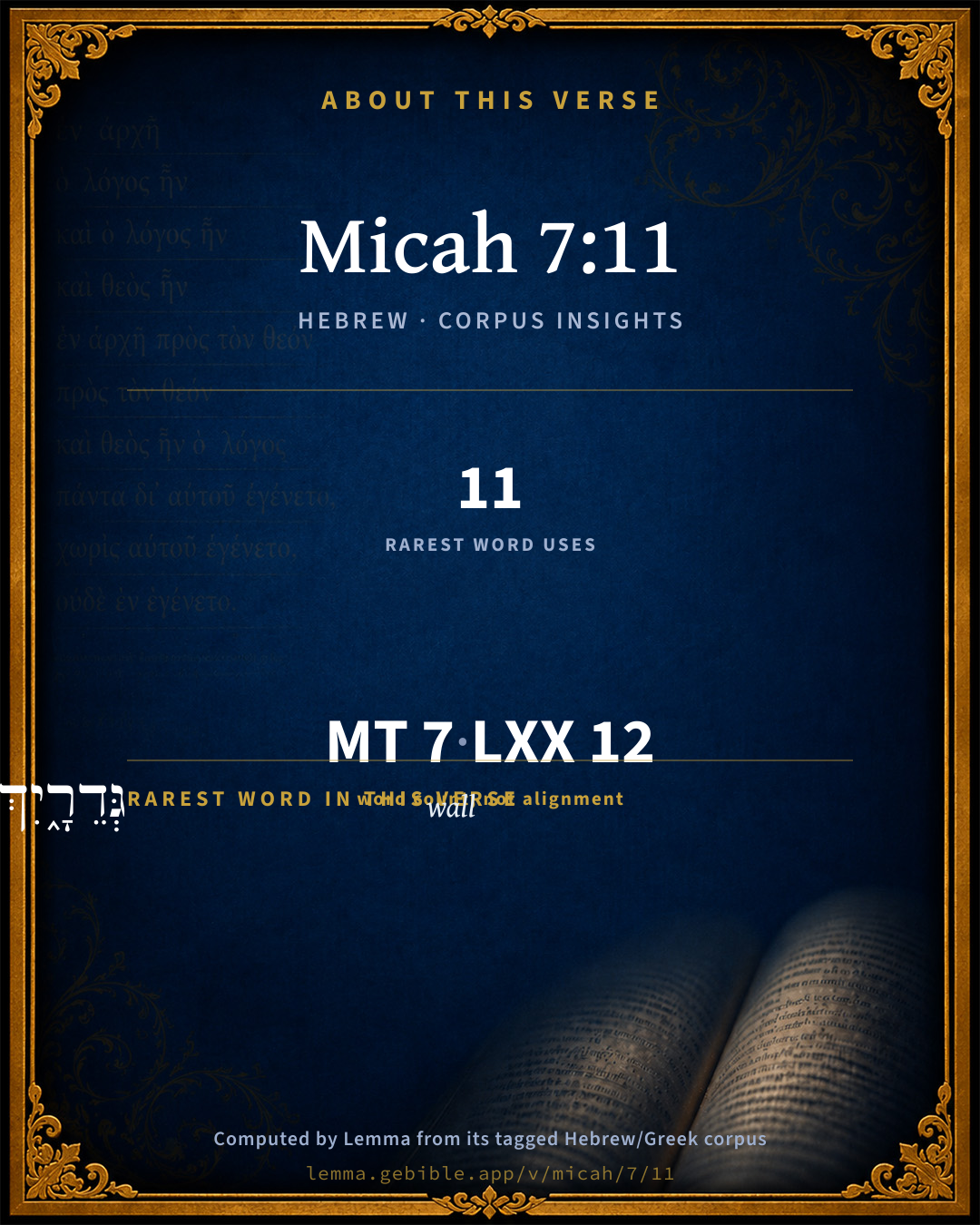
Micah 7:11

Hebrew (Westminster Leningrad Codex) Micah 7:11 appears in the Hebrew Old Testament. The text above is from the Westminster Leningrad Codex. Each word links to its Strong’s number, a concise gloss, and parsing drawn from the Open Scriptures Hebrew Bible morphology. Click any word for its full Brown-Driver-Briggs (BDB) entry.
Download image
Cite this verse

Micah 7:11 (World English Bible). Public Domain. Lemma interlinear Bible study tool, https://lemma.gebible.app/v/micah/7/11.

Show BibTeX & RIS
BibTeX
RIS
English Translation
A day to build your walls-- In that day, he will extend your boundary.
World English Bible · Public Domain
Download a study sheet

One document with this verse’s original text, its word-by-word gloss line, the meaning frame, cross-references with their text, attributed commentary, and full source and license credits — printable, and it pastes into notes with its structure intact.

This verse Autodidact and up

Study sheet (.html) Plain text (.txt)

A passage Seminary Student

Up to 50 verses in one chapter. A passage sheet keeps up to 6 commentary sources and 12 cross-references per verse, in the order this page ranks them, and says so on the sheet whenever that leaves anything out. Ask for a single verse and you get the Autodidact verse sheet above.

Everything on this page stays free to read, with no account — the sheet is a download of what is already on screen, not access to it.

Want to remove ads? Support Godless Engineer
Compare translations 3

The same verse in 3 English versions, stacked beneath the original-language interlinear above. Click any original word for its lexicon entry.

Each is an independent rendering of the whole verse — the interlinear is not word-aligned to these translations.

Highlighted words mark where these versions differ — a whole-verse word diff, not a word-by-word alignment.

  • World English Bible Public Domain
    A day to build your walls-- In that day, he will extend your boundary.
  • King James Version Public Domain
    In the day that thy walls are to be built, in that day shall the decree be far removed.
  • unfoldingWord Literal Text CC BY-SA 4.0
    A day to build your walls will come; on that day the boundaries will be extended very far.

unfoldingWord Literal Text — © unfoldingWord, licensed CC BY-SA 4.0. Word-aligned USFM3 via Door43 (git.door43.org/unfoldingWord/en_ult).

Versions to compare (up to 4)

3 of 4 selected

Show all 18 translations

Every available English version of this verse, each an independent rendering of the whole verse.

  • World English Bible Public Domain
    A day to build your walls-- In that day, he will extend your boundary.
  • Berean Standard Bible Public Domain
    The day for rebuilding your walls will come—the day for extending your boundary.
  • Majority Standard Bible Public Domain
    The day for rebuilding your walls will come—the day for extending your boundary.
  • King James Version Public Domain
    In the day that thy walls are to be built, in that day shall the decree be far removed.
  • American Standard Version (1901) Public Domain
    A day for building thy walls! in that day shall the decree be far removed.
  • Revised Version (1885) Public Domain
    A day for building thy walls! in that day shall the decree be far removed.
  • Geneva Bible (1599) Public Domain
    This is ye day, that thy walles shalbe built: this day shall driue farre away the decree.
  • Douay-Rheims (1899) Public Domain
    The day shall come, that thy walls may be built up: in that day shall the law be far removed.
  • Young's Literal Translation Public Domain
    The day to build thy walls! That day -- removed is the limit.
  • Literal Standard Version CC BY-SA 4.0
    The day to build your walls! That day—removed is the limit.
  • Unlocked Literal Bible CC BY-SA 4.0
    A day to build your walls will come; on that day the boundaries will be extended very far.
  • unfoldingWord Literal Text CC BY-SA 4.0
    A day to build your walls will come; on that day the boundaries will be extended very far.
  • Darby Bible Public Domain
    In the day when thy walls shall be built, on that day shall the established limit recede.
  • World Messianic Bible Public Domain
    A day to build your walls! In that day, he will extend your boundary.
  • Webster's Bible Public Domain
    In the day that thy walls are to be built, in that day shall the decree be far removed.
  • Free Bible Version CC BY-SA 4.0
    On that day it will be time to build your walls. On that day your boundaries will be extended.
  • Bible in Basic English Public Domain
    A day for building your walls! in that day will your limits be stretched far and wide.
  • JPS Tanakh (1917) Public Domain
    'The day for building thy walls, even that day, shall be far removed.'

Literal Standard Version (2020), Covenant Press — licensed CC BY-SA 4.0. Text via the HelloAO Bible API (eBible.org). Unlocked Literal Bible (unfoldingWord) — licensed CC BY-SA 4.0. Text via the HelloAO Bible API (eBible.org). unfoldingWord Literal Text — © unfoldingWord, licensed CC BY-SA 4.0. Word-aligned USFM3 via Door43 (git.door43.org/unfoldingWord/en_ult). Free Bible Version, Dr. Jonathan Gallagher — licensed CC BY-SA 4.0. Text via the HelloAO Bible API (eBible.org).

Word by word

More ways to search: Search by grammar → Find every occurrence → Compare this word →

Practice this passage: Drill this verse → Learn its vocabulary →

About this verse

These counts appear in no published source. They are computed here, from the morphology-tagged text and Lemma’s own curated glosses. What Lemma adds →

7
words
6
distinct lemmas
Prophets
section

Notable vocabulary

The rarest word here is גְּדֵרָ֑יִךְ wall H1447 — appearing just 11 times in the whole Hebrew Bible.

Shared distinctive vocabulary

גְּדֵרָ֑יִךְ wall H1447 occurs in 10 verses of the Hebrew Bible. Also found in:

Grammatical profile

  • 2 verbs
  • 4 nouns
  • 1 pronoun

Verb forms

  • לִבְנ֣וֹת Qal · Infinitive Construct
  • יִרְחַק Qal · Imperfect

Repetition

A word recurs within this verse — often emphatic in Hebrew:

  • י֖וֹם day H3117 ×2

Hebrew & Septuagint length

In English translation the verse runs 14 words from the Hebrew and 23 from the Septuagint (LXX English) — the Septuagint runs noticeably longer here. See the side-by-side →

A rough comparison of the two English renderings, which tokenize alike — not a word-level alignment.

Word counts can differ between the Hebrew and the Greek without any difference in meaning — e.g. the Hebrew direct-object marker אֵת has no separate Greek word, and Greek often adds the article ὁ.

In the original languages it is 7 Hebrew tokens and 12 Greek tokens — but the two are counted differently (Hebrew bundles its prefixes and suffixes into one token; the Greek is in lemma form), so that isn’t a like-for-like length.

Cross-references

9

Topical passages linked to Micah 7:11 in the Treasury of Scripture Knowledge — connected by theme and wording, ordered by reader-vote popularity; previews shown in the World English Bible.

  • Nehemiah 2:8 and a letter to Asaph the keeper of the king's forest, that he may give me timber to make beams for the gates of the castle which appertains to the house, and for the wall of the city, and for the house that I shall enter into. The king granted me, according to the good hand of my God on me.
  • Amos 9:11–15 In that day I will raise up the tent of David who is fallen, and close up its breaches, and I will raise up its ruins, and I will build it as in the days of old;
  • Ezra 4:12–24 Be it known to the king, that the Jews who came up from you are come to us to Jerusalem; they are building the rebellious and the bad city, and have finished the walls, and repaired the foundations.
  • Nehemiah 2:17 Then said I to them, You see the evil case that we are in, how Jerusalem lies waste, and the gates of it are burned with fire: come, and let us build up the wall of Jerusalem, that we be no more a reproach.
  • Nehemiah 3:1–16 Then Eliashib the high priest rose up with his brothers the priests, and they built the sheep gate; they sanctified it, and set up the doors of it; even to the tower of Hammeah they sanctified it, to the tower of Hananel.
  • Nehemiah 4:3 Now Tobiah the Ammonite was by him, and he said, Even that which they are building, if a fox go up, he shall break down their stone wall.
  • Nehemiah 4:6 So we built the wall; and all the wall was joined together to half [the height] of it: for the people had a mind to work.
  • Isaiah 54:11 you afflicted, tossed with tempest, and not comforted, behold, I will set your stones in beautiful colors, and lay your foundations with sapphires.
  • Daniel 9:25 Know therefore and discern, that from the going forth of the commandment to restore and to build Jerusalem to the Anointed One, the prince, shall be seven weeks, and sixty-two weeks: it shall be built again, with street and moat, even in troubled times.

Cross-references courtesy of OpenBible.info (CC BY 4.0).

Hebrew and Greek witnesses Masoretic Hebrew ↔ Greek Septuagint

The same verse in the two great witnesses to the Old Testament, shown verse-for-verse.

Here the Septuagint runs noticeably longer than the Hebrew — LXX2012 (modern English Septuagint) 23 words vs World English Bible 14. A rough length comparison of the two English translations, not a word-level alignment — read both below.

These are two independent witnesses, not word-aligned to each other, and the Septuagint is shown in lemma (dictionary) form.

Hebrew Micah 7:11 Masoretic · Westminster Leningrad Codex

י֖וֹם לִבְנ֣וֹת גְּדֵרָ֑יִךְ י֥וֹם הַה֖וּא יִרְחַק חֹֽק

A day to build your walls-- In that day, he will extend your boundary.

World English Bible · Public Domain

Greek LXX Micah 7:11 Septuagint · lemma form

ἡμέρα ἀλοιφή πλίνθος ἐξάλειψις σύ ὁ ἡμέρα ἐκεῖνος καί ἀποτρίβω νόμιμος σύ

It is the day of making of brick; that day shall be your utter destruction, and that day shall utterly abolish your ordinances.

LXX2012 (modern English Septuagint) · Public Domain

On this verse, Whedon's Commentary on the Bible discusses the Septuagint’s reading. Read the note in Commentary ↓

Hebrew: Westminster Leningrad Codex (CC BY 4.0). Greek: Septuagint (public domain); English from LXX2012 (modern English Septuagint) (Public Domain). How the Septuagint differs from the Hebrew →

Targum (Aramaic paraphrase)

1

The Targum is the ancient Jewish Aramaic paraphrase of the Hebrew Scriptures — an interpretive translation, not the Hebrew text itself. Onkelos (literal) and Pseudo-Jonathan (expansive) render the Torah, and Jonathan the Prophets. Coverage is partial: where no permissively-licensed English translation exists for a verse, only the Aramaic is shown. This is verse-level text, not a word-by-word alignment to the Hebrew.

  1. Targum Jonathan Prophets (Joshua–Malachi)
    בְּעִדָנָא הַהִיא יִתְבַּנְיָן כְּנִשְׁתָּא דְיִשְׂרָאֵל בְּעִדָנָא הַהִיא יִתְבַּטְלָן גְזֵירַת עַמְמַיָא:

    (no public-domain English translation for this verse)

    Targum Jonathan — Aramaic: “Mikraot Gedolot” (public domain). English: “Sefaria Community Translation” (CC0 1.0 (public-domain dedication)); “London "Chaldee Paraphrase," 1871” (public domain). Text via Sefaria.

Commentary

Notes on Micah 7:11 from classic Christian and Jewish commentators (each source and its license shown beneath its notes). The classic Christian expositions comment on the surrounding passage and are grouped to its opening verse, so a note may address several verses; the Jewish commentaries on the Tanakh (Rashi and others) are per-verse, so they appear only where the commentator wrote on this verse.

Lemma curates 59 commentaries, every one of them public domain or Creative Commons licensed, each selected and text-cleaned for this edition rather than reprinted as found. About our sources →

Trapp's Complete Commentary

John Trapp

Mic 7:11 [In] the day that thy walls are to be built, [in] that day shall the decree be far removed.

Ver. 11. In the day that thy walls are to be built] In the type, by Nehemiah, Neh 3:1-32, who did the work with all his might; and having a ready heart, made riddance and good dispatch of it. In the truth, and spiritually, when the gospel was to be "preached to every creature," Mar 16:15, and a Church collected of Jews and Gentiles. The Church is in the Canticles said to he a garden enclosed; such as hath a wall about it and a well within it, Son 4:12. {See Trapp on "Son 4:12"} God will be favourable in his good pleasure unto Zion, and build the walls of Jerusalem, Psa 51:18. His spirit also will set up a standard in his saints, against strong corruptions and temptations; and make them more than conquerors, even triumphers, Isa 59:19 Rom 8:37 2Co 2:14.

In that day shall the decree be far removed] That decree of the Babylonians, forbidding the building of the temple and city, shall be reversed; and those statutes that were not good (given them by Gods permission, because they had despised his statutes, Eze 20:24-25), shall be annulled, and removed far away. Some read it, In that day shall the decree go far abroad; and interpret it, by Psa 2:7-8, of the doctrine of the gospel.

John Trapp, A Commentary or Exposition upon All the Books of the Old and New Testament (1647–1656) — public domain. Text from a community e-Sword module.

The Biblical Illustrator

Joseph S. Exell

Mic_7:11-12

In the day that thy walls are to be built

The good time coming

I.

It will be a time for rebuilding the ruined. In the day that thy walls are to be built. The walls of Jerusalem are referred to--the walls of fortification, protection, these are to be rebuilt. There is, however, a more important rebuilding than this--a rebuilding that is going on, and will go on, until the great moral city shall be complete.

1. The human soul is a building; it is a temple, a spiritual house reared as a residence for the Eternal. It is a city whose builder and maker is God.

2. The human soul is a building in ruins. The walls are broken down; its columns, arches, roof, rooms, all in ruins.

3. The human soul is a building to be rebuilt. Christ is to be the foundation stone, etc. This rebuilding is going on according to a plan of the Great Moral Architect; is being worked out by agents that know nothing of the plan.

II. It will be a time for regathering the scattered. In that day also He shall come even to thee from Assyria, and from the fortified cities, and from the fortresses even to the river, and from sea to sea, and from mountain to mountain. The human family, which heaven intended to live as one grand brotherhood, has been riven into moral sections, antagonistic to each other, and scattered all over the world. The time will come when they shall be gathered together, not, of course, in a local sense, but in a spiritual--in unity of sentiment, sympathy, aim, soul. All shall be one in Christ. They will be gathered in spirit together from the four winds of heaven. (Homilist.)

The Biblical Illustrator, edited by Joseph S. Exell (c. 1880s–1900s) — public domain. Text from a community e-Sword module.

Whedon's Commentary on the Bible

Daniel D. Whedon

PROMISE OF A GLORIOUS RESTORATION, Mic_7:11-13.

In Mic_7:11 ff. the speaker is no longer the penitent, expectant remnant, but Jehovah himself, or the prophet as the spokesman of Jehovah. He comforts and encourages the speaker of Mic_7:7-10 with promises of a glorious restoration. Marti, in order to avoid a change in speakers, reads throughout the pronouns of the first person.

It is impossible to accept the text of Mic_7:11-12 as correct in every detail, on the other hand, the text is probably not as corrupt as is assumed by some scholars. Of the present text, A.V. does not offer the best translation. Two or three slight changes, supported in part by LXX., will produce a much better text (compare also R.V.): “A day for the building of thy walls shall that day be; extended shall be thy border on that day; and they shall come unto thee from Assyria and the cities of Egypt, and from Egypt even to the River, and from sea to sea, and from mountain to mountain.”

In the day that thy walls are to be built — Better, R.V., “A day for building thy walls!” The breaking down of the walls is threatened in Mic_3:12; in the day of restoration they will be rebuilt.

Decree — This translation gives no good sense, and all attempts at interpretation have proved futile. Hence it is better to follow R.V. margin in translating “boundary” or “border.” In the day of restoration the borders of the promised land will be extended so as to make room for the returning exiles (Oba_1:18-21). The word, which is rare in this sense, was used because of the similarity in sound between it and the original of “removed” or “extended.”

That day — The day in which the expectations expressed in Mic_7:7-10 will be realized.

Mic_7:12 contains a promise that in “that” day multitudes will flock to Jerusalem from every direction.

He shall come — R.V., “shall they come.” A.V. is a literal rendering of the original. Who shall come? Some find the answer in Mic_4:3 (compare Isa_19:24). From all parts of the world people will flock to Jehovah to be instructed by him. Others think of the return from exile; the exiles who were scattered in all directions will return to their old home. Perhaps both ideas are included.

Assyria — The place of exile of the northern tribes (2Ki_17:23).

Egypt — So far as we know no Hebrews had been carried into exile to Egypt before the time of Micah, but after the destruction of Jerusalem in 586 B.C. some took refuge there (2Ki_25:26). Hence many think that this promise presupposes the exile (compare Isa_11:11 ff.). There is much to be said in favor of this view, though the mention of Egypt as a place of exile does not absolutely prove a late date, in view of Hosea’s expectation of an Egyptian exile (Hos_8:13; Hos_9:3; Hos_9:6). If Micah shared this view — of which we have no evidence — he would naturally mention Egypt in a description of the restoration. No difficulty exists if the words are interpreted as pointing to a flocking of non-Israelitish worshipers to Jehovah (compare Isa_19:24).

The river — The Euphrates. The second clause is identical in meaning with the first.

Sea… mountain — The prophet may not have in mind any special sea or mountain; the expression may be used simply to indicate all parts of the known world. If he is thinking of definite locations the seas would probably be the Mediterranean in the west and the Persian Gulf in the southeast, the mountains, perhaps Mount Lebanon in the north and Mount Sinai in the south, unless we suppose that he is thinking of the far-away mountains beyond Assyria and Egypt.

The rendering of Mic_7:13 in A.V. and R.V. is a translation plus an interpretation. “Land” is understood as referring to Palestine. Before the glory expected in Mic_7:7-10 and promised in Mic_7:11-12 can be realized the land must be destroyed (Mic_3:12) because of the unrighteous doings of its inhabitants. Another interpretation seems more in harmony with the context. Instead of “land” we should read “earth” (compare Mic_7:2), and Mic_7:13 should be rendered, “But the earth shall be desolate because of them that dwell therein, for the fruit of their doings.” This is to be understood as a threat of the destruction of the whole earth, exclusive of Palestine, because of the outrages committed by its inhabitants against the people of Jehovah. This judgment upon the nations will make possible the return of the exiles (compare Joe_3:7-8; also Jer_32:20, where “men” is used of the nations outside of Israel).

Daniel D. Whedon (gen. ed.), Commentary on the Old and New Testaments (1874–1909) — public domain. Text from a community e-Sword module.

The Preacher's Complete Homiletical Commentary

Joseph S. Exell (gen. ed.)

CRITICAL NOTES.

Mic_7:11.] This confidence rises. Day] Fences will be built up. Decree] The law imposed upon Israel by heathens, some; others, the decree of God for her captivity.

Mic_7:12. That day] when the walls are built, there shall come to thee. He] i.e. many from Assyria, &c., scattered believers and heathen nations. From sea] i.e. from the Mediterranean to the Persian Sea. Mtn.] i.e. from Sinai in the south to Lebanon in the north.

Mic_7:13. Notwith.] Glorious the prospect of restoration, yet remember judgment. Land] i.e. the earth as opposed to the Church of God. In Zion alone will be deliverance, outside will be desolation.

HOMILETICS

A GLORIOUS DAY.—Mic_7:11-12

The Prophet predicts a glorious time, when Jerusalem shall be divested of enclosures and narrowness; when the Church shall be enlarged by the return of captives and the conversion of nations.

I. A day of deliverance from bondage. “In that day shall the decree be far removed.” God’s decree to punish, and the decree of Nebuchadnezzar to retain in captivity. Tyrannical rule would be destroyed, and perfect freedom enjoyed. No power on earth can detain God’s people in bondage when he intends to deliver.

II. A day of gathering together the scattered tribes. From fortress and fortified cities; from sea to sea, and from the utmost bounds of the earth, shall captive Jews return. As proselytes from all nations came to Jerusalem of old, so shall converts from north and south flow into the Christian Church. “In that day shall there be a highway out of Egypt to Assyria, and the Assyrian shall come into Egypt,” &c. (Isa_19:23).

III. A day of peaceful restoration. The walls of Zion shall no longer be in ruins. They shall be reared for a habitation and defence. Sin pulls down the walls and creates mischief. God alone can prosper and establish the Church. Without his aid we build in vain. Our prayer should ever be, “Do good in thy good pleasure unto Zion: build thou the walls of Jerusalem.”

THE LAND CURSED BY THE SINS OF ITS INHABITANTS.—Mic_7:13

Salvation may come to the people, but the desolation of their land would remind them of their sins. However glorious the prospect, “the fruit of their doings” would curse the country in which they lived. Many are the sins of a people which are calamities to the land in which they are committed. We notice a few.

I. National idleness is a curse to the land. The ground is cursed by the sin of man, but will yield produce when cultivated. But idleness will bring ruin in all departments of trade. As men sow, so must they reap in this respect.

II. National intemperance is a curse to the land. It squanders financial resources, aggravates the curse of poverty, and leads to failure in the means of comfort and subsistence. It devours savings and capital; and causes theft and destruction of property.

III. National war is a curse to the land. Devastated fields, the destruction of towns and villages, are some of the fruits of men’s doings. In many ways judgments from God, as real as the fire upon the cities of the plain, desolate the ground because of them that dwell therein (Hos_4:3; Jer_23:10; Gen_19:25). “A fruitful land into barrenness for the wickedness of them that dwell herein.”

HOMILETIC HINTS AND SUGGESTIONS

Mic_7:11-12. These words are a promise and consolation to the Jews, for their restoration is here foretold as Micah had already foretold it (ch. Mic_4:10). But the whole is not limited to this. He says with remarkable indefiniteness, there shall come. He does not say who shall come. But he twice sets two opposite boundaries, from which men should come; and since these boundaries, not being coincident, cannot be predicted of one and the same subject, there must be two distinct incomings. While in the first place the restoration of Israel is foretold, there follows that conversion of the world which Micah had before promised (Mic_4:1-3), and which was the object of the restoration of Israel [Pusey].

1. The Lord will in due time restore and make up the ruins of his destroyed Church and people; for thy walls are to be built.

2. God’s time is to be patiently waited for in the restoration of his Church; for there is the day for doing it which he will keep, and no sooner.

3. As it is one of the greatest trials to the Church, to lie under the tyranny and oppression of strangers, who, by decrees and injunctions executed with vigour, labour to ruin her and destroy the work of God; so, when he has wrought his work upon his Church by such trial, the Lord will deliver them from the yoke, set them at liberty to serve him and enjoy tranquillity without interruptions; for, in that day the decree shall be removed [Hutcheson].

The fate of the earth and the glory of Zion are here set forth. Zion is multiplied by the addition of Gentiles, but judgment falls upon a sinful world. Salvation and peace within, danger and destruction without.

ILLUSTRATIONS TO CHAPTER 7

Mic_7:12. From mountain to mountain probably includes all subdivisions of our habitable earth, as the words, from sea to sea, had embraced it as a whole. For, physically and to sight, mountains are the great natural divisions of our earth. Rivers are but the means of transit. The Euphrates and the Nile were the centres of the kingdoms which lay upon them. Each range of mountains, as it rises on the horizon, seems to present an insuperable barrier. No barrier should avail to hinder the onflow to the Gospel. Isaiah foretold that all obstacles should be removed, “Every valley shall be exalted,” &c. (Isa_40:4); so Micah prophesies from mountain to mountain [Pusey].

The Preacher's Complete Homiletical Commentary (gen. ed. Joseph S. Exell; Funk & Wagnalls, c. 1892) — public domain (pre-1929). A full-Bible homiletical/sermon-outline anthology covering 65 of 66 books (2 John is absent from the source module). Text from a community e-Sword module.

Keil & Delitzsch

C. F. Keil & F. Delitzsch

The confident expectation rises in Mic 7:11 ff. into an assurance of the promise; the words of the prophet in the name of the church rising into an address to Zion, confirm its hope by the promise of the restoration of Zion, and the entrance of crowds of people into the city of God. Mic 7:11. "A day to build thy walls (cometh); in that day will the ordinance be far away. Mic 7:12. In that day will they come to thee from Asshur and the cities of Egypt, and from Egypt to the river, and (to) sea from sea, and (from) mountain to mountain. Mic 7:13. And the earth will become a desert because of its inhabitants, for the fruit of their doings." Mic 7:11 consists of two clauses; for we may easily supply to yōm "is" or "will be" = come. The daughter Zion is addressed (cf. Mic 4:8) not as a church, but as a city, as the centre and representative of the kingdom of God. As such, she is compared to a vineyard, as in Isa 5:1-7; Isa 27:2-4; Psa 80:9-10. The word gâdēr, which is generally used for the hedge or wall around a vineyard, points to this (see Isa 5:5; Num 22:24; Ecc 10:8). יון ההוּא is an adverbial accusative; in that day will חק be far away. The meaning of this word is very difficult to find, and can hardly be settled with any certainty. The explanation of chōq, as signifying the law imposed upon Israel by the heathen oppressors (Chald., Hengstenberg, etc.), cannot be sustained, as this meaning cannot be established from Psa 104:20, and is not suggested by the context. So, again, the explanation, "On that day will the goal set (for Israel), or the boundary fixed (for it), be a far distant one (i.e., then will the boundaries of the land of Israel lie in the far distance, or be advanced to the remotest distance:" Hitzig, Caspari, and others), introduces a meaning into the words which they do not possess. Even if chōq does denote a fixed point or a limit of either space or time, it never signifies the boundary of a nation; and râchaq, to be far off, is not equivalent to being advanced to a great distance. Chōq is apparently used here for the ordinance or limit which God has appointed to separate Israel from the nations; not a land-boundary, but the law of Israel's separation from the nations.

This law will be far away, i.e., will be removed or set aside (yirach is only chosen for the sake of the assonance with chōq), inasmuch as numerous crowds, as is added in Mic 7:12 by way of explanation, will then stream to Zion, or come to the people of God, out of all lands (cf. Mic 4:1-2). For this is what Mic 7:12 refers to, and not the return to Zion of the Israelites who have been scattered in the heathen lands. יבוא (impersonal), one comes, they come: not "return," ישׁוּב, which must have been the expression used if the return of the Israelites out of their captivity had been meant. The heathen who cherish a desire for the God of Zion and His law (Mic 4:2) will come to Israel; not to Israel as still living in their midst (Caspari), but to the Israel that has already returned, and whose walls have been rebuilt (Mic 7:11). The building of the walls of Zion involves the gathering together of the dispersed nation, or rather presupposes it. Heathen will come "from Asshur and the cities of Egypt," i.e., from the two mightiest empires in the time of the prophet. Mâtsōr, the poetical name of Egypt, as in Isa 19:6; Isa 37:25; and "cities of Egypt," because that land or kingdom was especially rich in cities. The further definitions individualize the idea of the totality of the lands and provinces, the correlative members being transposed and incomplete in the last two sentences, so that the preposition עד must be supplied to וים, and the preposition מן to ההר. From Egypt to the river (Euphrates) includes the lands lying between these two terminal points; and in the expressions, "sea from sea, and mountain to mountain," seas and mountains are mentioned in the most general manner, as the boundaries of lands and nations; so that we have not to think of any particular seas and mountains, say the Western (or Mediterranean) Sea, and the Eastern (the Dead or the Galilean) Sea, as being the western and eastern boundaries of Palestine, and of Lebanon and Sinai as the northern and southern boundaries, but must adhere firmly to the general character of the expression: "from one sea and one mountain to another sea and mountain," i.e., from every land situated between seas and mountains, that is to say, from all the lands and provinces of the earth. The coming out of all lands is not to be understood as denoting simply passing visits to Canaan or Zion, but as coming to connect themselves with the people of God, to be received into fellowship with them. There is a parallel to this promise in the promise contained in Isa 19:18-25, that in the Messianic times Egypt and Asshur will turn to Jehovah. This takes place because the earth will become a desert, on account of the evil deeds of its inhabitants. Whilst Zion is rebuilt, and the people of God are multiplied, by the addition of the godly Gentiles out of all the countries of the earth, the judgment falls upon the sinful world. This statement of Mic 7:13 is simply attached to what precedes it by והיתה, in order to complete the promise of the restoration of Zion, by adding the fate which will befal the earth (i.e., the earth outside Canaan); but it actually contains the motive for the coming of the crowds to Zion. הארץ cannot be the land of Israel (Canaan) here, in support of which appeal has been made to Lev 26:33 and Isa 1:7; for the context neither leads to any such limitation as that הארץ could be taken in the sense of ארצכן (in Leviticus and Isaiah), nor allows of our thinking of the devastation of Canaan. When the day shall have come for the building of the walls of Zion, the land of Israel will not become a desert then; but, on the contrary, the devastation will cease. If the devastation of Canaan were intended here, we should have either to take והיתה as a pluperfect, in violation of the rules of the language, or arbitrarily to interpolate "previously," as Hitzig proposes. על ישׁביה is defined more precisely by מפּרי מעלליהם. The doings are of course evil ones, and the deeds themselves are the fruit (cf. Isa 3:10).

Keil & Delitzsch — Biblical Commentary on the Old Testament (1861–1891) — public domain (CC PDM 1.0). Text via the HelloAO Bible API. (Old Testament only.)

Tyndale Open Study Notes

Tyndale Open Resources

7:11-12 That day includes (1) 538 BC, when Israel began to return from exile in Babylon (see Ezra 1–2); and (2) the final restoration of God’s people (see Amos 9:11-15). As the nations flow to a renewed Israel, God’s purposes through Abraham will be fulfilled (Gen 12:3).

Tyndale Open Study Notes — © Tyndale Open Resources, licensed CC BY-SA 4.0. Text via the HelloAO Bible API.

Geneva Bible (1599)

Geneva Bible translators

To wit, when God shall show himself a deliverer of his Church, and a destroyer of his enemies.

Meaning, the cruel empire of the Babylonians.

Geneva Bible (1599) marginal notes — public domain. Text via Bolls.life.

Jamieson, Fausset & Brown

Robert Jamieson, A. R. Fausset & David Brown

thy walls . . . be built--under Cyrus, after the seventy years' captivity; and again, hereafter, when the Jews shall be restored (Amo 9:11; Zac 12:6).

shall the decree be far removed--namely, thy tyrannical decree or rule of Babylon shall be put away from thee, "the statutes that were not good" (Eze 20:25) [CALVIN]. Psa 102:13-16; Isa 9:4. The Hebrew is against MAURER'S translation, "the boundary of the city shall be far extended," so as to contain the people flocking into it from all nations (Mic 7:12; Isa 49:20; Isa 54:2).

Jamieson, Fausset & Brown — Commentary Critical and Explanatory on the Whole Bible (1871) — public domain (CC PDM 1.0). Text via the HelloAO Bible API.

Adam Clarke's Commentary

Verse 11. In the day that thy walls are to be built] This refers to Jerusalem; the decree, to the purpose of God to deliver the people into captivity. "This shall be far removed." God having purposed their return, I cannot think, with some commentators, that this verse contains threatenings against Jerusalem, and not promises. See the first chapter of Haggai, Hag 1:1, c. where the subject is similar and the restoration of Jerusalem is certainly what the prophet describes.

Adam Clarke's Commentary on the Bible (1810–1826) — public domain. Text from a community e-Sword/MySword module.

John Calvin's Commentaries

Micah pursues the subject on which he had previously spoken, — that though the Church thought itself for a time to be wholly lost, yet God would become its deliverer. He says first, that the day was near, in which they were to build the wall. The word גדר, gidar, means either a mound or a wall; so it ought to be distinguished from a wall, that is, a strong fortress. He then intimates that the time would come, when God would gather his Church, and preserve it, as though it were defended on every side by walls. For we know that the scattering of the Church is compared to the pulling down of walls or fences: as when a person pulls down the fence of a field or a vineyard, or breaks down all enclosures; so when the Church is exposed as a prey to all, she is said to be like an open field or a vineyard, which is without any fence. Now, on the other hand, the Prophet says here, that the time would come, when the faithful shall again build walls, by which they may be protected from the assaults and plunder of enemies, A day then to build thy walls

Then he adds, This day shall drive afar off the edict; some render it tribute; but the word properly means an edict, and this best suits the passage; for the Prophet’s meaning is, that the people would not, as before, be subject to the tyranny of Babylon. For after the subversion of Jerusalem, the Babylonians, no doubt, triumphed very unfeelingly over the miserable people, and uttered dreadful threatening. The Prophet, therefore, under the name of edict, includes that cruel and tyrannical dominion which the Babylonians for a time exercised. We know what God denounces on the Jews by Ezekiel,

‘Ye would not keep my good laws; I will therefore give you laws which are not good, which ye shall be constrained to keep; and yet ye shall not live in them,’ (Ezekiel 20:25.)

Those laws which were not good were the edicts of which the Prophet now speaks. That day then shall drive far away the edict, that the Jews might not dread the laws of their enemies. For the Babylonians no doubt forbade, under the severest punishment, any one from building even a single house in the place where Jerusalem formerly was; for they wished that place to remain desolate, that the people might know that they had no hope of restoration. That day then shall put afar off; or drive to a distance, the edict; for liberty shall be given to the Jews to build their city; and then they shall not tremblingly expect every hour, until new edicts come forth, denouncing grievous punishments on whomsoever that would dare to encourage his brethren to build the temple of God.

Some draw the Prophet’s words to another meaning: they first think that he speaks only of the spiritual kingdom of Christ, and then they take רחק, rechek, in the sense of extending or propagating, and consider this to be the Gospel which Christ, by the command of the Father, promulgated through the whole world. It is indeed true that David uses the word decree in Psalm 2, while speaking of the preaching of the Gospel; and it is also true, that the promulgation of that decree is promised in Psalm 110, ‘The rod of his power will Jehovah send forth from Zion.’ But this passage ought not to be thus violently perverted; for the Prophet no doubt means, that the Jews would be freed from all dread of tyranny when God restored them to liberty; and רחק, rechek, does not mean to extend or propagate, but to drive far away. That day then shall drive away the decree, so that the faithful shall be no more subject to tyrannical commands. We now perceive the true meaning of the Prophet.

The faithful doubtless prayed in their adversities, and depended on such prophecies as we find in Psalm 102,

‘The day is now come to show mercy to Zion, and to build its walls; for thy servants pity her stones.’

Nor did the faithful pray thus presumptuously, but taking confidence, as though God had dictated a form of prayer by his own mouth, they dealt with God according to his promise, “O Lord, thou hast promised the rebuilding of the city, and the time has been prefixed by Jeremiah and by other Prophets: since then the time is now completed, grant that the temple and the holy city may again be built.”

Some render the words, “In the day in which thou shalt build (or God shall build) thy walls — in that day shall be removed afar off the decree.” But I doubt not but that the Prophet promises here distinctly to the faithful both the restoration of the city and a civil freedom; for the sentence is in two parts: the Prophet intimates first, that the time was now near when the faithful would build their own walls, that they might not be exposed to the will of their enemies, — and then he adds, that they would be freed from the dread of tyranny; for God, as it is said by Isaiah, would break the yoke of the burden, and the scepter of the oppressor, (Isaiah 9:4;) and it is altogether the same kind of sentence.

John Calvin's Commentaries (1540-1563) — public domain. Text from the Calvin Translation Society English edition (1840s-50s) via the Christian Classics Ethereal Library (ccel.org). Calvin's coverage is partial (roughly two-thirds of the Bible); uncommented books and verses are honest gaps, never fabricated. The 19th-century editor's footnotes and remarks are omitted so the notes are faithfully Calvin's own voice.

Ellicott's Commentary for English Readers

(11) In that day shall the decree be far removed.—The “decree” was something “definite,” as an appointed law or statute, and this should be far removed. Some interpret this prophecy to mean the removal of the law of separation between Jews and Gentiles; others explain it as predicting that the decree of God concerned not the Jews only, but distant nations who should press into the kingdom of God. And this explanation coincides with the effect of the decree, which was to bring to Jerusalem people from “the ends of the world.”

A Bible Commentary for English Readers, edited by Charles John Ellicott (1878–1897) — public domain. Text from a community e-Sword module.

The Cambridge Bible for Schools and Colleges

gen. ed. J. J. S. Perowne

11. Here the soliloquy of believing and repentant Israel ceases, and a prophetic announcement begins.

In the day that thy walls] Rather, There cometh a day to build thy walls. The image is that of a vineyard, the walls of which have been thrown down (as Isa_5:5). The word rendered ‘walls’ is different from that which means the wall of a city.

shall the decree be far removed] But what decree? Rather, shall the bound be afar off, i.e. the boundaries of the land of Israel shall be widely extended. Comp. Isa_33:17 ‘thine eyes shall behold a land of distances’ (= a widely extended territory).

The Cambridge Bible for Schools and Colleges (gen. ed. J. J. S. Perowne; Cambridge University Press, 1878–1918) — public domain. Text from a community e-Sword module.

John Gill's Exposition

In the day that thy walls are to be built,.... These words are not spoken to the enemy, as some think; either the Chaldeans, the walls of whose city, Babylon, being demolished by the Persians, it would be a long day or time before they were rebuilt and when their power of sending their decrees abroad among the nations would be far off: or to the enemy that should think to build up their walls with the spoils of Israel, in the time of Gog and Magog, and when their decree determined over the nations and Israel would also be far off; but they are the words of the prophet to the church and people of God, comforting them with observing, that there would be a day when the walls of Jerusalem, and the temple, which would lie in ruins during their captivity, would be rebuilt; and which was fulfilled in the times of Zerubbabel and Nehemiah; and so the Targum,

"that time the congregation of Israel shall be built;''

and which had a further accomplishment, in a spiritual sense, in the first times of the Gospel, when the church of Christ was built up, and established in the world and will still have a greater completion in the latter day, when the tabernacle of David, or church of Christ, shall be raised that is fallen, and its breaches closed, and ruins repaired, Amo 9:11;

in that day shall the decree be far removed; which, as it literally respects Jerusalem, and the rebuilding of that after seventy years captivity, may signify either the decree of God concerning that captivity, which would then cease, according to the time fixed by it; or the cruel laws and edicts of the Babylonians, which should no more bind and press the Jews, and be as a heavy yoke upon them; those statutes, which were not good, that were given them. So the Targum,

"at that time the decrees of the nations shall cease;''

or the decree of Artaxerxes, forbidding and hindering the rebuilding of the city: but if the phrase "far removed" signifies its being divulged and spread far abroad, as it is interpreted by some; then it may refer to the decree of Cyrus for rebuilding the city and temple; and which was revived and confirmed by Darius Hystaspis, and by Darius Longimanus, and which was published everywhere; and by means of which the Jews from all parts were encouraged to come up to their own land, and proselytes with them; and which sense suits well with what follows: and as this, in a spiritual sense, may have regard to the church of Christ in Gospel times, it may signify the removal of human laws, traditions, rites, and ceremonies, respecting religious things, among the Gentiles, and their giving way to those of God and Christ; or the promulgation of the Gospel in all parts, called a decree, Psa 2:6; because a revelation of the decrees of God, respecting the salvation of men, and to which it owes its efficacy; by means of which many would be brought to the church, and the kingdom of Christ be enlarged, and spread everywhere, as follows:

John Gill's Exposition of the Whole Bible (1746–1763) — public domain (CC PDM 1.0). Text via the HelloAO Bible API.

Albert Barnes' Notes on the Bible

On this confession of unworthiness and trust the message of joy bursts in, with the abruptness and conciseness of Hosea or Nahum:

A day to build thy fences; (that is, cometh;)

That day, far shall be the degree;

That day, and he shall come quite to thee;

And there follows, in a longer but still remarkably measured and interrupted cadence,

the statement of the length and breadth from which the people shall come to her;

Up to and from Assyria and the cities of strong-land (Egypt;)

Up to and from strong-land and even to river (the Euphrates;)

And sea from sea, and mountain to mountain.

It is not human might or strength which God promises to restore. He had before predicted, that the kingdom of the Messiah should stand, not through earthly strength Mic 5:9-13. He promises the restoration, not of city walls, but of the fence of the vineyard of God, which God foretold by Isaiah that He would “break down” Isa 5:5. It is a peaceful renewal of her estate under God’s protection, like that, with the promise whereof Amos closed his prophecy; “In that day I will raise up the tabernacle of David that is fallen, and close up the breaches thereof” Amo 9:11. This decree, which he says shall be far away, might in itself be the decree either of God or of the enemy. The sense is the same, since the enemy was but the instrument of God. Yet it seems more in accordance with the language of the prophets, that it should be the decree of man. For the decree of God for the destruction of Jerusalem and the captivity of His people was accomplished, held its course, was fulfilled.

The destruction, captivity, restoration, were parts of one and the same decree of God, of which the restoration was the last accomplished in time. The restoration was not the removal, but the complete fulfillment, of the decree. He means then probably, that the decree of the enemy, whereby he held her captive, was to remove and be far off, not by any agency of her’s . The people were to stream to her of themselves. One by one, shall all thy banished, captive, scattered, children be brought quite home unto thee from all parts of the earth, whither they have been driven, “from Assyria, and from strong-land”. The name Matsor, which he gives to Egypt, modifying its ordinary dual name Mitsraim, is meant, at once to signify “Egypt” , and to mark the strength of the country; as, in fact, , “Egypt was on all sides by nature strongly guarded.”

A country, which was still strong relatively to Judah, would not, of itself, yield up its prey, but held it straitly; yet it should have to disgorge it. Isaiah and Hosea prophesied, in like way, the return of Israel and Judah from Assyria and from Egypt. “And from strong-land even to the river” Isa 11:11; Isa 27:13; Hos 11:11 (Euphrates); the ancient, widest, boundary of the promised land; “and from sea to sea, and from mountain to mountain” Gen 15:18; Exo 23:31; Deu 1:7; Deu 11:24, Jos 1:4; 1Ki 4:21, 1Ki 4:24. These last are too large to be the real boundaries of the land. If understood geographically, it would by narrowig those which had just been spoken of, from Egypt to the Euphratcs. Joel likens the destruction of the Northern army to the perishing of locusts in the two opposite seas, the Dead sea and the Mediterranean Joe 2:20; but the Dead sea was not the entire Eastern boundary of all Israel. Nor are there any mountains on the South, answering to Mount Libanus on the North. Not the mountains of Edom which lay to the South-East, but the desert Exo 23:31; Num 34:3; Deu 11:24 was the Southern boundary of Judah. In the times too of their greatest prosperity, Edom, Moab, Ammon, Syria, had been subject to them.

The rule of the Messiah “from sea to sea” had already been predicted by Solomon , enlarging the boundaries of the promised land to the whole compass of the world, from the sea, their bound westward, to the further encircling sea beyond all habitable land, in which, in fact, our continents are large islands . To this, Micah adds a new description, “from mountain to mountain”, including, probably, all subdivisions in our habitable earth, as the words, “sea to sea”, had embraced it as a whole. For, physically and to sight, mountains are the great natural divisions of our earth. Rivers are but a means of transit. The Euphrates and the Nile were the centers of the kingdoms which lay upon them. Each range of mountains, as it rises on the horizon, seems to present an insuperable barrier. No barrier should avail to hinder the inflow to the Gospel. As Isaiah foretold that all obstacles should be removed, “every valley shall be exalted, and every mountain and hill shall be made low” Isa 40:4, so Micah prophesies, “from mountain to mountain they shall come”.

The words are addressed as a promise and consolation to the Jews, and so, doubtless, the restoration of the Jews to their own land after the captivity is foretold here, as Micah had already foretold it Mic 4:10. But is the whole limited to this? He says, with remarkable indefiniteness, there shall come . He does not say, who “shall come.” But he twice sets two opposite boundaries, from which men should come; and, since these boundaries, not being coincident, cannot be predicted of one and the same subject, there must be two distinct incomings. The Jews were to come from those two countries, whither its people were then to be carried captive or would flee. From the boundaries of the world, the world was to come.

Thus, Micah embraces in one the prophecies, which are distinct in Isaiah, that not only God’s former people should come from Egypt and A ssyria, but that Egypt and Assyria themselves should be counted as one with Israel Isa 19:23-25; and while, in the first place, the restoration of Israel itself is foretold, there follows that conversion of the world, which Micah had before promised Mic 4:1-3, and which was the object of the restoration of Israel. This was fulfilled to Jews and pagan together, when the dispersed of the Jews were gathered into one in Christ, the Son of David according to the flesh, and the Gospel, beginning at Jerusalem, was spread abroad among all nations. The promise is thrice repeated, It is the day, assuring the truth thereof, as it were, in the Name of the All-Holy Trinity.

Albert Barnes' Notes on the Bible (1834–1885) — public domain. Text from a community e-Sword/MySword module.

Haydock's Catholic Bible Commentary

Law of thy enemies, who have tyrannized over thee. (Challoner) --- The walls of Jerusalem are ordered to be rebuilt, Aggeus i.

George Leo Haydock (1774–1849), Haydock's Catholic Family Bible and Commentary, 1859 edition — public domain. Excludes Psalms (Douay-Rheims chapter numbering differs from Protestant) and Deuterocanonical books (Catholic canon only).

Matthew Poole's English Annotations

These words are variously expounded, but the plainest and most suiting with the letter and history to me seems to be this:

In the day that thy walls are to be built; O Jerusalem, the days shall certainly come, that thy walls, overthrown and razed by the Babylonians, shall be rebuilt; which was first in part fulfilled under Cyrus, but more fully under Darius Hystaspes, and Darius Longimanus, who commissioned Nehemiah to repair the walls of Jerusalem.

Shall the decree; either the decree of Artaxerxes, who is also called Cambyses, and who forbade the building of the temple, or else the decree of Darius Hystaspes, reviving Cyrus’s decree for the return of all the Jews that would return.

Be far removed; for ever cease; if referred to Cambyses’s decree, this shall no more hinder; or else, shall be dispersed far and wide among all the provinces, if you mean Cyrus’s decree that all may return.

Matthew Poole's English Annotations on the Holy Bible (1683–1685) — public domain. Text from a community e-Sword/MySword module.

The Pulpit Commentary

The prophet here addresses Zion, and announces her restoration. In the day that thy walls are to be built; rather, a day for building thy walls (gader) cometh. Zion is represented as a vineyard whose fence has been destroyed. (Isa_5:5, Isa_5:7) The announcement is given abruptly and concisely in three short sentences. In that day shall the decree be far removed. The decree (Zep_2:2) is explained by Hengstenberg and many commentators, ancient and modern, to he that of the enemy by which they held Israel captive. Keil and others suppose the law to be meant which separated Israel from all other nations, the ancient ordinance which confined God"s people and the blessings of the theocracy to narrow limits. This is now to be set aside, (comp. Eph_2:11-16) when heathen nations flock to the city of God. Oaspari, Hitzig, Cheyne, and others translate, "shall the bound be afar off," i.e. the boundaries of the land of Israel shall be widely extended. (comp. Isa_33:17, which Cheyne explains, "Thine eyes shall behold a widely extended territory Wordsworth obtains much the same meaning by taking the verb in the sense of "promulgated," and referring the "decree," as in Psa_2:7, Psa_2:8, to God"s purpose of giving to Messiah the utmost parts of the earth for a possession. The building, of the walls does not indicate the narowing of the limits of the theocratic kingdom. Whether chok be taken to signify "decree" (lex, Vulgate) or "boundary," the effect of its removal afar is seen by the next verse to be the entrance of foreign nations into the kingdom of God. The LXX favours the first interpretation, Apotriqetai apwsetai , Alex. nomima sou sou omit, Alex. h hmera ekeinh , "That day shall utterly abolish thy ordinances.

Vers. 11, 12. The good time coming.

"In the day that thy walls are to be built, in that day shall the decree be far removed. In that day also he shall come even to thee from Assyria, and from the fortified cities, and from the fortress even to the river, and from sea to sea, and from mountain to mountain." The prophet here speaks in the name of Israel, and seems to exult in the expectation of the full restoration of Jerusalem. Her walls would be rebuilt, and her scattered citizens would be gathered unto her from Assyria to Egypt, from sea to sea, and from mountain to mountain. "The most natural construction," says Henderson, "is that the decree of God respecting the political changes that were to take place was not to be confined to Babylon, but was to be extended to all the countries round about Judaea, in consequence of which great numbers would become proselytes to the Jewish faith?" The words may be used to illustrate two things concerning the good time coming.

I IT WILL BE A TIME FOR REBUILDING THE RUINED. "In the day that thy walls are to be built." The walls of Jerusalem are referred to the walls of fortification, protection; these are to be rebuilt. Daniel said that they were to be rebuilt in troublesome times. (Dan_9:25) There is, however, a more important rebuilding than this a rebuilding that is going on, and will go on., until the great, moral city shall be complete.

1. The human soul is a building. It is a temple, a "spiritual house" reared as a residence for the Eternal, a home for the Holy Ghost to dwell in. It is "a city whose Builder and Maker is God.

2. The human soul is a building in ruins. The walls are broken down; its columns, arches, roof, rooms, all in ruins.

3. The human soul is a building to be rebuilt. Christ is to be the Foundation stone, etc. "Ye are built together for a habitation of God through the Spirit". (Eph_2:22) This rebuilding is going on according to a plan of the great moral Architect; is being worked out by agents that know nothing of the plan. It will be completed one day; the topstone will be brought forth one day, with shouts of "Grace, grace!". (Zec_4:7) This new Jerusalem established on earth, what a magnificent city it will be! The words may be used to illustrate another thing concerning the good time coming.

II IT WILL BE A TIME FOR REGATHERING THE SCATTERED. "In that day also he shall come even to thee from Assyria, and from the fortified cities, and from the fortresses even to the river, and from sea to sea, and from mountain to mountain." "All," says an old writer, "that belong to the land of Israel, whithersoever dispersed and however distressed, far and wide over the face of the whole earth, shall come flocking to it again. He shall come even to thee, having liberty to return and a heart to return from Assyria, whither the ten tribes were carried away, though it lay remote from the fortified cities and from the fortress those strongholds in which they thought they had them fast; for when God"s time comes, though Pharaoh will not let the people go, God will fetch them out with a high hand. They shall come from all the remote parts, from sea to sea, and mountain to mountain, not turning back for fear of your discouragements, but they shall go from strength to strength, till they come to Zion" The human family, which Heaven intended to live as one grand brotherhood, has been riven into moral sections, antagonistic to each other, and scattered all over the world. The time will come when they shall be gathered together, not, of course, in a local sense, but in a spiritual in unity of sentiment, sympathy, aim, soul. All shall be one in Christ. They will be gathered in spirit together from the four winds of heaven.

CONCLUSION. Haste this good time! May the chariot wheels of Providence revolve with greater speed! "One song employs all nations; and all cry, "Worthy the Lamb, for he was slain for us!" The dwellers in the vales and on the rocks Shout to each other, and the mountain tops From distant mountains catch the flying joy; Till, nation after nation taught the strain, Earth rolls the rapturous Hosanna round. (Cowper.) D.T.

The Pulpit Commentary (1880–1919), ed. H.D.M. Spence-Jones & Joseph S. Exell — public domain. Text from a community e-Sword module.

John Wesley's Explanatory Notes

Thy walls - O Jerusalem. The decree - Of Artaxerxes, which forbad the re-building of the temple. Removed - Abolished.

John Wesley, Explanatory Notes Upon the Whole Bible (1754–1765) — public domain. Text via the GEBible commentary corpus.

unfoldingWord translationNotes

Door43 World Missions Community

General Information:

Micah speaks to the people of Israel as if he were speaking to one man. (See: Forms of You)

A day to build your walls will come

Here "walls" refers to the walls around their cities, which provided safety and security from their enemies.

the boundaries will be extended very far

This can be translated in active form. AT: "Yahweh will greatly extend the boundaries of your land" or "Yahweh will greatly increase the size of your kingdom" (See: Active or Passive)

the River

You may need to make explicit the name of river. AT: "the Euphrates River" (See: Assumed Knowledge and Implicit Information)

from sea to sea

You may need to make explicit the names of the seas. "from the Mediterranean Sea in the west to the Dead Sea in the east" (See: Assumed Knowledge and Implicit Information)

from mountain to mountain

"from one mountain to another." Micah does not speak of any particular mountain. (See: Idiom)

the land will be desolate

"the land will be empty" or "no one will live in the land"

because of the fruit of their actions

Fruit is a metaphor for the results of an earlier action. AT: "because of the results of what they have done" (See: Metaphor)

translationWords

people of God

Assyria

Egypt

Euphrates River

fruit

unfoldingWord translationNotes — © Distant Shores Media and the Door43 World Missions Community, licensed CC BY-SA 4.0. Source: git.door43.org/Door43/en_tn.

Rashi

Rabbi Shlomo Yitzchaki (Rashi)

“The day to build your walls”—This refers back to “who says to me”: And she further says to me, “The day to build your walls, which you anticipate - that day...” “its time is way off” Heb. יִרְחַק-חֹק. Its time will be extended, and it will never come.

Rashi on the Tanakh — English translations: “The Judaica Press complete Tanach with Rashi, translated by A. J. Rosenberg” (CC BY 4.0); “Pentateuch with Rashi's commentary by M. Rosenbaum and A.M. Silbermann, 1929-1934” (public domain); “The Metsudah Tanach series, Lakewood, N.J” (CC BY 4.0); and “The Book of Joshua, Metsudah Publications, 1997” (CC BY 4.0). Text via Sefaria.

Lesson kit

Teaching starters — assembled from the data on this page, not authored interpretation. Every prompt links to the verse data it draws on. Edit before teaching.

Micah, in the Prophets, opens this verse with 7 words (6 distinct Hebrew lemmas). Its most distinctive word is gâdêr (“wall”). The Greek Septuagint runs longer here. A historical commentator’s framing appears above. Read the whole chapter for the surrounding context.

Discussion questions

  1. What does “wall” (gâdêr) contribute to the verse as a whole?
  2. How does Numbers 22:24, which shares the word «wall», read alongside this verse?
  3. What does the repetition of “day” (2× in this one verse) do in this verse?
  4. The Septuagint runs longer here than the Hebrew. What might account for the difference?
  5. The translations on this page render this verse differently — a whole-verse word diff, not a word-by-word alignment. What might account for the different wordings?
  6. «לִבְנ֣וֹת» is a Qal Infinitive Construct verb. How does that grammatical form shape the action described?
  7. Compare how Trapp's Complete Commentary and The Biblical Illustrator read this verse. Where do they agree or differ?

Things to notice

Reading settings

Reading text

Shown beneath each verse's original-language words.

Old Testament
Old Testament edition

Read the OT as the Masoretic Hebrew (MT) or the Greek Septuagint (LXX).

English shown for the Greek Septuagint (in the Hebrew ↔ Greek comparison).

Comparing translations? Open the Compare panel on any verse page to stack up to four side by side.