Proverbs 30:8

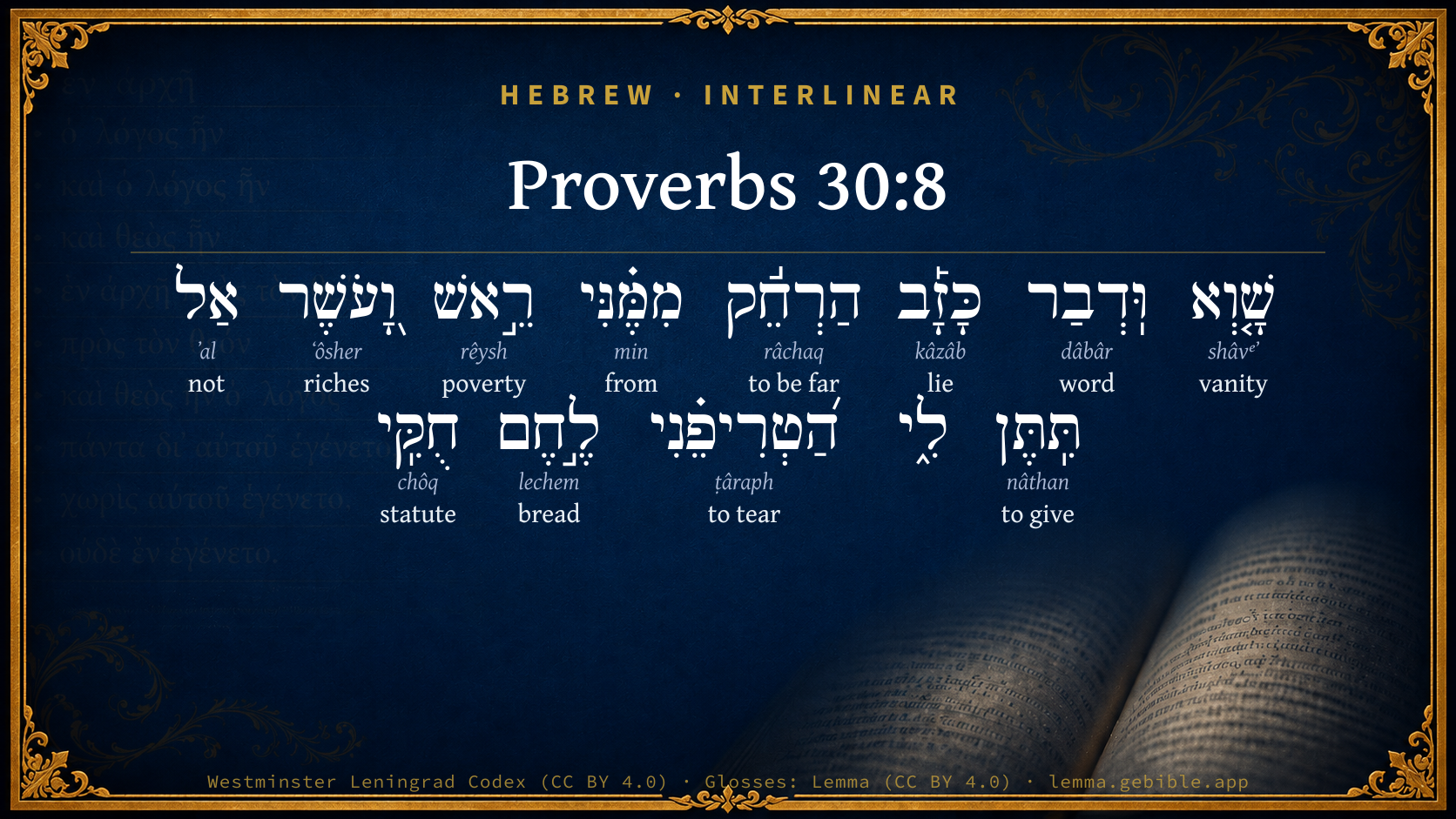
Hebrew (Westminster Leningrad Codex) Proverbs 30:8 appears in the Hebrew Old Testament. The text above is from the Westminster Leningrad Codex. Each word links to its Strong’s number, a concise gloss, and parsing drawn from the Open Scriptures Hebrew Bible morphology. Click any word for its full Brown-Driver-Briggs (BDB) entry.
Download image
Cite this verse

Proverbs 30:8 (World English Bible). Public Domain. Lemma interlinear Bible study tool, https://lemma.gebible.app/v/proverbs/30/8.

Show BibTeX & RIS
BibTeX
RIS
English Translation
Remove far from me falsehood and lies. Give me neither poverty nor riches. Feed me with the food that is needful for me;
World English Bible · Public Domain
Download a study sheet

One document with this verse’s original text, its word-by-word gloss line, the meaning frame, cross-references with their text, attributed commentary, and full source and license credits — printable, and it pastes into notes with its structure intact.

This verse Autodidact and up

Study sheet (.html) Plain text (.txt)

A passage Seminary Student

Up to 50 verses in one chapter. A passage sheet keeps up to 6 commentary sources and 12 cross-references per verse, in the order this page ranks them, and says so on the sheet whenever that leaves anything out. Ask for a single verse and you get the Autodidact verse sheet above.

Everything on this page stays free to read, with no account — the sheet is a download of what is already on screen, not access to it.

Want to remove ads? Support Godless Engineer
Compare translations 3

The same verse in 3 English versions, stacked beneath the original-language interlinear above. Click any original word for its lexicon entry.

Each is an independent rendering of the whole verse — the interlinear is not word-aligned to these translations.

Highlighted words mark where these versions differ — a whole-verse word diff, not a word-by-word alignment.

  • World English Bible Public Domain
    Remove far from me falsehood and lies. Give me neither poverty nor riches. Feed me with the food that is needful for me;
  • King James Version Public Domain
    Remove far from me vanity and lies: give me neither poverty nor riches; feed me with food convenient for me:
  • unfoldingWord Literal Text CC BY-SA 4.0
    Emptiness and the word of a lie put far away from me. Do not give to me poverty or riches; cause me to receive the bread of my portion.

unfoldingWord Literal Text — © unfoldingWord, licensed CC BY-SA 4.0. Word-aligned USFM3 via Door43 (git.door43.org/unfoldingWord/en_ult).

Versions to compare (up to 4)

3 of 4 selected

Show all 18 translations

Every available English version of this verse, each an independent rendering of the whole verse.

  • World English Bible Public Domain
    Remove far from me falsehood and lies. Give me neither poverty nor riches. Feed me with the food that is needful for me;
  • Berean Standard Bible Public Domain
    Keep falsehood and deceitful words far from me. Give me neither poverty nor riches; feed me with the bread that is my portion.
  • Majority Standard Bible Public Domain
    Keep falsehood and deceitful words far from me. Give me neither poverty nor riches; feed me with the bread that is my portion.
  • King James Version Public Domain
    Remove far from me vanity and lies: give me neither poverty nor riches; feed me with food convenient for me:
  • American Standard Version (1901) Public Domain
    Remove far from me falsehood and lies; Give me neither poverty nor riches; Feed me with the food that is needful for me:
  • Revised Version (1885) Public Domain
    Remove far from me vanity and lies: give me neither poverty nor riches; feed me with the food that is needful for me:
  • Geneva Bible (1599) Public Domain
    Remooue farre from me vanitie and lyes: giue me not pouertie, nor riches: feede me with foode conuenient for me,
  • Douay-Rheims (1899) Public Domain
    Remove far from me vanity, and lying words. Give me neither beggary, nor riches: give me only the necessaries of life:
  • Young's Literal Translation Public Domain
    Vanity and a lying word put far from me, Poverty or wealth give not to me, Cause me to eat the bread of my portion,
  • Literal Standard Version CC BY-SA 4.0
    Put vanity and a lying word far from me, || Do not give poverty or wealth to me, || Cause me to eat the bread of my portion,
  • Unlocked Literal Bible CC BY-SA 4.0
    Put vanity and lies far away from me. Give me neither poverty nor riches, just give me the food I need.
  • unfoldingWord Literal Text CC BY-SA 4.0
    Emptiness and the word of a lie put far away from me. Do not give to me poverty or riches; cause me to receive the bread of my portion.
  • Darby Bible Public Domain
    Remove far from me vanity and lies; give me neither poverty nor riches; feed me with the bread of my daily need:
  • World Messianic Bible Public Domain
    Remove far from me falsehood and lies. Give me neither poverty nor riches. Feed me with the food that is needful for me,
  • Webster's Bible Public Domain
    Remove far from me vanity and lies; give me neither poverty nor riches; feed me with food convenient for me:
  • Free Bible Version CC BY-SA 4.0
    Keep me from being false, help me not to tell lies. Don't make me poor or rich; just provide me with the food I need.
  • Bible in Basic English Public Domain
    Put far from me all false and foolish things: do not give me great wealth or let me be in need, but give me only enough food:
  • JPS Tanakh (1917) Public Domain
    Remove far from me falsehood and lies; give me neither poverty nor riches; feed me with mine allotted bread;

Literal Standard Version (2020), Covenant Press — licensed CC BY-SA 4.0. Text via the HelloAO Bible API (eBible.org). Unlocked Literal Bible (unfoldingWord) — licensed CC BY-SA 4.0. Text via the HelloAO Bible API (eBible.org). unfoldingWord Literal Text — © unfoldingWord, licensed CC BY-SA 4.0. Word-aligned USFM3 via Door43 (git.door43.org/unfoldingWord/en_ult). Free Bible Version, Dr. Jonathan Gallagher — licensed CC BY-SA 4.0. Text via the HelloAO Bible API (eBible.org).

Word by word

More ways to search: Search by grammar → Find every occurrence → Compare this word →

Practice this passage: Drill this verse → Learn its vocabulary →

רֵ֣אשׁ
rêysh
H7389
“poverty”
Noun, Common, Masculine, Singular, Absolute
Part of Speech
Noun
Type
Common
Gender
Masculine
Number
Singular
State
Absolute
Full BDB Definition

Origin: from H7326

TWOT: 2138a , 2138b

poverty
  1. שָׁ֤וְא shâvᵉʼ H7723 “vanity” Noun, Common, Masculine, Singular, Absolute
  2. וּֽדְבַר dâbâr H1697 “and · word of” Conjunction + Noun, Common, Masculine, Singular, Construct
  3. כָּזָ֡ב kâzâb H3577 “lie” Noun, Common, Masculine, Singular, Absolute
  4. הַרְחֵ֬ק râchaq H7368 “be far” Verb, Hiphil, Imperative, 2nd Person, Masculine, Singular
  5. מִמֶּ֗נִּי min H4480 “from · me” Preposition + Suffix, Personal, 1st Person, Common, Singular
  6. וָ֭עֹשֶׁר ʻôsher H6239 “and · riches” Conjunction + Noun, Common, Masculine, Singular, Absolute
  7. אַל ʼal H408 “not” Particle, Negative
  8. תִּֽתֶּן nâthan H5414 “to give” Verb, Qal, Jussive, 2nd Person, Masculine, Singular
  9. הַ֝טְרִיפֵ֗נִי ṭâraph H2963 “tear · me” Verb, Hiphil, Imperative, 2nd Person, Masculine, Singular + Suffix, Personal, 1st Person, Common, Singular
  10. לֶ֣חֶם lechem H3899 “bread of” Noun, Common, Both, Singular, Construct
  11. חֻקִּֽי chôq H2706 “statute · my” Noun, Common, Masculine, Singular, Construct + Suffix, Personal, 1st Person, Common, Singular

About this verse

These counts appear in no published source. They are computed here, from the morphology-tagged text and Lemma’s own curated glosses. What Lemma adds →

13
words
12
distinct lemmas
Wisdom
section

Notable vocabulary

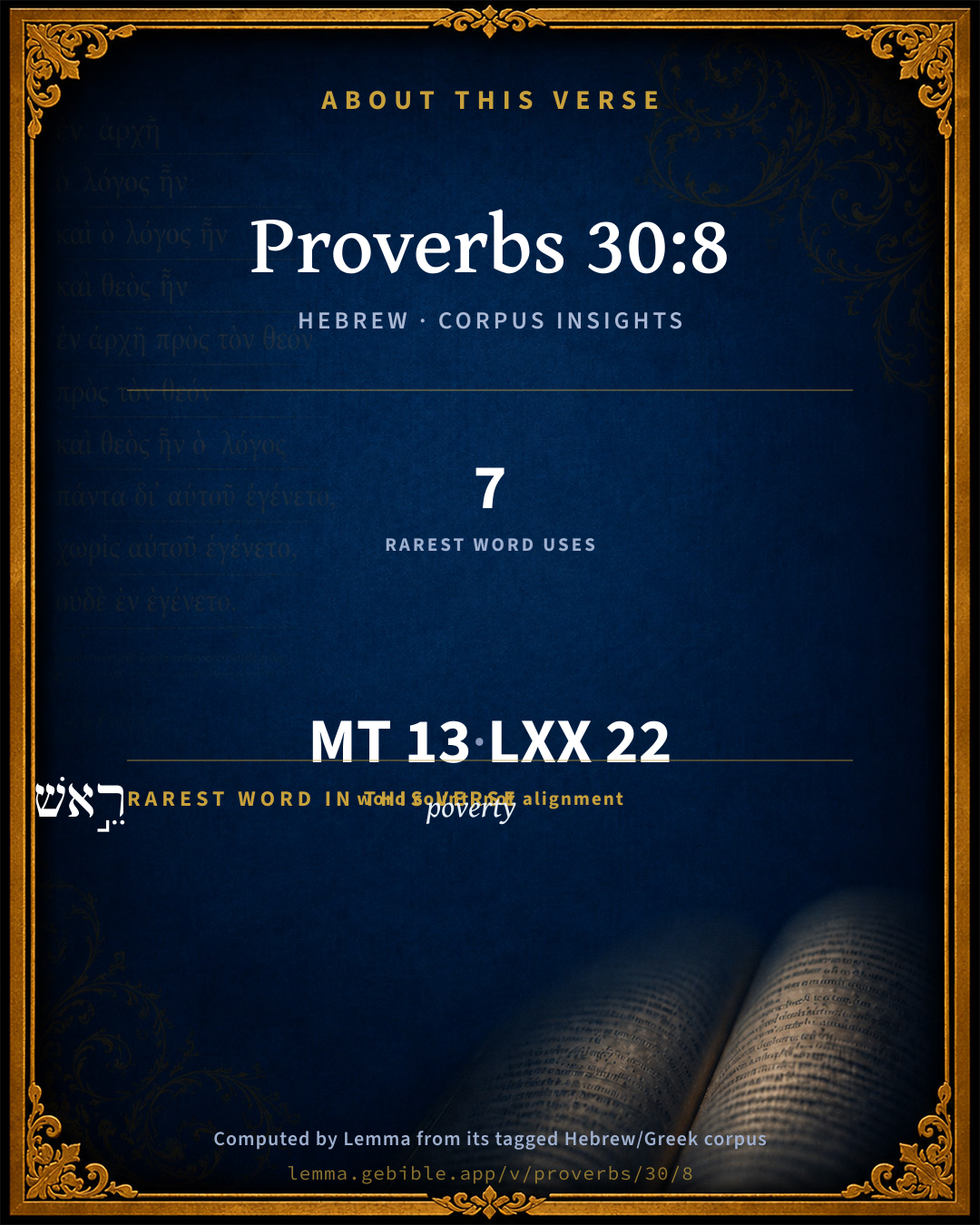
The rarest word here is רֵ֣אשׁ poverty H7389 — appearing just 7 times in the whole Hebrew Bible.

Shared distinctive vocabulary

רֵ֣אשׁ poverty H7389 occurs in 7 verses of the Hebrew Bible. Also found in:

Grammatical profile

  • 3 verbs
  • 7 nouns
  • 2 prepositions
  • 1 particle

Verb forms

  • הַרְחֵ֬ק Hiphil · Imperative
  • תִּֽתֶּן Qal · Jussive
  • הַ֝טְרִיפֵ֗נִי Hiphil · Imperative

Hebrew & Septuagint length

In English translation the verse runs 23 words from the Hebrew and 22 from the Septuagint (LXX English) — closely comparable.

A rough comparison of the two English renderings, which tokenize alike — not a word-level alignment.

Word counts can differ between the Hebrew and the Greek without any difference in meaning — e.g. the Hebrew direct-object marker אֵת has no separate Greek word, and Greek often adds the article ὁ.

In the original languages it is 13 Hebrew tokens and 22 Greek tokens — but the two are counted differently (Hebrew bundles its prefixes and suffixes into one token; the Greek is in lemma form), so that isn’t a like-for-like length.

Cross-references

26

Topical passages linked to Proverbs 30:8 in the Treasury of Scripture Knowledge — connected by theme and wording, ordered by reader-vote popularity; previews shown in the World English Bible.

  • 1 Timothy 6:6–8 But godliness with contentment is great gain.
  • Psalms 62:9–10 Surely men of low degree are just a breath, And men of high degree are a lie. In the balances they will go up. They are together lighter than a breath.
  • Psalms 119:37 Turn my eyes away from looking at worthless things. Revive me in your ways.
  • Matthew 6:33 But seek first God's Kingdom, and his righteousness; and all these things will be given to you as well.
  • Luke 11:3 Give us day by day our daily bread.
  • Psalms 119:29 Keep me from the way of deceit. Grant me your law graciously!
  • Job 23:12 I haven't gone back from the commandment of his lips. I have treasured up the words of his mouth more than my necessary food.
  • Proverbs 21:6 Getting treasures by a lying tongue Is a fleeting vapor for those who seek death.
  • Matthew 6:11 Give us today our daily bread.
  • Exodus 16:35 The children of Israel ate the manna forty years, until they came to an inhabited land. They ate the manna until they came to the borders of the land of Canaan.
  • 2 Kings 25:30 and for his allowance, there was a continual allowance given him of the king, every day a portion, all the days of his life.
  • Proverbs 22:8 He who sows wickedness reaps trouble, And the rod of his fury will be destroyed.
  • Exodus 16:15 When the children of Israel saw it, they said one to another, "What is it?" For they didn't know what it was. Moses said to them, "It is the bread which Yahweh has given you to eat."
  • Ecclesiastes 1:2 "Vanity of vanities," says the Preacher; "Vanity of vanities, all is vanity."
  • Acts 14:15 "Men, why are you doing these things? We also are men of like passions with you, and bring you good news, that you should turn from these vain things to the living God, who made the sky and the earth and the sea, and all that is in them;
  • Isaiah 5:18 Woe to those who draw iniquity with cords of falsehood, And wickedness as with cart rope;
  • Jeremiah 37:21 Then Zedekiah the king commanded, and they committed Jeremiah into the court of the guard; and they gave him daily a loaf of bread out of the bakers' street, until all the bread in the city was spent. Thus Jeremiah remained in the court of the guard.
  • Genesis 48:15–16 He blessed Joseph, and said, "The God before whom my fathers Abraham and Isaac did walk, the God who has fed me all my life long to this day,
  • Exodus 16:18 When they measured it with an omer, he who gathered much had nothing over, and he who gathered little had no lack. They gathered every man according to his eating.
  • Exodus 16:21–22 They gathered it morning by morning, everyone according to his eating. When the sun grew hot, it melted.
  • Jeremiah 52:34 and for his allowance, there was a continual allowance given him by the king of Babylon, every day a portion until the day of his death, all the days of his life.
  • Genesis 28:20 Jacob vowed a vow, saying, "If God will be with me, and will keep me in this way that I go, and will give me bread to eat, and clothing to put on,
  • Exodus 16:29 Behold, because Yahweh has given you the Sabbath, therefore he gives you on the sixth day the bread of two days. Everyone stay in his place. Let no one go out of his place on the seventh day."
  • Proverbs 23:5 Why do you set your eyes on that which is not? For it certainly sprouts wings like an eagle and flies in the sky.
  • Isaiah 59:4 None sues in righteousness, and none pleads in truth: they trust in vanity, and speak lies; they conceive mischief, and bring forth iniquity.
  • John 2:8 He said to them, "Now draw some out, and take it to the ruler of the feast." So they took it.

Cross-references courtesy of OpenBible.info (CC BY 4.0).

Hebrew and Greek witnesses Masoretic Hebrew ↔ Greek Septuagint

The same verse in the two great witnesses to the Old Testament, shown verse-for-verse.

These are two independent witnesses, not word-aligned to each other, and the Septuagint is shown in lemma (dictionary) form.

Hebrew Proverbs 30:8 Masoretic · Westminster Leningrad Codex

שָׁ֤וְא וּֽדְבַר כָּזָ֡ב הַרְחֵ֬ק מִמֶּ֗נִּי רֵ֣אשׁ וָ֭עֹשֶׁר אַל תִּֽתֶּן לִ֑י הַ֝טְרִיפֵ֗נִי לֶ֣חֶם חֻקִּֽי

Remove far from me falsehood and lies. Give me neither poverty nor riches. Feed me with the food that is needful for me;

World English Bible · Public Domain

Greek LXX Proverbs 30:8 Septuagint · lemma form

μάταιος λόγος καί ψευδής μακράν ἐγώ ποιέω πλοῦτος δέ καί πενία μή ἐγώ δίδωμι συντάσσω δέ ἐγώ ὁ δέω καί ὁ αὐτάρκης

Remove far from me vanity and falsehood: and give me not wealth or poverty; but appoint me what is needful and sufficient:

LXX2012 (modern English Septuagint) · Public Domain

On this verse, The Pulpit Commentary discusses the Septuagint’s reading. Read the note in Commentary ↓

Hebrew: Westminster Leningrad Codex (CC BY 4.0). Greek: Septuagint (public domain); English from LXX2012 (modern English Septuagint) (Public Domain). How the Septuagint differs from the Hebrew →

Commentary

Notes on Proverbs 30:8 from classic Christian and Jewish commentators (each source and its license shown beneath its notes). The classic Christian expositions comment on the surrounding passage and are grouped to its opening verse, so a note may address several verses; the Jewish commentaries on the Tanakh (Rashi and others) are per-verse, so they appear only where the commentator wrote on this verse.

Lemma curates 59 commentaries, every one of them public domain or Creative Commons licensed, each selected and text-cleaned for this edition rather than reprinted as found. About our sources →

Trapp's Complete Commentary

John Trapp

Pro 30:8 Remove far from me vanity and lies: give me neither poverty nor riches; feed me with food convenient for me:

Ver. 8. Remove far from me vanity and lies,] i.e., All sorts of sins, those lying vanities that promise much happiness to those that pursue them, but perform little enough; "shame" at the best, but usually "death." {Rom 6:21; Rom 6:23} Free me both from the damning and from the domineering power of sin; both from the sting and stain of it; from the guilt and filth; from the crime and curse; from the power and punishment. Let my person be justified, and my lusts mortified. "Forgive me my trespasses, and deliver me from evil."

Give me neither poverty nor riches.] So that God must give to be poor as well as to be rich. He makes holes in the money bag, {Hag 1:6} and he stops the secret issues and drains of expense at which men’s estates run out, they know not how nor when. Agur would have neither poverty, for the many inconveniences and discomforts that attend it, nor yet riches, for the many cares, cumbers, and other evils not a few that follow them; but a mediocrity, a competence, a sufficiency without superfluity. A state too big, he knew, is troublesome, as well as a shoe too big for the foot. They say it is not the great cage that makes the bird sing; sure we are it is not the great estate that brings always the inward joy, the cordial contentment. Glass keeps out wind and rain, but lets in the light, and is therefore useful in building. A moderate estate is neither so mean as to expose a man to the injuries, nor so great as to exclude a man from the influence of heaven. A staff may help a traveller, but a bundle of staves may be a burden to him; so may too great an estate to a godly man.

Feed me with food convenient for me.] Heb., With food of mine allowance, or which thou seest fit to allow me: so much as my demensum comes to; the piece that thou hast cut for me; the portion that belongs unto me; the bread of the day for the day; give me daily bread that I may in diem vivere, live on today, as Quintilian saith the birds do, the little birds, that have their meal brought in every day by their dams without defeatment. And hereunto the original here seems to allude. Pomponius Atticus thus defineth riches, Divitiae sunt, ad legem naturae composita paupertas, Riches are such a poverty or mediocrity as hath enough for nature’s uses. If I may have but offam et aquam, a morsel of meat, a mouthful of water, and convenient clothing, I shall not envy the richest Croesus or Crassus upon earth. {See Trapp on "Mat 6:11"} {See Trapp on "1Ti 6:8"}

John Trapp, A Commentary or Exposition upon All the Books of the Old and New Testament (1647–1656) — public domain. Text from a community e-Sword module.

Jamieson, Fausset & Brown

Robert Jamieson, A. R. Fausset & David Brown

vanity--all sorts of sinful acts (Job 11:11; Isa 5:18).

Jamieson, Fausset & Brown — Commentary Critical and Explanatory on the Whole Bible (1871) — public domain (CC PDM 1.0). Text via the HelloAO Bible API.

Adam Clarke's Commentary

Verse 8. Remove far from me vanity and lies.]

1. שוא shav, all false shows, all false appearances of happiness, every vain expectation. Let me not set my heart on any thing that is not solid, true, durable, and eternal.

2. Lies, דבר כזב debar cazab, all words of deception, empty pretensions, false promises, uncertain dependences, and words that FAIL; promises which, when they become due, are like bad bills; they are dishonoured because they are found to be forged, or the drawer insolvent.

From the import of the original, I am satisfied that Agur prays against idolatry, false religion, and false worship of every kind. שוא shau is used for an idol, a false god. Jer 18:15: "My people have forsaken me; they have burnt incense to VANITY;" לשוא lashshav, "to an IDOL." Ps 31:6: "I have hated them that regard lying VANITIES;" הבלי שוא habley shave, "vain IDOLS." See also Ho 12:11; Jon 2:8. And כזב cazab, a thing that fails or deceives, may well apply to the vain pretensions, false promises, and deceptive religious rites of idolatry. So Jer 15:18: "Wilt thou be unto me as a liar," כמו אכזב kemo achzob, like the false, failing promises of the false gods; "and as waters that fail;" לא נאמנו lo neemanu, that are not faithful; not like the true God, whose promises never fail. According to this view of the subject, Agur prays,

1. That he may be preserved from idolatry.

2. That he may put no confidence in any words but those pure words of God that never fail them that trust in him.

Give me neither poverty nor riches] Here are three requests:

1. Give me not poverty. The reason is added: Lest, being poor, I shall get into a covetous spirit, and, impelled by want, distrust my Maker, and take my neighbour's property; and, in order to excuse, hide, or vindicate my conduct, I take the name of my God in vain; תפשתי taphasti, "I catch at the name of God." Or, by swearing falsely, endeavour to make myself pass for innocent. Forswere the name of my God. - Old MS. Bible. Coverdale, "deny or apostatize from him."

2. Give me not riches. For which petition he gives a reason also: Lest I be full, and addict myself to luxurious living, pamper the flesh and starve the soul, and so deny thee, the Fountain of goodness; and, if called on to resort to first principles, I say, Who is Jehovah! Why should I acknowledge, why should I serve him? And thus cast aside all religion, and all moral obligation.

3. The third request is, Feed me with food convenient for me, הטריפני לחם חקי hatripheni lechem chukki; the meaning of which is, "give me as prey my statute allowance of bread," i.e., my daily bread, a sufficient portion for each day. There is an allusion made to hunting: "Direct so by thy good providence, that I may each day find sufficient portion to subsist on, as a hunter in the forest prays that he may have good speed." It is the province of a preacher to show the importance and utility of such a prayer, and dilate the circumstances, and expand the reasons, after the commentator has shown the literal sense.

Adam Clarke's Commentary on the Bible (1810–1826) — public domain. Text from a community e-Sword/MySword module.

Ellicott's Commentary for English Readers

(8) Vanity.—Falsehood either towards God or man.

Food convenient for me.—Literally, bread of my portion, such as is apportioned to me as suitable by the care of the heavenly Father. Comp. “daily bread” (Mat_6:11) in the sense of “proper for our sustenance.”

A Bible Commentary for English Readers, edited by Charles John Ellicott (1878–1897) — public domain. Text from a community e-Sword module.

The Cambridge Bible for Schools and Colleges

gen. ed. J. J. S. Perowne

8. food convenient for me] Heb. the bread of my portion, i.e. that is needful for me. The Heb. word is used of an appointed portion of labour, or a task, Pro_31:15; Exo_5:14. Comp. “Give us this day our daily bread.”

The Cambridge Bible for Schools and Colleges (gen. ed. J. J. S. Perowne; Cambridge University Press, 1878–1918) — public domain. Text from a community e-Sword module.

John Gill's Exposition

Remove far from me vanity and lies,.... This is the "first" request, to be preserved from sin, in general; which is a vain, lying, and deceitful thing; promising pleasure, profit, liberty, and impunity, which it does not give. Agur desires to have vain thoughts removed out of his mind, vain words from his mouth, and vain actions from his life and conversation; to have his eyes turned from beholding vanity, and his feet from walking in it; and his affections taken off from the vain things of the world, the lusts, pleasures, profits, and honours of it; as well as to be kept from all errors and false doctrines, which are lies in hypocrisy; with which men that lie in wait to deceive would, if it were possible, deceive the very elect: Agur conscious of his own weakness, and proneness to evil, desires the Lord would not lead him into temptation, but deliver him from all evil, doctrinal and practical. Some understand this of the forgiveness of sin; which is sometimes expressed by a putting or removing it away, Sa2 7:13, Psa 103:12;

give me neither poverty nor riches; this is the "second" request, not to be extremely poor nor too rich; but to be in a middle state between both, neither rich nor poor; which Horace (b) calls the golden mean, and which Agur wisely judged to be the happiest state; most free from care, least liable to temptation, and the best situation to serve the Lord in: a like wish was made by Theognis (c), I neither love to be rich,

"nor desire it; but to live on a little, having no evil;''

so Martial (d). Both riches and poverty are of God; men are rich or poor, as the Lord pleases; he suffers poverty in some, and gives riches to others: Agur deprecates both, as having their separate, peculiar, snares and temptations; though no doubt this request was made with submission to the will of God; and not as considering either of them as evils in themselves, but as they might be attended with bad consequences, and what is next mentioned being more eligible;

feed me with food convenient for me; not merely what was agreeable to his palate, suitable to his constitution, and sufficient for nature; nor for him personally, but for his family also; and what was proper and suitable to the condition and circumstances in which he was, and to the rank and quality he held, whether in a more private or in a more public capacity. Some render it, "the food of my allowance" (e); what is allotted and appointed for me It seems to be the same which Job calls his "necessary food", and Christ "our daily bread": it takes in both food and raiment, which having, men should be contented with; see Job 23:12. The allusion seems to be to the stated measure of food allowed to servants by the day, or rather by the month, called "demensum", and which was but small and scanty (f); yet with this Agur could be content.

(b) Camin. l. 2. Ode 10. v. 5. (c) Sententiae, v. 1151, 1152. (d) "Nunquam divitias deos rogavi, contentus modicis, meoque laetus; paupertas, veniam dabis, recede", Epigr. l. 4. Ep. 65. (e) "panem statuti mei", Montanus; "demensi mei", Tigurine version, Junius & Tremellius, Piscator, Mercerus, Cocceius, Michaelis, Schultens. (f) Vid. Juvenal. Sat. 14. v. 126. & Not. in ibid.

John Gill's Exposition of the Whole Bible (1746–1763) — public domain (CC PDM 1.0). Text via the HelloAO Bible API.

Albert Barnes' Notes on the Bible

The order of the two requests is significant. The wise man’s prayer is first and chiefly, “truth in the inward parts,” the removal of all forms of falsehood, hollowness, hypocrisy.

Neither poverty ... - The evil of the opposite extremes of social life is that in different ways they lead men to a false standard of duty, and so to that forgetfulness of God which passes into an absolute denial.

Food convenient for me - literally, “give me for food the bread of my appointed portion.” The prayer foreshadows that which we have been taught by the Divine Wisdom: “Give us, day by day, our daily bread.”

Albert Barnes' Notes on the Bible (1834–1885) — public domain. Text from a community e-Sword/MySword module.

Haydock's Catholic Bible Commentary

Words, which are so opposite to thine, ver. 5. --- Riches. The former often prompts men to deceive, the latter to grow proud and forget God.

George Leo Haydock (1774–1849), Haydock's Catholic Family Bible and Commentary, 1859 edition — public domain. Excludes Psalms (Douay-Rheims chapter numbering differs from Protestant) and Deuterocanonical books (Catholic canon only).

Matthew Poole's English Annotations

Remove far from me; from my heart, and from the course of my life. This is the first of Agur’s petitions.

Vanity; either,

1. All vain and false opinions concerning God, or the things of God; all unbelief, idolatry, or misbelief. Or,

2. All vanity of heart and life; a vain conversation, an affectation of the vain things of this world, as riches, pleasures, or honours, the bewitching power and sad effects whereof he had observed in others, and feared in himself, as the following request implies.

Lies; all falsehood and deceit in my words and carriage towards God or men.

Give me neither poverty nor riches: this is his second request, which may seem to have some reference to the former, poverty being commonly the occasion and temptation to the sin of lying, and riches being the great occasions and enticements to vanity. Thus, as his first petition was against the sins themselves, so this latter is against the occasions of them.

Food convenient for me; moderate, and suitable both to my natural necessities, and to that estate and condition of life in which thou hast put me, and to that work and service which thou hast for me to do. And this mediocrity of estate is so amiable, that it hath been oft desired by wise heathens, as more eligible than a state of the greatest plenty and glory.

Matthew Poole's English Annotations on the Holy Bible (1683–1685) — public domain. Text from a community e-Sword/MySword module.

The Pulpit Commentary

Here is the first request: Remove far from me vanity and lies. Shay, "vanity," is inward hollowness and worthlessness, and "lies" are the expression of this in words. The prayer might indeed be taken as an entreaty against being polluted with the companionship of the evil, like "Lead us not into temptation, but deliver us from evil;" but it is best taken subjectively, as a supplication for personal truthfulness and sincerity in all relations both towards God and man. Give me neither poverty nor riches. Both extremes are deprecated: the mean is the safest and the happiest, Horace, "Carm.," 3:16. 424 "Multa petentibus Desunt multa; bene est, cui deus obtulit Parca, quod satis est, manu." "The "ever craving" is Want"s slave and thrall; The gods most wisely thus their gifts accord, Giving "enough," they amply give to all. (Stanley.) Theognis, "Patron.," 1155 Ouk eramai ploutein oud eucomai alla moi eih Zhn apo twn pligwn mhden. "I want not wealth; I only ask to live On frugal means without corroding care.

Feed me with food convenient for me; literally, give me to eat the bread of my portion; that which by God s providence is determined for me. (comp. Gen_47:22, which speaks of the portion assigned for the support of the priests; Job_23:14; and below, Pro_31:15) It is natural to refer to tosion of the Lord"s Prayer; (Mat_6:11) but the idea is not the same. In the latter, bread for the needs of the coming day is meant; in our passage it is more indefinite, a casting one"s self on the Divine love, in readiness to take what that love assigns. "Having food and covering," says St. Paul, (1Ti_6:8) "we shall be therewith content." Septuagint, "Appoint for me what is necessary and what is sufficient (ta deonta kai ta autarkh ).

Vers. 8, 9. "Neither poverty nor riches.

A wise man here points out the danger of the two extremes of poverty and riches, and seeks for himself the happier middle position. In the present day the enormous wealth of one class and the hard penury of another suggest serious social questions, and raise alarms as to great possible dangers unless the terrible anomaly of this artificial condition is not remedied.

I THE EVIL OF POVERTY. The thought is of extreme poverty, of absolute destitution, or. at least, of that precarious livelihood that is always on the verge of want, and is therefore oppressed with an ever-haunting fear of the distress which can never be quire out of sight. Now, what is to be remarked here is that the great evil of excessive poverty pointed out in the passage before us is moral in character. The sufferings of perjury are sad to contemplate. Those of us who have never known what it is to be really hungry cannot understand the pangs of the starving. More tearful must be the trouble of parents who see their children crying for bread and cannot satisfy them. Yet the worst evil is not this suffering; it is the moral degradation that follows it. Wolf-like hunger assimilates its victims to the nature of the wolf. It is hard to be honest when in want of food. The temptations of the poor are frightful to contemplate. It is wonderful that there is so little crime, seeing that there is so much poverty. The grinding cares of poverty tend to wear the soul out, and blind its vision to spiritual truth. The patience and good behaviour of the dumb, suffering multitudes of the distressed is indeed a sight to move our sympathy and excite our admiration.

II THE EVIL OF WEALTH. The temptation of riches is not very unlike that of poverty in its character, but more deadly. Both extremes tempt to worldliness poverty to worldly care, riches to worldly satisfaction. The "care of this world" and "the deceitfulness of riches" stand together as the thorns that choke the good seed. (Mat_12:22) But riches goes further. It tempts a man to dispense with God. Poverty tempts to theft, often, indeed, with extenuating circumstances. But riches tempts to scornful atheism. Christ saw this danger when he said, "How hardly shall they that have riches enter into the kingdom of Grail". (Mar_10:23) On the other hand, when we see rich men who have conquered the exceptional temptations of their position, and who live a humble and useful Christian life, devoting their talents to the service of Christ, we should acknowledge that such victors over the world are deserving of especial honour.

III THE CHOICE OF A MIDDLE COURSE. We are here reminded of Aristotle"s doctrine of "the mean." There are circumstances in which the true mean is not just the middle way between two diverse policies. The lowering of the standard of right and wrong that comes from the peace-loving tendency to accept a compromise is disastrous to all conscientious conduct. But now we have to do with a middle course between two external states, both of which are dangerous. If Christian people understood their mission in the world aright, in its breath and humanity, they would know that the call to preach the gospel of the kingdom includes the inculcation of those social principles which tens to blot out the present ugly picture of extreme poverty set off by extreme wealth. A life that is neither crushed by care nor intoxicated by riches is the life in which it is least difficult to serve God and do right. Therefore we should labour to help on a state of society in which more of such lives will be possible.

The Pulpit Commentary (1880–1919), ed. H.D.M. Spence-Jones & Joseph S. Exell — public domain. Text from a community e-Sword module.

John Wesley's Explanatory Notes

Vanity - All vanity of heart and life; a vain conversation, or a love of the vain things of this world. Lies - All falsehood and deceit in my words and carriage. Convenient - Moderate and suitable both to my natural necessities, and to that condition of life in which thou hast put me.

John Wesley, Explanatory Notes Upon the Whole Bible (1754–1765) — public domain. Text via the GEBible commentary corpus.

Rashi

Rabbi Shlomo Yitzchaki (Rashi)

poverty Heb. ראש, poverty.

provide me Heb. הטריפני, an expression of food, and similarly (Ps. 111: 5): “He has given food (טרף) to those who fear Him.”

Rashi on the Tanakh — English translations: “The Judaica Press complete Tanach with Rashi, translated by A. J. Rosenberg” (CC BY 4.0); “Pentateuch with Rashi's commentary by M. Rosenbaum and A.M. Silbermann, 1929-1934” (public domain); “The Metsudah Tanach series, Lakewood, N.J” (CC BY 4.0); and “The Book of Joshua, Metsudah Publications, 1997” (CC BY 4.0). Text via Sefaria.

Lesson kit

Teaching starters — assembled from the data on this page, not authored interpretation. Every prompt links to the verse data it draws on. Edit before teaching.

Proverbs, in the Wisdom, opens this verse with 13 words (12 distinct Hebrew lemmas). Its most distinctive word is rêysh (“poverty”). A historical commentator’s framing appears above. Read the whole chapter for the surrounding context.

Discussion questions

  1. The word rêysh carries the sense “poverty.” How does it shape the verse?
  2. Proverbs 6:11 shares the word «poverty» with this verse. How do the two illuminate each other?
  3. These translations render this verse differently. What is at stake in choosing one wording over another?
  4. The verb «הַרְחֵ֬ק» is Hiphil Imperative. How does its form color the action?
  5. Reading how Trapp's Complete Commentary and Jamieson, Fausset & Brown read this verse, where do the two commentators agree and where do they part?

Things to notice

Reading settings

Reading text

Shown beneath each verse's original-language words.

Old Testament
Old Testament edition

Read the OT as the Masoretic Hebrew (MT) or the Greek Septuagint (LXX).

English shown for the Greek Septuagint (in the Hebrew ↔ Greek comparison).

Comparing translations? Open the Compare panel on any verse page to stack up to four side by side.