
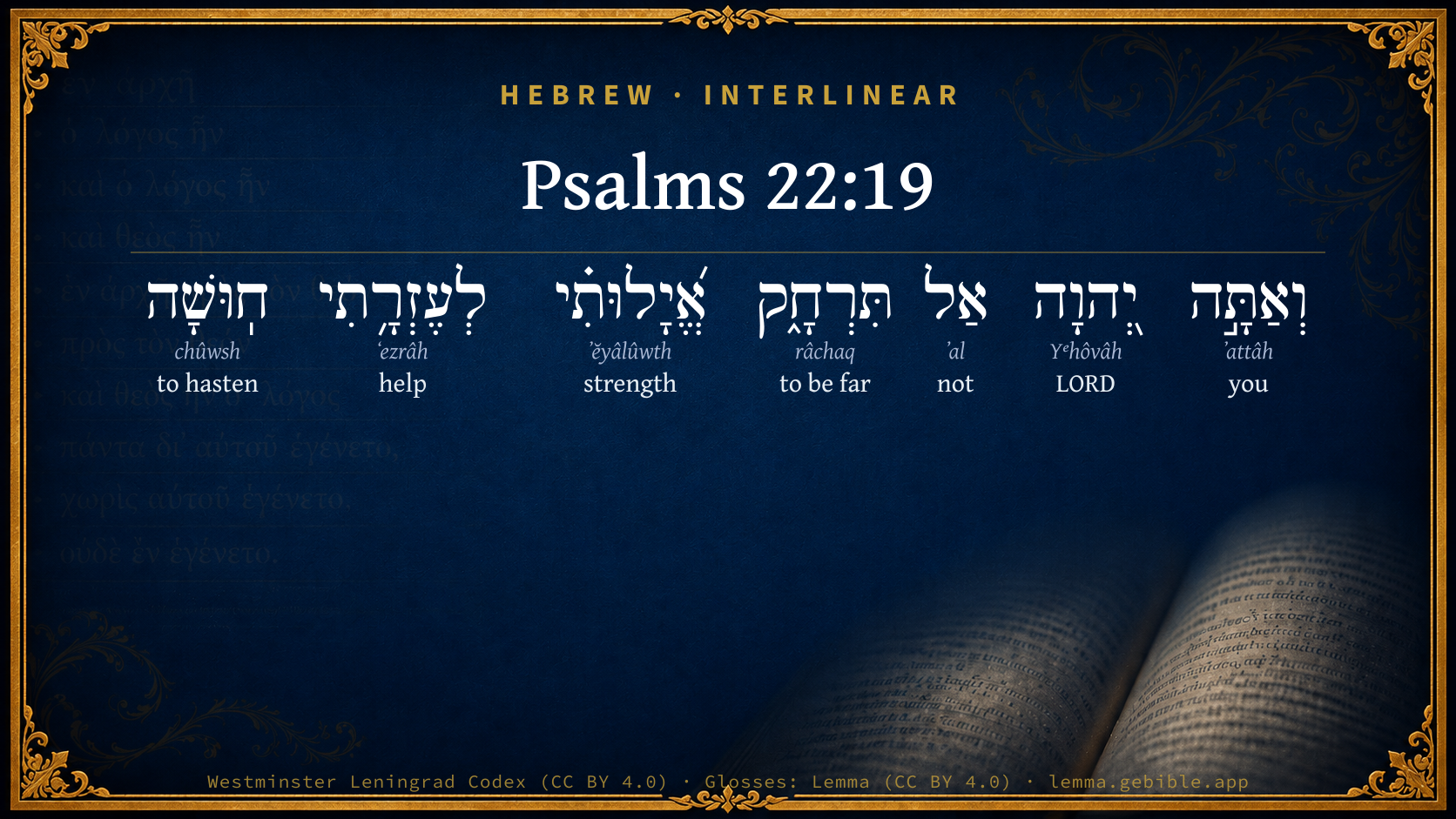
Psalms 22:19

Hebrew (Westminster Leningrad Codex) Psalms 22:19 appears in the Hebrew Old Testament. The text above is from the Westminster Leningrad Codex. Each word links to its Strong’s number, a concise gloss, and parsing drawn from the Open Scriptures Hebrew Bible morphology. Click any word for its full Brown-Driver-Briggs (BDB) entry.
Download image
Cite this verse

Psalms 22:19 (World English Bible). Public Domain. Lemma interlinear Bible study tool, https://lemma.gebible.app/v/psalms/22/19.

Show BibTeX & RIS
BibTeX
RIS
English Translation
But don't be far off, Yahweh. You are my help: hurry to help me.
World English Bible · Public Domain
Highlights
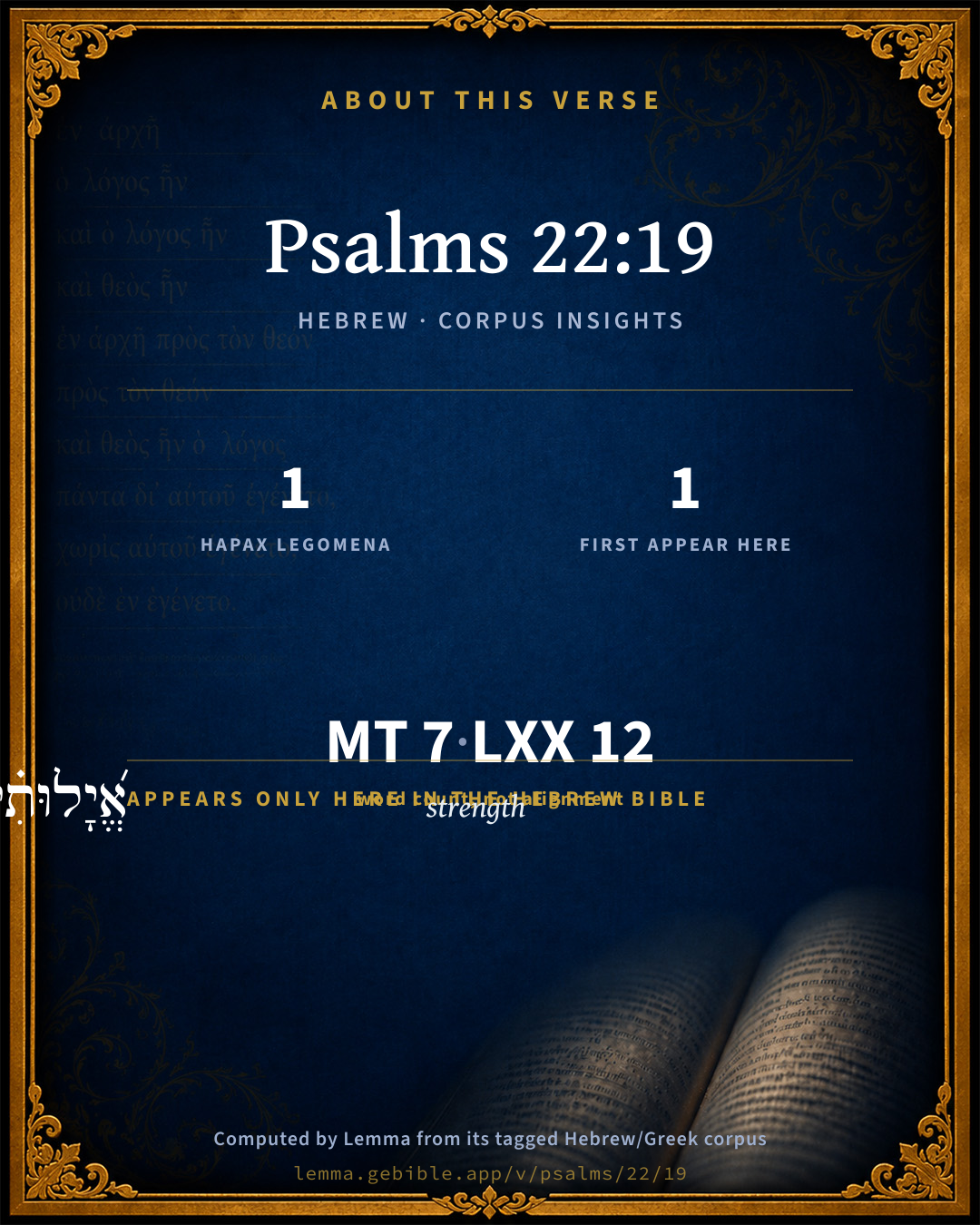
  • 1 hapax legomenon — only here in the Hebrew Bible
  • 1 first appearance in the Hebrew Bible
Full analysis ↓
Download a study sheet

One document with this verse’s original text, its word-by-word gloss line, the meaning frame, cross-references with their text, attributed commentary, and full source and license credits — printable, and it pastes into notes with its structure intact.

This verse Autodidact and up

Study sheet (.html) Plain text (.txt)

A passage Seminary Student

Up to 50 verses in one chapter. A passage sheet keeps up to 6 commentary sources and 12 cross-references per verse, in the order this page ranks them, and says so on the sheet whenever that leaves anything out. Ask for a single verse and you get the Autodidact verse sheet above.

Everything on this page stays free to read, with no account — the sheet is a download of what is already on screen, not access to it.

Want to remove ads? Support Godless Engineer
Compare translations 3

The same verse in 3 English versions, stacked beneath the original-language interlinear above. Click any original word for its lexicon entry.

Each is an independent rendering of the whole verse — the interlinear is not word-aligned to these translations.

Highlighted words mark where these versions differ — a whole-verse word diff, not a word-by-word alignment.

  • World English Bible Public Domain
    But don't be far off, Yahweh. You are my help: hurry to help me.
  • King James Version Public Domain
    But be not thou far from me, O LORD: O my strength, haste thee to help me.
  • unfoldingWord Literal Text CC BY-SA 4.0
    But you, Yahweh, not be far away. My strength, hurry to help me.

unfoldingWord Literal Text — © unfoldingWord, licensed CC BY-SA 4.0. Word-aligned USFM3 via Door43 (git.door43.org/unfoldingWord/en_ult).

Versions to compare (up to 4)

3 of 4 selected

Show all 18 translations

Every available English version of this verse, each an independent rendering of the whole verse.

  • World English Bible Public Domain
    But don't be far off, Yahweh. You are my help: hurry to help me.
  • Berean Standard Bible Public Domain
    But You, O LORD, be not far off; O my Strength, come quickly to help me.
  • Majority Standard Bible Public Domain
    But You, O LORD, be not far off; O my Strength, come quickly to help me.
  • King James Version Public Domain
    But be not thou far from me, O LORD: O my strength, haste thee to help me.
  • American Standard Version (1901) Public Domain
    But be not thou far off, O Jehovah: O thou my succor, haste thee to help me.
  • Revised Version (1885) Public Domain
    But be not thou far off, O LORD: O thou my succour, haste thee to help me.
  • Geneva Bible (1599) Public Domain
    But be thou not farre off, O Lord, my strength: hasten to helpe me.
  • Douay-Rheims (1899) Public Domain
    They parted my garments amongst them; and upon my vesture they cast lots.
  • Young's Literal Translation Public Domain
    And Thou, O Jehovah, be not far off, O my strength, to help me haste.
  • Literal Standard Version CC BY-SA 4.0
    And You, O YHWH, do not be far off, || O My strength, hurry to help Me.
  • Unlocked Literal Bible CC BY-SA 4.0
    Do not be far away, Yahweh; please hurry to help me, my strength!
  • unfoldingWord Literal Text CC BY-SA 4.0
    But you, Yahweh, not be far away. My strength, hurry to help me.
  • Darby Bible Public Domain
    But thou, Jehovah, be not far [from me]; O my strength, haste thee to help me.
  • World Messianic Bible Public Domain
    But don’t be far off, LORD. You are my help. Hurry to help me!
  • Webster's Bible Public Domain
    \\22:18\\They part my garments among them, and cast lots upon my vesture.
  • Free Bible Version CC BY-SA 4.0
    But you, Lord, don't be far away from me! You are my strength—hurry, come and help me!
  • Bible in Basic English Public Domain
    Do not be far from me, O Lord: O my strength, come quickly to my help.
  • JPS Tanakh (1917) Public Domain
    (22-20) But Thou, O LORD, be not far off; O Thou my strength, hasten to help me.

Literal Standard Version (2020), Covenant Press — licensed CC BY-SA 4.0. Text via the HelloAO Bible API (eBible.org). Unlocked Literal Bible (unfoldingWord) — licensed CC BY-SA 4.0. Text via the HelloAO Bible API (eBible.org). unfoldingWord Literal Text — © unfoldingWord, licensed CC BY-SA 4.0. Word-aligned USFM3 via Door43 (git.door43.org/unfoldingWord/en_ult). Free Bible Version, Dr. Jonathan Gallagher — licensed CC BY-SA 4.0. Text via the HelloAO Bible API (eBible.org).

Word by word

More ways to search: Search by grammar → Find every occurrence → Compare this word →

Practice this passage: Drill this verse → Learn its vocabulary →

About this verse

These counts appear in no published source. They are computed here, from the morphology-tagged text and Lemma’s own curated glosses. What Lemma adds →

7
words
7
distinct lemmas
Wisdom
section

Notable vocabulary

1 hapax legomenon — a word that appears only here in the entire Hebrew Bible:

  • אֱ֝יָלוּתִ֗י strength H360

First appearance in Scripture

This word makes its first canonical appearance in the Hebrew Bible here:

  • אֱ֝יָלוּתִ֗י strength H360

Shared distinctive vocabulary

חֽוּשָׁה to hasten H2363 occurs in 20 verses of the Hebrew Bible. Also found in:

Grammatical profile

  • 2 verbs
  • 3 nouns
  • 1 pronoun
  • 1 particle

Verb forms

  • תִּרְחָ֑ק Qal · Jussive
  • חֽוּשָׁה Qal · Imperative

Hebrew & Septuagint length

In English translation the verse runs 14 words from the Hebrew and 15 from the Septuagint (LXX English) — closely comparable.

A rough comparison of the two English renderings, which tokenize alike — not a word-level alignment.

Word counts can differ between the Hebrew and the Greek without any difference in meaning — e.g. the Hebrew direct-object marker אֵת has no separate Greek word, and Greek often adds the article ὁ.

In the original languages it is 7 Hebrew tokens and 12 Greek tokens — but the two are counted differently (Hebrew bundles its prefixes and suffixes into one token; the Greek is in lemma form), so that isn’t a like-for-like length.

Cross-references

7

Topical passages linked to Psalms 22:19 in the Treasury of Scripture Knowledge — connected by theme and wording, ordered by reader-vote popularity; previews shown in the World English Bible.

  • Psalms 22:11 Don't be far from me, for trouble is near. For there is none to help.
  • Psalms 40:13 Be pleased, Yahweh, to deliver me. Hurry to help me, Yahweh.
  • Psalms 40:17 But I am poor and needy; May the Lord think about me. You are my help and my deliverer. Don't delay, my God.
  • Psalms 10:1 Why do you stand far off, Yahweh? Why do you hide yourself in times of trouble?
  • Psalms 21:1 The king rejoices in your strength, Yahweh! How greatly he rejoices in your salvation!
  • Psalms 18:1 I love you, Yahweh, my strength.
  • Psalms 70:5 But I am poor and needy. Come to me quickly, God. You are my help and my deliverer. Yahweh, don't delay.

Cross-references courtesy of OpenBible.info (CC BY 4.0).

Hebrew and Greek witnesses Masoretic Hebrew ↔ Greek Septuagint

The same verse in the two great witnesses to the Old Testament, shown verse-for-verse.

You’re reading Greek Psalm 21 (Hebrew Psalm 22). The Septuagint counts the superscription, so verse numbers can differ from the Hebrew — chapter-level alignment, not verse-by-verse. Numbering follows Rahlfs.

These are two independent witnesses, not word-aligned to each other, and the Septuagint is shown in lemma (dictionary) form.

Hebrew Psalms 22:19 Masoretic · Westminster Leningrad Codex

וְאַתָּ֣ה יְ֭הוָה אַל תִּרְחָ֑ק אֱ֝יָלוּתִ֗י לְעֶזְרָ֥תִי חֽוּשָׁה

But don't be far off, Yahweh. You are my help: hurry to help me.

World English Bible · Public Domain

Greek LXX Greek Psalm 21:19 Septuagint · lemma form

διαμερίζω ὁ ἱμάτιον ἐγώ ἑαυτοῦ καί ἐπί ὁ ἱματισμός ἐγώ βάλλω κλῆρος

But you, O Lord, remove not my help afar off: be ready for my aid.

LXX2012 (modern English Septuagint) · Public Domain

On this verse, Keil & Delitzsch discusses the Septuagint’s reading. Read the note in Commentary ↓

Hebrew: Westminster Leningrad Codex (CC BY 4.0). Greek: Septuagint (public domain); English from LXX2012 (modern English Septuagint) (Public Domain). How the Septuagint differs from the Hebrew →

Commentary

Notes on Psalms 22:19 from classic Christian and Jewish commentators (each source and its license shown beneath its notes). The classic Christian expositions comment on the surrounding passage and are grouped to its opening verse, so a note may address several verses; the Jewish commentaries on the Tanakh (Rashi and others) are per-verse, so they appear only where the commentator wrote on this verse.

Lemma curates 59 commentaries, every one of them public domain or Creative Commons licensed, each selected and text-cleaned for this edition rather than reprinted as found. About our sources →

Trapp's Complete Commentary

John Trapp

Psa 22:19 But be not thou far from me, O LORD: O my strength, haste thee to help me.

Ver. 19. But be not thou far from me, O Lord] Here he resumeth and reinforceth his former prayer, after a most pathetic description of his so doleful condition. Faith wadeth out of trouble (as the moon doth out of a cloud) by hearty and affectionate prayer.

O my strength] God is so to a believer, then especially when he feeleth himself weak as water.

Haste thee to help me] Who am now in an exigent, and am therefore bold, without limitation, to request thee to haste away to me.

John Trapp, A Commentary or Exposition upon All the Books of the Old and New Testament (1647–1656) — public domain. Text from a community e-Sword module.

Keil & Delitzsch

C. F. Keil & F. Delitzsch

(Heb.: 22:20-22)In Psa 22:19 the description of affliction has reached its climax, for the parting of, and casting lots for, the garments assumes the certain death of the sufferer in the mind of the enemies. In Psa 22:20, with ואתּה the looks of the sufferer, in the face of his manifold torments, concentrate themselves all at once upon Jahve. He calls Him אילוּתי nom. abstr. from איל, Psa 88:5 : the very essence of strength, as it were the idea, or the ideal of strength; lė‛ezrāthi has the accent on the penult., as in Psa 71:12 (cf. on the other hand Ps 38:23), in order that two tone syllables may not come together. In Psa 22:21, חרב means the deadly weapon of the enemy and is used exemplificatively. In the expression מיּד כּלב, מיּד is not merely equivalent to מן, but יד is, according to the sense, equivalent to "paw" (cf. כּף, Lev 11:27), as פּי is equivalent to jaws; although elsewhere not only the expression "hand of the lion and of the bear," Sa1 17:37, but also "hands of the sword," Psa 63:11, and even "hand of the flame," Isa 47:14 are used, inasmuch as יד is the general designation of that which acts, seizes, and subjugates, as the instrument of the act. Just as in connection with the dog יד, and in connection with the lion פי (cf. however, Dan 6:28) is mentioned as its weapon of attack, the horns, not the horn (also not in Deu 33:17), are mentioned in connection with antilopes, רמים (a shorter form, occurring only in this passage, for ראמים, Psa 29:6; Psa 34:7). Nevertheless, Luther following the lxx and Vulgate, renders it "rescue me from the unicorns" (vid., thereon on Psa 29:6). יהידה, as the parallel member here and in Psa 35:17 shows, is an epithet of נפשׁ. The lxx in both instances renders it correctly τὴν μονογενῆ μου, Vulg. unicam meam, according to Gen 22:2; Jdg 11:34, the one soul besides which man has no second, the one life besides which man has no second to lose, applied subjectively, that is, soul or life as the dearest and most precious thing, cf. Homer's fi'lon kee'r. It is also interpreted according to Psa 25:16; Psa 68:7 : my solitary one, solitarium, the soul as forsaken by God and man, or at least by man, and abandoned to its own self (Hupfeld, Kamphausen, and others). But the parallel נפשׁי, and the analogy of כּבודי (= נפשׁי), stamp it as an universal name for the soul: the single one, i.e., that which does not exist in duplicate, and consequently that which cannot be replaced, when lost. The praet. עניתני might be equivalent to ענני, provided it is a perf. consec. deprived of its Waw convers. in favour of the placing of מקּרני רמים first for the sake of emphasis; but considering the turn which the Psalm takes in Psa 22:23, it must be regarded as perf. confidentiae, inasmuch as in the very midst of his supplication there springs up in the mind of the suppliant the assurance of being heard and answered. To answer from the horns of the antilope is equivalent to hearing and rescuing from them; cf. the equally pregnant expression ענה בּ Psa 118:5, perhaps also Heb 5:7.

(Note: Thrupp in his Emendations on the Psalms (Journal of Classic and Sacred Philology, 1860) suggests עניּתי, my poverty (my poor soul), instead of עניתני.)

Keil & Delitzsch — Biblical Commentary on the Old Testament (1861–1891) — public domain (CC PDM 1.0). Text via the HelloAO Bible API. (Old Testament only.)

J. A. Alexander on Psalms

Joseph Addison Alexander

20. (Psa 22:19). And thou, Jehovah, be not far; my strength! to my assistance hasten. The pronoun in the first clause is emphatic. "Such is the conduct of my enemies; but as for thee, O Lord, be not far from me." The word translated strength is used in this place only, and apparently in reference to the name of God with which the psalm begins and to the word hind in the title, both which are akin to it in etymology.

Joseph Addison Alexander, The Psalms Translated and Explained (1850) — public domain. Text from a community e-Sword module.

Tyndale Open Study Notes

Tyndale Open Resources

22:19-21 The psalmist faces his troubles by praying for God’s rescue. Only the Lord has the strength to ward off dogs, lions, and oxen.

Tyndale Open Study Notes — © Tyndale Open Resources, licensed CC BY-SA 4.0. Text via the HelloAO Bible API.

Jamieson, Fausset & Brown

Robert Jamieson, A. R. Fausset & David Brown

He now turns with unabated desire and trust to God, who, in His strength and faithfulness, is contrasted with the urgent dangers described.

Jamieson, Fausset & Brown — Commentary Critical and Explanatory on the Whole Bible (1871) — public domain (CC PDM 1.0). Text via the HelloAO Bible API.

Adam Clarke's Commentary

Verse 19. Be not thou far from me] In the first verse he asks, Why hast thou forsaken me? Or, as if astonished at their wickedness, Into what hands hast thou permitted me to fall? Now he prays, Be not far from me. St. Jerome observes here, that it is the humanity of our blessed Lord which speaks to his divinity. Jesus was perfect man; and as man he suffered and died. But this perfect and sinless man could not have sustained those sufferings so as to make them expiatory had he not been supported by the Divine nature. All the expressions in this Psalm that indicate any weakness, as far as it relates to Christ, (and indeed it relates principally to him,) are to be understood of the human nature; for, that in him God and man were united, but not confounded, the whole New Testament to me bears evidence, the manhood being a perfect man, the Godhead dwelling bodily in that manhood. Jesus, as MAN, was conceived, born, grew up, increased in wisdom, stature, and favour with God and man; hungered, thirsted, suffered, and died. Jesus, as GOD, knew all things, was from the beginning with God, healed the diseased, cleansed the lepers, and raised the dead; calmed the raging of the sea, and laid the tempest by a word; quickened the human nature, raised it from the dead, took it up into heaven, where as the Lamb newly slain, it ever appears in the presence of God for us. These are all Scripture facts. The man Christ Jesus could not work those miracles; the God in that man could not have suffered those sufferings. Yet one person appears to do and suffer all; here then is GOD manifested in the FLESH.

O my strength] The divinity being the power by which the humanity was sustained in this dreadful conflict.

Adam Clarke's Commentary on the Bible (1810–1826) — public domain. Text from a community e-Sword/MySword module.

John Calvin's Commentaries

19. Be not thou, then, far from me, O Jehovah! We must keep in mind all that David has hitherto related concerning himself. As his miseries had reached the utmost height, and as he saw not even a single ray of hope to encourage him to expect deliverance, it is a wonderful instance of the power of faith, that he not only endured his afflictions patiently, but that from the abyss of despair he arose to call upon God. Let us, therefore, particularly mark, that David did not pour out his lamentations thinking them to be in vain, and of no effect, as persons who are in perplexity often pour forth their groanings at random. The prayers which he adds sufficiently show that he hoped for such an issue as he desired. When he calls God his strength, by this epithet he gives a more evident proof of his faith. He does not pray in a doubting manner; but he promises himself the assistance which the eye of sense did not as yet perceive. By the sword, by the hand of the dog, by the mouth of the lion, and by the horns of the unicorns, he intimates that he was presently exposed to the danger of death, and that in many ways. Whence we gather, that although he utterly fainted in himself when thus surrounded by death, he yet continued strong in the Lord, and that the spirit of life had always been vigorous in his heart. Some take the words only soul, or only life, for dear and precious; That is, my life, which is dear and precious to me.

“La vie esseulee.” — Fr. “Life deserted or left alone.”

John Calvin's Commentaries (1540-1563) — public domain. Text from the Calvin Translation Society English edition (1840s-50s) via the Christian Classics Ethereal Library (ccel.org). Calvin's coverage is partial (roughly two-thirds of the Bible); uncommented books and verses are honest gaps, never fabricated. The 19th-century editor's footnotes and remarks are omitted so the notes are faithfully Calvin's own voice.

Ellicott's Commentary for English Readers

(19) Darling.—See margin. The Hebrew word is used of an only child, Gen_22:2; Gen_22:12, Jdg_11:34; of a person left desolate, Psa_25:16; Psa_68:6; here as a synonym for “soul” or “life.” We may compare the common Homeric expression, ϕίλον κῆρ.

A Bible Commentary for English Readers, edited by Charles John Ellicott (1878–1897) — public domain. Text from a community e-Sword module.

The Cambridge Bible for Schools and Colleges

gen. ed. J. J. S. Perowne

19. The prayer for help is repeated after this description of the urgency of his need. But thou, O lord (in emphatic contrast to they in Psa_22:17), keep not thou far off. The sufferer looks away from his numerous tormentors and fixes his gaze upon Jehovah.

O my strength] R.V., O thou my succour.

The Cambridge Bible for Schools and Colleges (gen. ed. J. J. S. Perowne; Cambridge University Press, 1878–1918) — public domain. Text from a community e-Sword module.

John Gill's Exposition

But be not thou far from me, O Lord,.... See Gill on Psa 22:11;

O my strength; Christ as God is the mighty God, the Almighty; as Mediator, he is the strength of his people; but, as man, God is his strength; he is the man of his right hand, whom he has made strong for himself, and whom he has promised his arm shall strengthen, Psa 80:17; and therefore he addresses him in this manner here, saying,

haste thee to help me; his help was alone in God his strength; there were none that could help him but he, and he seemed to stand afar off from helping him, Psa 22:1; and his case being so distressed, as is represented in the preceding verses, it required haste.

John Gill's Exposition of the Whole Bible (1746–1763) — public domain (CC PDM 1.0). Text via the HelloAO Bible API.

Albert Barnes' Notes on the Bible

But be not thou far from me, O Lord - “O Yahweh.” Others - all others - have forsaken me, and left me to perish. Now, in the day of my desertion and my peril, be thou near to me. See Psa 22:11. This is the burden of the prayer in the whole psalm, that God would not leave him, but sustain and deliver him. Compare Psa 22:1.

O my strength - Source of my strength; thou on whom I rely for support and deliverance.

Haste thee to help me - Help me speedily. Come to support me; come to deliver me from these dreadful sorrows. This is not necessarily a prayer to be rescued from death, but it would be applicable to deliverance from those deep mental sorrows that had come upon him - from this abandonment to unutterable woes.

Albert Barnes' Notes on the Bible (1834–1885) — public domain. Text from a community e-Sword/MySword module.

The Treasury of David

Charles H. Spurgeon

Ver. 19. But be thou not far from me, O Lord. Invincible faith returns to the charge, and uses the same means, viz., importunate prayer. He repeats the petition so piteously offered before. He wants nothing but his God, even in his lowest state. He does not ask for the most comfortable or nearest presence of God, he will be content if he is not far from him; humble requests speed at the throne.

O my strength, haste thee to help me. Hard cases need timely aid: when necessity justifies it we may be urgent with God as to time, and cry, "make haste; "but we must not do this out of wilfulness. Mark how in the last degree of personal weakness he calls the Lord my strength; after this fashion the believer can sing, "when I am weak, then am I strong."

None.

None.

Psalms 22:20*

Charles H. Spurgeon's The Treasury of David (1869–1885) — public domain. Psalms only. Text from a community e-Sword/MySword module.

Whedon's Commentary on the Bible

Daniel D. Whedon

19. But be not thou far from me—From his persecutors the afflicted petitioner turns his eye to his Deliverer. The appeal is exceedingly plaintive, as in Psa_22:11, and is the echo of Psa_22:1.

O my strength—He appropriates to God the title which best befits his helplessness.

Daniel D. Whedon (gen. ed.), Commentary on the Old and New Testaments (1874–1909) — public domain. Text from a community e-Sword module.

The Pulpit Commentary

But be not thou far from me, O Lord (comp. ver. 11). The special trouble for which he had invoked God"s aid having been minutely described, the Sufferer reverts to his prayer, which he first repeats, and then strengthens and enforces by requesting that the aid may be given speedily, O my strength, haste thee to help me. Eyaluth, the abstract term used for "strength," seems to mean "source, or substance, of all strength."

The Pulpit Commentary (1880–1919), ed. H.D.M. Spence-Jones & Joseph S. Exell — public domain. Text from a community e-Sword module.

Rashi

Rabbi Shlomo Yitzchaki (Rashi)

and cast lots for my raiment They plunder our property.

Rashi on the Tanakh — English translations: “The Judaica Press complete Tanach with Rashi, translated by A. J. Rosenberg” (CC BY 4.0); “Pentateuch with Rashi's commentary by M. Rosenbaum and A.M. Silbermann, 1929-1934” (public domain); “The Metsudah Tanach series, Lakewood, N.J” (CC BY 4.0); and “The Book of Joshua, Metsudah Publications, 1997” (CC BY 4.0). Text via Sefaria.

Radak

Rabbi David Kimhi (Radak)

They part my garments among them, And for my clothes do they cast lots: – They take our money and the labour of our hands to such an extent that they even part our garments and our clothes and take them for themselves and cast lots for them.

Radak on the Tanakh — English translations: “Sefaria Community Translation” (CC0 1.0 (public-domain dedication)); “Eliyahu Munk, HaChut Hameshulash” (CC BY 4.0); “Rabbi Mike Feuer, Jerusalem Anthology” (CC BY 4.0); and “R. David Kimhi on the first book of Psalms, Translated by R.G. Finch, London, 1919” (public domain). Text via Sefaria.

Lesson kit

Teaching starters — assembled from the data on this page, not authored interpretation. Every prompt links to the verse data it draws on. Edit before teaching.

Psalms, in the Wisdom, opens this verse with 7 words (7 distinct Hebrew lemmas). Its most distinctive word is ʼĕyâlûwth (“strength”). A historical commentator’s framing appears above. Read the whole chapter for the surrounding context.

Discussion questions

  1. How does “strength” (ʼĕyâlûwth) shape what this verse is saying?
  2. This verse holds 1 word here found nowhere else in the Hebrew Bible. What might the rare word draw attention to?
  3. The word “strength” first appears here in Scripture. What is being introduced at this debut?
  4. Numbers 32:17 shares the word «to hasten» with this verse. How do the two illuminate each other?
  5. The translations on this page render this verse differently — a whole-verse word diff, not a word-by-word alignment. What might account for the different wordings?
  6. The verb «תִּרְחָ֑ק» is Qal Jussive. How does its form color the action?
  7. Reading how Trapp's Complete Commentary and Keil & Delitzsch read this verse, where do the two commentators agree and where do they part?

Things to notice

Reading settings

Reading text

Shown beneath each verse's original-language words.

Old Testament
Old Testament edition

Read the OT as the Masoretic Hebrew (MT) or the Greek Septuagint (LXX).

English shown for the Greek Septuagint (in the Hebrew ↔ Greek comparison).

Comparing translations? Open the Compare panel on any verse page to stack up to four side by side.