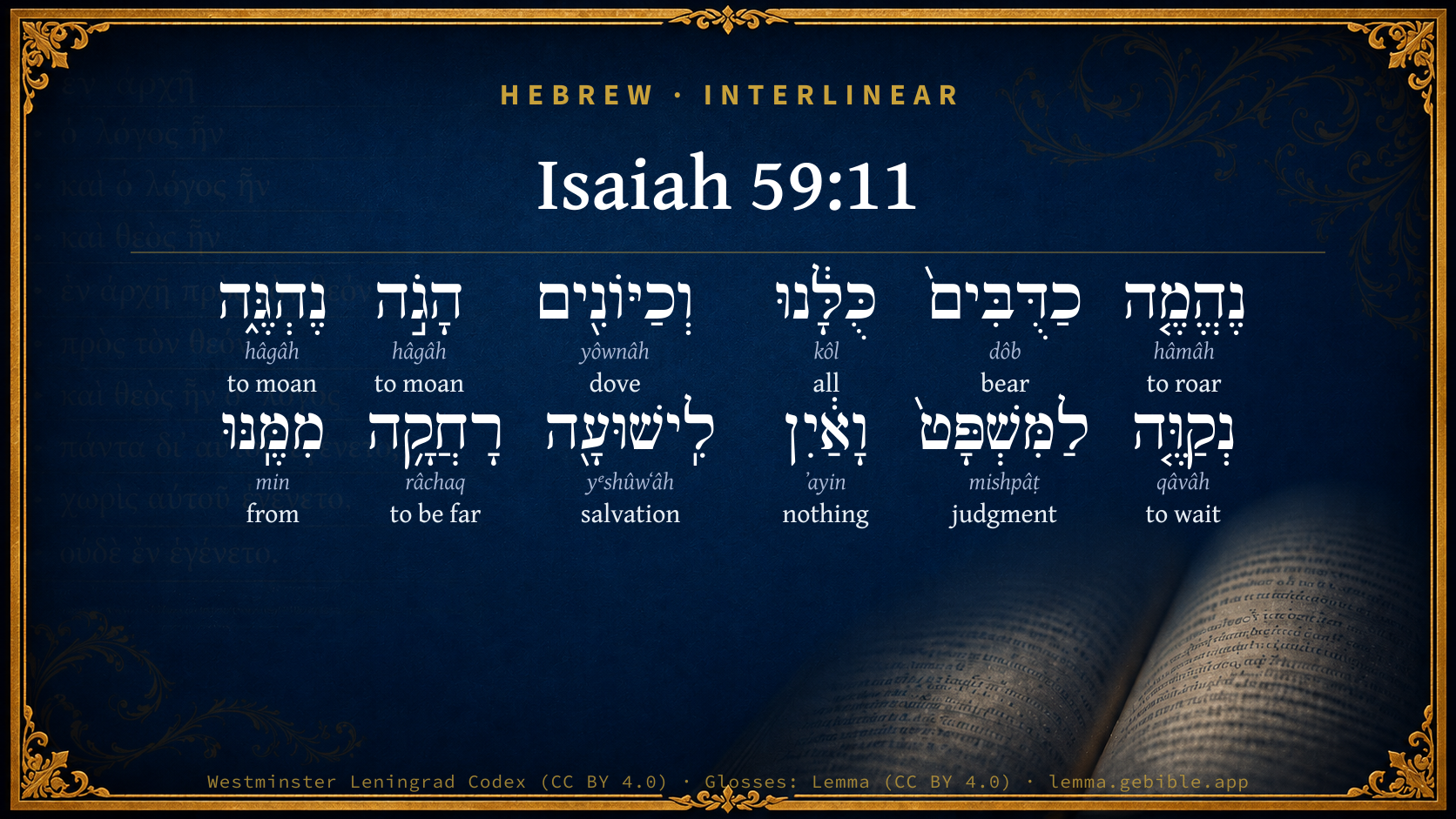
Isaiah 59:11

Hebrew (Westminster Leningrad Codex) Isaiah 59:11 appears in the Hebrew Old Testament. The text above is from the Westminster Leningrad Codex. Each word links to its Strong’s number, a concise gloss, and parsing drawn from the Open Scriptures Hebrew Bible morphology. Click any word for its full Brown-Driver-Briggs (BDB) entry.
Download image
Cite this verse

Isaiah 59:11 (World English Bible). Public Domain. Lemma interlinear Bible study tool, https://lemma.gebible.app/v/isaiah/59/11.

Show BibTeX & RIS
BibTeX
RIS
English Translation
We roar all like bears, and moan sore like doves: we look for justice, but there is none; for salvation, but it is far off from us.
World English Bible · Public Domain
Download a study sheet

One document with this verse’s original text, its word-by-word gloss line, the meaning frame, cross-references with their text, attributed commentary, and full source and license credits — printable, and it pastes into notes with its structure intact.

This verse Autodidact and up

Study sheet (.html) Plain text (.txt)

A passage Seminary Student

Up to 50 verses in one chapter. A passage sheet keeps up to 6 commentary sources and 12 cross-references per verse, in the order this page ranks them, and says so on the sheet whenever that leaves anything out. Ask for a single verse and you get the Autodidact verse sheet above.

Everything on this page stays free to read, with no account — the sheet is a download of what is already on screen, not access to it.

Want to remove ads? Support Godless Engineer
Compare translations 3

The same verse in 3 English versions, stacked beneath the original-language interlinear above. Click any original word for its lexicon entry.

Each is an independent rendering of the whole verse — the interlinear is not word-aligned to these translations.

Highlighted words mark where these versions differ — a whole-verse word diff, not a word-by-word alignment.

  • World English Bible Public Domain
    We roar all like bears, and moan sore like doves: we look for justice, but there is none; for salvation, but it is far off from us.
  • King James Version Public Domain
    We roar all like bears, and mourn sore like doves: we look for judgment, but there is none; for salvation, but it is far off from us.
  • unfoldingWord Literal Text CC BY-SA 4.0
    We growl like bears, all of us, and like doves, murmuring, we murmur. We wait for justice, but there is none; for salvation, it is far from us. q1

unfoldingWord Literal Text — © unfoldingWord, licensed CC BY-SA 4.0. Word-aligned USFM3 via Door43 (git.door43.org/unfoldingWord/en_ult).

Versions to compare (up to 4)

3 of 4 selected

Show all 18 translations

Every available English version of this verse, each an independent rendering of the whole verse.

  • World English Bible Public Domain
    We roar all like bears, and moan sore like doves: we look for justice, but there is none; for salvation, but it is far off from us.
  • Berean Standard Bible Public Domain
    We all growl like bears and moan like doves. We hope for justice, but find none, for salvation, but it is far from us.
  • Majority Standard Bible Public Domain
    We all growl like bears and moan like doves. We hope for justice, but find none, for salvation, but it is far from us.
  • King James Version Public Domain
    We roar all like bears, and mourn sore like doves: we look for judgment, but there is none; for salvation, but it is far off from us.
  • American Standard Version (1901) Public Domain
    We roar all like bears, and moan sore like doves: we look for justice, but there is none; for salvation, but it is far off from us.
  • Revised Version (1885) Public Domain
    We roar all like bears, and mourn sore like doves: we look for judgment, but there is none; for salvation, but it is far off from us.
  • Geneva Bible (1599) Public Domain
    We roare all like beares, and mourne like dooues: wee looke for equitie, but there is none: for health, but it is farre from vs.
  • Douay-Rheims (1899) Public Domain
    We shall roar all of us like bears, and shall lament as mournful doves. We have looked for judgment, and there is none: for salvation, and it is far from us.
  • Young's Literal Translation Public Domain
    We make a noise as bears -- all of us, And as doves we coo sorely; We wait for judgment, and there is none, For salvation -- it hath been far from us.
  • Literal Standard Version CC BY-SA 4.0
    We make a noise as bears—all of us, || And we coo severely as doves; We wait for judgment, and there is none, || For salvation—it has been far from us.
  • Unlocked Literal Bible CC BY-SA 4.0
    We growl like bears and moan like doves; we wait for justice, but there is none; for rescue, but it is far from us.
  • unfoldingWord Literal Text CC BY-SA 4.0
    We growl like bears, all of us, and like doves, murmuring, we murmur. We wait for justice, but there is none; for salvation, it is far from us. q1
  • Darby Bible Public Domain
    We roar all like bears, and mourn grievously like doves: we look for judgment, and there is none; for salvation, [but] it is far from us.
  • World Messianic Bible Public Domain
    We all roar like bears and moan sadly like doves. We look for justice, but there is none, for salvation, but it is far off from us.
  • Webster's Bible Public Domain
    We all roar like bears, and mourn bitterly like doves: we look for judgment, but there is none; for salvation, but it is far from us.
  • Free Bible Version CC BY-SA 4.0
    All of us growl like bears and coo like doves as we wait for justice to be done, but it never happens; we wait for salvation, but never receive it.
  • Bible in Basic English Public Domain
    We make noises of grief, like bears, and sad sounds like doves: we are looking for our right, but it is not there; for salvation, but it is far from us.
  • JPS Tanakh (1917) Public Domain
    We all growl like bears, and mourn sore like doves; we look for right, but there is none; for salvation, but it is far off from us.

Literal Standard Version (2020), Covenant Press — licensed CC BY-SA 4.0. Text via the HelloAO Bible API (eBible.org). Unlocked Literal Bible (unfoldingWord) — licensed CC BY-SA 4.0. Text via the HelloAO Bible API (eBible.org). unfoldingWord Literal Text — © unfoldingWord, licensed CC BY-SA 4.0. Word-aligned USFM3 via Door43 (git.door43.org/unfoldingWord/en_ult). Free Bible Version, Dr. Jonathan Gallagher — licensed CC BY-SA 4.0. Text via the HelloAO Bible API (eBible.org).

Word by word

More ways to search: Search by grammar → Find every occurrence → Compare this word →

Practice this passage: Drill this verse → Learn its vocabulary →

כַדֻּבִּים֙
dôb
H1677
“like/as the · bears”
Preposition, Determined + Noun, Common, Masculine, Plural, Absolute
Part of Speech
Preposition + Noun
Type
Common
Gender
Masculine
Number
Plural
State
Absolute
Full BDB Definition

Origin: from H1680

TWOT: 396a

bear
  1. נֶהֱמֶ֤ה hâmâh H1993 “to roar” Verb, Qal, Imperfect, 1st Person, Common, Plural
  2. כֻּלָּ֔נוּ kôl H3605 “all · our” Noun, Common, Masculine, Singular, Construct + Suffix, Personal, 1st Person, Common, Plural
  3. וְכַיּוֹנִ֖ים yôwnâh H3123 “and · like/as the · doves” Conjunction + Preposition, Determined + Noun, Common, Feminine, Plural, Absolute
  4. הָגֹ֣ה hâgâh H1897 “to moan” Verb, Qal, Infinitive Absolute
  5. נֶהְגֶּ֑ה hâgâh H1897 “to moan” Verb, Qal, Imperfect, 1st Person, Common, Plural
  6. נְקַוֶּ֤ה qâvâh H6960 “to wait” Verb, Piel, Imperfect, 1st Person, Common, Plural
  7. לַמִּשְׁפָּט֙ mishpâṭ H4941 “to/for the · judgment” Preposition, Determined + Noun, Common, Masculine, Singular, Absolute
  8. וָאַ֔יִן ʼayin H369 “and · nothing” Conjunction + Particle, Negative
  9. לִֽישׁוּעָ֖ה yᵉshûwʻâh H3444 “to/for · salvation” Preposition + Noun, Common, Feminine, Singular, Absolute
  10. רָחֲקָ֥ה râchaq H7368 “to be far” Verb, Qal, Perfect, 3rd Person, Feminine, Singular
  11. מִמֶּֽנּוּ min H4480 “from · us” Preposition + Suffix, Personal, 1st Person, Common, Plural

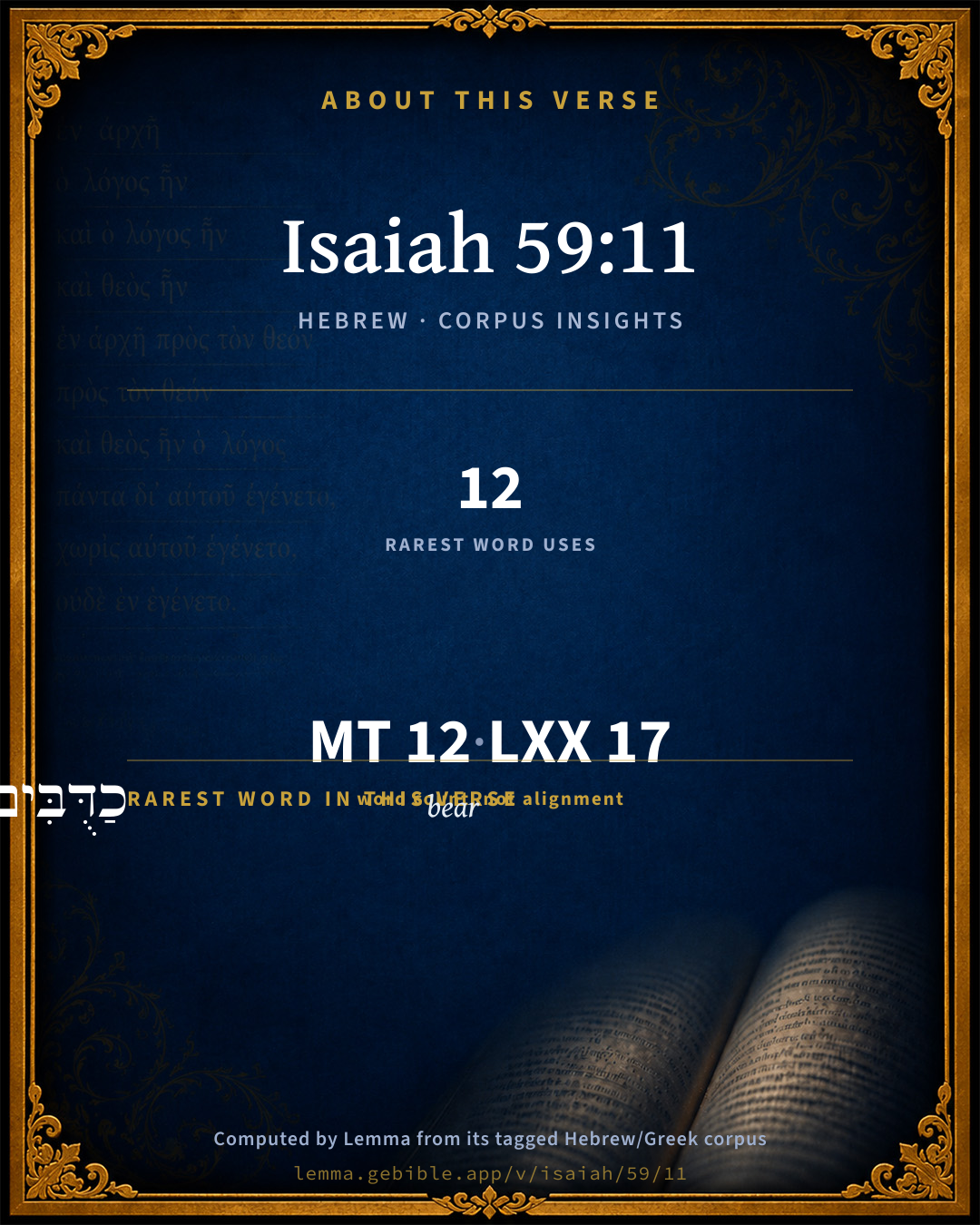
About this verse

These counts appear in no published source. They are computed here, from the morphology-tagged text and Lemma’s own curated glosses. What Lemma adds →

12
words
11
distinct lemmas
Prophets
section

Notable vocabulary

The rarest word here is כַדֻּבִּים֙ bear H1677 — appearing just 12 times in the whole Hebrew Bible.

Shared distinctive vocabulary

כַדֻּבִּים֙ bear H1677 occurs in 12 verses of the Hebrew Bible. Also found in:

Grammatical profile

  • 5 verbs
  • 5 nouns
  • 1 preposition
  • 1 particle

Verb forms

  • נֶהֱמֶ֤ה Qal · Imperfect
  • הָגֹ֣ה Qal · Infinitive Absolute
  • נֶהְגֶּ֑ה Qal · Imperfect
  • נְקַוֶּ֤ה Piel · Imperfect
  • רָחֲקָ֥ה Qal · Perfect

Repetition

A word recurs within this verse — often emphatic in Hebrew:

  • הָגֹ֣ה to moan H1897 ×2

Hebrew & Septuagint length

In English translation the verse runs 27 words from the Hebrew and 27 from the Septuagint (LXX English) — the same length.

A rough comparison of the two English renderings, which tokenize alike — not a word-level alignment.

Word counts can differ between the Hebrew and the Greek without any difference in meaning — e.g. the Hebrew direct-object marker אֵת has no separate Greek word, and Greek often adds the article ὁ.

In the original languages it is 12 Hebrew tokens and 17 Greek tokens — but the two are counted differently (Hebrew bundles its prefixes and suffixes into one token; the Greek is in lemma form), so that isn’t a like-for-like length.

Cross-references

12

Topical passages linked to Isaiah 59:11 in the Treasury of Scripture Knowledge — connected by theme and wording, ordered by reader-vote popularity; previews shown in the World English Bible.

  • Isaiah 38:14 Like a swallow [or] a crane, so did I chatter; I did moan as a dove; my eyes fail [with looking] upward: Lord, I am oppressed, be my collateral.
  • Ezekiel 7:16 But those of those who escape shall escape, and shall be on the mountains like doves of the valleys, all of them moaning, every one in his iniquity.
  • Job 30:28–29 I go mourning without the sun. I stand up in the assembly, and cry for help.
  • Psalms 32:3–4 When I kept silence, my bones wasted away through my groaning all day long.
  • Psalms 38:8 I am faint and severely bruised. I have groaned by reason of the anguish of my heart.
  • Psalms 85:9 Surely his salvation is near those who fear him, That glory may dwell in our land.
  • Psalms 119:155 Salvation is far from the wicked, For they don't seek your statutes.
  • Isaiah 51:20 Your sons have fainted, they lie at the head of all the streets, as an antelope in a net; they are full of the wrath of Yahweh, the rebuke of your God.
  • Isaiah 59:9 Therefore is justice far from us, neither does righteousness overtake us: we look for light, but, behold, darkness; for brightness, but we walk in obscurity.
  • Jeremiah 8:15 We looked for peace, but no good came; [and] for a time of healing, and, behold, dismay!
  • Jeremiah 9:1 Oh that my head were waters, and my eyes a spring of tears, that I might weep day and night for the slain of the daughter of my people!
  • Hosea 7:14 They haven't cried to me with their heart, But they howl on their beds. They assemble themselves for grain and new wine. They turn away from me.

Cross-references courtesy of OpenBible.info (CC BY 4.0).

Hebrew and Greek witnesses Masoretic Hebrew ↔ Greek Septuagint

The same verse in the two great witnesses to the Old Testament, shown verse-for-verse.

These are two independent witnesses, not word-aligned to each other, and the Septuagint is shown in lemma (dictionary) form.

Hebrew Isaiah 59:11 Masoretic · Westminster Leningrad Codex

נֶהֱמֶ֤ה כַדֻּבִּים֙ כֻּלָּ֔נוּ וְכַיּוֹנִ֖ים הָגֹ֣ה נֶהְגֶּ֑ה נְקַוֶּ֤ה לַמִּשְׁפָּט֙ וָאַ֔יִן לִֽישׁוּעָ֖ה רָחֲקָ֥ה מִמֶּֽנּוּ

We roar all like bears, and moan sore like doves: we look for justice, but there is none; for salvation, but it is far off from us.

World English Bible · Public Domain

Greek LXX Isaiah 59:11 Septuagint · lemma form

ὡς ἄρκος καί ὡς περιστερά ἅμα πορεύομαι ἀναμένω κρίσις καί οὐ εἰμί σωτηρία μακράν ἀποἵστημι ἀπό ἐγώ

They shall proceed together as a bear and as a dove: we have waited for judgment, and there is no salvation, it is gone far from us.

LXX2012 (modern English Septuagint) · Public Domain

Hebrew: Westminster Leningrad Codex (CC BY 4.0). Greek: Septuagint (public domain); English from LXX2012 (modern English Septuagint) (Public Domain). How the Septuagint differs from the Hebrew →

Targum (Aramaic paraphrase)

1

The Targum is the ancient Jewish Aramaic paraphrase of the Hebrew Scriptures — an interpretive translation, not the Hebrew text itself. Onkelos (literal) and Pseudo-Jonathan (expansive) render the Torah, and Jonathan the Prophets. Coverage is partial: where no permissively-licensed English translation exists for a verse, only the Aramaic is shown. This is verse-level text, not a word-by-word alignment to the Hebrew.

  1. Targum Jonathan Prophets (Joshua–Malachi)
    עַסֵינָא מִן קֳדָם בַּעֲלֵי דְבָבָנָא דְמִתְכַּנְשִׁין עֲלָנָא כְּדוּבִין כּוּלָנָא וּכְיוֹנִין נָהָמָא נָהֵימְנָא סַבַּרְנָא לְדִינָא וְלֵית לְפוּרְקָנָא אִתְרְחֵק מִנָנָא:

    We all roar like bears by reason of our enemies, who are gathered against us, and mourn like doves: we hoped for judgment, but there is none; for salvation, but it is far removed from us.

    Targum Jonathan — Aramaic: “Mikraot Gedolot” (public domain). English: “Sefaria Community Translation” (CC0 1.0 (public-domain dedication)); “London "Chaldee Paraphrase," 1871” (public domain). Text via Sefaria.

Commentary

Notes on Isaiah 59:11 from classic Christian and Jewish commentators (each source and its license shown beneath its notes). The classic Christian expositions comment on the surrounding passage and are grouped to its opening verse, so a note may address several verses; the Jewish commentaries on the Tanakh (Rashi and others) are per-verse, so they appear only where the commentator wrote on this verse.

Lemma curates 59 commentaries, every one of them public domain or Creative Commons licensed, each selected and text-cleaned for this edition rather than reprinted as found. About our sources →

Trapp's Complete Commentary

John Trapp

Isa 59:11 We roar all like bears, and mourn sore like doves: we look for judgment, but [there is] none; for salvation, [but] it is far off from us.

Ver. 11. We roar all like bears.] Fremimus, ac gemimus. The bear, when hurt or robbed, runs into his den and roareth; doves, when bereft of their mates, sit solitary and groan; so do we, indesinenter et intime gemimus, make pitiful moan; and that is all we can do.

John Trapp, A Commentary or Exposition upon All the Books of the Old and New Testament (1647–1656) — public domain. Text from a community e-Sword module.

Tyndale Open Study Notes

Tyndale Open Resources

59:11-14 The people growl and moan with longing for redemption, finally coming to terms with their sinfulness.

Tyndale Open Study Notes — © Tyndale Open Resources, licensed CC BY-SA 4.0. Text via the HelloAO Bible API.

Geneva Bible (1599)

Geneva Bible translators

We express our sorrows by outward signs, some more, some less.

Geneva Bible (1599) marginal notes — public domain. Text via Bolls.life.

Jamieson, Fausset & Brown

Robert Jamieson, A. R. Fausset & David Brown

roar--moan plaintively, like a hungry bear which growls for food.

doves-- (Isa 38:14; Eze 7:16).

salvation--retribution in kind: because not salvation, but "destruction" was "in their paths" (Isa 59:7).

Jamieson, Fausset & Brown — Commentary Critical and Explanatory on the Whole Bible (1871) — public domain (CC PDM 1.0). Text via the HelloAO Bible API.

Adam Clarke's Commentary

Verse 11. But it is far off from us - "And it is far distant from us."] The conjunction ו vau must necessarily be prefixed to the verb, as the Syriac, Chaldee, and Vulgate found it in their copies; ורחקה verachakah, "and far off."

Adam Clarke's Commentary on the Bible (1810–1826) — public domain. Text from a community e-Sword/MySword module.

Ellicott's Commentary for English Readers

(11) We roar all like bears . . .—The comparison is not found elsewhere in Scripture, but Horace (Epp. xvi. 51) gives “circumgemit ursus ovile.” For the dove, comp. Isa_38:14; Eze_7:16.

A Bible Commentary for English Readers, edited by Charles John Ellicott (1878–1897) — public domain. Text from a community e-Sword module.

The Cambridge Bible for Schools and Colleges

gen. ed. J. J. S. Perowne

11. We roar (better groan) all like bears] Comp. (with Gesenius) Horace, Epod. 16. 51:

“Nec vespertinus circumgemit ursus ovile.”

The comparison would no doubt gain in force if we could suppose, as Duhm hesitatingly suggests, that captive animals, pining for liberty, are meant. But this is not indicated.

On the “mourning” of the dove, cf. ch. Isa_38:14; Eze_7:16; Nah_2:7; and see Davidson’s Ezekiel (Cambridge Bible), p. 49.

we look for judgment, &c.] returning to the thought of Isa_59:9.

12–15a. Confession of the sins previously denounced, the prophet speaking in the name of the people.

The Cambridge Bible for Schools and Colleges (gen. ed. J. J. S. Perowne; Cambridge University Press, 1878–1918) — public domain. Text from a community e-Sword module.

John Gill's Exposition

We roar all like bears, and mourn sore like doves,.... Some in a more noisy and clamorous, others in a stiller way, yet all in private: for the bear, when robbed of its whelps, goes to its den and roars; and the dove, when it has lost its mate, mourns in solitude: this expresses the secret groanings of the saints under a sense of sin, and the forlorn state of religion. The Targum paraphrases it thus,

"we roar because of our enemies, who are gathered against us as bears; all of us indeed mourn sore as doves:''

we look for judgment, but there is none; for salvation, but it is far from us; we expect that God will take vengeance on our enemies, and save us; look for judgment on antichrist, and the antichristian states, and for the salvation of the church of God; for the vials of divine wrath on the one, and for happy times to the other; but neither of them as yet come; the reason of which is as follows.

John Gill's Exposition of the Whole Bible (1746–1763) — public domain (CC PDM 1.0). Text via the HelloAO Bible API.

Albert Barnes' Notes on the Bible

We roar all like bears - This is designed still further to describe the heavy judgments which had come upon them for their sins. The word rendered here ‘roar’ (from המה hâmâh, like English, to hum, German, hummen, spoken of bees), is applied to any murmuring, or confused noise or sound. It sometimes means to snarl, as a dog Psa 59:7, Psa 59:15; to coo, as a dove Eze 7:16; it is also applied to waves that roar Psa 46:4; Isa 51:15; to a crowd or tumultuous assemblage Psa 46:7; and to music Isa 16:11; Jer 48:36. Here it is applied to the low growl or groan of a bear. Bochart (Hieroz. i. 3. 9), says, that a bear produces a melancholy sound; and Horace (Epod. xvi. 51), speaks of its low groan:

Nee vespertinus circumgemit ursus ovile.

Here it is emblematic of mourning, and is designed to denote that they were suffering under heavy and long-continued calamity. Or, according to Gesenius (Commentary in loc.), it refers to a bear which is hungry, and which growls, impatient for food, and refers here to the complaining, dissatisfaction, and murmuring of the people, because God did not come to vindicate and relieve them.

And mourn sore like doves - The cooing of the dove, a plaintive sound, is often used to denote grief (see Eze 7:16; compare the notes at Isa 38:14).

We look for judgment ... - (See the notes at Isa 59:9.)

Albert Barnes' Notes on the Bible (1834–1885) — public domain. Text from a community e-Sword/MySword module.

Haydock's Catholic Bible Commentary

Judgment, that God would avenge us, (ver. 9.) and regard our fasts, chap. lviii. 3.

George Leo Haydock (1774–1849), Haydock's Catholic Family Bible and Commentary, 1859 edition — public domain. Excludes Psalms (Douay-Rheims chapter numbering differs from Protestant) and Deuterocanonical books (Catholic canon only).

Matthew Poole's English Annotations

We roar: this signifies the greatness of their anguish, that forced from them these loud outcries.

And mourn: this notes some sense of their condition, that wrought in them these sorrowful lamentations; or it may relate to the condition that both sorts of people were in under their oppressing governors. It made the wicked roar like bears, and the godly mourn like doves. It is thus expressed because these properties are peculiar to these creatures. The bear, when robbed, goes into his den and roars; the dove, when absent from her mate, sits solitary and mourns.

For salvation, but it is far off from us: see the exposition of this last part of the verse Isa 59:9.

Matthew Poole's English Annotations on the Holy Bible (1683–1685) — public domain. Text from a community e-Sword/MySword module.

The Pulpit Commentary

We roar all like bears; rather, we growl. The verb is used commonly of the "roaring" of the sea; (Isa_17:12 Isa_51:15 Jer_6:23 Jer_31:4-5 Jer_50:42 Jer_51:55) but is applied also to the noise made by a dog. (Psa_59:6, Psa_59:14) Here it represents the deep murmur of discontent, which alternates with the mournful tones of Israel"s despondency the latter being compared to the melancholy cooing of the dove. (see Isa_38:14) We look for judgment, but there is none, etc. The same complaint as in ver. 9, clause 1.

The Pulpit Commentary (1880–1919), ed. H.D.M. Spence-Jones & Joseph S. Exell — public domain. Text from a community e-Sword module.

John Wesley's Explanatory Notes

Mourn - Their oppressing governors made the wicked roar like bears, and the good mourn like doves.

John Wesley, Explanatory Notes Upon the Whole Bible (1754–1765) — public domain. Text via the GEBible commentary corpus.

J. A. Alexander on Isaiah

Joseph Addison Alexander

“We growl like the bears, all of us, and like the doves we moan (we) moan; we wait for justice and there is none, for salvation (and) it is far from us.” The Latin poets also speak of the voice of bears and doves as a gemitus or groaning. (See above, Isa 38:14, and Eze 7:16) The same effect which is produced in the first clause by the use of the phrase ‘all of us’, is produced in the other by the idiomatic repetition of the verb. Here, as in v. 9, we may understand by judgment or justice that which God does by His providential dispensations both to His people and His enemies.

Joseph Addison Alexander, The Prophecies of Isaiah (1846–1847; New York: Scribner, 1870–1878) — public domain. Text from a community e-Sword module.

unfoldingWord translationNotes

Door43 World Missions Community

General Information:

Isaiah continues speaking to the people of Israel.

We growl like bears and moan like doves

These refer to the sounds the people made because they were distressed and mourning. (See: Simile)

translationWords

dove

just

unfoldingWord translationNotes — © Distant Shores Media and the Door43 World Missions Community, licensed CC BY-SA 4.0. Source: git.door43.org/Door43/en_tn.

Rashi

Rabbi Shlomo Yitzchaki (Rashi)

we moan Heb. הָגֹה נֶהְגֶה, an expression of wailing.

Rashi on the Tanakh — English translations: “The Judaica Press complete Tanach with Rashi, translated by A. J. Rosenberg” (CC BY 4.0); “Pentateuch with Rashi's commentary by M. Rosenbaum and A.M. Silbermann, 1929-1934” (public domain); “The Metsudah Tanach series, Lakewood, N.J” (CC BY 4.0); and “The Book of Joshua, Metsudah Publications, 1997” (CC BY 4.0). Text via Sefaria.

Ibn Ezra

Rabbi Abraham ibn Ezra

We roar, etc. We cry, but nobody comes to our assistance, nobody comes to do us justice.

Ibn Ezra on the Tanakh — English translations: “Sefaria Community Translation” (CC0 1.0 (public-domain dedication)); “Yalkut, Sifsei Chachomim Chumash, Metsudah Publications, 2009” (CC BY 4.0); and “Commentary of Ibn Ezra on Isaiah - trans. by M. Friedlander, 1873” (public domain). Text via Sefaria.

Lesson kit

Teaching starters — assembled from the data on this page, not authored interpretation. Every prompt links to the verse data it draws on. Edit before teaching.

Isaiah, in the Prophets, opens this verse with 12 words (11 distinct Hebrew lemmas). Its most distinctive word is dôb (“bear”). A historical commentator’s framing appears above. Read the whole chapter for the surrounding context.

Discussion questions

  1. What does “bear” (dôb) contribute to the verse as a whole?
  2. How does 1 Samuel 17:34, which shares the word «bear», read alongside this verse?
  3. What does the repetition of “to moan” (2× in this one verse) do in this verse?
  4. These translations render this verse differently. What is at stake in choosing one wording over another?
  5. «נֶהֱמֶ֤ה» is a Qal Imperfect verb. How does that grammatical form shape the action described?
  6. Compare how Trapp's Complete Commentary and Tyndale Open Study Notes read this verse. Where do they agree or differ?

Things to notice

Reading settings

Reading text

Shown beneath each verse's original-language words.

Old Testament
Old Testament edition

Read the OT as the Masoretic Hebrew (MT) or the Greek Septuagint (LXX).

English shown for the Greek Septuagint (in the Hebrew ↔ Greek comparison).

Comparing translations? Open the Compare panel on any verse page to stack up to four side by side.