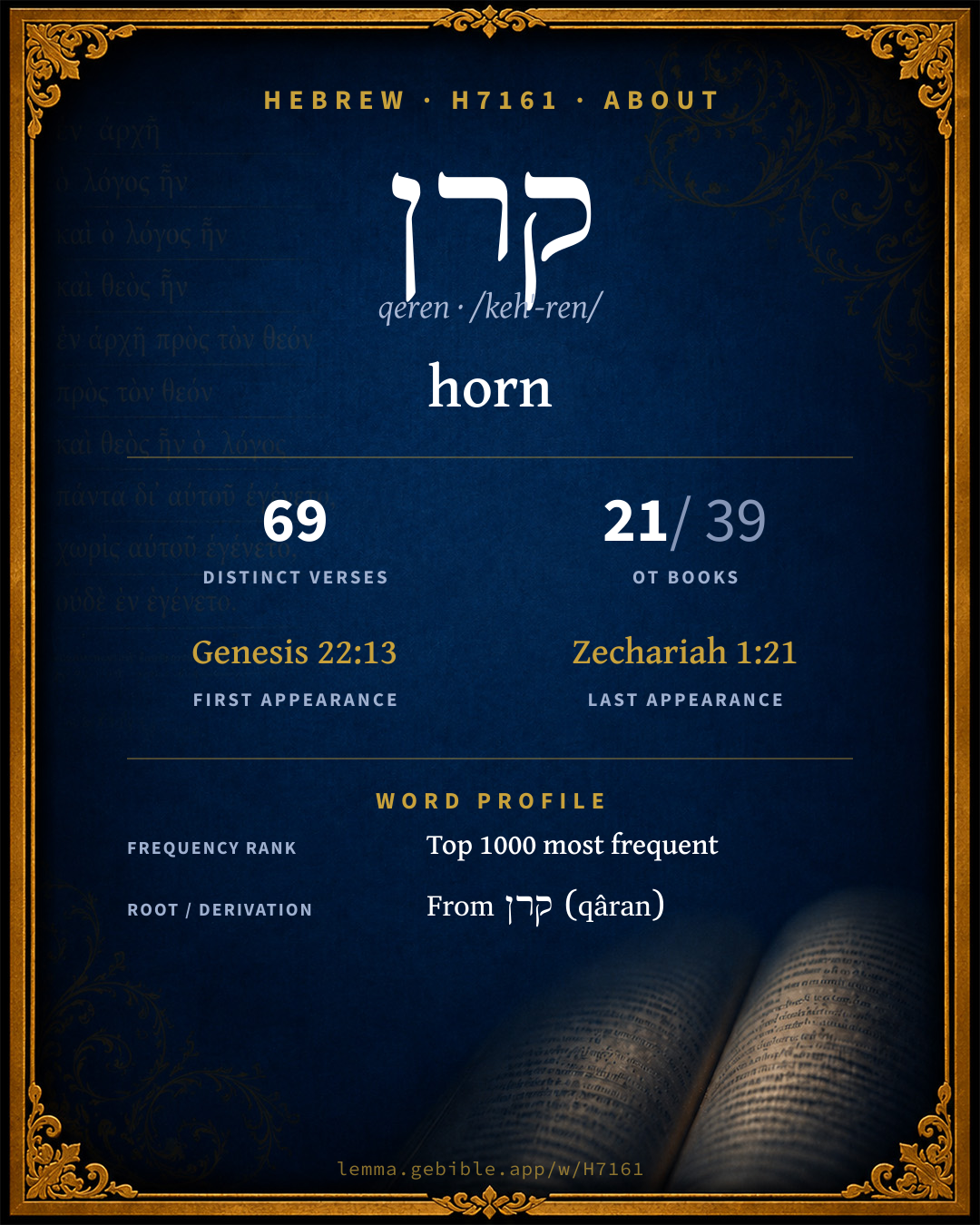
קֶ֫רֶן
horn
‘horn’ is one of 2 main senses fuller range ↓
Full lexicon entry — Brown-Driver-Briggs (BDB)
From Brown-Driver-Briggs (BDB)
Where this word appears
See every Construct-state word in the Hebrew Bible →
Grammar key — what these labels mean
Part of speech
- Noun
- A naming word — a person, place, thing, or idea.
Noun type
- Common
- A common noun — a general class of person, place, or thing (“king,” “city,” “water”), not a specific name.
- Proper
- A name of a specific person, place, or people (e.g. Abraham, Zion, Israel).
State
- Construct
- A noun bound to a following noun in a possessive / “of” relationship (the construct chain).
- Absolute
- The independent form of a noun, not bound to a following word.
Gender
- Both
- Attested as both masculine and feminine.
Number
- Plural
- More than one (in Hebrew, generally three or more).
- Singular
- One.
- Dual
- Exactly two — for natural pairs and some measures of time.
Grammatical forms
- Noun, Common, Both, Plural, Construct 28 times (37%)
- Noun, Common, Both, Singular, Construct 20 times (26%)
- Noun, Common, Both, Singular, Absolute 9 times (12%)
- Noun, Common, Both, Dual, Construct 9 times (12%)
- Noun, Common, Both, Dual, Absolute 5 times (7%)
- Noun, Common, Both, Plural, Absolute 4 times (5%)
- Noun, Proper 1 time (1%)
Parsed forms decoded from the imported morphology (morphhb / Westminster Leningrad Codex — WLC text public domain, morphhb tagging CC BY 4.0), counted across 76 parsed occurrences — not distinct verses.
Every verse where H7161 appears — 69 distinct verses across 21 books. Click any verse to open its interlinear word-by-word view. Verse text shown in the World English Bible for context — . Each verse’s Hebrew form is shown with its reference; the English is not keyword-highlighted, since the data carries no word-level English alignment. Use “Compare translations” on any verse to read it across multiple English versions. This concordance covers the Hebrew Bible; Septuagint (Greek Old Testament) occurrences are not indexed here.
Genesis 1 verse
Exodus 8 verses
- Exodus 27:2 קַרְנֹתָ֗י/ו קַרְנֹתָ֑י/ו n c bp cs + sfx pers 3ms n c bp cs + sfx pers 3ms You shall make its horns on its four corners; its horns shall be of one piece with it; and you shall overlay it with brass.
- Exodus 29:12 קַרְנֹ֥ת n c bp cs You shall take of the blood of the bull, and put it on the horns of the altar with your finger; and you shall pour out all the blood at the base of the altar.
- Exodus 30:2 קַרְנֹתָֽי/ו n c bp cs + sfx pers 3ms Its length shall be a cubit, and its breadth a cubit. It shall be square, and its height shall be two cubits. Its horns shall be of one piece with it.
- Exodus 30:3 קַרְנֹתָ֑י/ו n c bp cs + sfx pers 3ms You shall overlay it with pure gold, the top of it, the sides of it around it, and its horns; and you shall make a gold molding around it.
- Exodus 30:10 קַרְנֹתָ֔י/ו n c bp cs + sfx pers 3ms Aaron shall make atonement on its horns once in the year; with the blood of the sin offering of atonement once in the year he shall make atonement for it throughout your generations. It is most holy to Yahweh."
- Exodus 37:25 קַרְנֹתָֽי/ו n c bp cs + sfx pers 3ms He made the altar of incense of acacia wood. It was square: its length was a cubit, and its breadth a cubit. Its height was two cubits. Its horns were of one piece with it.
- Exodus 37:26 קַרְנֹתָ֑י/ו n c bp cs + sfx pers 3ms He overlaid it with pure gold, its top, its sides around it, and its horns. He made a gold molding around it.
- Exodus 38:2 קַרְנֹתָ֗י/ו קַרְנֹתָ֑י/ו n c bp cs + sfx pers 3ms n c bp cs + sfx pers 3ms He made its horns on its four corners. Its horns were of one piece with it, and he overlaid it with brass.
Leviticus 8 verses
- Leviticus 4:7 קַ֠רְנוֹת n c bp cs The priest shall put some of the blood on the horns of the altar of sweet incense before Yahweh, which is in the tent of meeting; and he shall pour out all the blood of the bull out at the base of the altar of burnt offering, which is at the door of the Tent of Meeting.
- Leviticus 4:18 קַרְנֹ֣ת n c bp cs He shall put some of the blood on the horns of the altar which is before Yahweh, that is in the Tent of Meeting; and the rest of the blood he shall pour out at the base of the altar of burnt offering, which is at the door of the Tent of Meeting.
- Leviticus 4:25 קַרְנֹ֖ת n c bp cs The priest shall take some of the blood of the sin offering with his finger, and put it on the horns of the altar of burnt offering. He shall pour out the rest of its blood at the base of the altar of burnt offering.
- Leviticus 4:30 קַרְנֹ֖ת n c bp cs The priest shall take some of its blood with his finger, and put it on the horns of the altar of burnt offering; and the rest of its blood he shall pour out at the base of the altar.
- Leviticus 4:34 קַרְנֹ֖ת n c bp cs The priest shall take some of the blood of the sin offering with his finger, and put it on the horns of the altar of burnt offering; and all the rest of its blood he shall pour out at the base of the altar.
- Leviticus 8:15 קַרְנ֨וֹת n c bp cs He killed it; and Moses took the blood, and put it on the horns of the altar round about with his finger, and purified the altar, and poured out the blood at the base of the altar, and sanctified it, to make atonement for it.
- Leviticus 9:9 קַרְנ֣וֹת n c bp cs The sons of Aaron presented the blood to him; and he dipped his finger in the blood, and put it on the horns of the altar, and poured out the blood at the base of the altar:
- Leviticus 16:18 קַרְנ֥וֹת n c bp cs "He shall go out to the altar that is before Yahweh and make atonement for it, and shall take some of the bull's blood, and some of the goat's blood, and put it on the horns of the altar round about.
Deuteronomy 1 verse
Joshua 1 verse
1 Samuel 4 verses
- 1 Samuel 2:1 קַרְנִ֖/י n c bs cs + sfx pers 1cs Hannah prayed, and said: My heart exults in Yahweh; My horn is exalted in Yahweh; My mouth is enlarged over my enemies; Because I rejoice in your salvation.
- 1 Samuel 2:10 קֶ֥רֶן n c bs cs Those who strive with Yahweh shall be broken to pieces; Against them will he thunder in the sky: Yahweh will judge the ends of the earth; He will give strength to his king, Exalt the horn of his anointed.
- 1 Samuel 16:1 קַרְנְ/ךָ֜ n c bs cs + sfx pers 2ms Yahweh said to Samuel, How long will you mourn for Saul, seeing I have rejected him from being king over Israel? fill your horn with oil, and go: I will send you to Jesse the Bethlehemite; for I have provided me a king among his sons.
- 1 Samuel 16:13 קֶ֣רֶן n c bs cs Then Samuel took the horn of oil, and anointed him in the midst of his brothers: and the Spirit of Yahweh came mightily on David from that day forward. So Samuel rose up, and went to Ramah.
2 Samuel 1 verse
1 Kings 5 verses
- 1 Kings 1:39 קֶ֤רֶן n c bs cs Zadok the priest took the horn of oil out of the Tent, and anointed Solomon. They blew the trumpet; and all the people said, [Long] live king Solomon.
- 1 Kings 1:50 בְּ/קַרְנ֥וֹת prep + n c bp cs Adonijah feared because of Solomon; and he arose, and went, and caught hold on the horns of the altar.
- 1 Kings 1:51 בְּ/קַרְנ֤וֹת prep + n c bp cs It was told Solomon, saying, Behold, Adonijah fears king Solomon; for, behold, he has laid hold on the horns of the altar, saying, Let king Solomon swear to me first that he will not kill his servant with the sword.
- 1 Kings 2:28 בְּ/קַרְנ֥וֹת prep + n c bp cs The news came to Joab; for Joab had turned after Adonijah, though he didn't turn after Absalom. Joab fled to the Tent of Yahweh, and caught hold on the horns of the altar.
- 1 Kings 22:11 קַרְנֵ֣י n c bd cs Zedekiah the son of Chenaanah made him horns of iron, and said, Thus says Yahweh, With these shall you push the Syrians, until they be consumed.
1 Chronicles 1 verse
2 Chronicles 1 verse
Job 1 verse
Psalms 12 verses
- Psalms 18:2 וְ/קֶֽרֶן conj + n c bs cs Yahweh is my rock, my fortress, and my deliverer; My God, my rock, in whom I take refuge; My shield, and the horn of my salvation, my high tower.
- Psalms 22:21 וּ/מִ/קַּרְנֵ֖י conj + prep + n c bd cs Save me from the lion's mouth; Yes, from the horns of the wild oxen you have answered me.
- Psalms 75:4 קָֽרֶן n c bs I said to the arrogant, "Don't boast;" To the wicked, "Don't lift up the horn.
- Psalms 75:5 קַרְנְ/כֶ֑ם n c bs cs + sfx pers 2mp Don't lift up your horn on high. Don't speak with a stiff neck."
- Psalms 75:10 קַרְנֵ֣י קַֽרְנ֥וֹת n c bd cs n c bp cs I will cut off all the horns of the wicked, But the horns of the righteous shall be lifted up.
- Psalms 89:17 קַרְנֵֽ/נוּ n c bs cs + sfx pers 1cp For you are the glory of their strength. In your favor, our horn will be exalted.
- Psalms 89:24 קַרְנֽ/וֹ n c bs cs + sfx pers 3ms But my faithfulness and my loving kindness will be with him. In my name, his horn will be exalted.
- Psalms 92:10 קַרְנִ֑/י n c bs cs + sfx pers 1cs But you have exalted my horn like that of the wild ox. I am anointed with fresh oil.
- Psalms 112:9 קַ֝רְנ֗/וֹ n c bs cs + sfx pers 3ms He has dispersed, he has given to the poor. His righteousness endures forever. His horn will be exalted with honor.
- Psalms 118:27 קַ֝רְנ֗וֹת n c bp cs Yahweh is God, and he has given us light. Bind the sacrifice with cords, even to the horns of the altar.
- Psalms 132:17 קֶ֣רֶן n c bs There I will make the horn of David to bud. I have ordained a lamp for my anointed.
- Psalms 148:14 קֶ֨רֶן n c bs He has lifted up the horn of his people, The praise of all his saints; Even of the children of Israel, a people near to him. Praise Yah!
Isaiah 1 verse
Jeremiah 2 verses
- Jeremiah 17:1 וּ/לְ/קַרְנ֖וֹת conj + prep + n c bp cs The sin of Judah is written with a pen of iron, [and] with the point of a diamond: it is engraved on the tablet of their heart, and on the horns of your altars;
- Jeremiah 48:25 קֶ֣רֶן n c bs cs The horn of Moab is cut off, and his arm is broken, says Yahweh.
Lamentations 2 verses
- Lamentations 2:3 קֶ֣רֶן n c bs cs He has cut off in fierce anger all the horn of Israel; He has drawn back his right hand from before the enemy: He has burned up Jacob like a flaming fire, which devours round about.
- Lamentations 2:17 קֶ֥רֶן n c bs cs Yahweh has done that which he purposed; he has fulfilled his word that he commanded in the days of old; He has thrown down, and has not pitied: He has caused the enemy to rejoice over you; he has exalted the horn of your adversaries.
Ezekiel 5 verses
- Ezekiel 27:15 קַרְנ֥וֹת n c bp cs The men of Dedan were your traffickers; many isles were the market of your hand: they brought you in exchange horns of ivory and ebony.
- Ezekiel 29:21 קֶ֨רֶן֙ n c bs In that day will I cause a horn to bud forth to the house of Israel, and I will give you the opening of the mouth in the midst of them; and they shall know that I am Yahweh.
- Ezekiel 34:21 וּ/בְ/קַרְנֵי/כֶ֥ם conj + prep + n c bd cs + sfx pers 2mp Because you thrust with side and with shoulder, and push all the diseased with your horns, until you have scattered them abroad;
- Ezekiel 43:15 הַ/קְּרָנ֖וֹת ptcl def.art + n c bp The upper altar shall be four cubits; and from the altar hearth and upward there shall be four horns.
- Ezekiel 43:20 קַרְנֹתָי/ו֙ n c bp cs + sfx pers 3ms You shall take of the blood of it, and put it on the four horns of it, and on the four corners of the ledge, and on the border round about: thus shall you cleanse it and make atonement for it.
Daniel 8 verses
- Daniel 8:3 קְרָנָ֑יִם וְ/הַ/קְּרָנַ֣יִם n c bd conj + ptcl def.art + n c bd Then I lifted up my eyes, and saw, and, behold, there stood before the river a ram which had two horns: and the two horns were high; but one was higher than the other, and the higher came up last.
- Daniel 8:5 קֶ֥רֶן n c bs cs As I was considering, behold, a male goat came from the west over the surface of the whole earth, and didn't touch the ground: and the goat had a notable horn between his eyes.
- Daniel 8:6 הַ/קְּרָנַ֔יִם ptcl def.art + n c bd He came to the ram that had the two horns, which I saw standing before the river, and ran on him in the fury of his power.
- Daniel 8:7 קְרָנָ֔י/ו n c bd cs + sfx pers 3ms I saw him come close to the ram, and he was moved with anger against him, and struck the ram, and broke his two horns; and there was no power in the ram to stand before him; but he cast him down to the ground, and trampled on him; and there was none who could deliver the ram out of his hand.
- Daniel 8:8 הַ/קֶּ֣רֶן ptcl def.art + n c bs The male goat magnified himself exceedingly: and when he was strong, the great horn was broken; and instead of it there came up four notable [horns] toward the four winds of the sky.
- Daniel 8:9 קֶֽרֶן n c bs Out of one of them came forth a little horn, which grew exceeding great, toward the south, and toward the east, and toward the glorious [land].
- Daniel 8:20 הַ/קְּרָנָ֑יִם ptcl def.art + n c bd The ram which you saw, that had the two horns, they are the kings of Media and Persia.
- Daniel 8:21 וְ/הַ/קֶּ֤רֶן conj + ptcl def.art + n c bs The rough male goat is the king of Greece: and the great horn that is between his eyes is the first king.
Amos 2 verses
- Amos 3:14 קַרְנ֣וֹת n c bp cs "For in the day that I visit the transgressions of Israel on him, I will also visit the altars of Bethel; And the horns of the altar will be cut off, And fall to the ground.
- Amos 6:13 קַרְנָֽיִם n Proper You who rejoice in a thing of nothing, who say, 'Haven't we taken for ourselves horns by our own strength?'
Micah 1 verse
Habakkuk 1 verse
Zechariah 3 verses
- Zechariah 1:18 קְרָנֽוֹת n c bp I lifted up my eyes, and saw, and, behold, four horns.
- Zechariah 1:19 הַ/קְּרָנוֹת֙ ptcl def.art + n c bp I asked the angel who talked with me, "What are these?" He answered me, "These are the horns which have scattered Judah, Israel, and Jerusalem."
- Zechariah 1:21 הַ/קְּרָנ֞וֹת קַרְנ֣וֹת קֶ֛רֶן ptcl def.art + n c bp n c bp cs n c bs Then I asked, "What are these coming to do?" He said, "These are the horns which scattered Judah, so that no man lifted up his head; but these have come to terrify them, to cast down the horns of the nations, which lifted up their horn against the land of Judah to scatter it."
About this entry
At a glance — auto-summarized from this page’s data, not written by a person. Every figure links to its source below. This summary describes the numbers; it doesn’t interpret them.
“horn” is the headline sense of the Hebrew word קרן (qeren). Its earliest occurrence is Genesis 22:13. It turns up in 69 verses across 21 books, a moderately common footprint. Its meaning spans more than one sense — see its full sense range. It clusters with קרן, קרן and קרן הפוך under a shared root. See the sense tree, 69-verse concordance, and the renderings breakdown below.
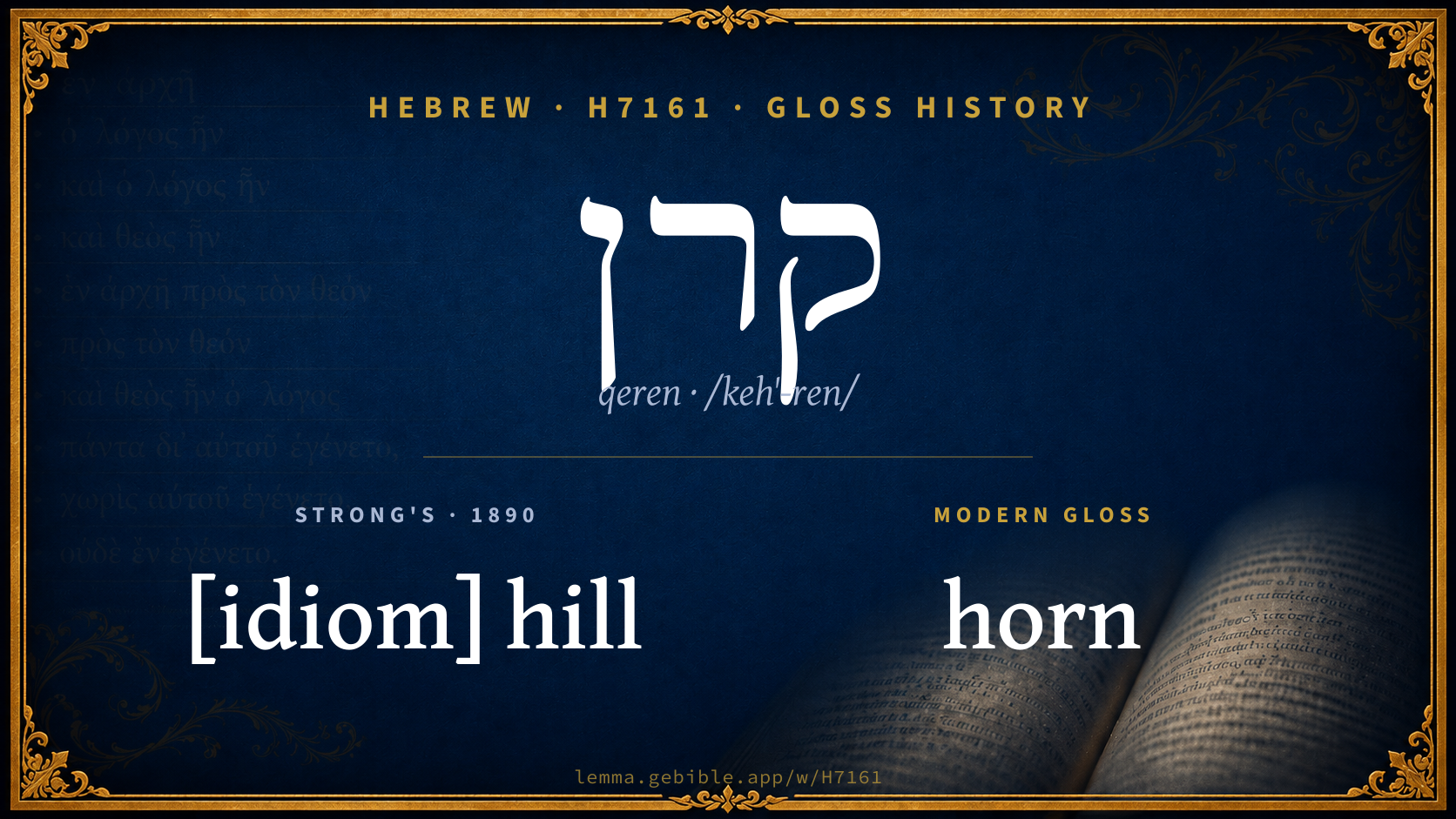
Gloss history
Strong's 1890 vs modern scholarship
About this word
Strong's H7161 catalogs a Hebrew word from the Hebrew Old Testament.
These counts are not copied from any lexicon or concordance. They are computed here, from the morphology-tagged Hebrew Old Testament. What Lemma adds →
- 69
- distinct verses
- The word appears in 69 distinct verses.
- 21 / 39
- OT books
- The word appears in 21 of 39 Old Testament books.
- #523
- by frequency
- Top 1000 most frequent Hebrew words (rank 523 of 8,640 Hebrew words by occurrence).
View all 69 occurrences in the concordance →
By section of the Old Testament
By traditional corpus
Conventional, traditional groupings — biblical authorship is debated, so this is a traditional corpus grouping, not an authorship claim. Each share is this word’s portion of its verses in that division of the Hebrew canon. Each figure is a share of the word’s 69 distinct verses.
- Prophets (Nevi'im) 26 verses · 38%
- Writings (Ketuvim) 25 verses · 36%
- Torah (Pentateuch) 18 verses · 26%
How translations render this word
Counts come from each version’s own published word-to-Strong’s tagging or interlinear alignment — an approximate guide to how each version renders this word, not a word-level alignment the data otherwise carries. Because each total is that version’s own tagged count, the per-version totals vary from one another and need not match the appearance or distinct-verse counts above. These counts may also differ from a printed concordance because Lemma counts each distinctly tagged rendering and does not collapse phrase taggings into a single head-word total. This is a fixed set of word-tagged versions (KJV, ASV, BSB, ULT) and does not change with the reading translation you choose elsewhere. Each version’s license is shown beside its name below (and on Sources).
- King James Version: Horns 36×, Horn 26×, Two horns 3×
- American Standard Version: Horns 29×, Horn 23×, Thereof 3×
- Berean Standard Bible: Horns 37×, Horn 24×, Are the horns 2×
- unfoldingWord Literal Text: Horn 20×, Horns of 20×, Horns 17×
King James Version Public Domain
Renders H7161 across 76 tagged occurrences — most commonly:
Plus 9 renderings that appear only once — usually multi-word phrases or single function words the recovered tagging swept in, not distinct renderings.
American Standard Version Public Domain
Renders H7161 across 76 tagged occurrences — most commonly:
Plus 18 renderings that appear only once — usually multi-word phrases or single function words the recovered tagging swept in, not distinct renderings.
Berean Standard Bible Public Domain
Renders H7161 across 76 tagged occurrences — most commonly:
Plus 11 renderings that appear only once — usually multi-word phrases or single function words the recovered tagging swept in, not distinct renderings.
unfoldingWord Literal Text CC BY-SA 4.0
Renders H7161 across 81 tagged occurrences — most commonly:
Plus 12 renderings that appear only once — usually multi-word phrases or single function words the recovered tagging swept in, not distinct renderings.
8 senses and sub-senses in the full BDB
What do BDB’s symbols mean?
BDB uses these scholarly abbreviations:
| Symbol | Meaning |
|---|---|
| 𝔊 | the Septuagint (the ancient Greek translation, LXX) |
| 𝔙 | the Vulgate (the Latin translation) |
| 𝔖 | the Syriac version (the Peshitta) |
| 𝔗 | the Targum (the Aramaic translation) |
| ψ | the Psalms |
| √ | root (the underlying root or stem) |
| ‖ | parallel passage (a synonymous or contrasted parallel) |
| † | the dagger: every passage where the word occurs is cited |
The 8 senses and sub-senses the full Brown-Driver-Briggs lexicon distinguishes for this word, in lexicon order (not ranked by frequency), with BDB’s own verbatim wording and sub-sense lettering. Shown in Hebrew script with BDB’s own scholarly abbreviations. The condensed entry is in the Lexicon Entry tab. See also the Forms in the corpus table below.
- 1.
- a. of ram (אַיִל) Gn 22:13, so in Daniel’s vision Dn 8:3(×2), 6, 7, 20, and (of goat) v 5, 8, 9, 21; of oppressors in Isr. (under fig. of rams) Ez 34:21, so of nations Zc 2:2(×3); of רְאֵם Dt 33:17 ψ 22:22 (both fig., cf. 92:11); of Zion under fig. of threshing-ox Mi 4:13; ק׳ בַּרְזֶל 1 K 22:11 = 2 Ch 18:10 (symbol.); seen in Zech.’s vision Zc 2:1. e.g. Genesis 22:13
- b. used as oil-flask 1 S 16:1, 13 1 K 1:39 (cf. קֶרֶן הַפּוּךְ Infr.). e.g. 1 Samuel 16:1
- c. ק׳ הַיּוֹבֵל, as wind-instr. Jos 6:5 (cf. שׁוֹפָר). e.g. Joshua 6:5
- d. קַרְנוֹת שֵׁן Ez 27:15 (from curved shape of tusks). e.g. Ezekiel 27:15
- 2. fig., of pers., symbl of strength Dt 33:17, ק׳ יִשְׁעִי 2 S 22:3 = ψ 18:3 (of י׳ as deliverer); others sub 3 or 4; especially as lifted up (רום, as of a lordly animal, cf. Dr 1 S 2:1), denoting increase of might, dignity 1 S 2:1, 10 La 2:17 ψ 75:11; 89:18, 25; 92:11; 112:9, so perhaps 1 Ch 25:5 (v. Kau; > Be blow loudly [cf. 1 c]), + לְעַמּוֹ ψ 148:14 (subj. י׳); also haughtiness, arrogance 75:5, 6; opp. גָּדַע ק׳ hew off horns, i.e. reduce, humiliate, La 2:3 ψ 75:11, pass. Je 48:25, so וְעֹלַלתִּי בֶעָפָר קַרְנִי Jb 16:15; אַצְמִיחַ ק׳ לְבֵית יִשׂ׳ Ez 29:21 is appar. of restoration of might (as ψ 148:14 supr., c. וַיָּרֶם), but אַצ׳ ק׳ לְדָוִד ψ 132:17 of raising up individual ruler of Davidic line. e.g. Deuteronomy 33:17
- 3. of altar, horn-like projections at corners (26 times), Am 3:14; Je 17:1; Ez 43:15, 20 ψ 118:27 Ex 27:2(×2) + 8 times Ex, Lv 4:7, 18 + 6 times Lv (all P); as sanctuary, refuge 1 K 1:50, 51; 2:28. e.g. Amos 3:14
- 4. hill (so in Arabic, peak, isolated hill, cf. Ges) Is 5:1. e.g. Isaiah 5:1
- 5. קַרְנַיִם מִיָּדוֹ לוֹ Hb 3:4 rays at his side(s) had he (of lightning-flashes in theoph, cf. Now Da).—Am 6:13 v. קַרְנַיִם n.pr.loc. e.g. Habakkuk 3:4
Senses from the full Brown-Driver-Briggs lexicon (Brown, Driver, Briggs; Oxford 1906 — public domain), digitized via Sefaria, supplemented by the OpenScriptures HebrewLexicon (CC BY 4.0). Full attribution on Sources.
Word origin
n.f. Je 48:25 horn;—abs. ק׳ Is 5:1 +, קָ֑רֶן, ψ 75:5; cstr. קֶ֫רֶן Jos 6:5 +; sf. קַרְנִי 1 S 2:1 ψ 92:11, etc.; du. קַרְנַיִם Hb 3:4, קְרָנַיִם Dn 8:3, 6, -נָ֑יִם v 3, 20; cstr. קַרְנֵי, קַרְנוֹת ψ 75:11, sf. קַרְנָיו Gn 22:13 Dt 33:17, קְרָנָיו Dn 8:7, קַרְנֵיכֶם Ez 34:21; pl. (usually in der. senses) קְרָנוֹת Ez 43:15 +; cstr. קַרְנֹת Ex 29:12 +, sf. קַרְנֹתָיו 27:2 +, etc.;—horn:
— Brown-Driver-Briggs (Oxford 1906, public domain), digitized via Sefaria, supplemented by the OpenScriptures HebrewLexicon (CC BY 4.0). See Sources.
Derived from קרן (qâran) (H7160) — to shine.
Jastrow Dictionary
A second Hebrew/Aramaic lexicon for comparison, covering Aramaic and post-biblical (Talmudic, Targumic, Midrashic) usage that the biblical-Hebrew BDB does not. Matched by lemma rather than by Strong’s number, so a lemma may carry more than one Jastrow headword (shown separately below), and the entries cover usage well beyond the Bible.
קָרַן
- to emit horns or rays.
- to be horned. Ḥull. 60ᵃ (ref. to Ps. LXIX, 32) מַקְרִין ברישא והדר מפריס first it got horns and then hoofs; v. מַקְרִין II.—Y. R. Hash. III, 58ᵈ top (strike out מקרן כתיב). e.g. Psalms 69:32
קְרַן I
- (cmp. Arab. ḳaran junxit &c.) to join, harness, put to. Y. Kidd. III, 64ᵃ ק׳ זבונה וכ׳ the trader put the beasts to and went off; [Var. קרץ, v. קְרַץ II].
קֶרֶן
- c. (b. h.; v. preced.) [joint, attachment; roundness, fulness,]
- 1. horn. Y. Erub. I, 19ᵇ bot. זכרותו של ק׳, v. זַכְרוּת. R. Hash. III, 2 כל השופרות … ק׳ all shofars (horns) are fit for use on the New Year’s day, except that of a cow, because it is called ḳeren (and not shofar); והלא כל … ק׳ do not all shofars also go by the name of ḳeren? Ib. 26ᵃ; a. v. fr.—Keth. XIII, 2, v. צְבִי.—Esp. (sub. נזק) damage done by an animal’s horn, goring. B. Kam. 2ᵇ. Ib. 4ᵃ; a. fr.—Trnsf. horn, trump, wind instrument. Kel. XI, 7 ק׳ עגולה a round (wound) metal horn; contrad. to פשוטה a plain (straight) horn; Sabb. 47ᵃ; a. fr.—Du. קַרְנַיִם, קַרְנַיִים, קַרְנַיִין; pl. קְרָנִים, קְרָנִין, קְרָנוֹת. Tosef. Par. II (I), 2; Bekh. 44ᵃ. Par. II, 2 פרה שקַרְנֶיהָ וכ׳ a red cow whose horns and hoofs are black; Bekh. l. c. שקרנים וכ׳ (corr. acc.). Ḥull. 60ᵃ, a. e. שור … קְרָנָיו קודמות וכ׳ the ox which Adam sacrificed was born with his horns (full grown) in advance of his hoofs. Par. XII, 9 ק׳ של יוצאי דרכים the travellers’ drinking horns. Gen. R. s. 99 אלו תוקעי ק׳ וכ׳ these (the Levites) blow horns, and those (the Greeks) blow trumpets. Ib. זה בעל ק׳ וזה בעל ק׳ this one (Joseph) is described as endowed with horns (power, Deut. XXXIII, 17), and that one (Rome) is &c. (Dan. VII, 24). Y. Shek. VI, 50ᵃ top כקַרְנֵי וכ׳, v. כִּילּוּיָא. Ib.; Yoma 77ᵇ קרני חגבים the antennæ of locusts; a. fr. e.g. Deuteronomy 33:17
- 2. any projection, point; a) beam, ray. —Pl. as ab. Ex. R. s. 47; Tanḥ. Ki Thissa 37 קרני ההוד the beams of glory, halo; a. e.—b) projecting staff or handle. Par. XII, 9, v. כְּלִיבָה. Lam. R. to I, 16 [read:] קרן גלוסקאן זו this point of the roll of white bread; a. e.—c) (with זוית or without) corner, v. זָוִית. Ber. 17ᵃ שתעמידנו בק׳ אורה … בק׳ חשכה that thou place us in the corner of light (position of honor), and not in the corner of obscurity. Men. 42ᵃ הטיל על הק׳ if one attaches the show-fringes exactly in the corner; a. fr.—Pl. as ab. Ḥull. 31ᵃ, v. אִיזְמֵל. Macc. 12ᵃ תפש בקַרְנוֹתָיו took hold of the projections of the altar; a. fr.—יושבי קרנות those seated at street corners, v. יָשַׁב.—[Gen. R. s. 75, v. יָשַׁב a. קָרוֹן.]
- 3. (cmp. כְּרַן) fulness, essence. Nidd. II, 6, v. כַּרְכּוֹם I.—Esp. principal, capital. B. Kam. IX, 7 משלם ק׳ וחומש וכ׳ must pay the principal (the full value of the stolen goods) and the fine of one-fifth, and bring a guilt-offering; a. v. fr.—Trnsf. the capital of reward or punishment laid aside for the hereafter. Peah I, 1; Tosef. ib. I, 2, sq., v. פֶּרִי; a. fr.—[ק׳ אפל, v. אָפִל II.]
קְרַן II
- 1. horn; trnsf. strength; beam, ray. Targ. Josh. VI, 5. Targ. I Sam. XVI, 1. Targ. Ps. LXXXIX, 18. Targ. Job XLII, 14; a. fr.—B. Bath. 16ᵇ, v. קֶרֶשׁ II. Ber. 62ᵇ (prov.) ק׳ קריא ברומי וכ׳ when the horn calls in (the market of) Rome, son of a trader in figs, sell thy father’s figs (wait not for thy father’s return, if he is absent). Macc. 16ᵇ, a. e. ק׳ דאומנא the surgeon’s horn (in which he receives the blood); a. fr.—Pl. קרְנִין, קַרְנֵי. Targ. I Kings XXII, 11. Targ. Ps. LXIX, 32 (v. Ḥull. 60ᵃ, quoted in preced.); a. fr.—Sabb. 154ᵇ ק׳ דאומנא, v. supra. Ib. 129ᵇ מאה ק׳ בזוזא וכ׳ Ar. a. Ms. O. (ed. קרי, v. Tosaf. a. l.) a hundred horns (hundred blood-lettings) for a Zuz, a hundred heads (hair-cuttings) for a Zuz, a hundred lips (trimmings of mustaches) for nothing. B. Bath. 74ᵃ; a. fr.
- 2. projection; corner. Targ. Prov. XXI, 9; a. e.—Keth. 111ᵃ וקרו לה ק׳ וכ׳ (not ליה) and they shall call it (Babylonia) the corner of salvation. B. Kam. 27ᵇ, v. עַצְרָא. Men. 34ᵃ פיתחא דאַקַּ׳ a door at the corner (having only one post); a. e.—Pl. קַרְנִין, קַרְנָתָא, קַרְנָאתָא; constr. קַרְנַת. Targ. Ex. XXIX, 12. Ib. XXX, 10. Targ. Ps. LXIX, 13; a. e.—B. Bath. 95ᵇ דמיזדבין אק׳ which is sold at the street-corners. Pes. 12ᵇ שית יומא בי ק׳ קאי (not בק׳) at six hours (at noon) the sun stands between the corners (of the globe, equally distant from east and west &c.).
- 3. essence, v. כְּרֵן.
- 4. principal, stock. B. Mets. 79ᵃ; B. Kam. 3ᵃ, v. כְּלֵי I. Y. M. Kat. II, 81ᵇ top אגרא וק׳ קרן הוא וכ׳ the expected profit and the principal (cost price) are together considered as principal &c.; a. e.—[קרנא זול, v. קַרְנָזוֹל.]
A Dictionary of the Targumim, the Talmud Babli and Yerushalmi, and the Midrashic Literature (Marcus Jastrow; London, Luzac, 1903) — Public Domain. Digitized via Sefaria. Digitized via Sefaria. Full attribution on Sources.
Forms in the corpus
The 58 distinct written forms H7161 takes in the Hebrew Bible, most frequent first — each parse links to that state’s occurrences in the concordance. Hebrew forms include their vowel points and cantillation, so a single lemma takes many written forms.
Same root — word family
Other BDB entries built from the same root as H7161, grouped by Strong’s listed origin. These share a root / origin per the lexicon — not necessarily a shared meaning. Each links to that word’s own entry.
Derives from
Derived from this word
Proper names from this root
People and places named from this root — a name, not an additional meaning of the word.
Compare all same-root words → 1 of the same-root words is a proper name (a person or place). They share a root, not necessarily a meaning.
Septuagint verse parallels
This word appears in 58 verses that also exist in the Greek Old Testament (Septuagint), out of the 69 Hebrew verses it occurs in. You can read those verses in Greek by switching the Old Testament edition to the Septuagint.
Read these verses in the Septuagint
- Genesis 22:13
- Exodus 27:2
- Leviticus 4:7
- Deuteronomy 33:17
- Joshua 6:5
- 1 Samuel 2:1
- 2 Samuel 22:3
- 1 Kings 1:39
- 1 Chronicles 25:5
- 2 Chronicles 18:10
- Job 16:15
- Psalms 18:2
This is a verse-level parallel only — the same verses exist in both the Hebrew and Greek Old Testaments. No word-level Hebrew↔Greek correspondence is claimed: the data carries no such alignment, so no Greek word is shown as this Hebrew word’s translation. Coverage is not total — the Septuagint omits the deuterocanon and renumbers the Psalms, so some Hebrew verses have no direct Greek parallel.