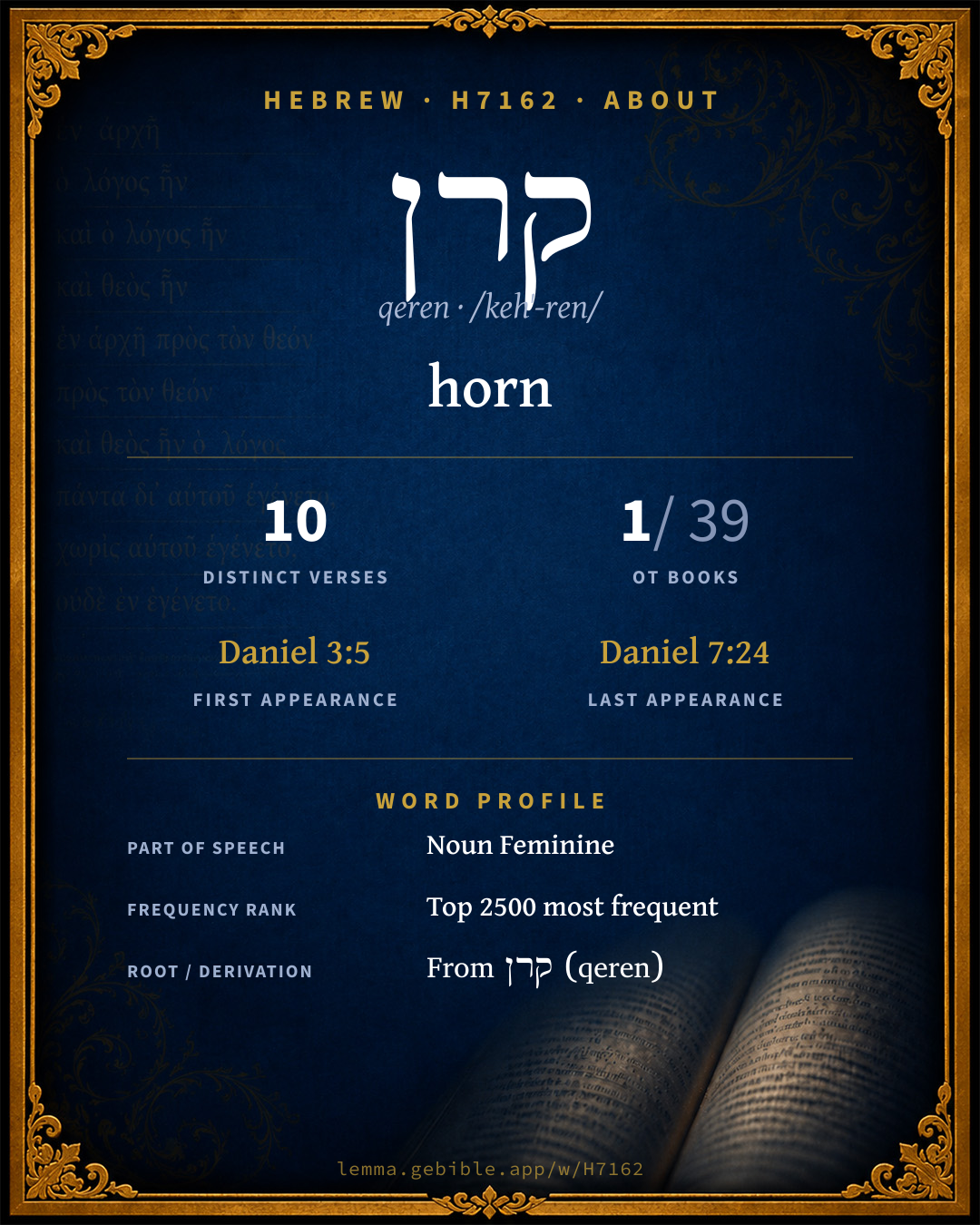
קֶ֫רֶן
horn
‘horn’ is one of 4 main senses fuller range ↓
Full lexicon entry — Brown-Driver-Briggs (BDB)
From Brown-Driver-Briggs (BDB)
Where this word appears
Grammar key — what these labels mean
Part of speech
- Noun
- A naming word — a person, place, thing, or idea.
Noun type
- Common
- A common noun — a general class of person, place, or thing (“king,” “city,” “water”), not a specific name.
State
- Absolute
- The independent form of a noun, not bound to a following word.
Gender
- Feminine
- Grammatically feminine.
Number
- Dual
- Exactly two — for natural pairs and some measures of time.
- Singular
- One.
Grammatical forms
- Particle, Definite Article 12 times (86%)
- Noun, Common, Feminine, Dual, Absolute 1 time (7%)
- Noun, Common, Feminine, Singular, Absolute 1 time (7%)
Parsed forms decoded from the imported morphology (morphhb / Westminster Leningrad Codex — WLC text public domain, morphhb tagging CC BY 4.0), counted across 14 parsed occurrences — not distinct verses.
Every verse where H7162 appears — 10 distinct verses across 1 book. Click any verse to open its interlinear word-by-word view. Verse text shown in the World English Bible for context — . Each verse’s Hebrew form is shown with its reference; the English is not keyword-highlighted, since the data carries no word-level English alignment. Use “Compare translations” on any verse to read it across multiple English versions. This concordance covers the Hebrew Bible; Septuagint (Greek Old Testament) occurrences are not indexed here.
Daniel 10 verses
- Daniel 3:5 קַרְנָ֣/א n c fs det + ptcl def.art that whenever you hear the sound of the horn, flute, zither, lyre, harp, pipe, and all kinds of music, you fall down and worship the golden image that Nebuchadnezzar the king has set up;
- Daniel 3:7 קַרְנָ/א֩ n c fs det + ptcl def.art Therefore at that time, when all the peoples heard the sound of the horn, flute, zither, lyre, harp, pipe, and all kinds of music, all the peoples, the nations, and the languages, fell down and worshiped the golden image that Nebuchadnezzar the king had set up.
- Daniel 3:10 קַרְנָ֣/א n c fs det + ptcl def.art You, O king, have made a decree, that every man that shall hear the sound of the horn, flute, zither, lyre, harp, pipe, and all kinds of music, shall fall down and worship the golden image;
- Daniel 3:15 קַרְנָ֣/א n c fs det + ptcl def.art Now if you are ready whenever you hear the sound of the horn, flute, zither, lyre, harp, pipe, and all kinds of music to you fall down and worship the image which I have made, [well]: but if you don't worship, you shall be cast the same hour into the midst of a burning fiery furnace; and who is that god that shall deliver you out of my hands?
- Daniel 7:7 וְ/קַרְנַ֥יִן conj + n c fd After this I saw in the night-visions, and, behold, a fourth animal, awesome and powerful, and strong exceedingly; and it had great iron teeth; it devoured and broke in pieces, and stamped the residue with its feet: and it was diverse from all the animals that were before it; and it had ten horns.
- Daniel 7:8 בְּ/קַרְנַיָּ֗/א קֶ֣רֶן קַרְנַיָּ/א֙ בְּ/קַרְנָ/א prep + n c fp det + ptcl def.art n c fs n c fp det + ptcl def.art prep + n c fs det + ptcl def.art I considered the horns, and, behold, there came up among them another horn, a little one, before which three of the first horns were plucked up by the roots: and, behold, in this horn were eyes like the eyes of a man, and a mouth speaking great things.
- Daniel 7:11 קַרְנָ֖/א n c fs det + ptcl def.art I saw at that time because of the voice of the great words which the horn spoke; I saw even until the animal was slain, and its body destroyed, and it was given to be burned with fire.
- Daniel 7:20 קַרְנַיָּ֤/א וְ/קַרְנָ֨/א n c fp det + ptcl def.art conj + n c fs det + ptcl def.art and concerning the ten horns that were on its head, and the other [horn] which came up, and before which three fell, even that horn that had eyes, and a mouth that spoke great things, whose look was more stout than its fellows.
- Daniel 7:21 וְ/קַרְנָ֣/א conj + n c fs det + ptcl def.art I saw, and the same horn made war with the saints, and prevailed against them;
- Daniel 7:24 וְ/קַרְנַיָּ֣/א conj + n c fp det + ptcl def.art As for the ten horns, out of this kingdom shall ten kings arise: and another shall arise after them; and he shall be diverse from the former, and he shall put down three kings.
About this entry
At a glance — auto-summarized from this page’s data, not written by a person. Every figure links to its source below. This summary describes the numbers; it doesn’t interpret them.
קרן — transliterated qeren — is a Hebrew noun carrying the sense “horn.” Its uses cluster heavily in Daniel (100% of all occurrences). Spanning 10 verses in 1 book, it ranks among the uncommon words of the Hebrew Bible. Its earliest occurrence is Daniel 3:5. The lexicon spreads it across several senses; see its full sense range. Each statement above links to its evidence; the full detail follows below.
Gloss history
Strong's 1890 vs modern scholarship
About this word
Strong's H7162 catalogs a Hebrew word from the Hebrew Old Testament.
These counts are not copied from any lexicon or concordance. They are computed here, from the morphology-tagged Hebrew Old Testament. What Lemma adds →
- 10
- distinct verses
- The word appears in 10 distinct verses.
- 1 / 39
- OT books
- The word appears in 1 of 39 Old Testament books.
- #1,910
- by frequency
- Top 2500 most frequent Hebrew words (rank 1,910 of 8,640 Hebrew words by occurrence).
View all 10 occurrences in the concordance →
Most concentrated in
- Daniel 10 verses 100%
By section of the Old Testament
By traditional corpus
Conventional, traditional groupings — biblical authorship is debated, so this is a traditional corpus grouping, not an authorship claim. Each share is this word’s portion of its verses in that division of the Hebrew canon. Each figure is a share of the word’s 10 distinct verses.
- Writings (Ketuvim) 10 verses · 100%
How translations render this word
Counts come from each version’s own published word-to-Strong’s tagging or interlinear alignment — an approximate guide to how each version renders this word, not a word-level alignment the data otherwise carries. Because each total is that version’s own tagged count, the per-version totals vary from one another and need not match the appearance or distinct-verse counts above. These counts may also differ from a printed concordance because Lemma counts each distinctly tagged rendering and does not collapse phrase taggings into a single head-word total. This is a fixed set of word-tagged versions (KJV, ASV, BSB, ULT) and does not change with the reading translation you choose elsewhere. Each version’s license is shown beside its name below (and on Sources).
- King James Version: Horn 5×, Horns 5×, Cornet 4×
- American Standard Version: Horn 5×, Cornet 4×, Horns 4×
- Berean Standard Bible: Horn 9×, Horns 5×
- unfoldingWord Literal Text: Horn 9×, Horns 5×, The 3×
King James Version Public Domain
Renders H7162 across 14 tagged occurrences — most commonly:
American Standard Version Public Domain
Renders H7162 across 14 tagged occurrences — most commonly:
Plus 1 rendering that appears only once — usually multi-word phrases or single function words the recovered tagging swept in, not distinct renderings.
Berean Standard Bible Public Domain
Renders H7162 across 14 tagged occurrences — most commonly:
unfoldingWord Literal Text CC BY-SA 4.0
Renders H7162 across 21 tagged occurrences — most commonly:
Plus 2 renderings that appear only once — usually multi-word phrases or single function words the recovered tagging swept in, not distinct renderings.
8 senses and sub-senses in the full BDB
What do BDB’s symbols mean?
BDB uses these scholarly abbreviations:
| Symbol | Meaning |
|---|---|
| 𝔊 | the Septuagint (the ancient Greek translation, LXX) |
| 𝔙 | the Vulgate (the Latin translation) |
| 𝔖 | the Syriac version (the Peshitta) |
| 𝔗 | the Targum (the Aramaic translation) |
| ψ | the Psalms |
| √ | root (the underlying root or stem) |
| ‖ | parallel passage (a synonymous or contrasted parallel) |
| † | the dagger: every passage where the word occurs is cited |
The 8 senses and sub-senses the full Brown-Driver-Briggs lexicon distinguishes for this word, in lexicon order (not ranked by frequency), with BDB’s own verbatim wording and sub-sense lettering. Shown in Hebrew script with BDB’s own scholarly abbreviations. The condensed entry is in the Lexicon Entry tab. See also the Forms in the corpus table below.
- 1.
- a. of ram (אַיִל) Gn 22:13, so in Daniel’s vision Dn 8:3(×2), 6, 7, 20, and (of goat) v 5, 8, 9, 21; of oppressors in Isr. (under fig. of rams) Ez 34:21, so of nations Zc 2:2(×3); of רְאֵם Dt 33:17 ψ 22:22 (both fig., cf. 92:11); of Zion under fig. of threshing-ox Mi 4:13; ק׳ בַּרְזֶל 1 K 22:11 = 2 Ch 18:10 (symbol.); seen in Zech.’s vision Zc 2:1. e.g. Genesis 22:13
- b. used as oil-flask 1 S 16:1, 13 1 K 1:39 (cf. קֶרֶן הַפּוּךְ Infr.). e.g. 1 Samuel 16:1
- c. ק׳ הַיּוֹבֵל, as wind-instr. Jos 6:5 (cf. שׁוֹפָר). e.g. Joshua 6:5
- d. קַרְנוֹת שֵׁן Ez 27:15 (from curved shape of tusks). e.g. Ezekiel 27:15
- 2. fig., of pers., symbl of strength Dt 33:17, ק׳ יִשְׁעִי 2 S 22:3 = ψ 18:3 (of י׳ as deliverer); others sub 3 or 4; especially as lifted up (רום, as of a lordly animal, cf. Dr 1 S 2:1), denoting increase of might, dignity 1 S 2:1, 10 La 2:17 ψ 75:11; 89:18, 25; 92:11; 112:9, so perhaps 1 Ch 25:5 (v. Kau; > Be blow loudly [cf. 1 c]), + לְעַמּוֹ ψ 148:14 (subj. י׳); also haughtiness, arrogance 75:5, 6; opp. גָּדַע ק׳ hew off horns, i.e. reduce, humiliate, La 2:3 ψ 75:11, pass. Je 48:25, so וְעֹלַלתִּי בֶעָפָר קַרְנִי Jb 16:15; אַצְמִיחַ ק׳ לְבֵית יִשׂ׳ Ez 29:21 is appar. of restoration of might (as ψ 148:14 supr., c. וַיָּרֶם), but אַצ׳ ק׳ לְדָוִד ψ 132:17 of raising up individual ruler of Davidic line. e.g. Deuteronomy 33:17
- 3. of altar, horn-like projections at corners (26 times), Am 3:14; Je 17:1; Ez 43:15, 20 ψ 118:27 Ex 27:2(×2) + 8 times Ex, Lv 4:7, 18 + 6 times Lv (all P); as sanctuary, refuge 1 K 1:50, 51; 2:28. e.g. Amos 3:14
- 4. hill (so in Arabic, peak, isolated hill, cf. Ges) Is 5:1. e.g. Isaiah 5:1
- 5. קַרְנַיִם מִיָּדוֹ לוֹ Hb 3:4 rays at his side(s) had he (of lightning-flashes in theoph, cf. Now Da).—Am 6:13 v. קַרְנַיִם n.pr.loc. e.g. Habakkuk 3:4
Senses from the full Brown-Driver-Briggs lexicon (Brown, Driver, Briggs; Oxford 1906 — public domain), digitized via Sefaria, supplemented by the OpenScriptures HebrewLexicon (CC BY 4.0). Full attribution on Sources.
Word origin
n.f. Je 48:25 horn;—abs. ק׳ Is 5:1 +, קָ֑רֶן, ψ 75:5; cstr. קֶ֫רֶן Jos 6:5 +; sf. קַרְנִי 1 S 2:1 ψ 92:11, etc.; du. קַרְנַיִם Hb 3:4, קְרָנַיִם Dn 8:3, 6, -נָ֑יִם v 3, 20; cstr. קַרְנֵי, קַרְנוֹת ψ 75:11, sf. קַרְנָיו Gn 22:13 Dt 33:17, קְרָנָיו Dn 8:7, קַרְנֵיכֶם Ez 34:21; pl. (usually in der. senses) קְרָנוֹת Ez 43:15 +; cstr. קַרְנֹת Ex 29:12 +, sf. קַרְנֹתָיו 27:2 +, etc.;—horn:
— Brown-Driver-Briggs (Oxford 1906, public domain), digitized via Sefaria, supplemented by the OpenScriptures HebrewLexicon (CC BY 4.0). See Sources.
Derived from קרן (qeren) (H7161) — horn.
Jastrow Dictionary
A second Hebrew/Aramaic lexicon for comparison, covering Aramaic and post-biblical (Talmudic, Targumic, Midrashic) usage that the biblical-Hebrew BDB does not. Matched by lemma rather than by Strong’s number, so a lemma may carry more than one Jastrow headword (shown separately below), and the entries cover usage well beyond the Bible.
קָרַן
- to emit horns or rays.
- to be horned. Ḥull. 60ᵃ (ref. to Ps. LXIX, 32) מַקְרִין ברישא והדר מפריס first it got horns and then hoofs; v. מַקְרִין II.—Y. R. Hash. III, 58ᵈ top (strike out מקרן כתיב). e.g. Psalms 69:32
קְרַן I
- (cmp. Arab. ḳaran junxit &c.) to join, harness, put to. Y. Kidd. III, 64ᵃ ק׳ זבונה וכ׳ the trader put the beasts to and went off; [Var. קרץ, v. קְרַץ II].
קֶרֶן
- c. (b. h.; v. preced.) [joint, attachment; roundness, fulness,]
- 1. horn. Y. Erub. I, 19ᵇ bot. זכרותו של ק׳, v. זַכְרוּת. R. Hash. III, 2 כל השופרות … ק׳ all shofars (horns) are fit for use on the New Year’s day, except that of a cow, because it is called ḳeren (and not shofar); והלא כל … ק׳ do not all shofars also go by the name of ḳeren? Ib. 26ᵃ; a. v. fr.—Keth. XIII, 2, v. צְבִי.—Esp. (sub. נזק) damage done by an animal’s horn, goring. B. Kam. 2ᵇ. Ib. 4ᵃ; a. fr.—Trnsf. horn, trump, wind instrument. Kel. XI, 7 ק׳ עגולה a round (wound) metal horn; contrad. to פשוטה a plain (straight) horn; Sabb. 47ᵃ; a. fr.—Du. קַרְנַיִם, קַרְנַיִים, קַרְנַיִין; pl. קְרָנִים, קְרָנִין, קְרָנוֹת. Tosef. Par. II (I), 2; Bekh. 44ᵃ. Par. II, 2 פרה שקַרְנֶיהָ וכ׳ a red cow whose horns and hoofs are black; Bekh. l. c. שקרנים וכ׳ (corr. acc.). Ḥull. 60ᵃ, a. e. שור … קְרָנָיו קודמות וכ׳ the ox which Adam sacrificed was born with his horns (full grown) in advance of his hoofs. Par. XII, 9 ק׳ של יוצאי דרכים the travellers’ drinking horns. Gen. R. s. 99 אלו תוקעי ק׳ וכ׳ these (the Levites) blow horns, and those (the Greeks) blow trumpets. Ib. זה בעל ק׳ וזה בעל ק׳ this one (Joseph) is described as endowed with horns (power, Deut. XXXIII, 17), and that one (Rome) is &c. (Dan. VII, 24). Y. Shek. VI, 50ᵃ top כקַרְנֵי וכ׳, v. כִּילּוּיָא. Ib.; Yoma 77ᵇ קרני חגבים the antennæ of locusts; a. fr. e.g. Deuteronomy 33:17
- 2. any projection, point; a) beam, ray. —Pl. as ab. Ex. R. s. 47; Tanḥ. Ki Thissa 37 קרני ההוד the beams of glory, halo; a. e.—b) projecting staff or handle. Par. XII, 9, v. כְּלִיבָה. Lam. R. to I, 16 [read:] קרן גלוסקאן זו this point of the roll of white bread; a. e.—c) (with זוית or without) corner, v. זָוִית. Ber. 17ᵃ שתעמידנו בק׳ אורה … בק׳ חשכה that thou place us in the corner of light (position of honor), and not in the corner of obscurity. Men. 42ᵃ הטיל על הק׳ if one attaches the show-fringes exactly in the corner; a. fr.—Pl. as ab. Ḥull. 31ᵃ, v. אִיזְמֵל. Macc. 12ᵃ תפש בקַרְנוֹתָיו took hold of the projections of the altar; a. fr.—יושבי קרנות those seated at street corners, v. יָשַׁב.—[Gen. R. s. 75, v. יָשַׁב a. קָרוֹן.]
- 3. (cmp. כְּרַן) fulness, essence. Nidd. II, 6, v. כַּרְכּוֹם I.—Esp. principal, capital. B. Kam. IX, 7 משלם ק׳ וחומש וכ׳ must pay the principal (the full value of the stolen goods) and the fine of one-fifth, and bring a guilt-offering; a. v. fr.—Trnsf. the capital of reward or punishment laid aside for the hereafter. Peah I, 1; Tosef. ib. I, 2, sq., v. פֶּרִי; a. fr.—[ק׳ אפל, v. אָפִל II.]
קְרַן II
- 1. horn; trnsf. strength; beam, ray. Targ. Josh. VI, 5. Targ. I Sam. XVI, 1. Targ. Ps. LXXXIX, 18. Targ. Job XLII, 14; a. fr.—B. Bath. 16ᵇ, v. קֶרֶשׁ II. Ber. 62ᵇ (prov.) ק׳ קריא ברומי וכ׳ when the horn calls in (the market of) Rome, son of a trader in figs, sell thy father’s figs (wait not for thy father’s return, if he is absent). Macc. 16ᵇ, a. e. ק׳ דאומנא the surgeon’s horn (in which he receives the blood); a. fr.—Pl. קרְנִין, קַרְנֵי. Targ. I Kings XXII, 11. Targ. Ps. LXIX, 32 (v. Ḥull. 60ᵃ, quoted in preced.); a. fr.—Sabb. 154ᵇ ק׳ דאומנא, v. supra. Ib. 129ᵇ מאה ק׳ בזוזא וכ׳ Ar. a. Ms. O. (ed. קרי, v. Tosaf. a. l.) a hundred horns (hundred blood-lettings) for a Zuz, a hundred heads (hair-cuttings) for a Zuz, a hundred lips (trimmings of mustaches) for nothing. B. Bath. 74ᵃ; a. fr.
- 2. projection; corner. Targ. Prov. XXI, 9; a. e.—Keth. 111ᵃ וקרו לה ק׳ וכ׳ (not ליה) and they shall call it (Babylonia) the corner of salvation. B. Kam. 27ᵇ, v. עַצְרָא. Men. 34ᵃ פיתחא דאַקַּ׳ a door at the corner (having only one post); a. e.—Pl. קַרְנִין, קַרְנָתָא, קַרְנָאתָא; constr. קַרְנַת. Targ. Ex. XXIX, 12. Ib. XXX, 10. Targ. Ps. LXIX, 13; a. e.—B. Bath. 95ᵇ דמיזדבין אק׳ which is sold at the street-corners. Pes. 12ᵇ שית יומא בי ק׳ קאי (not בק׳) at six hours (at noon) the sun stands between the corners (of the globe, equally distant from east and west &c.).
- 3. essence, v. כְּרֵן.
- 4. principal, stock. B. Mets. 79ᵃ; B. Kam. 3ᵃ, v. כְּלֵי I. Y. M. Kat. II, 81ᵇ top אגרא וק׳ קרן הוא וכ׳ the expected profit and the principal (cost price) are together considered as principal &c.; a. e.—[קרנא זול, v. קַרְנָזוֹל.]
A Dictionary of the Targumim, the Talmud Babli and Yerushalmi, and the Midrashic Literature (Marcus Jastrow; London, Luzac, 1903) — Public Domain. Digitized via Sefaria. Digitized via Sefaria. Full attribution on Sources.
Forms in the corpus
The 12 distinct written forms H7162 takes in the Hebrew Bible, most frequent first — each parse links to that state’s occurrences in the concordance. Hebrew forms include their vowel points and cantillation, so a single lemma takes many written forms.
| Form | Parsing | Example | Uses |
|---|---|---|---|
| קַרְנָ֣/א | Particle, Definite Article | Daniel 3:5 | 3 |
| בְּ/קַרְנַיָּ֗/א | Particle, Definite Article | Daniel 7:8 | 1 |
| בְּ/קַרְנָ/א | Particle, Definite Article | Daniel 7:8 | 1 |
| וְ/קַרְנַ֥יִן | Noun, Common, Feminine, Dual, Absolute | Daniel 7:7 | 1 |
| וְ/קַרְנַיָּ֣/א | Particle, Definite Article | Daniel 7:24 | 1 |
| וְ/קַרְנָ֣/א | Particle, Definite Article | Daniel 7:21 | 1 |
| וְ/קַרְנָ֨/א | Particle, Definite Article | Daniel 7:20 | 1 |
| קֶ֣רֶן | Noun, Common, Feminine, Singular, Absolute | Daniel 7:8 | 1 |
| קַרְנַיָּ/א֙ | Particle, Definite Article | Daniel 7:8 | 1 |
| קַרְנַיָּ֤/א | Particle, Definite Article | Daniel 7:20 | 1 |
| קַרְנָ/א֩ | Particle, Definite Article | Daniel 3:7 | 1 |
| קַרְנָ֖/א | Particle, Definite Article | Daniel 7:11 | 1 |
Same root — word family
Other BDB entries built from the same root as H7162, grouped by Strong’s listed origin. These share a root / origin per the lexicon — not necessarily a shared meaning. Each links to that word’s own entry.
Derives from
Proper names from this root
People and places named from this root — a name, not an additional meaning of the word.
Compare all same-root words → 1 of the same-root words is a proper name (a person or place). They share a root, not necessarily a meaning.
Septuagint verse parallels
This word appears in 10 verses that also exist in the Greek Old Testament (Septuagint), out of the 10 Hebrew verses it occurs in. You can read those verses in Greek by switching the Old Testament edition to the Septuagint.
Read these verses in the Septuagint
This is a verse-level parallel only — the same verses exist in both the Hebrew and Greek Old Testaments. No word-level Hebrew↔Greek correspondence is claimed: the data carries no such alignment, so no Greek word is shown as this Hebrew word’s translation. Coverage is not total — the Septuagint omits the deuterocanon and renumbers the Psalms, so some Hebrew verses have no direct Greek parallel.