Exodus 30:3

Hebrew (Westminster Leningrad Codex) Exodus 30:3 appears in the Hebrew Old Testament. The text above is from the Westminster Leningrad Codex. Each word links to its Strong’s number, a concise gloss, and parsing drawn from the Open Scriptures Hebrew Bible morphology. Click any word for its full Brown-Driver-Briggs (BDB) entry.
Download image
Cite this verse

Exodus 30:3 (World English Bible). Public Domain. Lemma interlinear Bible study tool, https://lemma.gebible.app/v/exodus/30/3.

Show BibTeX & RIS
BibTeX
RIS
English Translation
You shall overlay it with pure gold, the top of it, the sides of it around it, and its horns; and you shall make a gold molding around it.
World English Bible · Public Domain
Highlights
  • 2 first appearances in the Hebrew Bible
Full analysis ↓
Download a study sheet

One document with this verse’s original text, its word-by-word gloss line, the meaning frame, cross-references with their text, attributed commentary, and full source and license credits — printable, and it pastes into notes with its structure intact.

This verse Autodidact and up

Study sheet (.html) Plain text (.txt)

A passage Seminary Student

Up to 50 verses in one chapter. A passage sheet keeps up to 6 commentary sources and 12 cross-references per verse, in the order this page ranks them, and says so on the sheet whenever that leaves anything out. Ask for a single verse and you get the Autodidact verse sheet above.

Everything on this page stays free to read, with no account — the sheet is a download of what is already on screen, not access to it.

Want to remove ads? Support Godless Engineer
Compare translations 3

The same verse in 3 English versions, stacked beneath the original-language interlinear above. Click any original word for its lexicon entry.

Each is an independent rendering of the whole verse — the interlinear is not word-aligned to these translations.

Highlighted words mark where these versions differ — a whole-verse word diff, not a word-by-word alignment.

  • World English Bible Public Domain
    You shall overlay it with pure gold, the top of it, the sides of it around it, and its horns; and you shall make a gold molding around it.
  • King James Version Public Domain
    And thou shalt overlay it with pure gold, the top thereof, and the sides thereof round about, and the horns thereof; and thou shalt make unto it a crown of gold round about.
  • unfoldingWord Literal Text CC BY-SA 4.0
    And you shall overlay it with pure gold—its top and all around its sides and its horns—and you shall make for it a border of gold around it.

unfoldingWord Literal Text — © unfoldingWord, licensed CC BY-SA 4.0. Word-aligned USFM3 via Door43 (git.door43.org/unfoldingWord/en_ult).

Versions to compare (up to 4)

3 of 4 selected

Show all 18 translations

Every available English version of this verse, each an independent rendering of the whole verse.

  • World English Bible Public Domain
    You shall overlay it with pure gold, the top of it, the sides of it around it, and its horns; and you shall make a gold molding around it.
  • Berean Standard Bible Public Domain
    Overlay with pure gold the top and all the sides and horns, and make a molding of gold around it.
  • Majority Standard Bible Public Domain
    Overlay with pure gold the top and all the sides and horns, and make a molding of gold around it.
  • King James Version Public Domain
    And thou shalt overlay it with pure gold, the top thereof, and the sides thereof round about, and the horns thereof; and thou shalt make unto it a crown of gold round about.
  • American Standard Version (1901) Public Domain
    And thou shalt overlay it with pure gold, the top thereof, and the sides thereof round about, and the horns thereof; and thou shalt make unto it a crown of gold round about.
  • Revised Version (1885) Public Domain
    And thou shalt overlay it with pure gold, the top thereof, and the sides thereof round about, and the horns thereof; and thou shalt make unto it a crown of gold round about.
  • Geneva Bible (1599) Public Domain
    And thou shalt ouerlay it with fine golde, both the toppe therof and the sides thereof round about, and his hornes: also thou shalt make vnto it a crowne of gold round about.
  • Douay-Rheims (1899) Public Domain
    And thou shalt overlay it with the purest gold, as well as the grate thereof, as the walls round about and the horns. And thou shalt make to it a crown of gold round about,
  • Young's Literal Translation Public Domain
    `And thou hast overlaid it with pure gold, its top, and its sides round about, and its horns; and thou hast made to it a crown of gold round about;
  • Literal Standard Version CC BY-SA 4.0
    And you have overlaid it with pure gold—its top, and around its sides, and its horns; and you have made a crown of gold for it all around;
  • Unlocked Literal Bible CC BY-SA 4.0
    You must cover the incense altar with pure gold—its top, its sides, and its horns. You must make a surrounding border of gold for it.
  • unfoldingWord Literal Text CC BY-SA 4.0
    And you shall overlay it with pure gold—its top and all around its sides and its horns—and you shall make for it a border of gold around it.
  • Darby Bible Public Domain
    And thou shalt overlay it with pure gold, the top thereof, and the sides thereof round about, and the horns thereof; and thou shalt make upon it a border of gold round about.
  • World Messianic Bible Public Domain
    You shall overlay it with pure gold, its top, its sides around it, and its horns; and you shall make a gold molding around it.
  • Webster's Bible Public Domain
    And thou shalt overlay it with pure gold, its top, and its sides round about, and its horns; and thou shalt make to it a crown of gold round about.
  • Free Bible Version CC BY-SA 4.0
    Cover its top, its side, and its horns with pure gold, and make a gold trim to go all around it.
  • Bible in Basic English Public Domain
    It is to be plated with the best gold, the top of it and the sides and the horns, with an edging of gold all round it.
  • JPS Tanakh (1917) Public Domain
    And thou shalt overlay it with pure gold, the top thereof, and the sides thereof round about, and the horns thereof; and thou shalt make unto it a crown of gold round about.

Literal Standard Version (2020), Covenant Press — licensed CC BY-SA 4.0. Text via the HelloAO Bible API (eBible.org). Unlocked Literal Bible (unfoldingWord) — licensed CC BY-SA 4.0. Text via the HelloAO Bible API (eBible.org). unfoldingWord Literal Text — © unfoldingWord, licensed CC BY-SA 4.0. Word-aligned USFM3 via Door43 (git.door43.org/unfoldingWord/en_ult). Free Bible Version, Dr. Jonathan Gallagher — licensed CC BY-SA 4.0. Text via the HelloAO Bible API (eBible.org).

Word by word

More ways to search: Search by grammar → Find every occurrence → Compare this word →

Practice this passage: Drill this verse → Learn its vocabulary →

זֵ֥ר
zêr
H2213
“border”
Noun, Common, Masculine, Singular, Absolute
Part of Speech
Noun
Type
Common
Gender
Masculine
Number
Singular
State
Absolute
Full BDB Definition

Origin: from H2237 (in the sense of scattering)

TWOT: 543a

border, moulding, circlet
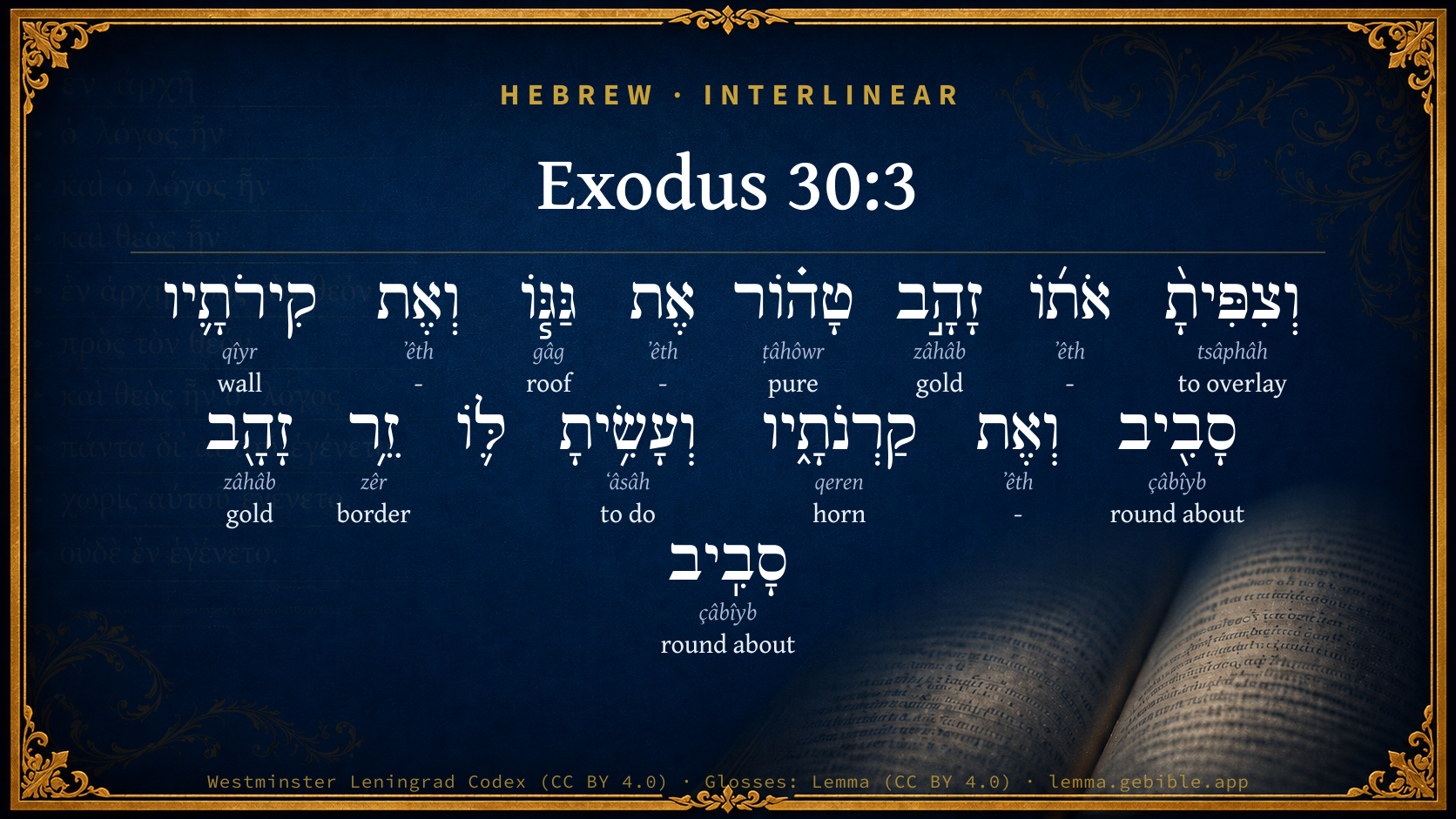
  1. וְצִפִּיתָ֨ tsâphâh H6823 “and · to overlay” Conjunction + Verb, Piel, Sequential Perfect, 2nd Person, Masculine, Singular
  2. אֹת֜וֹ ʼêth H853 “- · him” Particle, Direct Object + Suffix, Personal, 3rd Person, Masculine, Singular
  3. זָהָ֣ב zâhâb H2091 “gold” Noun, Common, Masculine, Singular, Absolute
  4. טָה֗וֹר ṭâhôwr H2889 “pure” Adjective, Adjective, Masculine, Singular, Absolute
  5. אֶת ʼêth H853 “-” Particle, Direct Object
  6. גַּגּ֧וֹ gâg H1406 “roof · his” Noun, Common, Masculine, Singular, Construct + Suffix, Personal, 3rd Person, Masculine, Singular
  7. וְאֶת ʼêth H853 “and · -” Conjunction + Particle, Direct Object
  8. קִירֹתָ֛יו qîyr H7023 “walls · his” Noun, Common, Masculine, Plural, Construct + Suffix, Personal, 3rd Person, Masculine, Singular
  9. סָבִ֖יב çâbîyb H5439 “round about” Noun, Common, Both, Singular, Absolute
  10. וְאֶת ʼêth H853 “and · -” Conjunction + Particle, Direct Object
  11. קַרְנֹתָ֑יו qeren H7161 “horns · his” Noun, Common, Both, Plural, Construct + Suffix, Personal, 3rd Person, Masculine, Singular
  12. וְעָשִׂ֥יתָ ʻâsâh H6213 “and · to do” Conjunction + Verb, Qal, Sequential Perfect, 2nd Person, Masculine, Singular
  13. זָהָ֖ב zâhâb H2091 “gold” Noun, Common, Masculine, Singular, Absolute
  14. סָבִֽיב çâbîyb H5439 “round about” Noun, Common, Both, Singular, Absolute

About this verse

These counts appear in no published source. They are computed here, from the morphology-tagged text and Lemma’s own curated glosses. What Lemma adds →

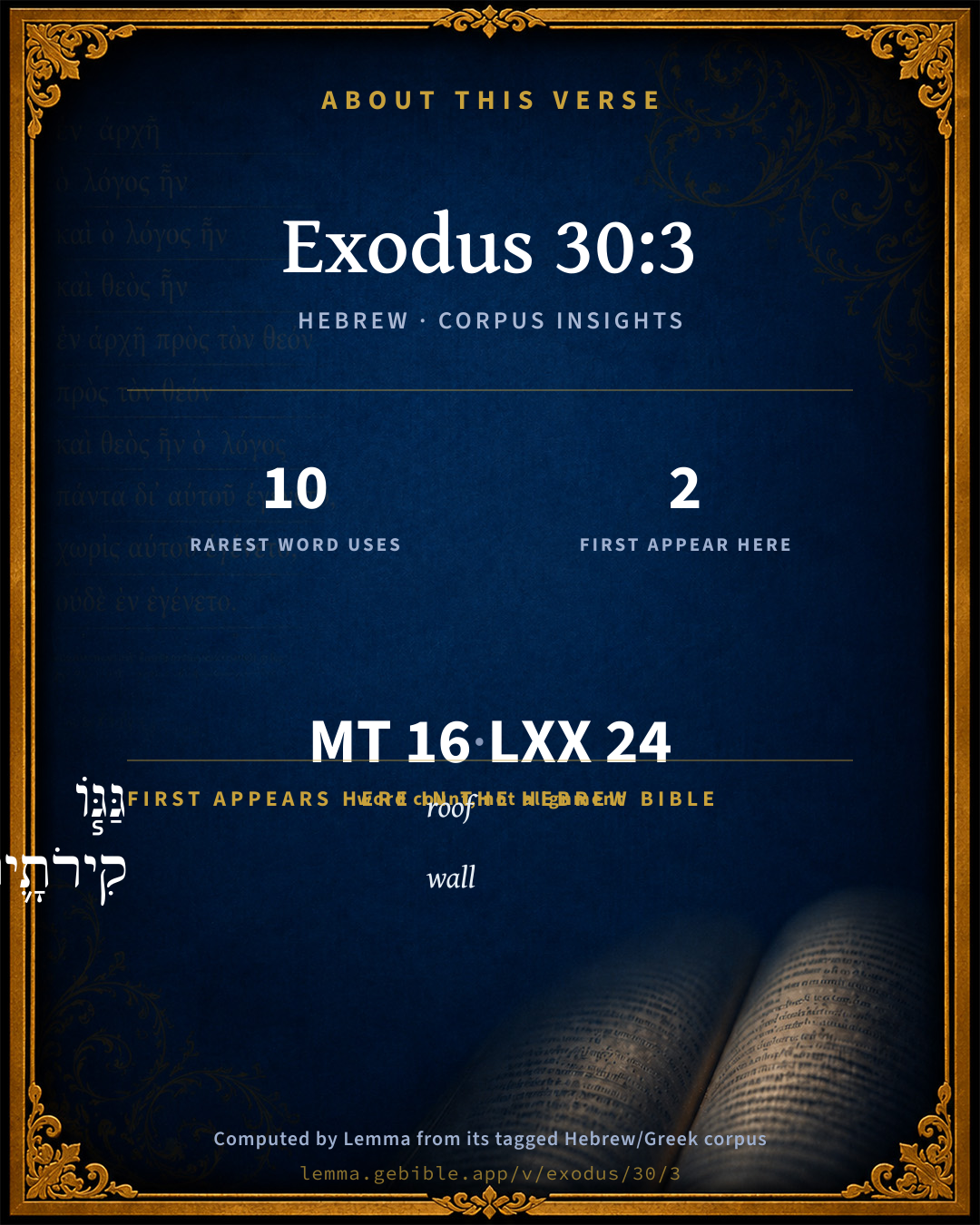
16
words
10
distinct lemmas
Pentateuch
section

Notable vocabulary

The rarest word here is זֵ֥ר border H2213 — appearing just 10 times in the whole Hebrew Bible.

First appearance in Scripture

These words make their first canonical appearance in the Hebrew Bible here:

  • גַּגּ֧וֹ roof H1406
  • קִירֹתָ֛יו wall H7023

Shared distinctive vocabulary

זֵ֥ר border H2213 occurs in 10 verses of the Hebrew Bible. Also found in:

Grammatical profile

  • 2 verbs
  • 8 nouns
  • 1 adjective
  • 1 preposition
  • 4 particles

Verb forms

  • וְצִפִּיתָ֨ Piel · Sequential Perfect
  • וְעָשִׂ֥יתָ Qal · Sequential Perfect

Repetition

Words recur within this verse — often emphatic in Hebrew:

  • זָהָ֣ב gold H2091 ×2
  • סָבִ֖יב round about H5439 ×2

Hebrew & Septuagint length

In English translation the verse runs 29 words from the Hebrew and 29 from the Septuagint (LXX English) — the same length.

A rough comparison of the two English renderings, which tokenize alike — not a word-level alignment.

Word counts can differ between the Hebrew and the Greek without any difference in meaning — e.g. the Hebrew direct-object marker אֵת has no separate Greek word, and Greek often adds the article ὁ.

In the original languages it is 16 Hebrew tokens and 24 Greek tokens — but the two are counted differently (Hebrew bundles its prefixes and suffixes into one token; the Greek is in lemma form), so that isn’t a like-for-like length.

Cross-references

2

Topical passages linked to Exodus 30:3 in the Treasury of Scripture Knowledge — connected by theme and wording, ordered by reader-vote popularity; previews shown in the World English Bible.

  • Exodus 25:11 You shall overlay it with pure gold. Inside and outside shall you overlay it, and shall make a gold molding around it.
  • Exodus 25:24 You shall overlay it with pure gold, and make a gold molding around it.

Cross-references courtesy of OpenBible.info (CC BY 4.0).

Hebrew and Greek witnesses Masoretic Hebrew ↔ Greek Septuagint

The same verse in the two great witnesses to the Old Testament, shown verse-for-verse.

These are two independent witnesses, not word-aligned to each other, and the Septuagint is shown in lemma (dictionary) form.

Hebrew Exodus 30:3 Masoretic · Westminster Leningrad Codex

וְצִפִּיתָ֨ אֹת֜וֹ זָהָ֣ב טָה֗וֹר אֶת גַּגּ֧וֹ וְאֶת קִירֹתָ֛יו סָבִ֖יב וְאֶת קַרְנֹתָ֑יו וְעָשִׂ֥יתָ לּ֛וֹ זֵ֥ר זָהָ֖ב סָבִֽיב

You shall overlay it with pure gold, the top of it, the sides of it around it, and its horns; and you shall make a gold molding around it.

World English Bible · Public Domain

Greek LXX Exodus 30:3 Septuagint · lemma form

καί καταχρυσόω αὐτός χρυσίον καθαρός ὁ ἐσχάρα αὐτός καί ὁ τοῖχος αὐτός κύκλος καί ὁ κέρας αὐτός καί ποιέω αὐτός στρεπτός στεφάνη χρυσοῦς κύκλος

And you shall gild its grate with pure gold, and its sides round about, and its horns; and you shall make for it a wreathen border of gold roundabout.

LXX2012 (modern English Septuagint) · Public Domain

Hebrew: Westminster Leningrad Codex (CC BY 4.0). Greek: Septuagint (public domain); English from LXX2012 (modern English Septuagint) (Public Domain). How the Septuagint differs from the Hebrew →

Targum (Aramaic paraphrase)

2

The Targum is the ancient Jewish Aramaic paraphrase of the Hebrew Scriptures — an interpretive translation, not the Hebrew text itself. Onkelos (literal) and Pseudo-Jonathan (expansive) render the Torah, and Jonathan the Prophets. Coverage is partial: where no permissively-licensed English translation exists for a verse, only the Aramaic is shown. This is verse-level text, not a word-by-word alignment to the Hebrew.

  1. Targum Onkelos Torah (Genesis–Deuteronomy)
    וְתַחֲפֵי יָתֵהּ דְהַב דְכֵי יָת אִגָרֵהּ וְיָת כָּתְלוֹהִי סְחוֹר סְחוֹר וְיָת קַרְנוֹהִי וְתַעְבֵּד לֵהּ דֵיר דִדְהב סְחוֹר סְחוֹר:

    (no public-domain English translation for this verse)

    Targum Onkelos — Aramaic: “Onkelos Genesis” (public domain); “Onkelos Exodus” (public domain); “Onkelos Leviticus” (public domain); “Onkelos Numbers” (public domain); “Onkelos Deuteronomy” (public domain). English: “Sefaria Community Translation” (CC0 1.0 (public-domain dedication)); “J.W. Etheridge. The Targums of Onkelos and Jonathan Ben Uzziel on the Pentateuch. London: Longmans, Green, 1862” (public domain). Text via Sefaria.

  2. Targum Pseudo-Jonathan Torah (Genesis–Deuteronomy)
    וְתַחְפֵי יָתֵיהּ דְּהַב דְּכֵי יַת אִיגְרֵיהּ וְיַת כּוֹתְלוֹי חֲזוֹר חֲזוֹר וְיַת קַרְנוֹי וְתַעֲבֵיד לֵיהּ זֵיר דִּדְהַב חֲזוֹר חֲזוֹר

    And thou shalt overlay it with pure gold, its top, and its wall round about, and its horns; and make for it a border of gold round about.

    Targum Pseudo-Jonathan — Aramaic: “Targum Jonathan on Genesis” (public domain); “Targum Jonathan on Exodus” (public domain); “Targum Jonathan on Leviticus” (public domain); “Targum Jonathan on Numbers” (public domain); “Targum Jonathan on Deuteronomy” (public domain). English: “The Targum of Jonathan ben Uzziel, trans. J. W. Etheridge, London, 1862” (public domain). Text via Sefaria.

Commentary

Notes on Exodus 30:3 from classic Christian and Jewish commentators (each source and its license shown beneath its notes). The classic Christian expositions comment on the surrounding passage and are grouped to its opening verse, so a note may address several verses; the Jewish commentaries on the Tanakh (Rashi and others) are per-verse, so they appear only where the commentator wrote on this verse.

Lemma curates 59 commentaries, every one of them public domain or Creative Commons licensed, each selected and text-cleaned for this edition rather than reprinted as found. About our sources →

Trapp's Complete Commentary

John Trapp

Exo 30:3 And thou shalt overlay it with pure gold, the top thereof, and the sides thereof round about, and the horns thereof; and thou shalt make unto it a crown of gold round about.

Ver. 3. Overlay it with pure gold.] Shadowing Christ’s deity, yielding glory to his humanity.

A crown of gold round about.] To show that devotion is a rich royal virtue, best beseeming the best princes.

John Trapp, A Commentary or Exposition upon All the Books of the Old and New Testament (1647–1656) — public domain. Text from a community e-Sword module.

Geneva Bible (1599)

Geneva Bible translators

Or, a circle and border.

Geneva Bible (1599) marginal notes — public domain. Text via Bolls.life.

Ellicott's Commentary for English Readers

(3) Thou shalt overlay it with pure gold.—Next to the Ark of the Covenant the most holy article of furniture contained either in the sanctuary or in its court was the altar of incense. It symbolised prayer in its general use (Psa_141:2; Luk_1:10), and it symbolised expiation in the purpose whereto it was to be applied on certain occasions, as when the high priest had sinned in his official capacity (Lev_4:3-12), or when the whole congregation had sinned through inadvertence (Lev_4:13-21). It was, therefore, “most holy to the Lord.” Hence, its materials were to be the same with those of the ark of the covenant, and its place was to be directly opposite the ark, near to it, but on the outer side of the vail (Exo_40:5).

A crown of gold round about.—Comp. what is said of the table of shewbread (Exo_25:24). In both cases a raised rim or edging is meant, which would prevent what was on the top from falling off.

A Bible Commentary for English Readers, edited by Charles John Ellicott (1878–1897) — public domain. Text from a community e-Sword module.

The Cambridge Bible for Schools and Colleges

gen. ed. J. J. S. Perowne

3. pure gold] see on Exo_25:3. From being thus overlaid wholly (except at the bottom) with gold, it was also called the golden altar (Exo_39:38, Exo_40:5; Exo_40:26, Num_4:11).

sides] Heb. walls: so of the Bronze altar, Lev_1:15; Lev_5:9.

a crown] a rim or moulding: see on Exo_25:11, and cf. Exo_25:24.

The Cambridge Bible for Schools and Colleges (gen. ed. J. J. S. Perowne; Cambridge University Press, 1878–1918) — public domain. Text from a community e-Sword module.

John Gill's Exposition

And thou shalt overlay it with pure gold,.... Hence this altar is sometimes called the golden altar, Num 4:11 this may figure the deity of Christ, whose head is as the most fine gold, and is in the divine nature, in the form of God, and is the brightness of his glory, and possessed of the same perfections; or rather the glorification of his human nature in heaven, where he is highly exalted, and the preciousness of his intercession, which is always powerful and prevalent, and the duration of it:

the top thereof, and the sides thereof, round about, and the horns thereof: all and each of them were covered with gold; this altar had a top, when the altar of burnt offering had none, but its hollow place was filled up with earth at every encampment; so Jarchi observes: this was not a grate, as the Vulgate Latin version renders it, for here were neither blood nor ashes to be let through; but it was a flat covering like the roof of a house, as the word signifies, on which was set a golden dish, with live coals and incense burning on them; and which, when burnt, was carried away: and the sides are the four sides of the frame, it being a square, or the two sides and two ends of it; and the horns, the four horns at each corner, all were covered with plates of gold; so that this altar was a richer and more excellent one than that of burnt offering; and may signify the superior excellency of Christ's state of exaltation to that of his humiliation: in the latter, which the altar of burnt offering respected, he was made of no reputation, and became obedient to the death of the cross, yea, was made sin, and a curse for his people; but in the former, which the altar of incense respected, he was raised from the dead, and had glory given him; he was raised for the justification of his people, and was himself justified in the Spirit, ascended on high, was received into glory, sat down at the right hand of God, making continual intercession for his saints:

and thou shall make unto it a crown of gold round about; which was partly to keep from slipping what was put upon it, but chiefly for ornament; and plainly points at the exaltation of Christ in our nature in heaven, as our interceding high priest, where he is a priest upon his throne; and is crowned with glory and honour.

John Gill's Exposition of the Whole Bible (1746–1763) — public domain (CC PDM 1.0). Text via the HelloAO Bible API.

Haydock's Catholic Bible Commentary

Grate, or covering. Some think the fire and incense were placed on this grate, and the ashes fell under the altar. But fire was taken hence, and put in the thuribles; (Numbers xvi. 17; Calmet) or a brazen thurible was placed on the fire, Leviticus x. 1. (Menochius) --- Walls, or sides, of setim-wood. --- Crown, cornice or moulding. See chap. xxv. 25.

George Leo Haydock (1774–1849), Haydock's Catholic Family Bible and Commentary, 1859 edition — public domain. Excludes Psalms (Douay-Rheims chapter numbering differs from Protestant) and Deuterocanonical books (Catholic canon only).

Matthew Poole's English Annotations

The top was made hollow like a grate, that the ashes might fall through it. The

crown was a border which encompassed the altar, that the things laid on it might not fall off.

Matthew Poole's English Annotations on the Holy Bible (1683–1685) — public domain. Text from a community e-Sword/MySword module.

The Pulpit Commentary

Thou shalt make unto it a crown of goldi.e. , a border, or moulding, all round the top, to prevent anything from falling off. Compare what is said of the table of shew-bread, Exo_25:24.

The Pulpit Commentary (1880–1919), ed. H.D.M. Spence-Jones & Joseph S. Exell — public domain. Text from a community e-Sword module.

unfoldingWord translationNotes

Door43 World Missions Community

General Information:

Yahweh continues telling Moses what the people must do.

the incense altar

"an altar to burn incense"

to be attached to it

This can be stated in active form. AT: "which you will attach to the altar" (See: Active or Passive)

translationWords

altar of incense

pure

gold

unfoldingWord translationNotes — © Distant Shores Media and the Door43 World Missions Community, licensed CC BY-SA 4.0. Source: git.door43.org/Door43/en_tn.

Rashi

Rabbi Shlomo Yitzchaki (Rashi)

את גגו THE ROOF THEREOF — This altar had a top but the altar of burnt-offering had no top, but they filled in the hollow space enclosed by its sides with earth wherever they encamped (cf. Mekhilta).

זר זהב A CROWN OF GOLD — an emblem of the crown of priesthood (Yoma 72b).

Rashi on the Tanakh — English translations: “The Judaica Press complete Tanach with Rashi, translated by A. J. Rosenberg” (CC BY 4.0); “Pentateuch with Rashi's commentary by M. Rosenbaum and A.M. Silbermann, 1929-1934” (public domain); “The Metsudah Tanach series, Lakewood, N.J” (CC BY 4.0); and “The Book of Joshua, Metsudah Publications, 1997” (CC BY 4.0). Text via Sefaria.

Lesson kit

Teaching starters — assembled from the data on this page, not authored interpretation. Every prompt links to the verse data it draws on. Edit before teaching.

Exodus, in the Pentateuch, opens this verse with 16 words (10 distinct Hebrew lemmas). Its most distinctive word is zêr (“border”). A historical commentator’s framing appears above. Read the whole chapter for the surrounding context.

Discussion questions

  1. What does “border” (zêr) contribute to the verse as a whole?
  2. 2 words here appear for the first time in Scripture. What is being introduced at this debut?
  3. Exodus 25:11 shares the word «border» with this verse. How do the two illuminate each other?
  4. “gold” occurs 2× in this one verse. What is the effect of the repetition?
  5. The translations on this page render this verse differently — a whole-verse word diff, not a word-by-word alignment. What might account for the different wordings?
  6. The verb «וְצִפִּיתָ֨» is Piel Sequential Perfect. How does its form color the action?
  7. Reading how Trapp's Complete Commentary and Geneva Bible (1599) read this verse, where do the two commentators agree and where do they part?

Things to notice

Reading settings

Reading text

Shown beneath each verse's original-language words.

Old Testament
Old Testament edition

Read the OT as the Masoretic Hebrew (MT) or the Greek Septuagint (LXX).

English shown for the Greek Septuagint (in the Hebrew ↔ Greek comparison).

Comparing translations? Open the Compare panel on any verse page to stack up to four side by side.