
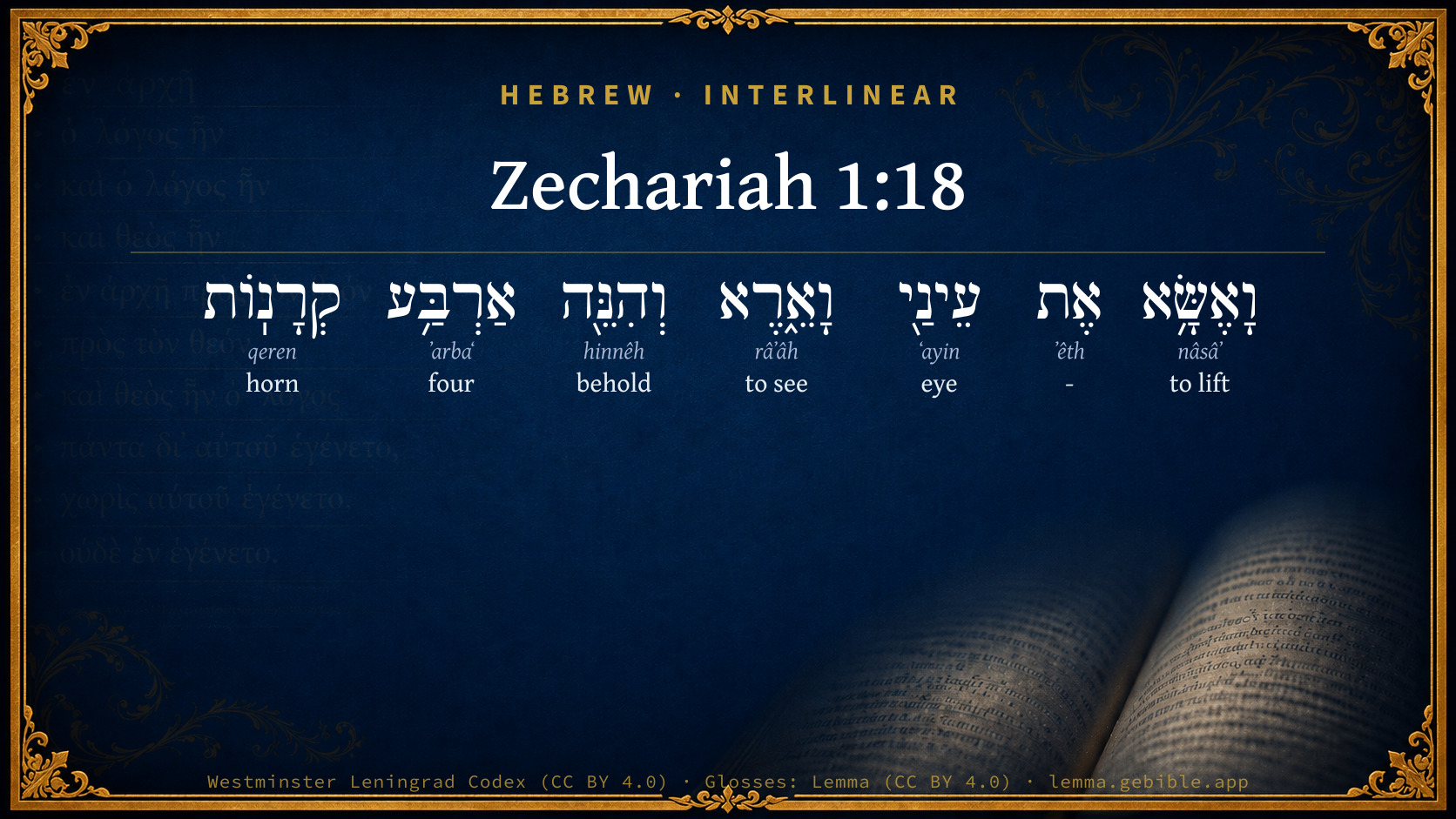
Zechariah 1:18

Hebrew (Westminster Leningrad Codex) Zechariah 1:18 appears in the Hebrew Old Testament. The text above is from the Westminster Leningrad Codex. Each word links to its Strong’s number, a concise gloss, and parsing drawn from the Open Scriptures Hebrew Bible morphology. Click any word for its full Brown-Driver-Briggs (BDB) entry.
Download image
Cite this verse

Zechariah 1:18 (World English Bible). Public Domain. Lemma interlinear Bible study tool, https://lemma.gebible.app/v/zechariah/1/18.

Show BibTeX & RIS
BibTeX
RIS
English Translation
I lifted up my eyes, and saw, and, behold, four horns.
World English Bible · Public Domain
Download a study sheet

One document with this verse’s original text, its word-by-word gloss line, the meaning frame, cross-references with their text, attributed commentary, and full source and license credits — printable, and it pastes into notes with its structure intact.

This verse Autodidact and up

Study sheet (.html) Plain text (.txt)

A passage Seminary Student

Up to 50 verses in one chapter. A passage sheet keeps up to 6 commentary sources and 12 cross-references per verse, in the order this page ranks them, and says so on the sheet whenever that leaves anything out. Ask for a single verse and you get the Autodidact verse sheet above.

Everything on this page stays free to read, with no account — the sheet is a download of what is already on screen, not access to it.

Want to remove ads? Support Godless Engineer
Compare translations 3

The same verse in 3 English versions, stacked beneath the original-language interlinear above. Click any original word for its lexicon entry.

Each is an independent rendering of the whole verse — the interlinear is not word-aligned to these translations.

Highlighted words mark where these versions differ — a whole-verse word diff, not a word-by-word alignment.

  • World English Bible Public Domain
    I lifted up my eyes, and saw, and, behold, four horns.
  • King James Version Public Domain
    Then lifted I up mine eyes, and saw, and behold four horns.
  • unfoldingWord Literal Text CC BY-SA 4.0
    And I lifted up my eyes and I saw, and behold, four horns.

unfoldingWord Literal Text — © unfoldingWord, licensed CC BY-SA 4.0. Word-aligned USFM3 via Door43 (git.door43.org/unfoldingWord/en_ult).

Versions to compare (up to 4)

3 of 4 selected

Show all 16 translations

Every available English version of this verse, each an independent rendering of the whole verse.

  • World English Bible Public Domain
    I lifted up my eyes, and saw, and, behold, four horns.
  • Berean Standard Bible Public Domain
    Then I looked up and saw four horns.
  • Majority Standard Bible Public Domain
    Then I looked up and saw four horns.
  • King James Version Public Domain
    Then lifted I up mine eyes, and saw, and behold four horns.
  • American Standard Version (1901) Public Domain
    And I lifted up mine eyes, and saw, and, behold, four horns.
  • Revised Version (1885) Public Domain
    And I lifted up mine eyes, and saw, and behold four horns.
  • Geneva Bible (1599) Public Domain
    Then lift I vp mine eyes and sawe, and beholde, foure hornes.
  • Douay-Rheims (1899) Public Domain
    And I lifted up my eyes, and saw: and behold four horns.
  • Young's Literal Translation Public Domain
    And I lift up mine eyes, and look, and lo, four horns.
  • Literal Standard Version CC BY-SA 4.0
    And I lift up my eyes, and look, and behold, four horns.
  • Unlocked Literal Bible CC BY-SA 4.0
    Then I lifted up my eyes and saw four horns!
  • unfoldingWord Literal Text CC BY-SA 4.0
    And I lifted up my eyes and I saw, and behold, four horns.
  • Darby Bible Public Domain
    And I lifted up mine eyes, and saw, and behold four horns.
  • World Messianic Bible Public Domain
    I lifted up my eyes and saw, and behold, four horns.
  • Free Bible Version CC BY-SA 4.0
    Then I looked and saw four animal horns.
  • JPS Tanakh (1917) Public Domain
    (2-1) And I lifted up mine eyes, and saw, and behold four horns.

Literal Standard Version (2020), Covenant Press — licensed CC BY-SA 4.0. Text via the HelloAO Bible API (eBible.org). Unlocked Literal Bible (unfoldingWord) — licensed CC BY-SA 4.0. Text via the HelloAO Bible API (eBible.org). unfoldingWord Literal Text — © unfoldingWord, licensed CC BY-SA 4.0. Word-aligned USFM3 via Door43 (git.door43.org/unfoldingWord/en_ult). Free Bible Version, Dr. Jonathan Gallagher — licensed CC BY-SA 4.0. Text via the HelloAO Bible API (eBible.org).

Word by word

More ways to search: Search by grammar → Find every occurrence → Compare this word →

Practice this passage: Drill this verse → Learn its vocabulary →

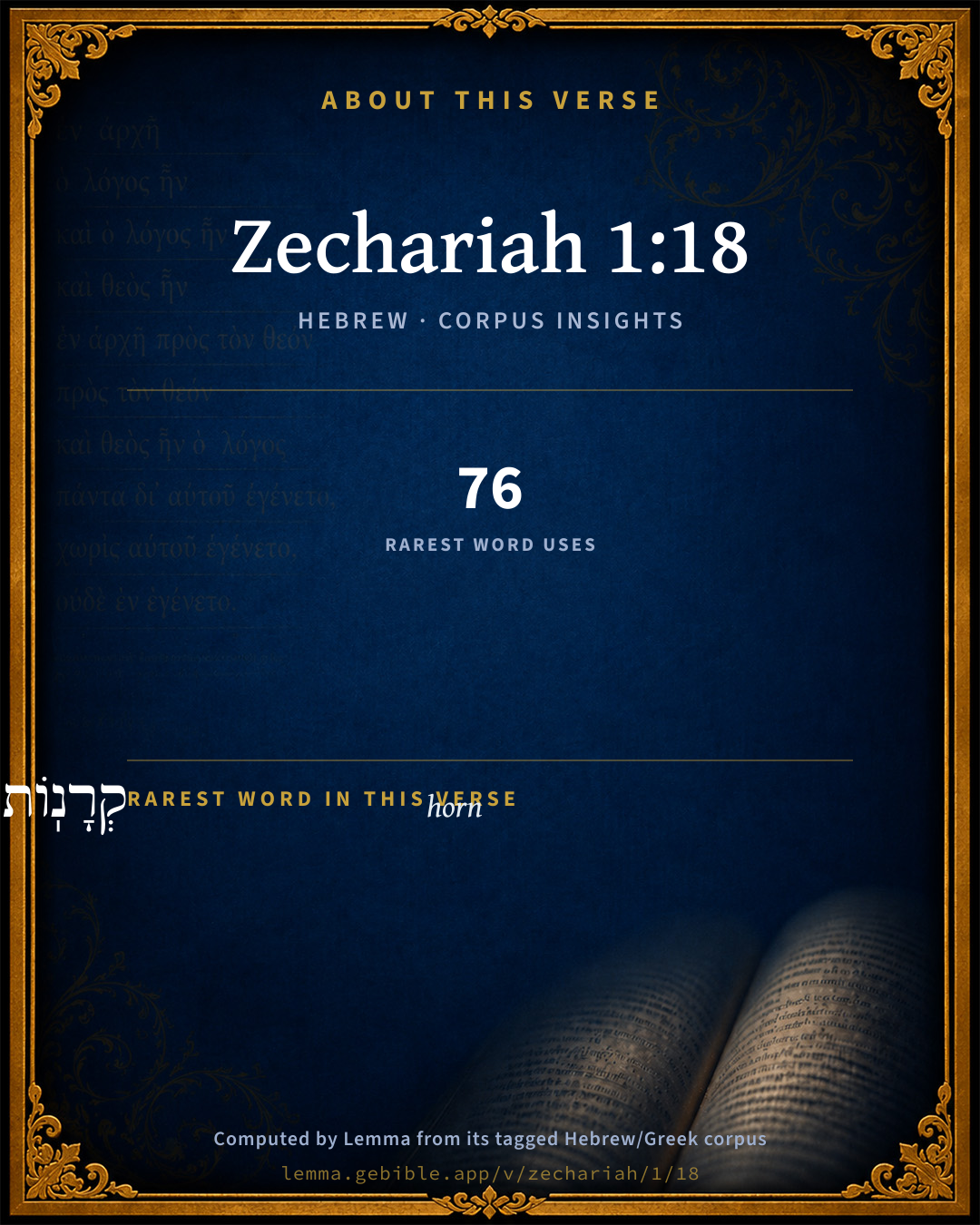
About this verse

These counts appear in no published source. They are computed here, from the morphology-tagged text and Lemma’s own curated glosses. What Lemma adds →

7
words
7
distinct lemmas
Prophets
section

Grammatical profile

  • 2 verbs
  • 2 nouns
  • 1 adjective
  • 2 particles

Verb forms

  • וָאֶשָּׂ֥א Qal · Sequential Imperfect
  • וָאֵ֑רֶא Qal · Sequential Imperfect

Hebrew & Septuagint length

In English translation the verse runs 11 words from the Hebrew and 12 from the Septuagint (LXX English) — closely comparable.

A rough comparison of the two English renderings, which tokenize alike — not a word-level alignment.

Word counts can differ between the Hebrew and the Greek without any difference in meaning — e.g. the Hebrew direct-object marker אֵת has no separate Greek word, and Greek often adds the article ὁ.

Cross-references

13

Topical passages linked to Zechariah 1:18 in the Treasury of Scripture Knowledge — connected by theme and wording, ordered by reader-vote popularity; previews shown in the World English Bible.

  • Joshua 5:13 It happened, when Joshua was by Jericho, that he lifted up his eyes and looked, and, behold, there stood a man over against him with his sword drawn in his hand: and Joshua went to him, and said to him, Are you for us, or for our adversaries?
  • 2 Kings 24:1–20 In his days Nebuchadnezzar king of Babylon came up, and Jehoiakim became his servant three years: then he turned and rebelled against him.
  • Daniel 8:3–14 Then I lifted up my eyes, and saw, and, behold, there stood before the river a ram which had two horns: and the two horns were high; but one was higher than the other, and the higher came up last.
  • Zechariah 5:9 Then lifted I up my eyes, and saw, and, behold, there were two women, and the wind was in their wings. Now they had wings like the wings of a stork, and they lifted up the ephah basket between earth and the sky.
  • 2 Kings 15:29 In the days of Pekah king of Israel came Tiglath Pileser king of Assyria, and took Ijon, and Abel Beth Maacah, and Janoah, and Kedesh, and Hazor, and Gilead, and Galilee, all the land of Naphtali; and he carried them captive to Assyria.
  • 2 Kings 17:1–6 In the twelfth year of Ahaz king of Judah began Hoshea the son of Elah to reign in Samaria over Israel, [and reigned] nine years.
  • 2 Kings 18:9–12 It happened in the fourth year of king Hezekiah, which was the seventh year of Hoshea son of Elah king of Israel, that Shalmaneser king of Assyria came up against Samaria, and besieged it.
  • Daniel 2:37–43 You, O king, are king of kings, to whom the God of heaven has given the kingdom, the power, and the strength, and the glory;
  • Daniel 7:3–8 Four great animals came up from the sea, diverse one from another.
  • Daniel 11:28–35 Then shall he return into his land with great substance; and his heart [shall be] against the holy covenant; and he shall do [his pleasure], and return to his own land.
  • Zechariah 2:1 I lifted up my eyes, and saw, and, behold, a man with a measuring line in his hand.
  • Zechariah 5:1 Then again I lifted up my eyes, and saw, and, behold, a flying scroll.
  • Zechariah 5:5 Then the angel who talked with me came forward, and said to me, "Lift up now your eyes, and see what is this that is appearing."

Cross-references courtesy of OpenBible.info (CC BY 4.0).

Hebrew and Greek witnesses Masoretic Hebrew ↔ Greek Septuagint

The same verse in the two great witnesses to the Old Testament, shown verse-for-verse.

These are two independent witnesses, not word-aligned to each other, and the Septuagint is shown in lemma (dictionary) form.

Hebrew Zechariah 1:18 Masoretic · Westminster Leningrad Codex

וָאֶשָּׂ֥א אֶת עֵינַ֖י וָאֵ֑רֶא וְהִנֵּ֖ה אַרְבַּ֥ע קְרָנֽוֹת

I lifted up my eyes, and saw, and, behold, four horns.

World English Bible · Public Domain

Greek LXX Zechariah 1:18 Septuagint · lemma form
And I lifted up my eyes and looked, and behold four horns.

LXX2012 (modern English Septuagint) · Public Domain

On this verse, Joseph Benson's Commentary discusses the Septuagint’s reading. Read the note in Commentary ↓

Hebrew: Westminster Leningrad Codex (CC BY 4.0). Greek: Septuagint (public domain); English from LXX2012 (modern English Septuagint) (Public Domain). How the Septuagint differs from the Hebrew →

Commentary

Notes on Zechariah 1:18 from classic Christian and Jewish commentators (each source and its license shown beneath its notes). The classic Christian expositions comment on the surrounding passage and are grouped to its opening verse, so a note may address several verses; the Jewish commentaries on the Tanakh (Rashi and others) are per-verse, so they appear only where the commentator wrote on this verse.

Lemma curates 59 commentaries, every one of them public domain or Creative Commons licensed, each selected and text-cleaned for this edition rather than reprinted as found. About our sources →

Matthew Henry's Commentary

It is the comfort and triumph of the church (Isa 59:19) that when the enemy shall come in like a flood, with mighty force and fury, then the Spirit of the Lord shall lift up a standard against him. Now, in this vision (the second which this prophet had), we have an illustration of that, God's Spirit making a stand, and making head, against the formidable power of the church's adversaries.

I. We have here the enemies of the church bold and daring, and threatening to be its death, to cut off the name of Israel; such the people of God had lately been insulted by: I looked and behold four horns (Zac 1:18), which are explained Zac 1:19. They are the horns which have scattered Judah, Israel, and Jerusalem, that is, the Jews both in the country and in the city, because they were the Israel of God. They have tossed them (so some read it), as furious bulls with their horns toss that which they are enraged at. They have scattered them, so that no man did lift up his head, Zac 1:21. No man durst show his face for fear of them, much less give them any opposition, or make head against them. They are horns, denoting their dignity and dominion - horns exalted, denoting also their strength, and power, and violence. They are four horns, for the Jews are surrounded with them on every side; when they avoid one horn that pushes at them they run upon another. The men of Judah and the inhabitants of Jerusalem, and many of Israel that joined themselves to them, set about the building of the temple; but the enemies of that work from all sides pushed at them, and drove them from it. Rehum, and Shimshai, and the other Samaritans that opposed the building of the temple, were these horns, Ezr 4:8. So were Sanballat and Tobiah, and the Ammonites and Arabians, that opposed the building of the wall, Neh 4:7. Note, The church's enemies have horns, and use them to the hindrance of every good work. The great enemy of the New Testament church has seven heads and ten horns (Rev 17:3), so that those who endeavour to do the church any service must expect to be pushed at.

II. We have here the friends of the church active and prevailing. The prophet did himself lift up his eyes and see the four horns, and saw them so formidable that he began to despair of the safety of every good man, and the success of every good work; but the Lord then showed him four carpenters, or smiths, who were empowered to cut off these horns, Zac 1:20, Zac 1:21. With an eye of sense we see the power of the enemies of the church; look which way we will, the world shows us that. But it is with an eye of faith that we see it safe, notwithstanding; it is the Lord that shows us that, as he opened the eyes of the prophet's servant to see the angelic guards round about his master, Kg2 6:17. Observe, Those that were to fray or break the horns of the Gentiles, and to cast them out, were, 1. Carpenters or smiths (for they are supposed by some to have been horns of iron), men who had skill and ability to do it, whose proper business it was, and who understood their business and had tools at hand to do it with. Note, God calls those to serve the interests of his church whom he either finds, or makes, fit for it. If there be horns (which denote the force and fury of beasts) against the church, there are carpenters (which denote the wisdom and forecast of men) for the church, by which they find ways to master the strongest beasts, for every kind of beasts is tamed, and has been tamed, of mankind, Jam 3:7. 2. They were four carpenters, as many horns so many hands to saw them off. Note, Which way soever the church is threatened with mischief, and opposition given to its interests, God can find out ways and means to check the force, to restrain the wrath, and make it turn to his praise. Some by these four carpenters understand Zerubbabel and Joshua, Ezra and Nehemiah, who carried on the work of God in spite of the opposition given to it. Those horned beasts broke into God's vineyard to tread it down; but the good magistrates and the good ministers whom God raised up, though they had not power to cut off the horns of the wicked (as David did, Psa 75:5, Psa 75:10), yet frightened them and cast them out. Note, When God has work to do he will raise up some to do it and others to defend it and protect those that are employed in the doing of it.

Matthew Henry's Commentary on the Whole Bible (1708–1710) — public domain (CC PDM 1.0). Text via the HelloAO Bible API.

Jamieson, Fausset & Brown

Robert Jamieson, A. R. Fausset & David Brown

SECOND VISION. The power of the Jews foes shall be dissipated. (Zac 1:18-21)

four horns--To a pastoral people like the Jews the horns of the strongest in the herd naturally suggested a symbol of power and pride of conscious strength: hence the ruling powers of the world (Rev 17:3, Rev 17:12). The number four in Zechariah's time referred to the four cardinal points of the horizon. Wherever God's people turned, there were foes to encounter (Neh 4:7); the Assyrian, Chaldean, and Samaritan on the north; Egypt and Arabia on the south; Philistia on the west; Ammon and Moab on the east. But the Spirit in the prophet looked farther; namely, to the four world powers, the only ones which were, or are, to rise till the kingdom of Messiah, the fifth, overthrows and absorbs all others in its universal dominion. Babylon and Medo-Persia alone had as yet risen, but soon Græco-Macedonia was to succeed (as Zac 9:13 foretells), and Rome the fourth and last, was to follow (Dan. 2:1-49; Dan. 7:1-28). The fact that the repairing of the evils caused to Judah and Israel by all four kingdoms is spoken of here, proves that the exhaustive fulfilment is yet future, and only the earnest of it given in the overthrow of the two world powers which up to Zechariah's time had "scattered" Judah (Jer 51:2; Eze 5:10, Eze 5:12). That only two of the four had as yet risen, is an argument having no weight with us, as we believe God's Spirit in the prophets regards the future as present; we therefore are not to be led by Rationalists who on such grounds deny the reference here and in Zac 6:1 to the four world kingdoms.

Jamieson, Fausset & Brown — Commentary Critical and Explanatory on the Whole Bible (1871) — public domain (CC PDM 1.0). Text via the HelloAO Bible API.

Ellicott's Commentary for English Readers

SECOND VISION.—THE FOUR HORNS AND THE FOUR SMITHS (Zec_1:18-21).

(18) Horns.—The horn is a symbol of power and hostility. The “four horns” denote the heathen nations which had oppressed them.

A Bible Commentary for English Readers, edited by Charles John Ellicott (1878–1897) — public domain. Text from a community e-Sword module.

Trapp's Complete Commentary

John Trapp

Zec 1:18 Then lifted I up mine eyes, and saw, and behold four horns.

Ver. 18. Then I lift up mine eyes, and saw] That is, I gave good heed to this second vision also; which was added purposely for confirmation of the former promises; which should be certainly accomplished to the Church, notwithstanding her many and mighty enemies. Horns they are called for their might and mischievousness; by a metaphor, a feris cornupetis, from fierce beasts, whose strength and wrath lie in their horns; or else from warriors, who wore iron horns upon their helmets.

And behold four horns] Not the four monarchies, for the Grecians and Romans were not yet; and this is spoken here for the present comfort of the afflicted Church, but the enemies of Israel from all the four parts of the world, see Psa 107:2-3, for they were surrounded: on the north were the Syrians, Assyrians, and Babylonians. ( Ab Aquilone nihil boni, Jer 4:6; Jer 6:1). On the east the Ammonites and Moabites. On the south the Edomites and Egyptians. On the west the Philistines, as may be gathered out of Jeremiah and Ezekiel. Geneva is at this day a small people, environed with enemies, French, Spanish, Savoy, Pope; and barred out from all aid of neighbours, cities, and churches; yet, by the mighty arm of God, strangely and strongly upheld and defended. This Mr Beza represented in a most elegant emblem of a city depainted as hanged by a twined thread; sustained and maintained by the mighty hand of God alone. Would any man take the Church’s picture? saith Luther; then let him paint a silly poor maid, sitting in a wood or wilderness, compassed about with hungry wolves, lions, boars, and bears, and with all manner of cruel and hurtful beasts; and in the midst of a great many furious men assaulting her every moment and minute; for this is her condition in the world.

John Trapp, A Commentary or Exposition upon All the Books of the Old and New Testament (1647–1656) — public domain. Text from a community e-Sword module.

The Biblical Illustrator

Joseph S. Exell

Zec_1:18-21

Behold four horns

The mission of the Churchs enemies

Three things there are which this age of ours hath brought forth: malignant enemies, special instruments of their ruin, and great endeavours for reformation.

Accordingly here are three visions: a vision of four horns (Zec_1:18-19); a vision of four carpenters (Zec_1:20-21); a vision of a man with a measuring line in his hand (chap. 2. Verse 1). The description of the Churchs enemies under the vision of four horns.

1. Their number or multitude; they are four horns according to four parts of the world.

2. Their power and strength. The horn in Scripture denotes strength.

3. Their mischievous and malignant practice; They scattered Judah, Israel, and Jerusalem. In the second vision is the description of those special instruments that are raised up for their destruction, under the similitude of four carpenters or smiths. Their work is to scatter the horns, and to cast out the Gentiles. The third vision presents the endeavours for reformation, under the similitude of a man with a measuring line in his hand; which is described in two ways: from the instrument thereof, a man, an excellent man, possibly alluding to Zerubbabel the governor; and from the exactness thereof,--he doth work by line.

Attend to three doctrines.

1. When God intendeth any good and salvation to His Churches, He doth first suffer many potent, malicious enemies to rise against them. Was it not so with Israel when God intended to bring them out of Egypt? Then their taskmasters arose and doubled their work. This is Gods way still. But what reason is there that God should suffer His people to be thus handled, oppressed, scattered, by Cruel enemies? Good reason. So many enemies, so many schoolmasters. Our enemies are our observers, and their observation is our preservation. Hereby they are occasioned to honour God; they are weaned from the world; they are more useful in their places, and even beneficial to their enemies; they carry the truths of God into other parts; they receive a fuller and clearer testimony of their own graces; their enemies themselves are the more convinced; the saints are kept from, and cured of, divisions among themselves; hereby the servants of God may see and know by experience, that it is better to serve God than man; and the servants of God learn the right use of the rod, both in Church and State. Then let no man be stumbled or offended at Gods present proceedings in the world, as if they were very mysterious.

2. Though God suffers the enemies of His Church to be many and great, He will raise up proportionate strength against them. Three enemies there are by whom you are most molested, the flesh, the devil, the world. The flesh brings forth three great evils. Ignorance in the understanding; in opposition to that Jesus Christ is called our Prophet. Rebellion in the will; in opposition to that Jesus Christ is called our King. Guiltiness that arises from ignorance and rebellion; in opposition to that Jesus Christ is called our Priest. The devil, our second enemy, is armed with all weapons of hostility against us. Whatever terms or titles of strength and power there is in Satan, there is somewhat in Jesus Christ that answereth, yea, that over answereth all. The third enemy, the world; is described in Rev_13:1. Our text speaks but of four horns, here are ten. So that, whatever your enemies are, there is strength enough in Jesus Christ to subdue their strength. Why is Christ thus furnished, but for His Church and people? He is the Lord-keeper of all our comforts; the Lord-treasurer of all our graces; and the great magazine of all our ammunition. The application of this doctrine looks two ways: to the saints by way of consolation and encouragement; to the carpenters Gods workmen, by way of direction and exhortation (W. Bridge, M. A.)

Horns and workmen

This second vision may be regarded as supplementary of the first. There the restoration of Judah was indicated generally; here some of the means by which that was to be effected are presented. Though enemies from all quarters, and on every side, might assail the people of God, the Lord, their protector, would raise up for them adequate defence, would bring into action powers sufficient to discomfit and cast down all their oppressors, however many or strong. What was thus showed for the comfort of the people of God in the old time is no less for the comfort and encouragement of the Church in all ages and places. The sum of the whole is, though the Church may not be exempt from many troubles, yet the Lord has in His hand resources by which He can restrain all assaults of the wicked, however impetuously and violently they may be impelled against the Church. The Angel of the Lord, the Divine Redeemer, abides forever with that Church which He has purchased with His own blood. And exalted as He is to the throne of His glory, and having all power in heaven and on earth, He can send forth at any time agencies by which the power of the Churchs enemies shall be broken, and all their forces routed. It behoves the Church, then, to have faith in her exalted head, and patiently to wait for Him. In due time He will interpose on her behalf when she is afflicted; He will scatter and discomfit all her adversaries, and will cause her righteousness to go forth as brightness, and her salvation as a lamp that burneth. (W. L. Alexander, D. D.)

The vision of the four horns

Some consider the four horns represent the four kingdoms of Babylon, Persia, Greece, and Rome. Others look on them as types of the whole of the enemies of Israel coming from the four quarters of the earth. The same general truths are taught in either case.

1. That while the world powers continue, and the Church of God lives in their midst, the latter will be subjected to opposition and persecution.

2. That whatever number of foes the Church may have, God will take care to provide her with an equal number of friends.

3. That though there will ever be conflict between Gods Church and her enemies, there will never be defeat but on one side. The strongest force must ultimately gain the day. We can account for the existence of the Church only from the fact that God is in the midst of her. (A London Minister.)

The purpose of this vision

I. For instruction. The progress of the wicked in their enmity against the Church, is but the prologue to the Churchs deliverance. First, the horns arise and play their part; and this brings on the hammermen to act their part.

II. For admonition: that Gods people be not offended, or dismayed, when they see things, go contrary to their deliverance. At such times let us calm ourselves--

1. With a consideration of the just aggravation of our own sins, our disunion and security that opened the door to let in the misery.

2. With the consideration of the character of the horns. It is the nature of a beast to do as they do, to push and scatter. A brute will be a brute. A devil will be a devil. But beasts are not made to rule over men. And the devil is the gaoler of the wicked, not our ruler.

3. As the constitution, so the complexion of the last times is indeed the worst; so no better is to be expected for a time, but, though the several hammers make at first but a confused noise, and the pieces of the building lie in the dust, yet, ere long, the new building is reared, and the Great Master of the house comes in and dwells among us in it.

III. For exhortation.

1. Let us not judge by sense, but by faith.

2. Judge not by present action, but by their productive tendency.

3. Judge not by the meanness of means, but by the might of the hand that useth them. (N. Homes.)

Destroyers and builders

The enemy came upon the laud, came upon the hills of Judah and of Israel, laid waste the city of Jerusalem, destroyed the temple, scattered the people, broke up their happy homes, and carried them into captivity. These are the horns of which the text speaks. Wise men were raised up, skilful workers, men willing and able to rebuild Jerusalem, restore the temple, and reestablish the worship of Jehovah there. These be the carpenters spoken of in the text. The first class is characterised by the fury of the beast, and the second by the wisdom and skill of the man.

I. There are the destroyers--there is the power of the destroyer. The power opposed to God and His purpose is in Scripture often described under the symbol of a beast. The prophet Daniel saw four beasts coming forth in succession to do their destructive work. This symbol teaches us that the power opposed to God is from below, from the abyss. The persecutions that raged against the Church in other ages were eruptions from the bottomless pit, real boiling volcanic floods sent forth from the mouth of that old serpent, called the devil and Satan, which deceiveth the whole world. Such is infidelity, and the criticism which merely destroys, and the philosophy which ignores God. The power opposed to God and goodness is coarse, rude, vulgar--the power of a beast. What will a beast do if turned into a flower garden? So the power of evil is rude and coarse. Whenever men begin to sneer at religion, at faith, at holiness, at Christianity, that moment they become coarse. The deepest and subtlest wisdom, the wisdom that can create, the wisdom that can construct and build up, is not necessary for the destroyers work. The rude, clumsy power of the reasonless beast will answer for that purpose. The power of the destroyer is out of harmony with the nature of things. The beasts of Bible symbol are all monsters. Not one of them is harmonious or proportionate. Here is one--he has the body of a leopard to begin with, the feet of a bear, the hungry mouth of a lion; he has seven heads and ten horns, and on each of the heads in flaming letters is inscribed the name of blasphemy. What a dreadful apparition that must have been to St. John! The power of evil being out of harmony with the laws of nature, we can never fall into the order of Gods universe while we are moved by the power of evil.

II. The skilful workers. These men have a Divine vocation, and are inspired of God--endued of Him for their work. There are very many Divine vocations in this world. There is the preacher, the student of nature, the statesman, the teacher, private Christians. These belong to the class of true workers. And Gods purpose shall at last be realised; the work of the skilful ones shall prosper. Refer to the building of the first temple at Jerusalem. It was an idea early started, again and again lost sight of, but at last fully realised. There is an old saying, that in this world every man has believed in his best moments that there is a golden age which belongs to humanity. Man never believes in his present degradation; he believes that it was never intended the world should remain as it is. And I am glad there are so many brave Christian people in this great city who are determined by Gods grace to do all that they can to realise this ancient idea. The prophets saw it, and it kindled their souls into rapture. (Thomas Jones.)

Four horns and four carpenters

This vision presents to us (the) cause of right in the earth.

I. That the cause of right on the earth has strong antagonists. Here are four horns, four mighty powers, all of which are in dead hostility to the covenant people. They are represented as those who have scattered Judah, so that no man did lift up his head. The enemies of the true scatter and crush. Though Babylon, Persia, Greece, and Rome have long since passed away, the horns, or the mighty powers of evil, are still here, and are at work. What are they? Reigning materialism is a horn; practical atheism is a horn; intolerant superstition is a horn; and dominant selfishness is a horn.

II. That the cause of truth upon the earth has Divine defenders. Here are four carpenters, or smiths, who appear to fray them, and to east out the horns of the Gentiles. Mark, the defenders were--

(1) Men, not angels. God saves man by man. Who were the first apostles?

(2) Working men. Toilers, labourers. It is man as man, not philosopher, poet, king, millionaire, that has to battle for the right. The greatest moral victories have been won by men in the lower walks of life.

(3) They were skilled men. These men had a trade; they were craftsmen; they had been trained to the work they undertook. There is a skill required in order to strike effectively at the errors and wrongs of life. Stupid men, however good their intentions, accomplish but little, if anything, in the noble cause. A man to convert souls must have as much aptitude for the work as the carpenter has to shape the wood to his purpose, or the smith to work the metals. (Homilist.)

The Biblical Illustrator, edited by Joseph S. Exell (c. 1880s–1900s) — public domain. Text from a community e-Sword module.

Joseph Benson's Commentary

Zec 1:18-21. Then, behold, four horns — Horns often signify the power of princes or people, the metaphor being taken from those cattle whose strength lies in their horns. The horns here mentioned denote the powers which had scattered Israel and Judah, or that should scatter them, as a bull, in his fury, tosses into the air whatever opposes him. It is uncertain whether the number four is here used indefinitely, or to denote that specific number; and if the latter, what particular powers are pointed out by it. Calmet supposes the Assyrians, Chaldeans, Persians, and Egyptians. But “the most ancient and prevailing opinion among the Jews themselves, and perhaps the most probable of any, is, that the four great empires, the Assyrian, or Babylonian, the Persian, Grecian, and Roman, are intended; namely, the empires alluded to by the four beasts, Daniel 7. By each of these the Jewish nation hath been in turns oppressed, and all of them have been successively brought down and annihilated; although, from the depression of the last, the Jews have not as yet apparently derived any considerable advantage.” — Blayney. The Lord showed me four carpenters — Or workmen, as Bishop Newcome renders the word, observing, “Vitringa supposes that the horns were iron, and that these were fabri ferrarii malleis dolabris que intructi,” blacksmiths furnished with hammers and axes. Then said I, What come these to do? — He inquires not who or what they were, but what was their business and design. And he spake, (or said,) These are the horns — In order to satisfy the inquiry of the prophet, the angel first points to the four horns, mentioned Zec 1:18-19, as if he had said, See, there are four horns, which have scattered Judah. The LXX. add, και την Ισραηλ κατεαξαν, and have broken Israel. Instead of which addition the Arabic has, and destroyed Jerusalem. So that no man did lift up his head — No one had either strength or courage to make any resistance: so dispirited and dejected were all the people. But these are come to fray them — These are principal commanders, or powers, raised up by God to dismay and deter them. To cast out the horns of the Gentiles — To break, or cast down, the power of these nations; which lifted up their horn over the land of Judah — Who employed their strength, and used all possible efforts, to hinder the Jewish people from flourishing again in Judea. Observe, reader, in what way soever the church is threatened with mischief, and whatever opposition is given to its interests, God can find out ways and means to check the force, or restrain the wrath of its enemies, and make it turn to his praise.

Joseph Benson's Commentary on the Old and New Testaments (1811–1818) — public domain. Text from a community e-Sword module.

Whedon's Commentary on the Bible

Daniel D. Whedon

The second vision — the four horns and the four smiths, Zec_1:18-21 (in Hebrew, Zec_2:1-4).

In the second vision the prophet beholds four horns. Upon inquiry he is told by his companion that these horns symbolize the nations that have scattered the Jews. He also sees four smiths, who, he is informed, represent the divinely appointed agents to execute judgment upon the hostile nations. The first vision announces, on the one hand, the return of Jehovah to Zion; on the other, the divine wrath against the nations. These two aspects of the first vision are expanded in visions two and three respectively. The second pictures the execution of judgment upon Israel’s enemies; the third, the blessings to be enjoyed by Jerusalem and Judah.

18. Then lifted I up mine eyes — Introduces a new vision (Zec_2:1; Zec_5:1; Zec_6:1). If all the visions came in one night they must have followed one another in rapid succession.

Four horns — It is useless to speculate as to whether these horns belonged to one, two, or four animals, for that does not affect the symbolism. Horn is a symbol of power (Amo_6:13; Mic_4:13; Jer_48:25); four indicates the four points of the compass; the four horns represent powers approaching from the four points of the compass. This does not mean, however, that the enemies actually approached or were expected to approach from four directions; the expression is used in the more general sense of every direction or all directions. From all sides enemies crowded upon the Jews during the postexilic period; all these are to be overthrown. Some have supposed that Zechariah has in mind four definite powers, either the Babylonians, Medes and Persians, Greeks, Romans, or the Assyrians, Egyptians, Babylonians, Medes and Persians. In view of Zec_1:19; Zec_1:21, which indicate that the enemies are enemies of the past, the Greeks and Romans cannot be meant. The first interpretation, which leaves the enemies unidentified, is to be preferred. 19. The prophet turns for an explanation to the interpreting angel, who replies that the four horns represent the powers that have been hostile toward the Jews.

Judah — The southern kingdom.

Israel — The northern kingdom.

Jerusalem — Mentioned on account of its special sanctity as the earthly dwelling place of Jehovah. In the corresponding passage in Zec_1:21 only Judah is mentioned, which has led many to suppose that in this verse the other names are a later addition.

In Zec_1:20 a new feature is introduced.

Carpenters — R.V., “smiths”; A.V. follows LXX.; literally, workmen, artificers. The term is used of workers in wood as well as in iron or stone. If the horns are thought of as made of iron (Mic_4:13) smith is the more suitable translation. The smiths may have had their hammers in their hands, ready to strike. 21.

He — The interpreting angel, whose duty it was to explain the symbolism to the prophet. According to his interpretation the four smiths represent the agents who are divinely appointed to execute judgment upon the nations.

No man did lift up his head — The people were completely overwhelmed.

Fray — R.V., “terrify.” Throw in a state of alarm (2Sa_17:2).

Cast out [“down”] the horns — A picture of utter destruction (compare Amo_3:14). Who the powers are that Jehovah will use to execute his judgment Upon the hostile nations is not stated. It is enough to assure the despondent community that the judgment will be executed.

Daniel D. Whedon (gen. ed.), Commentary on the Old and New Testaments (1874–1909) — public domain. Text from a community e-Sword module.

Keil & Delitzsch

C. F. Keil & F. Delitzsch

The second vision is closely connected with the first, and shows how God will discharge the fierceness of His wrath upon the heathen nations in their self-security (Zac 1:15). Zac 1:18. "And I lifted up mine eyes, and saw, and behold four horns. Zac 1:19. And I said to the angel that talked with me, What are these? And he said to me, These are the horns which have scattered Judah, Israel, and Jerusalem. Zac 1:20. And Jehovah showed me four smiths. Zac 1:21. And I said, What come these to do? And He spake to me thus: These are the horns which have scattered Judah, so that no one lifted up his head; these are now come to terrify them, to cast down the horns of the nations which have lifted up the horn against the land of Judah to scatter it." The mediating angel interprets the four horns to the prophet first of all as the horns which have scattered Judah; then literally, as the nations which have lifted up the horn against the land of Judah to scatter it. The horn is a symbol of power (cf. Amo 6:13). The horns therefore symbolize the powers of the world, which rise up in hostility against Judah and hurt it. The number four does not point to the four quarters of the heaven, denoting the heathen foes of Israel in all the countries of the world (Hitzig, Maurer, Koehler, and others). This view cannot be established from Zac 1:10, for there is no reference to any dispersion of Israel to the four winds there. Nor does it follow from the perfect זרוּ that only such nations are to be thought of, as had already risen up in hostility to Israel and Judah in the time of Zechariah; for it cannot be shown that there were four such nations. At that time all the nations round about Judah were subject to the Persian empire, as they had been in Nebuchadnezzar's time to the Babylonian. Both the number four and the perfect zērū belong to the sphere of inward intuition, in which the objects are combined together so as to form one complete picture, without any regard to the time of their appearing in historical reality. Just as the prophet in Zac 6:1-15 sees the four chariots all together, although they follow one another in action, so may the four horns which are seen simultaneously represent nations which succeeded one another. This is shown still more clearly by the visions in Daniel 2 and 7, in which not only the colossal image seen in a dream by Nebuchadnezzar (ch. 2), but also the four beasts which are seen by Daniel to ascend simultaneously from the sea, symbolize the four empires, which rose up in succession one after the other. It is to these four empires that the four horns of our vision refer, as Jerome, Abarb., Hengstenberg, and others have correctly pointed out, since even the picturing of nations or empires as horns points back to Dan 7:7-8, and Dan 8:3-9. Zechariah sees these in all the full development of their power, in which they have oppressed and crushed the people of God (hence the perfect zērū), and for which they are to be destroyed themselves. Zârâh, to scatter, denotes the dissolution of the united condition and independence of the nation of God. In this sense all four empires destroyed Judah, although the Persian and Grecian empires did not carry Judah out of their own land.

The striking combination, "Judah, Israel, and Jerusalem," in which not only the introduction of the name of Israel between Judah and Jerusalem is to be noticed, but also the fact that the nota acc. את is only placed before Yehūdâh and Yisrâ'ēl, and not before Yerūshâlaim also, is not explained on the ground that Israel denotes the kingdom of the ten tribes, Judah the southern kingdom, and Jerusalem the capital of the kingdom (Maurer, Umbreit, and others), for in that case Israel would necessarily have been repeated before Judah, and 'ēth before Yerūshâlaim. Still less can the name Israel denote the rural population of Judah (Hitzig), or the name Judah the princely house (Neumann). By the fact that 'ēth is omitted before Yerūshâlaim, and only Vav stands before it, Jerusalem is connected with Israel and separated from Judah; and by the repetition of 'ēth before Yisrâ'ēl, as well as before Yehūdâh, Israel with Jerusalem is co-ordinated with Judah. Kliefoth infers from this that "the heathen had dispersed on the one hand Judah, and on the other hand Israel together with Jerusalem," and understands this as signifying that in the nation of God itself a separation is presupposed, like the previous separation into Judah and the kingdom of the ten tribes. "When the Messiah comes," he says, "a small portion of the Israel according to the flesh will receive Him, and so constitute the genuine people of God and the true Israel, the Judah; whereas the greater part of the Israel according to the flesh will reject the Messiah at first, and harden itself in unbelief, until at the end of time it will also be converted, and join the true Judah of Christendom." But this explanation, according to which Judah would denote the believing portion of the nation of twelve tribes, and Israel and Jerusalem the unbelieving, is wrecked on the grammatical difficulty that the cop. ו is wanting before את־ישׂראל. If the names Judah and Israel were intended to be co-ordinated with one another as two different portions of the covenant nation as a whole, the two parts would necessarily have been connected together by the cop. Vav. Moreover, in the two co-ordinated names Judah and Israel, the one could not possibly stand in the spiritual sense, and the other in the carnal. The co-ordination of 'eth-Yehūdâh with 'eth-Yisrâ'ēl without the cop. Vav shows that Israel is really equivalent to the Jerusalem which is subordinated to it, and does not contain a second member (or part), which is added to it, - in other words, that Israel with Jerusalem is merely an interpretation or more precise definition of Yehūdâh; and Hengstenberg has hit upon the correct idea, when he takes Israel as the honourable name of Judah, or, more correctly, as an honourable name for the covenant nation as then existing in Judah. This explanation is not rendered questionable by the objection offered by Koehler: viz., that after the separation of the two kingdoms, the expression Israel always denotes either the kingdom of the ten tribes, or the posterity of Jacob without regard to their being broken up, because this is not the fact. The use of the name Israel for Judah after the separation of the kingdoms is established beyond all question by Ch2 12:1; Ch2 15:17; Ch2 19:8; Ch2 21:2, Ch2 21:4; Ch2 23:2; Ch2 24:5, etc.

(Note: Gesenius has correctly observed in his Thesaurus, p. 1339, that "from this time (i.e., from the severance of the kingdom) the name of Israel began to be usurped by the whole nation that was then in existence, and was used chiefly by the prophets Jeremiah, Ezekiel, and Deutero(?)-Isaiah, and after the captivity by Ezra and Nehemiah; from which it came to pass, that in the Paralipomena, even when allusion is made to an earlier period, Israel stands for Judah," although the proofs adduced in support of this from the passages quoted from the prophets need considerable sifting.)

Jehovah then showed the prophet four chârâshı̄m, or workmen, i.e., smiths; and on his putting the question, "What have these come to do?" gave him this reply: "To terrify those," etc. For the order of the words מה אלּה בּאים לעשׂות, instead of מה לעשׂות אלּה בּאים, see Gen 42:12; Neh 2:12; Jdg 9:48. אלּה הקּרנות is not a nominative written absolutely at the head of the sentence in the sense of "these horns," for that would require הקרנות האלּה; but the whole sentence is repeated from Zac 1:2, and to that the statement of the purpose for which the smiths have come is attached in the form of an apodosis: "these are the horns, etc., and they (the smiths) have come." At the same time, the earlier statement as to the horns is defined more minutely by the additional clause כּפי אישׁ וגו, according to the measure, i.e., in such a manner that no man lifted up his head any more, or so that Judah was utterly prostrate. Hachărı̄d, to throw into a state of alarm, as in Sa2 17:2. Them ('ōthâm): this refers ad sensum to the nations symbolized by the horns. Yaddōth, inf. piel of yâdâh, to cast down, may be explained as referring to the power of the nations symbolized by the horns. 'Erets Yehūdâh (the land of Judah) stands for the inhabitants of the land. The four smiths, therefore, symbolize the instruments "of the divine omnipotence by which the imperial power in its several historical forms is overthrown" (Kliefoth), or, as Theod. Mops. expresses it, "the powers that serve God and inflict vengeance upon them from many directions." The vision does not show what powers God will use for this purpose. It is simply designed to show to the people of God, that every hostile power of the world which has risen up against it, or shall rise up, is to be judged and destroyed by the Lord.

Keil & Delitzsch — Biblical Commentary on the Old Testament (1861–1891) — public domain (CC PDM 1.0). Text via the HelloAO Bible API. (Old Testament only.)

Lange's Commentary on the Holy Scriptures

VISION II. THE FOUR HORNS AND FOUR SMITHS

Zec_1:18-21

A. Four Horns which scattered the People of God (Zec_1:18-19). B. Four Smiths which cast down these Horns (Zec_1:20-21)

18–19 And I lifted up my eyes and saw, and behold, four horns. And I said to the angel that talked with me, What are these? And he said to me, These are the horns which have scattered Judah, Israel, and Jerusalem. 20 And Jehovah showed me four smiths. 21 And I said, What come these to do? And he said thus,22 These are the horns which have scattered Judah, so that23 no man lifted up his head, but these are come to terrify them, to cast out24 the horns of the nations which lifted up the horn against the land of Judah to scatter it.

EXEGETICAL AND CRITICAL

This vision carries forward the assurance given in the one before it, by showing the provision made for repelling the foes of the covenant people.

Zec_1:18. I lifted up my eyes. After seeing the first vision, the Prophet had sunk down in meditation. Again he raises his eyes, and behold, four horns. The horn is a common Scriptural symbol of strength, and in the prophecies usually represents a kingdom or political power. Do these four horns refer to just so many kings or empires which oppressed the covenant people? Not a few expositors answer in the affirmative, but they differ widely in the designation of these opposing powers. Cyril names Pul, Salmaneser, Sennacherib, and Nebuchadnezzar; Grotius, the Persian Kings, Alexander, Antiochus, and Ptolemy; Pressel, Assyria, Chaldæa, Egypt, and Persia; but the greater number refer to the four great empires predicted by Daniel, so Jerome; Kimchi, Hengstenberg, Keil, Baumgarten, Wordsworth. It is not a sufficient objection to this last view, to say with Henderson and Köhler, that of these powers two were not in existence at this time, and cannot have been spoken of, because the hostility described in the vision had already taken place; for the vision might very well have included the future as well as the past. A more serious objection is that each of these destroyed its predecessor, whereas in the vision the smiths are represented as distinct from the horns. And besides, neither the Persian nor Alexander were enemies of the Jews. It is better, therefore, with the majority of interpreters (Theodoret, Calvin, Umbreit, Hitzig, Maurer, Köhler), to refer the number four to the cardinal points of the compass, and thus make it include all possible enemies. As a matter of fact the people of God had enemies on all sides, the Assyrian, Chaldean, and Samaritan on the north, the Egyptian on the south, Philistines on the west, and Moabites and Ammonites on the east. These foes scattered Judah, Israel, and Jerusalem, i. e., the twelve tribes in their completeness, with special mention for the sake of emphasis, of the capital city. The objection to this founded upon the lack of אֵת before the last substantive (Keil) is of no force, as that sign of the definite object may be inserted or omitted at pleasure, Deu_12:6 (Green H. G., § 270 b).

Zec_1:20. The Prophet saw four smiths. The LXX. render חָרָשִׁים, τεκτονες, whence our E. V., “carpenters.” The Vulgate gives fabri, which corresponds exactly to the Hebrew, but in view of the work assigned to these persons, most expositors render the term smiths. No man lifted up his head=all were in an utterly prostrate condition. To scatter it=its inhabitants. The four smiths simply express the various powers which God raises up and employs to overthrow the agencies which are hostile to his people. There is no indication in the passage itself what these powers are, and there seems to be no need to seek information elsewhere. The point of the entire vision lies in the coincidence of the numbers of the horns and the smiths. For every horn there was a smith to beat it down. The Church then could rest calmly in the assurance that every hostile power that rose in opposition should be judged and destroyed by the Lord. The primary reference was of course to the work of the Jews in restoring the city and completing the Temple, but this did not exhaust the meaning of this very simple but significant symbol. It had as wide a sweep as the corresponding verbal statement of Isaiah (Isa_54:17), “No weapon that is formed against thee shall prosper.” Zion’s God controls all persons and powers and events; and through the long tract of the Church’s history it will be seen that for every evil there is a remedy, and for every enemy a deliverer. The horn will arise and do its work, but the smith will also appear and do his work.

It is worthy of observation that what the angel in Zec_1:19 calls “Judah, Israel, and Jerusalem,” he calls in Zec_1:21 simply “Judah.” So that here is a clear and indubitable proof, in the first part of the Book whose post-exile origin is unquestioned, that Israel is used, not to denote distinctively the northern kingdom, but merely to round out the view of what was left of the entire covenant people after the restoration. This bears upon the similar use of “Israel” and “Ephraim” in the second part of these prophecies.

DOCTRINAL AND ETHICAL

1. The Church of God on earth exists in the midst of conflict. There always have appeared horns which attempt to scatter it. A halcyon period sometimes is found like that mentioned in Act_9:31, “Then had the Churches [true text, Church] rest throughout all Judæa and Galilee and Samaria,” but its normal state is that of a struggle against numerous and mighty foes. The Saviour came not to send peace on earth but a sword. The carnal mind is enmity with God, and the flashing of truth upon an unregenerate conscience must needs provoke wrath. Hence the bloody tracks which so often occur in the records of the past. There has never been any considerable period since our Lord’s ascension, in which persecution of his followers has not existed in some quarter of the earth. Even now it is found in the remote east, in the Turkish Empire and in the Baltic Provinces of Russia. True believers are tossed on the horns of furious foes. Their course lies through a storm to the haven, through a battle to the crown. Let them not “count it a strange thing” when even a fiery trial befalls them. Such an experience belongs to the fixed purpose of God.

2. Conflict does not mean defeat. The very same voice which announces the gory horn, sets forth the agency which is to crush it. The character of this agency varies indefinitely. One horn may be used to destroy another horn, or a totally different instrument may be employed, but in either case the result is the same. Such an equilibrium between assault and defense is maintained that the Church is indestructible. One heathen ruler persecuted, another protected and restored. So in the conflicts of the early Church and of the Reformation, for every formidable horn there was found an equally formidable smith. Thus, too, in the organized attacks of Deism, Rationalism, and Scientific Atheism, at first the air was filled with the shouts of victory, but the rejoicing was premature. In every instance, the head of the Church raised up, sometimes in an unexpected quarter, a workman who needed not to be ashamed, who successfully vindicated the old truth and put to flight the armies of the alien.

HOMILETICAL AND PRACTICAL

Jay: We see from this that the friends of Zion are as numerous as her foes; that her defense is equal to her danger; and that as the state of his people requires it, the Lord will seasonably raise up means and instruments for their succor and deliverance. The assurance may be derived from four principles: the love of God; the power of God; the faithfulness of God; the conduct of God. In the first we see that He must be inclined to appear for them as they are infinitely dear to Him. In the second, we see that He is able to do it. In the third, that He is engaged to do it, and his promise cannot be broken. In the fourth, that He always has done it, Scripture, history, and experience being witness.

Then let the world forbear their rage,

The Church renounce her fear;

Israel must live through every age,

And be the Almighty’s care.

Calvin: The Prophet by asking the angel (Zec_1:19), sets before us the example of a truly teachable disposition. Tough the Lord does not immediately explain his messages, there is no reason for us disdainfully to reject what is obscure as many do in our day, who complain that God’s Word is ambiguous and extremely difficult. The Prophet although perplexed did not morosely turn away, but asked the angel. And though the angels are not nigh us or at least do not visibly appear, yet God can by other means afford us help when it is needed. He promises to give the Spirit of understanding and wisdom. If then, we do not neglect the word and sacraments, and especially if we ask for the guidance of the Spirit, there is nothing obscure or intricate in the prophecies which He will not make known so far as is necessary.

Footnotes:

[22]Zec_1:21.—אֵלֶּה הַקְּרנוֹת is not an absolute nominative which would require a different construction, but to be rendered just as the same phrase is in Zec_1:19.

[23]Zec_1:21—כְּפִי, supply אֶשֶׁר=so that. This is a rare use of the form, but it is allowed by nearly all critics.

[24]Zec_1:21—יַדּוֹת. Prof. Cowles says that this word has the sense cast down to the ground, but none of the instances of its use (Jer_50:14; Lam_3:53, etc.) will bear a stronger sense than cast or cast out.

Lange's Commentary on the Holy Scriptures (Critical, Doctrinal, and Homiletical), ed. John Peter Lange, English translation edited by Philip Schaff (1864–1880) — public domain. Text from a community e-Sword module.

Tyndale Open Study Notes

Tyndale Open Resources

1:18-21 The second vision states God’s plan to bring his judgment against the nations who destroyed Jerusalem and exiled Judah. The prophet leaves unspecified the identity of the nations represented by the four horns; it is best to view the number four as symbolic of all those nations who will face divine judgment for scattering the people of God.

1:18-19 Then I looked up suggests that the prophet was interrupted by another vision while still preoccupied with the previous one (also in 2:1; 5:1; 6:1). • Horns symbolized power and authority in the biblical world and might represent an individual ruler (see Dan 7:8; 8:8), a dynasty, or nations.

Tyndale Open Study Notes — © Tyndale Open Resources, licensed CC BY-SA 4.0. Text via the HelloAO Bible API.

Geneva Bible (1599)

Geneva Bible translators

Which signified all the enemies of the Church, East, West, North, South.

Geneva Bible (1599) marginal notes — public domain. Text via Bolls.life.

Adam Clarke's Commentary

Verse 18. And behold four horns.] Denoting four powers by which the Jews had been oppressed; the Assyrians, Persians, Chaldeans, and Egyptians. Or these enemies may be termed four, in reference to the four cardinal points of the heavens, whence they came: -

1. NORTH. The Assyrians and Babylonians.

2. EAST. The Moabites and Ammonites.

3. SOUTH. The Egyptians.

4. WEST. The Philistines. See Martin.

Adam Clarke's Commentary on the Bible (1810–1826) — public domain. Text from a community e-Sword/MySword module.

John Calvin's Commentaries

Now follows another vision, by which God confirms what he had before testified to his Prophet. He then says, that though enemies should on every side rise up against the Church and cause it many troubles, there was yet a remedy in God’s hand, as he would break in pieces all horns by his hammers. He compares the Gentiles, who had been hostile to the Jews, to horns; and he afterwards compares to workmen the other enemies, whose hand and labor God would use for the purpose of breaking down the efforts of all those who would be troublesome to the Church. The import of the whole then is, — that though the Church would not be exempt and free from troubles, and those many, yet God would have in his hand those remedies by which he would check all the assaults of the wicked, however impetuously and violently they may rage against his miserable Church.

But let us see in the first place why the Prophet mentions four horns. The Jews refer to the Assyrians and the Babylonians, to the Persian, the Grecians, and the Romans; because we find in other places, and Daniel especially shows very clearly, (Daniel 2:32,) that there were to be four principal monarchies, by which God intended to give clear and memorable examples of his judgments. But the Prophet, I have no doubt, speaks here of the Moabites and of the Syrians, and of other nations, as well as of the Assyrians or Chaldees. They are then mistaken, as I think, who suppose that these four monarchies are intended here: but Zechariah says that they were four horns, because they arose from the four quarters of the world; for we know that the Jews were not harassed only on one side, but on the east and the west, on the north and the south. Since then enemies on every side joined their strength and their forces against the Jews, so that there was a cause for trembling from the four quarters of the world, that is, from all places around them, the Prophet says, that they had been scattered by four horns

This view, however, seems still frigid, because it was not necessary for the Prophet to state what was well known to all: but God intended to show that the nations which had been inimical and hostile to the Jews, had done nothing but through his hidden impulse, in order that the Jews might understand that these were so many scourges by which he purposed to chastise them.

John Calvin's Commentaries (1540-1563) — public domain. Text from the Calvin Translation Society English edition (1840s-50s) via the Christian Classics Ethereal Library (ccel.org). Calvin's coverage is partial (roughly two-thirds of the Bible); uncommented books and verses are honest gaps, never fabricated. The 19th-century editor's footnotes and remarks are omitted so the notes are faithfully Calvin's own voice.

The Cambridge Bible for Schools and Colleges

gen. ed. J. J. S. Perowne

18. four horns] The horn is a symbol of honour (1Sa_2:1; Job_16:15), and of power (Jer_48:25; Amo_6:13). Here the latter idea is prominent. By the four horns some understand four definite powers or kingdoms, either, Babylonians, Medes and Persians, Macedonians, and Romans, in accordance with the visions of Daniel, chaps. 2, 4; or, inasmuch as the horns are interpreted in Zec_1:19 to be powers which “have (already) scattered” Judah, Israel and Jerusalem, Assyria, Egypt, Babylon and Medo-Persia. But it is better to take the number four generally of enemies on every side, or towards every point of the compass.

The Cambridge Bible for Schools and Colleges (gen. ed. J. J. S. Perowne; Cambridge University Press, 1878–1918) — public domain. Text from a community e-Sword module.

John Gill's Exposition

Then I lifted up mine eyes,.... To behold another vision which follows:

and saw, and behold four horns; either iron ones, such as Zedekiah the son of Chenaanah made to push the Syrians with, Kg1 22:11 or horns of beasts, as the horns of unicorns, to which the horns of Joseph are compared, Deu 33:17 and signify kingdoms or kings, and these very powerful and mighty; and so the Targum interprets them of "four kingdoms"; and which Kimchi and Abarbinel understand of the four monarchies, Babylonian, Persian, Grecian, and Roman; so ten horns, in Dan 7:24 design ten kings or kingdoms; unless rather, seeing these horns were such who had already distressed and scattered Judah, Israel, and Jerusalem; and two of the above monarchies were not yet in being, the Grecian and Roman, when this vision was seen; and one of those that were, were friends to the Jews, as the Persians; they may in general signify all the enemies of the Jews that were round about them, on the four corners of them; as the Syrians, Assyrians, and Babylonians, on the north; the Ammonites and Moabites on the east; the Edomites and Egyptians on the south; and the Philistines on the west; as Junius thinks. Cocceius interprets them of four kings, Shalmaneser, Nebuchadnezzar, Xerxes, and Artaxerxes the first, called Longimanus; and may be applied to the antichristian states, Pagan and Papal, in the various parts of the world, called horns, Dan 7:24.

John Gill's Exposition of the Whole Bible (1746–1763) — public domain (CC PDM 1.0). Text via the HelloAO Bible API.

Albert Barnes' Notes on the Bible

And I lifted up mine eyes - o. Cyril on Zec 2:1 : “Not those of the body (for such visions are invisible to the eyes of the flesh), but rather the inner eyes of the heart and mind.” It seems as though, at the close of each vision, Zechariah sank in meditation on what had been shown him; from which he was again roused by the exhibition of another vision.

I saw four horns - The mention of the horns naturally suggests the thought of the creatures which wielded them; as in the first vision that of the horses following the chiefs, implies the presence of the riders upon them. And this the more, since the word “fray them away” implies living creatures, liable to fear. Cyril: “The horn, in inspired Scripture, is always taken as an image of strength, and mostly of pride also, as David said to some, “I said unto the fools, Deal not so foolishly, and to the ungodly, Lift not up the horns. Lift not up your horns on high and speak not with a stiff neck” Psa 75:4. The prophet then sees four horns, that is, four hard and warlike nations, who could easily uproot cities and countries.”

Albert Barnes' Notes on the Bible (1834–1885) — public domain. Text from a community e-Sword/MySword module.

Haydock's Catholic Bible Commentary

Four horns,...four smiths. The four horns represent the empires, or kingdoms, that persecute and oppress the people of God: the four smiths or carpenters (for faber may signify either) represent those whom God makes his instruments in bringing to nothing the power of persecutors. (Challoner) --- The Ammonites, &c., on the east, the Philistines on the west, the Idumeans and Egyptians on the south, and the Assyrians and Chaldeans on the north, had much molested God’s people, and were therefore punished. (Worthington) --- The princes of Assyria and of Babylon, the kings of Persia and of Egypt, had all treated them ill; and these four empires have or will be destroyed by four chariots, (chap. vi. 1.) Nabopolassar, Cyrus, Alexander, and Antiochus, Daniel vii. 1., &c. St. Jerome, and many who usually follow him, understand the empires of the Chaldeans, Persians, Greeks, and Romans, to be designated by the horns, as the workmen mean the angels who have chastised those nations.

George Leo Haydock (1774–1849), Haydock's Catholic Family Bible and Commentary, 1859 edition — public domain. Excludes Psalms (Douay-Rheims chapter numbering differs from Protestant) and Deuterocanonical books (Catholic canon only).

Matthew Poole's English Annotations

Then; after I had seen those things, and heard those comfortable words, and received commission to publish all the good news I had heard.

I lifted up mine eyes: he was so intent before, that he looked on nothing else; now he lifts up his eyes.

Saw; clearly, certainly, and distinctly.

Behold four horns; emblems of the enemies of the Jews, for strength, fierceness, and pride, and for their number, from all parts of the world.

Matthew Poole's English Annotations on the Holy Bible (1683–1685) — public domain. Text from a community e-Sword/MySword module.

The Pulpit Commentary

Vers. 18-21. The second vision. the four horns and the four craftsmen.

I lifted up mine eyes, and saw. This vision is closely connected with the former. The prophet had been told that the hostile nations should be punished and scattered; he now is shown this threat being executed. Four horns, belching to four beasts but dimly seen or wholly invisible. Horns are symbols of strength and power. (comp. Psa_75:4, 5 Dan_8:3 Amo_6:13) Here they mean powers hostile to Israel, and the number "four" (the symbol of completeness) points to the four winds from which they come, i.e. from every side. In the Hebrew Zec 2 begins at this verse.

Vers. 18-21. A vision of help.

"Then lifted I up mine eyes, and saw," etc. In these verses, and some that follow, certain detached portions of the previous general prophecy seem to be set before us again in greater amplitude and detail like maps of England, France, and so on, in an atlas, following the general but smaller-scaled map of the whole "quarter" of Europe. In the verses now especially before us, it is the previous message concerning the enemies of God"s people (vers. 14, 15) which seems to be thus followed up and enlarged. And the twofold purpose in view seems to be that of reminding his people in this connection

(1) of their special danger; and

(2) of their special defence.

I THEIR SPECIAL DANGER. On this point they are shown:

1. Its reality,. Though God was sorely displeased with the heathen, though he had done much already to restrain them, so that the earth now was "at rest" (supra, ver. 11), and the returned people were able to rebuild his house, he had by no means destroyed them as yet. The four "horns" seen in the vision the well known symbols of authority and strength and hostility (Psa_75:4-7, 10 Jer_48:25 Deu_33:17 1Ki_22:11) suffice to prove this. However restrained at that moment, the ability and the disposition to injure were still in existence.

2. Its peculiar greatness. This

(1) as to power. How much evil those same Gentile horns had already done in the past (see end of vers. 19 and 21)! Also perhaps

(2) as to direction; the "four" horns representing that they had such enemies on all sides. (comp. Psa_83:5-8, where every side of Palestine seems to be represented) Or possibly

(3) as to duration; first one enemy, then another, as in the very similar description of Jer_1:17; or else with some reference to the four successive world empires of Daniel"s visions, and as meaning to intimate, in that case, that, whichever of such "horns" should be specially exalted for the time, it would be a horn against them. So much was their condition, of itself, like that described in Luk_10:3.

II THEIR SPECIAL DEFENCE.

1. The fact itself. This manifest having such enemies as they had from their still continued existence. Though "scattered," it was not beyond recovery; though so prostrate that no man could "lift up the head," they were not destroyed. (comp. Psa_129:1, Psa_129:2) Who could have caused this but Jehovah himself?

2. The peculiar nature of this defence. Jehovah restrains the many enemies of his people by "fraying" or frightening them from going too far. (comp. Psa_76:9, Psa_76:10; also Gen_35:5 Exo_15:16 2Ki_19:6 2Ch_17:10; and to some extent the cases of Abimelech, Gen_20:7; and Balsam, Deu_23:5)

3. The peculiar instrument of this defence. Not other "horns" to push against these; not other men of war to overcome these; but artificers only, men of peace. Possibly also artificers of the class engaged in building, as though to intimate that the work of building God"s temple was the best defence at that time to God"s people.

4. The peculiar completeness of this defence. As shown, perhaps, by there being as many in number thus to defend as there were to attack. From whichever side, at whatever time, the attack, there also would be prepared against it this kind of defence. (comp. Psa_32:7, Psa_32:10)

We see all this abundantly illustrated:

1. In the subsequent history of the literal Israel. How often since assaulted! how apparently close, at times, to extermination! how utterly powerless, frequently, in themselves! yet how wonderfully preserved in existence, by similar restraints of their enemies, from that day until this!

2. In the history of nations and Churches. It is at least worthy of consideration, in this connection, that since the day when the Reformation found its most congenial home in this island, every projected hostile invader has been restrained from reaching our shores. Also, perhaps, the remarkable (true) prosperity and preservation of the Moravian and Waldensian Churches, are eases in point.

3. In the history of the spiritual Israel at large. How many its enemies from the first! (Act_28:22 Luk_21:17 Eph_6:12) How incapable of defending itself! (Mat_10:16, as before) Yet how wonderfully preserved until now; and also, to be preserved to the end! (Mat_16:18)

4. In the experience of individual believers. See lives of such men as Luther, Wesley, Whitefield, Simeon, and others. We may almost say of each of such, as just now of the Church at large, "Each man immortal till his work be done." So in truth of every one who truly believes in Christ Jesus. The righteous scarcely is saved, but he is saved, after all.

Vers. 18-21. The dark and the bright side of things.

Prophet depressed. Heart failing for fear. Roused. Vision twofold. Like the mystic pillar of the wilderness, it is dark and lowering towards God"s enemies, but bright and cheering towards his friends.

I THE POWERS OF EVIL. Beasts dimly seen. "Horses" indicate the strength and malice of the world powers. The results are terrible. The unity of Israel is broken. Strength dissipated in party conflicts. Gored and tossed and sore oppressed by their enemies. Dispirited, "so that no man did lift up his head." But man"s extremity is God"s opportunity. Let us feel and confess in true humility our sin, and the justice of our sufferings, and cry mightily to God; then deliverance will surely come.

II THE POWERS OF GOOD. (Vers. 20, 21) Cf. Elisha and his servant. (2Ki_6:17) So here. "Carpenters; workmen.

1. Equal in number. Four indicates completeness. There will be sufficiency for God"s purpose, and yet the number will not be in excess of that on the other side, as if the victory were to be obtained by might and not by right.

2. Greater in authority. Law at their back. Ministers of justice. Power not usurped or wrongly used, but employed under the authority of God.

3. Completer in equipment. (Eze_21:3-6) Men of free souls, sympathetic hearts, and invincible courage. Men of trained intelligence and executive ability. The right men in the right time. F.

Vers. 18-21. Second vision: four horns and four carpenters.

"Then lifted I up mine eyes, and saw, and behold four horns. And I said unto the angel that talked with me, What be these? And he answered me, These are the horns which have scattered Judah, Israel, and Jerusalem," etc. This is the second vision that the prophet had that night. The "horn" in the Bible is a symbol of power. (Amo_6:13) The horns here represent possibly those worldly kingdoms which had been, or were to be, opposed to the Jewish people, namely, Babylon, Persia, Greece, and Rome. These four were symbolized in the colossal figure which filled the imagination of Nebuchadnezzar in his dream. Whom do the "four carpenters" symbolize, or, as some translate it, the "four smiths"? Undoubtedly, those instruments by which the moral Governor of the world overcomes all the enemies of truth and right. The interpreting angel says, in relation to these four smiths, or workmen, that they had "come to fray," or terrify and cast down, the hostile powers represented by the horns. This vision presents to us the cause of right on the earth, and suggests two thoughts in relation to it.

I THAT THE CAUSE OF RIGHT ON THE EARTH HAS STRONG ANTAGONISTS. Here are four horns, four mighty powers, all of which are in dead hostility to the covenant people. They are represented as those who have "scattered Judah, so that no man did lift up his head." The enemies of the true scatter and crush. Though Babylon, Persia, Greece, and Rome have long since passed away, the horns, or the mighty powers of evil, are still here, and are at work. What are they? Reigning materialism is a horn; practical atheism is a horn; intolerant superstition is a horn; and dominant selfishness is a horn. All these mighty forces are ever at work in order to destroy the cause of right and truth upon the earth. They are the "principalities and powers of darkness," against which all that is righteous, true, and pure upon the earth have to wrestle for existence.

II THAT THE CAUSE OF TRUTH UPON THE EARTH HAS DIVINE DEFENDERS. Here are four carpenters, or smiths, who appear to "fray them, to cast out the horns of the Gentiles." Mark, the defenders were:

1. Men, not angels. God saves man by man. Who were the first apostles?

2. Working men. Toilers, labourers. It is man as man, not philosopher, poet, king, millionaire, that has to battle for the right. The greatest moral victories have been won by men in the lower walks of life.

3. They were skilled men. These men had a trade; they were craftsmen; they had been trained to the work they undertook. There is a skill required in order to strike effectively at the errors and wrongs of life. Stupid men, however good their intentions, accomplish but little, if anything, in the noble cause. They must be men of good natural sagacity, and that sagacity trained by the Spirit of God. A man to convert souls must have as much aptitude for the work as the carpenter has in order to shape the wood to his purpose, or the smith to mould and shape the metals.

CONCLUSION. Thank God that if the "horns" are here, there are carpenters here also to bring them to ruin, and to build up the blessed kingdom of truth and righteousness. D.T.

The Pulpit Commentary (1880–1919), ed. H.D.M. Spence-Jones & Joseph S. Exell — public domain. Text from a community e-Sword module.

John Wesley's Explanatory Notes

Four horns - Emblems of the enemies of the Jews.

John Wesley, Explanatory Notes Upon the Whole Bible (1754–1765) — public domain. Text via the GEBible commentary corpus.

Scofield Reference Notes

C. I. Scofield

horn

A "horn" is the symbol of a Gentile king Dan 7:24; Rev 17:12 and the vision is of the four world empires; Dan 2:36-44; Dan 7:3-7 which have "scattered Judah, Israel, and Jerusalem" (Zec 1:19)

The Scofield Reference Bible (1917 edition), notes by C. I. Scofield — public domain. Text from a community e-Sword module.

Kretzmann's Popular Commentary

Paul E. Kretzmann

The Vision of the Four Horns and the Four Smiths

v. 18. Then, after the first vision had fully come to an end, lifted I up mine eyes and saw, in a second distinct vision, and behold four horns, the common Scriptural symbol of strength.

v. 19. And I said unto the angel that talked with me, What be these? the prophet again desirous of knowing their significance. And he answered me, These are the horns which have scattered Judah, Israel, and Jerusalem, the heathen nations that had destroyed the twelve tribes as a people.

v. 20. And the Lord showed me four carpenters, rather, four craftsmen in iron, four smiths.

v. 21. Then said I, What come these to do? What was the object in introducing them into the picture?. And He spake, saying, These are the horns which have scattered Judah, so that no man did lift up his head, being altogether discouraged; but these are come to fray them, to terrify the great powers of evil, to cast out the horns of the Gentiles, to break them off, which lifted up their horn over the land of Judah to scatter it. It has ever been a characteristic of the enemies of the Lord that they rejoice over the misfortune of His people; but in the end the Church will triumph.

Paul E. Kretzmann, Popular Commentary of the Bible (1921–1924) — public domain. Text from a community e-Sword module.

unfoldingWord translationNotes

Door43 World Missions Community

I lifted up my eyes

The word "eyes" represents the person who looks. AT: "I looked up" (See: Synecdoche)

These are the horns that have scattered Judah, Israel, and Jerusalem

Horns were often used as a symbol for military power. Here they symbolize the powerful nations that had conquered the kingdoms of Israel. The words "Judah, Israel, and Jerusalem" represent the people who lived in those places. AT: "These horns represent the nations that have scattered the people of Judah, Israel, and Jerusalem" (See: Symbolic Language and Metonymy)

translationWords

angel

Judah

Israel

Jerusalem

unfoldingWord translationNotes — © Distant Shores Media and the Door43 World Missions Community, licensed CC BY-SA 4.0. Source: git.door43.org/Door43/en_tn.

Lesson kit

Teaching starters — assembled from the data on this page, not authored interpretation. Every prompt links to the verse data it draws on. Edit before teaching.

Zechariah, in the Prophets, opens this verse with 7 words (7 distinct Hebrew lemmas). Its most distinctive word is qeren (“horn”). A historical commentator’s framing appears above. Read the whole chapter for the surrounding context.

Discussion questions

  1. How does “horn” (qeren) shape what this verse is saying?
  2. How does Joshua 5:13, which shares this passage’s theme, read alongside this verse?
  3. These translations render this verse differently. What is at stake in choosing one wording over another?
  4. «וָאֶשָּׂ֥א» is a Qal Sequential Imperfect verb. How does that grammatical form shape the action described?
  5. Compare how Matthew Henry's Commentary and Jamieson, Fausset & Brown read this verse. Where do they agree or differ?

Things to notice

Reading settings

Reading text

Shown beneath each verse's original-language words.

Old Testament
Old Testament edition

Read the OT as the Masoretic Hebrew (MT) or the Greek Septuagint (LXX).

English shown for the Greek Septuagint (in the Hebrew ↔ Greek comparison).

Comparing translations? Open the Compare panel on any verse page to stack up to four side by side.