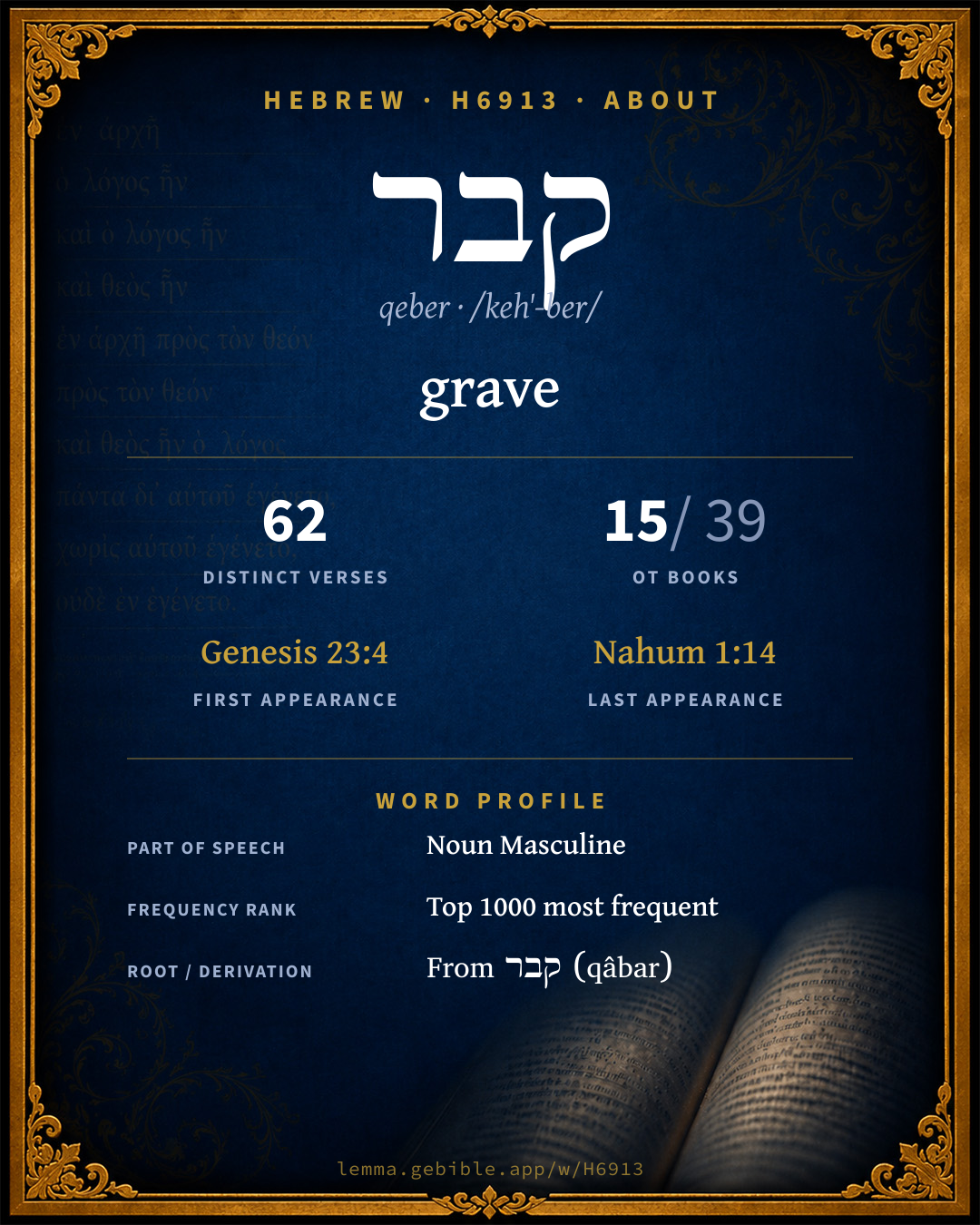
קֶ֫בֶר
grave
Full lexicon entry — Brown-Driver-Briggs (BDB)
From Brown-Driver-Briggs (BDB)
Where this word appears
See every Construct-state word in the Hebrew Bible →
Grammar key — what these labels mean
Part of speech
- Noun
- A naming word — a person, place, thing, or idea.
Noun type
- Common
- A common noun — a general class of person, place, or thing (“king,” “city,” “water”), not a specific name.
State
- Absolute
- The independent form of a noun, not bound to a following word.
- Construct
- A noun bound to a following noun in a possessive / “of” relationship (the construct chain).
Gender
- Masculine
- Grammatically masculine.
Number
- Singular
- One.
- Plural
- More than one (in Hebrew, generally three or more).
25 distinct verses where H6913 appears in the Absolute state, across 11 books. Filtered view — show all forms. Click any verse to open its interlinear word-by-word view. Verse text shown in the World English Bible for context — . Each verse’s Hebrew form is shown with its reference; the English is not keyword-highlighted, since the data carries no word-level English alignment. Use “Compare translations” on any verse to read it across multiple English versions. This concordance covers the Hebrew Bible; Septuagint (Greek Old Testament) occurrences are not indexed here.
Genesis 5 verses
- Genesis 23:4 קֶ֨בֶר֙ n c ms "I am a stranger and a foreigner living with you. Give me a possession of a burying-place with you, that I may bury my dead out of my sight."
- Genesis 23:9 קָֽבֶר n c ms that he may give me the cave of Machpelah, which he has, which is in the end of his field. For the full price let him give it to me in the midst of you for a possession of a burying-place."
- Genesis 23:20 קָ֑בֶר n c ms The field, and the cave that is therein, were made sure to Abraham for a possession of a burying place by the children of Heth.
- Genesis 49:30 קָֽבֶר n c ms in the cave that is in the field of Machpelah, which is before Mamre, in the land of Canaan, which Abraham bought with the field from Ephron the Hittite as a burial place.
- Genesis 50:13 קֶ֗בֶר n c ms for his sons carried him into the land of Canaan, and buried him in the cave of the field of Machpelah, which Abraham bought with the field, for a possession of a burying-place, from Ephron the Hittite, before Mamre.
Exodus 1 verse
Numbers 2 verses
- Numbers 19:16 בְ/קָ֑בֶר prep + n c ms Whoever in the open field touches one who is slain with a sword, or a dead body, or a bone of a man, or a grave, shall be unclean seven days.
- Numbers 19:18 בַ/קָּֽבֶר prep det + n c ms and a clean person shall take hyssop, and dip it in the water, and sprinkle it on the tent, and on all the vessels, and on the persons who were there, and on him who touched the bone, or the slain, or the dead, or the grave:
1 Kings 2 verses
- 1 Kings 13:31 בַּ/קֶּ֕בֶר prep det + n c ms It happened, after he had buried him, that he spoke to his sons, saying, When I am dead, then bury me in the tomb in which the man of God is buried; lay my bones beside his bones.
- 1 Kings 14:13 קָ֑בֶר n c ms All Israel shall mourn for him, and bury him; for he only of Jeroboam shall come to the grave, because in him there is found some good thing toward Yahweh, the God of Israel, in the house of Jeroboam.
2 Kings 2 verses
- 2 Kings 23:16 הַ/קְּבָרִ֤ים הַ/קְּבָרִ֔ים ptcl def.art + n c mp ptcl def.art + n c mp As Josiah turned himself, he spied the tombs that were there in the mountain; and he sent, and took the bones out of the tombs, and burned them on the altar, and defiled it, according to the word of Yahweh which the man of God proclaimed, who proclaimed these things.
- 2 Kings 23:17 הַ/קֶּ֤בֶר ptcl def.art + n c ms Then he said, What monument is that which I see? The men of the city told him, It is the tomb of the man of God, who came from Judah, and proclaimed these things that you have done against the altar of Bethel.
2 Chronicles 1 verse
Job 5 verses
- Job 3:22 קָֽבֶר n c ms Who rejoice exceedingly, Are glad, when they can find the grave?
- Job 5:26 קָ֑בֶר n c ms You shall come to your grave in a full age, Like a shock of grain comes in its season.
- Job 10:19 לַ/קֶּ֥בֶר prep det + n c ms I should have been as though I had not been. I should have been carried from the womb to the grave.
- Job 17:1 קְבָרִ֥ים n c mp "My spirit is consumed, my days are extinct, And the grave is ready for me.
- Job 21:32 לִ/קְבָר֣וֹת prep + n c mp Yet shall he be borne to the grave, Men shall keep watch over the tomb.
Psalms 3 verses
- Psalms 5:9 קֶֽבֶר n c ms For there is no faithfulness in their mouth. Their heart is destruction. Their throat is an open tomb. They flatter with their tongue.
- Psalms 88:5 קֶ֗בֶר n c ms Set apart among the dead, Like the slain who lie in the grave, Whom you remember no more. They are cut off from your hand.
- Psalms 88:11 בַּ/קֶּ֣בֶר prep det + n c ms Is your loving kindness declared in the grave? Or your faithfulness in Destruction?
Isaiah 2 verses
- Isaiah 22:16 קָ֑בֶר קִבְר֔/וֹ n c ms n c ms cs + sfx pers 3ms "What are you doing here? and who has you here, that you have hewed out a tomb here? Cutting him out a tomb on high, chiseling a habitation for himself in the rock!"
- Isaiah 65:4 בַּ/קְּבָרִ֔ים prep det + n c mp who sit among the graves, and lodge in the secret places; who eat pig's flesh, and broth of abominable things is in their vessels;
Jeremiah 1 verse
Ezekiel 1 verse
About this entry
At a glance — auto-summarized from this page’s data, not written by a person. Every figure links to its source below. This summary describes the numbers; it doesn’t interpret them.
קבר — transliterated qeber — is a Hebrew noun carrying the sense “grave.” Its English rendering has broadened — “grave” classically, “tomb” (Berean Standard Bible) in modern versions; see the renderings breakdown. The Hebrew Bible uses it across 62 verses — moderately common. It first appears in Genesis 23:4. Related forms include קבר, קבורה and קברות התאוה. Each statement above links to its evidence; the full detail follows below.
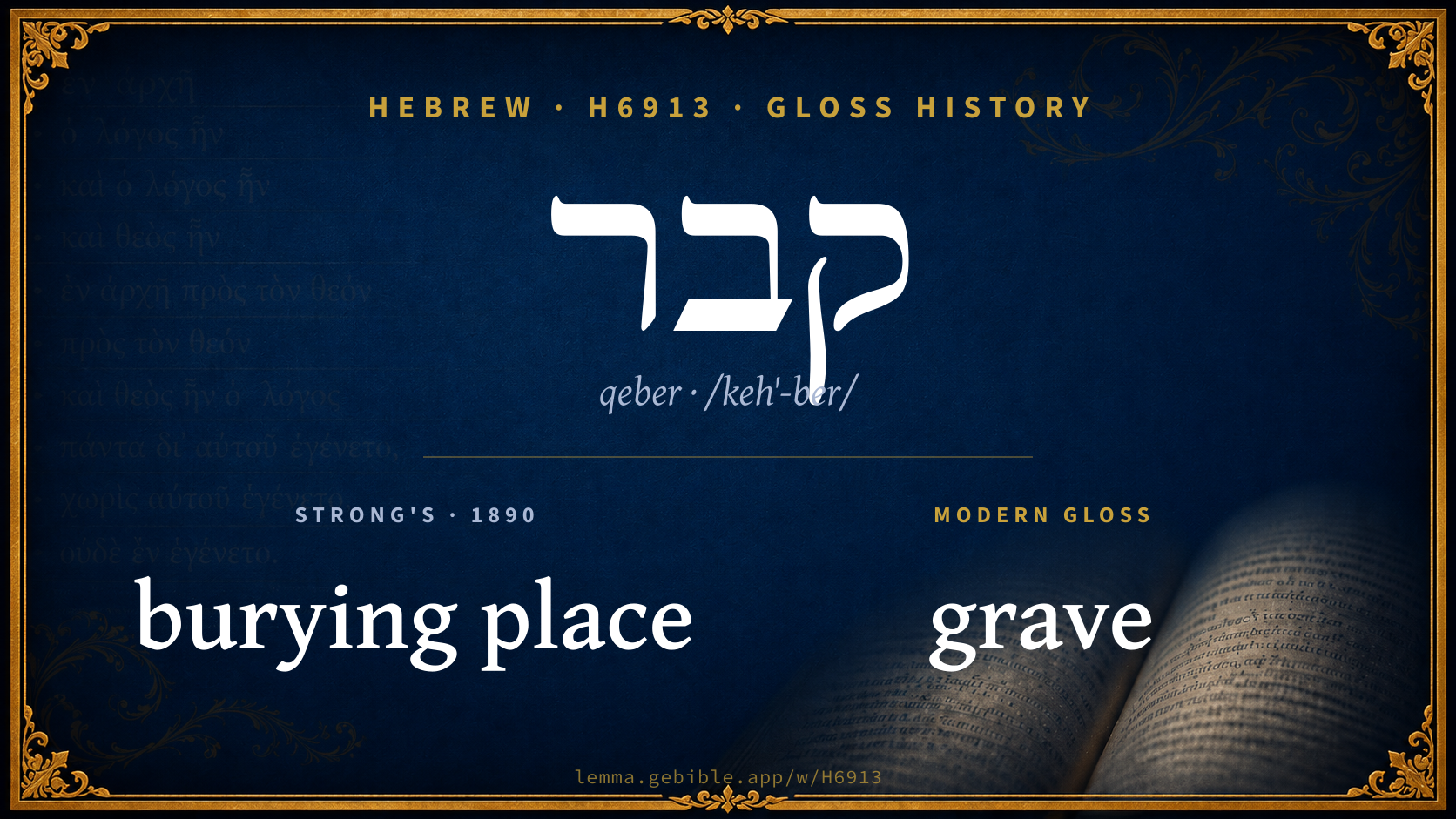
Gloss history
Strong's 1890 vs modern scholarship
About this word
Strong's H6913 catalogs a Hebrew word from the Hebrew Old Testament.
These counts are not copied from any lexicon or concordance. They are computed here, from the morphology-tagged Hebrew Old Testament. What Lemma adds →
- 62
- distinct verses
- The word appears in 62 distinct verses.
- 15 / 39
- OT books
- The word appears in 15 of 39 Old Testament books.
- #587
- by frequency
- Top 1000 most frequent Hebrew words (rank 587 of 8,640 Hebrew words by occurrence).
View all 62 occurrences in the concordance →
Most concentrated in
- 2 Chronicles 8 verses 13%
- Genesis 7 verses 11%
- Ezekiel 7 verses 11%
By section of the Old Testament
By traditional corpus
Conventional, traditional groupings — biblical authorship is debated, so this is a traditional corpus grouping, not an authorship claim. Each share is this word’s portion of its verses in that division of the Hebrew canon. Each figure is a share of the word’s 62 distinct verses.
- Prophets (Nevi'im) 33 verses · 53%
- Writings (Ketuvim) 19 verses · 31%
- Torah (Pentateuch) 10 verses · 16%
How translations render this word
Counts come from each version’s own published word-to-Strong’s tagging or interlinear alignment — an approximate guide to how each version renders this word, not a word-level alignment the data otherwise carries. Because each total is that version’s own tagged count, the per-version totals vary from one another and need not match the appearance or distinct-verse counts above. These counts may also differ from a printed concordance because Lemma counts each distinctly tagged rendering and does not collapse phrase taggings into a single head-word total. This is a fixed set of word-tagged versions (KJV, ASV, BSB, ULT) and does not change with the reading translation you choose elsewhere. Each version’s license is shown beside its name below (and on Sources).
- King James Version: Grave 14×, Graves 13×, Sepulchre 12×
- American Standard Version: Grave 15×, Graves 11×, Sepulchre 11×
- Berean Standard Bible: Tomb 17×, Grave 15×, Graves 12×
- unfoldingWord Literal Text: Grave 18×, Graves 14×, Grave of 9×
King James Version Public Domain
Renders H6913 across 67 tagged occurrences — most commonly:
Plus 11 renderings that appear only once — usually multi-word phrases or single function words the recovered tagging swept in, not distinct renderings.
American Standard Version Public Domain
Renders H6913 across 67 tagged occurrences — most commonly:
Plus 15 renderings that appear only once — usually multi-word phrases or single function words the recovered tagging swept in, not distinct renderings.
Berean Standard Bible Public Domain
Renders H6913 across 66 tagged occurrences — most commonly:
Plus 4 renderings that appear only once — usually multi-word phrases or single function words the recovered tagging swept in, not distinct renderings. Not rendered by a distinct English word in 1 further occurrence.
unfoldingWord Literal Text CC BY-SA 4.0
Renders H6913 across 69 tagged occurrences — most commonly:
Plus 8 renderings that appear only once — usually multi-word phrases or single function words the recovered tagging swept in, not distinct renderings.
Senses in BDB
The 1 sense BDB distinguishes for this word, in lexicon order (not ranked by frequency or importance). The full entry — with sub-senses — is in the Lexicon Entry tab.
- grave, sepulchre, tomb
Word origin
n.m. 1 K 13:31 grave, sepulchre;—abs. ק׳ Gn 23:4 +, קָ֑בֶר 1 K 14:13 +; cstr. קֶבֶר Ju 8:32 +; sf. קִבְרִי Gn 50:5, etc.; pl. קְבָרִים Ex 14:11 +, cstr. קִבְרֵי Je 26:23 +, sf. קִבְרֵיהֶם 8:1; also קְבָרוֹת Jb 21:32, cstr. קִבְרוֹת Ne 2:3 +, sf. קִבְרֹתָיו Ez 32:22; 2 Ch 16:14, etc.;—grave, Ex 14:11; Nu 11:34; Ju 8:32; 2 S 2:32; 1 K 13:22 +; אֲחֻזַּת ק׳ Gn 23:4, 9, 20; 49:30; 50:13; hewn out (חָצַב) Is 22:16(×2); מִבֶּטֶן לַקֶּבֶר אוּבָ֑ל Jb 10:19; fig. וַתְּהִי־לִ׳ אִמִּי ק׳ Je 20:17; שֹׁכְבֵי ק׳ ψ 88:6 the slain lying in grave; הַיּשְׁבִים בַּקְבָרִים Is 65:4 they who sit in the tombs (occult rite, prob. in necromancy, etc., cf. Che and RSSem. i. 180 ff.; 2nd ed. 197 ff.); קֶבֶר בְּנֵי הָעָם 2 K 23:6 i.e. burial-place of common people, so קִבְרֵי בְּנֵי הָעָם Je 26:23; pl. intens. Jb 17:1, also of stately (royal) sepulchre 2 K 22:20 = 2 Ch 34:28, Ne 3:16; 2 Ch 16:14; cf. 35:24; Jb 21:32; conceived as in lower world Ez 32:22, 23, 25, 26; ‖ אֲבַדּוֹן ψ 88:12; ψ 49:12 read קְבָרִים for קִרְבָּם Vrss and most; ק׳ פָּתוּחַ sim. of quiver Je 5:16; fig. ק׳ פ׳ גְּרֹנָם ψ 5:10; of exile Ez 37:12(×2), 13(×2)
— Brown-Driver-Briggs (Oxford 1906, public domain), digitized via Sefaria, supplemented by the OpenScriptures HebrewLexicon (CC BY 4.0). See Sources.
Derived from קבר (qâbar) (H6912) — to bury.
Jastrow Dictionary
A second Hebrew/Aramaic lexicon for comparison, covering Aramaic and post-biblical (Talmudic, Targumic, Midrashic) usage that the biblical-Hebrew BDB does not. Matched by lemma rather than by Strong’s number, so a lemma may carry more than one Jastrow headword (shown separately below), and the entries cover usage well beyond the Bible.
קָבַר
- (b. h.) [to cave out; to arch,] to bury. Snh. 52ᵃ הנראה מי קוֹבֵר את מי (Ms. M. הא נראה) we shall see, which will cover which (which will die first). Sot. 14ᵃ הקב"ה ק׳ … קְבוֹר מתים the Lord buried the dead, … thou, too, bury the dead (consider attending to the dead a religious duty). Nidd. 24ᵇ קובר מתים הייתי I used to be a grave-digger. B. Bath. 15ᵇ לא … לִקְבּוֹר וכ׳ he had no place where to bury Sarah; Ex. R. s. 6. Treat. S’maḥ. ch. XII קָבְרֵנִי תחלה וכ׳ first bury me in the valley, and then collect my bones. Ib. קִבְרוּ אותי תחת וכ׳ bury me at the feet of my father. Sabb. 114ᵃ אל תִּקְבְּרוּנִי לא וכ׳ bury me neither in white clothes nor in black &c.; a. fr.—Part. pass. קָבוּר; f. קְבוּרָה. Keth. 111ᵃ כל הק׳ בא"י כאילו ק׳ וכ׳ he that is buried in Palestine is as though buried under the altar. Ber. 18ᵇ שאני ק׳ במחצלת וכ׳ for I am buried in a reed mat. Gitt. 56ᵇ (ref. to Koh. VIII, 10) קְבוּרִים ממש וכ׳ it really means buried things, for even hidden things were discovered by them, v. קָבַץ; a. fr. e.g. Ecclesiastes 8:10
- to be buried. Snh. 47ᵃ לא נספד ולא נ׳ if a body has been neither lamented over (v. סָפַד) nor buried. Ib.ᵇ לא יִקָּבֵר בו וכ׳ he must never be buried in that place; a. fr.
- to bury (one after the other). Ib. 113ᵃ היה מְקַבֵּר והולך וכ׳ he successively buried (his children) beginning with Abiham &c.
קְבַר
- 1. same, to bury. Targ. Gen. XXIII, 4. Targ. Ps. LXXIX, 3; a. fr.—Part. pass. קְבִיר; f. קְבִירָא &c. Targ. O. Deut. XXXIII, 21 (Y. קָבוּר, Hebr. form). Targ. Ruth I, 17. Targ. Job XXVII, 15; a. fr.—Snh. 46ᵇ לא בעינא דלִיקְבְּרוּהָ וכ׳ I do not want them to bury this man (I want not to be buried when I am dead). Ib. מדקַבְרֵיה וכ׳ because the Lord buried Moses. Sabb. 151ᵇ וקביר, v. חֲפִיר; a. fr.—Ab. Zar. 38ᵃ וק׳ ביה ישראל וכ׳ after an Israelite had hidden a pumpkin in it (the oven).
- 2. (of tide) to overflow, inundate. Gen. R. s. 13; Koh. R. to I, 7 דמרבי וקָבֵר which grows and floods, v. קַבְרִיאֵל.
- as preced. Pi. Targ. Num. XXXIII, 4; a. e.
- to be buried. Targ. Gen. XV, 15. Targ. Jer. VIII, 2; a. fr.—Snh. l. c. מדאִיקְּבוּר צדיקי since righteous men are buried (it would seem that burial is not for the sake of purging the dead from sin). Ib. הנך נמי לִיקַּבְּרוּ וכ׳ they (the other members of the house of Jeroboam) ought also to have been buried for the sake of atonement. Ib. 104ᵃ קברה ולא אִיקְבְּרָא וכ׳ he buried it (Joiakim’s skull), and it would not remain under ground, buried it again &c.; a. e.
קֶבֶר
- preced.) grave. Snh. 47ᵇ ק׳ חדש a fresh grave (that has been dug but not used). Ib. ק׳ בנין a grave on which something has been built, i.e. an arched grave (not flat). Ib. שלשה קברות הן ק׳ הנמצא there are three kinds of graves (with reference to law): a grave that has been discovered (a fresh grave in which somebody was buried without the consent of the owner of the ground); ק׳ הידוע a known grave (in which one was buried with the owner’s consent); ק׳ המזיק את הרבים a grave which interferes with public comfort (made in a thoroughfare). Y. Naz. IX, 57ᵈ top., v. תְּהוֹם. Ohol. XVII, 1 החורש את הק׳ if one passes the plough over a grave. Koh. R. to VII, 8 וכיון שקברוהו … את קִבְרוֹ when they had buried him (Elisha-Aḥer), a fire came to burn his grave; a. v. fr.—Pl. קְבָרִים, קְבָרוֹת. Taan. 25ᵇ תקנתם ק׳ וכ׳ have you prepared graves for yourselves (are you ready to die)? Ib. 22ᵇ שלא יהא בתיהם קִבְרֵיהֶם that their houses may not become their graves (that their dwellings may not fall down from excessive rains); Y. Yoma V, 42ᶜ top שלא יעשו … קִבְרֵיהֶן. Ḥag. 22ᵇ נשתטח על קִבְרֵי וכ׳ he prostrated himself over the graves of &c. Yeb. 47ᵇ שני ק׳ נמסרו וכ׳ the court has charge of two burial places (for culprits). Snh. VI, 5 ולא היו קוברין אותו בקִבְרוֹת אבותיו they did not bury him (the culprit) in the burial place of their ancestors; a. fr.—בֵּית הקברות (abbr. בה"ק) cemetery; pl. בָּתֵּי ק׳. Ber. 18ᵇ הלך ולן בב"הק he went and spent the night in the cemetery. Snh. l. c. (46ᵇ) שני בתי ק׳ וכ׳ two burial grounds were at the disposal of the courts, one for those put to death by the sword, and one &c.; a. fr.—Trnsf. uterus (containing an embryo). Nidd. 21ᵃ באיפשר לפתיחת הק׳ וכ׳ they differ as to whether the uterus can open (to pass the embryo) without discharging blood. Sabb. 129ᵃ חיה כל זמן שהק׳ פתוח וכ׳ for a woman in confinement you must violate the Sabbath laws as long as the uterus is open, whether she says that she needs it or that she needs it not. Ib. מאימתי פתיחת הק׳ when does the opening of the womb begin (in regard to Sabbath laws)?; עד מתי … הק׳ how long is it considered open? Ohol. VII, 4 אין לנפלים פ׳ הק׳ וכ׳ in the case of abortions the laws of levitical cleanness connected with the opening of the womb do not apply, unless &c., v. פִּיקָא I; Tosef. ib. VIII, 8; a. fr.
A Dictionary of the Targumim, the Talmud Babli and Yerushalmi, and the Midrashic Literature (Marcus Jastrow; London, Luzac, 1903) — Public Domain. Digitized via Sefaria. Digitized via Sefaria. Full attribution on Sources.
Forms in the corpus
The 51 distinct written forms H6913 takes in the Hebrew Bible, most frequent first — each parse links to that state’s occurrences in the concordance. Hebrew forms include their vowel points and cantillation, so a single lemma takes many written forms.
Same root — word family
Other BDB entries built from the same root as H6913, grouped by Strong’s listed origin. These share a root / origin per the lexicon — not necessarily a shared meaning. Each links to that word’s own entry.
Derives from
Shares the same root
Proper names from this root
People and places named from this root — a name, not an additional meaning of the word.
Compare all same-root words → 1 of the same-root words is a proper name (a person or place). They share a root, not necessarily a meaning.
Septuagint verse parallels
This word appears in 58 verses that also exist in the Greek Old Testament (Septuagint), out of the 62 Hebrew verses it occurs in. You can read those verses in Greek by switching the Old Testament edition to the Septuagint.
Read these verses in the Septuagint
- Genesis 23:4
- Exodus 14:11
- Numbers 19:16
- Judges 8:32
- 2 Samuel 2:32
- 1 Kings 13:22
- 2 Kings 13:21
- 2 Chronicles 16:14
- Job 3:22
- Psalms 5:9
- Isaiah 14:19
- Jeremiah 5:16
This is a verse-level parallel only — the same verses exist in both the Hebrew and Greek Old Testaments. No word-level Hebrew↔Greek correspondence is claimed: the data carries no such alignment, so no Greek word is shown as this Hebrew word’s translation. Coverage is not total — the Septuagint omits the deuterocanon and renumbers the Psalms, so some Hebrew verses have no direct Greek parallel.