
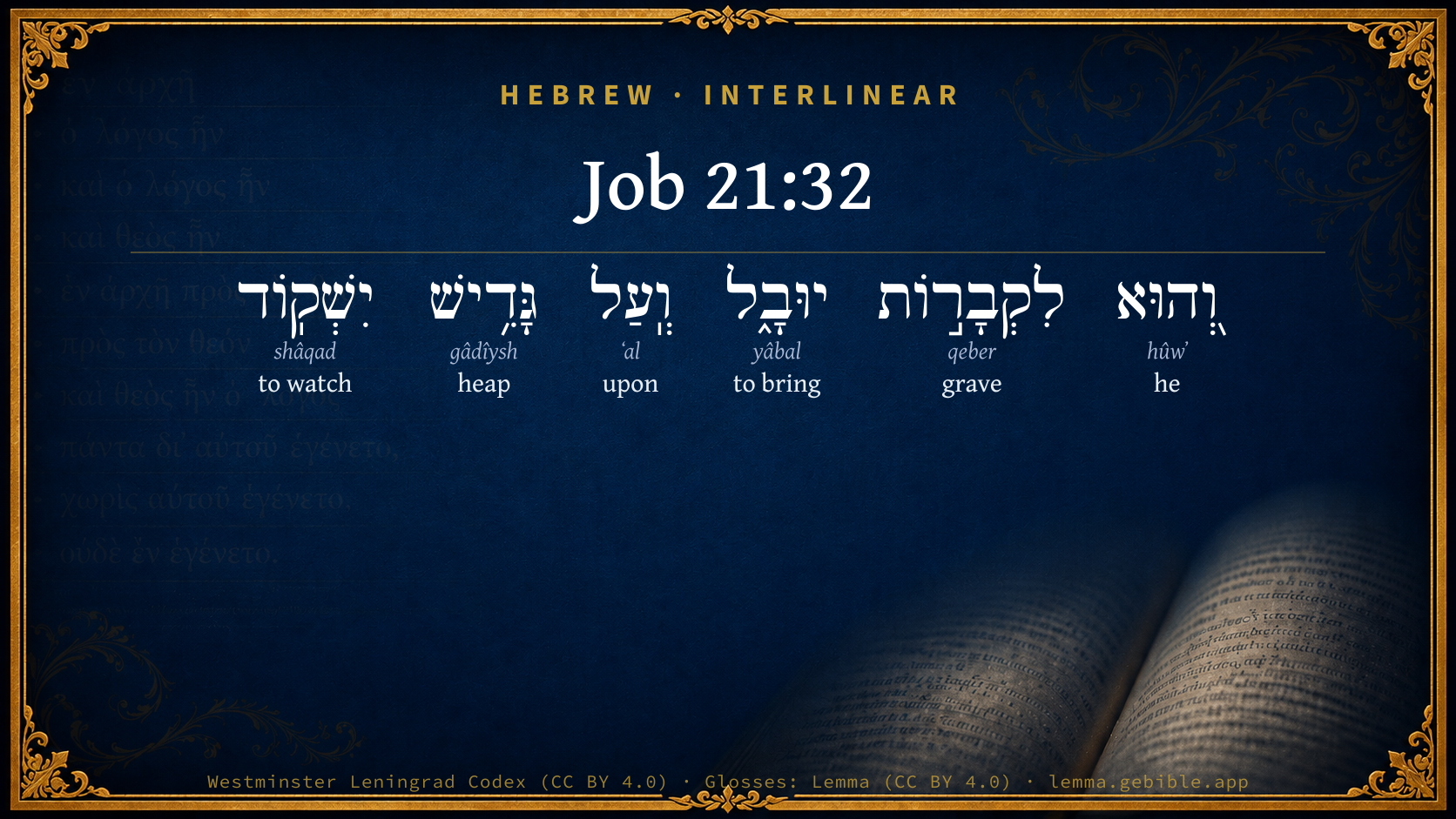
Job 21:32

Hebrew (Westminster Leningrad Codex) Job 21:32 appears in the Hebrew Old Testament. The text above is from the Westminster Leningrad Codex. Each word links to its Strong’s number, a concise gloss, and parsing drawn from the Open Scriptures Hebrew Bible morphology. Click any word for its full Brown-Driver-Briggs (BDB) entry.
Download image
Cite this verse

Job 21:32 (World English Bible). Public Domain. Lemma interlinear Bible study tool, https://lemma.gebible.app/v/job/21/32.

Show BibTeX & RIS
BibTeX
RIS
English Translation
Yet shall he be borne to the grave, Men shall keep watch over the tomb.
World English Bible · Public Domain
Download a study sheet

One document with this verse’s original text, its word-by-word gloss line, the meaning frame, cross-references with their text, attributed commentary, and full source and license credits — printable, and it pastes into notes with its structure intact.

This verse Autodidact and up

Study sheet (.html) Plain text (.txt)

A passage Seminary Student

Up to 50 verses in one chapter. A passage sheet keeps up to 6 commentary sources and 12 cross-references per verse, in the order this page ranks them, and says so on the sheet whenever that leaves anything out. Ask for a single verse and you get the Autodidact verse sheet above.

Everything on this page stays free to read, with no account — the sheet is a download of what is already on screen, not access to it.

Want to remove ads? Support Godless Engineer
Compare translations 3

The same verse in 3 English versions, stacked beneath the original-language interlinear above. Click any original word for its lexicon entry.

Each is an independent rendering of the whole verse — the interlinear is not word-aligned to these translations.

Highlighted words mark where these versions differ — a whole-verse word diff, not a word-by-word alignment.

  • World English Bible Public Domain
    Yet shall he be borne to the grave, Men shall keep watch over the tomb.
  • King James Version Public Domain
    Yet shall he be brought to the grave, and shall remain in the tomb.
  • unfoldingWord Literal Text CC BY-SA 4.0
    Indeed, he will be brought forth to the grave, and one will watch over the burial mound.

unfoldingWord Literal Text — © unfoldingWord, licensed CC BY-SA 4.0. Word-aligned USFM3 via Door43 (git.door43.org/unfoldingWord/en_ult).

Versions to compare (up to 4)

3 of 4 selected

Show all 18 translations

Every available English version of this verse, each an independent rendering of the whole verse.

  • World English Bible Public Domain
    Yet shall he be borne to the grave, Men shall keep watch over the tomb.
  • Berean Standard Bible Public Domain
    He is carried to the grave, and watch is kept over his tomb.
  • Majority Standard Bible Public Domain
    He is carried to the grave, and watch is kept over his tomb.
  • King James Version Public Domain
    Yet shall he be brought to the grave, and shall remain in the tomb.
  • American Standard Version (1901) Public Domain
    Yet shall he be borne to the grave, And men shall keep watch over the tomb.
  • Revised Version (1885) Public Domain
    Yet shall he be borne to the grave, and shall keep watch over the tomb.
  • Geneva Bible (1599) Public Domain
    Yet shall he be brought to the graue, and remaine in the heape.
  • Douay-Rheims (1899) Public Domain
    He shall be brought to the graves, and shall watch in the heap of the dead.
  • Young's Literal Translation Public Domain
    And he -- to the graves he is brought. And over the heap a watch is kept.
  • Literal Standard Version CC BY-SA 4.0
    And he is brought to the graves, || And a watch is kept over the heap.
  • Unlocked Literal Bible CC BY-SA 4.0
    Yet he will be borne to the grave; men will keep watch over his tomb.
  • unfoldingWord Literal Text CC BY-SA 4.0
    Indeed, he will be brought forth to the grave, and one will watch over the burial mound.
  • Darby Bible Public Domain
    Yet is he carried to the graves, and watch is kept over the tomb.
  • World Messianic Bible Public Domain
    Yet he will be borne to the grave. Men will keep watch over the tomb.
  • Webster's Bible Public Domain
    Yet he shall be brought to the grave, and shall remain in the tomb.
  • Free Bible Version CC BY-SA 4.0
    When they eventually die and are carried to the graveyard, their tomb is guarded. The earth of the grave softly covers them.
  • Bible in Basic English Public Domain
    He is taken to his last resting-place, and keeps watch over it.
  • JPS Tanakh (1917) Public Domain
    For he is borne to the grave, and watch is kept over his tomb.

Literal Standard Version (2020), Covenant Press — licensed CC BY-SA 4.0. Text via the HelloAO Bible API (eBible.org). Unlocked Literal Bible (unfoldingWord) — licensed CC BY-SA 4.0. Text via the HelloAO Bible API (eBible.org). unfoldingWord Literal Text — © unfoldingWord, licensed CC BY-SA 4.0. Word-aligned USFM3 via Door43 (git.door43.org/unfoldingWord/en_ult). Free Bible Version, Dr. Jonathan Gallagher — licensed CC BY-SA 4.0. Text via the HelloAO Bible API (eBible.org).

Word by word

More ways to search: Search by grammar → Find every occurrence → Compare this word →

Practice this passage: Drill this verse → Learn its vocabulary →

About this verse

These counts appear in no published source. They are computed here, from the morphology-tagged text and Lemma’s own curated glosses. What Lemma adds →

6
words
6
distinct lemmas
Wisdom
section

Notable vocabulary

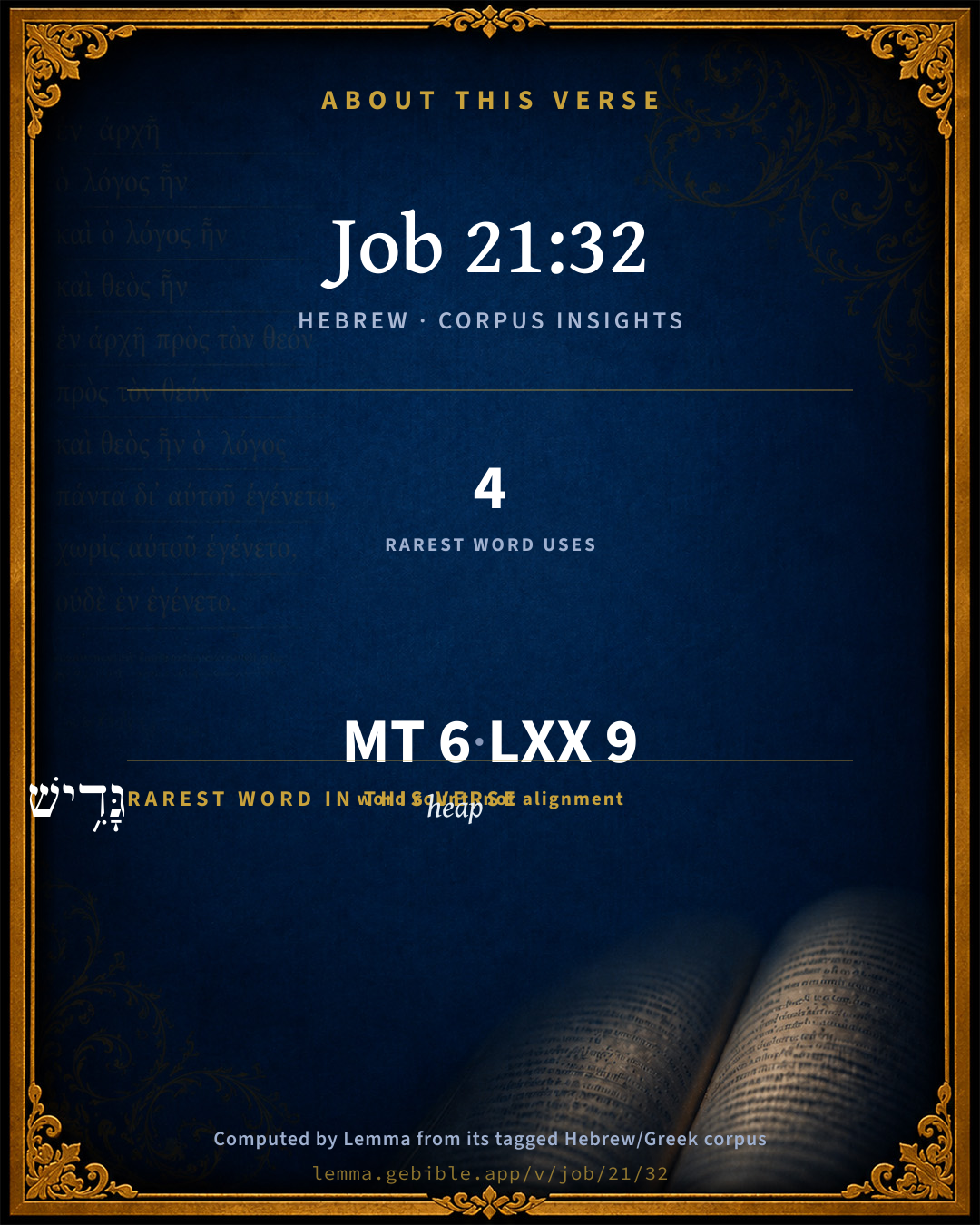
The rarest word here is גָּדִ֥ישׁ heap H1430 — appearing just 4 times in the whole Hebrew Bible.

Shared distinctive vocabulary

גָּדִ֥ישׁ heap H1430 occurs in 4 verses of the Hebrew Bible. Also found in:

Grammatical profile

  • 2 verbs
  • 2 nouns
  • 1 pronoun
  • 1 preposition

Verb forms

  • יוּבָ֑ל Hophal · Imperfect
  • יִשְׁקֽוֹד Qal · Imperfect

Hebrew & Septuagint length

In English translation the verse runs 15 words from the Hebrew and 16 from the Septuagint (LXX English) — closely comparable.

A rough comparison of the two English renderings, which tokenize alike — not a word-level alignment.

Word counts can differ between the Hebrew and the Greek without any difference in meaning — e.g. the Hebrew direct-object marker אֵת has no separate Greek word, and Greek often adds the article ὁ.

In the original languages it is 6 Hebrew tokens and 9 Greek tokens — but the two are counted differently (Hebrew bundles its prefixes and suffixes into one token; the Greek is in lemma form), so that isn’t a like-for-like length.

Cross-references

3

Topical passages linked to Job 21:32 in the Treasury of Scripture Knowledge — connected by theme and wording, ordered by reader-vote popularity; previews shown in the World English Bible.

  • Luke 16:22 It happened that the beggar died, and that he was carried away by the angels to Abraham's bosom. The rich man also died, and was buried.
  • Psalms 49:14 They are appointed as a flock for Sheol. Death shall be their shepherd. The upright shall have dominion over them in the morning. Their beauty shall decay in Sheol, Far from their mansion.
  • Ezekiel 32:21–32 The strong among the mighty shall speak to him out of the midst of Sheol with those who help him: they are gone down, they lie still, even the uncircumcised, slain by the sword.

Cross-references courtesy of OpenBible.info (CC BY 4.0).

Hebrew and Greek witnesses Masoretic Hebrew ↔ Greek Septuagint

The same verse in the two great witnesses to the Old Testament, shown verse-for-verse.

These are two independent witnesses, not word-aligned to each other, and the Septuagint is shown in lemma (dictionary) form.

Hebrew Job 21:32 Masoretic · Westminster Leningrad Codex

וְ֭הוּא לִקְבָר֣וֹת יוּבָ֑ל וְֽעַל גָּדִ֥ישׁ יִשְׁקֽוֹד

Yet shall he be borne to the grave, Men shall keep watch over the tomb.

World English Bible · Public Domain

Greek LXX Job 21:32 Septuagint · lemma form

καί αὐτός εἰς τάφος ἀποφέρω καί ἐπί σορός ἀγρυπνέω

And he has been led away to the tombs, and he has watched over the heaps.

LXX2012 (modern English Septuagint) · Public Domain

On this verse, Albert Barnes' Notes on the Bible discusses the Septuagint’s reading. Read the note in Commentary ↓

Hebrew: Westminster Leningrad Codex (CC BY 4.0). Greek: Septuagint (public domain); English from LXX2012 (modern English Septuagint) (Public Domain). How the Septuagint differs from the Hebrew →

Commentary

Notes on Job 21:32 from classic Christian and Jewish commentators (each source and its license shown beneath its notes). The classic Christian expositions comment on the surrounding passage and are grouped to its opening verse, so a note may address several verses; the Jewish commentaries on the Tanakh (Rashi and others) are per-verse, so they appear only where the commentator wrote on this verse.

Lemma curates 59 commentaries, every one of them public domain or Creative Commons licensed, each selected and text-cleaned for this edition rather than reprinted as found. About our sources →

Adam Clarke's Commentary

Verse 32. Yet shall he be brought to the grave] He shall die like other men; and the corruption of the grave shall prey upon him. Mr. Carlyle, in his specimens of Arabic poetry, Translations, p. 16, quotes this verse, which he translates and paraphrases, והוא לקברות יובל "He shall be brought to the grave," ועל גדוש ישקוד And shall watch upon the high-raised heap."

It was the opinion of the pagan Arabs, that upon the death of any person, a bird, by them called Manah, issued from the brain, and haunted the sepulchre of the deceased, uttering a lamentable scream. This notion, he adds, is evidently alluded to in Job 21:32. Thus Abusahel, on the death of his mistress: -

"If her ghost's funereal screech

Through the earth my grave should reach,

On that voice I loved so well

My transported ghost would dwell."

Adam Clarke's Commentary on the Bible (1810–1826) — public domain. Text from a community e-Sword/MySword module.

Trapp's Complete Commentary

John Trapp

Job 21:32 Yet shall he be brought to the grave, and shall remain in the tomb.

Ver. 32. Yet shall he be brought to the grave] He that was erst so stern and terrible shall shortly be laid low enough, and then leoni mortuo vel mus insultabit. the corpse of a lion or a leaping mouse. Though he were such a son of Belial that none could speak to him (as Nabal was, 1Sa 25:17), yet death will speak with him, and confute this proud haughty scorner, that dealeth in proud wrath. When death comes, saith Sir Walter Raleigh, which hates and destroys men, that is believed and obeyed; but God, that loveth and maketh men, he is not regarded. Oh mighty death! Oh eloquent death! whom none could advise, thou art able to prevail with.

And shall remain in the tomb] Heb. He shall watch over the heap, super tumulum cumulo frugum in area constructo similem (Lavat.); as a watchman, there he is fixed and keeps this place. Or, He shall be watched in the tomb.

John Trapp, A Commentary or Exposition upon All the Books of the Old and New Testament (1647–1656) — public domain. Text from a community e-Sword module.

Joseph Benson's Commentary

Job 21:32. Yet — Hebrew, And, the pomp of his death shall be suitable to the glory of his life; shall he be brought to the grave — With pomp and state, as the word יובל, jubal, signifies. Hebrew, לקברות, likbaroth, to the graves, that is, to an honourable and eminent grave; the plural number being often used emphatically to denote eminence. He shall not die a violent, but a natural death, and shall lie in the bed of honour. And shall remain in the tomb — Or, watch in the heap. His body shall quietly rest in his grave or monument, where he shall be embalmed and preserved so entire and uncorrupted that he might rather seem to be a living watchman, set there to guard the body, than to be a dead corpse. Hebrew, ישׁקוד

ועל גדישׁ, vegnal gadish jishkod, over the tomb he shall watch. “A stately monument,” says Bishop Patrick, “is raised to preserve his memory, and represent him as if he were still living.”

Joseph Benson's Commentary on the Old and New Testaments (1811–1818) — public domain. Text from a community e-Sword module.

Jamieson, Fausset & Brown

Robert Jamieson, A. R. Fausset & David Brown

Yet--rather, "and."

brought--with solemn pomp (Psa 45:15).

grave--literally, "graves"; that is, the place where the graves are.

remain in--rather, watch on the tomb, or sepulchral mound. Even after death he seems still to live and watch (that is, have his "remembrance" preserved) by means of the monument over the grave. In opposition to Bildad (Job 18:17).

Jamieson, Fausset & Brown — Commentary Critical and Explanatory on the Whole Bible (1871) — public domain (CC PDM 1.0). Text via the HelloAO Bible API.

Ellicott's Commentary for English Readers

(32) And shall remain in the tomb.—The word rendered tomb is rendered shock of corn in Job_5:26, and is not found in the sense of tomb elsewhere. It is doubtful, therefore, whether this is its meaning here. The verse may mean: “He shall be borne to the grave, and men shall watch over his sheaves,” i.e., his possessions; or “He shall be borne to the grave with as much deference as when he used to watch over his sheaves” (to protect them from robbery).

A Bible Commentary for English Readers, edited by Charles John Ellicott (1878–1897) — public domain. Text from a community e-Sword module.

The Cambridge Bible for Schools and Colleges

gen. ed. J. J. S. Perowne

32. Yet shall he be brought] Rather, and he is carried, as above. Comp. ch. Job_10:19, where Job uses the same language of his own burial. The word is that used in Job_21:30 (led forth, cf. reff.), and suggests the pomp and slow solemnity of his interment.

shall remain in the tomb] Rather, as above, keep watch over his tomb, lit. his heap (ch. Job_5:26 of a heap of sheaves), meaning the monument raised over him. This may have been first a heap of stones, but naturally the word might be used in a wider sense of any sepulchral monument. This is watched against desecration. In the Sidonian inscription on the tomb of Eshmun‘azar that monarch utters deep curses against any who shall violate his grave. Instead of “they keep watch” others render “he watches,” considering the reference to be to the effigy of the deceased graven upon his sarcophagus. The practice of making such an effigy was common in Egypt, and the Author of the Book might be familiar with it. But the practice was not unknown elsewhere. The sarcophagus of Eshmun’azar has such an effigy, the inscription of 22 lines being cut upon the breast and body of the figure, and again in part around the head. The Author of the Book is fond of alluding to customs and things not specifically Hebrew. At the same time, whether we render “they watch over,” or “he watches upon,” the words might be used in a less precise sense, meaning in the one case that they looked with respect or reverence to his place of sepulture, and in the other that his memory and life were perpetuated in the monument upon his tomb.

32, 33. The wicked man is buried in honour; and his example followed.

32 And he is carried to the grave,

And they keep watch over his tomb;

33 The clods of the valley are sweet unto him;

And all men draw after him,

As there were innumerable before him.

The Cambridge Bible for Schools and Colleges (gen. ed. J. J. S. Perowne; Cambridge University Press, 1878–1918) — public domain. Text from a community e-Sword module.

John Gill's Exposition

The clods of the valley shall be sweet unto him,.... Where he lies interred, alluding to places of interment at the bottom of hills, and mountains, and under rocks, in plains and vales, see Gen 35:8; and by this strong figure is signified, that the dead wicked man, lying in the clods of the valley in his grave, is in great repose, and in the utmost ease and quiet, feels no pains of body, nor has any uneasiness of mind concerning what befalls his posterity after his death, Job 14:21;

and every man shall draw after him, as there are innumerable before him; which either respects the pomp at his funeral procession, vast numbers being drawn and gathered together to gaze at it, as is common at grand funerals; and particularly, it may describe the multitude that go before the corpse, as well as those that follow after it; but rather as he is before represented as brought to his grave, and laid there, this clause is added, to denote the universality of death, it being common to all; thousands and ten thousands, even a number which no man can number, have gone before him by death into another world, as every man that comes after him must; and so this may prevent an objection to the grandeur of a wicked man, that after all he dies; but then death is no other than what is common to all men, to the vast multitudes that have gone before, and will be the case of all that come after, to the end of the world.

John Gill's Exposition of the Whole Bible (1746–1763) — public domain (CC PDM 1.0). Text via the HelloAO Bible API.

Albert Barnes' Notes on the Bible

Yet shall he be brought to the grave - Margin, “graves.” That is, he is brought with honor and prosperity to the grave. He is not cut down by manifest divine displeasure for his sins. He is conducted to the grave as other people are, not withstanding his enormous wickedness. The “object” of this is clearly to state that he would not be overwhelmed with calamity, as the friends of Job had maintained, and that nothing could be determined in regard to his character from the divine dealings toward him in this life.

And shall remain in the tomb - Margin, “watch in the heap.” The marginal reading does not make sense, though it seems to be an exact translation of the Hebrew. Noyes renders it, “Yet he still survives upon his tomb.” Prof. Lee, “For the tomb was he watchful;” that is, his anxiety was to have an honored and a splendid burial. Wemyss, “They watch over his tomb;” that is, he is honored in his death, and his friends visit his tomb with affectionate solicitude, and keep watch over his grave. So Dr. Good renders it. Jerome translates it; “et in congerie mortuorum vigilabit.” The Septuagint, “And he shall be borne to the graves, and he shall watch over the tombs;” or, he shall cause a watch to be kept over his tomb - ἐπὶ σωρῶν ἠγρύπνησεν epi sōrōn ēgrupnēsen. Amidst this variety of interpretation, it is not easy to determine the true sense of the passage. The “general” meaning is not difficult.

It is, that he should be honored even in his death; that he would live in prosperity, and be buried with magnificence. There would be nothing in his death or burial which would certainly show that God regarded him as a wicked man. But there is considerable difficulty in determining the exact sense of the original words. The word rendered “tomb” in the text and “heap” in the margin (גדישׁ gâdı̂ysh) occurs only in the following places, Exo 22:6; Job 5:26; Jdg 15:5, where it is rendered “a shock of corn,” and in this place. The “verb” in the Syriac, Arabic, and in Chaldee, means “to heap up” (see Castell), and the noun may denote, therefore, a stack, or a heap, of grain, or a tomb, that was made by a pile of earth, or stones. The ancient “tumuli” were there heaps of earth or stone, and probably such a pile was made usually over a grave as a monument. On the meaning of the word used here, the reader may consult Bochart, Hieroz. P. i.

L. iii. c. xiii. p. 853. There can be little doubt that it here means a tomb, or a monument raised over a tomb. There is more difficulty about the word rendered “shall remain” (ישׁקוד yı̂shqôd). This properly means, to wake, to be watchful, to be sleepless. So the Chaldee שקד, and the Arabic “dakash” The verb is commonly rendered in the Scriptures, “watch,” or “waketh.” See Psa 127:1; Psa 102:7; Jer 31:28; Jer 1:12; Jer 5:6; Jer 44:27; Isa 29:20; Ezr 8:29; Dan 9:14. There is usually in the word the notion of “watching,” with a view to guarding, or protecting, as when one watches a vineyard, a house, or other property. The sense here is, probably, that his tomb should be carefully “watched” by friends, and the verb is probably taken impersonally, or used to denote that “someone” would watch over his grave. This might be either as a proof of affection, or to keep it in repair. One of the most painful ideas might have been then, as it is now among American savages (Bancroft’s History of the United States, vol. iii. p. 299), that of having the grave left or violated, and it may have been regarded as a special honor to have had friends, who would come and watch over their sepulchre.

According to this view, the meaning is, that the wicked man was often honorably buried; that a monument was reared to his memory; and that every mark of attention was paid to him after he was dead. Numbers followed him to his burial, and friends came and wept with affection around his tomb. The argument of Job is, that there was no such distinction between the lives and death of the righteous and the wicked as to make it possible to determine the character; and is it not so still? The wicked man often dies in a palace, and with all the comforts that every clime can furnish to alleviate his pain, and to soothe him in his dying moments. He lies upon a bed of down; friends attend him with unwearied care; the skill of medicine is exhausted to restore him, and there is every indication of grief at his death. So, in the place of his burial, a monument of finest marble, sculptured with all the skill of art, is reared over his grave. An inscription, beautiful as taste can make it, proclaims his virtues to the traveler and the stranger. Friends go and plant roses over his grave, that breathe forth their odors around the spot where he lies. Who, from the dying scene, the funeral, the monument, the attendants, would suppose that he was a man whom God abhorred, and whose soul was already in hell? This is the argument of Job, and of its solidity no one can doubt.

Albert Barnes' Notes on the Bible (1834–1885) — public domain. Text from a community e-Sword/MySword module.

Haydock's Catholic Bible Commentary

Dead. Hebrew, "the sheaves," being quite ripe for harvest, and even in the tomb, the tyrant retains some sore of pre-eminence, as he is buried with honour, an set like a more elevated sheaf, to inspect the rest. (Calmet) --- Godiss, is rendered by Protestants, "tomb," (margin) "heap." But (chap. v. 26.) where only the word occurs again, we find "a shock of corn," and this comparison seems very suitable here. The damned shall watch, alas, when it will be to no purpose, among the heap of fellow-sufferers, who would not think while they had time to repent. After millions of night spent thus without sleep or ease, we may imagine we hear their mournful lamentations from the depth of the abyss. Always misery! and never any hope of ease! (Haydock) --- "Eternity," says Bridayne, (ser. in Maury’s Eloq.) "is a pendulum, the vibration of which sounds continually, Always! Never! In the mean while, a reprobate cries out: What o’clock is it? And the same voice answers, Eternity!" Thus at last the wicked shal awake from the sleep in which they have spent their days; (Haydock) and their watching, restless, and immortal souls (St. Thomas Aquinas) will bitterly lament their past folly. What profit will they derive from the honours paid to their corpse by surviving friends, (Haydock) even though they be embalmed, and seem to live in marble statues? (Pineda)

George Leo Haydock (1774–1849), Haydock's Catholic Family Bible and Commentary, 1859 edition — public domain. Excludes Psalms (Douay-Rheims chapter numbering differs from Protestant) and Deuterocanonical books (Catholic canon only).

Matthew Poole's English Annotations

Yet, Heb. and. The pomp of his death shall be suitable to the glory of his life.

Shall he be brought, with pomp and state, as the word signifies.

To the grave, Heb. to the graves, i.e. to an honourable and eminent grave; the plural number being oft used emphatically to note eminency, as Job 40:10; Pro 1:20 Lam 3:22. He shall not die a violent, but a natural death, and shall lie in the bed of honour.

Shall remain in the tomb, Heb. shall watch (i.e. have a constant and fixed abode, as watchmen have in the watching-place) in the heap, i.e. in his grave, which is called a heap, either because the earth is there heaped up, or because it was adorned with some pyramid or other monument raised up to his honour. His body shall quietly rest in his grave or monument, where he shall be embalmed and preserved so entire and uncorrupted, that he might rather seem to be a living watchman, set there to guard the body, than to be a dead corpse.

Matthew Poole's English Annotations on the Holy Bible (1683–1685) — public domain. Text from a community e-Sword/MySword module.

Whedon's Commentary on the Bible

Daniel D. Whedon

32. The grave — Like “dwelling-places” in Job_21:28, “the graves” here is an amplificative plural. (Delitzsch.)

Brought — The idea of pomp, or ceremony, is involved in the word youbal. The magnificence displayed by the ancient Egyptians in the burial of their dead surpasses description. (See CAREY’S Job, p. 458.)

Shall remain in the tomb — Shall watch over the tomb. Mercerus remarks: “The dead is said to watch in the sepulchre; since there he is assiduous; there assiduously remains! — never thence departs.” Renan surmises that there may be an allusion to the threatening inscriptions against those who profane the abodes of the dead, (see note Job_18:16,) which will remind of Shakspeare’s curse against him who should disturb his bones. A better view is, that the wicked, instead of perishing from remembrance, as Bildad had said, (Job_18:17,) lives on either in the affection that cares for his tomb, or in the splendid memorial crowning the sepulchral height. There may be an allusion, says Hengstenberg, to the Egyptian custom of placing in the tomb an image of the dead, either as a statue or a painting on the wall.

Daniel D. Whedon (gen. ed.), Commentary on the Old and New Testaments (1874–1909) — public domain. Text from a community e-Sword module.

The Pulpit Commentary

Yet shall he be brought to the grave; rather, he moreover is borne (in pomp) to the grave. Even in death the advantage is still with the wicked man. He is borne in procession to the grave a mausoleum or a family vault by a long train of mourners, who weep and lament for him, and pay him funeral honours. The poor virtuous man, on the other hand, is hastily thrust under the soil. And shall remain in in the tomb; or shall keep watch over his tomb. The allusion is probably to the custom, common certainly in Egypt and Phoenicia, of carving a figure of the deceased on the lid of his sarcophagus, to keep as it were watch over the remains deposited within. The figure was sometimes accompanied by an inscription, denouncing curses on those who should dare to violate the tomb or disturb the remains (see "Records of the Past," vol. 9. pp. 112-114; and compare the author"s "History of Phoenicia," pp. 393-395).

The Pulpit Commentary (1880–1919), ed. H.D.M. Spence-Jones & Joseph S. Exell — public domain. Text from a community e-Sword module.

John Wesley's Explanatory Notes

And - The pomp of his death shall be suitable to the glory of his life. Brought - With pomp and state, as the word signifies. Grave - Hebrew. to the graves; to an honourable and eminent grave: the plural number being used emphatically to denote eminency. He shall not die a violent but a natural death.

John Wesley, Explanatory Notes Upon the Whole Bible (1754–1765) — public domain. Text via the GEBible commentary corpus.

Keil & Delitzsch

C. F. Keil & F. Delitzsch

32 And he is brought to the grave,

And over the tomb he still keepeth watch.

33 The clods of the valley are sweet to him,

And all men draw after him,

As they preceded him without number.

. . . . . .

34 And how will ye comfort me so vainly!

Your replies are and remain perfidy.

During life removed at the time of dire calamity, this unapproachable evil-doer is after his death carried to the grave with all honour (יוּבל, comp. Job 10:19), and indeed to a splendid tomb; for, like משׁכנות above, קברות is also an amplificative plural. It is certainly the most natural to refer ישׁקד, like יוּבל, to the deceased. The explanation: and over the tomb one keeps watch (Bttch., Hahn, Rd., Olsh.), is indeed in itself admissible, since that which serves as the efficient subject is often left unexpressed (Gen 48:2; Kg2 9:21; Isa 53:9; comp. supra, on Job 18:18); but that, according to the prevalent usage of the language, ישׁקד would denote only a guard of honour at night, not also in the day, and that for clearness it would have required גּדישׁו instead of גּדישׁ, are considerations which do not favour this explanation, for שׁקד signifies to watch, to be active, instead of sleeping or resting; and moreover, the placing of guards of honour by graves is an assumed, but not proved, custom of antiquity. Nevertheless, ישׁקד might also in general denote the watchful, careful tending of the grave, and the maqâm (the tomb) of one who is highly honoured has, according to Moslem custom, servants (châdimı̂n) who are appointed for this duty. But though the translation "one watches" should not be objected to on this ground, the preference is to be given to a commendable rendering which makes the deceased the subject of ישׁקד. Raschi's explanation does not, however, commend itself: "buried in his own land, he also in death still keeps watch over the heaps of sheaves." The lxx translates similarly, ἐπὶ σωρῶν, which Jerome improperly, but according to a right sentiment, translates, in congerie mortuorum. For after the preceding mention of the pomp of burial, גּדישׁ, which certainly signifies a heap of sheaves in Job 5:26, is favoured by the assumption of its signifying a sepulchral heap, with reference to which also in that passage (where interment is likewise the subject of discourse) the expression is chosen. Haji Gaon observes that the dome (קבּה, Arab. qbbt, the dome and the sepulchral monument vaulted over by it)

(Note: Vid., Lane's Manners and Customs of the Modern Egyptians (translated by Zenker).)

erected over graves according to Arab custom is intended; and Aben-Ezra says, that not exactly this, but in general the grave-mound formed of earth, etc., is to be understood. In reality, גדישׁ (from the verb גדשׁ, cumulare, commonly used in the Talmud and Aramaic) signifies cumulus, in the most diversified connections, which in Arabic are distributed among the verbs jds, kds, and jdš, especially tumulus, Arab. jadatun (broader pronunciation jadafun). If by grave-mound a mound with the grave upon it can be understood, a beautiful explanation is presented which accords with the preference of the Beduin for being buried on an eminence, in order that even in death he may be surrounded by his relations, and as it were be able still to overlook their encampment: the one who should have had a better lot is buried in the best place of the plain, in an insignificant grave; the rich man, however, is brought up to an eminence and keeps watch on his elevated tomb, since from this eminence as from a watch-tower he even in death, as it were, enjoys the wide prospect which delighted him so while living.

(Note: "Take my bones," says an Arabian poem, "and carry them with you, wherever you go; and if ye bury them, bury them opposite your encampment! And bury me not under a vine, which would shade me, but upon a hill, so that my eye can see you!" Vid., Ausland, 1863, Nr. 15 (Ein Ritt nach Transjordanien).)

But the signification collis cannot be supported; גדישׁ signifies the hill which is formed by the grave itself, and Job 21:33 indeed directs us to the wady as the place of burial, not to the hill. But if גדישׁ is the grave-mound, it is also not possible with Schlottm. to think of the pictures on the wall and images of the deceased, as they are found in the Egyptian vaults (although in Job 3:14 we recognised an allusion to the pyramids), for it cannot then be a גדישׁ in the strict sense that is spoken of; the word ought, like the Arabic jdṯ (which the Arab. translation of the New Testament in the London Polyglott uses of the μνημεῖον of Jesus), with a mingling of its original signification, to have been used in the general signification sepulcrum. This would be possible, but it need not be supposed. Job's words are the pictorial antithesis to Bildad's assertion, Job 18:17, that the godless man dies away without trace or memorial; it is not so, but as may be heard from the mouth of people who have experience in the world: he keeps watch over his tomb, he continues to watch although asleep, since he is continually brought to remembrance by the monument built over his tomb. A keeping watch that no one approaches the tomb disrespectfully (Ew.), is not to be thought of. שׁקד is a relative negation of the sleep of death: he is dead, but in a certain manner he continues to live, viz., in the monument planting forward his memory, which it remains for the imagination to conceive of as a mausoleum, or weapons, or other votive offerings hung upon the walls, etc. In connection with such honour, which follows him even to and beyond death, the clods of the valley (est ei terra levis) are sweet (מתקוּ is accentuated with Mercha, and לו without Makkeph with little-Rebia) to him; and if death in itself ought to be accounted an evil, he has shared the common fate which all men after him will meet, and which all before him have met; it is the common end of all made sweet to him by the pageantry of his burial and his after-fame. Most modern expositors (Ew., Hirz., Umbr., Hlgst., Welte) understand the ימשׁך, which is used, certainly, not in the transitive signification: to draw after one's self, but in the intransitive: to draw towards (lxx απελεύσεται), as Jdg 4:6 (vid., Ges. Thes.), of an imitative treading of the same way; but כּל־אדם would then be an untrue hyperbole, by which Job would expose himself to the attack of his adversaries.

In Job 21:34 Job concludes his speech; the Waw of ואיך, according to the idea (as e.g., the Waw in ואני, Isa 43:12), is an inferential ergo. Their consolation, which is only available on condition of penitence, is useless; and their replies, which are intended to make him an evil-doer against the testimony of his conscience, remain מעל. It is not necessary to construe: and as to your answers, only מעל remains. The predicate stands per attractionem in the sing.: their answers, reduced to their true value, leave nothing behind but מעל, end in מעל, viz., באלהים, Jos 22:22, perfidious sinning against God, i.e., on account of the sanctimonious injustice and uncharitableness with which they look suspiciously on him.

Job has hitherto answered the accusations of the friends, which they express in ever-increasingly terrible representations of the end of the godless, presenting only the terrible side of their dogma of the justice of God, with a stedfast attestation of his innocence, and with the ever-increasing hope of divine vindication against human accusation. In him was manifest that faith which, being thrust back by men, clings to God, and, thrust back by God, even soars aloft from the present wrath of God to His faithfulness and mercy. The friends, however, instead of learning in Job's spiritual condition to distinguish between the appearance and the reality in this confidence, which comes back to itself, see in it only a constant wilful hardening of himself against their exhortations to penitence. It does not confound them, that he over whom, according to their firm opinion, the sword of God's vengeance hangs, warns them of that same sword, but only confirms them still more in their conviction, that they have to do with one who is grievously self-deluded.

Zophar has painted anew the end of the evil-doer in the most hideous colours, in order that Job might behold himself in this mirror, and be astonished at himself. We see also, from the answer of Job to Zophar's speech, that the passionate excitement which Job displayed at first in opposition to the friends has given place to a calmer tone; he has already got over the first impression of disappointed expectation, and the more confidently certain of the infallibility of divine justice he becomes, the more does he feel raised above his accusers. He now expects no further comfort; careful attention to what he has to say shall henceforth be his consolation. He will also complain against and of men no more, for he has long since ceased to hope for anything for himself from men; his vexation concerns the objective indefensibility of that which his opponents maintain as a primeval law of the divine government in the world. The maxim that godlessness always works its own punishment by a calamitous issue, is by no means supported by experience. One sees godless persons who are determined to know nothing of God, and are at the same time prosperous. It is not to be said that God treasures up the punishment they have deserved for their children. The godless ought rather to bear the punishment themselves, since the destiny of their children no longer concerns them after they have enjoyed their fill of life. That law is therefore a precept which human short-sightedness has laid down for God, but one by which, however, He is not guided. The godless who have lived prosperously all their days, and the righteous who have experienced only sorrow, share the common lot of death. One has only to ask persons who have had experience of the world: they can relate instances of notorious sinners who maintained their high position until death, and who, without being overtaken by divine judgments, and without human opposition and contradiction, were carried in honour to the grave, and their memory is immortalized by the monuments erected over their tomb. From this Job infers that the connection into which the friends bring his suffering with supposed guilt, is a false one, and that all their answers are, after all, reducible to an unjust and uncharitable judgment, by which they attack (מעל) God.

Job has more than once given expression to the thought, that a just distribution of prosperity and misfortune is not to be found in the world, Job 9:22-24; Job 12:6. But now for the first time he designedly brings it forward in reply to the friends, after he has found every form of assertion of his innocence unavailing, and their behaviour towards him with their dogma is become still more and more inconsiderate and rash. Job sins in this speech; but in order to form a correct judgment of this sinning, two things must be attended to. Job does not revel in the contradiction in which this lasting fact of experience stands to the justice of divine retribution, he had rather be ignorant of it; for he has no need of it in order, in spite of his affliction, to be able to hold fast the consciousness of his innocence. No indeed! if he thinks of this mystery he is perplexed, and shuddering comes over him, Job 21:6. And when he depicts the prosperity of sinners, he expresses his horror of the sins of such prosperous men in the words: The counsel of the ungodly be far from me! (Job 21:16), in order that it may not be erroneously imagined that he lusts after such prosperity.

If we compare Zophar's and Job's speeches one with another, we are obliged to say, that relatively the greater right is on the side of Job. True, the Scriptures confirm what Zophar says of the destruction of the evil-doer in innumerable passages; and this calamitous end of one who has long been prosperous and defiant, is the solution by which the Old Testament Scriptures (Ps. 37, 73; Jer 12:1-3; Hab. 1:13-2:1) remove the stumbling-block of the mysterious phenomenon of the prosperity of the evil-doer. But if we bear in mind that this solution is insufficient, so long as that calamitous end is regarded only outwardly, and with reference to the present world, - that the solution only becomes satisfactory when, as in the book of Ecclesiastes, in reply to a similar doubt to that which Job expresses (Ecc 7:15; Ecc 8:14), the end is regarded as the end of all, and as the decision of a final judgment which sets all contradictions right, - that, however, neither Zophar nor Job know anything of a decision beyond death, but regard death as the end whither human destiny and divine retribution tend, without being capable of any further distinction: we cannot deny that Job is most in the right in placing the prosperous life and death of the godless as based upon the incontrovertible facts of experience, in opposition to Zophar's primeval exceptionless law of the terrible end of the godless. The speeches of Zophar and of Job are both true and false, - both one-sided, and therefore mutually supplementary. The real final end of the evil-doer is indeed none other than Zophar describes; and the temporal prosperity of the evil-doer, lasting often until death, is really a frequent phenomenon. If, however, we consider further, that Job is not able to deny the occurrence of such examples of punishment, such revelations of the retributive justice of God, as those which Zophar represents as occurring regularly and without exception; that, however, on the other hand, exceptional instances undeniably do exist, and the friends are obliged to be blind to them, because otherwise the whole structure of their opposition would fall in, - it is manifest that Job is nearer to the truth than Zophar. For it is truer that the retributive justice of God is often, but by far not always, revealed in the present world and outwardly, than that it never becomes manifest.

Wherein, then, does Job's sin in this speech consist? Herein, that he altogether ignores the palpably just distribution of human destinies, which does occur frequently enough. In this he becomes unjust towards his opponent, and incapable of convincing him. From it, it appears as though in the divine government there is not merely a preponderance of what is mysterious, of what is irreconcilable with divine justice, but as though justice were altogether contradicted. The reproach with which he reproaches his opponents: Shall one teach God understanding? is one which also applies to himself; for when he says that God, if He punishes, must visit punishment upon the evil-doer himself, and not on his children, it is an unbecoming dictation with regard to God's doing. We should be mistaken in supposing that the poet, in Job 21:19-21, brings forward a concealed contradiction to the Mosaic doctrine of retribution; nowhere in the Old Testament, not even in the Mosaic law, is it taught, that God visits the sins of the fathers on the children, while He allows them themselves to go free, Exo 20:5, comp. Deu 24:16; Eze 18:1; Jer 31:29. What Job asserts, that the sinner himself must endure the punishment of his sins, not his children instead of him, is true; but the thought lying in the background, that God does not punish where He ought to punish, is sinful. Thus here Job again falls into error, which he must by and by penitently acknowledge and confess, by speaking unbecomingly of God: the God of the future is again vanished from him behind the clouds of temptation, and he is unable to understand and love the God of the present; He is a mystery to him, the incomprehensibility of which causes him pain. "The joyous thought of the future, which a little before struggled forth, again vanishes, because the present, into the abyss of which he is again drawn down, has remained perfectly dark the whole time, and as yet no bridge has been revealed crossing from this side to that."

Keil & Delitzsch — Biblical Commentary on the Old Testament (1861–1891) — public domain (CC PDM 1.0). Text via the HelloAO Bible API. (Old Testament only.)

Rashi

Rabbi Shlomo Yitzchaki (Rashi)

But he will be borne to the grave He will ultimately be borne to the grave.

and he will hasten to be beside the stacks of grain when he is buried in the fields beside the stacks of grain.

Rashi on the Tanakh — English translations: “The Judaica Press complete Tanach with Rashi, translated by A. J. Rosenberg” (CC BY 4.0); “Pentateuch with Rashi's commentary by M. Rosenbaum and A.M. Silbermann, 1929-1934” (public domain); “The Metsudah Tanach series, Lakewood, N.J” (CC BY 4.0); and “The Book of Joshua, Metsudah Publications, 1997” (CC BY 4.0). Text via Sefaria.

Lesson kit

Teaching starters — assembled from the data on this page, not authored interpretation. Every prompt links to the verse data it draws on. Edit before teaching.

Job, in the Wisdom, opens this verse with 6 words (6 distinct Hebrew lemmas). Its most distinctive word is gâdîysh (“heap”). A historical commentator’s framing appears above. Read the whole chapter for the surrounding context.

Discussion questions

  1. What does “heap” (gâdîysh) contribute to the verse as a whole?
  2. How does Exodus 22:6, which shares the word «heap», read alongside this verse?
  3. These translations render this verse differently; the difference is in the English rendering, not the original. What questions does that raise?
  4. «יוּבָ֑ל» is a Hophal Imperfect verb. How does that grammatical form shape the action described?
  5. Compare how Adam Clarke's Commentary and Trapp's Complete Commentary read this verse. Where do they agree or differ?

Things to notice

Reading settings

Reading text

Shown beneath each verse's original-language words.

Old Testament
Old Testament edition

Read the OT as the Masoretic Hebrew (MT) or the Greek Septuagint (LXX).

English shown for the Greek Septuagint (in the Hebrew ↔ Greek comparison).

Comparing translations? Open the Compare panel on any verse page to stack up to four side by side.