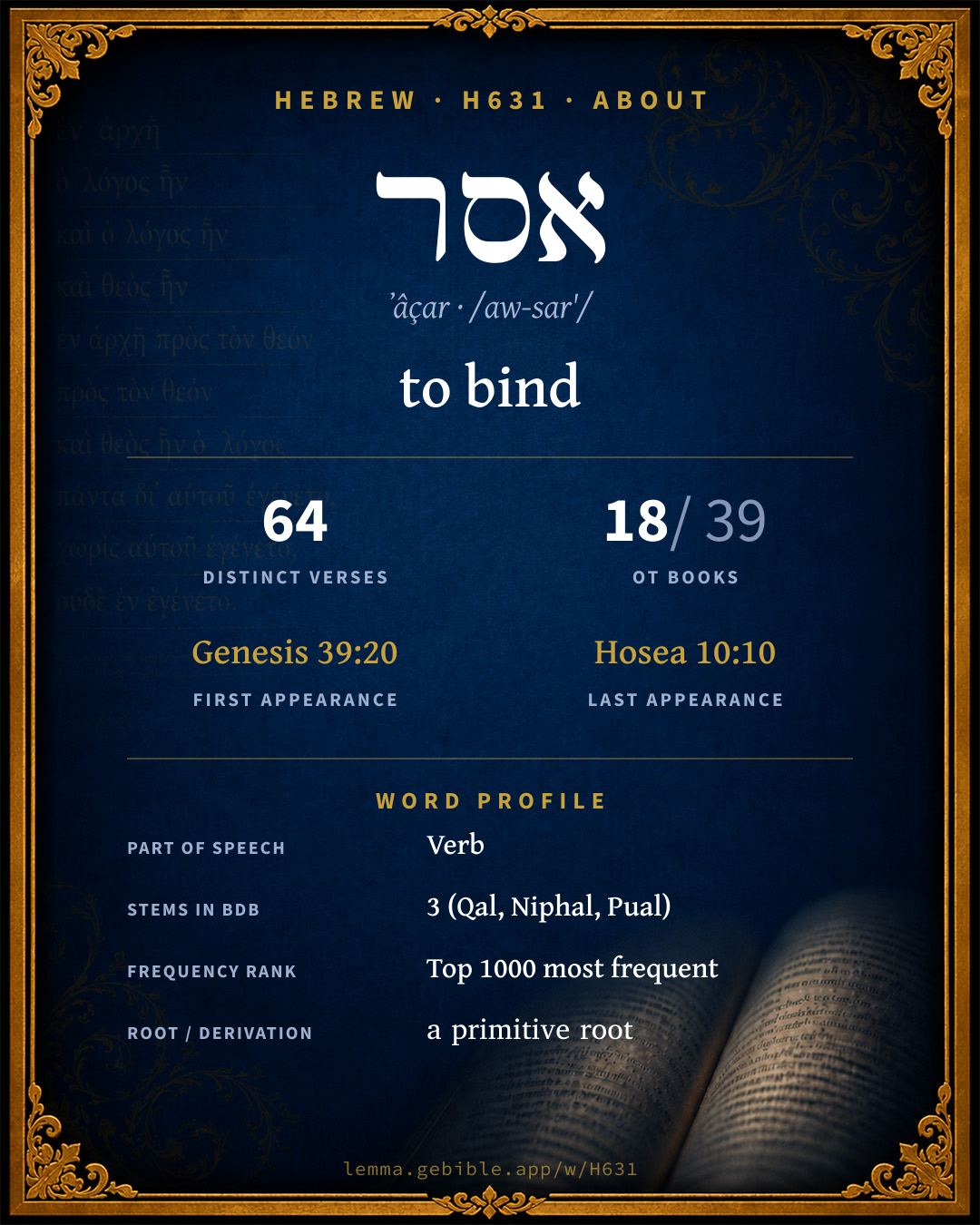
אָסַר
to bind
‘to bind’ is one of 3 main senses fuller range ↓
Full lexicon entry — Brown-Driver-Briggs (BDB)
From Brown-Driver-Briggs (BDB)
Where this word appears
See every Qal verb in the Hebrew Bible →
Grammar key — what these labels mean
Part of speech
- Verb
- An action or state-of-being word.
Stem
- Qal
- The basic, simple active stem — the plain form of the verb (“he wrote”). Here: ‘tie’
- Niphal
- Usually the simple passive or reflexive of the Qal (“he was written”). Here: ‘of Qal 3’
- Pual
- The passive counterpart of the Piel. Here: ‘be taken prisoner’
Form
- Perfect
- A completed action or state — Hebrew marks aspect (completeness) more than strict tense (“he wrote”).
- Sequential Imperfect
- An imperfect with prefixed waw — the standard past-narrative form (waw-consecutive imperfect).
- Participle Passive
- A verbal adjective expressing action received (“written”).
- Infinitive Construct
- A bound verbal noun, frequently with prepositions (“to write / in writing”).
- Imperfect
- An incomplete, ongoing, or future action (“he will / would write”).
- Infinitive Absolute
- An unbound verbal noun, often intensifying or standing in for a finite verb.
- Imperative
- A direct command (“write!”).
- Sequential Perfect
- A perfect with prefixed waw continuing a preceding imperfect or command (waw-consecutive perfect).
- Participle Active
- A verbal adjective expressing ongoing or characteristic action (“writing / one who writes”).
State
- Absolute
- The independent form of a noun, not bound to a following word.
- Construct
- A noun bound to a following noun in a possessive / “of” relationship (the construct chain).
Person
- 3rd Person
- The one spoken about (“he / she / it / they”).
- 2nd Person
- The one addressed (“you”).
- 1st Person
- The speaker (“I / we”).
Gender
- Feminine
- Grammatically feminine.
- Masculine
- Grammatically masculine.
- Common
- Either gender — not distinguished for this form.
Number
- Singular
- One.
- Plural
- More than one (in Hebrew, generally three or more).
58 distinct verses where H631 appears in the Qal stem, across 18 books. Filtered view — show all forms. Click any verse to open its interlinear word-by-word view. Verse text shown in the World English Bible for context — . Each verse’s Hebrew form is shown with its reference; the English is not keyword-highlighted, since the data carries no word-level English alignment. Use “Compare translations” on any verse to read it across multiple English versions. This concordance covers the Hebrew Bible; Septuagint (Greek Old Testament) occurrences are not indexed here.
Genesis 6 verses
- Genesis 39:20 אסורי אֲסוּרִ֑ים Qal ptcp.pass mp cs Qal ptcp.pass mp Joseph's master took him, and put him into the prison, the place where the king's prisoners were bound, and he was there in custody.
- Genesis 40:3 אָס֥וּר Qal ptcp.pass ms He put them in custody in the house of the captain of the guard, into the prison, the place where Joseph was bound.
- Genesis 40:5 אֲסוּרִ֖ים Qal ptcp.pass mp They both dreamed a dream, each man his dream, in one night, each man according to the interpretation of his dream, the cupbearer and the baker of the king of Egypt, who were bound in the prison.
- Genesis 42:24 וַ/יֶּאֱסֹ֥ר conj + Qal wimpf 3ms He turned himself about from them, and wept, and he returned to them, and spoke to them, and took Simeon from among them, and bound him before their eyes.
- Genesis 46:29 וַ/יֶּאְסֹ֤ר conj + Qal wimpf 3ms Joseph made ready his chariot, and went up to meet Israel, his father, in Goshen. He presented himself to him, and fell on his neck, and wept on his neck a good while.
- Genesis 49:11 אֹסְרִ֤י Qal ptcp.act ms cs Binding his foal to the vine, His donkey's colt to the choice vine; He has washed his garments in wine, His robes in the blood of grapes:
Exodus 1 verse
Numbers 10 verses
- Numbers 30:2 לֶ/אְסֹ֤ר prep + Qal inf.cs When a man vows a vow to Yahweh, or swears an oath to bind his soul with a bond, he shall not break his word; he shall do according to all that proceeds out of his mouth.
- Numbers 30:3 וְ/אָסְרָ֥ה conj + Qal wpf 3fs Also when a woman vows a vow to Yahweh, and binds herself by a bond, being in her father's house, in her youth,
- Numbers 30:4 אָֽסְרָ֣ה אָסְרָ֥ה Qal pf 3fs Qal pf 3fs and her father hears her vow, and her bond with which she has bound her soul, and her father holds his peace at her; then all her vows shall stand, and every bond with which she has bound her soul shall stand.
- Numbers 30:5 אָסְרָ֥ה Qal pf 3fs But if her father disallow her in the day that he hears, none of her vows, or of her bonds with which she has bound her soul, shall stand: and Yahweh will forgive her, because her father disallowed her.
- Numbers 30:6 אָסְרָ֖ה Qal pf 3fs If she be [married] to a husband, while her vows are on her, or the rash utterance of her lips, with which she has bound her soul,
- Numbers 30:7 אָסְרָ֥ה Qal pf 3fs and her husband hear it, and hold his peace at her in the day that he hears it; then her vows shall stand, and her bonds with which she has bound her soul shall stand.
- Numbers 30:8 אָסְרָ֖ה Qal pf 3fs But if her husband disallow her in the day that he hears it, then he shall make void her vow which is on her, and the rash utterance of her lips, with which she has bound her soul: and Yahweh will forgive her.
- Numbers 30:9 אָסְרָ֥ה Qal pf 3fs But the vow of a widow, or of her who is divorced, [even] everything with which she has bound her soul, shall stand against her.
- Numbers 30:10 אָסְרָ֥ה Qal pf 3fs If she vowed in her husband's house, or bound her soul by a bond with an oath,
- Numbers 30:11 אָסְרָ֥ה Qal pf 3fs and her husband heard it, and held his peace at her, and didn't disallow her; then all her vows shall stand, and every bond with which she bound her soul shall stand.
Judges 10 verses
- Judges 15:10 לֶ/אֱס֤וֹר prep + Qal inf.cs The men of Judah said, Why are you come up against us? They said, To bind Samson are we come up, to do to him as he has done to us.
- Judges 15:12 לֶ/אֱסָרְ/ךָ֣ prep + Qal inf.cs + sfx pers 2ms They said to him, We have come down to bind you, that we may deliver you into the hand of the Philistines. Samson said to them, Swear to me that you will not fall on me yourselves.
- Judges 15:13 אָסֹ֤ר נֶֽאֱסָרְ/ךָ֙ וַ/יַּאַסְרֻ֗/הוּ Qal inf.abs Qal impf 1cp + sfx pers 2ms conj + Qal wimpf 3mp + sfx pers 3ms They spoke to him, saying, No; but we will bind you fast, and deliver you into their hand: but surely we will not kill you. They bound him with two new ropes, and brought him up from the rock.
- Judges 16:5 וַ/אֲסַרְנֻ֖/הוּ conj + Qal pf 1cp + sfx pers 3ms The lords of the Philistines came up to her, and said to her, Entice him, and see in which his great strength lies, and by what means we may prevail against him, that we may bind him to afflict him: and we will each give you of us eleven hundred [pieces] of silver.
- Judges 16:7 יַאַסְרֻ֗/נִי Qal impf 3mp + sfx pers 1cs Samson said to her, If they bind me with seven green cords that were never dried, then shall I become weak, and be as another man.
- Judges 16:8 וַ/תַּאַסְרֵ֖/הוּ conj + Qal wimpf 3fs + sfx pers 3ms Then the lords of the Philistines brought up to her seven green cords which had not been dried, and she bound him with them.
- Judges 16:11 אָס֤וֹר יַאַסְר֨וּ/נִי֙ Qal inf.abs Qal impf 3mp + sfx pers 1cs He said to her, If they only bind me with new ropes with which no work has been done, then shall I become weak, and be as another man.
- Judges 16:12 וַ/תַּאַסְרֵ֣/הוּ conj + Qal wimpf 3fs + sfx pers 3ms So Delilah took new ropes, and bound him therewith, and said to him, The Philistines are on you, Samson. The liers-in-wait were abiding in the inner chamber. He broke them off his arms like a thread.
- Judges 16:21 וַ/יַּאַסְר֨וּ/הוּ֙ הָ/אֲסוּרִֽים conj + Qal wimpf 3mp + sfx pers 3ms ptcl def.art + Qal ptcp.pass mp The Philistines laid hold on him, and put out his eyes; and they brought him down to Gaza, and bound him with fetters of brass; and he did grind in the prison-house.
- Judges 16:25 הָ/אֲסוּרִ֗ים ptcl def.art + Qal ptcp.pass mp It happened, when their hearts were merry, that they said, Call for Samson, that he may make us sport. They called for Samson out of the prison-house; and he made sport before them. They set him between the pillars:
1 Samuel 2 verses
- 1 Samuel 6:7 וַ/אֲסַרְתֶּ֤ם conj + Qal wpf 2mp Now therefore take and prepare yourselves a new cart, and two milk cattle, on which there has come no yoke; and tie the cattle to the cart, and bring their calves home from them;
- 1 Samuel 6:10 וַ/יַּאַסְר֖וּ/ם conj + Qal wimpf 3mp + sfx pers 3mp The men did so, and took two milk cattle, and tied them to the cart, and shut up their calves at home;
2 Samuel 1 verse
1 Kings 2 verses
- 1 Kings 18:44 אֱסֹ֣ר Qal impv 2ms It happened at the seventh time, that he said, "Behold, a small cloud, like a man's hand, is rising out of the sea." He said, Go up, tell Ahab, Make ready [your chariot], and get you down, that the rain not stop you.
- 1 Kings 20:14 יֶאְסֹ֥ר Qal impf 3ms Ahab said, By whom? He said, Thus says Yahweh, By the young men of the princes of the provinces. Then he said, Who shall begin the battle? He answered, You.
2 Kings 5 verses
- 2 Kings 7:10 אָסוּר֙ אָס֔וּר Qal ptcp.pass ms Qal ptcp.pass ms So they came and called to the porter of the city; and they told them, saying, We came to the camp of the Syrians, and, behold, there was no man there, neither voice of man, but the horses tied, and the donkeys tied, and the tents as they were.
- 2 Kings 9:21 אֱסֹ֔ר וַ/יֶּאְסֹ֖ר Qal impv 2ms conj + Qal wimpf 3ms Joram said, Make ready. They made ready his chariot. Joram king of Israel and Ahaziah king of Judah went out, each in his chariot, and they went out to meet Jehu, and found him in the portion of Naboth the Jezreelite.
- 2 Kings 17:4 וַ/יַּאַסְרֵ֖/הוּ conj + Qal wimpf 3ms + sfx pers 3ms The king of Assyria found conspiracy in Hoshea; for he had sent messengers to So king of Egypt, and offered no tribute to the king of Assyria, as he had done year by year: therefore the king of Assyria shut him up, and bound him in prison.
- 2 Kings 23:33 וַ/יַּאַסְרֵ/הוּ֩ conj + Qal wimpf 3ms + sfx pers 3ms Pharaoh Necoh put him in bonds at Riblah in the land of Hamath, that he might not reign in Jerusalem; and put the land to a tribute of one hundred talents of silver, and a talent of gold.
- 2 Kings 25:7 וַ/יַּאַסְרֵ֨/הוּ֙ conj + Qal wimpf 3ms + sfx pers 3ms They killed the sons of Zedekiah before his eyes, and put out the eyes of Zedekiah, and bound him in fetters, and carried him to Babylon.
2 Chronicles 3 verses
- 2 Chronicles 13:3 וַ/יֶּאְסֹ֨ר conj + Qal wimpf 3ms Abijah joined battle with an army of valiant men of war, even four hundred thousand chosen men: and Jeroboam set the battle in array against him with eight hundred thousand chosen men, who were mighty men of valor.
- 2 Chronicles 33:11 וַ/יַּֽאַסְרֻ֨/הוּ֙ conj + Qal wimpf 3mp + sfx pers 3ms Therefore Yahweh brought on them the captains of the host of the king of Assyria, who took Manasseh in chains, and bound him with fetters, and carried him to Babylon.
- 2 Chronicles 36:6 וַ/יַּֽאַסְרֵ֨/הוּ֙ conj + Qal wimpf 3ms + sfx pers 3ms Against him came up Nebuchadnezzar king of Babylon, and bound him in fetters, to carry him to Babylon.
Nehemiah 1 verse
Job 3 verses
- Job 12:18 וַ/יֶּאְסֹ֥ר conj + Qal wimpf 3ms He loosens the bond of kings, He binds their loins with a belt.
- Job 36:8 אֲסוּרִ֥ים Qal ptcp.pass mp If they are bound in fetters, And are taken in the cords of afflictions,
- Job 36:13 אֲסָרָֽ/ם Qal pf 3ms + sfx pers 3mp "But those who are godless in heart lay up anger. They don't cry for help when he binds them.
Psalms 4 verses
- Psalms 105:22 לֶ/אְסֹ֣ר prep + Qal inf.cs To discipline his princes at his pleasure, And to teach his elders wisdom.
- Psalms 118:27 אִסְרוּ Qal impv 2mp Yahweh is God, and he has given us light. Bind the sacrifice with cords, even to the horns of the altar.
- Psalms 146:7 אֲסוּרִֽים Qal ptcp.pass mp Who executes justice for the oppressed; Who gives food to the hungry. Yahweh frees the prisoners.
- Psalms 149:8 לֶ/אְסֹ֣ר prep + Qal inf.cs To bind their kings with chains, And their nobles with fetters of iron;
Ecclesiastes 1 verse
Song of Solomon 1 verse
Isaiah 2 verses
- Isaiah 49:9 לַֽ/אֲסוּרִים֙ prep + Qal ptcp.pass mp saying to those who are bound, Go forth; to those who are in darkness, Show yourselves. They shall feed in the ways, and on all bare heights shall be their pasture.
- Isaiah 61:1 וְ/לַ/אֲסוּרִ֖ים conj + prep + Qal ptcp.pass mp The Spirit of the Lord Yahweh is on me; because Yahweh has anointed me to preach good news to the humble; he has sent me to bind up the broken-hearted, to proclaim liberty to the captives, and the opening [of the prison] to those who are bound;
Jeremiah 4 verses
- Jeremiah 39:7 וַ/יַּאַסְרֵ֨/הוּ֙ conj + Qal wimpf 3ms + sfx pers 3ms Moreover he put out Zedekiah's eyes, and bound him in fetters, to carry him to Babylon.
- Jeremiah 40:1 אָס֤וּר Qal ptcp.pass ms The word which came to Jeremiah from Yahweh, after that Nebuzaradan the captain of the guard had let him go from Ramah, when he had taken him being bound in chains among all the captives of Jerusalem and Judah, who were carried away captive to Babylon.
- Jeremiah 46:4 אִסְר֣וּ Qal impv 2mp Harness the horses, and get up, you horsemen, and stand forth with your helmets; furbish the spears, put on the coats of mail.
- Jeremiah 52:11 וַ/יַּאַסְרֵ֣/הוּ conj + Qal wimpf 3ms + sfx pers 3ms He put out the eyes of Zedekiah; and the king of Babylon bound him in fetters, and carried him to Babylon, and put him in prison until the day of his death.
Ezekiel 1 verse
Hosea 1 verse
About this entry
At a glance — auto-summarized from this page’s data, not written by a person. Every figure links to its source below. This summary describes the numbers; it doesn’t interpret them.
אסר (ʼâçar) is a Hebrew verb most often rendered “to bind.” It first appears in Genesis 39:20. With 64 verses in 18 books, it is a moderately common word in the Hebrew Bible. Different stems carry different senses — BDB groups them under 3 stems, among them Qal and Niphal. It clusters with אסור, אסיר and אסר under a shared root. For the data behind this summary, explore the sense tree and the renderings breakdown below.
Gloss history
Strong's 1890 vs modern scholarship
About this word
Strong's H631 catalogs a Hebrew word from the Hebrew Old Testament.
These counts are not copied from any lexicon or concordance. They are computed here, from the morphology-tagged Hebrew Old Testament. What Lemma adds →
- 64
- distinct verses
- The word appears in 64 distinct verses.
- 18 / 39
- OT books
- The word appears in 18 of 39 Old Testament books.
- #542
- by frequency
- Top 1000 most frequent Hebrew words (rank 542 of 8,640 Hebrew words by occurrence).
View all 64 occurrences in the concordance →
By section of the Old Testament
By traditional corpus
Conventional, traditional groupings — biblical authorship is debated, so this is a traditional corpus grouping, not an authorship claim. Each share is this word’s portion of its verses in that division of the Hebrew canon. Each figure is a share of the word’s 64 distinct verses.
- Prophets (Nevi'im) 32 verses · 50%
- Torah (Pentateuch) 19 verses · 30%
- Writings (Ketuvim) 13 verses · 20%
How translations render this word
Counts come from each version’s own published word-to-Strong’s tagging or interlinear alignment — an approximate guide to how each version renders this word, not a word-level alignment the data otherwise carries. Because each total is that version’s own tagged count, the per-version totals vary from one another and need not match the appearance or distinct-verse counts above. These counts may also differ from a printed concordance because Lemma counts each distinctly tagged rendering and does not collapse phrase taggings into a single head-word total. This is a fixed set of word-tagged versions (KJV, ASV, BSB, ULT) and does not change with the reading translation you choose elsewhere. Each version’s license is shown beside its name below (and on Sources).
- King James Version: Bound 8×, Bind 7×, Wherewith she bound 4×
- American Standard Version: Bound 7×, Wherewith she hath bound 6×, Bind 4×
- Berean Standard Bible: Bound him 4×, Bound 3×, Prisoners 3×
- unfoldingWord Literal Text: Bind 5×, She bound 5×, Bound 4×
King James Version Public Domain
Renders H631 across 73 tagged occurrences — most commonly:
Plus 39 renderings that appear only once — usually multi-word phrases or single function words the recovered tagging swept in, not distinct renderings.
American Standard Version Public Domain
Renders H631 across 74 tagged occurrences — most commonly:
Plus 42 renderings that appear only once — usually multi-word phrases or single function words the recovered tagging swept in, not distinct renderings.
Berean Standard Bible Public Domain
Renders H631 across 66 tagged occurrences — most commonly:
Plus 40 renderings that appear only once — usually multi-word phrases or single function words the recovered tagging swept in, not distinct renderings. Not rendered by a distinct English word in 5 further occurrences.
unfoldingWord Literal Text CC BY-SA 4.0
Renders H631 across 73 tagged occurrences — most commonly:
Plus other, less common renderings. Plus 30 renderings that appear only once — usually multi-word phrases or single function words the recovered tagging swept in, not distinct renderings.
9 senses and sub-senses in the full BDB
Hebrew verbs can shift meaning by stem (binyan): Qal is the basic action, Niphal is often passive or reflexive, Piel often intensifies or makes it factitive, and Hiphil is typically causative. The senses below are grouped under the stem BDB assigns to each. This entry also uses Pual (the passive of Piel).
What do BDB’s symbols mean?
BDB uses these scholarly abbreviations:
| Symbol | Meaning |
|---|---|
| 𝔊 | the Septuagint (the ancient Greek translation, LXX) |
| 𝔙 | the Vulgate (the Latin translation) |
| 𝔖 | the Syriac version (the Peshitta) |
| 𝔗 | the Targum (the Aramaic translation) |
| ψ | the Psalms |
| √ | root (the underlying root or stem) |
| ‖ | parallel passage (a synonymous or contrasted parallel) |
| † | the dagger: every passage where the word occurs is cited |
The 9 senses and sub-senses the full Brown-Driver-Briggs lexicon distinguishes for this word, in lexicon order (not ranked by frequency), with BDB’s own verbatim wording and sub-sense lettering. Shown in Hebrew script with BDB’s own scholarly abbreviations. The condensed entry is in the Lexicon Entry tab. See also the Forms in the corpus table below.
Qal
- Pf. sf. אֲסָרָם Jb 36:13; 3 fs. אָֽסְרָה Nu 30:5 +, etc.; Impf. יֶאְסֹר 1 K 20:14; וַיֶּאֱסֹר Gn 42:24; וַיֶּאְסֹר Gn 46:29 +; pl. sf. יַאַסְרֻנִי Ju 16:7 etc.; Imv. אֱסֹר 1 K 18:44; 2 K 9:21; אִסְרוּ Je 46:4 ψ 118:27; Inf. abs. אָסֹר Ju 15:13; אָסוֹר 16:11; cstr. לֶאְסֹר Nu 30:3 +; לֶאֱסוֹר Ju 15:10; לֶאֱסָרְךָ 15:12; אָסֳּרָם Ho 10:10; Pt. act. cstr. אֹסְרִי Gn 49:11; pass. אָסוּר Gn 40:3 +; pl. אֲסוּרִים 39:20 +; also Ju 16:21, 25 Qr (Kt אסירים); הָסוּרִים Ec 4:14 (cf. Now); אֲסֻרוֹת 2 S 3:34; cstr. אסורי Gn 39:20; Kt (Qr אֲסִירֵי);— e.g. Job 36:13
- 1. tie, bind, for security, foal to vine (sq. ל) Gn 49:11 (blessing of Jacob); horses and asses 2 K 7:10(×2); ψ 118:27 is dub. De bind the festal victim with cords; Che bind the procession with branches, etc. e.g. Genesis 49:11
- 2. tie, harness, kine to (ב) cart 1 S 6:7, 10; so (metaph.) Ho 10:10 harness them to (ל) their two iniquities (but Jer Ew Now make א׳ here = יסר chastise, cf. אֶסֳּרֵם v a); also sq. acc. chariot Gn 46:29 (J) Ex 14:6 (E) 2 K 9:21; abs. 1 K 18:44 2 K 9:21; even of making ready chargers א׳ הַסּוּסִים Je 46:4 (‖ עֲלוּ הַפָּרָשִׁים). e.g. 1 Samuel 6:7
- 3. bind, with cords, fetters, etc., as prisoner, Simeon Gn 42:24 (E), Samson Ju 15:10, 12, 13(×3); 16:5, 7, 8, 11(×2), 12; א׳ בַּנְחֻשְׁתַּיִם 2 K 25:7 = 2 Ch 36:6 = Je 39:7; 52:11; also 2 Ch 33:11; cf. (without בַּנ׳) 2 K 17:4 (א׳ בֵּית כֶּלֶא ‖ עָצַר), 23:33; cf. of divine chastisement Jb 36:13 & v. also Ez 3:25 ψ 149:8; fig. of absolute authority ψ 105:22; especially Pt. pass. 2 S 3:34 thy hands were not bound (‖ and thy feet not put in fetters); א׳ בָּאֿזִקִּים Je 40:1 cf. א׳ בַּזִּקִּים Jb 36:8 (prob. fig. ‖ חַבְלֵי־עֹ֑נִי); metaph. of king held captive by a woman’s tresses Ct 7:6; perhaps = imprisoned (whether bound or not) Gn 39:20; 40:3, 5 (all JE); as subst. pl. prisoners Gn 39:20 (Kt, v. supr.); so (late) as distressed, & obj. of divine compassion Is 49:9; 61:1 ψ 146:7; בֵּית האסיר֯ים prison Ju 16:21, 25; cf. Ec 4:14. e.g. Genesis 42:24
- 4. gird (rare & late) א׳ אֵזוֹר בְּמָתְנֵיהֶם Jb 12:18 (אֵזוֹר = slaves’ waistcloth, RS p. 25 supr.; Hoffm reads וַיָּסַר for וַיֶּאְסֹר); חַרְבּוֹ אֲסוּרִים עַל־מָתְנָיו Ne 4:12. e.g. Job 12:18
- 5. sq. מִלְחָמָה begin the battle, make the attack (cf. Germ. mit jemandem anbinden) 1 K 20:14 2 Ch 13:3. e.g. 1 Kings 20:14
- 6. fig. of obligation of oath or vow (only Nu 30, P) א׳ עַל־נֶפֶשׁ, usually sq. acc. cogn. אֱסָר, אִסָּר Nu 30:3, 5(×2), 6, 8, 9, 11, 12; without אֱסָר etc., v 7, 10; cf. v 4 א׳ אִסָּר (עַל־נֶפֶשׁ om.) e.g. Numbers 30:3
Niphal
- pass. of Qal 3, be bound, imprisoned, Impf. (juss.) יֵאָסֵר Gn 42:19 (E); 2 ms. תֵּאָסֵר Ju 16:6, 10, 13 (of Samson); Imv. הֵאָֽסְרוּ Gn 42:16 (E). e.g. Genesis 42:19
Pual
- Pf. be taken prisoner אֻסְּרוּ Is 22:3; אֻסָּ֑רוּ ib. e.g. Isaiah 22:3
Senses from the full Brown-Driver-Briggs lexicon (Brown, Driver, Briggs; Oxford 1906 — public domain), digitized via Sefaria, supplemented by the OpenScriptures HebrewLexicon (CC BY 4.0). Full attribution on Sources.
Word origin
vb. tie, bind, imprison (Arabic أَسَرَ, Assyrian asâru, cf. COTGloss, Aramaic אֲסַר, ܐܶܣܰܪ, Ethiopic አሰረ, አሠረ )—
— Brown-Driver-Briggs (Oxford 1906, public domain), digitized via Sefaria, supplemented by the OpenScriptures HebrewLexicon (CC BY 4.0). See Sources.
Origin: a primitive root
Jastrow Dictionary
A second Hebrew/Aramaic lexicon for comparison, covering Aramaic and post-biblical (Talmudic, Targumic, Midrashic) usage that the biblical-Hebrew BDB does not. Matched by lemma rather than by Strong’s number, so a lemma may carry more than one Jastrow headword (shown separately below), and the entries cover usage well beyond the Bible.
אָסַר
- to surround, enclose (v. Schr. KAT Gloss. II, s. v.)—whence
- 1. to chain, imprison; to sentence to prison. Ber. 28ᵇ, v. אֵיסוּר.
- 2. to harness, put the horses to. Mekh. B’shall. 1. Gen. R. s. 55, v. אֲסָרָה.
- 3. to bind, obligate. Lev. R. s. 23 אילולי שא׳ וכ׳ had not the Lord bound himself by an oath; a. e.
- 4. to interdict, to declare a thing forbidden according to ritual law, opp. הִתִּיר to loosen the tie, to allow. Ḥag. 3ᵇ הללו אוֹסְרִין והללו מתירין the ones declare forbidden what the others allow. Lev. R. s. 22 מה שאָסַרְתִּי לך התרתי לך of whatever I have forbidden thee (as a class) I have allowed thee (a specimen). Erub. VIII, 4 אוֹסַר עליו he (by residing there) restricts the other (debarring him from carrying things around on the Sabbath).—Part. pass. אָסוּר, f. אֲסוּרָה (it is) forbidden. Ber. 35ᵃ א׳ לו לאדם ש׳ וכ׳ one must not &c.; a. v. fr.—Pl. אֲסוּרִים, אֲסוּרִין; f. אֲסוּרוֹת. Ter. X, 12; a. v. fr. V. אָסוּר.
- to be forbidden, to become subject to ritual prohibition. Ib. 11 אוֹסֶרֶת ואינה נֶאֱסָרֶת affects other things which come in contact with it, but is not affected; a. fr.
אֲסַר
- 1. to chain, imprison. Targ. II Kings XVII, 4; a. fr.
- 2. to bind by spell, charm. Targ. Ps. LVIII, 6; a. e.
- 3. to tie up, put on &c. Targ. Y. Gen. XLIX, 11; a. e.—B. Mets. 86ᵇ דקא א׳ ושרי that he tied up (his wound) and untied it. Sabb. 81ᵇ אֲסַרְתָּהּ לארבא she tied (stopped) the ship (by magic spell).
- 4. to bind the bowels, check diarrhœa. Gitt. 69ᵇ למֵיסַר.
- 5. to forbid. Ḥull. 109ᵇ כל דא׳ לן וכ׳, v. preced.; a. v. fr. Ib. 111ᵇ; 112ᵃ, a. fr. אָסִיר, אֲסִירֵי it is, they are, forbidden.—Ab. Zar. 37ᵇ יוסף אָסְרָא מיבעי ליה he ought to be called, ‘Joseph the forbidder.’—Y. Meg. I, 70ᶜ bot. לוֹסַר לפניו to forbid fasting on the day preceding.
- 6. *to bind one’s self by vowing a fast (cmp. Num. XXX, 3), or to be bound. Meg. Taan. XII, end, quoted and discussed Taan. 12ᵃ (v. Var. lect. in Rabb. D. S. a. l. a. notes). e.g. Numbers 30:3
- to tie (sheaves). Targ. O. Gen. XXXVII, 7.
- 1. to be imprisoned. Targ. Gen. XLII, 19; a. e.
- 2. (in Talm.) Ithpe. אִיתְּסַר to be forbidden. Targ. Y. Num. XI, 10.—Ḥull. 101ᵇ ליתסר let it be forbidden. Ib. 115ᵃ מעשה שבת ליתסרו what has been prepared on the Sabbath ought to be forbidden. Yeb. 33ᵃ קא מיתסר במלאכה he is forbidden from doing labor; a. fr.
אֱסָר
- , v. אֵיסָר
אֵסַר
- , v. אֵיסַר, אִיסְרָא I
A Dictionary of the Targumim, the Talmud Babli and Yerushalmi, and the Midrashic Literature (Marcus Jastrow; London, Luzac, 1903) — Public Domain. Digitized via Sefaria. Digitized via Sefaria. Full attribution on Sources.
Forms in the corpus
The 62 distinct written forms H631 takes in the Hebrew Bible, most frequent first — each parse links to that stem’s occurrences in the concordance. Hebrew forms include their vowel points and cantillation, so a single lemma takes many written forms.
The 60 most common forms are shown; 2 rarer forms follow in the full concordance.
Same root — word family
Other BDB entries built from the same root as H631, grouped by Strong’s listed origin. These share a root / origin per the lexicon — not necessarily a shared meaning. Each links to that word’s own entry.
Derived from this word
- אסור ʼêçûwr H612 bond
- אסיר ʼâçîyr H615 captive
- אסר ʼĕçâr H632 bond
- מסרת mâçôreth H4562 covenant bond
Compare all same-root words → Showing 4 of 5 — not the complete family. They share a root, not necessarily a meaning.
Septuagint verse parallels
This word appears in 63 verses that also exist in the Greek Old Testament (Septuagint), out of the 64 Hebrew verses it occurs in. You can read those verses in Greek by switching the Old Testament edition to the Septuagint.
Read these verses in the Septuagint
- Genesis 39:20
- Exodus 14:6
- Numbers 30:2
- Judges 15:10
- 1 Samuel 6:7
- 2 Samuel 3:34
- 1 Kings 18:44
- 2 Kings 7:10
- 2 Chronicles 13:3
- Job 12:18
- Psalms 105:22
- Ecclesiastes 4:14
This is a verse-level parallel only — the same verses exist in both the Hebrew and Greek Old Testaments. No word-level Hebrew↔Greek correspondence is claimed: the data carries no such alignment, so no Greek word is shown as this Hebrew word’s translation. Coverage is not total — the Septuagint omits the deuterocanon and renumbers the Psalms, so some Hebrew verses have no direct Greek parallel.