
Jeremiah 39:7

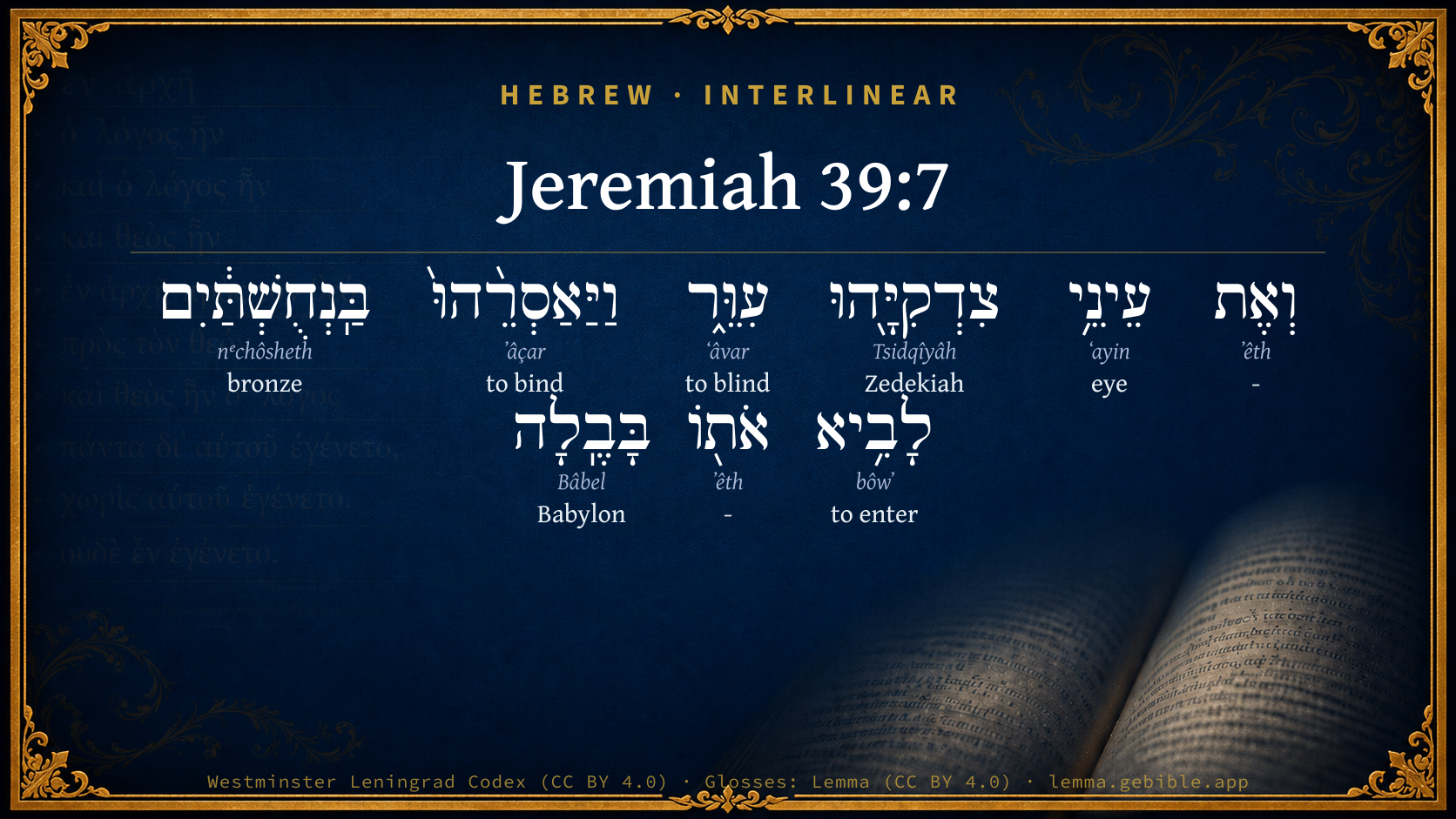
Hebrew (Westminster Leningrad Codex) Jeremiah 39:7 appears in the Hebrew Old Testament. The text above is from the Westminster Leningrad Codex. Each word links to its Strong’s number, a concise gloss, and parsing drawn from the Open Scriptures Hebrew Bible morphology. Click any word for its full Brown-Driver-Briggs (BDB) entry.
Download image
Cite this verse

Jeremiah 39:7 (World English Bible). Public Domain. Lemma interlinear Bible study tool, https://lemma.gebible.app/v/jeremiah/39/7.

Show BibTeX & RIS
BibTeX
RIS
English Translation
Moreover he put out Zedekiah's eyes, and bound him in fetters, to carry him to Babylon.
World English Bible · Public Domain
Download a study sheet

One document with this verse’s original text, its word-by-word gloss line, the meaning frame, cross-references with their text, attributed commentary, and full source and license credits — printable, and it pastes into notes with its structure intact.

This verse Autodidact and up

Study sheet (.html) Plain text (.txt)

A passage Seminary Student

Up to 50 verses in one chapter. A passage sheet keeps up to 6 commentary sources and 12 cross-references per verse, in the order this page ranks them, and says so on the sheet whenever that leaves anything out. Ask for a single verse and you get the Autodidact verse sheet above.

Everything on this page stays free to read, with no account — the sheet is a download of what is already on screen, not access to it.

Want to remove ads? Support Godless Engineer
Compare translations 3

The same verse in 3 English versions, stacked beneath the original-language interlinear above. Click any original word for its lexicon entry.

Each is an independent rendering of the whole verse — the interlinear is not word-aligned to these translations.

Highlighted words mark where these versions differ — a whole-verse word diff, not a word-by-word alignment.

  • World English Bible Public Domain
    Moreover he put out Zedekiah's eyes, and bound him in fetters, to carry him to Babylon.
  • King James Version Public Domain
    Moreover he put out Zedekiah's eyes, and bound him with chains, to carry him to Babylon.
  • unfoldingWord Literal Text CC BY-SA 4.0
    Then he put out Zedekiah’s eyes and bound him in bronze chains in order to take him to Babylon.

unfoldingWord Literal Text — © unfoldingWord, licensed CC BY-SA 4.0. Word-aligned USFM3 via Door43 (git.door43.org/unfoldingWord/en_ult).

Versions to compare (up to 4)

3 of 4 selected

Show all 18 translations

Every available English version of this verse, each an independent rendering of the whole verse.

  • World English Bible Public Domain
    Moreover he put out Zedekiah's eyes, and bound him in fetters, to carry him to Babylon.
  • Berean Standard Bible Public Domain
    Then he put out Zedekiah’s eyes and bound him with bronze chains to take him to Babylon.
  • Majority Standard Bible Public Domain
    Then he put out Zedekiah’s eyes and bound him with bronze chains to take him to Babylon.
  • King James Version Public Domain
    Moreover he put out Zedekiah's eyes, and bound him with chains, to carry him to Babylon.
  • American Standard Version (1901) Public Domain
    Moreover he put out Zedekiah's eyes, and bound him in fetters, to carry him to Babylon.
  • Revised Version (1885) Public Domain
    Moreover he put out Zedekiah’s eyes, and bound him in fetters, to carry him to Babylon.
  • Geneva Bible (1599) Public Domain
    Moreouer he put out Zedekiahs eyes, and bound him in chaines, to cary him to Babel.
  • Douay-Rheims (1899) Public Domain
    He also put out the eyes of Sedecias: and bound him with fetters, to be carried to Babylon.
  • Young's Literal Translation Public Domain
    And the eyes of Zedekiah he hath blinded, and he bindeth him with brazen fetters, to bring him in to Babylon.
  • Literal Standard Version CC BY-SA 4.0
    And he has blinded the eyes of Zedekiah, and he binds him with bronze chains to bring him to Babylon.
  • Unlocked Literal Bible CC BY-SA 4.0
    Then he put out Zedekiah's eyes and bound him in bronze chains in order to take him to Babylon.
  • unfoldingWord Literal Text CC BY-SA 4.0
    Then he put out Zedekiah’s eyes and bound him in bronze chains in order to take him to Babylon.
  • Darby Bible Public Domain
    and he put out the eyes of Zedekiah, and bound him with chains of brass, to carry him to Babylon.
  • World Messianic Bible Public Domain
    Moreover he put out Zedekiah’s eyes and bound him in fetters, to carry him to Babylon.
  • Webster's Bible Public Domain
    Moreover he put out Zedekiah's eyes, and bound him with chains, to carry him to Babylon.
  • Free Bible Version CC BY-SA 4.0
    Then he had Zedekiah's eyes gouged out, and had him bound with bronze chains and taken away to Babylon.
  • Bible in Basic English Public Domain
    And more than this, he put out Zedekiah's eyes, and had him put in chains to take him away to Babylon.
  • JPS Tanakh (1917) Public Domain
    Moreover he put out Zedekiah's eyes, and bound him in fetters, to carry him to Babylon.

Literal Standard Version (2020), Covenant Press — licensed CC BY-SA 4.0. Text via the HelloAO Bible API (eBible.org). Unlocked Literal Bible (unfoldingWord) — licensed CC BY-SA 4.0. Text via the HelloAO Bible API (eBible.org). unfoldingWord Literal Text — © unfoldingWord, licensed CC BY-SA 4.0. Word-aligned USFM3 via Door43 (git.door43.org/unfoldingWord/en_ult). Free Bible Version, Dr. Jonathan Gallagher — licensed CC BY-SA 4.0. Text via the HelloAO Bible API (eBible.org).

Word by word

More ways to search: Search by grammar → Find every occurrence → Compare this word →

Practice this passage: Drill this verse → Learn its vocabulary →

עִוֵּ֑ר
ʻâvar
H5786
“to blind”
Verb, Piel, Perfect, 3rd Person, Masculine, Singular
Part of Speech
Verb
Stem
Piel
Form
Perfect
Person
3rd Person
Gender
Masculine
Number
Singular
Full BDB Definition

Origin: a primitive root [rather denominatively from H5785 through the idea of a film over the eyes]

TWOT: 1586

(Piel) to blind, make blind, put out the eyes of
  1. וְאֶת ʼêth H853 “and · -” Conjunction + Particle, Direct Object
  2. עֵינֵ֥י ʻayin H5869 “eyes of” Noun, Common, Both, Dual, Construct
  3. צִדְקִיָּ֖הוּ Tsidqîyâh H6667 “Zedekiah” Noun, Proper
  4. וַיַּאַסְרֵ֨הוּ֙ ʼâçar H631 “and · to bind · him” Conjunction + Verb, Qal, Sequential Imperfect, 3rd Person, Masculine, Singular + Suffix, Personal, 3rd Person, Masculine, Singular
  5. בַּֽנְחֻשְׁתַּ֔יִם nᵉchôsheth H5178 “in/at the · bronze fetters” Preposition, Determined + Noun, Common, Feminine, Dual, Absolute
  6. לָבִ֥יא bôwʼ H935 “to enter” Preposition + Verb, Hiphil, Infinitive Construct
  7. אֹת֖וֹ ʼêth H853 “- · him” Particle, Direct Object + Suffix, Personal, 3rd Person, Masculine, Singular
  8. בָּבֶֽלָה Bâbel H894 “Babylon · toward” Noun, Proper + Suffix, Demonstrative

About this verse

These counts appear in no published source. They are computed here, from the morphology-tagged text and Lemma’s own curated glosses. What Lemma adds →

9
words
8
distinct lemmas
Prophets
section

Notable vocabulary

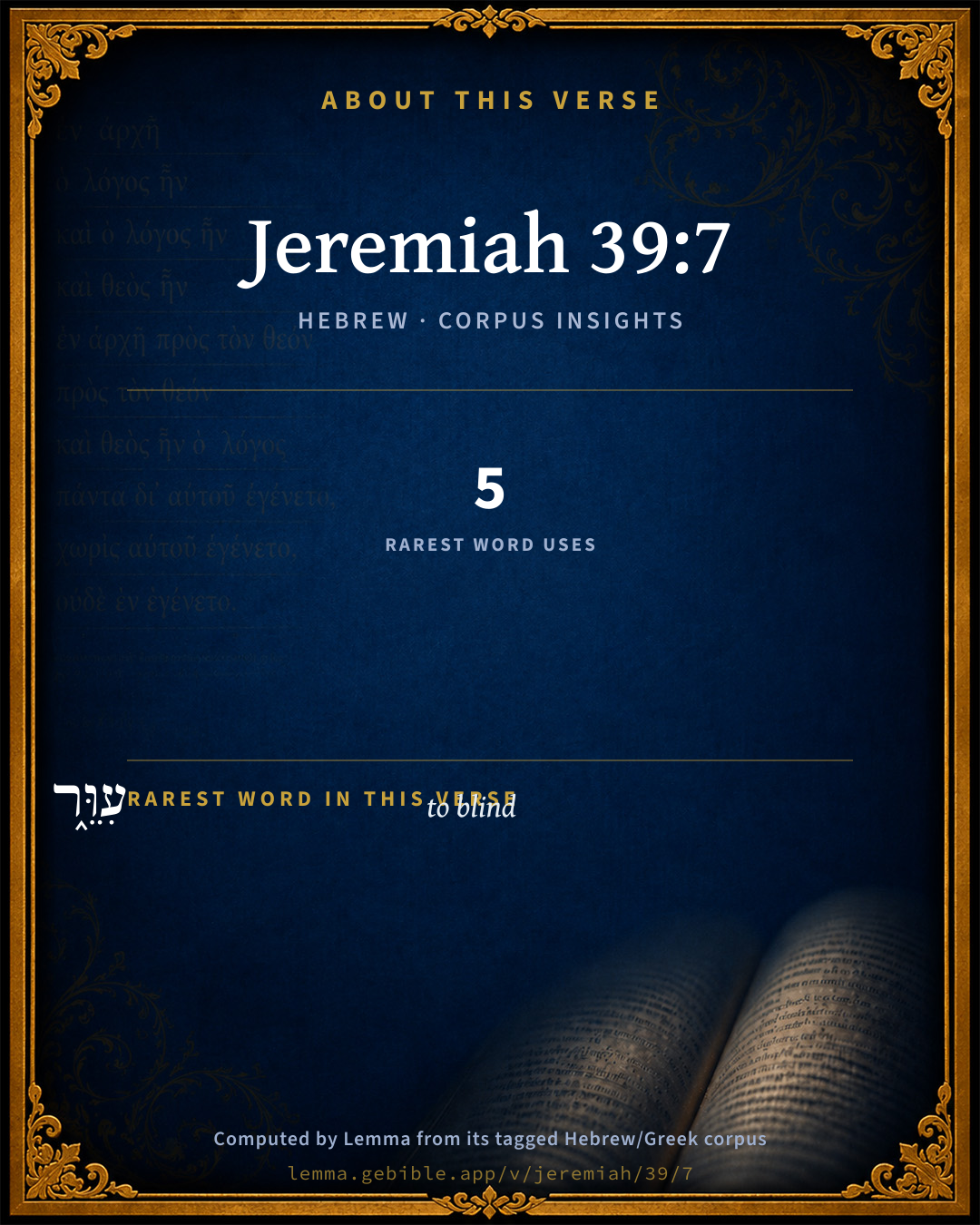
The rarest word here is עִוֵּ֑ר to blind H5786 — appearing just 5 times in the whole Hebrew Bible.

Shared distinctive vocabulary

עִוֵּ֑ר to blind H5786 occurs in 5 verses of the Hebrew Bible. Also found in:

Grammatical profile

  • 3 verbs
  • 4 nouns
  • 2 particles

Verb forms

  • עִוֵּ֑ר Piel · Perfect
  • וַיַּאַסְרֵ֨הוּ֙ Qal · Sequential Imperfect
  • לָבִ֥יא Hiphil · Infinitive Construct

Cross-references

7

Topical passages linked to Jeremiah 39:7 in the Treasury of Scripture Knowledge — connected by theme and wording, ordered by reader-vote popularity; previews shown in the World English Bible.

  • Ezekiel 12:13 My net also will I spread on him, and he shall be taken in my snare; and I will bring him to Babylon to the land of the Chaldeans; yet shall he not see it, though he shall die there.
  • Judges 16:21 The Philistines laid hold on him, and put out his eyes; and they brought him down to Gaza, and bound him with fetters of brass; and he did grind in the prison-house.
  • 2 Kings 25:7 They killed the sons of Zedekiah before his eyes, and put out the eyes of Zedekiah, and bound him in fetters, and carried him to Babylon.
  • Jeremiah 32:4–5 and Zedekiah king of Judah shall not escape out of the hand of the Chaldeans, but shall surely be delivered into the hand of the king of Babylon, and shall speak with him mouth to mouth, and his eyes shall see his eyes;
  • Jeremiah 52:11 He put out the eyes of Zedekiah; and the king of Babylon bound him in fetters, and carried him to Babylon, and put him in prison until the day of his death.
  • Psalms 107:10–11 Some sat in darkness and in the shadow of death, Being bound in affliction and iron,
  • Psalms 119:8 I will observe your statutes. Don't utterly forsake me.

Cross-references courtesy of OpenBible.info (CC BY 4.0).

Hebrew and Greek witnesses Masoretic Hebrew ↔ Greek Septuagint

The same verse in the two great witnesses to the Old Testament, shown verse-for-verse.

These are two independent witnesses, not word-aligned to each other, and the Septuagint is shown in lemma (dictionary) form.

Hebrew Jeremiah 39:7 Masoretic · Westminster Leningrad Codex

וְאֶת עֵינֵ֥י צִדְקִיָּ֖הוּ עִוֵּ֑ר וַיַּאַסְרֵ֨הוּ֙ בַּֽנְחֻשְׁתַּ֔יִם לָבִ֥יא אֹת֖וֹ בָּבֶֽלָה

Moreover he put out Zedekiah's eyes, and bound him in fetters, to carry him to Babylon.

World English Bible · Public Domain

Greek LXX Structure differs

In the Septuagint, Jeremiah is about an eighth shorter than the Hebrew and arranges its material differently — the Oracles Against the Nations (Hebrew chapters 46–51) appear in the middle of the Greek book, after 25:13. Because the chapter and verse boundaries do not line up, a verse-for-verse comparison with the Hebrew is not shown.

A verse-for-verse comparison isn’t shown here because the chapters and verses don’t line up. Switch to the LXX edition with the MT / LXX toggle above to read the Greek directly.

Hebrew: Westminster Leningrad Codex (CC BY 4.0). Greek: Septuagint (public domain); English from a public-domain English Septuagint. How the Septuagint differs from the Hebrew →

Targum (Aramaic paraphrase)

1

The Targum is the ancient Jewish Aramaic paraphrase of the Hebrew Scriptures — an interpretive translation, not the Hebrew text itself. Onkelos (literal) and Pseudo-Jonathan (expansive) render the Torah, and Jonathan the Prophets. Coverage is partial: where no permissively-licensed English translation exists for a verse, only the Aramaic is shown. This is verse-level text, not a word-by-word alignment to the Hebrew.

  1. Targum Jonathan Prophets (Joshua–Malachi)
    וְיַת עֵינֵי צִדְקִיָה עִוֵר וְאַסְרֵיהּ בְּשַׁלְשְׁלָן דִנְחָשׁ לְאוֹבָלָא יָתֵיהּ לְבָבֶל:

    (no public-domain English translation for this verse)

    Targum Jonathan — Aramaic: “Mikraot Gedolot” (public domain). English: “Sefaria Community Translation” (CC0 1.0 (public-domain dedication)); “London "Chaldee Paraphrase," 1871” (public domain). Text via Sefaria.

Commentary

Notes on Jeremiah 39:7 from classic Christian and Jewish commentators (each source and its license shown beneath its notes). The classic Christian expositions comment on the surrounding passage and are grouped to its opening verse, so a note may address several verses; the Jewish commentaries on the Tanakh (Rashi and others) are per-verse, so they appear only where the commentator wrote on this verse.

Lemma curates 59 commentaries, every one of them public domain or Creative Commons licensed, each selected and text-cleaned for this edition rather than reprinted as found. About our sources →

Trapp's Complete Commentary

John Trapp

Jer 39:7 Moreover he put out Zedekiah’s eyes, and bound him with chains, to carry him to Babylon.

Ver. 7. See on 2Ki 25:7.

John Trapp, A Commentary or Exposition upon All the Books of the Old and New Testament (1647–1656) — public domain. Text from a community e-Sword module.

Tyndale Open Study Notes

Tyndale Open Resources

39:7 After Nebuchadnezzar gouged out Zedekiah’s eyes, Zedekiah had to walk 400 miles to Babylon, blinded, in great pain, and with his arms in bronze chains.

Tyndale Open Study Notes — © Tyndale Open Resources, licensed CC BY-SA 4.0. Text via the HelloAO Bible API.

Adam Clarke's Commentary

Verse 7. Bound him with chains] Margin: "Two brazen chains;" one for his hands, and the other for his feet.

Adam Clarke's Commentary on the Bible (1810–1826) — public domain. Text from a community e-Sword/MySword module.

John Calvin's Commentaries

Here was an accumulation of misery: the king had his eyes pulled out, after having been a spectator of the slaughter of his own sons! He then saw heaped together the dead bodies of his own offspring and of all his nobles. After that slaughter he was made blind. His life was, no doubt, prolonged to him, that he might die, as it were, by little and little, according to what a notorious tyrant has said. And thus Nebuchadnezzar intended to kill him a hundred and a thousand times, and not at once to put him to death, for death removes man from all the miseries of the present life. That Zedekiah remained alive, was then a much harder condition.

And this has been recorded that we may know, that as he had been so long obstinate against God, the punishment inflicted on him was long protracted; for he had not sinned through levity or want of thought, or some hidden impulse, but hardened himself against every truth and all counsels. It was therefore just that he should die by little and little, and not be killed at once. This was the reason why the king of Babylon pulled out his eyes.

The Prophet says in the last place, that he was bound with chains, and that he was in this miserable condition led into Babylon This reproach was an addition to his blindness: he was bound with chains as a criminal. It would have been better for him to have been taken immediately to the gallows, or to have been put to death in any way; but it was the design of Nebuchadnezzar, that he should lead a miserable life in this degraded state, and be a public example of what perfidy deserved. It follows, —

John Calvin's Commentaries (1540-1563) — public domain. Text from the Calvin Translation Society English edition (1840s-50s) via the Christian Classics Ethereal Library (ccel.org). Calvin's coverage is partial (roughly two-thirds of the Bible); uncommented books and verses are honest gaps, never fabricated. The 19th-century editor's footnotes and remarks are omitted so the notes are faithfully Calvin's own voice.

Ellicott's Commentary for English Readers

(7) Moreover he put out Zedekiah’s eyes.—The special form of punishment is noticeable as fulfilling the two prophecies—(1) that Zedekiah should see the king of Babylon and be taken to that city (Jer_32:4); and (2) that though he was to die in Babylon, he should never see it (Eze_12:13). Beyond this, the fate of the last king of Judah is buried in darkness. His brother Jehoiachin was already a prisoner in Babylon (2Ki_24:15), but we do not know whether the two were allowed to meet. Twenty-six years later Jehoiachin was released by Evil-merodach (2Ki_25:27); but there is no mention of Zedekiah, and it is a natural inference that his sufferings had ended previously.

Bound him with chains.—Literally, as in the margin, with two brazen chains.

A Bible Commentary for English Readers, edited by Charles John Ellicott (1878–1897) — public domain. Text from a community e-Sword module.

The Cambridge Bible for Schools and Colleges

gen. ed. J. J. S. Perowne

7. Moreover he put out Zedekiah’s eyes] See on Jer_34:3 and cp. Jdg_16:21. “Putting out the eyes has been at all times a common Oriental punishment.… The frequency of the punishment in the time of the younger Cyrus is indicated by a passage in Xenophon, where it is said that men deprived of sight for their crimes were a common spectacle along the highways within his government.” Rawlinson’s Herod. vol. IV. p. 16. C.B. (Barnes), on the parallel passage in Kings, quotes Layard for modern instances in Persia.

fetters] The Hebrew word is dual, and the meaning therefore probably two chains. Cp. Act_12:6.

The Cambridge Bible for Schools and Colleges (gen. ed. J. J. S. Perowne; Cambridge University Press, 1878–1918) — public domain. Text from a community e-Sword module.

John Gill's Exposition

Moreover he put out Zedekiah's eyes,.... By what means is not certain; however, hereby the prophecy of Jeremiah was fulfilled, that his eyes should see the king of Babylon, as they did, before they were put out, and that he should not die by the sword, Jer 34:3; and also the prophecy of Ezekiel, Eze 12:13; that he should be brought to Babylon, and yet should not see it; for his eyes were put out before he was carried there: a full proof this of the prescience of God; of his foreknowledge of future and contingent events; of the truth and certainty of prophecy, and of the authority of divine revelation:

and bound him with chains, to carry him to Babylon; with two brass or iron chains, or fetters, for both his legs; and thus bound he was carried to Babylon, where he remained to the day of his death.

John Gill's Exposition of the Whole Bible (1746–1763) — public domain (CC PDM 1.0). Text via the HelloAO Bible API.

Matthew Poole's English Annotations

Thus the two prophecies were fulfilled; that of this prophet, Jer 34:4, that Zedekiah should not die by the sword; and that of Ezekiel, that he should not see Babylon, though he should die there, Eze 12:13. Riblah was at a great distance from Babylon, where the king was at this time, probably to be nearer his army while the siege lasted at Jerusalem, and to give orders about it, and to divert himself, the place being a pleasant place, and the king not willing to trouble himself about the siege to go thither in person; but the siege being over, he now removeth to Babylon, and carrieth Zedekiah and the rest of the prisoners along with him.

Matthew Poole's English Annotations on the Holy Bible (1683–1685) — public domain. Text from a community e-Sword/MySword module.

Whedon's Commentary on the Bible

Daniel D. Whedon

7. Put out Zedekiah’s eyes — Jer_32:4, says, “his eyes shall behold his eyes,” and Eze_12:13, “shall he not see it [Babylon] though he shall die there.” In this passage we have the explanation of these apparently incongruous statements.

Daniel D. Whedon (gen. ed.), Commentary on the Old and New Testaments (1874–1909) — public domain. Text from a community e-Sword module.

Scofield Reference Notes

C. I. Scofield

Babylon

Here began the "times of the Gentiles," the mark of which is that Jerusalem is "trodden down of the Gentiles," i.e. under Gentile overlordship. This has been true from the time of Nebuchadnezzar to this day. See "Times of the Gentiles" (See Scofield "Luk 21:24"). See Scofield "Rev 16:19".

The Scofield Reference Bible (1917 edition), notes by C. I. Scofield — public domain. Text from a community e-Sword module.

Lesson kit

Teaching starters — assembled from the data on this page, not authored interpretation. Every prompt links to the verse data it draws on. Edit before teaching.

Jeremiah, in the Prophets, opens this verse with 9 words (8 distinct Hebrew lemmas). Its most distinctive word is ʻâvar (“to blind”). A historical commentator’s framing appears above. Read the whole chapter for the surrounding context.

Discussion questions

  1. How does “to blind” (ʻâvar) shape what this verse is saying?
  2. Exodus 23:8 shares the word «to blind» with this verse. How do the two illuminate each other?
  3. These translations render this verse differently; the difference is in the English rendering, not the original. What questions does that raise?
  4. The verb «עִוֵּ֑ר» is Piel Perfect. How does its form color the action?
  5. Reading how Trapp's Complete Commentary and Tyndale Open Study Notes read this verse, where do the two commentators agree and where do they part?

Things to notice

Reading settings

Reading text

Shown beneath each verse's original-language words.

Old Testament
Old Testament edition

Read the OT as the Masoretic Hebrew (MT) or the Greek Septuagint (LXX).

English shown for the Greek Septuagint (in the Hebrew ↔ Greek comparison).

Comparing translations? Open the Compare panel on any verse page to stack up to four side by side.