
Numbers 30:2

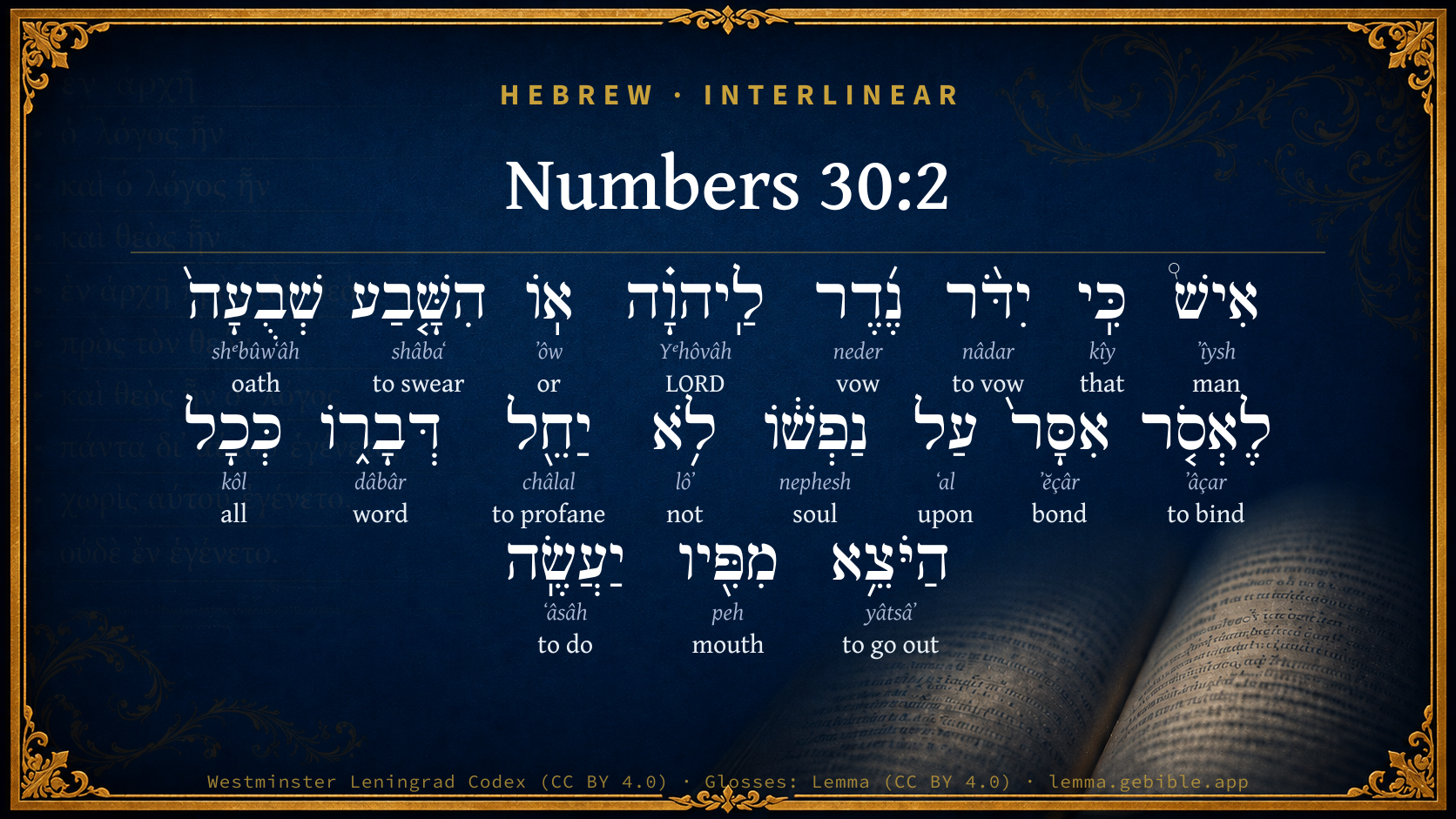
Hebrew (Westminster Leningrad Codex) Numbers 30:2 appears in the Hebrew Old Testament. The text above is from the Westminster Leningrad Codex. Each word links to its Strong’s number, a concise gloss, and parsing drawn from the Open Scriptures Hebrew Bible morphology. Click any word for its full Brown-Driver-Briggs (BDB) entry.
Download image
Cite this verse

Numbers 30:2 (World English Bible). Public Domain. Lemma interlinear Bible study tool, https://lemma.gebible.app/v/numbers/30/2.

Show BibTeX & RIS
BibTeX
RIS
English Translation
When a man vows a vow to Yahweh, or swears an oath to bind his soul with a bond, he shall not break his word; he shall do according to all that proceeds out of his mouth.
World English Bible · Public Domain
Highlights Full analysis ↓
Download a study sheet

One document with this verse’s original text, its word-by-word gloss line, the meaning frame, cross-references with their text, attributed commentary, and full source and license credits — printable, and it pastes into notes with its structure intact.

This verse Autodidact and up

Study sheet (.html) Plain text (.txt)

A passage Seminary Student

Up to 50 verses in one chapter. A passage sheet keeps up to 6 commentary sources and 12 cross-references per verse, in the order this page ranks them, and says so on the sheet whenever that leaves anything out. Ask for a single verse and you get the Autodidact verse sheet above.

Everything on this page stays free to read, with no account — the sheet is a download of what is already on screen, not access to it.

Want to remove ads? Support Godless Engineer
Compare translations 3

The same verse in 3 English versions, stacked beneath the original-language interlinear above. Click any original word for its lexicon entry.

Each is an independent rendering of the whole verse — the interlinear is not word-aligned to these translations.

Highlighted words mark where these versions differ — a whole-verse word diff, not a word-by-word alignment.

  • World English Bible Public Domain
    When a man vows a vow to Yahweh, or swears an oath to bind his soul with a bond, he shall not break his word; he shall do according to all that proceeds out of his mouth.
  • King James Version Public Domain
    If a man vow a vow unto the LORD, or swear an oath to bind his soul with a bond; he shall not break his word, he shall do according to all that proceedeth out of his mouth.
  • unfoldingWord Literal Text CC BY-SA 4.0
    When a man vows a vow to Yahweh or swears an oath to bind a binding vow on his life, he shall not profane his word. He shall do according to all that came out from his mouth.

unfoldingWord Literal Text — © unfoldingWord, licensed CC BY-SA 4.0. Word-aligned USFM3 via Door43 (git.door43.org/unfoldingWord/en_ult).

Versions to compare (up to 4)

3 of 4 selected

Show all 18 translations

Every available English version of this verse, each an independent rendering of the whole verse.

  • World English Bible Public Domain
    When a man vows a vow to Yahweh, or swears an oath to bind his soul with a bond, he shall not break his word; he shall do according to all that proceeds out of his mouth.
  • Berean Standard Bible Public Domain
    If a man makes a vow to the LORD or swears an oath to obligate himself by a pledge, he must not break his word; he must do everything he has promised.
  • Majority Standard Bible Public Domain
    If a man makes a vow to the LORD or swears an oath to obligate himself by a pledge, he must not break his word; he must do everything he has promised.
  • King James Version Public Domain
    If a man vow a vow unto the LORD, or swear an oath to bind his soul with a bond; he shall not break his word, he shall do according to all that proceedeth out of his mouth.
  • American Standard Version (1901) Public Domain
    When a man voweth a vow unto Jehovah, or sweareth an oath to bind his soul with a bond, he shall not break his word; he shall do according to all that proceedeth out of his mouth.
  • Revised Version (1885) Public Domain
    When a man voweth a vow unto the LORD, or sweareth an oath to bind his soul with a bond, he shall not break his word; he shall do according to all that proceedeth out of his mouth.
  • Geneva Bible (1599) Public Domain
    Moses also spake vnto the heads of ye tribes concerning the children of Israel, saying, This is the thing which the Lord hath commanded,
  • Douay-Rheims (1899) Public Domain
    And he said to the princes of the tribes of the children of Israel: This is the word that the Lord hath commanded:
  • Young's Literal Translation Public Domain
    `When a man voweth a vow to Jehovah, or hath sworn an oath to bind a bond on his soul, he doth not pollute his word; according to all that is going out from his mouth he doth.
  • Literal Standard Version CC BY-SA 4.0
    When a man vows a vow to YHWH, or has sworn an oath to bind a bond on his soul, he does not defile his word; he does according to all that is going out from his mouth.
  • Unlocked Literal Bible CC BY-SA 4.0
    When anyone makes a vow to Yahweh, or swears an oath to bind himself with a promise, he must not break his word. He must keep his promise to do everything that comes out of his mouth.
  • unfoldingWord Literal Text CC BY-SA 4.0
    When a man vows a vow to Yahweh or swears an oath to bind a binding vow on his life, he shall not profane his word. He shall do according to all that came out from his mouth.
  • Darby Bible Public Domain
    If a man vow a vow to Jehovah, or swear an oath to bind his soul with a bond, he shall not break his word; according to all that hath gone out of his mouth shall he do.
  • World Messianic Bible Public Domain
    When a man vows a vow to the LORD, or swears an oath to bind his soul with a bond, he shall not break his word. He shall do according to all that proceeds out of his mouth.
  • Webster's Bible Public Domain
    \\30:1\\And Moses spoke to the heads of the tribes concerning the children of Israel, saying, This is the thing which the LORD hath commanded.
  • Free Bible Version CC BY-SA 4.0
    If a man makes a solemn promise to the Lord, or pledges to do something by swearing an oath, he must not break his promise. He must do everything he said he would.
  • Bible in Basic English Public Domain
    And Moses said to the heads of the tribes of the children of Israel, This is the order of the Lord.
  • JPS Tanakh (1917) Public Domain
    (30-3) When a man voweth a vow unto the LORD, or sweareth an oath to bind his soul with a bond, he shall not break his word; he shall do according to all that proceedeth out of his mouth.

Literal Standard Version (2020), Covenant Press — licensed CC BY-SA 4.0. Text via the HelloAO Bible API (eBible.org). Unlocked Literal Bible (unfoldingWord) — licensed CC BY-SA 4.0. Text via the HelloAO Bible API (eBible.org). unfoldingWord Literal Text — © unfoldingWord, licensed CC BY-SA 4.0. Word-aligned USFM3 via Door43 (git.door43.org/unfoldingWord/en_ult). Free Bible Version, Dr. Jonathan Gallagher — licensed CC BY-SA 4.0. Text via the HelloAO Bible API (eBible.org).

Word by word

More ways to search: Search by grammar → Find every occurrence → Compare this word →

Practice this passage: Drill this verse → Learn its vocabulary →

אִסָּר֙
ʼĕçâr
H632
“bond”
Noun, Common, Masculine, Singular, Absolute
Part of Speech
Noun
Type
Common
Gender
Masculine
Number
Singular
State
Absolute
Full BDB Definition

Origin: from H631

TWOT: 141d

bond, binding obligation, obligation
  1. אִישׁ֩ ʼîysh H376 “man” Noun, Common, Masculine, Singular, Absolute
  2. כִּֽי kîy H3588 “that” Conjunction
  3. יִדֹּ֨ר nâdar H5087 “to vow” Verb, Qal, Imperfect, 3rd Person, Masculine, Singular
  4. נֶ֜דֶר neder H5088 “vow” Noun, Common, Masculine, Singular, Absolute
  5. לַֽיהוָ֗ה Yᵉhôvâh H3068 “to/for · LORD” Preposition + Noun, Proper
  6. אֽוֹ ʼôw H176 “or” Conjunction
  7. הִשָּׁ֤בַע shâbaʻ H7650 “to swear” Verb, Niphal, Infinitive Absolute
  8. שְׁבֻעָה֙ shᵉbûwʻâh H7621 “oath” Noun, Common, Feminine, Singular, Absolute
  9. לֶאְסֹ֤ר ʼâçar H631 “to bind” Preposition + Verb, Qal, Infinitive Construct
  10. עַל ʻal H5921 “upon” Preposition
  11. נַפְשׁ֔וֹ nephesh H5315 “soul · his” Noun, Common, Both, Singular, Construct + Suffix, Personal, 3rd Person, Masculine, Singular
  12. לֹ֥א lôʼ H3808 “not” Particle, Negative
  13. יַחֵ֖ל châlal H2490 “to profane” Verb, Hiphil, Imperfect, 3rd Person, Masculine, Singular
  14. דְּבָר֑וֹ dâbâr H1697 “word · his” Noun, Common, Masculine, Singular, Construct + Suffix, Personal, 3rd Person, Masculine, Singular
  15. כְּכָל kôl H3605 “like/as · all of” Preposition + Noun, Common, Masculine, Singular, Construct
  16. הַיֹּצֵ֥א yâtsâʼ H3318 “the · going out” Particle, Definite Article + Verb, Qal, Participle Active, Masculine, Singular, Absolute
  17. מִפִּ֖יו peh H6310 “from · mouth · his” Preposition + Noun, Common, Masculine, Singular, Construct + Suffix, Personal, 3rd Person, Masculine, Singular
  18. יַעֲשֶֽׂה ʻâsâh H6213 “to do” Verb, Qal, Imperfect, 3rd Person, Masculine, Singular

About this verse

These counts appear in no published source. They are computed here, from the morphology-tagged text and Lemma’s own curated glosses. What Lemma adds →

19
words
19
distinct lemmas
Pentateuch
section

Notable vocabulary

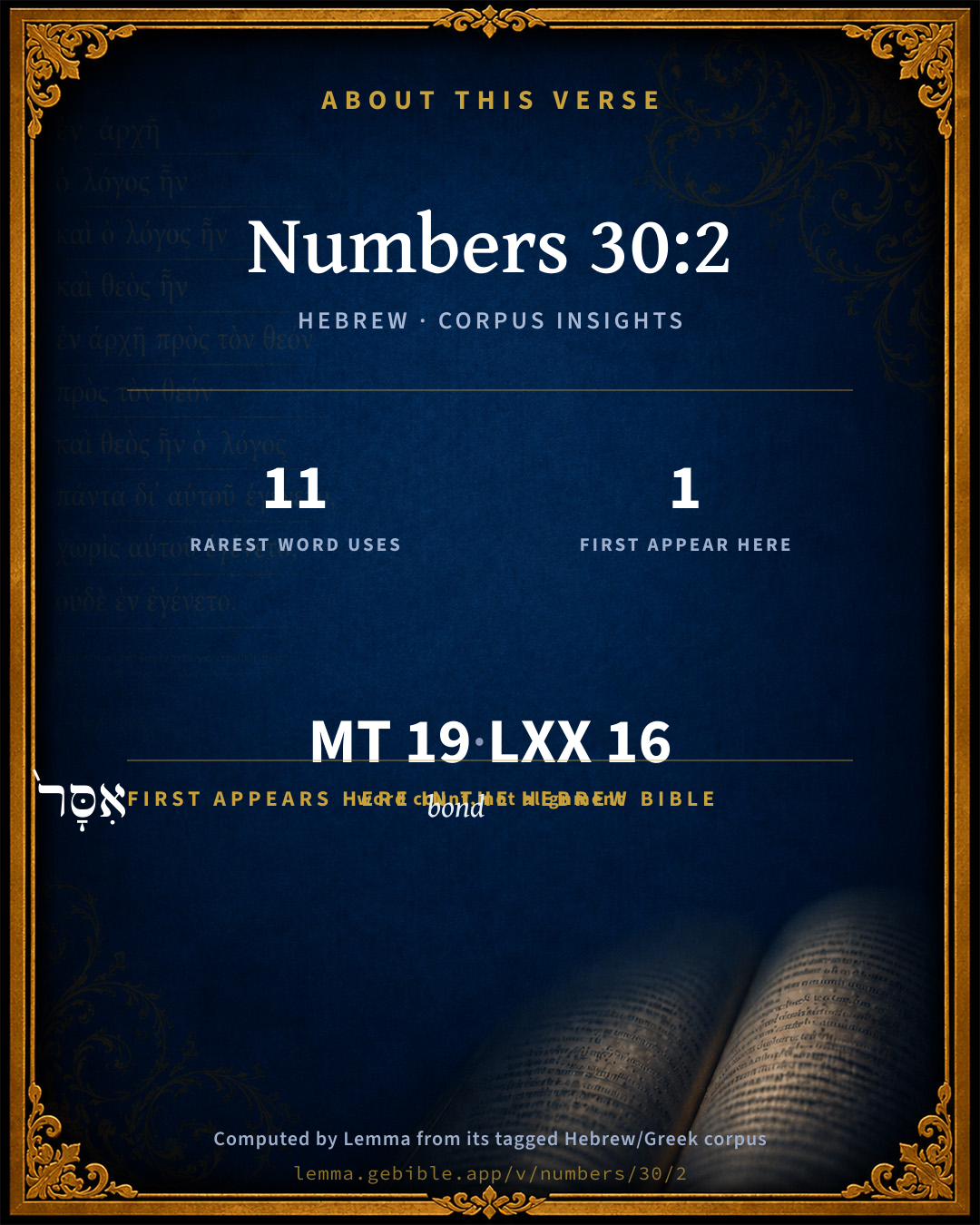
The rarest word here is אִסָּר֙ bond H632 — appearing just 11 times in the whole Hebrew Bible.

First appearance in Scripture

This word makes its first canonical appearance in the Hebrew Bible here:

  • אִסָּר֙ bond H632

Shared distinctive vocabulary

אִסָּר֙ bond H632 occurs in 10 verses of the Hebrew Bible. Also found in:

Grammatical profile

  • 6 verbs
  • 9 nouns
  • 1 preposition
  • 2 conjunctions
  • 1 particle

Verb forms

  • יִדֹּ֨ר Qal · Imperfect
  • הִשָּׁ֤בַע Niphal · Infinitive Absolute
  • לֶאְסֹ֤ר Qal · Infinitive Construct
  • יַחֵ֖ל Hiphil · Imperfect
  • הַיֹּצֵ֥א Qal · Participle Active
  • יַעֲשֶֽׂה Qal · Imperfect

Hebrew & Septuagint length

In English translation the verse runs 37 words from the Hebrew and 24 from the Septuagint (LXX English) — the Septuagint runs noticeably shorter here. See the side-by-side →

A rough comparison of the two English renderings, which tokenize alike — not a word-level alignment.

Word counts can differ between the Hebrew and the Greek without any difference in meaning — e.g. the Hebrew direct-object marker אֵת has no separate Greek word, and Greek often adds the article ὁ.

In the original languages it is 19 Hebrew tokens and 16 Greek tokens — but the two are counted differently (Hebrew bundles its prefixes and suffixes into one token; the Greek is in lemma form), so that isn’t a like-for-like length.

Cross-references

35

Topical passages linked to Numbers 30:2 in the Treasury of Scripture Knowledge — connected by theme and wording, ordered by reader-vote popularity; previews shown in the World English Bible.

  • Psalms 50:14 Offer to God the sacrifice of thanksgiving. Pay your vows to the Most High.
  • Psalms 116:14 I will pay my vows to Yahweh, Yes, in the presence of all his people.
  • Job 22:27 You shall make your prayer to him, and he will hear you. You shall pay your vows.
  • Ecclesiastes 5:4–5 When you vow a vow to God, don't defer to pay it; for he has no pleasure in fools. Pay that which you vow.
  • Psalms 66:13–14 I will come into your temple with burnt offerings. I will pay my vows to you,
  • Acts 23:12 When it was day, some of the Jews banded together, and bound themselves under a curse, saying that they would neither eat nor drink until they had killed Paul.
  • Leviticus 5:4 "'Or if anyone swears rashly with his lips to do evil, or to do good, whatever it is that a man might utter rashly with an oath, and it is hidden from him; when he knows of it, then he shall be guilty of one of these.
  • Numbers 30:3–4 Also when a woman vows a vow to Yahweh, and binds herself by a bond, being in her father's house, in her youth,
  • Psalms 22:25 Of you comes my praise in the great assembly. I will pay my vows before those who fear him.
  • Psalms 55:20 He raises his hands against his friends. He has violated his covenant.
  • Psalms 116:18 I will pay my vows to Yahweh, Yes, in the presence of all his people,
  • Proverbs 20:25 It is a snare to a man to make a rash dedication, Then later to consider his vows.
  • Nahum 1:15 Behold, on the mountains the feet of him who brings good news, who publishes peace! Keep your feasts, Judah! Perform your vows, for the wicked one will no more pass through you. He is utterly cut off.
  • Matthew 5:33–34 "Again you have heard that it was said to them of old time, 'You shall not make false vows, but shall perform to the Lord your vows,'
  • Acts 23:21 Therefore don't yield to them, for more than forty men lie in wait for him, who have bound themselves under a curse neither to eat nor to drink until they have killed him. Now they are ready, looking for the promise from you."
  • Psalms 76:11 Make vows to Yahweh your God, and fulfill them! Let all of his neighbors bring presents to him who is to be feared.
  • 2 Corinthians 1:23 But I call God for a witness to my soul, that I didn't come to Corinth to spare you.
  • 2 Corinthians 9:9–11 As it is written, "He has scattered abroad, he has given to the poor. His righteousness remains forever."
  • Genesis 28:20–22 Jacob vowed a vow, saying, "If God will be with me, and will keep me in this way that I go, and will give me bread to eat, and clothing to put on,
  • Exodus 20:7 "You shall not take the name of Yahweh your God in vain, for Yahweh will not hold him guiltless who takes his name in vain.
  • Leviticus 27:2–34 "Speak to the children of Israel, and say to them, 'When a man makes a vow, the persons shall be for Yahweh by your valuation.
  • Numbers 21:2 Israel vowed a vow to Yahweh, and said, If you will indeed deliver this people into my hand, then I will utterly destroy their cities.
  • Numbers 30:10 If she vowed in her husband's house, or bound her soul by a bond with an oath,
  • Deuteronomy 23:21–23 When you shall vow a vow to Yahweh your God, you shall not be slack to pay it: for Yahweh your God will surely require it of you; and it would be sin in you.
  • Judges 11:11 Then Jephthah went with the elders of Gilead, and the people made him head and chief over them: and Jephthah spoke all his words before Yahweh in Mizpah.
  • Judges 11:30–31 Jephthah vowed a vow to Yahweh, and said, If you will indeed deliver the children of Ammon into my hand,
  • Judges 11:35–36 It happened, when he saw her, that he tore his clothes, and said, Alas, my daughter! you have brought me very low, and you are one of those who trouble me; for I have opened my mouth to Yahweh, and I can't go back.
  • Judges 11:39 It happened at the end of two months, that she returned to her father, who did with her according to his vow which he had vowed: and she was a virgin. It was a custom in Israel,
  • Psalms 56:12 Your vows are on me, God. I will give thank offerings to you.
  • Psalms 119:106 I have sworn, and have confirmed it, That I will obey your righteous ordinances.
  • Matthew 14:7–9 Whereupon he promised with an oath to give her whatever she should ask.
  • Matthew 23:16 "Woe to you, you blind guides, who say, 'Whoever swears by the temple, it is nothing; but whoever swears by the gold of the temple, he is obligated.'
  • Matthew 23:18 'Whoever swears by the altar, it is nothing; but whoever swears by the gift that is on it, he is obligated.'
  • Acts 23:14 They came to the chief priests and the elders, and said, "We have bound ourselves under a great curse, to taste nothing until we have killed Paul.
  • Psalms 15:3 He who doesn't slander with his tongue, Nor does evil to his friend, Nor casts slurs against his fellow man;

Cross-references courtesy of OpenBible.info (CC BY 4.0).

Hebrew and Greek witnesses Masoretic Hebrew ↔ Greek Septuagint

The same verse in the two great witnesses to the Old Testament, shown verse-for-verse.

Here the Septuagint runs noticeably shorter than the Hebrew — LXX2012 (modern English Septuagint) 24 words vs World English Bible 37. A rough length comparison of the two English translations, not a word-level alignment — read both below.

These are two independent witnesses, not word-aligned to each other, and the Septuagint is shown in lemma (dictionary) form.

Hebrew Numbers 30:2 Masoretic · Westminster Leningrad Codex

אִישׁ֩ כִּֽי יִדֹּ֨ר נֶ֜דֶר לַֽיהוָ֗ה אֽוֹ הִשָּׁ֤בַע שְׁבֻעָה֙ לֶאְסֹ֤ר אִסָּר֙ עַל נַפְשׁ֔וֹ לֹ֥א יַחֵ֖ל דְּבָר֑וֹ כְּכָל הַיֹּצֵ֥א מִפִּ֖יו יַעֲשֶֽׂה

When a man vows a vow to Yahweh, or swears an oath to bind his soul with a bond, he shall not break his word; he shall do according to all that proceeds out of his mouth.

World English Bible · Public Domain

Greek LXX Numbers 30:2 Septuagint · lemma form

καί λαλέω μωυσῆς πρός ὁ ἄρχων ὁ φυλή ἰσραήλ λέγω οὗτος ὁ ῥῆμα ὅς συντάσσω κύριος

And Moses spoke to the heads of the tribes of the children of Israel, saying, This is the thing which the Lord has commanded.

LXX2012 (modern English Septuagint) · Public Domain

Hebrew: Westminster Leningrad Codex (CC BY 4.0). Greek: Septuagint (public domain); English from LXX2012 (modern English Septuagint) (Public Domain). How the Septuagint differs from the Hebrew →

Targum (Aramaic paraphrase)

2

The Targum is the ancient Jewish Aramaic paraphrase of the Hebrew Scriptures — an interpretive translation, not the Hebrew text itself. Onkelos (literal) and Pseudo-Jonathan (expansive) render the Torah, and Jonathan the Prophets. Coverage is partial: where no permissively-licensed English translation exists for a verse, only the Aramaic is shown. This is verse-level text, not a word-by-word alignment to the Hebrew.

  1. Targum Onkelos Torah (Genesis–Deuteronomy)
    וּמַלִיל משֶׁה עִם רֵישֵׁי שִׁבְטַּיָא לִבְנֵי יִשְׂרָאֵל לְמֵימָר דֵין פִּתְגָמָא דִי פַקֵיד יְיָ

    And Moses spoke with the leaders of the tribes of the children of Israel saying, These are the words that God has commanded:

    Targum Onkelos — Aramaic: “Onkelos Genesis” (public domain); “Onkelos Exodus” (public domain); “Onkelos Leviticus” (public domain); “Onkelos Numbers” (public domain); “Onkelos Deuteronomy” (public domain). English: “Sefaria Community Translation” (CC0 1.0 (public-domain dedication)); “J.W. Etheridge. The Targums of Onkelos and Jonathan Ben Uzziel on the Pentateuch. London: Longmans, Green, 1862” (public domain). Text via Sefaria.

  2. Targum Pseudo-Jonathan Torah (Genesis–Deuteronomy)
    וידבר וּמַלֵיל משֶׁה עִם אֲמַרְכְּלֵי שִׁבְטַיָא לִבְנֵי יִשְרָאֵל לְמֵימָר דֵין פִּתְגָמָא דְמַלֵיל יְיָ לְמֵימָר

    AND Mosheh spake with the chiefs of the Tribes of the Beni Israel, saying: This is the Word which the Lord hath spoken, saying:

    Targum Pseudo-Jonathan — Aramaic: “Targum Jonathan on Genesis” (public domain); “Targum Jonathan on Exodus” (public domain); “Targum Jonathan on Leviticus” (public domain); “Targum Jonathan on Numbers” (public domain); “Targum Jonathan on Deuteronomy” (public domain). English: “The Targum of Jonathan ben Uzziel, trans. J. W. Etheridge, London, 1862” (public domain). Text via Sefaria.

Commentary

Notes on Numbers 30:2 from classic Christian and Jewish commentators (each source and its license shown beneath its notes). The classic Christian expositions comment on the surrounding passage and are grouped to its opening verse, so a note may address several verses; the Jewish commentaries on the Tanakh (Rashi and others) are per-verse, so they appear only where the commentator wrote on this verse.

Lemma curates 59 commentaries, every one of them public domain or Creative Commons licensed, each selected and text-cleaned for this edition rather than reprinted as found. About our sources →

Trapp's Complete Commentary

John Trapp

Num 30:2 If a man vow a vow unto the LORD, or swear an oath to bind his soul with a bond; he shall not break his word, he shall do according to all that proceedeth out of his mouth.

Ver. 2. If a man vow a vow unto the Lord.] God is the proper object of a vow. {Psa 76:11} Papists vow to saints, both themselves, as to Francis, Austin, Dominick, &c., and other things, as pilgrimages, oblations, &c. Our Lady, as they call her, of Loretto, hath her churches so stuffed with vowed presents and memories, as they are fain to hang their cloisters and churchyards with them. {a} This is sacrilege; yea, it is idolatry.

To bind his soul with a bond.] Which none ought to do, but such as (1.) are free, or have the consent of their governors; (2.) Such as have knowledge and judgment to discern of a vow or oath; {Ecc 5:3; Ecc 5:5} (3.) Are conscientious, as Jacob, Hannah, &c. Not such votaries as Herod, {Mat 14:7} those assassins, {Act 23:14} those idolaters. {Jer 44:27}

He shall not break his word.] If he do, he will make a great breach in his conscience and crack his comfort exceedingly. "Better not vow than not pay." {Ecc 5:4} It is a sin as bad or worse than perjury, and God takes it heavily at men’s hands. {Jer 34:10-11}

{a} Sandys’s Relation of West. Relig., sect. 4.

John Trapp, A Commentary or Exposition upon All the Books of the Old and New Testament (1647–1656) — public domain. Text from a community e-Sword module.

The Biblical Illustrator

Joseph S. Exell

Num_30:2

If a man vow a vow unto the Lord.

The sacred bond

The practice of binding the soul with vows and oaths is of very ancient date, and common to all systems of religion. Now precisely of this nature is the baptismal obligation, a sacrament in which we are most solemnly pledged to the service of God, a covenant which we are bound all the days of our life faithfully to keep and perform. In confirmation we publicly recognise our personal responsibility in that act, and profess our serious purpose to fulfil the solemn engagement; while the bishop officiating, with all the faithful present, implores for us the aid of the Holy Spirit, that we may be enabled effectually to carry out our purpose. In entering into any important transaction, obviously, nothing is more necessary than a correct idea of its nature and its significance. In order to this, in the present case, we should consider with whom it is that we make the solemn engagement. Engagements of great weight are sometimes made with men, but none are so important as those which are made with God. In joining the Freemasons, the Knights Templar, or any other voluntary association, you must assume certain obligations, and give certain pledges for their performance, before you can have any right to the peculiar privileges of the order. But in becoming a member of Christs flock you not only make an engagement with your Christian brethren, binding yourselves to observe and do certain things which are essential to the welfare of the sacred fraternity, but you make in your baptism and renew in your confirmation a covenant with God Himself--with God, the Father of the spirits of all flesh, to whom all hearts are open, all desires known, and from whom no secrets are hid--with God, who understands your motives better than you understand them yourselves, who cannot look upon iniquity, but hates all dissimulation with perfect hatred, and will bring every work into judgment, with every secret thing, whether it be good or bad. But let no man undertake thoughtlessly what ought to be done with the greatest deliberation and the utmost seriousness. Remember that the act you contemplate is irrevocable; the obligation you are about to assume is perpetual; the covenant you are going to ratify is an everlasting covenant, never to be forgotten. Its neglect is peril; its rupture is perdition. What you promise to renounce, you must renounce for ever; what you engage to perform, you must do all the days of your life; what you pledge yourselves to believe, is the unchangeable and everlasting faith once for all delivered to the saints. No man putting his hand to the plough and looking back is fit for the kingdom of heaven. Oh, how will his broken promises haunt the delinquent on the bed of death, and stand like threatening spectres before him in the twilight of eternity! Forget not, then, that the vows of God are upon you, and you cannot escape the obligation. But let not the fear of failure frighten any of you from the duty. You owe it to Christ, you owe it to the Church, you owe it to your sponsors, you owe it to your own souls, to redeem the pledge you have given. Lay hold upon the proffered strength of God, and renew your consecration to His service. He will not be wanting on His part. His word is for ever settled in heaven. Your assurance stands in two immutable things by which it is impossible for God to lie. For He also hath vowed a vow, and sworn an oath to bind His soul with a bond; and He will not break His word, but will do according to all that hath proceeded out of His mouth. (J. Cross, D. D.)

The solemn obligation of religious vows

I. The case supposed. If a man vow a vow unto the Lord, or swear an oath to bind his soul with a bond.

1. The vow is made unto God. He is the only true and proper object of religious vows.

2. The vow binds the soul. Swear an oath to bind his soul with a bond. A promise to man is a bond upon the estate, but a promise to God is a bond upon the soul.

3. The vow is voluntarily made.

4. The thing vowed must be lawful.

II. The danger implied. He shall not break his word, &c. There is in human nature a deep-rooted tendency to forget in health the vows which were made in sickness, and to ignore in our security and peace the vows we made in our danger and alarm.

III. The command given.

1. That he shall perform his vow. He shall not break his word.

2. That he shall fully perform his vow. He shall do according to all that proceedeth out of his mouth.

Conclusion: Appeal to those who have unfulfilled vows resting upon them.

1. Baptismal vows, in the case of some of you, are unfulfilled.

2. Vows made in affliction or danger by some of you have not been paid. (W. Jones.)

Vows not to be discouraged

It is not an idle or dangerous thing to form good resolutions, and make promises, and enter into pledges and covenants anew. A promise is often a bud; the attempt to keep it a flower, and success therein the fruit. Some would discourage all promises and pledges lest they be broken. We might as well bid all the trees in the spring-time keep back their buds for fear of late frost, or warn them against opening their hearts to the sun lest they be betrayed and blighted. (Christian Age.)

.

The Biblical Illustrator, edited by Joseph S. Exell (c. 1880s–1900s) — public domain. Text from a community e-Sword module.

Joseph Benson's Commentary

Num 30:2. If a man vow a vow — Concerning something lawful, and in his power to perform. Unto the Lord — To the honour and service of God. Or swear an oath — Confirm his vow by an oath. To bind his soul with a bond — To restrain himself from something otherwise lawful; as, suppose, from such a sort of meat or drink; or to oblige himself to the performance of something otherwise not necessary, as to observe a private day of fasting. He shall not break (Hebrew, he shall not profane) his word — Not render his word, and consequently himself, profane, or contemptible in the eyes of others. He shall do according to all that proceedeth out of his mouth — Punctually and conscientiously. His vow shall be performed in the manner, time, and kind which was at first proposed, in reverence to the great God to whom it was made. But in case a man vows, or takes an oath, to do any thing that is in itself unlawful, as those Jews did, mentioned Act 23:14, nothing can be plainer than that such vow or oath must be void in the very nature of the thing. For promises and resolutions, enforced by the strongest oaths, or most solemn vows, are but secondary obligations, and therefore can never absolve us from our primary and immutable obligation to obey the laws of God and nature; for this would be to say, that we could, by an oath, oblige ourselves to do what God had before obliged us not to do. “He who perpetrates any act of injustice,” says Philo Judæus, de specialibus legibus, “upon account of his oath, adds one crime to another; first by taking an unlawful oath, and then by doing an unlawful action. Therefore such a one ought to abstain from the unjust action, and pray God to pardon him for his rash oath.” Thus Herod ought to have done; instead of performing the rash promise which he had sealed with an oath, he ought to have punished that wicked woman, who instigated him to commit murder, under pretence of fulfilling his oath, Mat 14:9. Grotius observes further, that though the thing promised be not absolutely unlawful, yet, if it obstruct some greater moral good, such a promise, even sealed with an oath, is not binding.

Joseph Benson's Commentary on the Old and New Testaments (1811–1818) — public domain. Text from a community e-Sword module.

Keil & Delitzsch

C. F. Keil & F. Delitzsch

At the head there stands the general rule, "If any one vow a vow to Jehovah, or swear an oath, to bind his soul to abstinence, he shall not break his word; he shall do according to all that has gone out of his mouth:" i.e., he shall keep or fulfil the vow, and the promise of abstinence, in perfect accordance with his word. נדר is a positive vow, or promise to give or sanctify any part of one's property to the Lord. אסּר, from אסר, to bind or fetter, the negative vow, or vow of abstinence. על־נפשׁו אסּר אסר, to take an abstinence upon his soul. In what such abstinence consisted is not explained, because it was well understood from traditional customs; in all probability it consisted chiefly in fasting and other similar abstinence from lawful things. The Nazarite's vow, which is generally reckoned among the vows of abstinence, is called neder in Num 6:2., not issar, because it consisted not merely in abstinence from the fruit of the vine, but also in the positive act of permitting the hair to grow freely in honour of the Lord. The expression "swear an oath" (Num 30:2; cf. Num 30:13) shows that, as a rule, they bound themselves to abstinence by an oath. The inf. constr., השּׁבא, is used here, as in other places, for the inf. abs. (cf. Ges. 131, 4, note 2). יחל, from חלל, for יחל, as in Eze 39:7 (cf. Ges. 67, note 8), to desecrate (his word), i.e., to leave it unfulfilled or break it.

Keil & Delitzsch — Biblical Commentary on the Old Testament (1861–1891) — public domain (CC PDM 1.0). Text via the HelloAO Bible API. (Old Testament only.)

Geneva Bible (1599)

Geneva Bible translators

Because they might declare them to the Israelites.

Geneva Bible (1599) marginal notes — public domain. Text via Bolls.life.

Jamieson, Fausset & Brown

Robert Jamieson, A. R. Fausset & David Brown

If a man vow a vow unto the Lord--A mere secret purpose of the mind was not enough to constitute a vow; it had to be actually expressed in words; and though a purely voluntary act, yet when once the vow was made, the performance of it, like that of every other promise, became an indispensable duty--all the more because, referring to a sacred thing, it could not be neglected without the guilt of prevarication and unfaithfulness to God.

he shall not break his word--literally, "profane his word"--render it vain and contemptible (Psa 55:20; Psa 89:34). But as it would frequently happen that parties would vow to do things which were neither good in themselves nor in their power to perform, the law ordained that their natural superiors should have the right of judging as to the propriety of those vows, with discretionary power to sanction or interdict their fulfilment. Parents were to determine in the case of their children, and husbands in that of their wives--being, however, allowed only a day for deliberation after the matter became known to them; and their judgment, if unfavorable, released the devotee from all obligation [Num 30:3-8].

Jamieson, Fausset & Brown — Commentary Critical and Explanatory on the Whole Bible (1871) — public domain (CC PDM 1.0). Text via the HelloAO Bible API.

Adam Clarke's Commentary

Verse 2. If a man vow a vow] A vow is a religious promise made to God. Vows were of several kinds:-

1. Of abstinence or humiliation, see ver. Nu 30:13;

2. Of the Nazarite, see Nu 6:1-21;

3. Of giving certain things or sacrifices to the Lord, Le 7:16;

4. Of alms given to the poor, see De 23:21.

The law in this chapter must have been very useful, as it both prevented and annulled rash vows, and provided a proper sanction for the support and performance of those that were rationally and piously made. Besides, this law must have acted as a great preventive of lying and hypocrisy. If a vow was properly made, a man or woman was bound, under penalty of the displeasure of God, to fulfil it.

Adam Clarke's Commentary on the Bible (1810–1826) — public domain. Text from a community e-Sword/MySword module.

The Cambridge Bible for Schools and Colleges

gen. ed. J. J. S. Perowne

2. Two kinds of pledges are here mentioned, a vow and an obligation. A vow is a promise to give something to God. Such votive offerings were frequent in times of danger or special need (cf. Gen_28:20-22, Jdg_11:30 f.). In post-exilic times they would often consist in gifts to the temple (cf. Luk_21:5 ἀναθήματα). An obligation is a prohibition laid upon oneself, a pledge of abstinence; e.g from wine, as in the case of a Nazirite (ch. 6), or from food (1Sa_14:24, Act_23:21); see also Psa_132:3 f.

he shall not profane his word] To break a solemn promise is an act of profanation. The importance of keeping vows is emphasized in Deu_23:21 ff., Ecc_5:4 f.; cf. Mat_5:33.

all that proceedeth out of his mouth] A vow is not a vow until it has been expressed in words (cf. Num_32:24, Jdg_11:35 f.). The Rabbis of a later time further enjoined in the Mishna that the mere utterance of words without a real intention is not binding. ‘No utterance is binding unless the mouth and the heart agree.’

The Cambridge Bible for Schools and Colleges (gen. ed. J. J. S. Perowne; Cambridge University Press, 1878–1918) — public domain. Text from a community e-Sword module.

John Gill's Exposition

If a man vow a vow unto the Lord,.... Which must be in a thing that is lawful to be done, which is not contrary to the revealed will and mind of God, and which may tend to the glory of God, the honour of religion, the service of the sanctuary, the good of a man's self or of his neighbour; or in things purely indifferent, which may, or may not be done, without offence to God or man; as that he will not eat such a thing for such a time, or he will do this or the other thing, as Jarchi observes; who moreover says, that he may forbid himself what is forbidden, and forbid what is free and lawful; but he may not make free or lawful what is forbidden, that is, he may not vow to do a thing which is contrary to the law of God, such a vow will not stand: and he was to be of such an age before he could make a vow that would be valid; according to the Targum of Jonathan, he must be thirteen years of age; it is said in the Misnah (p),"a son of twelve years and one day, his vows are examined; a son of thirteen years and one day, his vows are firm, and they examine the whole thirteenth year before that time; although they say we know to whose name (or on whose account) we vow or consecrate, their vow is no vow, nor their consecration no consecration; but after that time, though they say we know not to whose name (or, on whose account) we vow or consecrate, their vow is a vow, and their consecration a consecration:"

or swear an oath to bind his soul with a bond; to his vow adds an oath for the greater confirmation of it, and to lay himself under the greater obligation to perform it:

he shall not break his word; or profane it (q) but punctually perform it; men should be careful how they vow, and not rashly do it; but when they have vowed, they ought to perform; see Ecc 5:4,

he shall do according to all that proceedeth out of his mouth; it is not in his power to revoke his vow or make it null: the Misnic doctors (r) say, a man can loose all vows, excepting his own. R. Judah says, not the vows of his wife, nor those which are between her and others; that is, as one of the commentators (s) explains it, such vows which are not made to afflict, or respect not fasting; but according to the Targum of Jonathan, though a man cannot loose his vows, or free himself from them, yet the sanhedrim, or court of judicature, can, or a wise man that is authenticated thereby, as Jarchi says, or three private persons; but these are such traditions; which make void the commandment of God, as our Lord complains, Mat 15:1.

(p) Niddah, c. 5. sect. 6. (q) (r) Negaim, c. 5. sect. 5. (s) Bartenora in Misn. Negaim, c. 5. sect. 5.

John Gill's Exposition of the Whole Bible (1746–1763) — public domain (CC PDM 1.0). Text via the HelloAO Bible API.

Albert Barnes' Notes on the Bible

The “vow” was positive; the “bond” negative or restrictive. By a vow a man engaged to dedicate something to God, or to accomplish some work for Him: by a bond he debarred himself from some privilege or enjoyment. A vow involved an obligation to do: a bond, an obligation to forbear doing.

Albert Barnes' Notes on the Bible (1834–1885) — public domain. Text from a community e-Sword/MySword module.

Matthew Poole's English Annotations

A man; which notes both the sex, as appears by Num 30:3, and the age, that he be grown up; for none can be so weak as to think the vow of a young child would bind it.

A vow, i.e. a simple Vow to do something possible and lawful.

Unto the Lord; to the honour and service of God.

Or swear an oath; confirm his vow by an oath.

To bind his soul with a bond; to restrain himself from something otherwise lawful, as suppose from such a sort of meat or drink; or to oblige himself to the performance of something otherwise not necessary, is to observe a private day of fasting.

He shall not break his word, Heb. not pollute or profane his word, as the same phrase is used, Psa 55:20; 89:34, i.e. not render his word, and consequently himself, profane, or vile and contemptible in the eyes of others.

According to all that proceedeth out of his own mouth; and that without delay, Deu 23:21; Ecc 5:4, provided the thing be not unlawful and forbidden by God, Act 23:14; for it is an idle conceit that a man can give away God’s right, or that he can make void God’s commands by his own vows, which was the dotage of the Pharisees, Mar 6:23,26.

Matthew Poole's English Annotations on the Holy Bible (1683–1685) — public domain. Text from a community e-Sword/MySword module.

Whedon's Commentary on the Bible

Daniel D. Whedon

THE SACREDNESS OF VOWS, Num_30:1-2.

2. A vow is a religions promise unto the Lord. For the different kinds see Leviticus 27, introductory note. Alms promised to the poor were also, by the interpretation of the rabbins, comprehended under vows, on the principle that the poor stand in place of the Lord. Pro_19:17; Mat_25:40; Mat_26:11.

To bind his soul with a bond — Literally, bind his soul to abstain, that is, not to do a thing. The Nazarite’s vow is indicated by another word — neder. Num_6:2, note. In what the abstaining consisted is not explained, because it was well understood from traditional customs; in all probability it chiefly consisted in refraining from food and other lawful things. Act_23:12.

He shall not break his word — Profane his word. Slackness or needless delay was also prohibited. Deu_23:21. The time and place of paying vowed sacrifices was at the great feasts, before the Lord at the door of the tabernacle. Lev_1:3; Deu_12:5-7; Deu_16:16-17. Impossible vows are to be repented of, and wicked vows are to be broken. Acts xxiii, 21.

Daniel D. Whedon (gen. ed.), Commentary on the Old and New Testaments (1874–1909) — public domain. Text from a community e-Sword module.

The Pulpit Commentary

If a man vow a vow. rdn, a vow, is commonly said to be distinctively a positive vow, a promise to render something unto the Lord. This, however, cannot be strictly maintained, because the Nazarite vow was healer, and that was essentially a vow of abstinence. To say that the vow of the Nazarite was of a positive character because he had to let his hair grow "unto the Lord" is a mere evasion. It is, however, probable that neder, when it occurs (as in this passage) in connection with issar, does take on the narrower signification of a positive vow. Swear an oath to bind his soul with a bond. Literally, "to bind a bond upon his soul." rSai, a bond, which occurs only in this chapter, is considered to be a restrictive obligation, a vow of abstinence. It would appear that the issar was always undertaken upon oath, whereas the neder (as in the case of the Nazarite) did not of necessity require it. He shall not break his word.

This was the general principle with respect to vows, and, as here laid down, it was in accordance with the universal religious feeling of mankind. Whatever crimes may have claimed the sanction of this sentiment, whatever exceptions and safeguards a clearer revelation and a better knowledge of God may have established, yet the principle remained that whatsoever a man had promised unto the Lord, that he must fulfill. Iphigenia in Aulis, Jephthah"s daughter in Gilead, proclaim to what horrid extremities any one religious principle, unchecked by other coordinate principles, may lead; but they also proclaim how deep and true this religious principle must have been which could so over-ride the natural feelings of men not cruel nor depraved.

The Pulpit Commentary (1880–1919), ed. H.D.M. Spence-Jones & Joseph S. Exell — public domain. Text from a community e-Sword module.

Rashi

Rabbi Shlomo Yitzchaki (Rashi)

ראשי המטות [AND MOSES SPAKE TO] THE HEADS OF THE TRIBES OF THE CHILDREN OF ISRAEL] — This does not mean that he spoke only to the princes of the children of Israel and not to the people also, but that he showed respect to the princes by teaching them first and that afterwards he taught the children of Israel. This explanation seems to assume that this was the general method of instruction, but from what Biblical verse may we infer that this was so in the case of all addresses, and that this was no exceptional case? Because it says, (Exodus 34:31—32) “[And Moses called unto them], and Aaron and all the princes of the congregation returned unto him and Moses spake unto them; and afterwards all the children of Israel came nigh, [and he gave them all the commandments which the Lord had spoken to him in Mount Sinai]”. But if this be no exceptional case, what reason is there for Scripture going out of its way to state it here? Because by specially stating that the laws about vows were taught in the first instance to the princes and afterwards to the Israelites, it intends to teach that the annulling of vows is really to be effected by one person who is expert in the Law, and that only if there be no such expert, may they be annulled by three ordinary persons. But you may perhaps say that the statement does mean that Moses spoke this section only to the princes of the children of Israel, and that Moses did not speak to them also, and that consequently nothing about the expert and laymen can be inferred! But it is stated here, “This is the word”, and it is stated in the passage dealing with “animals slaughtered outside the sanctuary” (Leviticus 17:2) “This is the word”. What is the case there? It was addressed to Aaron and to his sons and to all the children of Israel, as it is said there, “Speak unto Aaron [and unto his sons and unto all the children of Israel]”! So, too, this was addressed to all of them (and the reason why it is stated here is to tell us that the annulling of vows etc., as above) (cf. Sifrei Bamidbar 153:1; Nedarim 78a).

זה הדבר THIS IS THE WORD — Moses prophesied with the words (introduced his message by the statement), “Thus saith the Lord, About midnight [will I go into the midst of Egypt]” (Exodus 11:4), and other prophets also prophesied with “Thus saith the Lord”, Moses, however, had an additional superiority in that he prophesied also with the expression “This is the actual word [that God hath spoken]” (Sifrei Bamidbar 153:2). Another explanation of זה הדבר THIS IS THE WORD: it is a restrictive phrase serving to intimate that the Sage (the expert) makes use of the expression “invalidating” (התרה), and the husband (dealing with his wife’s vows), only of the expression “annulling” (הפרה), as is the language of Scripture here (e. g., in v. 9), and that if they (one of them) exchanges the expression, it (the vow) is not invalidated nor is it annulled as the case may be (Nedarim 78a).

Rashi on the Tanakh — English translations: “The Judaica Press complete Tanach with Rashi, translated by A. J. Rosenberg” (CC BY 4.0); “Pentateuch with Rashi's commentary by M. Rosenbaum and A.M. Silbermann, 1929-1934” (public domain); “The Metsudah Tanach series, Lakewood, N.J” (CC BY 4.0); and “The Book of Joshua, Metsudah Publications, 1997” (CC BY 4.0). Text via Sefaria.

Ramban (Nachmanides)

Rabbi Moshe ben Nachman (Ramban / Nachmanides)

AND MOSES SPOKE UNTO THE HEADS OF THE TRIBES. Scripture did not precede this section with [the statement]: “And the Eternal spoke unto Moses, saying: Speak unto the heads of the tribes, and say unto them: This is the thing which the Eternal hath commanded,” as He stated in the section [dealing with] slaughtering [offerings] outside the Sanctuary Court, and in other sections. Instead, He mentioned it as the end of this section, saying, These are the statutes, which the Eternal commanded Moses. And in the section of Vayehi Bayom Ha’shemini it says: And Moses said: ‘This is the thing which the Eternal commanded that ye should do,’, Verse 6. See also Ramban ibid. Verse 2. but did not mention the [actual] command [given by G-d to Moses] at all. Similarly, in the section about the manna [it is said], And Moses said: ‘This is the thing which the Eternal hath commanded: Let an omerful of it be kept etc.’ [although the Divine command about it to Moses is not expressly stated].Now the heads of the tribes of the children of Israel are the princes of the standards, whom the tribes had appointed over their standards after Nachshon the son of Amminadab [prince of the children of Judah] and his colleagues had died. It is possible that they [the heads of the tribes referred to here] were those who are mentioned in the section [dealing with] the inheritance [of the Land]: These are the names of the men that shall take possession of the Land for you; or it may be that those [referred to here] were others, for there Scripture speaks about [the leaders of] the future [saying] that when they come to divide up the Land [in the time of Joshua] all those mentioned will be living, and they will represent them [in the apportionment of the Land].And Moses spoke unto the heads of the tribes. The reason [why he did not address this section to the entire people] is because it was not necessary to teach all the children of Israel that the father and husband [of a woman] can declare void those vows [of their daughter or wife, respectively] which involve affliction of the soul, and perhaps it is [even] necessary to conceal these [rights] from them, so that they should not treat vows lightly. But it was to the Sages of Israel, the heads of their tribes, that he taught the ordinance [of vows]. The verse also alludes to the interpretation of our Rabbis [who said] that the heads of the tribes have a special function and power in vows over and above the rest of the people, namely, that a single person who is an expert in the laws can release a person from a vow [and therefore, this section was addressed to the heads of the tribes, i.e., the Sages].Now the [power of] release from vows [by a Sage] is not expressly stated in the Torah, but it is a law declared to Moses on Sinai, and Scripture “hung it on a hair’s-breadth,” just as the Rabbis have said:, 11b). “[The rules concerning] the release from vows [by a Sage] hover in the air, and have nothing [in Scripture itself] on which they can be based.” But Scripture did allude to it [by saying]: ‘lo yacheil’ (he shall not profane) his word. For it did not say: “he shall not transgress his word.” but commanded that he should not make “profane” his word, meaning that he should not treat the vow as a hollow [and irreverent] thing; and when he comes to the court and they find him a cause for absolution and he regrets [having made the vow], and they release him thereof, he is not profaning it., 11b). And the reason for this [law being indicated in this manner of allusion] is as I have said [above], that Scripture treated absolution from a vow or oath as if it were one of the secrets of the Torah which are only to be revealed to those who are fit to [hear] them, and therefore they are written [in the Torah] in allusion. And this section [of vows] is placed here [in the Torah] because since [in the section above] He mentioned vows to the Sanctuary, [as it is said], beside your vows, and your freewill offerings, whether they be your burnt-offerings, or your meal-offerings, or your drink-offerings, or your peace-offerings, therefore He said furthermore: “Apart from these above-mentioned vows, there are also vows of a secular nature. [In the case of these vows, too], according to all that proceedeth out of a man’s mouth he is obliged to fulfill, and to do all with which he bound his soul; for in [the case of] all vows [whether of a holy or secular nature] he shall not profane his word, but others may absolve it for him” [by finding him a cause for absolution, as explained above].

Ramban (Nachmanides) on the Tanakh — English translation: “Commentary on the Torah by Ramban (Nachmanides). Translated and annotated by Charles B. Chavel. New York, Shilo Pub. House, 1971-1976” (CC BY 4.0). Text via Sefaria.

Lesson kit

Teaching starters — assembled from the data on this page, not authored interpretation. Every prompt links to the verse data it draws on. Edit before teaching.

Numbers, in the Pentateuch, opens this verse with 19 words (19 distinct Hebrew lemmas). Its most distinctive word is ʼĕçâr (“bond”). The Greek Septuagint runs shorter here. A historical commentator’s framing appears above. Read the whole chapter for the surrounding context.

Discussion questions

  1. What does “bond” (ʼĕçâr) contribute to the verse as a whole?
  2. This is the first place “bond” appears in Scripture (first appears here). What does its debut here establish?
  3. How does Numbers 30:3, which shares the word «bond», read alongside this verse?
  4. The Septuagint runs shorter here than the Hebrew. What might account for the difference?
  5. These translations render this verse differently. What is at stake in choosing one wording over another?
  6. «יִדֹּ֨ר» is a Qal Imperfect verb. How does that grammatical form shape the action described?
  7. Compare how Trapp's Complete Commentary and The Biblical Illustrator read this verse. Where do they agree or differ?

Things to notice

Reading settings

Reading text

Shown beneath each verse's original-language words.

Old Testament
Old Testament edition

Read the OT as the Masoretic Hebrew (MT) or the Greek Septuagint (LXX).

English shown for the Greek Septuagint (in the Hebrew ↔ Greek comparison).

Comparing translations? Open the Compare panel on any verse page to stack up to four side by side.