1 Samuel 6:10

Hebrew (Westminster Leningrad Codex) 1 Samuel 6:10 appears in the Hebrew Old Testament. The text above is from the Westminster Leningrad Codex. Each word links to its Strong’s number, a concise gloss, and parsing drawn from the Open Scriptures Hebrew Bible morphology. Click any word for its full Brown-Driver-Briggs (BDB) entry.
Download image
Cite this verse

1 Samuel 6:10 (World English Bible). Public Domain. Lemma interlinear Bible study tool, https://lemma.gebible.app/v/1-samuel/6/10.

Show BibTeX & RIS
BibTeX
RIS
English Translation
The men did so, and took two milk cattle, and tied them to the cart, and shut up their calves at home;
World English Bible · Public Domain
Download a study sheet

One document with this verse’s original text, its word-by-word gloss line, the meaning frame, cross-references with their text, attributed commentary, and full source and license credits — printable, and it pastes into notes with its structure intact.

This verse Autodidact and up

Study sheet (.html) Plain text (.txt)

A passage Seminary Student

Up to 50 verses in one chapter. A passage sheet keeps up to 6 commentary sources and 12 cross-references per verse, in the order this page ranks them, and says so on the sheet whenever that leaves anything out. Ask for a single verse and you get the Autodidact verse sheet above.

Everything on this page stays free to read, with no account — the sheet is a download of what is already on screen, not access to it.

Want to remove ads? Support Godless Engineer
Compare translations 3

The same verse in 3 English versions, stacked beneath the original-language interlinear above. Click any original word for its lexicon entry.

Each is an independent rendering of the whole verse — the interlinear is not word-aligned to these translations.

Highlighted words mark where these versions differ — a whole-verse word diff, not a word-by-word alignment.

  • World English Bible Public Domain
    The men did so, and took two milk cattle, and tied them to the cart, and shut up their calves at home;
  • King James Version Public Domain
    And the men did so; and took two milch kine, and tied them to the cart, and shut up their calves at home:
  • unfoldingWord Literal Text CC BY-SA 4.0
    And the men did thus, for they took two nursing cows, and they harnessed them to the cart, but they shut up their calves in the house.

unfoldingWord Literal Text — © unfoldingWord, licensed CC BY-SA 4.0. Word-aligned USFM3 via Door43 (git.door43.org/unfoldingWord/en_ult).

Versions to compare (up to 4)

3 of 4 selected

Show all 18 translations

Every available English version of this verse, each an independent rendering of the whole verse.

  • World English Bible Public Domain
    The men did so, and took two milk cattle, and tied them to the cart, and shut up their calves at home;
  • Berean Standard Bible Public Domain
    So the men did as instructed. They took two milk cows, hitched them to the cart, and penned up their calves.
  • Majority Standard Bible Public Domain
    So the men did as instructed. They took two milk cows, hitched them to the cart, and penned up their calves.
  • King James Version Public Domain
    And the men did so; and took two milch kine, and tied them to the cart, and shut up their calves at home:
  • American Standard Version (1901) Public Domain
    And the men did so, and took two milch kine, and tied them to the cart, and shut up their calves at home;
  • Revised Version (1885) Public Domain
    And the men did so; and took two milch kine, and tied them to the cart, and shut up their calves at home:
  • Geneva Bible (1599) Public Domain
    And the men did so: for they tooke two kine that gaue milke, and tied them to the cart, and shut the calues at home.
  • Douay-Rheims (1899) Public Domain
    They did therefore in this manner: and taking two kine, that had suckling calves, they yoked them to the cart, and shut up their calves at home.
  • Young's Literal Translation Public Domain
    And the men do so, and take two suckling kine, and bind them in the cart, and their young ones they have shut up in the house;
  • Literal Standard Version CC BY-SA 4.0
    And the men do so, and take two suckling cows, and bind them in the cart, and they shut up their young ones in the house;
  • Unlocked Literal Bible CC BY-SA 4.0
    The men did as they were told; they took two nursing cows, tied them to the cart, and confined their calves at home.
  • unfoldingWord Literal Text CC BY-SA 4.0
    And the men did thus, for they took two nursing cows, and they harnessed them to the cart, but they shut up their calves in the house.
  • Darby Bible Public Domain
    And the men did so, and took two milch kine, and tied them to the cart, and shut up their calves at home.
  • World Messianic Bible Public Domain
    The men did so, and took two milk cows and tied them to the cart, and shut up their calves at home.
  • Webster's Bible Public Domain
    And the men did so; and took two milch cows, and tied them to the cart, and shut up their calves at home:
  • Free Bible Version CC BY-SA 4.0
    So that's what the people did. They took two milk cows and tied them to the cart, and kept their calves in a stall.
  • Bible in Basic English Public Domain
    And the men did so; they took two cows, yoking them to the cart and shutting up their young ones in their living-place:
  • JPS Tanakh (1917) Public Domain
    And the men did so; and took two milch kine, and tied them to the cart, and shut up their calves at home.

Literal Standard Version (2020), Covenant Press — licensed CC BY-SA 4.0. Text via the HelloAO Bible API (eBible.org). Unlocked Literal Bible (unfoldingWord) — licensed CC BY-SA 4.0. Text via the HelloAO Bible API (eBible.org). unfoldingWord Literal Text — © unfoldingWord, licensed CC BY-SA 4.0. Word-aligned USFM3 via Door43 (git.door43.org/unfoldingWord/en_ult). Free Bible Version, Dr. Jonathan Gallagher — licensed CC BY-SA 4.0. Text via the HelloAO Bible API (eBible.org).

Word by word

More ways to search: Search by grammar → Find every occurrence → Compare this word →

Practice this passage: Drill this verse → Learn its vocabulary →

עָל֔וֹת
ʻûwl
H5763
“nursing”
Verb, Qal, Participle Active, Feminine, Plural, Absolute
Part of Speech
Verb
Stem
Qal
Form
Participle Active
Gender
Feminine
Number
Plural
State
Absolute
Full BDB Definition

Origin: a primitive root

TWOT: 1579

to give suck, suckle, nurse - (Qal) giving suck (participle)
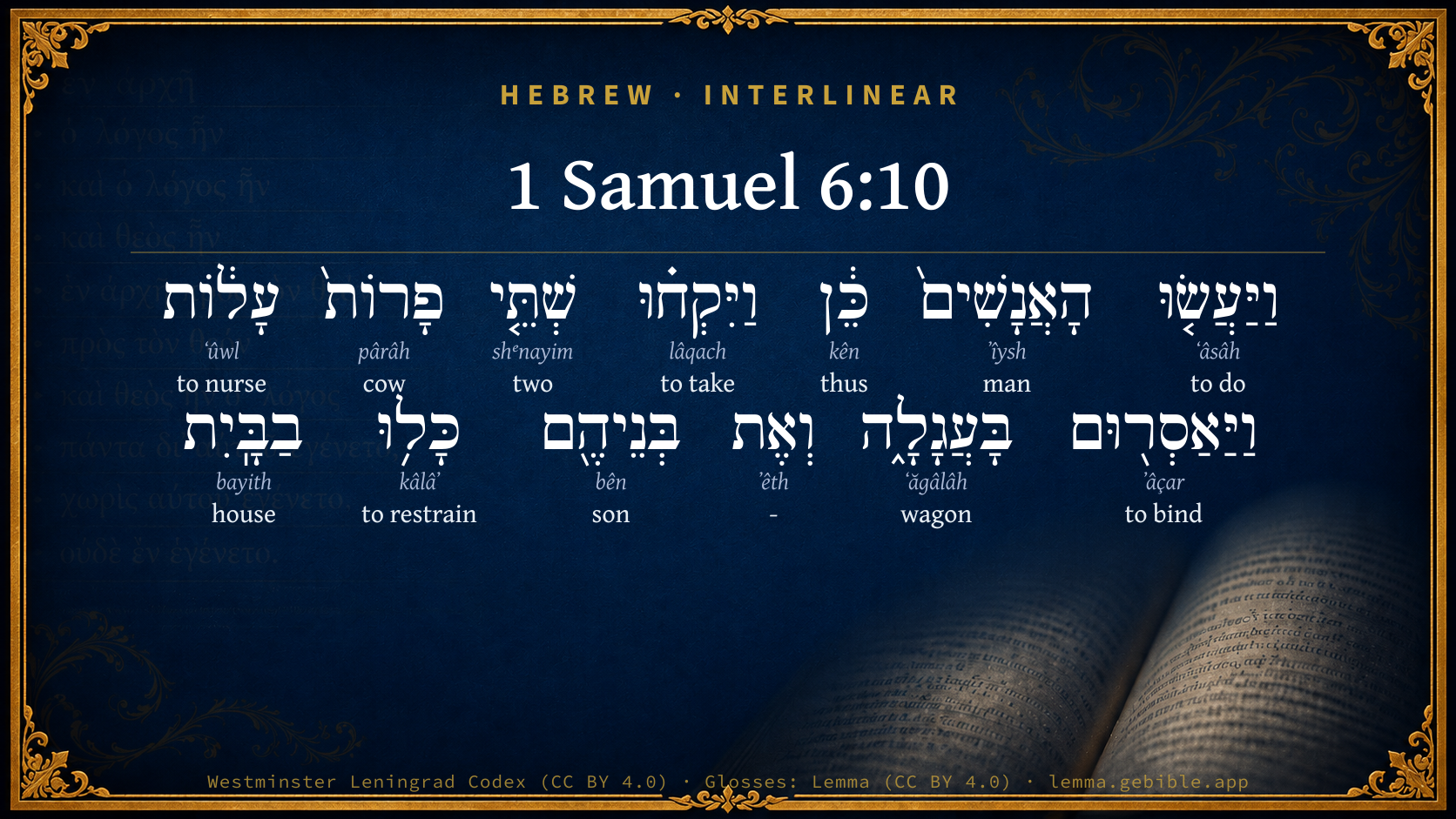
  1. וַיַּעֲשׂ֤וּ ʻâsâh H6213 “and · to do” Conjunction + Verb, Qal, Sequential Imperfect, 3rd Person, Masculine, Plural
  2. הָאֲנָשִׁים֙ ʼîysh H376 “the · men” Particle, Definite Article + Noun, Common, Masculine, Plural, Absolute
  3. כֵּ֔ן kên H3651 “thus” Particle, Demonstrative
  4. וַיִּקְח֗וּ lâqach H3947 “and · to take” Conjunction + Verb, Qal, Sequential Imperfect, 3rd Person, Masculine, Plural
  5. שְׁתֵּ֤י shᵉnayim H8147 “two” Adjective, Cardinal number, Feminine, Dual, Construct
  6. פָרוֹת֙ pârâh H6510 “cows” Noun, Common, Feminine, Plural, Absolute
  7. וַיַּאַסְר֖וּם ʼâçar H631 “and · to bind · them” Conjunction + Verb, Qal, Sequential Imperfect, 3rd Person, Masculine, Plural + Suffix, Personal, 3rd Person, Masculine, Plural
  8. בָּעֲגָלָ֑ה ʻăgâlâh H5699 “in/at the · wagon” Preposition, Determined + Noun, Common, Feminine, Singular, Absolute
  9. וְאֶת ʼêth H853 “and · -” Conjunction + Particle, Direct Object
  10. בְּנֵיהֶ֖ם bên H1121 “sons · their” Noun, Common, Masculine, Plural, Construct + Suffix, Personal, 3rd Person, Masculine, Plural
  11. כָּל֥וּ kâlâʼ H3607 “to restrain” Verb, Qal, Perfect, 3rd Person, Common, Plural
  12. בַבָּֽיִת bayith H1004 “in/at the · house” Preposition, Determined + Noun, Common, Masculine, Singular, Absolute

About this verse

These counts appear in no published source. They are computed here, from the morphology-tagged text and Lemma’s own curated glosses. What Lemma adds →

13
words
13
distinct lemmas
Historical
section

Notable vocabulary

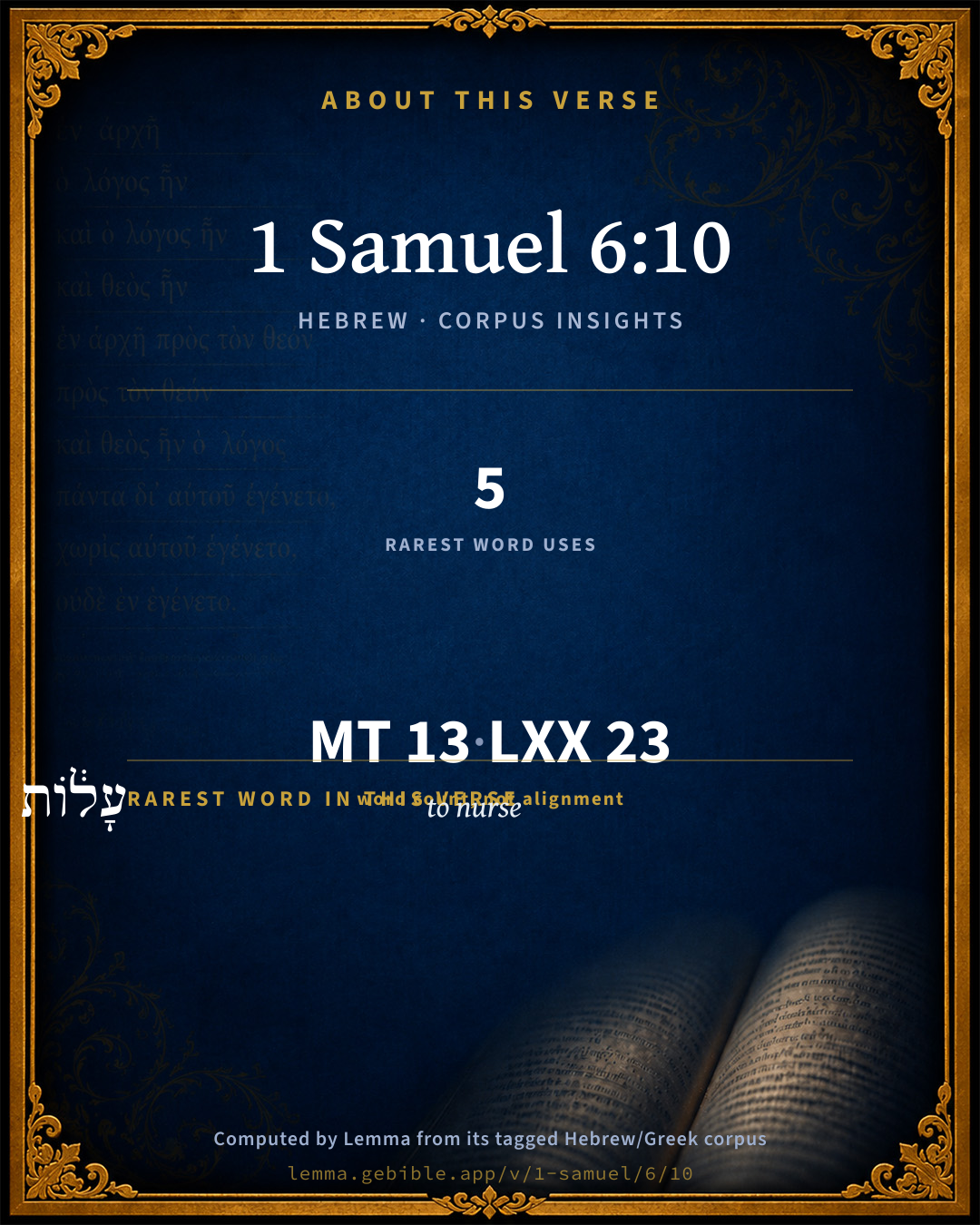
The rarest word here is עָל֔וֹת to nurse H5763 — appearing just 5 times in the whole Hebrew Bible.

Shared distinctive vocabulary

עָל֔וֹת to nurse H5763 occurs in 5 verses of the Hebrew Bible. Also found in:

Grammatical profile

  • 5 verbs
  • 5 nouns
  • 1 adjective
  • 2 particles

Verb forms

  • וַיַּעֲשׂ֤וּ Qal · Sequential Imperfect
  • וַיִּקְח֗וּ Qal · Sequential Imperfect
  • עָל֔וֹת Qal · Participle Active
  • וַיַּאַסְר֖וּם Qal · Sequential Imperfect
  • כָּל֥וּ Qal · Perfect

Hebrew & Septuagint length

In English translation the verse runs 22 words from the Hebrew and 30 from the Septuagint (LXX English) — closely comparable.

A rough comparison of the two English renderings, which tokenize alike — not a word-level alignment.

Word counts can differ between the Hebrew and the Greek without any difference in meaning — e.g. the Hebrew direct-object marker אֵת has no separate Greek word, and Greek often adds the article ὁ.

In the original languages it is 13 Hebrew tokens and 23 Greek tokens — but the two are counted differently (Hebrew bundles its prefixes and suffixes into one token; the Greek is in lemma form), so that isn’t a like-for-like length.

Hebrew and Greek witnesses Masoretic Hebrew ↔ Greek Septuagint

The same verse in the two great witnesses to the Old Testament, shown verse-for-verse.

These are two independent witnesses, not word-aligned to each other, and the Septuagint is shown in lemma (dictionary) form.

Hebrew 1 Samuel 6:10 Masoretic · Westminster Leningrad Codex

וַיַּעֲשׂ֤וּ הָאֲנָשִׁים֙ כֵּ֔ן וַיִּקְח֗וּ שְׁתֵּ֤י פָרוֹת֙ עָל֔וֹת וַיַּאַסְר֖וּם בָּעֲגָלָ֑ה וְאֶת בְּנֵיהֶ֖ם כָּל֥וּ בַבָּֽיִת

The men did so, and took two milk cattle, and tied them to the cart, and shut up their calves at home;

World English Bible · Public Domain

Greek LXX 1 Samuel 6:10 Septuagint · lemma form

καί ποιέω ὁ ἀλλόφυλος οὕτως καί λαμβάνω δύο βοῦς πρωτοτοκέω καί ζευγνύω αὐτός ἐν ὁ ἅμαξα καί ὁ τέκνον αὐτός ἀποκωλύω εἰς οἶκος

And the Philistines did so; and they took two cows that had calved for the first time, and yoked them to the wagon, and shut up their calves at home.

LXX2012 (modern English Septuagint) · Public Domain

Hebrew: Westminster Leningrad Codex (CC BY 4.0). Greek: Septuagint (public domain); English from LXX2012 (modern English Septuagint) (Public Domain). How the Septuagint differs from the Hebrew →

Targum (Aramaic paraphrase)

1

The Targum is the ancient Jewish Aramaic paraphrase of the Hebrew Scriptures — an interpretive translation, not the Hebrew text itself. Onkelos (literal) and Pseudo-Jonathan (expansive) render the Torah, and Jonathan the Prophets. Coverage is partial: where no permissively-licensed English translation exists for a verse, only the Aramaic is shown. This is verse-level text, not a word-by-word alignment to the Hebrew.

  1. Targum Jonathan Prophets (Joshua–Malachi)
    וַעֲבַדוּ גַבְרַיָא כֵּן וּנְסִיבוּ תַּרְתֵּין תּוֹרָן מְיַנְקָן וְאַסְרוּנוּן בַּעֲגָלָתָא וְיַת בְּנֵיהֶן כָּלוּ בְּבֵיתָא:

    (no public-domain English translation for this verse)

    Targum Jonathan — Aramaic: “Mikraot Gedolot” (public domain). English: “Sefaria Community Translation” (CC0 1.0 (public-domain dedication)); “London "Chaldee Paraphrase," 1871” (public domain). Text via Sefaria.

Commentary

Notes on 1 Samuel 6:10 from classic Christian and Jewish commentators (each source and its license shown beneath its notes). The classic Christian expositions comment on the surrounding passage and are grouped to its opening verse, so a note may address several verses; the Jewish commentaries on the Tanakh (Rashi and others) are per-verse, so they appear only where the commentator wrote on this verse.

Lemma curates 59 commentaries, every one of them public domain or Creative Commons licensed, each selected and text-cleaned for this edition rather than reprinted as found. About our sources →

Matthew Henry's Commentary

We are here told,

I. How the Philistines dismissed the ark, Sa1 6:10, Sa1 6:11. They were made as glad to part with it as ever they had been to take it. As God had fetched Israel out of the house of bondage, so now he fetched the ark out of its captivity, in such a manner as that Egypt was glad when they departed, Psa 105:38. 1. They received no money or price for the ransom of it, as they hoped to do, even beyond a king's ransom. Thus it is prophesied of Cyrus (Isa 45:13), He shall let go my captives, not for price nor reward. Nay, 2. They gave jewels of gold, as the Egyptians did to the Israelites, to be rid of it. Thus the ark that was carried into the land of the Philistines, a trophy of their victory, carried back with it trophies of its own, and lasting monuments of the disgrace of the Philistines. Note, God will be no loser in his glory, at last, by the successes of the church's enemies against his ark, but will get himself honour from those that seek to do dishonour to him.

II. How the kine brought it to the land of Israel, Sa1 6:12. They took the straight way to Beth-shemesh, the next city of the land of Israel, and a priests' city, and turned not aside. This was a wonderful instance of the power of God over the brute-creatures, and, all things considered, no less than a miracle, that cattle unaccustomed to the yoke should draw so even, so orderly, and still go forward, - that, without any driver, they should go from home, to which all tame creatures have a natural inclination, and from their own calves, to which they had a natural affection, - that, without any director, they should go the straight road to Beth-shemesh, a city eight or ten miles off, never miss the way, never turn aside into the fields to feed themselves, nor turn back home to feed their calves. They went on lowing for their young ones, by which it appeared that they had not forgotten them, but that nature was sensible of the grievance of going from them; the power of the God of nature therefore appeared so much the greater, in overruling one of the strongest instincts of nature. These two kine, says Dr. Lightfoot, knew their owner, their great owner (Isa 1:3), whom Hophni and Phinehas knew not, to which I may add they brought home the ark to shame the stupidity of Israel, that made no attempt to fetch it home. God's providence is conversant about the motions even of brute-creatures, and serves its own purposes by them. The lords of the Philistines, with a suitable retinue no doubt, went after them, wondering at the power of the God of Israel; and thus those who thought to triumph over the ark were made to go like menial servants after it.

III. How it was welcomed to the land of Israel: The men of Beth-shemesh were reaping their wheat-harvest, Sa1 6:13. They were going on with their worldly business, and were in no care about the ark, made no enquiries what had become of it; if they had, it is likely they might have had private intelligence beforehand of its coming, and might have gone to meet it, and conduct it into their own border. But they were as careless as the people that ceiled their own houses and let God's house lie waste. Note, God will in his own time effect the deliverance of his church, not only though it be fought against by its enemies, but though it be neglected by its friends. Some observe that the returning ark found the men of Beth-shemesh, not idling or sporting in the streets of the city, but busy, reaping their corn in their fields, and well employed. Thus the tidings of the birth of Christ were brought to the shepherds when they were keeping their flock by night. The devil visits idle men with his temptations. God visits industrious men with his favours. The same invisible hand that directed the kine to the land of Israel brought them into the field of Joshua, and in that field they stood, some think for the owner's sake, on whom, being a very good man, they suppose God designed to put this honour. I rather think it was for the sake of the great stone in that field, which was convenient to put the ark upon, and which is spoken of, v. 14, 15, 18. Now, 1. When the reapers saw the ark, they rejoiced (v. 13); their joy for that was greater than the joy of harvest, and therefore they left their work to bid it welcome. When the Lord turned again the captivity of his ark they were like men that dream; then was their mouth filled with laughter, Psa 126:1, Psa 126:2. Though they had not zeal and courage enough to attempt the rescue or ransom of it, yet, when it did come, they bade it heartily welcome. Note, The return of the ark, and the revival of holy ordinances, after days of restraint and trouble, cannot but be matter of great joy to every faithful Israelite. 3. They offered up the kine for a burnt-offering, to the honour of God, and made use of the wood of the cart for fuel, Sa1 6:14. Probably the Philistines intended these, when they sent them, to be a part of their trespass-offering, to make atonement, Sa1 6:3, Sa1 6:7. However, the men of Beth-shemesh looked upon it as proper to make this use of them, because it was by no means fit that ever they should be put to any other use; never shall that cart carry any common thing that has once carried that sacred symbol of the divine presence: and the kine had been under such an immediate guidance of heaven that God had, as it were, already laid claim to them; they were servants to him, and therefore must be sacrifices to him, and no doubt were accepted, though females, whereas, in strictness, every burnt-offering was to be a male. 3. They deposited the ark, with a chest of jewels that the Philistines presented, upon the great stone in the open field, a cold lodging for the ark of the Lord and a very mean one; yet better so than in Dagon's temple, or in the hands of the Philistines. It is desirable to see the ark in its habitation in all the circumstances of solemnity and splendour; but better have it upon a great stone, and in the fields of the wood, than be without it. The intrinsic grandeur of instituted ordinances ought not to be diminished in our eyes by the meanness and poverty of the place where they are administered. As the burning of the cart and cows that brought home the ark might be construed to signify their hopes that it should never be carried away again out of the land of Israel, so the setting of it upon a great stone might signify their hopes that it should be established again upon a firm foundation. The church is built upon a rock. 4. They offered the sacrifices of thanksgiving to God, some think upon the great stone, more probably upon an altar of earth made for the purpose, Sa1 6:15. And, the case being extraordinary, the law for offering at the altar in the court of the tabernacle was dispensed with, and the more easily because Shiloh was now dismantled; God himself had forsaken it, and the ark, which was its chief glory, they had with them here. Beth-shemesh, though it lay within the lot of the tribe of Dan, yet belonged to Judah, so that this accidental bringing of the ark hither was an indication of its designed settlement there, in process of time; for, when God refused the tabernacle of Joseph, he chose the tribe of Judah, Psa 78:67, Psa 78:68. It was one of those cities which were assigned out of the lot of Judah to the sons of Aaron, Jos 21:16. Whither should the ark go but to a priests' city? And it was well they had those of that sacred order ready (for though they are here called Levites, Sa1 6:15, yet it should seem they were priests) both to take down the ark and to offer the sacrifices. 5. The lords of the Philistines returned to Ekron, much affected, we may suppose, with what they had seen of the glory of God and the zeal of the Israelites, and yet not reclaimed from the worship of Dagon; for how seldom has a nation changed its gods, though they were no gods! Jer 2:11. Though they cannot but think the God of Israel glorious in holiness and fearful in praises, yet they are resolved they will think Baal-zebub, the god of Ekron, at least as good as he, and to him they will cleave because he is theirs. 6. Notice is taken of the continuance of the great stone in the same place; there it is unto this day (Sa1 6:18), because it remained a lasting memorial of this great event, and served to support the traditional history by which it was transmitted to posterity. The fathers would say to the children, "This is the stone upon which the ark of God was set when it came out of the Philistines' hands, a thing never to be forgotten."

Matthew Henry's Commentary on the Whole Bible (1708–1710) — public domain (CC PDM 1.0). Text via the HelloAO Bible API.

Trapp's Complete Commentary

John Trapp

1Sa 6:10 And the men did so; and took two milch kine, and tied them to the cart, and shut up their calves at home:

Ver. 10. And the men did so.] According to the advice of the priests and diviners, who were of no small authority amongst them: as likewise were the Brachmanni among the Indians, the Druids among the Gauls, and the Bards here in Albion: of such esteem they are said to have been among the greatest commanders, that if two armies were even at push of pike, and a bard or priest had stepped in between them, they would have held their hands, hearkened to his advice, and not have offered to strike till he were out of danger.

John Trapp, A Commentary or Exposition upon All the Books of the Old and New Testament (1647–1656) — public domain. Text from a community e-Sword module.

John Gill's Exposition

And the men did so,.... Made a new cart, not the lords of the Philistines, but workmen by their orders:

and took two milch kine, and tied them to the cart; with the gear that horses, asses, or oxen, were usually fastened to a carriage they drew:

and shut up their calves at home; or, "in the house" (s); the cow house or stable where they used to be put; this they did to restrain them from following the cows, which would disturb them in drawing the cart.

(s) "in domo", Pagninus, Montanus, &c.

John Gill's Exposition of the Whole Bible (1746–1763) — public domain (CC PDM 1.0). Text via the HelloAO Bible API.

The Pulpit Commentary

Vers. 10-15.

Restored blessings.

The facts are

1. The kine bearing the ark, contrary to their instincts, go away from theirhome to Beth-shemesh.

2. The men of Beth-shemesh, seeing the returning ark, leave their occupations, and express their joy in sacrificial worship.

3. The Levites, exceeding their privileges, open the ark and examine itssacred contents.

4. The representatives of the Philistines observe the issue of theirexperiment and return. The rapid succession of incidents connected with the restoration of the ark illustrates several important truths.

I The SUPREMACY OF GOD OVER HIS CREATURES. As a human device, the means for ascertaining the will of the God of Israel were excellent; and it is a mark of condescension that God should thus use imperfect men to effect his purpose. The men argued that he who commands disease and the ravages of vermin can, if disposed, effect his will through the agency of other creatures. God is not indisposed to exert his great power, should moral cause exist, even through the actions of men who act up to the measure of light attained to. The departure of the kine from their home and young to a strange land was a remarkable instance of the control of God over the strongest instincts. The seeming unnaturalness of the event is owing to our one-sided views of God"s purposes and methods. It was contrary to their nature, as ordinarily exercised, to go from home. It was not contrary to the nature of things for them to do the will of their Maker.

1. It is a reality in every case of animal life that God"s will is done. All creatures are "HIS." He formed their powers and gave them tendencies. Therefore every creature, in following its ordinary course, is actually carrying out a Divine intent. In this the kine were one with all cattle.

2. Animals exist not for themselves. The end of their existence is moral and spiritual. The fabric of the universe and the lower creatures are for the development of the spiritual and eternal. In the case of the kine a great spiritual end was subserved the restoration of the ark and consequent development of the "kingdom which cannot be moved." The original appointment of instinct and the specific control of it are acts identical in kind supernatural.

3. There are other instances of special control. Balaam"s ass was used to reprove the prophet. The lions were restrained from touching Daniel. In either case, as here, the event was connected with a manifest spiritual purpose; and who shall say that he who governs men and calms the sea shall not be free to control the movements of kine, as truly as when on his way to Jerusalem he guided the ass on which he sat?

1. It is a means of teaching important truth. This subordination of the most powerful impulses to the high purposes of God sets forth the truth that the most powerful natural attachments must yield to the requirements of the kingdom of God; as well perhaps as that, in coming years, the inferior creatures will subserve the advance of Christ"s kingdom as certainly as that they will share in its blessings. (Isa_11:6, Isa_11:7; Mat_13:32)

II The JOY OF RESTORED BLESSINGS. The men of Beth-shemesh were the first honoured with a sight of the ark, and with the instinct of the true Israelite they appreciated the boon.

1. The blessing now received was very great. The significance of the ark to Israel cannot be fully expressed. Its return from captivity meant to the people a reinstatement in the favour of God. Their cry of anguish and the intercession of Samuel had been heard. Likewise the Church, after seasons of chastisement and loss of privilege, knows the greatness of the boon when God makes "the place of his feet glorious," and comforts Zion with the light of his countenance.

1. The restoration was unexpected. Both as to the fact and the means there was no anticipation of what occurred. Men were called from common toils to share in a great spiritual joy. Thus does God in his mercy break in on the cares and sorrows of common life with blessings in excess of our hopes. Israel was not able to devise means of delivery from Egypt, and surprise filled their minds when they saw the salvation of God. Christ"s appearance after death even took away the power of utterance. (Luk_24:36-41)

2. "For a small moment have I forsaken thee, but with great mercies will I gather thee.

3. The expression of joy was natural. It was most proper for a nature toned by recent chastisement to rush from the occupations of life to bid welcome to the long wept for ark of God. The recovery of property, the return of a lost son, nothing, could stir such deep feelings as the sign of the restored favour of Jehovah. The sacrifice of the kine was a form of penitence, homage, and gratitude culminating in highest joy. There is no joy like that of God"s assured.presence and favour. It is a gladness beyond that of the time when corn and wine increase. "Then was our mouth filled with laughter, and our tongue with singing.

III UNLAWFUL CURIOSITY. A debased condition is not recovered from suddenly. Despite the repentance for past sin and gratitude for return of God"s favour, the low tone of life consequent on former practices remained. As a consequence of the singular combination of good and bad qualities at this hopeful turn in affairs, the joy of the day was marred by a wicked, profane curiosity. This was the more culpable because the inhabitants were chiefly Levites, who must have been acquainted with the very strict prohibition to manifest any rude curiosity in reference to the sacred symbols. (Exo_3:5 Exo_19:21; Num_4:20)

1. Curiosity, though useful in the acquisition of knowledge, is sometimes wicked.

(1) In human affairs, as when it consists in an idle intrusion into the secret business or sorrows of others, or endeavour to obtain information with malicious intent.

(2) In Divine things, as when it consists in a restless craving to know the secret purposes of God; or an endeavour to subject the Divine nature to the same kind of criticism and analysis as the work of his hand; or a fruitless endeavour to solve the mystery of his sovereignty in relation to the existence of evil; or a rude, irreverent attempt to penetrate into the great "mystery of godliness," the person of Christ.

2. The wickedness of such curiosity is evident., because of

(1) The relation of man to God. God is the infinite, eternal, holy One, of whom all that is is but the dim shadow. No ideas, no beings, not even the totality of the material and spiritual universe, are commensurate with him. On the other hand, man is only one among many creatures, limited in power, defective in nature, and incapable even of knowing the mysteries within his own breast. The moral evil in man unfits him for the vision of God even so far as that is possible to holy beings. The reverence due to God is due also in measure to man from man when justice and fellow feeling bar the way to secret things.

(2) The habit is destructive to all that is good. In no instance is evil better known by its fruits than in that of curiosity carried into Divine and human things. It is the ruin of reverence, which is the essence of worship, the guardian of all that is good in life, the crowning grace of conduct, and the spring of manifold virtues. It, when prevalent, renders man distrustful of his fellows, and loosens the bonds of home. No society can exist where all reverence is dead, and unbridled curiosity is its death.

IV AN IMPORTANT DISCOVERY. The five lords of the Philistines witnessed the restoration of the ark and the joy of the men of Bethshemesh, and they became wiser men. They carried back the information that Jehovah was indeed the Destroyer of Dagon, the Controller of disease, the Lord of the brute creation, and unchanged Friend of Israel. Thus in defeat there was a triumph. Thus have we an indication of what will yet be. The foes of the Church of Christ will learn that he does hold the mastery over all. Ebbs there may be in the prosperity of the Church, but the power will reassert itself, and men will marvel both at the means and the fact. A great discovery will be made to all creatures when, after the conflict of ages with the world power, the true Israel of God shall rejoice in the perfect and everlasting presence of their Lord.

HOMILIES BY B. DALE. Ver. 1Ti_1:14) The people of Israel do not appear to have made any effort for its restoration, but God remembered them, and for their sake constrained their enemies to send back the precious treasure. "That is free love which never has been desired, never has been deserved, and never can be requited.

2. Shown in an extraordinary manner. It was brought by creatures acting contrary to their natural instincts, under a Divine impulse, in a direct line to the nearest border city of Israel Beth-shemesh (the house of the sun); a sign to Israel as well as the heathen. "Two kine knew their owner as (Isa_1:3) Hophni and Phinehas knew him not" (Lightfoot). God"s favour often comes by the most unlikely agencies and means. His power is universal, and all things serve him.

3. Unexpected and surprising (ver. 13). It was the time of harvest, and the men of Beth-shemesh were pursuing their ordinary secular occupations, thinking nothing of the ark, when they suddenly lifted up their eyes and beheld it approaching. It was found by them like "the treasure hid in the field.

4. Distinguishing. Shown toward Beth-shemesh beyond other cities, and toward Joshua beyond any other man; for some reason, perchance, in the people as well as in the locality. The city we know was a priestly city. (Jos_21:10) "We shall probably be doing them no wrong if we suppose that they regarded its presence as an honour to themselves. It distinguished their township above all the cities of Israel.

II RECEIVED WITH GREAT JOY (vers. 13-18). We can imagine how promptly they put aside their harvest work and gathered with one accord around the sacred object. Their joy was the joy of

1. Gratitude for the favour shown toward them. (1Ki_8:62-66; Ezr_6:16, Ezr_6:17)

2. Devotion (vers. 14, 15). "They offered burnt offerings and sacrificed sacrifices (peace offerings) unto the Lord.

3. Hope; for in it they saw a proof of the power of God over the heathen, and a promise of their own freedom and prosperity.

4. And the day of their abounding joy was commemorated by means of the great stone on which the ark and the coffer containing the jewels of gold were set, "which remaineth unto this day.

III REGARDED WITH IRREVERENT CURIOSITY (vers. 19, 20).

1. Their conduct consisted of "looking into (or upon) the ark." Whether they actually pried into it is uncertain. Whatever may have been the precise nature of their conduct, the spirit in which they acted was their chief offence in the sight of him who "looketh at the heart." There may be much sin in a look.

2. Their sin was great; exhibiting want of reverence and godly fear, presumption, perhaps rationalism, recklessness, profanity. (Lev_10:3) A spirit of intelligent curiosity and inquiry is of unspeakable worth, being the principal means of discovering truth and promoting human progress; but it should be ever joined with humility and reverence, as it has been in the greatest minds. "Fools rush in where angels fear to tread." The fact that Beth-shemesh was a city of the priests would lead us to expect better things of its inhabitants. "It is not improbable that in their festive rejoicing they may have fallen into intemperance, and hence into presumptuous irreverence, as it is thought was the case with Nadab and Abihu" ("Sp. Com.").

3. Their punishment was severe; for "of fifty thousand men, seventy died a sudden death" (Hengstenberg; ver. 19). What is sent as a blessing is often turned by men themselves into a curse.

4. The effect was morally benefical on the people generally. "Who is able to stand before this holy Lord God?" etc. (ver. 20).

(1) A conviction of his transcendent and awful holiness. "Our God is a consuming fire". (Heb_12:29)

(2) A feeling of their own deep sinfulness, which the former never fails to produce. (Isa_6:5; Luk_5:8)

(3) A persuasion of the necessity of "righteousness and true holiness in those among whom he dwells; for their request to the inhabitants of Kirjath-jearim, "Come ye down, and fetch it up to you," was the expression of something more than selfish dread, (1Sa_5:7) being caused by the belief that it would be more worthily honoured by others than by themselves. The conduct of a single city sometimes reveals the moral condition of a whole nation. And Israel was evidently not prepared to receive openly and fully the sign of God"s presence among them, nor, until they should have passed through long and painful discipline, any further signal manifestation of his favour.

IV REINSTATED IN RESPECTFUL BUT IMPERFECT HONOUR (ver. 21; 1Sa_7:1) From Beth-shemesh it was taken (not to Shiloh, which had been rendered unworthy, and was now perhaps in ruins, but) to Kirjath-jearim (city of forests or woods, (Psa_132:6) where it was

1. Settled among a willing people, and in the house of a devout man Abinadab, "on the hill." "God will find out a resting-place for the ark." When one people prove themselves unworthy of it, and wish to part with it, he will provide another people of greater worth, and ready to welcome it. "It is no new thing for the ark to be in a private dwelling house.

2. Placed under special and proper guardianship. "Sanctified (consecrated) Eleazar his son to keep the ark from profane intrusion." Even in the most corrupt times there are individual instances of true piety. These are honoured of God, and for their sakes others are spared. (Isa_1:9)

1. Disassociated from the tabernacle and its services. After the capture of the ark the desecrated tabernacle appears to have been removed from Shiloh to Nob, where we find it long afterwards, (1Sa_21:6) attended by more than eighty priests, and subsequently to Gibeon (1Ki_3:4; 1Ch_16:39 1Ch_21:29; 2Ch_1:3, 2Ch_1:6, 2Ch_1:7) where it finally fell into decay and perished; the ark itself remained in Kirjath-jearim about seventy years, when it was removed to the house of Obed-edom, (2Sa_6:3, 2Sa_6:11. Gibeah = the hill) and shortly afterwards to Jerusalem, where it abode "in curtains" until deposited in the temple of Solomon. The separation was anomalous, preventive of the full observance of the prescribed order of Levitical services, and indicative of

2. the imperfect moral relations which subsisted between the people of Israel and their Divine King.

3. Long disregarded by the nation. No public assemblies appear to have met at the place where it stood; no sacrifices to have been offered there, no festivities held, as previously at Shiloh. It is not even mentioned again until the time of David, when it was said, "We inquired not at (or for) the ark in the days of Saul". (1Ch_13:3) Its neglect was permitted because its proper use was impossible until a thorough internal reformation and more complete union of the nation should be effected. "It was made evident that the nation was not yet worthy to receive the perfect fulfilment of the promise, "I will dwell in your midst." They endeavoured to dispose of the ark in the best possible way. It was buried, as it were, in Kirjathjearim until the time when God would bring about its joyful resurrection" (Hengstenberg). D.

The Pulpit Commentary (1880–1919), ed. H.D.M. Spence-Jones & Joseph S. Exell — public domain. Text from a community e-Sword module.

Keil & Delitzsch

C. F. Keil & F. Delitzsch

The God of Israel actually did what the idolatrous priests hardly considered possible. When the Philistines, in accordance with the advice given them by their priests, had placed the ark of the covenant and the expiatory gifts upon the cart to which the two cows were harnessed, "the cows went straight forward on the way to Bethshemesh; they went along a road going and lowing (i.e., lowing the whole time), and turned not to the right or to the left; and the princes of the Philistines went behind them to the territory of Bethshemesh." בּדּרך ישּׁרנה, lit., "they were straight in the way," i.e., they went straight along the road. The form ישּׁרנה for יישׁרנה is the imperf. Kal, third pers. plur. fem., with the preformative י instead of ת, as in Gen 30:38 (see Ges. 47, Anm. 3; Ewald, 191, b.). Bethshemesh, the present Ain-shems, was a priests' city on the border of Judah and Dan (see at Jos 15:10).

Keil & Delitzsch — Biblical Commentary on the Old Testament (1861–1891) — public domain (CC PDM 1.0). Text via the HelloAO Bible API. (Old Testament only.)

unfoldingWord translationNotes

Door43 World Missions Community

two nursing cows

"two cows that have calves that are still drinking milk" See how you translated this in 1 Samuel 6:7.

mice

Translated this as in 1 Samuel 6:4.

castings of their tumors

"models of their tumors"

tumors

Possible meanings are 1) painful swelling under the skin or 2) hemorrhoids. See how you translated this in 1 Samuel 5:6.

The cows went straight in the direction of Beth Shemesh

Nursing cows would normally return to their calves, but these cows went to Beth Shemesh.

lowing as they went

Lowing is the noise cows make with their voices.

they did not turn aside either to the right or to the left

"they did not wander off of the highway." This can be stated positively. AT: "they stayed on the highway" or "they went straight ahead"

translationWords

turn

unfoldingWord translationNotes — © Distant Shores Media and the Door43 World Missions Community, licensed CC BY-SA 4.0. Source: git.door43.org/Door43/en_tn.

Rashi

Rabbi Shlomo Yitzchaki (Rashi)

Confined in the house. 'כָּלוּ' is an expression of 'כֶּלֶא' [imprisonment].

Rashi on the Tanakh — English translations: “The Judaica Press complete Tanach with Rashi, translated by A. J. Rosenberg” (CC BY 4.0); “Pentateuch with Rashi's commentary by M. Rosenbaum and A.M. Silbermann, 1929-1934” (public domain); “The Metsudah Tanach series, Lakewood, N.J” (CC BY 4.0); and “The Book of Joshua, Metsudah Publications, 1997” (CC BY 4.0). Text via Sefaria.

Lesson kit

Teaching starters — assembled from the data on this page, not authored interpretation. Every prompt links to the verse data it draws on. Edit before teaching.

1 Samuel, in the Historical, opens this verse with 13 words (13 distinct Hebrew lemmas). Its most distinctive word is ʻûwl (“to nurse”). A historical commentator’s framing appears above. Read the whole chapter for the surrounding context.

Discussion questions

  1. What does “to nurse” (ʻûwl) contribute to the verse as a whole?
  2. How does Genesis 33:13, which shares the word «to nurse», read alongside this verse?
  3. These translations render this verse differently; the difference is in the English rendering, not the original. What questions does that raise?
  4. «וַיַּעֲשׂ֤וּ» is a Qal Sequential Imperfect verb. How does that grammatical form shape the action described?
  5. Compare how Matthew Henry's Commentary and Trapp's Complete Commentary read this verse. Where do they agree or differ?

Things to notice

Reading settings

Reading text

Shown beneath each verse's original-language words.

Old Testament
Old Testament edition

Read the OT as the Masoretic Hebrew (MT) or the Greek Septuagint (LXX).

English shown for the Greek Septuagint (in the Hebrew ↔ Greek comparison).

Comparing translations? Open the Compare panel on any verse page to stack up to four side by side.