
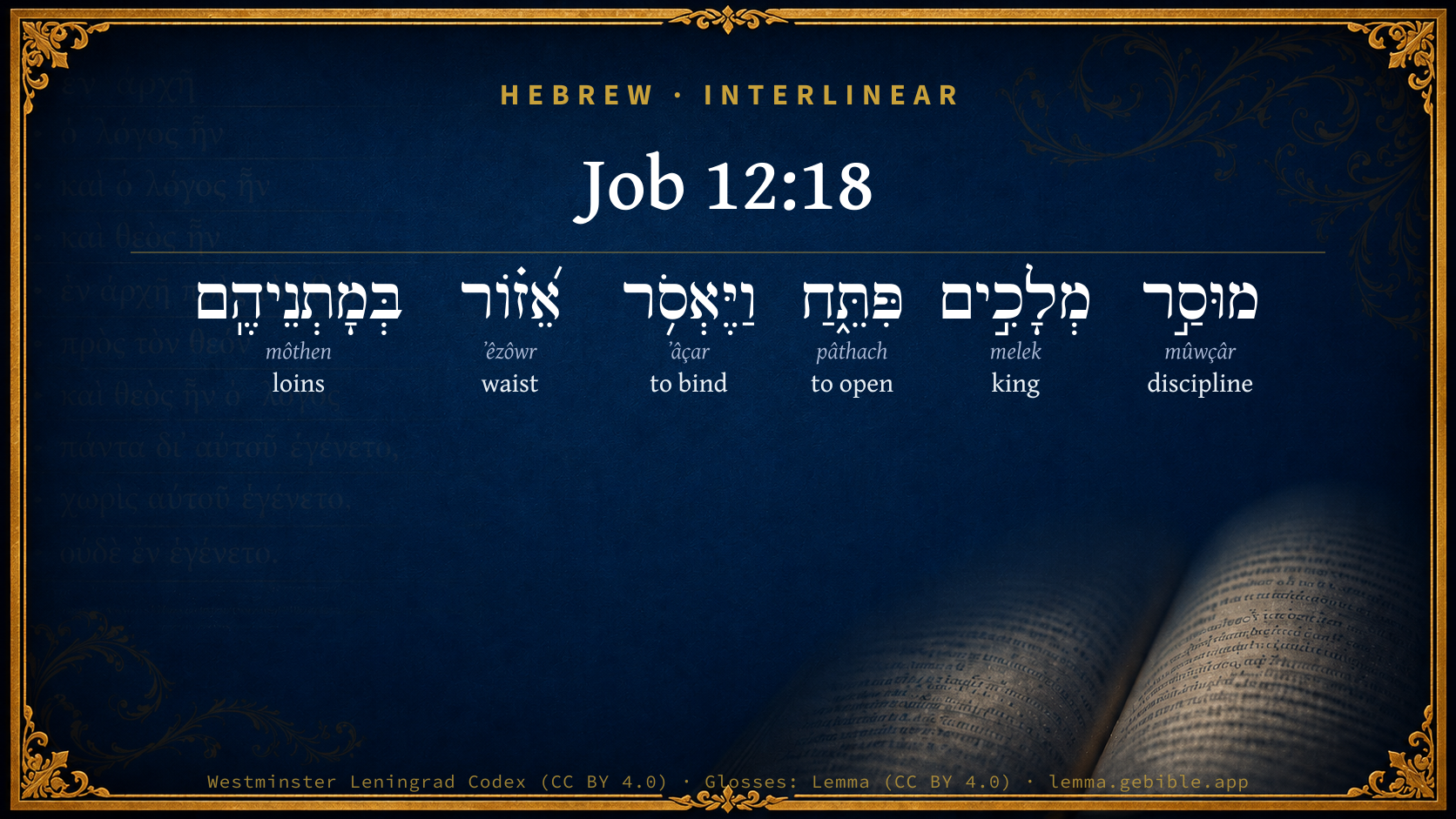
Job 12:18

Hebrew (Westminster Leningrad Codex) Job 12:18 appears in the Hebrew Old Testament. The text above is from the Westminster Leningrad Codex. Each word links to its Strong’s number, a concise gloss, and parsing drawn from the Open Scriptures Hebrew Bible morphology. Click any word for its full Brown-Driver-Briggs (BDB) entry.
Download image
Cite this verse

Job 12:18 (World English Bible). Public Domain. Lemma interlinear Bible study tool, https://lemma.gebible.app/v/job/12/18.

Show BibTeX & RIS
BibTeX
RIS
English Translation
He loosens the bond of kings, He binds their loins with a belt.
World English Bible · Public Domain
Download a study sheet

One document with this verse’s original text, its word-by-word gloss line, the meaning frame, cross-references with their text, attributed commentary, and full source and license credits — printable, and it pastes into notes with its structure intact.

This verse Autodidact and up

Study sheet (.html) Plain text (.txt)

A passage Seminary Student

Up to 50 verses in one chapter. A passage sheet keeps up to 6 commentary sources and 12 cross-references per verse, in the order this page ranks them, and says so on the sheet whenever that leaves anything out. Ask for a single verse and you get the Autodidact verse sheet above.

Everything on this page stays free to read, with no account — the sheet is a download of what is already on screen, not access to it.

Want to remove ads? Support Godless Engineer
Compare translations 3

The same verse in 3 English versions, stacked beneath the original-language interlinear above. Click any original word for its lexicon entry.

Each is an independent rendering of the whole verse — the interlinear is not word-aligned to these translations.

Highlighted words mark where these versions differ — a whole-verse word diff, not a word-by-word alignment.

  • World English Bible Public Domain
    He loosens the bond of kings, He binds their loins with a belt.
  • King James Version Public Domain
    He looseth the bond of kings, and girdeth their loins with a girdle.
  • unfoldingWord Literal Text CC BY-SA 4.0
    He removes the bond of kings and he wraps a cloth around their loins,

unfoldingWord Literal Text — © unfoldingWord, licensed CC BY-SA 4.0. Word-aligned USFM3 via Door43 (git.door43.org/unfoldingWord/en_ult).

Versions to compare (up to 4)

3 of 4 selected

Show all 18 translations

Every available English version of this verse, each an independent rendering of the whole verse.

  • World English Bible Public Domain
    He loosens the bond of kings, He binds their loins with a belt.
  • Berean Standard Bible Public Domain
    He loosens the bonds placed by kings and fastens a belt around their waists.
  • Majority Standard Bible Public Domain
    He loosens the bonds placed by kings and fastens a belt around their waists.
  • King James Version Public Domain
    He looseth the bond of kings, and girdeth their loins with a girdle.
  • American Standard Version (1901) Public Domain
    He looseth the bond of kings, And he bindeth their loins with a girdle.
  • Revised Version (1885) Public Domain
    He looseth the bond of kings, and bindeth their loins with a girdle.
  • Geneva Bible (1599) Public Domain
    He looseth the collar of Kings, and girdeth their loynes with a girdle.
  • Douay-Rheims (1899) Public Domain
    He looseth the belt of kings, and girdeth their loins with a cord.
  • Young's Literal Translation Public Domain
    The bands of kings He hath opened, And He bindeth a girdle on their loins.
  • Literal Standard Version CC BY-SA 4.0
    He has opened the bands of kings, || And He binds a girdle on their loins.
  • Unlocked Literal Bible CC BY-SA 4.0
    He takes off the chain of authority from kings; he wraps a cloth about their waists.
  • unfoldingWord Literal Text CC BY-SA 4.0
    He removes the bond of kings and he wraps a cloth around their loins,
  • Darby Bible Public Domain
    He weakeneth the government of kings, and bindeth their loins with a fetter;
  • World Messianic Bible Public Domain
    He loosens the bond of kings. He binds their waist with a belt.
  • Webster's Bible Public Domain
    He looseth the bond of kings, and girdeth their loins with a girdle.
  • Free Bible Version CC BY-SA 4.0
    He removes the chains of office from kings and makes them wear loincloths.
  • Bible in Basic English Public Domain
    He undoes the chains of kings, and puts his band on them;
  • JPS Tanakh (1917) Public Domain
    He looseth the bond of kings, and bindeth their loins with a girdle.

Literal Standard Version (2020), Covenant Press — licensed CC BY-SA 4.0. Text via the HelloAO Bible API (eBible.org). Unlocked Literal Bible (unfoldingWord) — licensed CC BY-SA 4.0. Text via the HelloAO Bible API (eBible.org). unfoldingWord Literal Text — © unfoldingWord, licensed CC BY-SA 4.0. Word-aligned USFM3 via Door43 (git.door43.org/unfoldingWord/en_ult). Free Bible Version, Dr. Jonathan Gallagher — licensed CC BY-SA 4.0. Text via the HelloAO Bible API (eBible.org).

Word by word

More ways to search: Search by grammar → Find every occurrence → Compare this word →

Practice this passage: Drill this verse → Learn its vocabulary →

About this verse

These counts appear in no published source. They are computed here, from the morphology-tagged text and Lemma’s own curated glosses. What Lemma adds →

6
words
6
distinct lemmas
Wisdom
section

Notable vocabulary

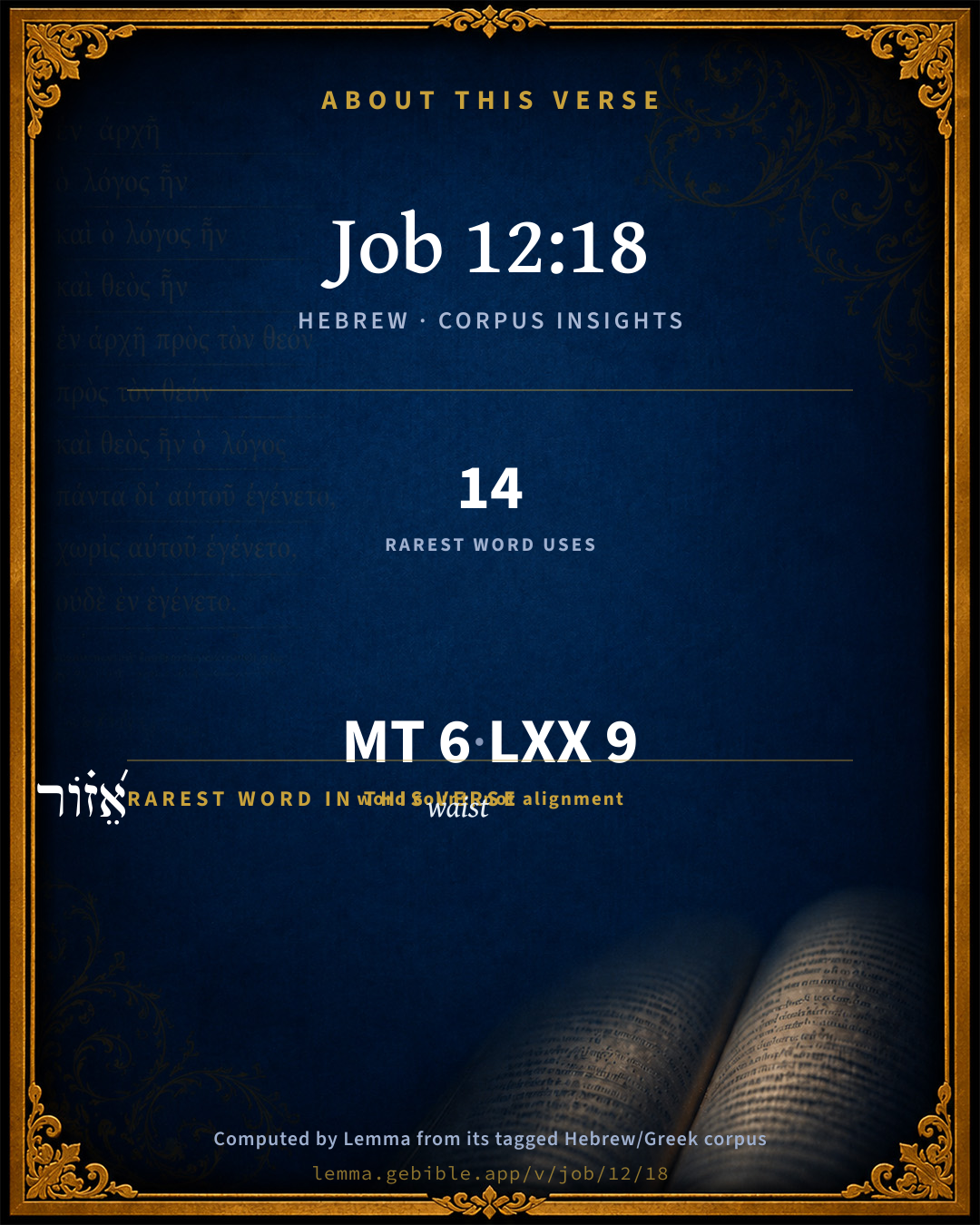
The rarest word here is אֵ֝ז֗וֹר waist H232 — appearing just 14 times in the whole Hebrew Bible.

Shared distinctive vocabulary

אֵ֝ז֗וֹר waist H232 occurs in 12 verses of the Hebrew Bible. Also found in:

Grammatical profile

  • 2 verbs
  • 4 nouns

Verb forms

  • פִּתֵּ֑חַ Piel · Perfect
  • וַיֶּאְסֹ֥ר Qal · Sequential Imperfect

Hebrew & Septuagint length

In English translation the verse runs 13 words from the Hebrew and 12 from the Septuagint (LXX English) — closely comparable.

A rough comparison of the two English renderings, which tokenize alike — not a word-level alignment.

Word counts can differ between the Hebrew and the Greek without any difference in meaning — e.g. the Hebrew direct-object marker אֵת has no separate Greek word, and Greek often adds the article ὁ.

In the original languages it is 6 Hebrew tokens and 9 Greek tokens — but the two are counted differently (Hebrew bundles its prefixes and suffixes into one token; the Greek is in lemma form), so that isn’t a like-for-like length.

Cross-references

5

Topical passages linked to Job 12:18 in the Treasury of Scripture Knowledge — connected by theme and wording, ordered by reader-vote popularity; previews shown in the World English Bible.

  • Daniel 2:21 He changes the times and the seasons; he removes kings, and sets up kings; he gives wisdom to the wise, and knowledge to those who have understanding;
  • Psalms 116:16 Yahweh, truly I am your servant. I am your servant, the son of your handmaid. You have freed me from my chains.
  • 2 Chronicles 33:11–14 Therefore Yahweh brought on them the captains of the host of the king of Assyria, who took Manasseh in chains, and bound him with fetters, and carried him to Babylon.
  • Jeremiah 52:31–34 It happened in the seven and thirtieth year of the captivity of Jehoiachin king of Judah, in the twelfth month, in the five and twentieth day of the month, that Evilmerodach king of Babylon, in the [first] year of his reign, lifted up the head of Jehoiachin king of Judah, and brought him forth out of prison;
  • Revelation 19:16 He has on his garment and on his thigh a name written, "KING OF KINGS, AND LORD OF LORDS."

Cross-references courtesy of OpenBible.info (CC BY 4.0).

Hebrew and Greek witnesses Masoretic Hebrew ↔ Greek Septuagint

The same verse in the two great witnesses to the Old Testament, shown verse-for-verse.

These are two independent witnesses, not word-aligned to each other, and the Septuagint is shown in lemma (dictionary) form.

Hebrew Job 12:18 Masoretic · Westminster Leningrad Codex

מוּסַ֣ר מְלָכִ֣ים פִּתֵּ֑חַ וַיֶּאְסֹ֥ר אֵ֝ז֗וֹר בְּמָתְנֵיהֶֽם

He loosens the bond of kings, He binds their loins with a belt.

World English Bible · Public Domain

Greek LXX Job 12:18 Septuagint · lemma form

καθιζάνω βασιλεύς ἐπί θρόνος καί περιδέω ζωνή ὀσφύς αὐτός

He seats kings upon thrones, and girds their loins with a girdle.

LXX2012 (modern English Septuagint) · Public Domain

On this verse, John Gill's Exposition discusses the Septuagint’s reading. Read the note in Commentary ↓

Hebrew: Westminster Leningrad Codex (CC BY 4.0). Greek: Septuagint (public domain); English from LXX2012 (modern English Septuagint) (Public Domain). How the Septuagint differs from the Hebrew →

Commentary

Notes on Job 12:18 from classic Christian and Jewish commentators (each source and its license shown beneath its notes). The classic Christian expositions comment on the surrounding passage and are grouped to its opening verse, so a note may address several verses; the Jewish commentaries on the Tanakh (Rashi and others) are per-verse, so they appear only where the commentator wrote on this verse.

Lemma curates 59 commentaries, every one of them public domain or Creative Commons licensed, each selected and text-cleaned for this edition rather than reprinted as found. About our sources →

Trapp's Complete Commentary

John Trapp

Job 12:18 He looseth the bond of kings, and girdeth their loins with a girdle.

Ver. 18. He looseth the bonds of kings] He degradeth them, taking away all command and authority from them, which is the bond that bindeth the people to obedience and subjection, Job 30:11 Isa 45:1; Isa 45:5; as our Henry III, who was called Regni dilapidator, unloved by his people, and far a less king, saith Daniel, by striving to be more than he was; the just reward of violations.

And girdeth their loins with a girdle] With a rope, say the Vulgate; he brings them from the throne to the prison (Val. Max. Christ.); he layeth affliction upon their loins, as Psa 66:11. An instance hereof (beside the late king, and Corradinus, king of Germany, likewise beheaded at Naples) we had here in Richard II, brought forth in a royal robe to be deposed, and then hunger starved in prison; as also in Henry VI, who having been the most potent monarch for dominions that ever England had, was afterwards (when deposed) not the master of a mole hill, nor owner of his own liberty, but baffled and beaten by every base fellow. Some interpreters make the sense this way: God sometimes looseth the bonds into which princes are brought, and advanceth them again to kingly dignity, the ensign whereof was of old a precious girdle. So it befell Manasseh, Nebuchadnezzar, Jehoiakim, restored and honoured again as a king, by Evilmerodaeh, 2Ki 25:28. Historians write, that Nebuchadnezzar was so offended with his son and successor, Evilmerodach, as he cast him into prison, and that in prison he and Jehoiakim became acquainted together, which resulted in his advancement afterwards.

John Trapp, A Commentary or Exposition upon All the Books of the Old and New Testament (1647–1656) — public domain. Text from a community e-Sword module.

Joseph Benson's Commentary

Job 12:18. He looseth the bond of kings — He takes from them the power and authority wherewith they ruled their subjects; ruled them with rigour, perhaps tyrannised over and enslaved them: and he divests them of that majesty which he had stamped upon them, and by which they kept their people in awe. These God can, and often does, take away from them, and thereby free the people from their bonds, of which we have abundance of instances in the history of different nations; and girdeth their loins with a girdle — He reduces them to a mean and servile condition; which is thus expressed, because servants used to gird up their garments, (which, after the manner of those parts of the world, were loose and long,) that they might be fitter for attendance upon their masters: he not only deposes them from their thrones, but brings them into slavery.

Joseph Benson's Commentary on the Old and New Testaments (1811–1818) — public domain. Text from a community e-Sword module.

Tyndale Open Study Notes

Tyndale Open Resources

12:18 When God removes the royal robe of kings, he takes away the symbols of their authority (cp. 19:9). It could also be translated as “God loosens the bonds of kings,” referring to the bondage they have imposed on others.

Tyndale Open Study Notes — © Tyndale Open Resources, licensed CC BY-SA 4.0. Text via the HelloAO Bible API.

Geneva Bible (1599)

Geneva Bible translators

He abateth the honor of princes, and bringeth them into the subjection of others.

He taketh wisdom from them.

Geneva Bible (1599) marginal notes — public domain. Text via Bolls.life.

Jamieson, Fausset & Brown

Robert Jamieson, A. R. Fausset & David Brown

He looseth the bond of kings--He looseth the authority of kings--the "bond" with which they bind their subjects (Isa 45:1; Gen 14:4; Dan 2:21).

a girdle--the cord, with which they are bound as captives, instead of the royal "girdle" they once wore (Isa 22:21), and the bond they once bound others with. So "gird"--put on one the bonds of a prisoner instead of the ordinary girdle (Joh 21:18).

Jamieson, Fausset & Brown — Commentary Critical and Explanatory on the Whole Bible (1871) — public domain (CC PDM 1.0). Text via the HelloAO Bible API.

Adam Clarke's Commentary

Verse 18. He looseth the bond of kings] He takes away their splendid robes, and clothes them with sackcloth; or, he dissolves their authority, permits their subjects to rebel and overthrow the state, to bind them as captives, and despoil them of all power, authority, and liberty. Many proofs of this occur in the Israelitish history and in the history of the principal nations of the earth, and not a few in the history of Britain.

Adam Clarke's Commentary on the Bible (1810–1826) — public domain. Text from a community e-Sword/MySword module.

Ellicott's Commentary for English Readers

(18) He looseth the bond of kings.—He looseth the confederacy of kings, by which they bind themselves together, and girdeth them to fight against each other. Some understand it of the girdle of servitude in contrast to the girdle of state.

A Bible Commentary for English Readers, edited by Charles John Ellicott (1878–1897) — public domain. Text from a community e-Sword module.

The Cambridge Bible for Schools and Colleges

gen. ed. J. J. S. Perowne

18. he looseth the bond of kings] The verse probably means, he relaxes, removes the authority of kings, destroys their bond or power over men; and as a consequence their own loins are girt with a girdle, i. e. either the common girdle of the labourer, or the cord of the captive.

The Cambridge Bible for Schools and Colleges (gen. ed. J. J. S. Perowne; Cambridge University Press, 1878–1918) — public domain. Text from a community e-Sword module.

John Gill's Exposition

He leadeth princes away spoiled,.... Of their principalities and dominions, of their wealth and riches, and of their honour and glory; or "priests" (u), as some choose to render the word, against whom God has indignation for their sins, and leads them into captivity with others; so the Septuagint version, "he leads the priests captives"; for no office, ever so sacred, can protect wicked men, see Lam 2:6; and from these sometimes the law perishes, and they are spoiled of their wisdom and knowledge, and made unfit to instruct the people, and so of their credit and reputation among them. Sephorno interprets it of the priests spoiled of their prophesying, they prophesying false things to kings:

and overthroweth the mighty; the mighty angels from heaven when they sinned, and mighty men on earth, kings and princes, whom he puts down from their seats of majesty and grandeur. Sephorno interprets this of kings, whose ways are perverted, by being led by false prophets, as Ahab was. Some (w) understand this of ecclesiastical men, mighty in word and doctrine, well grounded in theology, yet their wisdom being taken away from them, they turn aside into wicked paths, practices, and principles, and fall from their steadfastness in truth and holiness.

(u) "sacerdotes", V. L. Montanus, Tigurine version, Bolducius, Cocceius, Schmidt, Schultens. (w) Schmidt, Michaelis, Schultens.

John Gill's Exposition of the Whole Bible (1746–1763) — public domain (CC PDM 1.0). Text via the HelloAO Bible API.

Albert Barnes' Notes on the Bible

He looseth the bond of kings - The bond of kings (מוּסר mûsâr) here means that by which they bind others. Their power over others he loosens or takes away.

And girdeth their loins with a girdle - That is, he girds them with a rope or cord, and leads them away as prisoners. The whole series of remarks here refers to the reverses and changes in the conditions of life. The meaning here is, that the bonds of authority which they imposed on others are unbound, and that their own loins are bound with a girdle, not a girdle of royal dignity and ornament, but such a one as they are bound with who are servants, or who travel. “Pict. Bib.”

Albert Barnes' Notes on the Bible (1834–1885) — public domain. Text from a community e-Sword/MySword module.

Haydock's Catholic Bible Commentary

Looseth. Septuagint, "setteth kings upon the throne," &c. --- Belt. This was usually very magnificent, and a military ornament. See that of Pallas described. (Virgil, Æneid x.) Job intimates that God derives kings of their authority, at pleasure. Hebrew may also signify that he looseth the bond or prisoner of kings, and reduces themselves to slavery. (Calmet) --- Things never remain long in the same state. (Haydock) --- Even kings are sometimes obliged to beg. (Menochius)

George Leo Haydock (1774–1849), Haydock's Catholic Family Bible and Commentary, 1859 edition — public domain. Excludes Psalms (Douay-Rheims chapter numbering differs from Protestant) and Deuterocanonical books (Catholic canon only).

Matthew Poole's English Annotations

He looseth the bond of kings; either,

1. Passively, whereby they are bound. He freeth them from prison or restraint. Or rather,

2. Actively, that wherewith they bind their subjects to obedience, to wit, their power and authority, and that majesty which God stamps upon kings to keep their people in awe; all which God can, and oft doth, take away from them, and freeth the people from their bonds, when it pleaseth him; of which all histories give instances. See Dan 2:21.

With a girdle; either,

1. With a girdle of dignity and glory, which was put upon the loins of men in great honour and authority, as Isa 11:5; 22:21; Jer 13:1,2. So this member of the verse is opposite to the; former, and the sense of the whole is, he either casteth down kings or raiseth them up, as he pleaseth. But the Scripture no where mentions this girdle as one of the ornaments of kings. Or rather,

2. With a servile girdle; for seeing all, both the foregoing and succeeding passages, do evidently note acts of judgment or punishments inflicted upon them, it seems improper to understand this alone of an act of God’s favour to them. So the sense is, he reduceth them into a mean and servile condition; which is thus expressed, because servants did use to gird up their garments, (which after the manner of those parts and time were loose and long,) that they might be fitter for attendance upon their masters; of which see Luk 12:37; 17:8. And so this is an amplification of the former sentence. He not only deposeth them from their thrones, but brings them into bondage and slavery.

Matthew Poole's English Annotations on the Holy Bible (1683–1685) — public domain. Text from a community e-Sword/MySword module.

Whedon's Commentary on the Bible

Daniel D. Whedon

18. Bond of kings — The bond or fetter with which they bound their subjects.

Girdeth their loins — Literally, Binds a (girdle) fetter upon their loins. An instance of like retribution. The tyrannical binder of his subjects is himself bound with a captive’s cord. History is full of instances of such sad vicissitudes of fate. With no class of society has fortune been a more “fickle goddess” (so called) than with monarchs. The wreck of thrones, on the other hand, is an unceasing proclamation that “God reigns.” Lucretius (12:1232) had remarked the instability of all human glory, but failed to perceive in its oft-repeated overthrow the providence and power of God: —

So from his awful shades, some POWER UNSEEN

O’erthrows all human greatness! treads to dust

Rods, ensigns, crowns — the proudest pomps of state,

And laughs at all the mockery of man.

Daniel D. Whedon (gen. ed.), Commentary on the Old and New Testaments (1874–1909) — public domain. Text from a community e-Sword module.

The Pulpit Commentary

He looseth the bond of kings, and girdeth their loins with a girdle. This may either mean that God at his pleasure both looses kings from captivity, and also binds them with a cord and causes them to be carried away captive; or that he looses the authority which kings have over their subjects, and then lets them be carried away captive by their enemies. The latter is perhaps the more probable sense.

The Pulpit Commentary (1880–1919), ed. H.D.M. Spence-Jones & Joseph S. Exell — public domain. Text from a community e-Sword module.

John Wesley's Explanatory Notes

Looseth - He freeth them from that wherewith they bind their subjects to obedience, their power and authority, and that majesty which God stamps upon kings, to keep their people in awe. Girdeth - He reduces them to a mean and servile condition; which is thus expressed, because servants did use to gird up their garments (that after the manner of those parts were loose and long) that they might be fitter for attendance upon their masters: he not only deposes them from their thrones, but brings them into slavery.

John Wesley, Explanatory Notes Upon the Whole Bible (1754–1765) — public domain. Text via the GEBible commentary corpus.

Rashi

Rabbi Shlomo Yitzchaki (Rashi)

He loosens the bond of kings He removed the bond of the yoke from Nebuchadnezzar and dethroned him.

and He binds a girdle to their loins At his start, when He desired him, He girded his loins, and imbued him with strength for kingship.

Rashi on the Tanakh — English translations: “The Judaica Press complete Tanach with Rashi, translated by A. J. Rosenberg” (CC BY 4.0); “Pentateuch with Rashi's commentary by M. Rosenbaum and A.M. Silbermann, 1929-1934” (public domain); “The Metsudah Tanach series, Lakewood, N.J” (CC BY 4.0); and “The Book of Joshua, Metsudah Publications, 1997” (CC BY 4.0). Text via Sefaria.

Lesson kit

Teaching starters — assembled from the data on this page, not authored interpretation. Every prompt links to the verse data it draws on. Edit before teaching.

Job, in the Wisdom, opens this verse with 6 words (6 distinct Hebrew lemmas). Its most distinctive word is ʼêzôwr (“waist”). A historical commentator’s framing appears above. Read the whole chapter for the surrounding context.

Discussion questions

  1. What does “waist” (ʼêzôwr) contribute to the verse as a whole?
  2. How does 2 Kings 1:8, which shares the word «waist», read alongside this verse?
  3. These translations render this verse differently; the difference is in the English rendering, not the original. What questions does that raise?
  4. «פִּתֵּ֑חַ» is a Piel Perfect verb. How does that grammatical form shape the action described?
  5. Compare how Trapp's Complete Commentary and Joseph Benson's Commentary read this verse. Where do they agree or differ?

Things to notice

Reading settings

Reading text

Shown beneath each verse's original-language words.

Old Testament
Old Testament edition

Read the OT as the Masoretic Hebrew (MT) or the Greek Septuagint (LXX).

English shown for the Greek Septuagint (in the Hebrew ↔ Greek comparison).

Comparing translations? Open the Compare panel on any verse page to stack up to four side by side.