Song of Solomon 7:5

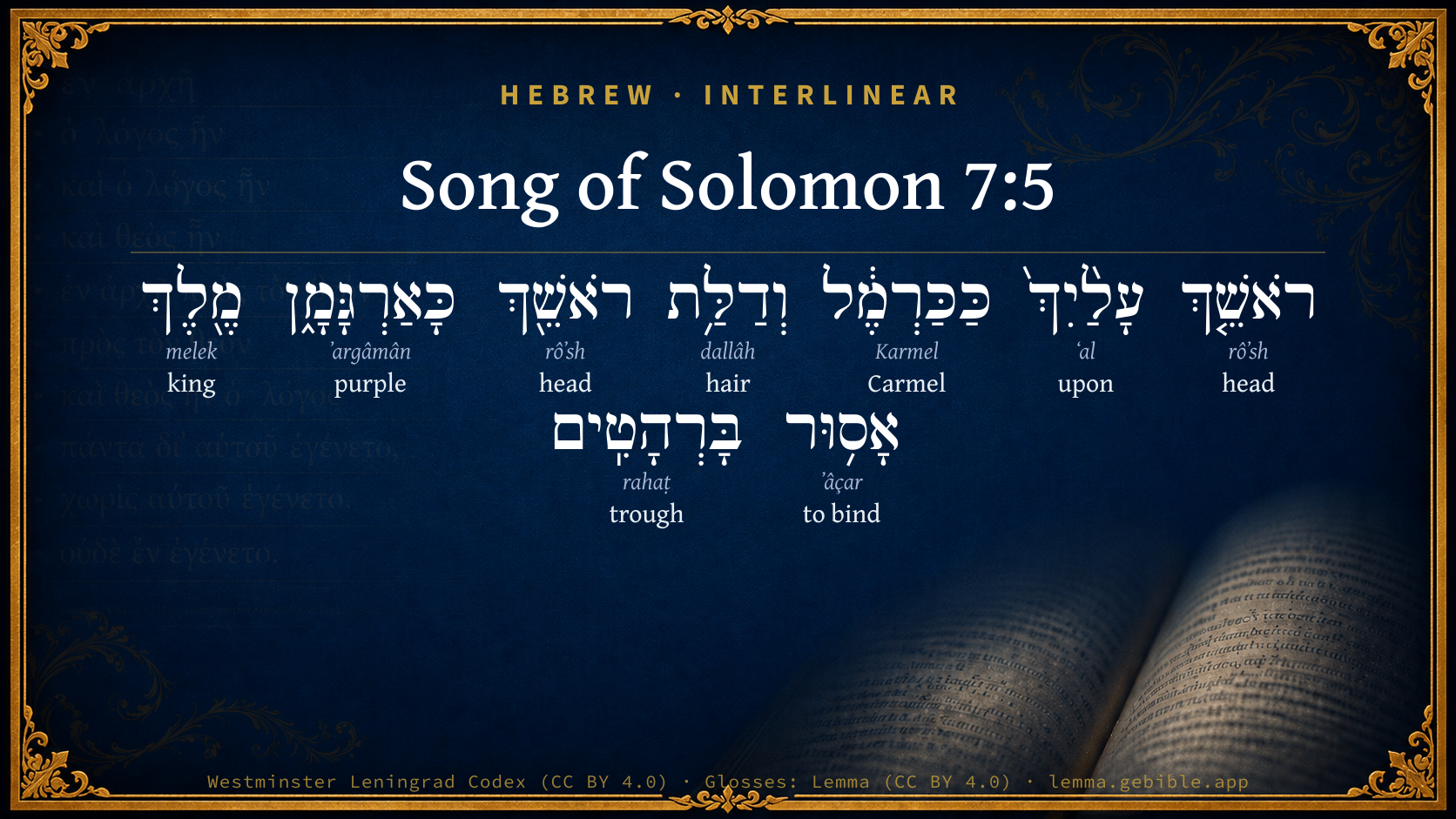
Hebrew (Westminster Leningrad Codex) Song of Solomon 7:5 appears in the Hebrew Old Testament. The text above is from the Westminster Leningrad Codex. Each word links to its Strong’s number, a concise gloss, and parsing drawn from the Open Scriptures Hebrew Bible morphology. Click any word for its full Brown-Driver-Briggs (BDB) entry.
Download image
Cite this verse

Song of Solomon 7:5 (World English Bible). Public Domain. Lemma interlinear Bible study tool, https://lemma.gebible.app/v/song-of-solomon/7/5.

Show BibTeX & RIS
BibTeX
RIS
English Translation
Your head on you is like Carmel, The hair of your head like purple; The king is held captive in its tresses.
World English Bible · Public Domain
Download a study sheet

One document with this verse’s original text, its word-by-word gloss line, the meaning frame, cross-references with their text, attributed commentary, and full source and license credits — printable, and it pastes into notes with its structure intact.

This verse Autodidact and up

Study sheet (.html) Plain text (.txt)

A passage Seminary Student

Up to 50 verses in one chapter. A passage sheet keeps up to 6 commentary sources and 12 cross-references per verse, in the order this page ranks them, and says so on the sheet whenever that leaves anything out. Ask for a single verse and you get the Autodidact verse sheet above.

Everything on this page stays free to read, with no account — the sheet is a download of what is already on screen, not access to it.

Want to remove ads? Support Godless Engineer
Compare translations 3

The same verse in 3 English versions, stacked beneath the original-language interlinear above. Click any original word for its lexicon entry.

Each is an independent rendering of the whole verse — the interlinear is not word-aligned to these translations.

Highlighted words mark where these versions differ — a whole-verse word diff, not a word-by-word alignment.

  • World English Bible Public Domain
    Your head on you is like Carmel, The hair of your head like purple; The king is held captive in its tresses.
  • King James Version Public Domain
    Thine head upon thee is like Carmel, and the hair of thine head like purple; the king is held in the galleries.
  • unfoldingWord Literal Text CC BY-SA 4.0
    Your head on you like Carmel, and the loose hair of your head like purple; a king is held captive in the tresses.

unfoldingWord Literal Text — © unfoldingWord, licensed CC BY-SA 4.0. Word-aligned USFM3 via Door43 (git.door43.org/unfoldingWord/en_ult).

Versions to compare (up to 4)

3 of 4 selected

Show all 18 translations

Every available English version of this verse, each an independent rendering of the whole verse.

  • World English Bible Public Domain
    Your head on you is like Carmel, The hair of your head like purple; The king is held captive in its tresses.
  • Berean Standard Bible Public Domain
    Your head crowns you like Mount Carmel, the hair of your head like purple threads; the king is captured in your tresses.
  • Majority Standard Bible Public Domain
    Your head crowns you like Mount Carmel, the hair of your head like purple threads; the king is captured in your tresses.
  • King James Version Public Domain
    Thine head upon thee is like Carmel, and the hair of thine head like purple; the king is held in the galleries.
  • American Standard Version (1901) Public Domain
    Thy head upon thee is like Carmel, And the hair of thy head like purple; The king is held captive in the tresses `thereof'.
  • Revised Version (1885) Public Domain
    Thine head upon thee is like Carmel, and the hair of thine head like purple; the king is held captive in the tresses thereof.
  • Geneva Bible (1599) Public Domain
    Thine head vpon thee is as skarlet, and the bush of thine head like purple: the King is tyed in the rafters.
  • Douay-Rheims (1899) Public Domain
    Thy head is like Carmel: and the hairs of thy head as the purple of the king bound in the channels.
  • Young's Literal Translation Public Domain
    Thy head upon thee as Carmel, And the locks of thy head as purple, The king is bound with the flowings!
  • Literal Standard Version CC BY-SA 4.0
    Your head on you as Carmel, || And the locks of your head as purple, || The king is bound with the flowings!
  • Unlocked Literal Bible CC BY-SA 4.0
    Your head is on you like Carmel; the hair on your head is dark purple. The king is held captive by its tresses.
  • unfoldingWord Literal Text CC BY-SA 4.0
    Your head on you like Carmel, and the loose hair of your head like purple; a king is held captive in the tresses.
  • Darby Bible Public Domain
    Thy head upon thee is like Carmel, And the locks of thy head like purple; The king is fettered by [thy] ringlets!
  • World Messianic Bible Public Domain
    Your head on you is like Carmel. The hair of your head like purple. The king is held captive in its tresses.
  • Webster's Bible Public Domain
    Thy head upon thee is like Carmel, and the hair of thy head like purple; the king is held in the galleries.
  • Free Bible Version CC BY-SA 4.0
    Your head is as magnificent as Mount Carmel; your black hair has a purple sheen, as if a king was held captive in your locks!
  • Bible in Basic English Public Domain
    Your head is like Carmel, and the hair of your head is like purple, in whose net the king is prisoner.
  • JPS Tanakh (1917) Public Domain
    (7-6) Thy head upon thee is like Carmel, and the hair of thy head like purple; the king is held captive in the tresses thereof.

Literal Standard Version (2020), Covenant Press — licensed CC BY-SA 4.0. Text via the HelloAO Bible API (eBible.org). Unlocked Literal Bible (unfoldingWord) — licensed CC BY-SA 4.0. Text via the HelloAO Bible API (eBible.org). unfoldingWord Literal Text — © unfoldingWord, licensed CC BY-SA 4.0. Word-aligned USFM3 via Door43 (git.door43.org/unfoldingWord/en_ult). Free Bible Version, Dr. Jonathan Gallagher — licensed CC BY-SA 4.0. Text via the HelloAO Bible API (eBible.org).

Word by word

More ways to search: Search by grammar → Find every occurrence → Compare this word →

Practice this passage: Drill this verse → Learn its vocabulary →

בָּרְהָטִֽים
rahaṭ
H7298
“in/at the · troughs”
Preposition, Determined + Noun, Common, Masculine, Plural, Absolute
Part of Speech
Preposition + Noun
Type
Common
Gender
Masculine
Number
Plural
State
Absolute
Full BDB Definition

Origin: from an unused root apparently meaning to hollow out

TWOT: TWOT - 2127a , 2128a

trough, hollow - lock of hair - meaning dubious
  1. רֹאשֵׁ֤ךְ rôʼsh H7218 “head · your” Noun, Common, Masculine, Singular, Construct + Suffix, Personal, 2nd Person, Feminine, Singular
  2. עָלַ֨יִךְ֙ ʻal H5921 “upon · you” Preposition + Suffix, Personal, 2nd Person, Feminine, Singular
  3. כַּכַּרְמֶ֔ל Karmel H3760 “like/as the · Carmel” Preposition, Determined + Noun, Proper
  4. וְדַלַּ֥ת dallâh H1803 “and · hair of” Conjunction + Noun, Common, Feminine, Singular, Construct
  5. רֹאשֵׁ֖ךְ rôʼsh H7218 “head · your” Noun, Common, Masculine, Singular, Construct + Suffix, Personal, 2nd Person, Feminine, Singular
  6. כָּאַרְגָּמָ֑ן ʼargâmân H713 “like/as the · purple” Preposition, Determined + Noun, Common, Masculine, Singular, Absolute
  7. מֶ֖לֶךְ melek H4428 “king” Noun, Common, Masculine, Singular, Absolute
  8. אָס֥וּר ʼâçar H631 “bound” Verb, Qal, Participle Passive, Masculine, Singular, Absolute

About this verse

These counts appear in no published source. They are computed here, from the morphology-tagged text and Lemma’s own curated glosses. What Lemma adds →

9
words
8
distinct lemmas
Wisdom
section

Notable vocabulary

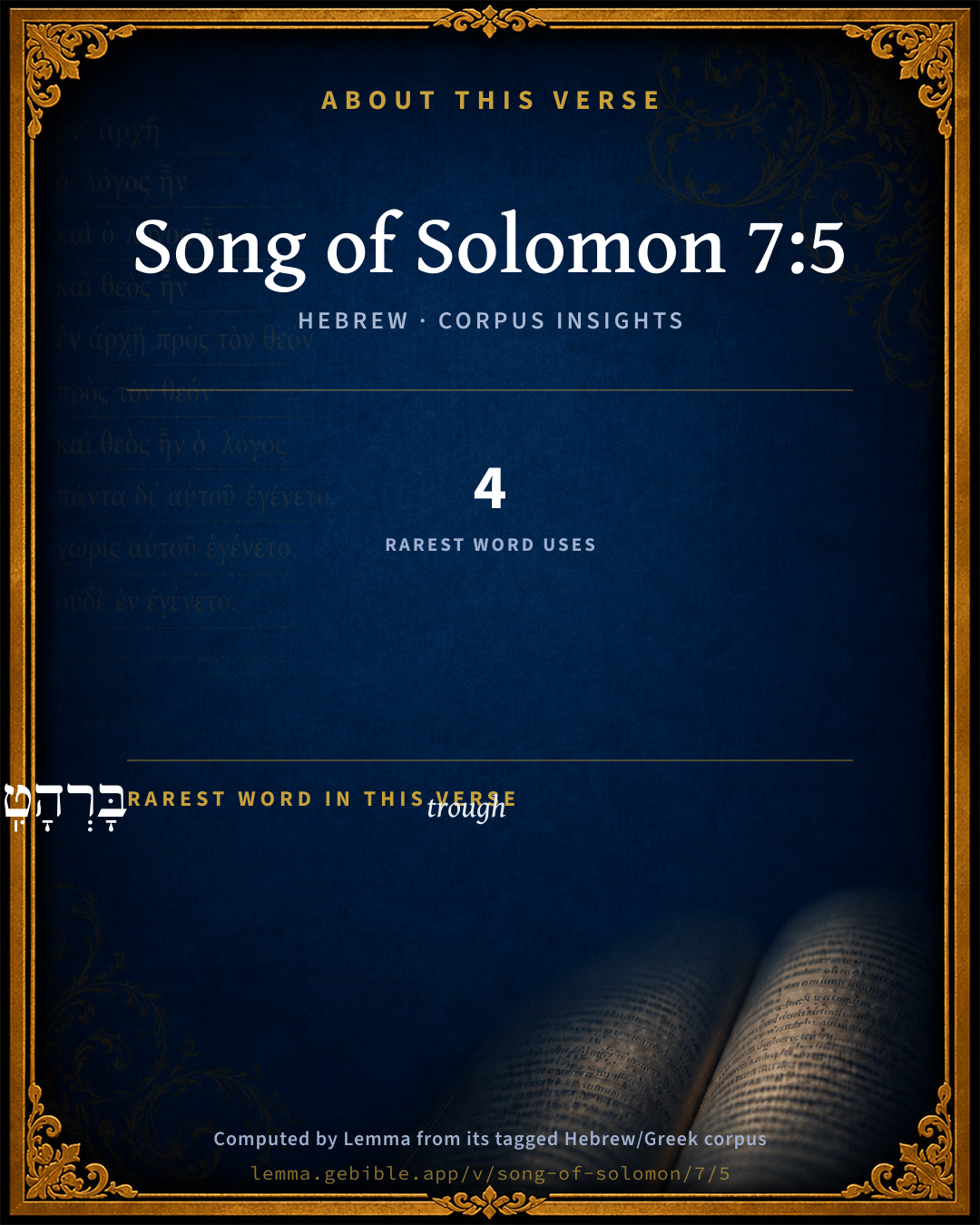
The rarest word here is בָּרְהָטִֽים trough H7298 — appearing just 4 times in the whole Hebrew Bible.

Shared distinctive vocabulary

בָּרְהָטִֽים trough H7298 occurs in 4 verses of the Hebrew Bible. Also found in:

Grammatical profile

  • 1 verb
  • 7 nouns
  • 1 preposition

Verb forms

  • אָס֥וּר Qal · Participle Passive

Repetition

A word recurs within this verse — often emphatic in Hebrew:

  • רֹאשֵׁ֤ךְ head H7218 ×2

Hebrew & Septuagint length

In English translation the verse runs 22 words from the Hebrew and 22 from the Septuagint (LXX English) — the same length.

A rough comparison of the two English renderings, which tokenize alike — not a word-level alignment.

Word counts can differ between the Hebrew and the Greek without any difference in meaning — e.g. the Hebrew direct-object marker אֵת has no separate Greek word, and Greek often adds the article ὁ.

Cross-references

15

Topical passages linked to Song of Solomon 7:5 in the Treasury of Scripture Knowledge — connected by theme and wording, ordered by reader-vote popularity; previews shown in the World English Bible.

  • Isaiah 35:2 It shall blossom abundantly, and rejoice even with joy and singing; the glory of Lebanon shall be given to it, the excellency of Carmel and Sharon: they shall see the glory of Yahweh, the excellency of our God.
  • Song of Solomon 4:1 Behold, you are beautiful, my love. Behold, you are beautiful. Your eyes are doves behind your veil. Your hair is as a flock of goats, That descend from Mount Gilead.
  • Genesis 32:26 The man said, "Let me go, for the day breaks." Jacob said, "I won't let you go, unless you bless me."
  • Psalms 68:24 They have seen your processions, God, Even the processions of my God, my King, into the sanctuary.
  • Psalms 87:2 Yahweh loves the gates of Zion more than all the dwellings of Jacob.
  • Song of Solomon 1:17 The beams of our house are cedars. Our rafters are firs. Beloved
  • Song of Solomon 5:11 His head is like the purest gold. His hair is bushy, black as a raven.
  • Micah 7:14 Shepherd your people with your staff, The flock of your heritage, Who dwell by themselves in a forest, In the midst of fertile pasture land, let them feed; In Bashan and Gilead, as in the days of old.
  • Matthew 18:20 For where two or three are gathered together in my name, there I am in the midst of them."
  • Matthew 28:20 teaching them to observe all things that I commanded you. Behold, I am with you always, even to the end of the age." Amen.
  • Ephesians 1:22 He put all things in subjection under his feet, and gave him to be head over all things for the assembly,
  • Ephesians 4:15–16 but speaking truth in love, we may grow up in all things into him, who is the head, Christ;
  • Colossians 1:18 He is the head of the body, the assembly, who is the beginning, the firstborn from the dead; that in all things he might have the preeminence.
  • Colossians 2:19 and not holding firmly to the Head, from whom all the body, being supplied and knit together through the joints and ligaments, grows with God's growth.
  • Revelation 1:14 His head and his hair were white as white wool, like snow. His eyes were like a flame of fire.

Cross-references courtesy of OpenBible.info (CC BY 4.0).

Hebrew and Greek witnesses Masoretic Hebrew ↔ Greek Septuagint

The same verse in the two great witnesses to the Old Testament, shown verse-for-verse.

These are two independent witnesses, not word-aligned to each other, and the Septuagint is shown in lemma (dictionary) form.

Hebrew Song of Solomon 7:5 Masoretic · Westminster Leningrad Codex

רֹאשֵׁ֤ךְ עָלַ֨יִךְ֙ כַּכַּרְמֶ֔ל וְדַלַּ֥ת רֹאשֵׁ֖ךְ כָּאַרְגָּמָ֑ן מֶ֖לֶךְ אָס֥וּר בָּרְהָטִֽים

Your head on you is like Carmel, The hair of your head like purple; The king is held captive in its tresses.

World English Bible · Public Domain

Greek LXX Song of Solomon 7:5 Septuagint · lemma form

τράχηλος σύ ὡς πύργος ἐλεφάντινος ὀφθαλμός σύ ὡς λίμνη ἐν εσεβων ἐν πύλη θυγάτηρ πολύς μυκτήρ σύ ὡς πύργος ὁ λίβανος σκοπεύω πρόσωπον δαμασκός

Your head upon you is as Carmel, and the curls of your hair like scarlet; the king is bound in the galleries.

LXX2012 (modern English Septuagint) · Public Domain

Hebrew: Westminster Leningrad Codex (CC BY 4.0). Greek: Septuagint (public domain); English from LXX2012 (modern English Septuagint) (Public Domain). How the Septuagint differs from the Hebrew →

Commentary

Notes on Song of Solomon 7:5 from classic Christian and Jewish commentators (each source and its license shown beneath its notes). The classic Christian expositions comment on the surrounding passage and are grouped to its opening verse, so a note may address several verses; the Jewish commentaries on the Tanakh (Rashi and others) are per-verse, so they appear only where the commentator wrote on this verse.

Lemma curates 59 commentaries, every one of them public domain or Creative Commons licensed, each selected and text-cleaned for this edition rather than reprinted as found. About our sources →

Trapp's Complete Commentary

John Trapp

Son 7:5 Thine head upon thee [is] like Carmel, and the hair of thine head like purple; the king [is] held in the galleries.

Ver. 5. Thine head upon thee is like Carmel.] This head is Christ himself, for he is the sole head of his Church: "God hath put all things under his feet" - hence he is here compared to Carmel, because he is high over all - "and given him to be head over all things" - that is, over all persons - "to the Church." {Eph 1:18; Eph 1:22} Angels are under Christ as a head of government, of influence, of confirmation, not of redemption, as the saints are. The angels are great friends to the Church, but not members of it. {Heb 2:16} The Church Christ sanctified and washed with his blood. {Eph 5:26} Not so the angels. He was but a poor patron of the Pope’s headship that said - and, as he thought, very wisely too - that he had read in some vocabulary that Cephas signified a head, therefore Peter was head of the Church. But if that should have been granted him, yet it would not follow that the Pope is therefore so too; for Bellarmine, {a} a better scholar by far, is forced to say, Forte non est de iure divino Rom. pontificem Petro succedere, perhaps it is not by any divine right that the Pope succeedeth Peter. And again, Rom. pontificem Petro succedere non habetur expresse in Scripturis, it is not expressly set down in the Scriptures that the Pope succeedeth Peter.

And the hair of thine head like purple.] Which was the colour of kings and princes. The saints - called here the hair of the Church’s head for their number or multitude - are "princes in all lands"; {Psa 45:16} yea, they are kings in righteousness, as Melchisedec was a king, but somewhat obscure. Compare Mat 13:17 Luk 10:24. "Many righteous," saith one, "Many kings," saith the other, "have desired to see those things that ye see," &c.

The king is held in the gallaries,] i.e., There is no king in the world wo great and glorious but might find in his heart to be tied to these walks, and to be held prisoner in the sight of thee and thy bravery; like as King James, coming first into the public library at Oxford, and viewing the little chains wherewith each book there is tied to its place, wished that if ever it were his destiny to be a prisoner, that library might be his prison, those books his fellow prisoners, those chains his fetters. {Psa 138:4-5; Psa 119:72} {b} The Psalmist shows by prophesying that even kings, coming to taste the excellence of the comforts of godliness, and to feel the power of God’s Word, should sing for joy of heart, and greatly acknowledge the excelling glory of Christ’s spouse the Church. See David’s desire. {Psa 27:4 Psa 84:1-12} Constantine and Valentinian, two emperors, called themselves Vasallos Christi, as Socrates reports, the vassals of Christ. And Theodosius, another emperor, professed that it was more honour and comfort to him to be membrum ecclesiae, quam caput imperii, a member of the Church, than head of the empire. Nay, Numa, second king of Rome, though but a heathen, held it a higher honour to serve God than to reign over men. {c} Some interpreters by the king here understand Christ, coveting the Church’s beauty, {Psa 45:11} and held fast bound unto her in the bands of pure affection, of spiritual wedlock.

{a} De Rom. Pontif., lib. ii. cap. 12.

{b} Rex Platon., page 123.

{c} Tου Yεου υπηροσιαν βασιλευειν ενομεζεν - Plutarch.

John Trapp, A Commentary or Exposition upon All the Books of the Old and New Testament (1647–1656) — public domain. Text from a community e-Sword module.

The Biblical Illustrator

Joseph S. Exell

Son_7:5

The King is held in the galleries.

The King is held in the galleries

Christ, the blessed King of Zion, condescends sometimes to be held and detained by His people in the galleries of Gospel-ordinances.

I. I will give some account of this royal King.

1. That he is a King appears from these particulars.

(1) From the Fathers designation and ordination.

(2) From the prophecies that went of Him before His actual manifestation in our nature (Gen_49:10; Luk_1:32-33; Psa_132:11; Isa_9:6).

(3) From the types and shadows that prefigured Him. He was typified by Melchizedek, who is called the King of righteousness and the King of peace; by David; and by Solomon.

(4) From the princely titles that are given Him in Scripture. He is called the Prince of peace, the King of righteousness, and the King of kings and Lord of lords; and it is God the Fathers will that every one should confess that Jesus Christ is the Lord.

(5) From the princely prerogatives and royalties that are assigned Him by His Father (Psa_89:20).

2. As He is a King, so He is the King by way of eminency and excellency.

(1) He is the King eternal (1Ti_1:17; Isa_9:6).

(2) He is called the King immortal (1Ti_1:17).

(3) He is the King invisible (1Ti_6:16).

(4) He is the only blessed and happy King (1Ti_6:15).

(5) He is the absolute and universal King. His kingdom is universal in respect of all persons, places, times.

II. The galleries wherein this royal King trysts and keeps company with His people.

1. I will only mention these few galleries.

(1) There is the secret gallery of meditation, wherein David found God s lovingkindness to be better than life, and had his soul satisfied as with marrow and fatness.

(2) There is the gallery of prayer, wherein Jacob wrestled with the angel of the Covenant, and, like a prince, prevailed for the blessing.

(3) There is a gallery of reading of the Scriptures, wherein the Ethiopian eunuch got such a discovery of the promised Messiah as made him go on his way rejoicing.

(4) There is a gallery of Christian converse anent soul-matters; wherein the disciples going to Emmaus had such a meeting with Christ as made their hearts burn within them.

(5) There is the gallery of preaching, or of hearing of the Word preached; by, the foolishness of which God sayeth them that believed. Here it was that Lydia s heart was opened.

(6) The Sacraments of the New Testament, baptism and the Lords Supper, are galleries wherein Zion s King displays His glory before His people.

2. Why are these ordinances compared to galleries?

(1) Galleries are magnificent apartments of royal and stately buildings. So there is a Divine magnificence in the ordinances of the Gospel when countenanced with the presence of the great Master of assemblies.

(2) Galleries are lightsome and pleasant apartments. O how pleasant and lightsome are ordinances to a gracious soul!

(3) Galleries are places of walk and converse, as is plain from. Eze_41:15. So it is in Gospel-ordinances that Christ doth walk and converse with His people.

(4) Galleries are places of public feasting and entertainment of friends. So it is in the mount of Gospel-ordinances that the Lord has provided for His people a feast of fat things, etc.

III. The holding of the King in the galleries.

1. What does it suppose and imply on the believers part?

(1) It necessarily supposes a meeting with Christ in the galleries; for no person can hold that which they never had.

(2) It supposes a high esteem of Christ, a love to, and liking of, His company.

(3) On the believer s part, this holding of Christ supposes a fear of losing Him or of being deprived of His company.

(4) It supposes a seeming willingness in Christ to withdraw from His people after their sweetest enjoyments.

(5) It implies a holy solicitude, and earnest desire of soul, to have His presence continued.

(6) It implies an ardent breathing of soul after more and more nearness to Christ, and further discoveries of Him.

(7) It implies a firm resolution not to part with His company.

(8) It implies a cleaving or adhering to Christ with the whole strength and vigour of the soul. How, or wherein does the soul put forth its strength in cleaving to Christ? I answer, it does it by these three especially.

(i.) By the lively exercise of faith. Hence faith is called an apprehending of Christ, and a cleaving to Him.

(ii.) The soul binds or holds Christ in the galleries by sincere and ardent love.

(iii.) The soul cleaves to Christ by fervent and ardent prayer.

2. What does it imply on Christs part?

(1) It implies amazing grace and condescendency toward the work of His own hands.

(2) It implies Christs great delight in the society of His people.

(3) It implies that there are certain cords which have a constraining power to stay Him in His peoples company: and sure they must be strong cords indeed wherewith Omnipotency is bound.

(i.) He is bound by the cord of His own faithfulness, which He has laid in pawn in the promise.

(ii.) He is bound in the galleries by the cord of His own love.

(iii.) He is bound to them by the bond of marriage.

IV. The application of the doctrine.

1. The first use is of information. Is it so that Zions King is sometimes held in the galleries of Gospel-ordinances? Then,

(1) See hence the happiness and dignity of the saints of God beyond the rest of the world.

(2) See hence why the saints put such a value and estimate on Gospel-ordinances.

2. By way of trial and examination. You have been in the galleries of the King of Zion; but that is not enough: and therefore let me ask, Have you been in the galleries with the King? and have you been holding the King in the galleries?

(1) What did you hear in the galleries? what said the King unto you?

(2) What did you see in the galleries? Many sights are to be seen in the galleries of ordinances, and particularly in that of the Lords Supper. Here the Lamb of God is to be seen, which taketh away the sin of the world, and in a crucified Christ, who is evidently set forth in that ordinance, all the Divine attributes and perfections shine with a greater lustre than in the large volume of the creation.

(3) What have you tasted in the galleries? for galleries are for feasting and entertainment of friends. Now, did the King say to you, or is He yet saying it, Eat, O friends, drink, yea, drink abundantly, O beloved? Did He make you to eat of the fatness of His house, and to drink of the rivers of His pleasures?

3. Use third may be in a short word directed to two or three sorts of persons.

(1) To you who know nothing of this doctrine, never met with the King in the galleries.

(2) To you who have had a comfortable meeting with Him.

(3) To those who perhaps are complaining, I sought Him, but I found Him not. (E. Erskine.)

The Biblical Illustrator, edited by Joseph S. Exell (c. 1880s–1900s) — public domain. Text from a community e-Sword module.

Joseph Benson's Commentary

Son 7:5-6. Thy head is like Carmel — Eminent and pleasant to the eye, and fruitful as mount Carmel was: which may denote that her mind was replenished with knowledge, and other excellent gifts of the Holy Ghost. The hair of thy head like purple — Which colour was anciently much esteemed. The king is held in the galleries — In which he walks, and, having once espied thee, is unable to take off his eyes from thee. How fair, &c., for delights — For those various and lovely features which are in thee.

Joseph Benson's Commentary on the Old and New Testaments (1811–1818) — public domain. Text from a community e-Sword module.

Tyndale Open Study Notes

Tyndale Open Resources

7:5-6 Mount Carmel is a high mountain range on the Mediterranean coast. • your hair radiates royalty (literally your hair is as purple threads): Purple was an expensive color to produce, so it was the exclusive property of royalty.

Tyndale Open Study Notes — © Tyndale Open Resources, licensed CC BY-SA 4.0. Text via the HelloAO Bible API.

Geneva Bible (1599)

Geneva Bible translators

He delighteth to come near thee, and to be in thy company.

Or, galleries.

Geneva Bible (1599) marginal notes — public domain. Text via Bolls.life.

Adam Clarke's Commentary

Verse 5. Thine head - like Carmel] Rising majestically upon thy neck, and above thy shoulders, as Mount Carmel does in its district. Carmel was the name of the mountain where Elijah had his contest with the prophets of Baal. See 1Kg 18:19, &c.

The hair of thine head like purple] Ornamented with ribbons and jewellery of this tint.

The king is held in the galleries.] Or is detained in the antechamber. His heart is captivated by thy person and conduct. Some understand the ringlets of the bride's hair.

Adam Clarke's Commentary on the Bible (1810–1826) — public domain. Text from a community e-Sword/MySword module.

Ellicott's Commentary for English Readers

(5) Carmel.—Marg., crimson, from reading charmîl, which preserves the parallelism with the next clause better. But the whole passage deals in the author’s favourite figures from localities; and certainly the comparison of a finely-set head to a mountain is at least as apt as that in the preceding verse, of the nose to a “tower in Lebanon.” Besides, there may be a play on words, which in turn may have suggested the allusion to purple in the next clause, or possibly the vicinity of Carmel to Tyre may have led to the thought of its famous dyes.

Hair.—Heb. dallath, most probably = flowing tresses. For comparison—

“Carmine purpurea est Nisi coma.”

“Et pro purpureo dat pœnas Scylla capillo.

(Comp. πορφύρεος πλόκαμος in Lucian., and πορφυρᾶι χᾶιται in Anacreon.) So Collins:—

“The youths whose locks divinely spreading,

Like vernal hyacinths in sullen hue.”

Ode to Liberty.

The king is held (Marg., bound) in the galleries.—For galleries, see Note on Son_1:17. Translate “A king caught and bound by thy tresses,” i.e., they are so beautiful that a monarch would be caught by them.

(Comp.—

“When I lie tangled in her hair

And fettered in her eye.”)

A Bible Commentary for English Readers, edited by Charles John Ellicott (1878–1897) — public domain. Text from a community e-Sword module.

The Cambridge Bible for Schools and Colleges

gen. ed. J. J. S. Perowne

5. Thine head upon thee is like Carmel] Mount Carmel, looked at from the North especially, is the crown of the country, towering over sea and land in solitary majesty; hence the comparison to a head proudly held. The A.V. margin, following some Jewish authorities, renders ‘crimson,’ regarding karmel as equivalent to karmîl, and Ginsburg, adopting this explanation, thinks that the words mean that her hair was arranged in the form of a murex shell.

the hair of thine head] The word translated ‘hair,’ which occurs nowhere else in the O.T., appears to mean flowing tresses.

like purple] Apparently the text means to indicate that the bride’s hair was of that intense black which is sometimes called blue black. For argâmân see note on Son_3:10.

the king is held in the galleries] Better (cp. R.V.), a king is held captive in the tresses thereof. The word translated ‘tresses’ occurs in the O.T. three times only, Gen_30:38; Gen_30:41, and Exo_2:16, where it means ‘water troughs.’ The connexion between these and a woman’s hair is not obvious, unless it be that it flows down like water from a water trough. That is hardly satisfactory, but that tresses is intended seems certain. The idea of a lover being held captive in the hair of his lady is common in the love poetry of all lands. Cp. Lovelace’s poem To Althea from Prison:

“When I lie tangled in her hair,

And fettered to her eye,

The birds that wanton in the air

Know no such liberty.”

Budde and Siegfried take the ‘king’ here to mean as usual the young husband of the king’s week. But in that case it would more naturally be the king.

The Cambridge Bible for Schools and Colleges (gen. ed. J. J. S. Perowne; Cambridge University Press, 1878–1918) — public domain. Text from a community e-Sword module.

Albert Barnes' Notes on the Bible

Compare and contrast with Son 5:15. The rendering in the margin takes “Carmel” as the name of a color, equivalent to “carmine” (rendered “crimson” in 2Ch 2:7, 2Ch 2:14; 2Ch 3:14). This interpretation is favored by the parallelism with “purple,” but removes a beautiful image.

Purple - A deep violet black.

The king ... - Rather, “A king is bound in the tresses or windings of thy hair.” These last words indicate the king’s approach.

Albert Barnes' Notes on the Bible (1834–1885) — public domain. Text from a community e-Sword/MySword module.

Haydock's Catholic Bible Commentary

Carmel. Shaded with trees. (Calmet) --- Hebrew, "purple," which colour was sometimes given to the hair. (Propertius ii. 18.) --- Channels. Of the dyers. Hebrew, "to beams." (Calmet) --- Protestants, "the king is held in the galleries" to view thee. (Haydock) --- Christ was all charity, and the faithful are twice dyed, with the love of God, and of their neighbour. (Menochius)

George Leo Haydock (1774–1849), Haydock's Catholic Family Bible and Commentary, 1859 edition — public domain. Excludes Psalms (Douay-Rheims chapter numbering differs from Protestant) and Deuterocanonical books (Catholic canon only).

Matthew Poole's English Annotations

Thine head, which may signify the church’s mind or understanding, which is seated in the head,

upon thee, which is upon thee, or above the rest of thy body,

is like Carmel, eminent and pleasant to the eye, and fruitful as Mount Carmel was, as hath been formerly noted; which may note that her mind was adorned and replenished with knowledge and other excellent gifts of the Holy Ghost. Or, as others render it, like crimson or purple, which is called Carmel, 2Ch 2:7; 3:14, because those fishes out of which they had their purple were taken in the sea bordering upon Mount Carmel. And so the same thing is repeated in the next clause in other words.

Like purple; which colour was anciently much esteemed and commended, as by sacred, so also by profane writers.

The king is held in the galleries; in which he walketh, and having once espied thee, is captivated by thee, and unable or unwilling either to depart or to take off his eyes from thee, as if he were fast bound and chained to thee. The galleries may note either the ordinances, or rather the churches, in which Christ walketh, Rev 2:1, in which Christ and believers converse together.

Matthew Poole's English Annotations on the Holy Bible (1683–1685) — public domain. Text from a community e-Sword/MySword module.

Whedon's Commentary on the Bible

Daniel D. Whedon

5. Like Carmel — This beautiful promontory, jutting boldly into the sea, seems to have received its name from “the crimson fringes of the evening” lingering so long upon its summit. The fish found near it, which yields colouring matter, may take its name from the mountain.

Like purple — Pliny says, that the ancient purple was glossy, and inclining to black. The curious linguist will find in all ancient tongues — the Greek as well as the Hebrew — a singular poverty and obscurity of words to express colours, and here “Carmel” may mean “purple,” which the following clause only makes more emphatic. The king, etc. — Hebrew, The king is charmed with thy flowing ringlets.

Daniel D. Whedon (gen. ed.), Commentary on the Old and New Testaments (1874–1909) — public domain. Text from a community e-Sword module.

The Pulpit Commentary

Thine head upon thee is like Carmel, and the hair of thine head like purple; the king is held captive in the tresses thereof. Carmel is called the "Nose of the mountain range" (Arf-ef-jebel). It is a promontory. The meaning, no doubt, is the exquisite fitness of the head upon the neck, which is one of the most lovely traits of personal beauty. Some, however, think that the reference is to colour Carmel being derived from the Persian, and meaning "crimson." This is rejected by Delitzsch, as the Persian would be carmile, not carmel. The transition is natural from the position and shape of the head and neck to the hair. The purple shellfish is found near Carmel (cf. Lucian"s porfureov plokamov and Anacreon"s porfurai caitai , and similar expressions in Virgil"s "Georgics," 1:405, and Tibullus, 1:4, 63). The locks of hair are a glistening purple colour, i.e. their black is purple as they catch the lights. Hengstenberg, however, thinks that the reference is to the temples, and not to the hair itself; but the use of the term in classical poets is decisive. The lovely head shaking the locks as the body moves gracefully in the dance fills the king with delight and admiration. He is quite captivated, and the ladies, having finished their description of the bride, look at the bridegroom, and behold him quite lost in the fascination captive in the tresses." Delitzsch quotes a similar expression from Goethe, in the "West Ostliche Divan," "There are more than fifty hooks in each lock of thy hair." The idea of taking captive is frequent in Hebrew poetry. (cf. Pro_6:25 RAPC Sir 9:3, 4) Thus ends the song of the ladies in praise of the bride. We must suppose that the king, who is probably present, then takes up the word, and pours out his heart.

The Pulpit Commentary (1880–1919), ed. H.D.M. Spence-Jones & Joseph S. Exell — public domain. Text from a community e-Sword module.

John Wesley's Explanatory Notes

Carmel - Eminent and pleasant to the eye, and fruitful as mount Carmel was. Which may denote that her mind was replenished with knowledge, and other excellent gifts of the Holy Ghost. Purple - Which colour was anciently much esteemed. Is held - In which he walks, and having once espied thee, is unable to take off his eyes from thee.

John Wesley, Explanatory Notes Upon the Whole Bible (1754–1765) — public domain. Text via the GEBible commentary corpus.

unfoldingWord translationNotes

Door43 World Missions Community

General Information:

The man continues to describe the woman.

Your head is on you like Carmel

Mount Carmel is higher than everything else around it. The man wants to look at the woman's head more than at anything else. AT: "Your head is on you like a crown, higher than anything else" (See: Simile)

dark purple

Other possible translations are 1) "dark black" or 2) "dark red."

The king is held captive by its tresses

This can be translated in active form. AT: "Your hair that hangs down is so beautiful that the king is not able to stop admiring it" (See: Metaphor and Active or Passive)

tresses

clusters of hair that hang down from a woman's head

my love, with delights!

"my love. You delight me!"

translationWords

Carmel

purple

king

captive

unfoldingWord translationNotes — © Distant Shores Media and the Door43 World Missions Community, licensed CC BY-SA 4.0. Source: git.door43.org/Door43/en_tn.

Rashi

Rabbi Shlomo Yitzchaki (Rashi)

Your neck the Temple and the altar, which are erect and tall, and the Chamber of Hewn Stone, which is also there, made for strength and for a shield, like an ivory tower.

your eyes are like pools (בְּרֵכוֹת) in Heshbon, through which water flows. So are your eyes by the gate of the multitudes. Your sages, when they sit in the gates of Jerusalem, the city of multitudes, and engage in the computation (חֶשְּׁבּוֹן) of the seasons and the signs of the zodiac—their wisdom and understanding in the eyes of the peoples flow like pools of water. Alternatively, we can explain בְּרֵכוֹת בְּחֶשְּׁבּוֹן to mean doves, and this is a Mishnaic usage: If one buys the doves of a dovecote, he must let the first brood (בְּרִיכָה) fly away; covedes in Old French, covey, brood.

your face is as the tower of Lebanon Heb. אַפֵּךְ. I cannot explain this to mean a nose, either in reference to its simple meaning or in reference to its allegorical meaning, for what praise of beauty is there in a nose that is large and erect as a tower? I say, therefore, that אַפֵּךְ means a face. Now the reason he uses the singular and does not say אַפַּיִךְ, is that he speaks of the forehead, which is the main recognizable feature of the face, as it is said (Isa. 3:9): “The recognition of their faces testified against them.” And you should know, for he progressively praises them from bottom to top”—Your eyes are [like] pools in Heshbon,” and after them the forehead, and so do the nations praise (Ezek. 3:8): “and your forehead is strong against” the forehead of all who come to harm you and entice you.

as the tower of Lebanon, facing towards Damascus I saw [the following] in the Midrash (Zuta): This is the house of the Lebanon forest, which King Solomon made. Whoever stood on it could look and count how many houses there were in Damascus. Another explanation: Your face looks towards Damascus; looks forward to the coming of the gates of Jerusalem until Damascus, for it is destined to expand as far as Damascus.

Rashi on the Tanakh — English translations: “The Judaica Press complete Tanach with Rashi, translated by A. J. Rosenberg” (CC BY 4.0); “Pentateuch with Rashi's commentary by M. Rosenbaum and A.M. Silbermann, 1929-1934” (public domain); “The Metsudah Tanach series, Lakewood, N.J” (CC BY 4.0); and “The Book of Joshua, Metsudah Publications, 1997” (CC BY 4.0). Text via Sefaria.

Lesson kit

Teaching starters — assembled from the data on this page, not authored interpretation. Every prompt links to the verse data it draws on. Edit before teaching.

Song of Solomon, in the Wisdom, opens this verse with 9 words (8 distinct Hebrew lemmas). Its most distinctive word is rahaṭ (“trough”). A historical commentator’s framing appears above. Read the whole chapter for the surrounding context.

Discussion questions

  1. How does “trough” (rahaṭ) shape what this verse is saying?
  2. How does Genesis 30:38, which shares the word «trough», read alongside this verse?
  3. What does the repetition of “head” (2× in this one verse) do in this verse?
  4. These translations render this verse differently. What is at stake in choosing one wording over another?
  5. «אָס֥וּר» is a Qal Participle Passive verb. How does that grammatical form shape the action described?
  6. Compare how Trapp's Complete Commentary and The Biblical Illustrator read this verse. Where do they agree or differ?

Things to notice

Reading settings

Reading text

Shown beneath each verse's original-language words.

Old Testament
Old Testament edition

Read the OT as the Masoretic Hebrew (MT) or the Greek Septuagint (LXX).

English shown for the Greek Septuagint (in the Hebrew ↔ Greek comparison).

Comparing translations? Open the Compare panel on any verse page to stack up to four side by side.