Ezekiel 3:25

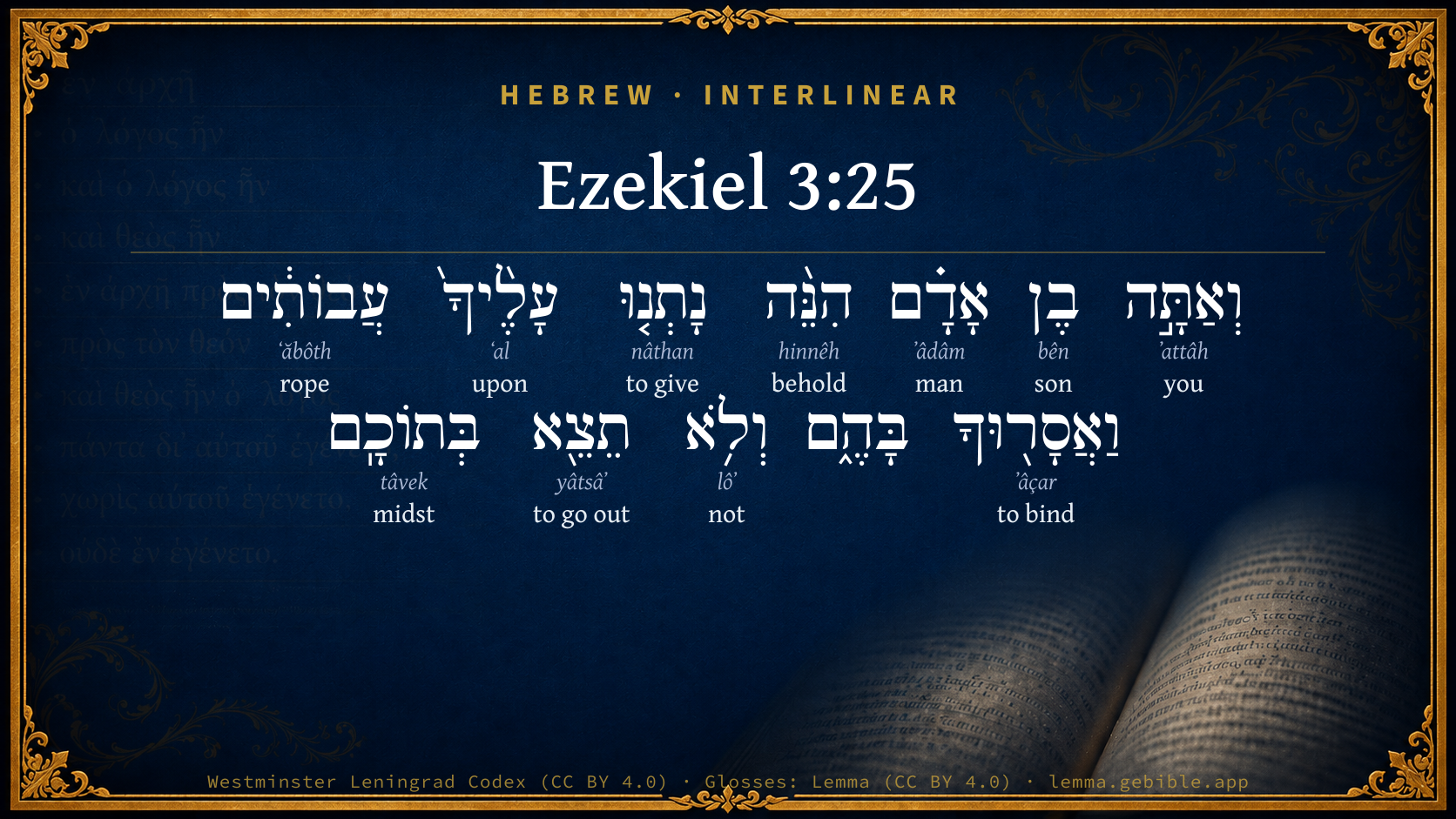
Hebrew (Westminster Leningrad Codex) Ezekiel 3:25 appears in the Hebrew Old Testament. The text above is from the Westminster Leningrad Codex. Each word links to its Strong’s number, a concise gloss, and parsing drawn from the Open Scriptures Hebrew Bible morphology. Click any word for its full Brown-Driver-Briggs (BDB) entry.
Download image
Cite this verse

Ezekiel 3:25 (World English Bible). Public Domain. Lemma interlinear Bible study tool, https://lemma.gebible.app/v/ezekiel/3/25.

Show BibTeX & RIS
BibTeX
RIS
English Translation
But you, son of man, behold, they shall lay bands on you, and shall bind you with them, and you shall not go out among them:
World English Bible · Public Domain
Download a study sheet

One document with this verse’s original text, its word-by-word gloss line, the meaning frame, cross-references with their text, attributed commentary, and full source and license credits — printable, and it pastes into notes with its structure intact.

This verse Autodidact and up

Study sheet (.html) Plain text (.txt)

A passage Seminary Student

Up to 50 verses in one chapter. A passage sheet keeps up to 6 commentary sources and 12 cross-references per verse, in the order this page ranks them, and says so on the sheet whenever that leaves anything out. Ask for a single verse and you get the Autodidact verse sheet above.

Everything on this page stays free to read, with no account — the sheet is a download of what is already on screen, not access to it.

Want to remove ads? Support Godless Engineer
Compare translations 3

The same verse in 3 English versions, stacked beneath the original-language interlinear above. Click any original word for its lexicon entry.

Each is an independent rendering of the whole verse — the interlinear is not word-aligned to these translations.

Highlighted words mark where these versions differ — a whole-verse word diff, not a word-by-word alignment.

  • World English Bible Public Domain
    But you, son of man, behold, they shall lay bands on you, and shall bind you with them, and you shall not go out among them:
  • King James Version Public Domain
    But thou, O son of man, behold, they shall put bands upon thee, and shall bind thee with them, and thou shalt not go out among them:
  • unfoldingWord Literal Text CC BY-SA 4.0
    for now, son of man, they will place ropes upon you and tie you so you cannot go out among them.

unfoldingWord Literal Text — © unfoldingWord, licensed CC BY-SA 4.0. Word-aligned USFM3 via Door43 (git.door43.org/unfoldingWord/en_ult).

Versions to compare (up to 4)

3 of 4 selected

Show all 18 translations

Every available English version of this verse, each an independent rendering of the whole verse.

  • World English Bible Public Domain
    But you, son of man, behold, they shall lay bands on you, and shall bind you with them, and you shall not go out among them:
  • Berean Standard Bible Public Domain
    And you, son of man, they will tie with ropes, and you will be bound so that you cannot go out among the people.
  • Majority Standard Bible Public Domain
    And you, son of man, they will tie with ropes, and you will be bound so that you cannot go out among the people.
  • King James Version Public Domain
    But thou, O son of man, behold, they shall put bands upon thee, and shall bind thee with them, and thou shalt not go out among them:
  • American Standard Version (1901) Public Domain
    But thou, son of man, behold, they shall lay bands upon thee, and shall bind thee with them, and thou shalt not go out among them:
  • Revised Version (1885) Public Domain
    But thou, son of man, behold, they shall lay bands upon thee, and shall bind thee with them, and thou shalt not go out among them:
  • Geneva Bible (1599) Public Domain
    But thou, O sonne of man, beholde, they shall put bandes vpon thee, and shall binde thee with them, and thou shalt not goe out among them.
  • Douay-Rheims (1899) Public Domain
    And thou, O son of man, behold they shall put bands upon thee, and they shall bind thee with them: and thou shalt not go forth from the midst of them.
  • Young's Literal Translation Public Domain
    `And thou, son of man, lo, they have put on thee thick bands, and have bound thee with them, and thou goest not forth in their midst;
  • Literal Standard Version CC BY-SA 4.0
    And you, son of man, behold, they have put thick bands on you, and have bound you with them, and you do not go forth in their midst;
  • Unlocked Literal Bible CC BY-SA 4.0
    for now, son of man, they will place ropes upon you and tie you so you cannot go out among them.
  • unfoldingWord Literal Text CC BY-SA 4.0
    for now, son of man, they will place ropes upon you and tie you so you cannot go out among them.
  • Darby Bible Public Domain
    And thou, son of man, behold, they shall put bands upon thee, and shall bind thee therewith, and thou shalt not go out among them.
  • World Messianic Bible Public Domain
    But you, son of man, behold, they will put ropes on you, and will bind you with them, and you will not go out among them.
  • Webster's Bible Public Domain
    But thou, O son of man, behold, they shall put bands upon thee, and shall bind thee with them, and thou shalt not go out among them:
  • Free Bible Version CC BY-SA 4.0
    You will be tied up with ropes, son of man. You will be bound so that you won't be able to go out among the people.
  • Bible in Basic English Public Domain
    But see, O son of man, I will put bands on you, prisoning you in them, and you will not go out among them:
  • JPS Tanakh (1917) Public Domain
    But thou, son of man, behold, bands shall be put upon thee, and thou shalt be bound with them, and thou shalt not go out among them;

Literal Standard Version (2020), Covenant Press — licensed CC BY-SA 4.0. Text via the HelloAO Bible API (eBible.org). Unlocked Literal Bible (unfoldingWord) — licensed CC BY-SA 4.0. Text via the HelloAO Bible API (eBible.org). unfoldingWord Literal Text — © unfoldingWord, licensed CC BY-SA 4.0. Word-aligned USFM3 via Door43 (git.door43.org/unfoldingWord/en_ult). Free Bible Version, Dr. Jonathan Gallagher — licensed CC BY-SA 4.0. Text via the HelloAO Bible API (eBible.org).

Word by word

More ways to search: Search by grammar → Find every occurrence → Compare this word →

Practice this passage: Drill this verse → Learn its vocabulary →

עֲבוֹתִ֔ים
ʻăbôth
H5688
“ropes”
Noun, Common, Both, Plural, Absolute
Part of Speech
Noun
Type
Common
Gender
Both
Number
Plural
State
Absolute
Full BDB Definition

Origin: the same as H5687

TWOT: 1558b

cord, rope, cordage, foliage, interwoven foliage - cord, rope, cordage, chain - interwoven foliage
  1. וְאַתָּ֣ה ʼattâh H859 “and · you” Conjunction + Pronoun, Personal, 2nd Person, Masculine, Singular
  2. בֶן bên H1121 “son of” Noun, Common, Masculine, Singular, Construct
  3. אָדָ֗ם ʼâdâm H120 “man” Noun, Common, Masculine, Singular, Absolute
  4. הִנֵּ֨ה hinnêh H2009 “behold” Particle, Demonstrative
  5. נָתְנ֤וּ nâthan H5414 “to give” Verb, Qal, Perfect, 3rd Person, Common, Plural
  6. עָלֶ֨יךָ֙ ʻal H5921 “upon · you” Preposition + Suffix, Personal, 2nd Person, Masculine, Singular
  7. וַאֲסָר֖וּךָ ʼâçar H631 “and · to bind · you” Conjunction + Verb, Qal, Sequential Perfect, 3rd Person, Common, Plural + Suffix, Personal, 2nd Person, Masculine, Singular
  8. וְלֹ֥א lôʼ H3808 “and · not” Conjunction + Particle, Negative
  9. תֵצֵ֖א yâtsâʼ H3318 “to go out” Verb, Qal, Imperfect, 2nd Person, Masculine, Singular
  10. בְּתוֹכָֽם tâvek H8432 “in/at · midst · their” Preposition + Noun, Common, Masculine, Singular, Construct + Suffix, Personal, 3rd Person, Masculine, Plural

About this verse

These counts appear in no published source. They are computed here, from the morphology-tagged text and Lemma’s own curated glosses. What Lemma adds →

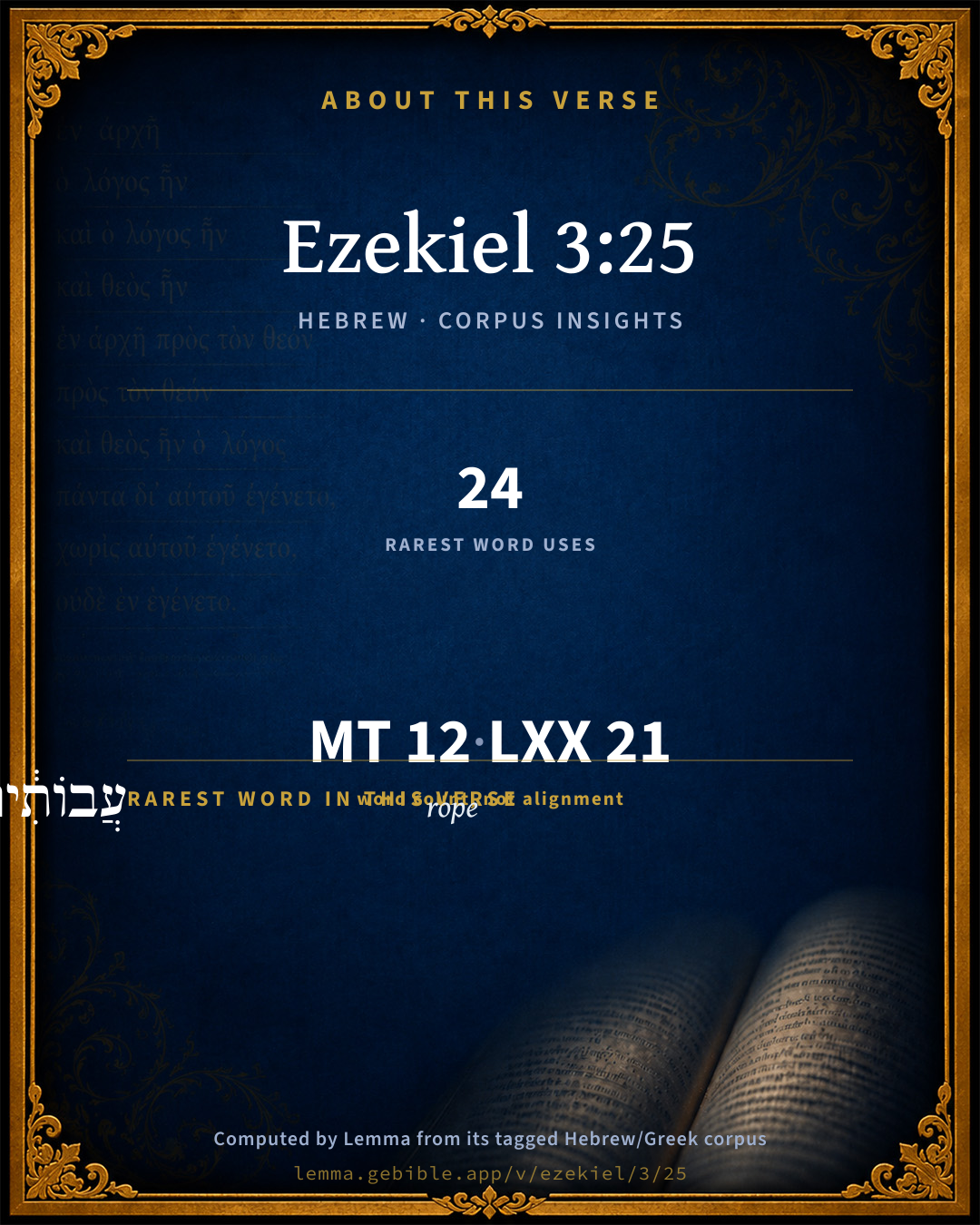
12
words
11
distinct lemmas
Prophets
section

Notable vocabulary

The rarest word here is עֲבוֹתִ֔ים rope H5688 — appearing just 24 times in the whole Hebrew Bible.

Shared distinctive vocabulary

עֲבוֹתִ֔ים rope H5688 occurs in 23 verses of the Hebrew Bible. Also found in:

Grammatical profile

  • 3 verbs
  • 4 nouns
  • 1 pronoun
  • 2 prepositions
  • 2 particles

Verb forms

  • נָתְנ֤וּ Qal · Perfect
  • וַאֲסָר֖וּךָ Qal · Sequential Perfect
  • תֵצֵ֖א Qal · Imperfect

Hebrew & Septuagint length

In English translation the verse runs 26 words from the Hebrew and 29 from the Septuagint (LXX English) — closely comparable.

A rough comparison of the two English renderings, which tokenize alike — not a word-level alignment.

Word counts can differ between the Hebrew and the Greek without any difference in meaning — e.g. the Hebrew direct-object marker אֵת has no separate Greek word, and Greek often adds the article ὁ.

In the original languages it is 12 Hebrew tokens and 21 Greek tokens — but the two are counted differently (Hebrew bundles its prefixes and suffixes into one token; the Greek is in lemma form), so that isn’t a like-for-like length.

Cross-references

6

Topical passages linked to Ezekiel 3:25 in the Treasury of Scripture Knowledge — connected by theme and wording, ordered by reader-vote popularity; previews shown in the World English Bible.

  • Ezekiel 4:8 Behold, I lay bands on you, and you shall not turn you from one side to the other, until you have accomplished the days of your siege.
  • Mark 3:21 When his friends heard it, they went out to seize him: for they said, "He is insane."
  • John 21:18 Most assuredly I tell you, when you were young, you dressed yourself, and walked where you wanted to. But when you are old, you will stretch out your hands, and another will dress you, and carry you where you don't want to go."
  • Acts 9:16 For I will show him how many things he must suffer for my name's sake."
  • Acts 20:23 except that the Holy Spirit testifies in every city, saying that bonds and afflictions wait for me.
  • Acts 21:11–13 Coming to us, and taking Paul's belt, he bound his own feet and hands, and said, "Thus says the Holy Spirit: 'So will the Jews at Jerusalem bind the man who owns this belt, and will deliver him into the hands of the Gentiles.'"

Cross-references courtesy of OpenBible.info (CC BY 4.0).

Hebrew and Greek witnesses Masoretic Hebrew ↔ Greek Septuagint

The same verse in the two great witnesses to the Old Testament, shown verse-for-verse.

These are two independent witnesses, not word-aligned to each other, and the Septuagint is shown in lemma (dictionary) form.

Hebrew Ezekiel 3:25 Masoretic · Westminster Leningrad Codex

וְאַתָּ֣ה בֶן אָדָ֗ם הִנֵּ֨ה נָתְנ֤וּ עָלֶ֨יךָ֙ עֲבוֹתִ֔ים וַאֲסָר֖וּךָ בָּהֶ֑ם וְלֹ֥א תֵצֵ֖א בְּתוֹכָֽם

But you, son of man, behold, they shall lay bands on you, and shall bind you with them, and you shall not go out among them:

World English Bible · Public Domain

Greek LXX Ezekiel 3:25 Septuagint · lemma form

καί σύ υἱός ἄνθρωπος ἰδού δίδωμι ἐπί σύ δεσμός καί δέω σύ ἐν αὐτός καί οὐ μή ἐκἔρχομαι ἐκ μέσος αὐτός

And you, son of man, behold, bonds are prepared for you, and they shall bind you with them, and you shall not come forth of the midst of them.

LXX2012 (modern English Septuagint) · Public Domain

On this verse, John Gill's Exposition discusses the Septuagint’s reading. Read the note in Commentary ↓

Hebrew: Westminster Leningrad Codex (CC BY 4.0). Greek: Septuagint (public domain); English from LXX2012 (modern English Septuagint) (Public Domain). How the Septuagint differs from the Hebrew →

Targum (Aramaic paraphrase)

1

The Targum is the ancient Jewish Aramaic paraphrase of the Hebrew Scriptures — an interpretive translation, not the Hebrew text itself. Onkelos (literal) and Pseudo-Jonathan (expansive) render the Torah, and Jonathan the Prophets. Coverage is partial: where no permissively-licensed English translation exists for a verse, only the Aramaic is shown. This is verse-level text, not a word-by-word alignment to the Hebrew.

  1. Targum Jonathan Prophets (Joshua–Malachi)
    וְאַתְּ בַּר אָדָם הָא גְזָרֵית פִּתְגָמֵי פוּמִי עֲלָךְ כֶּאֱסוֹר גְדִילַן דְאָסְרִין בָּהֶן וְלָא תִפּוֹק בֵּינֵיהוֹן:

    (no public-domain English translation for this verse)

    Targum Jonathan — Aramaic: “Mikraot Gedolot” (public domain). English: “Sefaria Community Translation” (CC0 1.0 (public-domain dedication)); “London "Chaldee Paraphrase," 1871” (public domain). Text via Sefaria.

Commentary

Notes on Ezekiel 3:25 from classic Christian and Jewish commentators (each source and its license shown beneath its notes). The classic Christian expositions comment on the surrounding passage and are grouped to its opening verse, so a note may address several verses; the Jewish commentaries on the Tanakh (Rashi and others) are per-verse, so they appear only where the commentator wrote on this verse.

Lemma curates 59 commentaries, every one of them public domain or Creative Commons licensed, each selected and text-cleaned for this edition rather than reprinted as found. About our sources →

Trapp's Complete Commentary

John Trapp

Eze 3:25 But thou, O son of man, behold, they shall put bands upon thee, and shall bind thee with them, and thou shalt not go out among them:

Ver. 25. Behold, they shall put bands upon thee.] Thy friends shall bind thee for a madman. See Mar 3:21. {See Trapp on "Mar 3:21"}

John Trapp, A Commentary or Exposition upon All the Books of the Old and New Testament (1647–1656) — public domain. Text from a community e-Sword module.

The Biblical Illustrator

Joseph S. Exell

Eze_3:25

They shall put bands upon thee.

Restraints in serving the Lord

I. They are often experienced. Every true life for Christ, at one step or another, verifies the expression of Paul, Without are fightings, within are fears.

1. The restraints may be in the servants. They may be ready to spread the Gospel, but are forbidden to enter the door which is apparently opened, or are afflicted with disease and unable to enter, or are prostrated in their energies by some domestic event and unfit to enter.

2. The restraints may be from those for whom the service is required.

(1) They may become violent against the persons who stand up for the rights of God.

(2) Or the people may be rebellious in heart.

II. The restraints are under the direction of the Lord. He concerns Himself with every matter relating to His kingdom amongst men. The enforced silence and disablement of the prophet and the gross heart of the people are controlled for His righteous and good ends.

1. Traces of His working are perceptible. Restraints are felt teaching His suffering servants to be patient, vigilant for Him, and so qualifing for future action and future reward. If we suffer with Him we are glorified together.

2. Hopes of His working may be entertained. When men make void His law, that is a time to ask God to do special work.

III. Restraints may be associated with communion between the Lord and His servants. This fact is brought to pass--

1. By a fresh consciousness of God in His service. He seems to come nearer to them, and they say, Thou holdest me by my right hand.

2. By a deepened conviction that He who has led them is the same forever.

3. By the power of the Holy Spirit. He takes the things that are Christs and shows them to us. He teaches to profit, and we receive power, love, and a sound mind. The efficacy of all true ministry depends on His energy. (D. G. Watt, M. A.)

Gods servants are told what to expect

1. Christ deals fairly, not fraudulently with His; He tells them at first what they must expect; not gold and silver, but bands and chains They shall bind thee. He told Jeremiah, they shall fight against him (Jer_1:19). So Paul no sooner is called to preaching, but he hears of suffering (Act_9:16). Christ tells all the apostles that they must be afflicted, hated, killed (Joh_16:2).

2. No excellency exempts a prophet from the malice of mens tongues and hands.

3. The generality of people are enemies to their own good, and active to their own ruin. The house of Israel, they are against the prophet; they fetter and chain him up, and think they have done well, to make him secure from coming amongst them. And alas, what have they done! thrust away the physician that should cure them; shut out mercy by shutting up a prophet; put out the light. Christ the great Prophet, the people, after all His precious sermons and glorious miracles, cry (Luk_23:18; Luk_23:21).

4. Wicked ones deal severely, cruelly with the prophets when they fall into their hands.

5. Afflictive conditions seldom better mens spirits. In the case of the Jews here, their wronging of the prophets was the cause of their suffering, and yet all their sufferings did not subdue their spirits, and work them to entertain the truth. The plough breaks the earth in many places, but doth not better it, but leaves it as it was; nothing is put in by the plough.

6. It is no new thing for prophets and ministers to be roughly entreated, and laid by as useless things (1Pe_5:9). (W. Greenhill, M. A.)

Liberty compatible with bodily restraint

When Bishop Hall was, with nine of his episcopal brethren, committed to the Tower on a charge of high treason, in the early days of the Long Parliament, besides preaching, as he had opportunity, on the Sundays, he wrote a treatise, under the title: Free Prisoner; or, The Comfort of the Saint, joyously contrasting the bondage which he endured with that of lust and sinful desires. Madame Guyon took the same happy view of her imprisonment in the Bastille, in which she reckoned herself one of Gods singing birds, whom He had caged there to have pleasure in her music.

The Biblical Illustrator, edited by Joseph S. Exell (c. 1880s–1900s) — public domain. Text from a community e-Sword module.

Jamieson, Fausset & Brown

Robert Jamieson, A. R. Fausset & David Brown

put bands upon thee--not literally, but spiritually, the binding, depressing influence which their rebellious conduct would exert on his spirit. Their perversity, like bands, would repress his freedom in preaching; as in Co2 6:12, Paul calls himself "straitened" because his teaching did not find easy access to them. Or else, it is said to console the prophet for being shut up; if thou wert now at once to announce God's message, they would rush on thee and bind them with "bands" [CALVIN].

Jamieson, Fausset & Brown — Commentary Critical and Explanatory on the Whole Bible (1871) — public domain (CC PDM 1.0). Text via the HelloAO Bible API.

Adam Clarke's Commentary

Verse 25. They shall put bands upon thee] Thy countrymen will rise up against thee; and, to prevent thy prophesying, will confine thee.

Adam Clarke's Commentary on the Bible (1810–1826) — public domain. Text from a community e-Sword/MySword module.

John Calvin's Commentaries

Now God explains the reason why he wishes the Prophet to cease for a time, and to remain at home as if dumb. They have placed, said he, ropes upon thee with which they may bind thee. The opinion of those who take the passage metaphorically is not unsuitable, as if it had been said, the perverseness of the people hinders Ezekiel in the discharge of his duty, just as if he had been bound with ropes.

To make this clearer, we may call to mind what Paul says to the Corinthians, (2 Corinthians 6:11,) namely, that he was held in bondage, because his teaching could not find access to them, nor penetrate to their souls. “Our mouth,” says he, “is open towards you, O Corinthians! Our heart is enlarged towards you:” that is, as far as lieth in me, I am prepared faithfully to spend my labors upon you: but your bowels are straitened. Since therefore men, by their own depravity, hinder the course of doctrine, by reducing the servants of God to straits, it is quite consistent to represent the malice of those who are not teachable to be like ropes by which faithful teachers are bound, so that they cannot proceed freely in the course of their duty. If any one, however, prefers taking what is here said strictly and literally, the sentence must thus be understood, that the Israelites were not as yet prepared for instruction, because if the Prophet shall utter God’s commands immediately, they would be like the furious who would lay hands upon him and bind him with ropes. This sense also is very appropriate, and hence we may choose freely between them. But as to the general purport, God’s intention is by no means obscure, namely, that the Prophet ought not to take it ill, if he be for a time apparently useless without obtaining either hearers or fit disciples. We see then that this is said for the Prophet’s comfort, that he should not murmur or take it ill that God wishes him ‘to remain shut up at home; because the fit time had not yet come, as if it had been said — “If you hasten now, you will approach furious men who will by and bye rush against you and bind you with ropes. Because, therefore, you see them not yet prepared for learning, wait a while until I prepare their ears for you, that they may attend to you; or at least, that they may be rendered the more excuseless, I will send thee; and meanwhile, although they are as yet perverse, yet they cannot rise violently against thee, but whether they will or not, they shall be compelled to hear the commands which proceed from my mouth.” And he afterwards confirms this at length, as we shall see.

John Calvin's Commentaries (1540-1563) — public domain. Text from the Calvin Translation Society English edition (1840s-50s) via the Christian Classics Ethereal Library (ccel.org). Calvin's coverage is partial (roughly two-thirds of the Bible); uncommented books and verses are honest gaps, never fabricated. The 19th-century editor's footnotes and remarks are omitted so the notes are faithfully Calvin's own voice.

Ellicott's Commentary for English Readers

(25) They shall put bands upon thee.—Ezekiel’s contemporary prophet, Jeremiah, was actually thrown into prison in Judæa, and even into a foul dungeon (Jer_37:21; Jer_38:6); but nothing of this kind is to be understood here. There is no trace of such treatment throughout the book, nor is it likely that it would have been suffered by Nebuchadnezzar among his captives, or possible under the administration of Daniel. Besides, a similar laying of bands upon him (although for a different purpose) is mentioned in Eze_4:8, which must necessarily be understood figuratively. The compulsion described in this and the following verse was a moral one. Ezekiel’s countrymen, especially during the period of his warnings until the destruction of Jerusalem, should so absolutely refuse to hear him, that it would become practically impossible for him to declare his prophecies; he would be as if he were bound.

A Bible Commentary for English Readers, edited by Charles John Ellicott (1878–1897) — public domain. Text from a community e-Sword module.

The Cambridge Bible for Schools and Colleges

gen. ed. J. J. S. Perowne

25. they shall put bands upon thee] that is, the exiles, as the words “thou shalt not go out among them” imply. The expression can hardly be merely equivalent to the pass., “cords shall be put upon thee” (Sep. Vulg.). The language is a figure for the restraint of opposition (ch. Eze_4:8).

The Cambridge Bible for Schools and Colleges (gen. ed. J. J. S. Perowne; Cambridge University Press, 1878–1918) — public domain. Text from a community e-Sword module.

John Gill's Exposition

But thou, O son of man, behold, they shall put bands upon thee,.... Or, "bands shall be put upon thee"; either visionally, or really; not by angels, but by the Jews, who, taking the prophet for a madman by his motions and gestures; would bind him, and keep him within doors: or figuratively this may be understood of the sins of the people, their rebellion and obstinacy, which hindered the prophet from prophesying among them as yet; and so this is observed to conciliate his mind to the divine order, to shut up himself for a while in his own house, and be silent: or else by these bonds may be meant the divine order itself, which restrained him from doing his office as yet. So the Targum,

"behold, I have appointed the words of my mouth upon thee, as a band of ropes with which they bind;''

and shall bind thee with them; which some think is emblematical of the Jews being bound by the Chaldeans:

and thou shall not go out among them; to converse with them, or prophesy unto them. The Septuagint version renders it, "shall not go out from the midst of them"; as if he should be taken out of his own house by the Jews, and be bound by them, and kept among them, and not able to get away from them; but it is to be understood of his being bound in his own house, and not able to go out of that to them; and may signify, that in like manner the Jews should not be able to go out of Jerusalem when besieged by the Chaldeans.

John Gill's Exposition of the Whole Bible (1746–1763) — public domain (CC PDM 1.0). Text via the HelloAO Bible API.

Haydock's Catholic Bible Commentary

Bands. It is uncertain whether by his order, or they supposed he was deranged, as our Saviour’s brethren meant to treat him, Mark iii. 21. The Chaldean explains it figuratively of God’s order, attaching the prophet to his service. (Calmet) --- But real chains would more forcibly shew the future captivity of Juda (Haydock) which the prophet declared both by words and actions. (Calmet)

George Leo Haydock (1774–1849), Haydock's Catholic Family Bible and Commentary, 1859 edition — public domain. Excludes Psalms (Douay-Rheims chapter numbering differs from Protestant) and Deuterocanonical books (Catholic canon only).

Matthew Poole's English Annotations

Son of man: see Eze 2:1. It is not said who shall do this, therefore interpreters guess variously at it. Some say it is figurative, noting the malice of the Jews, who would not suffer him quietly to converse with them, their malice was like bonds. Others understand the words as they sound, and refer,

1. To angels, as if they bound him.

2. To his friends and domestics, who would take his intenseness and earnestness in continued, retired thoughtfulness to be madness; so prophets were mistaken and misreported, 2Ki 9; Mr 3:21. To the ruder and more violent of the Jews, who on all occasions were ready thus to confine their prophets, when they foretold unwelcome tidings, and to stir up their governors hereto, as 1Ki 22:27; Jer 32:2; 37:15; 38:6,7. It is not improbable that the rabble should incense the αιχμαλωτα χαι, presidents of the captivity, to do this.

Put bands upon thee; signifying the bonds and chains of their future captivity who were yet at Jerusalem.

Shall bind thee with them: this I suppose denotes the severity with which the conqueror would treat them, he would bind their bonds fast, close, and this will be pain and grief to the bounden.

Thou shalt not go out among them; a Hebraism, thou shalt be denied a free converse.

Matthew Poole's English Annotations on the Holy Bible (1683–1685) — public domain. Text from a community e-Sword/MySword module.

Whedon's Commentary on the Bible

Daniel D. Whedon

25. They shall put bands upon thee — Or, bands shall be put upon thee, and thou shalt be bound with them. If this is to be taken literally, it is the first sermon which Ezekiel is to preach to his countrymen. It will contain the lesson of his own helplessness. It will be a public confession of his inability to move hand or foot except as Jehovah bids him. This same lesson, less easily understood, however, might have been learned if the “bands” were purely mental. His seclusion in his own house might have caused remark and been attributed to a divine command.

Daniel D. Whedon (gen. ed.), Commentary on the Old and New Testaments (1874–1909) — public domain. Text from a community e-Sword module.

The Pulpit Commentary

They shall put bands upon thee, etc. Did the warning mean that the prophet"s hearers would treat him as the men of Jerusalem treated Jeremiah? (Jer_32:3 Jer_33:1 Jer_38:6) Of this, at all events, we have no record, and so far we are led to the other alternative of taking the words (Eze_4:8) in a figurative sense. The prophet would feel, as he stood in the presence of the rebellious house, as tongue tied, bound hand and foot by their hardness of heart, teaching by strange and startling signs only, and, it may be, writing his prophecies. in Eze_24:27, four years later, and again in Eze_29:21, we have a distinct reference to a long period of such protracted silence. We may compare, as in some sense parallel, the silence of Zacharias. (Luk_1:22) That silence unbroken for nine months was a sign to those who "were looking for redemption in Jerusalem," more eloquent than speech.

A prophet stricken dumb.

This is something abnormal, almost monstrous. A prophet is a speaker by calling. His mission is to use his voice. Something is strangely amiss if he is to be driven to silence. The occurrence, the causes, and the consequences of such a phenomenon must be of exceptional importance.

I THE FACT. The prophet"s tongue is to cleave to the roof of his mouth. If he would speak, he shall not be able to do so. Then, as before the time of Samuel, the word of the Lord must be "rare". (1Sa_3:1) Divine messages cease.

1. No light. The sun is eclipsed. At noon it is night. Truth sinks into obscurity. Heaven ceases to have a meaning. Man is left to earth alone.

2. No guiding hand. Left in the dark, people may plunge into quagmires of error or fall into pits of destruction; there is no warning to keep them safe.

3. No commanding voice. Now the people feel free to choose their own course.

4. No consolation nor message of grace. The prophets were not all Cassandra, nor was every message a prediction of judgment. These men were the consolers of the sorrowful. They bore Messianic messages of hope. Now their words are hushed. If the black thundercloud is dispelled, so also is the rainbow that spanned it.

II THE CAUSE.

1. By the power of God. It is God who paralyzes the tongue of his servant. This is no matter of wilful reticence or sullen silence on the part of the prophet. If God sends a message, he can also withhold one. Revelation is not extorted from heaven by cunning sorcery. It is freely vouchsafed by the will of God, and if he chooses to hide it, no skill or might of man can extract it. The lips of the prophet from whom God has withheld a message are as surely sealed to all new Divine revelation as the lips of a corpse. The dead can tell no secrets, the uninspired prophet can make no revelation.

2. On account of mans sin. This is a judicial act. God does not work in caprice. But neither does he act with mechanical uniformity. He will not waste his gracious words forever. Christ warned his disciples not to cast their pearls before swine. How many have heard the gospel so often and heeded it not, that they may well feel they deserve to be shut out from hearing it any more! Why should the sower cast his seed by the wayside again, only to be trodden underfoot or stolen by the wild birds?

III THE PURPOSE. There must be an object in this cessation of prophecy, and that object must be more than the mere economy of effort. God has positive ends in view in all that he does, for he is ever advancing to larger good, and never simply withdrawing from fruitless fields as though frustrated and confined to a smaller area. At first the cessstion of prophecy may be accepted as a relief from inconvenient admonition. It used to remind men of ugly facts of sins committed and duties neglected. Now they are free from its annoying insistence. But presently other effects may be seen.

1. To show the value of what was neglected. Though we may not recognize the fact, the presence of a Divine voice is a great boon it is light and counsel and help. Men may learn to value it when they have lost it. We do not know how precious our friends were till they are taken from us. Perhaps we were sometimes irritated by what they said. Oh that we could have them back now that we have learnt their value! But it is too late.

2. To speak by silence. Many words have tailed. Silence itself may be eloquent. The very cessation of prophecy may provoke reflection on the old messages.

3. To spare the aggravation of guilt. The more words of warning are unheeded, the worse is the guilt of the rejection.

The Pulpit Commentary (1880–1919), ed. H.D.M. Spence-Jones & Joseph S. Exell — public domain. Text from a community e-Sword module.

John Wesley's Explanatory Notes

Not go - Thou shalt be straitly confined.

John Wesley, Explanatory Notes Upon the Whole Bible (1754–1765) — public domain. Text via the GEBible commentary corpus.

Rashi

Rabbi Shlomo Yitzchaki (Rashi)

behold they have placed ropes upon you Be imprisoned in your house as if you were bound with ropes. This is also how Jonathan paraphrases it: Behold the decree of My words upon you is like the binding of ropes, etc.

Rashi on the Tanakh — English translations: “The Judaica Press complete Tanach with Rashi, translated by A. J. Rosenberg” (CC BY 4.0); “Pentateuch with Rashi's commentary by M. Rosenbaum and A.M. Silbermann, 1929-1934” (public domain); “The Metsudah Tanach series, Lakewood, N.J” (CC BY 4.0); and “The Book of Joshua, Metsudah Publications, 1997” (CC BY 4.0). Text via Sefaria.

Lesson kit

Teaching starters — assembled from the data on this page, not authored interpretation. Every prompt links to the verse data it draws on. Edit before teaching.

Ezekiel, in the Prophets, opens this verse with 12 words (11 distinct Hebrew lemmas). Its most distinctive word is ʻăbôth (“rope”). A historical commentator’s framing appears above. Read the whole chapter for the surrounding context.

Discussion questions

  1. How does “rope” (ʻăbôth) shape what this verse is saying?
  2. How does Exodus 28:14, which shares the word «rope», read alongside this verse?
  3. The translations on this page render this verse differently — a whole-verse word diff, not a word-by-word alignment. What might account for the different wordings?
  4. «נָתְנ֤וּ» is a Qal Perfect verb. How does that grammatical form shape the action described?
  5. Compare how Trapp's Complete Commentary and The Biblical Illustrator read this verse. Where do they agree or differ?

Things to notice

Reading settings

Reading text

Shown beneath each verse's original-language words.

Old Testament
Old Testament edition

Read the OT as the Masoretic Hebrew (MT) or the Greek Septuagint (LXX).

English shown for the Greek Septuagint (in the Hebrew ↔ Greek comparison).

Comparing translations? Open the Compare panel on any verse page to stack up to four side by side.