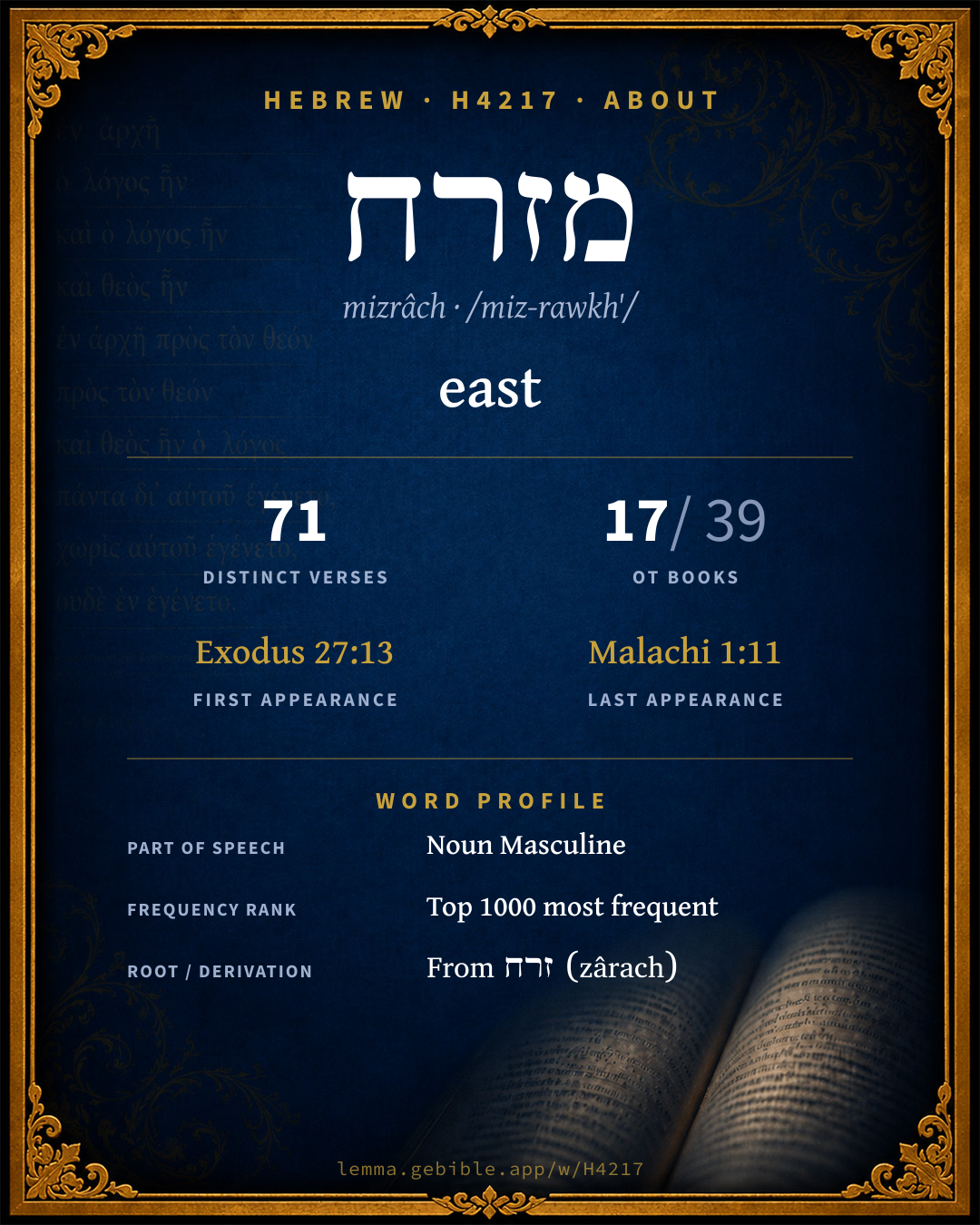
מִזְרָח
east
‘east’ is one of 4 main senses fuller range ↓
Full lexicon entry — Brown-Driver-Briggs (BDB)
From Brown-Driver-Briggs (BDB)
Where this word appears
See every Absolute-state word in the Hebrew Bible →
Grammar key — what these labels mean
Part of speech
- Noun
- A naming word — a person, place, thing, or idea.
Noun type
- Common
- A common noun — a general class of person, place, or thing (“king,” “city,” “water”), not a specific name.
State
- Absolute
- The independent form of a noun, not bound to a following word.
- Construct
- A noun bound to a following noun in a possessive / “of” relationship (the construct chain).
Gender
- Masculine
- Grammatically masculine.
Number
- Singular
- One.
50 distinct verses where H4217 appears in the Absolute state, across 14 books. Filtered view — show all forms. Click any verse to open its interlinear word-by-word view. Verse text shown in the World English Bible for context — . Each verse’s Hebrew form is shown with its reference; the English is not keyword-highlighted, since the data carries no word-level English alignment. Use “Compare translations” on any verse to read it across multiple English versions. This concordance covers the Hebrew Bible; Septuagint (Greek Old Testament) occurrences are not indexed here.
Exodus 2 verses
Numbers 4 verses
- Numbers 2:3 מִזְרָ֔חָ/ה n c ms + sfx dem Those who encamp on the east side toward the sunrise shall be of the standard of the camp of Judah, according to their divisions: and the prince of the children of Judah shall be Nahshon the son of Amminadab.
- Numbers 3:38 מִזְרָ֜חָ/ה n c ms + sfx dem Those who encamp before the tabernacle eastward, in front of the Tent of Meeting toward the sunrise, shall be Moses, and Aaron and his sons, keeping the charge of the sanctuary for the charge of the children of Israel. The stranger who comes near shall be put to death.
- Numbers 32:19 מִזְרָֽחָ/ה n c ms + sfx dem For we will not inherit with them on the other side of the Jordan, and forward; because our inheritance is fallen to us on this side of the Jordan eastward.
- Numbers 34:15 מִזְרָֽחָ/ה n c ms + sfx dem the two tribes and the half-tribe have received their inheritance beyond the Jordan at Jericho eastward, toward the sunrise.
Deuteronomy 3 verses
- Deuteronomy 3:17 מִזְרָֽחָ/ה n c ms + sfx dem the Arabah also, and the Jordan and the border [of it], from Chinnereth even to the sea of the Arabah, the Salt Sea, under the slopes of Pisgah eastward.
- Deuteronomy 3:27 וּ/מִזְרָ֖חָ/ה conj + n c ms + sfx dem Go up to the top of Pisgah, and lift up your eyes westward, and northward, and southward, and eastward, and see with your eyes: for you shall not go over this Jordan.
- Deuteronomy 4:49 מִזְרָ֔חָ/ה n c ms + sfx dem and all the Arabah beyond the Jordan eastward, even to the sea of the Arabah, under the slopes of Pisgah.
Joshua 14 verses
- Joshua 11:3 מִ/מִּזְרָ֣ח prep + n c ms to the Canaanite on the east and on the west, and the Amorite, and the Hittite, and the Perizzite, and the Jebusite in the hill-country, and the Hivite under Hermon in the land of Mizpah.
- Joshua 11:8 מִזְרָ֑חָ/ה n c ms + sfx dem Yahweh delivered them into the hand of Israel, and they struck them, and chased them to great Sidon, and to Misrephoth Maim, and to the valley of Mizpeh eastward; and they struck them, until they left them none remaining.
- Joshua 12:1 מִזְרְחָ֣/ה מִזְרָֽחָ/ה n c ms cs + sfx dem n c ms + sfx dem Now these are the kings of the land, whom the children of Israel struck, and possessed their land beyond the Jordan toward the sunrise, from the valley of the Arnon to Mount Hermon, and all the Arabah eastward:
- Joshua 12:3 מִזְרָ֗חָ/ה מִזְרָ֔חָ/ה n c ms + sfx dem n c ms + sfx dem and the Arabah to the sea of Chinneroth, eastward, and to the sea of the Arabah, even the Salt Sea, eastward, the way to Beth-jeshimoth; and on the south, under the slopes of Pisgah:
- Joshua 13:8 מִזְרָ֔חָ/ה n c ms + sfx dem With him the Reubenites and the Gadites received their inheritance, which Moses gave them, beyond the Jordan eastward, even as Moses the servant of Yahweh gave them:
- Joshua 13:27 מִזְרָֽחָ/ה n c ms + sfx dem and in the valley, Beth Haram, and Beth Nimrah, and Succoth, and Zaphon, the rest of the kingdom of Sihon king of Heshbon, the Jordan and the border [of it], to the uttermost part of the sea of Chinnereth beyond the Jordan eastward.
- Joshua 13:32 מִזְרָֽחָ/ה n c ms + sfx dem These are the inheritances which Moses distributed in the plains of Moab, beyond the Jordan at Jericho, eastward.
- Joshua 16:1 מִזְרָ֑חָ/ה n c ms + sfx dem The lot came out for the children of Joseph from the Jordan at Jericho, at the waters of Jericho on the east, even the wilderness, going up from Jericho through the hill-country to Bethel;
- Joshua 16:5 מִזְרָ֔חָ/ה n c ms + sfx dem The border of the children of Ephraim according to their families was [thus]: the border of their inheritance eastward was Ataroth Addar, to Beth Horon the upper;
- Joshua 16:6 מִזְרָ֖חָ/ה מִ/מִּזְרַ֖ח n c ms + sfx dem prep + n c ms cs and the border went out westward at Michmethath on the north; and the border turned about eastward to Taanath Shiloh, and passed along it on the east of Janoah;
- Joshua 17:10 מִ/מִּזְרָֽח prep + n c ms southward it was Ephraim's, and northward it was Manasseh's, and the sea was his border; and they reached to Asher on the north, and to Issachar on the east.
- Joshua 18:7 מִזְרָ֔חָ/ה n c ms + sfx dem For the Levites have no portion among you; for the priesthood of Yahweh is their inheritance: and Gad and Reuben and the half-tribe of Manasseh have received their inheritance beyond the Jordan eastward, which Moses the servant of Yahweh gave them.
- Joshua 19:13 מִזְרָ֔חָ/ה n c ms + sfx dem and from there it passed along eastward to Gath Hepher, to Eth-kazin; and it went out at Rimmon which stretches to Neah;
- Joshua 20:8 מִזְרָ֔חָ/ה n c ms + sfx dem Beyond the Jordan at Jericho eastward, they assigned Bezer in the wilderness in the plain out of the tribe of Reuben, and Ramoth in Gilead out of the tribe of Gad, and Golan in Bashan out of the tribe of Manasseh.
1 Kings 1 verse
1 Chronicles 8 verses
- 1 Chronicles 5:9 וְ/לַ/מִּזְרָ֗ח conj + prep det + n c ms and eastward he lived even to the entrance of the wilderness from the river Euphrates, because their cattle were multiplied in the land of Gilead.
- 1 Chronicles 5:10 מִזְרָ֥ח n c ms In the days of Saul, they made war with the Hagrites, who fell by their hand; and they lived in their tents throughout all the [land] east of Gilead.
- 1 Chronicles 7:28 וְ/לַ/מִּזְרָ֣ח conj + prep det + n c ms Their possessions and habitations were Bethel and the towns of it, and eastward Naaran, and westward Gezer, with the towns of it; Shechem also and the towns of it, to Azzah and the towns of it;
- 1 Chronicles 9:18 מִזְרָ֑חָ/ה n c ms + sfx dem who hitherto [waited] in the king's gate eastward: they were the porters for the camp of the children of Levi.
- 1 Chronicles 9:24 מִזְרָ֥ח n c ms On the four sides were the porters, toward the east, west, north, and south.
- 1 Chronicles 12:15 לַ/מִּזְרָ֖ח prep det + n c ms These are those who went over the Jordan in the first month, when it had overflowed all its banks; and they put to flight all them of the valleys, both toward the east, and toward the west.
- 1 Chronicles 26:14 מִזְרָ֖חָ/ה n c ms + sfx dem The lot eastward fell to Shelemiah. Then for Zechariah his son, a wise counselor, they cast lots; and his lot came out northward.
- 1 Chronicles 26:17 לַ/מִּזְרָח֮ prep det + n c ms Eastward were six Levites, northward four a day, southward four a day, and for the store-house two and two.
2 Chronicles 4 verses
- 2 Chronicles 4:4 מִזְרָ֔חָ/ה n c ms + sfx dem It stood on twelve oxen, three looking toward the north, and three looking toward the west, and three looking toward the south, and three looking toward the east: and the sea was set on them above, and all their hinder parts were inward.
- 2 Chronicles 5:12 מִזְרָ֣ח n c ms also the Levites who were the singers, all of them, even Asaph, Heman, Jeduthun, and their sons and their brothers, arrayed in fine linen, with cymbals and psalteries and harps, stood at the east end of the altar, and with them one hundred twenty priests sounding with trumpets;)
- 2 Chronicles 29:4 הַ/מִּזְרָֽח ptcl def.art + n c ms He brought in the priests and the Levites, and gathered them together into the broad place on the east,
- 2 Chronicles 31:14 לַ/מִּזְרָ֔חָ/ה prep det + n c ms + sfx dem Kore the son of Imnah the Levite, the porter at the east [gate], was over the freewill-offerings of God, to distribute the offerings of Yahweh, and the most holy things.
Nehemiah 3 verses
- Nehemiah 3:26 לַ/מִּזְרָ֔ח prep det + n c ms (Now the Nethinim lived in Ophel, to the place over against the water gate toward the east, and the tower that stands out.)
- Nehemiah 3:29 הַ/מִּזְרָֽח ptcl def.art + n c ms After them repaired Zadok the son of Immer over against his own house. After him repaired Shemaiah the son of Shecaniah, the keeper of the east gate.
- Nehemiah 12:37 מִזְרָֽח n c ms By the spring gate, and straight before them, they went up by the stairs of the city of David, at the ascent of the wall, above the house of David, even to the water gate eastward.
Psalms 2 verses
Isaiah 3 verses
- Isaiah 41:2 מִ/מִּזְרָ֔ח prep + n c ms Who has raised up one from the east, whom he calls in righteousness to his foot? he gives nations before him, and makes him rule over kings; he gives them as the dust to his sword, as the driven stubble to his bow.
- Isaiah 43:5 מִ/מִּזְרָח֙ prep + n c ms Don't be afraid; for I am with you: I will bring your seed from the east, and gather you from the west;
- Isaiah 46:11 מִ/מִּזְרָח֙ prep + n c ms calling a ravenous bird from the east, the man of my counsel from a far country; yes, I have spoken, I will also bring it to pass; I have purposed, I will also do it.
Jeremiah 1 verse
Daniel 2 verses
- Daniel 8:9 הַ/מִּזְרָ֖ח ptcl def.art + n c ms Out of one of them came forth a little horn, which grew exceeding great, toward the south, and toward the east, and toward the glorious [land].
- Daniel 11:44 מִ/מִּזְרָ֖ח prep + n c ms But news out of the east and out of the north shall trouble him; and he shall go forth with great fury to destroy and utterly to sweep away many.
Amos 1 verse
Zechariah 2 verses
- Zechariah 8:7 מִזְרָ֑ח n c ms Thus says Yahweh of Hosts: "Behold, I will save my people from the east country, and from the west country;
- Zechariah 14:4 מִזְרָ֣חָ/ה n c ms + sfx dem His feet will stand in that day on the Mount of Olives, which is before Jerusalem on the east; and the Mount of Olives will be split in two, from east to west, making a very great valley. Half of the mountain will move toward the north, and half of it toward the south.
About this entry
At a glance — auto-summarized from this page’s data, not written by a person. Every figure links to its source below. This summary describes the numbers; it doesn’t interpret them.
מזרח (mizrâch) is a Hebrew noun most often rendered “east.” It is not a single-sense word — see its full sense range. The Hebrew Bible uses it across 71 verses — moderately common. Joshua dominates its distribution — 20 of 71 verses. Debuting at Exodus 27:13, it then recurs through the corpus. For the data behind this summary, explore the sense tree and the renderings breakdown below.
Gloss history
Strong's 1890 vs modern scholarship
About this word
Strong's H4217 catalogs a Hebrew word from the Hebrew Old Testament.
These counts are not copied from any lexicon or concordance. They are computed here, from the morphology-tagged Hebrew Old Testament. What Lemma adds →
- 71
- distinct verses
- The word appears in 71 distinct verses.
- 17 / 39
- OT books
- The word appears in 17 of 39 Old Testament books.
- #536
- by frequency
- Top 1000 most frequent Hebrew words (rank 536 of 8,640 Hebrew words by occurrence).
View all 71 occurrences in the concordance →
Most concentrated in
- Joshua 20 verses 28%
- 1 Chronicles 10 verses 14%
- Isaiah 6 verses 8%
By section of the Old Testament
By traditional corpus
Conventional, traditional groupings — biblical authorship is debated, so this is a traditional corpus grouping, not an authorship claim. Each share is this word’s portion of its verses in that division of the Hebrew canon. Each figure is a share of the word’s 71 distinct verses.
- Prophets (Nevi'im) 36 verses · 51%
- Writings (Ketuvim) 23 verses · 32%
- Torah (Pentateuch) 12 verses · 17%
How translations render this word
Counts come from each version’s own published word-to-Strong’s tagging or interlinear alignment — an approximate guide to how each version renders this word, not a word-level alignment the data otherwise carries. Because each total is that version’s own tagged count, the per-version totals vary from one another and need not match the appearance or distinct-verse counts above. These counts may also differ from a printed concordance because Lemma counts each distinctly tagged rendering and does not collapse phrase taggings into a single head-word total. This is a fixed set of word-tagged versions (KJV, ASV, BSB, ULT) and does not change with the reading translation you choose elsewhere. Each version’s license is shown beside its name below (and on Sources).
- King James Version: East 19×, Eastward 19×, Toward the sunrising 9×
- American Standard Version: Eastward 24×, East 13×, Toward the sunrising 11×
- Berean Standard Bible: East 44×, Eastward 6×, Toward the sunrise 5×
- unfoldingWord Literal Text: East 20×, Sunrise 16×, Rising of 12×
King James Version Public Domain
Renders H4217 across 73 tagged occurrences — most commonly:
Plus 6 renderings that appear only once — usually multi-word phrases or single function words the recovered tagging swept in, not distinct renderings. Not rendered by a distinct English word in 1 further occurrence.
American Standard Version Public Domain
Renders H4217 across 70 tagged occurrences — most commonly:
Plus 8 renderings that appear only once — usually multi-word phrases or single function words the recovered tagging swept in, not distinct renderings. Not rendered by a distinct English word in 1 further occurrence.
Berean Standard Bible Public Domain
Renders H4217 across 70 tagged occurrences — most commonly:
Plus 5 renderings that appear only once — usually multi-word phrases or single function words the recovered tagging swept in, not distinct renderings. Not rendered by a distinct English word in 2 further occurrences.
unfoldingWord Literal Text CC BY-SA 4.0
Renders H4217 across 78 tagged occurrences — most commonly:
Plus 3 renderings that appear only once — usually multi-word phrases or single function words the recovered tagging swept in, not distinct renderings.
7 senses and sub-senses in the full BDB
What do BDB’s symbols mean?
BDB uses these scholarly abbreviations:
| Symbol | Meaning |
|---|---|
| 𝔊 | the Septuagint (the ancient Greek translation, LXX) |
| 𝔙 | the Vulgate (the Latin translation) |
| 𝔖 | the Syriac version (the Peshitta) |
| 𝔗 | the Targum (the Aramaic translation) |
| ψ | the Psalms |
| √ | root (the underlying root or stem) |
| ‖ | parallel passage (a synonymous or contrasted parallel) |
| † | the dagger: every passage where the word occurs is cited |
The 7 senses and sub-senses the full Brown-Driver-Briggs lexicon distinguishes for this word, in lexicon order (not ranked by frequency), with BDB’s own verbatim wording and sub-sense lettering. Shown in Hebrew script with BDB’s own scholarly abbreviations. The condensed entry is in the Lexicon Entry tab. See also the Forms in the corpus table below.
- 1. sunrise, always of quarter of the heavens = east מ׳ (ה)שׁמשׁ Nu 21:11 (P), Dt 4:41, 47 Jos 1:15; 12:1; 13:5 (all D), 19:12, 27, 34 (all P), Ju 20:43; 21:19 2 K 10:33 Is 41:25; 45:6; 59:19, cf. מ׳ שׁמשׁ לארץ Ju 11:18; מִמִּז׳ שׁמשׁ וְעַד־מְבוֹאוֹ ψ 50:1; 113:3 Mal 1:11; more often e.g. Numbers 21:11
- 2. without שֶׁמֶשׁ:
- a. the east בִּרְחֹק מ׳ מִמַּעֲרָ֑ב ψ 103:12. e.g. Psalms 103:12
- b. מִמּ׳ from the east Is 41:2; 43:5 (opp. מִמַּעֲרָב), 46:11 Dn 11:44 (+ מִצָּפוֹן); מִמּ׳ וּמִמַּעֲרָ֑ב מִצָּפוֹן וּמִיָּם ψ 107:3. e.g. Isaiah 41:2
- c. to or toward the place of sunrise, to the east, eastward: (1) מִזְרָ֫חָה Nu 32:19 (P), Dt 3:17, 27 (יָ֫מָּה וְצָפ֫וֹנָה וְתֵימָ֫נָה וּמ׳), 4:49 Jos 11:8; 16:1 (JE), 12:1, 3(×2); 13:8 (all D), v 27, 32; 16:5; 18:7; 20:8 (all P), 1 Ch 9:18; 26:14; ‖ קֵ֫דְמָה Nu 3:38 Jos 19:13 (both P) Je 31:40; ‖ צָפ֫וֹנָה, יָ֫מָּה, נֶ֫גְבָּה 1 K 7:25, cf. Jos 16:6 (P) 1 Ch 26:17; + קֵ֫דְמָה Ex 27:13; 38:13 Nu 2:3; 34:15 (all P); מִקֶּדֶם Zc 14:4 (opp. יָ֫מָּה); (2) מִזְרָח (without ה loc.), מ׳ יָ֫מָּה צָפ֫וֹנָה וָנֶ֫גְבָּה 1 Ch 9:24, cf. Ne 12:37; מ׳ לַמִּזְבֵּחַ 2 Ch 5:12; (3) לַמִּז׳ 1 Ch 5:9; 7:28 (opp. לַמַּעֲרָב) 12:16 (so Baer; v 15 van d. H.; opp. id.), 26:17 (+ לַצָּפ֫וֹנָה, לַנֶּ֫גְבָּה), Ne 3:26; לַמִּזְרָ֫חָה 2 Ch 31:14; (4) אֶל־הַמּ׳ Dn 8:9 (+ אֶל־הַנֶּגֶב, אֶל־הַצֶּ֑בִי); (5) מִיָּם עָד־יָם וּמִצָּפוֹן עַד־מִזְרָח Am 8:12. e.g. Numbers 32:19
- d. (on) the east side of, cstr. קְצֵה מִזְרַח יְרִיחוֹ Jos 4:19 (P); also c. לְמִזְרַח הַגָּ֑יְא לְ 1 Ch 4:39, לְמ׳ הַיַּרְדֵּן 6:63; c. מִן, מִמִּז׳ Jos 11:3 (opp. מִיָּם) cf. 17:10 (+ מִצָּפוֹן; both JE), also 16:6 (P). e.g. Joshua 4:19
- e. after a cstr. עַל־כָּל־פְּנֵי מ׳ לגלעד 1 Ch 5:10; רְחוֹב הַמּ׳ 2 Ch 29:4; שַׁעַר הַמּ׳ Ne 3:29; אֶרֶץ מ׳ Zc 8:7 (opp. ארץ מְבוֹא הַשֶּׁמֶשׁ). e.g. 1 Chronicles 5:10
Senses from the full Brown-Driver-Briggs lexicon (Brown, Driver, Briggs; Oxford 1906 — public domain), digitized via Sefaria, supplemented by the OpenScriptures HebrewLexicon (CC BY 4.0). Full attribution on Sources.
Word origin
n.[m.] place of sunrise, east—abs. מ׳ Jos 11:3 + 21 times; cstr. מִזְרַח Nu 21:10 + 19 times, c. ה loc. מִזְרָ֫חָה Ex 27:13 + 28 times, cstr. מִזְרְחָה Dt 4:41 Jos 12:1 Ju 21:19 (not in Gn Lv Sa Ez etc.);—
— Brown-Driver-Briggs (Oxford 1906, public domain), digitized via Sefaria, supplemented by the OpenScriptures HebrewLexicon (CC BY 4.0). See Sources.
Derived from זרח (zârach) (H2224) — to rise.
Jastrow Dictionary
A second Hebrew/Aramaic lexicon for comparison, covering Aramaic and post-biblical (Talmudic, Targumic, Midrashic) usage that the biblical-Hebrew BDB does not. Matched by lemma rather than by Strong’s number, so a lemma may carry more than one Jastrow headword (shown separately below), and the entries cover usage well beyond the Bible.
מִזְרָח
- sunrise, East. Men. 110ᵃ מקרטיגני כלפי מ׳ from Carthagene eastward. Tam. I, 3 דרך המ׳ in an eastern direction. Ib. 4 למִזְרָחוֹ של כבש east of the bridge. Ib. II, 4 מִזְרָחָה facing east. Ib. III, 2; Yoma III, 1 פני כל המ׳, v. אוֹר I.—Sabb. 156ᵇ (Chald. dict.) ומוקמינא ליה במ׳ and I will place it in the eastern horizon; a. fr.
A Dictionary of the Targumim, the Talmud Babli and Yerushalmi, and the Midrashic Literature (Marcus Jastrow; London, Luzac, 1903) — Public Domain. Digitized via Sefaria. Digitized via Sefaria. Full attribution on Sources.
Forms in the corpus
The 36 distinct written forms H4217 takes in the Hebrew Bible, most frequent first — each parse links to that state’s occurrences in the concordance. Hebrew forms include their vowel points and cantillation, so a single lemma takes many written forms.
Same root — word family
Other BDB entries built from the same root as H4217, grouped by Strong’s listed origin. These share a root / origin per the lexicon — not necessarily a shared meaning. Each links to that word’s own entry.
Derives from
Shares the same root
Proper names from this root
People and places named from this root — a name, not an additional meaning of the word.
Compare all same-root words → Showing 4 of 5 — not the complete family. 1 of the same-root words is a proper name (a person or place). They share a root, not necessarily a meaning.
Septuagint verse parallels
This word appears in 66 verses that also exist in the Greek Old Testament (Septuagint), out of the 71 Hebrew verses it occurs in. You can read those verses in Greek by switching the Old Testament edition to the Septuagint.
Read these verses in the Septuagint
- Exodus 27:13
- Numbers 2:3
- Deuteronomy 3:17
- Joshua 1:15
- Judges 11:18
- 1 Kings 7:25
- 2 Kings 10:33
- 1 Chronicles 4:39
- 2 Chronicles 4:4
- Psalms 50:1
- Isaiah 41:2
- Jeremiah 31:40
This is a verse-level parallel only — the same verses exist in both the Hebrew and Greek Old Testaments. No word-level Hebrew↔Greek correspondence is claimed: the data carries no such alignment, so no Greek word is shown as this Hebrew word’s translation. Coverage is not total — the Septuagint omits the deuterocanon and renumbers the Psalms, so some Hebrew verses have no direct Greek parallel.