Numbers 32:19

Hebrew (Westminster Leningrad Codex) Numbers 32:19 appears in the Hebrew Old Testament. The text above is from the Westminster Leningrad Codex. Each word links to its Strong’s number, a concise gloss, and parsing drawn from the Open Scriptures Hebrew Bible morphology. Click any word for its full Brown-Driver-Briggs (BDB) entry.
Download image
Cite this verse

Numbers 32:19 (World English Bible). Public Domain. Lemma interlinear Bible study tool, https://lemma.gebible.app/v/numbers/32/19.

Show BibTeX & RIS
BibTeX
RIS
English Translation
For we will not inherit with them on the other side of the Jordan, and forward; because our inheritance is fallen to us on this side of the Jordan eastward.
World English Bible · Public Domain
Download a study sheet

One document with this verse’s original text, its word-by-word gloss line, the meaning frame, cross-references with their text, attributed commentary, and full source and license credits — printable, and it pastes into notes with its structure intact.

This verse Autodidact and up

Study sheet (.html) Plain text (.txt)

A passage Seminary Student

Up to 50 verses in one chapter. A passage sheet keeps up to 6 commentary sources and 12 cross-references per verse, in the order this page ranks them, and says so on the sheet whenever that leaves anything out. Ask for a single verse and you get the Autodidact verse sheet above.

Everything on this page stays free to read, with no account — the sheet is a download of what is already on screen, not access to it.

Want to remove ads? Support Godless Engineer
Compare translations 3

The same verse in 3 English versions, stacked beneath the original-language interlinear above. Click any original word for its lexicon entry.

Each is an independent rendering of the whole verse — the interlinear is not word-aligned to these translations.

Highlighted words mark where these versions differ — a whole-verse word diff, not a word-by-word alignment.

  • World English Bible Public Domain
    For we will not inherit with them on the other side of the Jordan, and forward; because our inheritance is fallen to us on this side of the Jordan eastward.
  • King James Version Public Domain
    For we will not inherit with them on yonder side Jordan, or forward; because our inheritance is fallen to us on this side Jordan eastward.
  • unfoldingWord Literal Text CC BY-SA 4.0
    For we will not inherit with them from across of the Jordan and beyond, because our inheritance came to us from beyond the Jordan toward the sunrise.”

unfoldingWord Literal Text — © unfoldingWord, licensed CC BY-SA 4.0. Word-aligned USFM3 via Door43 (git.door43.org/unfoldingWord/en_ult).

Versions to compare (up to 4)

3 of 4 selected

Show all 18 translations

Every available English version of this verse, each an independent rendering of the whole verse.

  • World English Bible Public Domain
    For we will not inherit with them on the other side of the Jordan, and forward; because our inheritance is fallen to us on this side of the Jordan eastward.
  • Berean Standard Bible Public Domain
    Yet we will not have an inheritance with them across the Jordan and beyond, because our inheritance has come to us on the east side of the Jordan.”
  • Majority Standard Bible Public Domain
    Yet we will not have an inheritance with them across the Jordan and beyond, because our inheritance has come to us on the east side of the Jordan.”
  • King James Version Public Domain
    For we will not inherit with them on yonder side Jordan, or forward; because our inheritance is fallen to us on this side Jordan eastward.
  • American Standard Version (1901) Public Domain
    For we will not inherit with them on the other side of the Jordan, and forward; because our inheritance is fallen to us on this side of the Jordan eastward.
  • Revised Version (1885) Public Domain
    For we will not inherit with them on the other side Jordan, and forward; because our inheritance is fallen to us on this side Jordan eastward.
  • Geneva Bible (1599) Public Domain
    Neither wil we inherite with them beyond Iorden and on that side, because our inheritance is fallen to vs on this side Iorden Eastwarde.
  • Douay-Rheims (1899) Public Domain
    Neither will we seek any thing beyond the Jordan, because we have already our possession on the east side thereof,
  • Young's Literal Translation Public Domain
    for we do not inherit with them beyond the Jordan and yonder, for our inheritance hath come unto us beyond the Jordan at the `sun'-rising.'
  • Literal Standard Version CC BY-SA 4.0
    for we do not inherit with them across the Jordan and beyond, for our inheritance has come to us beyond the Jordan at the [sun]-rising.”
  • Unlocked Literal Bible CC BY-SA 4.0
    We will not inherit the land with them on the other side of the Jordan, because our inheritance is here on the east side of the Jordan.”
  • unfoldingWord Literal Text CC BY-SA 4.0
    For we will not inherit with them from across of the Jordan and beyond, because our inheritance came to us from beyond the Jordan toward the sunrise.”
  • Darby Bible Public Domain
    For we will not inherit with them on yonder side the Jordan, and further, because our inheritance is fallen to us on this side the Jordan eastward.
  • World Messianic Bible Public Domain
    For we will not inherit with them on the other side of the Jordan and beyond, because our inheritance has come to us on this side of the Jordan eastward.”
  • Webster's Bible Public Domain
    For we will not inherit with them on the other side of Jordan, or forward; because our inheritance hath fallen to us on this side of Jordan eastward.
  • Free Bible Version CC BY-SA 4.0
    However, we won't own any land on the other side of the Jordan because we've received this land to own on this eastern side of the Jordan.”
  • Bible in Basic English Public Domain
    For we will not have our heritage with them on the other side of Jordan and forward; because our heritage has come to us on this side of Jordan to the east.
  • JPS Tanakh (1917) Public Domain
    For we will not inherit with them on the other side of the Jordan, and forward, because our inheritance is fallen to us on this side of the Jordan eastward.'

Literal Standard Version (2020), Covenant Press — licensed CC BY-SA 4.0. Text via the HelloAO Bible API (eBible.org). Unlocked Literal Bible (unfoldingWord) — licensed CC BY-SA 4.0. Text via the HelloAO Bible API (eBible.org). unfoldingWord Literal Text — © unfoldingWord, licensed CC BY-SA 4.0. Word-aligned USFM3 via Door43 (git.door43.org/unfoldingWord/en_ult). Free Bible Version, Dr. Jonathan Gallagher — licensed CC BY-SA 4.0. Text via the HelloAO Bible API (eBible.org).

Word by word

More ways to search: Search by grammar → Find every occurrence → Compare this word →

Practice this passage: Drill this verse → Learn its vocabulary →

וָהָ֑לְאָה
hâlᵉʼâh
H1973
“and · yonder”
Conjunction + Adverb
Part of Speech
Conjunction + Adverb
Full BDB Definition

Origin: from the primitive form of the article [hal]

TWOT: 496a

out there, onwards, further - yonder, beyond (of place) - onwards (of time)
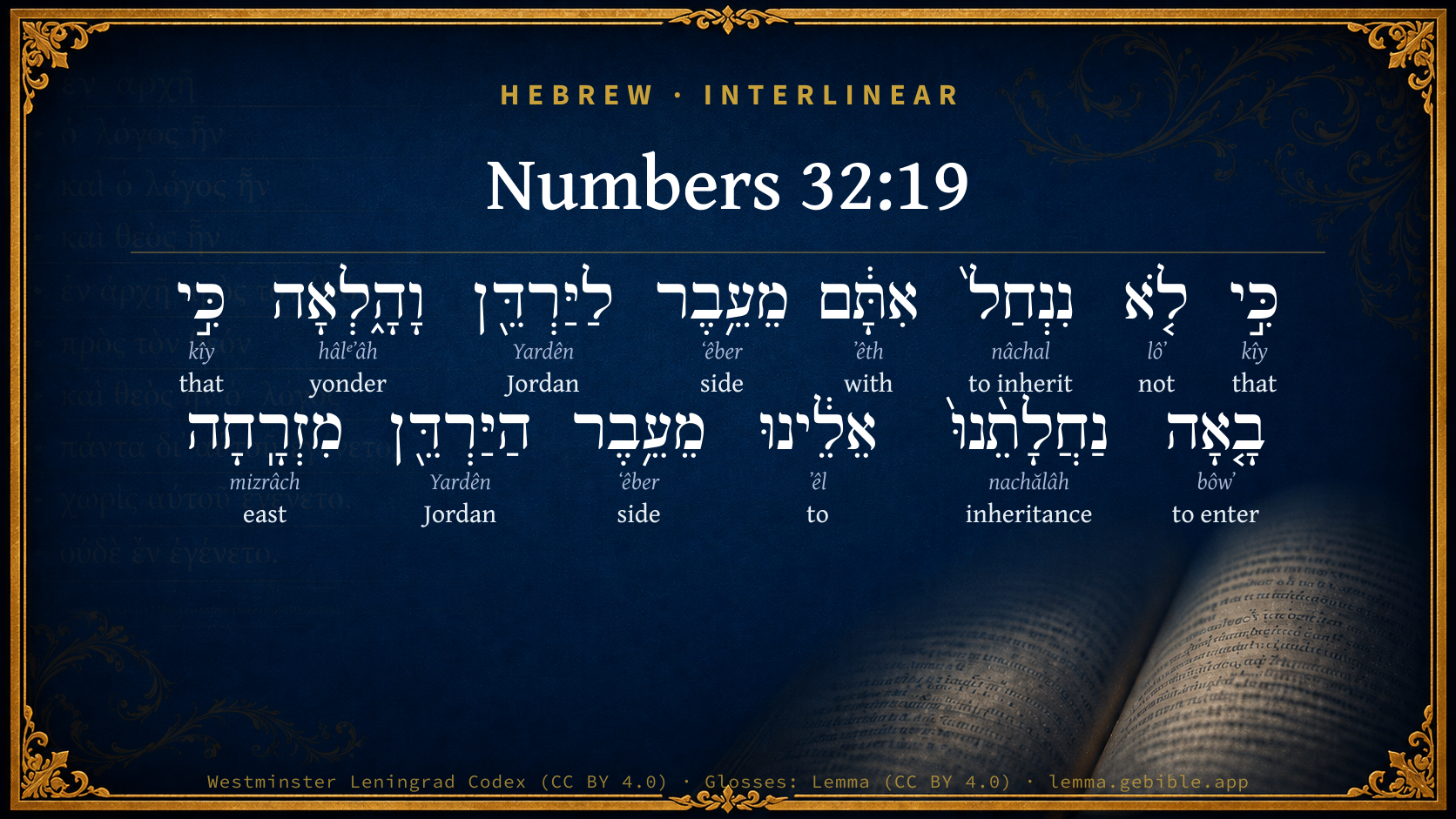
  1. כִּ֣י kîy H3588 “that” Conjunction
  2. לֹ֤א lôʼ H3808 “not” Particle, Negative
  3. נִנְחַל֙ nâchal H5157 “to inherit” Verb, Qal, Imperfect, 1st Person, Common, Plural
  4. אִתָּ֔ם ʼêth H854 “with · them” Preposition + Suffix, Personal, 3rd Person, Masculine, Plural
  5. מֵעֵ֥בֶר ʻêber H5676 “from · side” Preposition + Noun, Common, Masculine, Singular, Absolute
  6. לַיַּרְדֵּ֖ן Yardên H3383 “to/for the · Jordan” Preposition, Determined + Noun, Proper
  7. כִּ֣י kîy H3588 “that” Conjunction
  8. בָ֤אָה bôwʼ H935 “to enter” Verb, Qal, Perfect, 3rd Person, Feminine, Singular
  9. נַחֲלָתֵ֨נוּ֙ nachălâh H5159 “inheritance · our” Noun, Common, Feminine, Singular, Construct + Suffix, Personal, 1st Person, Common, Plural
  10. אֵלֵ֔ינוּ ʼêl H413 “to · us” Preposition + Suffix, Personal, 1st Person, Common, Plural
  11. מֵעֵ֥בֶר ʻêber H5676 “from · side of” Preposition + Noun, Common, Masculine, Singular, Construct
  12. הַיַּרְדֵּ֖ן Yardên H3383 “the · Jordan” Particle, Definite Article + Noun, Proper
  13. מִזְרָֽחָה mizrâch H4217 “east · toward” Noun, Common, Masculine, Singular, Absolute + Suffix, Demonstrative

About this verse

These counts appear in no published source. They are computed here, from the morphology-tagged text and Lemma’s own curated glosses. What Lemma adds →

14
words
11
distinct lemmas
Pentateuch
section

Notable vocabulary

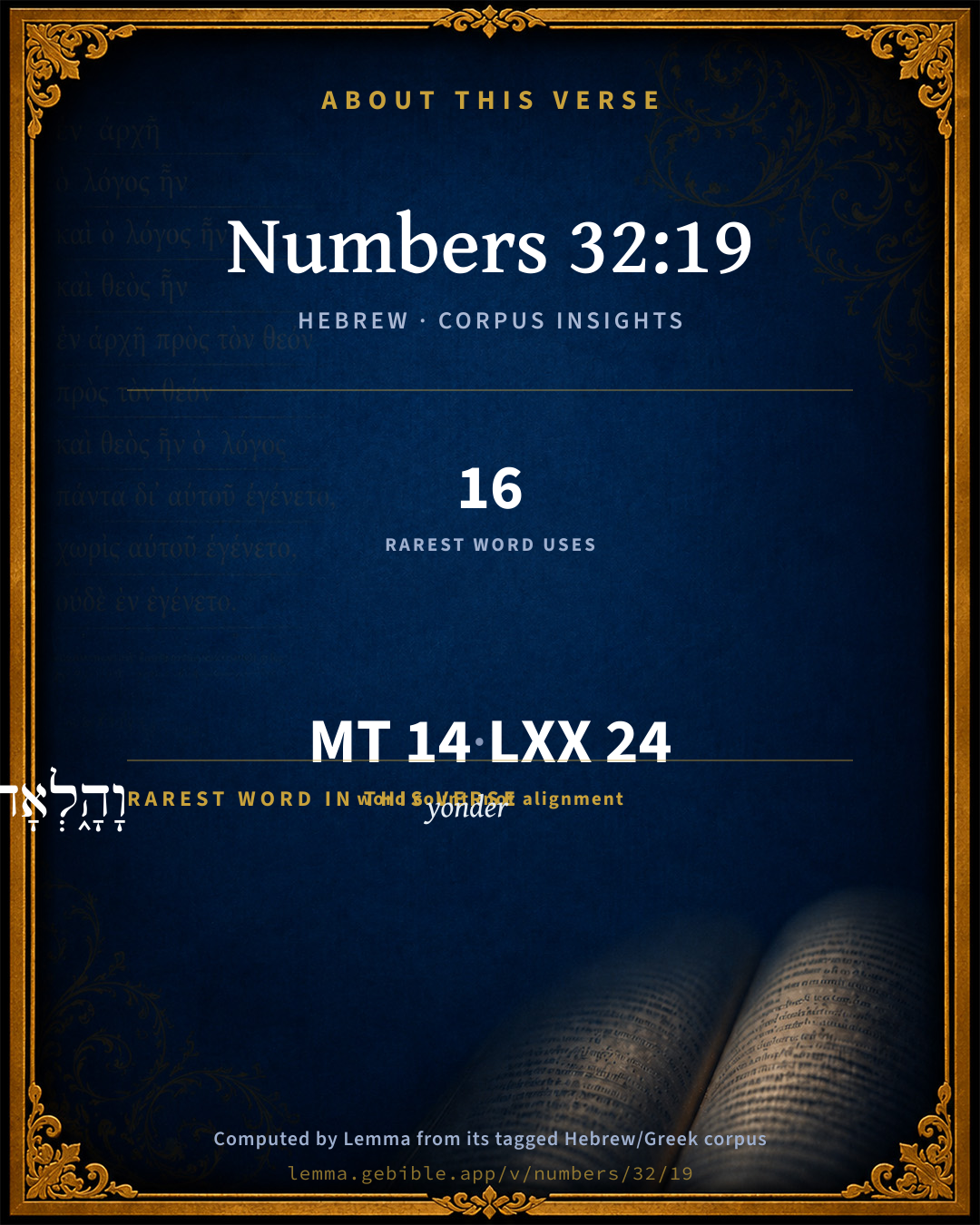
The rarest word here is וָהָ֑לְאָה yonder H1973 — appearing just 16 times in the whole Hebrew Bible.

Shared distinctive vocabulary

וָהָ֑לְאָה yonder H1973 occurs in 16 verses of the Hebrew Bible. Also found in:

Grammatical profile

  • 2 verbs
  • 6 nouns
  • 2 prepositions
  • 2 conjunctions
  • 1 adverb
  • 1 particle

Verb forms

  • נִנְחַל֙ Qal · Imperfect
  • בָ֤אָה Qal · Perfect

Repetition

Words recur within this verse — often emphatic in Hebrew:

  • מֵעֵ֥בֶר side H5676 ×2
  • לַיַּרְדֵּ֖ן Jordan H3383 ×2
  • כִּ֣י that H3588 ×2

Hebrew & Septuagint length

In English translation the verse runs 30 words from the Hebrew and 29 from the Septuagint (LXX English) — closely comparable.

A rough comparison of the two English renderings, which tokenize alike — not a word-level alignment.

Word counts can differ between the Hebrew and the Greek without any difference in meaning — e.g. the Hebrew direct-object marker אֵת has no separate Greek word, and Greek often adds the article ὁ.

In the original languages it is 14 Hebrew tokens and 24 Greek tokens — but the two are counted differently (Hebrew bundles its prefixes and suffixes into one token; the Greek is in lemma form), so that isn’t a like-for-like length.

Cross-references

11

Topical passages linked to Numbers 32:19 in the Treasury of Scripture Knowledge — connected by theme and wording, ordered by reader-vote popularity; previews shown in the World English Bible.

  • Joshua 13:8 With him the Reubenites and the Gadites received their inheritance, which Moses gave them, beyond the Jordan eastward, even as Moses the servant of Yahweh gave them:
  • Genesis 13:10–12 Lot lifted up his eyes, and saw all the plain of the Jordan, that it was well watered every where, before Yahweh destroyed Sodom and Gomorrah, like the garden of Yahweh, like the land of Egypt, as you go to Zoar.
  • Genesis 14:12 They took Lot, Abram's brother's son, who lived in Sodom, and his goods, and departed.
  • Numbers 32:32–33 We will pass over armed before Yahweh into the land of Canaan, and the possession of our inheritance [shall remain] with us beyond the Jordan.
  • Numbers 34:15 the two tribes and the half-tribe have received their inheritance beyond the Jordan at Jericho eastward, toward the sunrise.
  • Joshua 1:14–15 Your wives, your little ones, and your cattle, shall abide in the land which Moses gave you beyond the Jordan; but you shall pass over before your brothers armed, all the mighty men of valor, and shall help them;
  • Joshua 12:1–6 Now these are the kings of the land, whom the children of Israel struck, and possessed their land beyond the Jordan toward the sunrise, from the valley of the Arnon to Mount Hermon, and all the Arabah eastward:
  • 2 Kings 10:32–33 In those days Yahweh began to cut off from Israel: and Hazael struck them in all the borders of Israel;
  • 2 Kings 15:29 In the days of Pekah king of Israel came Tiglath Pileser king of Assyria, and took Ijon, and Abel Beth Maacah, and Janoah, and Kedesh, and Hazor, and Gilead, and Galilee, all the land of Naphtali; and he carried them captive to Assyria.
  • 1 Chronicles 5:25–26 They trespassed against the God of their fathers, and played the prostitute after the gods of the peoples of the land, whom God destroyed before them.
  • Proverbs 20:21 An inheritance quickly gained at the beginning, Won't be blessed in the end.

Cross-references courtesy of OpenBible.info (CC BY 4.0).

Hebrew and Greek witnesses Masoretic Hebrew ↔ Greek Septuagint

The same verse in the two great witnesses to the Old Testament, shown verse-for-verse.

These are two independent witnesses, not word-aligned to each other, and the Septuagint is shown in lemma (dictionary) form.

Hebrew Numbers 32:19 Masoretic · Westminster Leningrad Codex

כִּ֣י לֹ֤א נִנְחַל֙ אִתָּ֔ם מֵעֵ֥בֶר לַיַּרְדֵּ֖ן וָהָ֑לְאָה כִּ֣י בָ֤אָה נַחֲלָתֵ֨נוּ֙ אֵלֵ֔ינוּ מֵעֵ֥בֶר הַיַּרְדֵּ֖ן מִזְרָֽחָה

For we will not inherit with them on the other side of the Jordan, and forward; because our inheritance is fallen to us on this side of the Jordan eastward.

World English Bible · Public Domain

Greek LXX Numbers 32:19 Septuagint · lemma form

καί οὐκέτι κληρονομέω ἐν αὐτός ἀπό ὁ πέραν ὁ ἰορδάνης καί ἐπέκεινα ὅτι ἀποἔχω ὁ κλῆρος ἐγώ ἐν ὁ πέραν ὁ ἰορδάνης ἐν ἀνατολή

And we will not any longer inherit with them from the other side of Jordan and onwards, because we have our full inheritance on the side beyond Jordan eastward.

LXX2012 (modern English Septuagint) · Public Domain

On this verse, The Pulpit Commentary discusses the Septuagint’s reading. Read the note in Commentary ↓

Hebrew: Westminster Leningrad Codex (CC BY 4.0). Greek: Septuagint (public domain); English from LXX2012 (modern English Septuagint) (Public Domain). How the Septuagint differs from the Hebrew →

Targum (Aramaic paraphrase)

2

The Targum is the ancient Jewish Aramaic paraphrase of the Hebrew Scriptures — an interpretive translation, not the Hebrew text itself. Onkelos (literal) and Pseudo-Jonathan (expansive) render the Torah, and Jonathan the Prophets. Coverage is partial: where no permissively-licensed English translation exists for a verse, only the Aramaic is shown. This is verse-level text, not a word-by-word alignment to the Hebrew.

  1. Targum Onkelos Torah (Genesis–Deuteronomy)
    אֲרֵי לָא נַחֲסִין עִמְהוֹן מֵעִבְרָא לְיַרְדְנָא וּלְהָלָא אֲרֵי קַבֵּילְנָא אַחֲסַנְתָּנָא לָנָא מֵעִבְרָא לְיַרְדְנָא מַדִינְחָא

    (no public-domain English translation for this verse)

    Targum Onkelos — Aramaic: “Onkelos Genesis” (public domain); “Onkelos Exodus” (public domain); “Onkelos Leviticus” (public domain); “Onkelos Numbers” (public domain); “Onkelos Deuteronomy” (public domain). English: “Sefaria Community Translation” (CC0 1.0 (public-domain dedication)); “J.W. Etheridge. The Targums of Onkelos and Jonathan Ben Uzziel on the Pentateuch. London: Longmans, Green, 1862” (public domain). Text via Sefaria.

  2. Targum Pseudo-Jonathan Torah (Genesis–Deuteronomy)
    אֲרוּם לָא נַחְסִין עִמְהוֹן מֵעִיבְרָא לְיוֹרְדְנָא וּלְהָלָא אֲרוּם מָטַת אַחְסַנְתָּנָא לָנָא מֵעִיבְרָא דְיוֹרְדְנָא מַדִינְחָא

    For we will not inherit with them over the Jordan and beyond; for our inheritance cometh to us beyond Jordan eastward.

    Targum Pseudo-Jonathan — Aramaic: “Targum Jonathan on Genesis” (public domain); “Targum Jonathan on Exodus” (public domain); “Targum Jonathan on Leviticus” (public domain); “Targum Jonathan on Numbers” (public domain); “Targum Jonathan on Deuteronomy” (public domain). English: “The Targum of Jonathan ben Uzziel, trans. J. W. Etheridge, London, 1862” (public domain). Text via Sefaria.

Commentary

Notes on Numbers 32:19 from classic Christian and Jewish commentators (each source and its license shown beneath its notes). The classic Christian expositions comment on the surrounding passage and are grouped to its opening verse, so a note may address several verses; the Jewish commentaries on the Tanakh (Rashi and others) are per-verse, so they appear only where the commentator wrote on this verse.

Lemma curates 59 commentaries, every one of them public domain or Creative Commons licensed, each selected and text-cleaned for this edition rather than reprinted as found. About our sources →

Ellicott's Commentary for English Readers

(19) For we will not inherit with them on yonder side Jordan, or forward . . . on this side Jordan eastward.—This is one of the critical passages which determine the meaning of the word which is rendered “on yonder side” in the first clause of the verse, and “on this side” in the second clause. It is true that the meaning of the word in the first clause is defined by the addition of the word which is rendered “or forward,” and which is more correctly rendered and forward—i.e., “further off,” or “to a greater distance; “and that its meaning in the second clause is defined by the addition of the word “eastward,” or “towards the sun-rising;” but the application of the same word to the country on both sides of the Jordan shows that it cannot be inferred, with any degree of certainty, from the use of this word, whether the position of the writer was on the eastern or western side of the river. (See Num_32:32, where the same word occurs without any addition.) The language of the Gadites and the Reubenites must not be interpreted as if it were spoken in a defiant spirit, but as disclaiming their right to any portion of the inheritance on the west of the Jordan if they obtained their request to settle on the eastern side.

A Bible Commentary for English Readers, edited by Charles John Ellicott (1878–1897) — public domain. Text from a community e-Sword module.

John Gill's Exposition

And Moses said unto them,.... Being better disposed towards them, and more satisfied with the reasonableness of their request, it being explained unto him:

if ye will do this thing; which they had promised:

if ye will go armed before the Lord to war; they had said they would go ready armed before the children of Israel, but Moses expresses it "before the Lord"; which is more agreeable to their encampment and order in marching, for not the standard of Reuben but that of Judah went foremost, yet the standard of Reuben marched directly before the sanctuary bore by the Kohathites, Num 10:18, and so might be properly said to go before the Lord, who dwelt there.

John Gill's Exposition of the Whole Bible (1746–1763) — public domain (CC PDM 1.0). Text via the HelloAO Bible API.

Haydock's Catholic Bible Commentary

Jordan. Hebrew adds, "or forward," any where, in case fresh conquests be made. (Calmet)

George Leo Haydock (1774–1849), Haydock's Catholic Family Bible and Commentary, 1859 edition — public domain. Excludes Psalms (Douay-Rheims chapter numbering differs from Protestant) and Deuterocanonical books (Catholic canon only).

Whedon's Commentary on the Bible

Daniel D. Whedon

19. This side Jordan — According to geographical usage, the land “beyond Jordan” signifies the country to the east of the river. But to prevent mistake in this instance the word eastward is added. The application of the same expression to the land on the west and the east of the Jordan indicates a transition period. Jos_1:14, note.

Daniel D. Whedon (gen. ed.), Commentary on the Old and New Testaments (1874–1909) — public domain. Text from a community e-Sword module.

The Pulpit Commentary

On yonder side Jordan. Deryl rbeme. Septuagint, apo tou peran tou Iordanou . This phrase is here used in what is apparently its more natural sense, as it would be used by one dwelling in the plains of Moab. (see on Num_22:1, and on next verse) Or forward. halhw. Septuagint, kai epekeina , i.e., onwards towards the west and south and north, as the tide of conquest might flow. Our inheritance is fallen to us on this side Jordan eastward. It does not appear on what ground they spoke so confidently. They do not seem to have received any Divine intimation that their lot was to be on the east of Jordan, but rather to have been guided by their own preference. If so, they cannot be acquitted of a certain presumptuous willfulness in action, and of a certain want of honesty in speech. The phrase here rendered "on this side Jordan" (zDerYh rbeme) cannot be distinguished grammatically from that which bears an opposite signification in the preceding verse. In itself it is perfectly ambiguous without some qualifying word or phrase, and it is very difficult to know what the ordinary use of it was in the time of Moses. In later ages, no doubt, it came to mean simply the trans-Jordanic territory, or Peraea, without reference to the position of the speaker. The difficulty here is to decide whether the expression, as further defined by "eastward," would actually have been used at that time and in that place, or whether the expression is due to a writer living on the west of Jordan. All we can say is, that the awkward use of the phrase in two opposite meanings, with words of clearer definition added, points more or less strongly towards a probability that the passage as it stands was written or revised at a later date.

The Pulpit Commentary (1880–1919), ed. H.D.M. Spence-Jones & Joseph S. Exell — public domain. Text from a community e-Sword module.

Rashi

Rabbi Shlomo Yitzchaki (Rashi)

מעבר לירדן וגו׳ ON THE SIDE OF THE JORDAN AND YONDER — i.e., on the western side.

כי באה נחלתנו FOR OUR INHERITANCE HAS COME [TO US] — This means: by that time we shall have already received it on the eastern side.

Rashi on the Tanakh — English translations: “The Judaica Press complete Tanach with Rashi, translated by A. J. Rosenberg” (CC BY 4.0); “Pentateuch with Rashi's commentary by M. Rosenbaum and A.M. Silbermann, 1929-1934” (public domain); “The Metsudah Tanach series, Lakewood, N.J” (CC BY 4.0); and “The Book of Joshua, Metsudah Publications, 1997” (CC BY 4.0). Text via Sefaria.

Ramban (Nachmanides)

Rabbi Moshe ben Nachman (Ramban / Nachmanides)

FOR OUR INHERITANCE HAS COME TO US — “we have already received it on the eastern side [of the Jordan].” This is Rashi’s language. But it would not be correct for them to speak in this manner in front of Moses, saying, “we have already received it,” for it was not up to them, but on his will that the matter depended, and they did not receive it until he [decided to] give it to them. Instead, [the explanation of their words is that] they said to Moses: “For you do not have to give us an inheritance with them, thereby making their inheritance in their good Land smaller, for an inheritance which is suitable for us has come to us, since it is a land [fit] for cattle, and we have more cattle than the other tribes.” This they said in the nature of a request, not by way of contention. Or perhaps they said: “For we will not inherit with them, because even if you do not want to give us the land [on the east side of the Jordan] now, we will cross over together with them [the rest of the children of Israel], we and all that we have, but we will not inherit with them, for we will return to this land which is the inheritance that is suitable for us, and which we want, and which none of the other tribes want at all.”

Ramban (Nachmanides) on the Tanakh — English translation: “Commentary on the Torah by Ramban (Nachmanides). Translated and annotated by Charles B. Chavel. New York, Shilo Pub. House, 1971-1976” (CC BY 4.0). Text via Sefaria.

Lesson kit

Teaching starters — assembled from the data on this page, not authored interpretation. Every prompt links to the verse data it draws on. Edit before teaching.

Numbers, in the Pentateuch, opens this verse with 14 words (11 distinct Hebrew lemmas). Its most distinctive word is hâlᵉʼâh (“yonder”). A historical commentator’s framing appears above. Read the whole chapter for the surrounding context.

Discussion questions

  1. What does “yonder” (hâlᵉʼâh) contribute to the verse as a whole?
  2. How does Genesis 19:9, which shares the word «yonder», read alongside this verse?
  3. What does the repetition of “side” (2× in this one verse) do in this verse?
  4. These translations render this verse differently; the difference is in the English rendering, not the original. What questions does that raise?
  5. «נִנְחַל֙» is a Qal Imperfect verb. How does that grammatical form shape the action described?
  6. Compare how Ellicott's Commentary for English Readers and John Gill's Exposition read this verse. Where do they agree or differ?

Things to notice

Reading settings

Reading text

Shown beneath each verse's original-language words.

Old Testament
Old Testament edition

Read the OT as the Masoretic Hebrew (MT) or the Greek Septuagint (LXX).

English shown for the Greek Septuagint (in the Hebrew ↔ Greek comparison).

Comparing translations? Open the Compare panel on any verse page to stack up to four side by side.