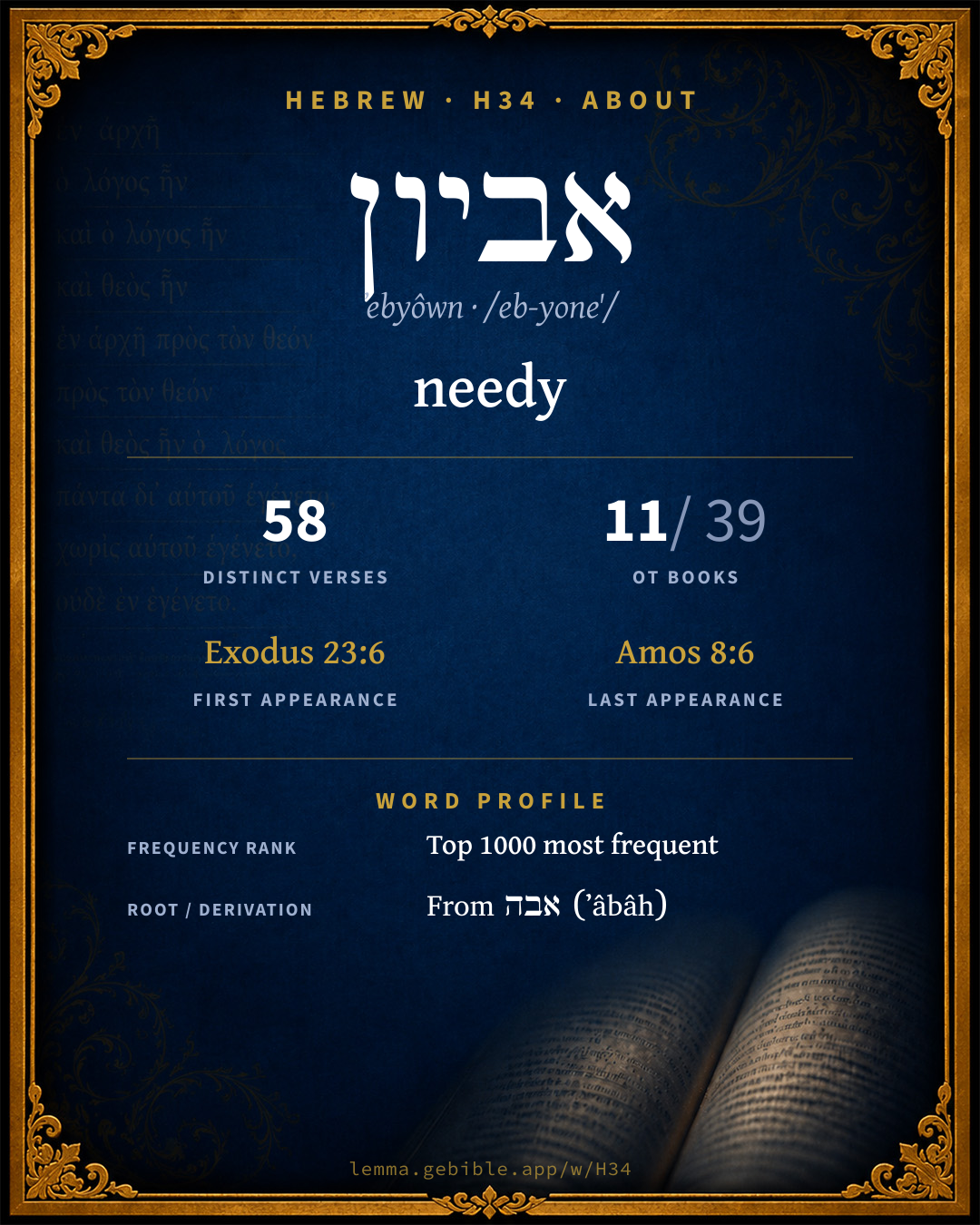
אֶבְיוֹן
needy
also: in want, chiefly poor, needy person fuller range ↓
Full lexicon entry — Brown-Driver-Briggs (BDB)
From Brown-Driver-Briggs (BDB)
Where this word appears
See every Absolute-state word in the Hebrew Bible →
Grammar key — what these labels mean
Part of speech
- Adjective
- A word that describes or qualifies a noun.
State
- Absolute
- The independent form of a noun, not bound to a following word.
- Construct
- A noun bound to a following noun in a possessive / “of” relationship (the construct chain).
Gender
- Masculine
- Grammatically masculine.
Number
- Singular
- One.
- Plural
- More than one (in Hebrew, generally three or more).
Grammatical forms
- Adjective, Adjective, Masculine, Singular, Absolute 41 times (67%)
- Adjective, Adjective, Masculine, Plural, Absolute 15 times (25%)
- Adjective, Adjective, Masculine, Plural, Construct 3 times (5%)
- Adjective, Adjective, Masculine, Singular, Construct 2 times (3%)
Parsed forms decoded from the imported morphology (morphhb / Westminster Leningrad Codex — WLC text public domain, morphhb tagging CC BY 4.0), counted across 61 parsed occurrences — not distinct verses.
Every verse where H34 appears — 58 distinct verses across 11 books. Click any verse to open its interlinear word-by-word view. Verse text shown in the World English Bible for context — . Each verse’s Hebrew form is shown with its reference; the English is not keyword-highlighted, since the data carries no word-level English alignment. Use “Compare translations” on any verse to read it across multiple English versions. This concordance covers the Hebrew Bible; Septuagint (Greek Old Testament) occurrences are not indexed here.
Exodus 2 verses
- Exodus 23:6 אֶבְיֹנְ/ךָ֖ adj Adjective ms cs + sfx pers 2ms "You shall not deny justice to your poor people in their lawsuits.
- Exodus 23:11 אֶבְיֹנֵ֣י adj Adjective mp cs but the seventh year you shall let it rest and lie fallow, that the poor of your people may eat; and what they leave the animal of the field shall eat. In like manner you shall deal with your vineyard and with your olive grove.
Deuteronomy 5 verses
- Deuteronomy 15:4 אֶבְי֑וֹן adj Adjective ms However there shall be no poor with you; (for Yahweh will surely bless you in the land which Yahweh your God gives you for an inheritance to possess it;)
- Deuteronomy 15:7 אֶבְי֜וֹן הָ/אֶבְיֽוֹן adj Adjective ms ptcl def.art + Adjective Adjective ms If there be with you a poor man, one of your brothers, within any of your gates in your land which Yahweh your God gives you, you shall not harden your heart, nor shut your hand from your poor brother;
- Deuteronomy 15:9 הָֽ/אֶבְי֔וֹן ptcl def.art + Adjective Adjective ms Beware that there not be a base thought in your heart, saying, The seventh year, the year of release, is at hand; and your eye be evil against your poor brother, and you give him nothing; and he cry to Yahweh against you, and it be sin to you.
- Deuteronomy 15:11 אֶבְי֖וֹן וּ/לְ/אֶבְיֹנְ/ךָ֖ adj Adjective ms conj + prep + Adjective Adjective ms cs + sfx pers 2ms For the poor will never cease out of the land: therefore I command you, saying, You shall surely open your hand to your brother, to your needy, and to your poor, in your land.
- Deuteronomy 24:14 וְ/אֶבְי֑וֹן conj + Adjective Adjective ms You shall not oppress a hired servant who is poor and needy, whether he be of your brothers, or of your foreigners who are in your land within your gates:
1 Samuel 1 verse
Esther 1 verse
Job 6 verses
- Job 5:15 אֶבְיֽוֹן adj Adjective ms But he saves from the sword of their mouth, Even the needy from the hand of the mighty.
- Job 24:4 אֶבְיוֹנִ֣ים adj Adjective mp They turn the needy out of the way. The poor of the earth all hide themselves.
- Job 24:14 וְ/אֶבְי֑וֹן conj + Adjective Adjective ms The murderer rises with the light. He kills the poor and needy. In the night he is like a thief.
- Job 29:16 לָֽ/אֶבְיוֹנִ֑ים prep det + Adjective Adjective mp I was a father to the needy. The cause of him who I didn't know, I searched out.
- Job 30:25 לָ/אֶבְיֽוֹן prep det + Adjective Adjective ms Didn't I weep for him who was in trouble? Wasn't my soul grieved for the needy?
- Job 31:19 לָ/אֶבְיֽוֹן prep det + Adjective Adjective ms If I have seen any perish for want of clothing, Or that the needy had no covering;
Psalms 22 verses
- Psalms 9:18 אֶבְי֑וֹן adj Adjective ms For the needy shall not always be forgotten, Nor the hope of the poor perish forever.
- Psalms 12:5 אֶבְי֫וֹנִ֥ים adj Adjective mp "Because of the oppression of the weak and because of the groaning of the needy, I will now arise," says Yahweh; "I will set him in safety from those who malign him."
- Psalms 35:10 וְ֝/אֶבְי֗וֹן conj + Adjective Adjective ms All my bones shall say, "Yahweh, who is like you, Who delivers the poor from him who is too strong for him, Yes, the poor and the needy from him who robs him?"
- Psalms 37:14 וְ/אֶבְי֑וֹן conj + Adjective Adjective ms The wicked have drawn out the sword, and have bent their bow, To cast down the poor and needy, To kill those who are upright in the way.
- Psalms 40:17 וְ/אֶבְיוֹן֮ conj + Adjective Adjective ms But I am poor and needy; May the Lord think about me. You are my help and my deliverer. Don't delay, my God.
- Psalms 49:2 וְ/אֶבְיֽוֹן conj + Adjective Adjective ms Both low and high, Rich and poor together.
- Psalms 69:33 אֶבְיוֹנִ֣ים adj Adjective mp For Yahweh hears the needy, And doesn't despise his captive people.
- Psalms 70:5 וְ/אֶבְיוֹן֮ conj + Adjective Adjective ms But I am poor and needy. Come to me quickly, God. You are my help and my deliverer. Yahweh, don't delay.
- Psalms 72:4 אֶבְי֑וֹן adj Adjective ms He will judge the poor of the people. He will save the children of the needy, And will break the oppressor in pieces.
- Psalms 72:12 אֶבְי֣וֹן adj Adjective ms For he will deliver the needy when he cries; The poor, who has no helper.
- Psalms 72:13 וְ/אֶבְי֑וֹן אֶבְיוֹנִ֣ים conj + Adjective Adjective ms adj Adjective mp He will have pity on the poor and needy. He will save the souls of the needy.
- Psalms 74:21 וְ֝/אֶבְי֗וֹן conj + Adjective Adjective ms Don't let the oppressed return ashamed. Let the poor and needy praise your name.
- Psalms 82:4 וְ/אֶבְי֑וֹן conj + Adjective Adjective ms Rescue the weak and needy. Deliver them out of the hand of the wicked."
- Psalms 86:1 וְ/אֶבְי֣וֹן conj + Adjective Adjective ms Hear, Yahweh, and answer me, For I am poor and needy.
- Psalms 107:41 אֶבְי֣וֹן adj Adjective ms Yet he lifts the needy out of their affliction, And increases their families like a flock.
- Psalms 109:16 וְ֭/אֶבְיוֹן conj + Adjective Adjective ms Because he didn't remember to show kindness, But persecuted the poor and needy man, The broken in heart, to kill them.
- Psalms 109:22 וְ/אֶבְי֣וֹן conj + Adjective Adjective ms For I am poor and needy. My heart is wounded within me.
- Psalms 109:31 אֶבְי֑וֹן adj Adjective ms For he will stand at the right hand of the needy, To save him from those who judge his soul.
- Psalms 112:9 לָ/אֶבְיוֹנִ֗ים prep det + Adjective Adjective mp He has dispersed, he has given to the poor. His righteousness endures forever. His horn will be exalted with honor.
- Psalms 113:7 אֶבְיֽוֹן adj Adjective ms He raises up the poor out of the dust. Lifts up the needy from the ash heap;
- Psalms 132:15 אֶ֝בְיוֹנֶ֗י/הָ adj Adjective mp cs + sfx pers 3fs I will abundantly bless her provision. I will satisfy her poor with bread.
- Psalms 140:12 אֶבְיֹנִֽים adj Adjective mp I know that Yahweh will maintain the cause of the afflicted, And justice for the needy.
Proverbs 4 verses
- Proverbs 14:31 אֶבְיֽוֹן adj Adjective ms He who oppresses the poor shows contempt for his Maker, But he who is kind to the needy honors him.
- Proverbs 30:14 וְ֝/אֶבְיוֹנִ֗ים conj + Adjective Adjective mp There is a generation whose teeth are like swords, And their jaws like knives, To devour the poor from the earth, and the needy from among men.
- Proverbs 31:9 וְ/אֶבְיֽוֹן conj + Adjective Adjective ms Open your mouth, judge righteously, And serve justice to the poor and needy."
- Proverbs 31:20 לָֽ/אֶבְיֽוֹן prep det + Adjective Adjective ms She opens her arms to the poor; Yes, she extends her hands to the needy.
Isaiah 5 verses
- Isaiah 14:30 וְ/אֶבְיוֹנִ֖ים conj + Adjective Adjective mp The firstborn of the poor shall feed, and the needy shall lie down in safety; and I will kill your root with famine, and your remnant shall be killed.
- Isaiah 25:4 לָ/אֶבְי֖וֹן prep det + Adjective Adjective ms For you have been a stronghold to the poor, a stronghold to the needy in his distress, a refuge from the storm, a shade from the heat, when the blast of the awesome ones is as a storm against the wall.
- Isaiah 29:19 וְ/אֶבְיוֹנֵ֣י conj + Adjective Adjective mp cs The humble also shall increase their joy in Yahweh, and the poor among men shall rejoice in the Holy One of Israel.
- Isaiah 32:7 אֶבְי֖וֹן adj Adjective ms The instruments of the churl are evil: he devises wicked devices to destroy the humble with lying words, even when the needy speaks right.
- Isaiah 41:17 וְ/הָ/אֶבְיוֹנִ֜ים conj + ptcl def.art + Adjective Adjective mp The poor and needy seek water, and there is none, and their tongue fails for thirst; I, Yahweh, will answer them, I, the God of Israel, will not forsake them.
Jeremiah 4 verses
- Jeremiah 2:34 אֶבְיוֹנִ֖ים adj Adjective mp Also in your skirts is found the blood of the souls of the innocent poor: you did not find them breaking in; but it is because of all these things.
- Jeremiah 5:28 אֶבְיוֹנִ֖ים adj Adjective mp They are grew fat, they shine: yes, they overpass in deeds of wickedness; they don't plead the cause, the cause of the fatherless, that they may prosper; and the right of the needy they don't judge.
- Jeremiah 20:13 אֶבְי֖וֹן adj Adjective ms Sing to Yahweh, praise you Yahweh; for he has delivered the soul of the needy from the hand of evil-doers.
- Jeremiah 22:16 וְ/אֶבְי֖וֹן conj + Adjective Adjective ms He judged the cause of the poor and needy; then it was well. Wasn't this to know me? says Yahweh.
Ezekiel 3 verses
- Ezekiel 16:49 וְ/אֶבְי֖וֹן conj + Adjective Adjective ms Behold, this was the iniquity of your sister Sodom: pride, fullness of bread, and prosperous ease was in her and in her daughters; neither did she strengthen the hand of the poor and needy.
- Ezekiel 18:12 וְ/אֶבְיוֹן֙ conj + Adjective Adjective ms has wronged the poor and needy, has taken by robbery, has not restored the pledge, and has lifted up his eyes to the idols, has committed abomination,
- Ezekiel 22:29 וְ/אֶבְיוֹן֙ conj + Adjective Adjective ms The people of the land have used oppression, and exercised robbery; yes, they have vexed the poor and needy, and have oppressed the foreigner wrongfully.
Amos 5 verses
- Amos 2:6 וְ/אֶבְי֖וֹן conj + Adjective Adjective ms Thus says Yahweh: "For three transgressions of Israel, yes, for four, I will not turn away its punishment; Because they have sold the righteous for silver, And the needy for a pair of shoes;
- Amos 4:1 אֶבְיוֹנִ֑ים adj Adjective mp Listen to this word, you cows of Bashan, who are on the mountain of Samaria, who oppress the poor, who crush the needy, who tell their lords, "Bring, and let us drink."
- Amos 5:12 וְ/אֶבְיוֹנִ֖ים conj + Adjective Adjective mp For I know how many your offenses, And how great are your sins-- You who afflict the just, Who take a bribe, And who turn aside the needy in the courts.
- Amos 8:4 אֶבְי֑וֹן adj Adjective ms Hear this, you who desire to swallow up the needy, And cause the poor of the land to fail,
- Amos 8:6 וְ/אֶבְי֖וֹן conj + Adjective Adjective ms That we may buy the poor for silver, And the needy for a pair of shoes, And sell the sweepings with the wheat?'"
About this entry
At a glance — auto-summarized from this page’s data, not written by a person. Every figure links to its source below. This summary describes the numbers; it doesn’t interpret them.
אביון — transliterated ʼebyôwn — is a Hebrew word carrying the sense “needy.” BDB distinguishes 4 senses; alongside “needy” it spans “in want”, “chiefly poor”, and “needy person”. With 58 verses in 11 books, it is a moderately common word in the Hebrew Bible. Its uses concentrate in Psalms (38% of all occurrences). Debuting at Exodus 23:6, it then recurs through the corpus. Each statement above links to its evidence; the full detail follows below.
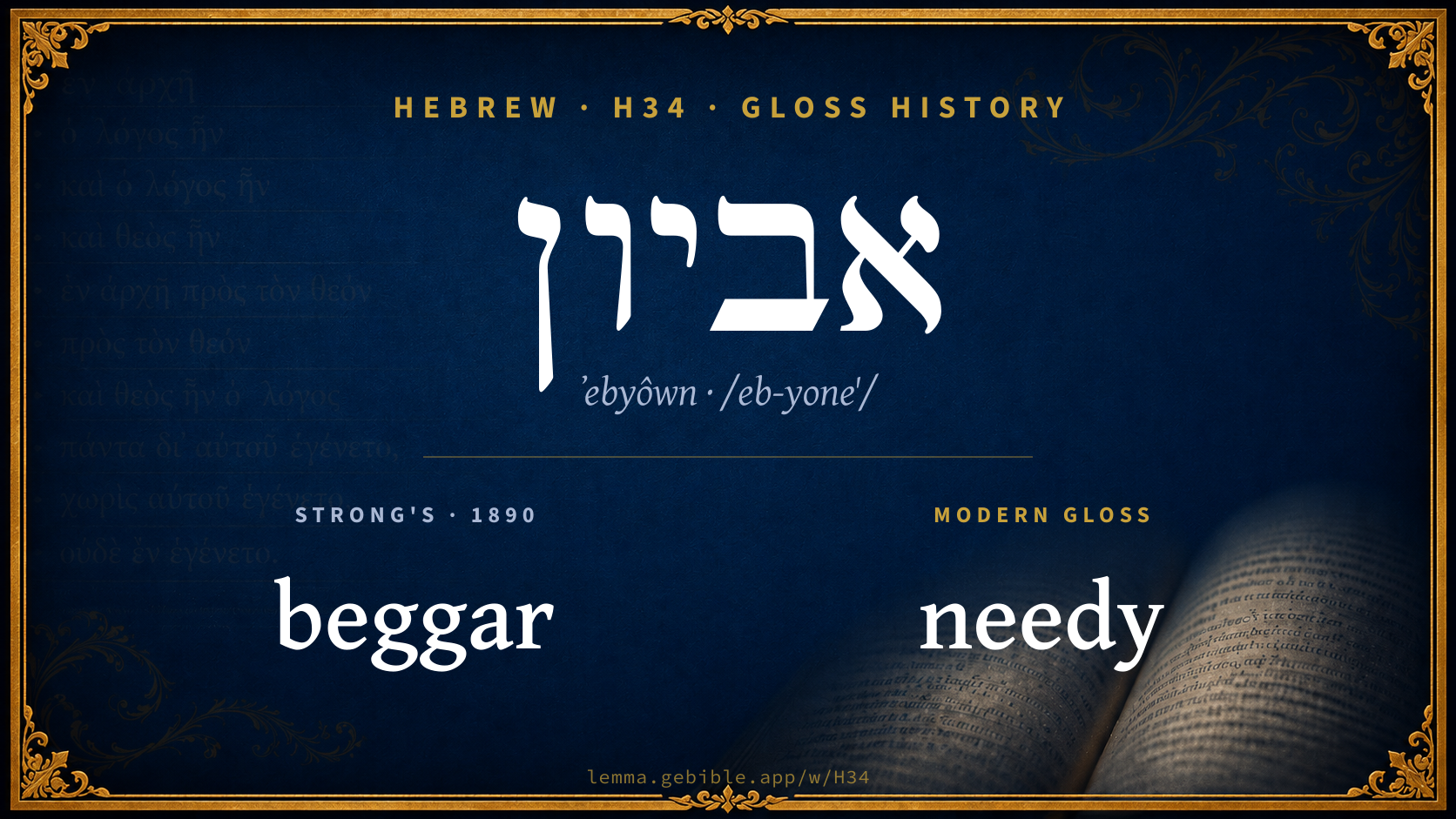
Gloss history
Strong's 1890 vs modern scholarship
About this word
Strong's H34 catalogs a Hebrew word from the Hebrew Old Testament.
These counts are not copied from any lexicon or concordance. They are computed here, from the morphology-tagged Hebrew Old Testament. What Lemma adds →
- 58
- distinct verses
- The word appears in 58 distinct verses.
- 11 / 39
- OT books
- The word appears in 11 of 39 Old Testament books.
- #629
- by frequency
- Top 1000 most frequent Hebrew words (rank 629 of 8,640 Hebrew words by occurrence).
View all 58 occurrences in the concordance →
Most concentrated in
- Psalms 22 verses 38%
- Job 6 verses 10%
- Deuteronomy 5 verses 9%
By section of the Old Testament
By traditional corpus
Conventional, traditional groupings — biblical authorship is debated, so this is a traditional corpus grouping, not an authorship claim. Each share is this word’s portion of its verses in that division of the Hebrew canon. Each figure is a share of the word’s 58 distinct verses.
- Writings (Ketuvim) 33 verses · 57%
- Prophets (Nevi'im) 18 verses · 31%
- Torah (Pentateuch) 7 verses · 12%
How translations render this word
Counts come from each version’s own published word-to-Strong’s tagging or interlinear alignment — an approximate guide to how each version renders this word, not a word-level alignment the data otherwise carries. Because each total is that version’s own tagged count, the per-version totals vary from one another and need not match the appearance or distinct-verse counts above. These counts may also differ from a printed concordance because Lemma counts each distinctly tagged rendering and does not collapse phrase taggings into a single head-word total. This is a fixed set of word-tagged versions (KJV, ASV, BSB, ULT) and does not change with the reading translation you choose elsewhere. Each version’s license is shown beside its name below (and on Sources).
- King James Version: Needy 35×, Poor 19×
- American Standard Version: Needy 39×, Poor 7×
- Berean Standard Bible: Needy 44×, Poor 11×
- unfoldingWord Literal Text: Needy 42×, Poor 11×, Needy one 2×
King James Version Public Domain
Renders H34 across 61 tagged occurrences — most commonly:
Plus 7 renderings that appear only once — usually multi-word phrases or single function words the recovered tagging swept in, not distinct renderings.
American Standard Version Public Domain
Renders H34 across 57 tagged occurrences — most commonly:
Plus 11 renderings that appear only once — usually multi-word phrases or single function words the recovered tagging swept in, not distinct renderings.
Berean Standard Bible Public Domain
Renders H34 across 61 tagged occurrences — most commonly:
Plus 6 renderings that appear only once — usually multi-word phrases or single function words the recovered tagging swept in, not distinct renderings.
unfoldingWord Literal Text CC BY-SA 4.0
Renders H34 across 63 tagged occurrences — most commonly:
Plus 6 renderings that appear only once — usually multi-word phrases or single function words the recovered tagging swept in, not distinct renderings.
Senses in BDB
The 4 senses BDB distinguishes for this word, in lexicon order (not ranked by frequency or importance). The full entry — with sub-senses — is in the Lexicon Entry tab.
- in want, needy, chiefly poor, needy person
- subject to oppression and abuse
- needing help, deliverance from trouble, especially as delivered by God
- general reference to lowest class
Word origin
adj. in want, needy, poor,—so, always abs., Dt 15:4 + 40 times; אֶבְיֹנְךָ Ex 23:6 Dt 15:11; אֶבְיוֹנִים Am 4:1 + 14 times; אֶבְיוֹנֵי (אֶבְיֹנֵי) Ex 23:11 Is 29:19; אֶבְיוֹנֶיהָ ψ 132:15—(Hex. only JED; mostly poet., 23 times ψ) needy, chiefly poor (in material things); as adj. Dt 15:7(×2), 9; 24:14 ψ 109:16 (both ‖ עָנִי); elsewhere subst.; ψ 49:3 (‖ עָשׁיר); Dt 15:4, 11; subj. to oppression & abuse Am 2:6; 5:12 (both ‖ צַדִּיק) 4:1; 8:6 (all ‖ דַּל) Is 32:7; Am 8:4 Ez 16:49; 18:12; 22:29 ψ 37:14 Jb 24:4, 14 Pr 30:14—cf. ψ 109:16 supr.—(all ‖ עָנִי) Je 5:28 (‖ יָתוֹם) 2:34; cared for by good Jb 29:16; 30:25 (‖ קְשֵׁה־יוֹם) 31:19 ψ 112:9 Est 9:22; Pr 14:31 (‖ דַּל) 31:20 Je 22:16 (‖ עָנִי); care of them enjoined, negatively Ex 23:6; = cf. Dt 24:14 supr.—positively Ex 23:11 Dt 15:11 Pr 31:9 (both ‖ עָנִי)—cf. Dt 15:7(×2), 9 supr.—ψ 82:4 (‖ דַּל); cared for by God Je 20:13 ψ 107:41; 132:15 Jb 5:15; 1 S 2:8 = ψ 113:7 Is 14:30 (all ‖ דַּל) ψ 35:10; 140:13 (both ‖ עָנִי), cf. Davidic king ψ 72:12 (‖ עָנִי) = v 4 בְּנֵי אֶבְ׳ (‖ id.), v 13(×2) (‖ דַּל); needing help, deliverance from trouble, especially as delivered by God ψ 9:19; 12:6; 40:18 = 70:6; 74:21; 86:1; 109:22 Is 29:19; 41:17 (all ‖ עָנִי) Is 25:4 (‖ דַּל) ψ 69:34; 109:31.
— Brown-Driver-Briggs (Oxford 1906, public domain), digitized via Sefaria, supplemented by the OpenScriptures HebrewLexicon (CC BY 4.0). See Sources.
Derived from אבה (ʼâbâh) (H14) — to be willing.
Jastrow Dictionary
A second Hebrew/Aramaic lexicon for comparison, covering Aramaic and post-biblical (Talmudic, Targumic, Midrashic) usage that the biblical-Hebrew BDB does not. Matched by lemma rather than by Strong’s number, so a lemma may carry more than one Jastrow headword (shown separately below), and the entries cover usage well beyond the Bible.
אֶבְיוֹן
- poor, distressed. Lev. R. s. 34 (etymol.) he is called ebyon, שהוא מתאב לכל (Yalk. a. l. מתאוה) because he longs for everything. Gen. R. s. 71. B. Mets. 111ᵇ
A Dictionary of the Targumim, the Talmud Babli and Yerushalmi, and the Midrashic Literature (Marcus Jastrow; London, Luzac, 1903) — Public Domain. Digitized via Sefaria. Digitized via Sefaria. Full attribution on Sources.
Forms in the corpus
The 35 distinct written forms H34 takes in the Hebrew Bible, most frequent first — each parse links to that state’s occurrences in the concordance. Hebrew forms include their vowel points and cantillation, so a single lemma takes many written forms.
Same root — word family
Other BDB entries built from the same root as H34, grouped by Strong’s listed origin. These share a root / origin per the lexicon — not necessarily a shared meaning. Each links to that word’s own entry.
Derives from
Shares the same root
Compare all same-root words → Showing 4 of 6 — not the complete family. They share a root, not necessarily a meaning.
Septuagint verse parallels
This word appears in 49 verses that also exist in the Greek Old Testament (Septuagint), out of the 58 Hebrew verses it occurs in. You can read those verses in Greek by switching the Old Testament edition to the Septuagint.
Read these verses in the Septuagint
- Exodus 23:6
- Deuteronomy 15:4
- 1 Samuel 2:8
- Esther 9:22
- Job 5:15
- Psalms 9:18
- Proverbs 14:31
- Isaiah 14:30
- Jeremiah 2:34
- Ezekiel 16:49
- Amos 2:6
This is a verse-level parallel only — the same verses exist in both the Hebrew and Greek Old Testaments. No word-level Hebrew↔Greek correspondence is claimed: the data carries no such alignment, so no Greek word is shown as this Hebrew word’s translation. Coverage is not total — the Septuagint omits the deuterocanon and renumbers the Psalms, so some Hebrew verses have no direct Greek parallel.