
Psalms 49:2

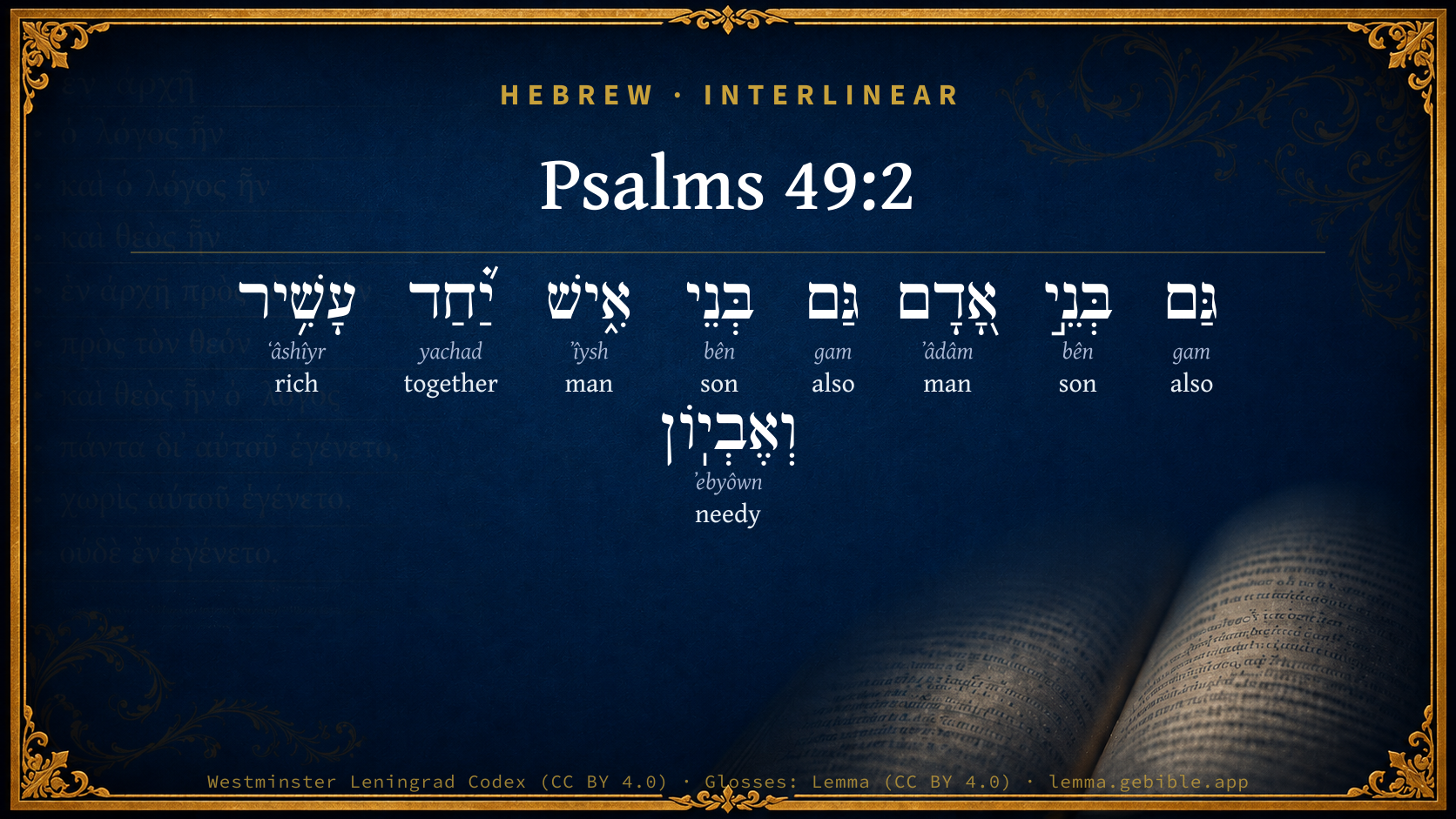
Hebrew (Westminster Leningrad Codex) Psalms 49:2 appears in the Hebrew Old Testament. The text above is from the Westminster Leningrad Codex. Each word links to its Strong’s number, a concise gloss, and parsing drawn from the Open Scriptures Hebrew Bible morphology. Click any word for its full Brown-Driver-Briggs (BDB) entry.
Download image
Cite this verse

Psalms 49:2 (World English Bible). Public Domain. Lemma interlinear Bible study tool, https://lemma.gebible.app/v/psalms/49/2.

Show BibTeX & RIS
BibTeX
RIS
English Translation
Both low and high, Rich and poor together.
World English Bible · Public Domain
Download a study sheet

One document with this verse’s original text, its word-by-word gloss line, the meaning frame, cross-references with their text, attributed commentary, and full source and license credits — printable, and it pastes into notes with its structure intact.

This verse Autodidact and up

Study sheet (.html) Plain text (.txt)

A passage Seminary Student

Up to 50 verses in one chapter. A passage sheet keeps up to 6 commentary sources and 12 cross-references per verse, in the order this page ranks them, and says so on the sheet whenever that leaves anything out. Ask for a single verse and you get the Autodidact verse sheet above.

Everything on this page stays free to read, with no account — the sheet is a download of what is already on screen, not access to it.

Want to remove ads? Support Godless Engineer
Compare translations 3

The same verse in 3 English versions, stacked beneath the original-language interlinear above. Click any original word for its lexicon entry.

Each is an independent rendering of the whole verse — the interlinear is not word-aligned to these translations.

Highlighted words mark where these versions differ — a whole-verse word diff, not a word-by-word alignment.

  • World English Bible Public Domain
    Both low and high, Rich and poor together.
  • King James Version Public Domain
    Both low and high, rich and poor, together.
  • unfoldingWord Literal Text CC BY-SA 4.0
    both sons of a human and sons of a man, the rich and the poor together.

unfoldingWord Literal Text — © unfoldingWord, licensed CC BY-SA 4.0. Word-aligned USFM3 via Door43 (git.door43.org/unfoldingWord/en_ult).

Versions to compare (up to 4)

3 of 4 selected

Show all 18 translations

Every available English version of this verse, each an independent rendering of the whole verse.

  • World English Bible Public Domain
    Both low and high, Rich and poor together.
  • Berean Standard Bible Public Domain
    both low and high, rich and poor alike.
  • Majority Standard Bible Public Domain
    both low and high, rich and poor alike.
  • King James Version Public Domain
    Both low and high, rich and poor, together.
  • American Standard Version (1901) Public Domain
    Both low and high, Rich and poor together.
  • Revised Version (1885) Public Domain
    Both low and high, rich and poor together.
  • Geneva Bible (1599) Public Domain
    As well lowe as hie, both rich and poore.
  • Douay-Rheims (1899) Public Domain
    Hear these things, all ye nations: give ear, all ye inhabitants of the world.
  • Young's Literal Translation Public Domain
    Both low and high, together rich and needy.
  • Literal Standard Version CC BY-SA 4.0
    Both low and high, together rich and needy.
  • Unlocked Literal Bible CC BY-SA 4.0
    both low and high, rich and poor together.
  • unfoldingWord Literal Text CC BY-SA 4.0
    both sons of a human and sons of a man, the rich and the poor together.
  • Darby Bible Public Domain
    Both men of low and men of high degree, rich and poor alike.
  • World Messianic Bible Public Domain
    both low and high, rich and poor together.
  • Webster's Bible Public Domain
    \\49:1\\To the chief Musician, A Psalm for the sons of Korah. Hear this, all ye people; give ear, all ye inhabitants of the world:
  • Free Bible Version CC BY-SA 4.0
    whether you are highborn or lowborn, rich or poor!
  • Bible in Basic English Public Domain
    High and low together, the poor, and those who have wealth.
  • JPS Tanakh (1917) Public Domain
    (49-3) Both low and high, rich and poor together.

Literal Standard Version (2020), Covenant Press — licensed CC BY-SA 4.0. Text via the HelloAO Bible API (eBible.org). Unlocked Literal Bible (unfoldingWord) — licensed CC BY-SA 4.0. Text via the HelloAO Bible API (eBible.org). unfoldingWord Literal Text — © unfoldingWord, licensed CC BY-SA 4.0. Word-aligned USFM3 via Door43 (git.door43.org/unfoldingWord/en_ult). Free Bible Version, Dr. Jonathan Gallagher — licensed CC BY-SA 4.0. Text via the HelloAO Bible API (eBible.org).

Word by word

More ways to search: Search by grammar → Find every occurrence → Compare this word →

Practice this passage: Drill this verse → Learn its vocabulary →

About this verse

These counts appear in no published source. They are computed here, from the morphology-tagged text and Lemma’s own curated glosses. What Lemma adds →

9
words
7
distinct lemmas
Wisdom
section

Notable vocabulary

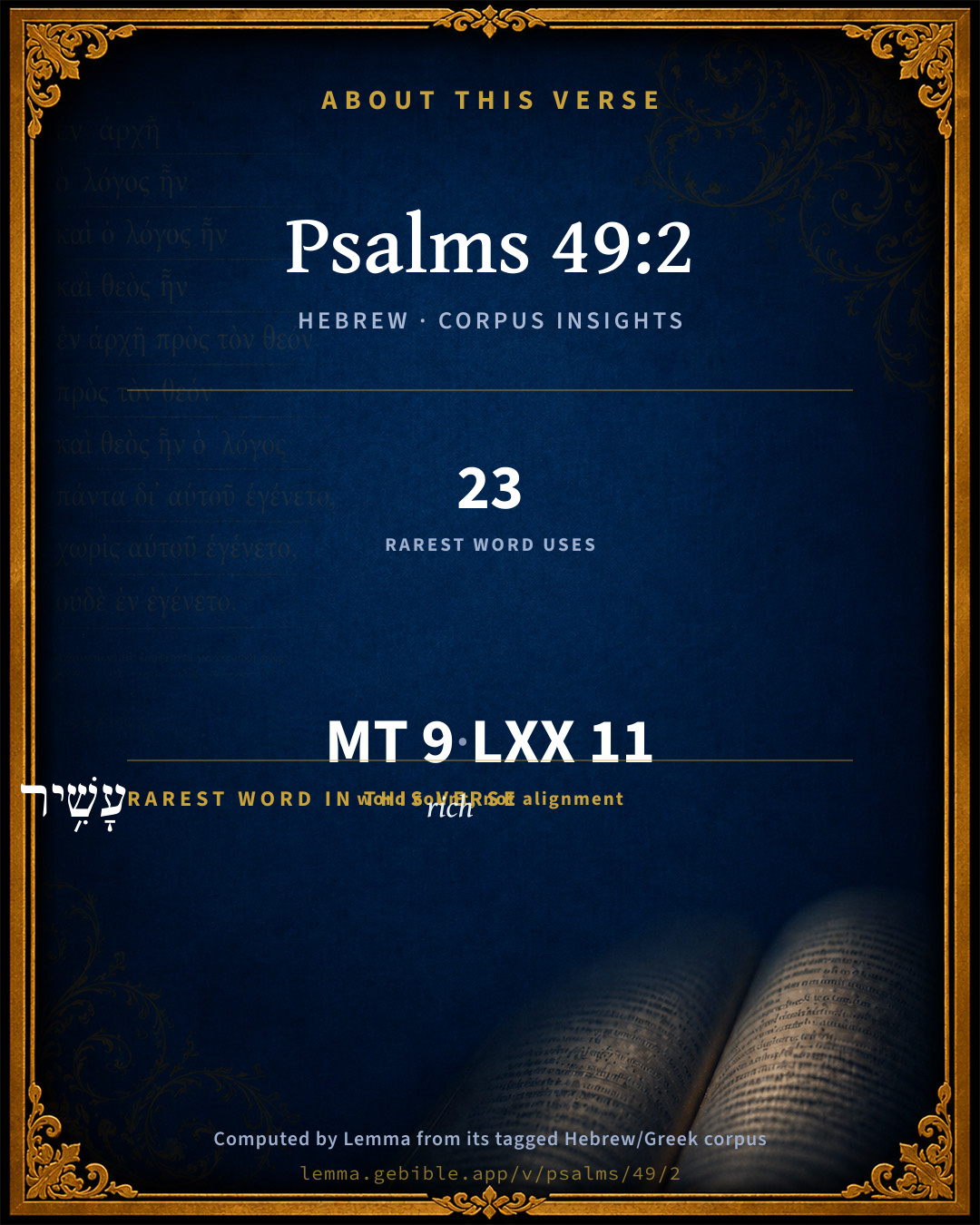
The rarest word here is עָשִׁ֥יר rich H6223 — appearing just 23 times in the whole Hebrew Bible.

Shared distinctive vocabulary

עָשִׁ֥יר rich H6223 occurs in 23 verses of the Hebrew Bible. Also found in:

Grammatical profile

  • 4 nouns
  • 2 adjectives
  • 1 adverb
  • 2 particles

Repetition

Words recur within this verse — often emphatic in Hebrew:

  • גַּם also H1571 ×2
  • בְּנֵ֣י son H1121 ×2

Hebrew & Septuagint length

In English translation the verse runs 8 words from the Hebrew and 17 from the Septuagint (LXX English) — closely comparable.

A rough comparison of the two English renderings, which tokenize alike — not a word-level alignment.

Word counts can differ between the Hebrew and the Greek without any difference in meaning — e.g. the Hebrew direct-object marker אֵת has no separate Greek word, and Greek often adds the article ὁ.

In the original languages it is 9 Hebrew tokens and 11 Greek tokens — but the two are counted differently (Hebrew bundles its prefixes and suffixes into one token; the Greek is in lemma form), so that isn’t a like-for-like length.

Cross-references

8

Topical passages linked to Psalms 49:2 in the Treasury of Scripture Knowledge — connected by theme and wording, ordered by reader-vote popularity; previews shown in the World English Bible.

  • Psalms 62:9 Surely men of low degree are just a breath, And men of high degree are a lie. In the balances they will go up. They are together lighter than a breath.
  • James 2:1–7 My brothers, don't hold the faith of our Lord Jesus Christ of glory with partiality.
  • 1 Samuel 2:7–8 Yahweh makes poor, and makes rich: He brings low, he also lifts up.
  • Job 34:19 Who doesn't respect the persons of princes, Nor regards the rich more than the poor; For they all are the work of his hands.
  • Proverbs 22:2 The rich and the poor have this in common: Yahweh is the maker of them all.
  • Jeremiah 5:4–5 Then I said, Surely these are poor; they are foolish; for they don't know the way of Yahweh, nor the law of their God:
  • James 1:9–11 But let the brother in humble circumstances glory in his high position;
  • Revelation 6:15–17 The kings of the earth, the princes, the commanding officers, the rich, the strong, and every slave and free person, hid themselves in the caves and in the rocks of the mountains.

Cross-references courtesy of OpenBible.info (CC BY 4.0).

Hebrew and Greek witnesses Masoretic Hebrew ↔ Greek Septuagint

The same verse in the two great witnesses to the Old Testament, shown verse-for-verse.

You’re reading Greek Psalm 48 (Hebrew Psalm 49). The Septuagint counts the superscription, so verse numbers can differ from the Hebrew — chapter-level alignment, not verse-by-verse. Numbering follows Rahlfs.

These are two independent witnesses, not word-aligned to each other, and the Septuagint is shown in lemma (dictionary) form.

Hebrew Psalms 49:2 Masoretic · Westminster Leningrad Codex

גַּם בְּנֵ֣י אָ֭דָם גַּם בְּנֵי אִ֑ישׁ יַ֝֗חַד עָשִׁ֥יר וְאֶבְיֽוֹן

Both low and high, Rich and poor together.

World English Bible · Public Domain

Greek LXX Greek Psalm 48:2 Septuagint · lemma form

ἀκούω οὗτος πᾶς ὁ ἔθνος ἐνωτίζομαι πᾶς ὁ καταοἰκέω ὁ οἰκέω

both the sons of mean men, and sons of great men; the rich and poor man together.

LXX2012 (modern English Septuagint) · Public Domain

On this verse, Ellicott's Commentary for English Readers discusses the Septuagint’s reading. Read the note in Commentary ↓

Hebrew: Westminster Leningrad Codex (CC BY 4.0). Greek: Septuagint (public domain); English from LXX2012 (modern English Septuagint) (Public Domain). How the Septuagint differs from the Hebrew →

Commentary

Notes on Psalms 49:2 from classic Christian and Jewish commentators (each source and its license shown beneath its notes). The classic Christian expositions comment on the surrounding passage and are grouped to its opening verse, so a note may address several verses; the Jewish commentaries on the Tanakh (Rashi and others) are per-verse, so they appear only where the commentator wrote on this verse.

Lemma curates 59 commentaries, every one of them public domain or Creative Commons licensed, each selected and text-cleaned for this edition rather than reprinted as found. About our sources →

Trapp's Complete Commentary

John Trapp

Psa 49:2 Both low and high, rich and poor, together.

Ver. 2. Both low and high, rich and poor together] Heb. Both sons of Adam, or earthy man, and sons of Ish, or nobleman

quorum

Ex meliore luto finxit praecordia Titan.

Diogenes once made a like outcry at Athens, Aκουσατε ανδρες, Hear, O ye men; and when a company came about him expecting what he would say to them, he looked upon them and said, Aνδρας εκαλεσα ου ακθαρματα, I called for men, and not for slaves (varlets).

John Trapp, A Commentary or Exposition upon All the Books of the Old and New Testament (1647–1656) — public domain. Text from a community e-Sword module.

J. A. Alexander on Psalms

Joseph Addison Alexander

3. (Psa 49:2). Both low and high together, rich and poor This is the conclusion of the sentence begun in the preceding verse. The first clause is highly idiomatic in its form, and cannot be literally rendered into intelligible English. Likewise sons of man, likewise sons of man. The word man here corresponds to two distinct Hebrew words which, when placed in opposition, denote men of high and low degree. See above, on Psa 5:3 (2), and below, on Psa 62:10 (9), and compare Pro 8:4. The same antithesis is presented in a different form, Psa 22:30 (29). The rich are here summoned to receive reproof and warning, the poor consolation and encouragement.

Joseph Addison Alexander, The Psalms Translated and Explained (1850) — public domain. Text from a community e-Sword module.

Ellicott's Commentary for English Readers

(2) Both high and low.—The two Hebrew expressions here used, benê-âdam and benê-îsh, answer to one another much as homo and vir in Latin. The LXX. and Vulg., taking âdam in its primary sense, render “sons of the soil and sons of men.” Symmachus makes the expressions stand for men in general and men as individuals.

Shall be of understanding.—The copula supplied by the Authorised Version is unnecessary. The word rendered meditation may mean, from its etymology, “muttered thoughts,” and it is quite consistent to say, my musings speak of understanding. So LXX. and Vulgate.

A Bible Commentary for English Readers, edited by Charles John Ellicott (1878–1897) — public domain. Text from a community e-Sword module.

The Cambridge Bible for Schools and Colleges

gen. ed. J. J. S. Perowne

2. Both low and high] So the A.V. rightly paraphrases the Heb. sons of mankind (âdâm) and sons of men (’îsh): those whose personality is lost in the common multitude, and those who are individually distinguished; plebeians and patricians. Adâm corresponds to ἄνθρωπος, homo; ’îsh to ἀνήρ, vir. Cp. Psa_4:2; Psa_62:9. The P.B.V. (high and low) wrongly inverts the meanings.

rich and poor together] The rich that they may recognise the vanity of riches, and take warning: the poor that they may learn to be contented with their lot, and not to envy the rich.

The Cambridge Bible for Schools and Colleges (gen. ed. J. J. S. Perowne; Cambridge University Press, 1878–1918) — public domain. Text from a community e-Sword module.

John Gill's Exposition

Both low and high,.... Or "both the sons of Adam and the sons of men". By the sons of "Adam" are meant the multitude of the people, as Ben Melech explains it; the common people, the meaner sort, the base things of this world; and such are they, generally speaking, who are called by grace under the Gospel dispensation: and by "the sons of men" are meant the princes, nobles, and great men of the earth; men of high birth and illustrious extraction: so Adam is rendered, "the mean man", and "Ish", the word here used, "the great man", in Isa 2:9. And though not many, yet some of this sort are called by grace; and all of them have a peculiar concern in many things spoken of in this psalm; see Psa 49:12;

rich and poor together: these are called upon to hearken to what is after said, that the one may not be elated with and trust in their riches, and that the other may not be dejected on account of their poverty; and seeing both must die, and meet together at the judgment day; and inasmuch as the Gospel is preached to one as to another; and for the most part the poor hear it, receive it, and are called by it.

John Gill's Exposition of the Whole Bible (1746–1763) — public domain (CC PDM 1.0). Text via the HelloAO Bible API.

Albert Barnes' Notes on the Bible

Both low and high - Those alike of humble and those of exalted rank, for it pertains equally to all. On the meaning of the “terms” employed here, see the notes at Isa 2:9. These truths pertained to the “low;” that is, to those of humble rank, as teaching them not to envy the rich, and not to fear their power; and they pertained to those of exalted rank, as teaching them not to trust in their riches, and not to suppose that they could permanently possess and enjoy them.

Rich and poor together - As equally interested in these truths; that is, What the psalmist was about to say was adapted to impart useful lessons to both classes. Both needed instruction on the subject; and the same class of truths was adapted to furnish that instruction. The class of truths referred to was derived from the powerlessness of wealth in regard to the things of most importance to man, and from the fact that all which a man can gain must soon be left: teaching those of one class that they should not set their heart on wealth, and should not pride themselves on possessing it, and teaching the other class that they should not envy or fear the possessor of riches.

Albert Barnes' Notes on the Bible (1834–1885) — public domain. Text from a community e-Sword/MySword module.

The Treasury of David

Charles H. Spurgeon

Ver. 2. Both low and high, rich and poor, together. Sons of great men, and children of mean men, men of large estate, and ye who pine in poverty, ye are all bidden to hear the inspired minstrel as he touches his harp to a mournful but instructive lay. The low will be encouraged, the high will be warned, the rich will be sobered, the poor consoled, there will be a useful lesson for each if they are willing to learn it. Our preaching ought to have a voice for all classes, and all should have an ear for it. To suit our word to the rich alone is wicked sycophancy, and to aim only at pleasing the poor is to act the part of a demagogue. Truth may be so spoken as to command the ear of all, and wise men seek to learn that acceptable style. Rich and poor must soon meet together in the grave, they may well be content to meet together now. In the congregation of the dead all differences of rank will be obliterated, they ought not now to be obstructions to united instructions.

Ver. 2. In this Psalm David, as it were, summons and divides mankind. In the first verse he summons: "Hear this, all ye people; give ear, all ye inhabitants of the world." In the second verse he divides: Both low and high, rich and poor, together. The word in the Hebrew for high is (vya ynb), bene ish, sons of Ish, and the word for low is (Mda ynb) bene Adam, sons of Adam. If we should translate the text directly, according to the letter, the words must run, sons of men and sons of men; for, sons of Adam and sons of Ish are both translated sons of men. Yet when they are set together in a way of opposition, the one signifieth low and the other high; and so our translators render it according to the sense, not sons of men and sons of men, but low and high. Junius translates to this sense, though in more words, as well they who are born of mean men, as they who are born of the honourable. Joseph Caryl.

Ver. 2.

1. The common needs of rich and poor men.

2. The common privileges of rich and poor saints.

3. Their common service.

4. Their common heaven.

Psalms 49:3*

Charles H. Spurgeon's The Treasury of David (1869–1885) — public domain. Psalms only. Text from a community e-Sword/MySword module.

Whedon's Commentary on the Bible

Daniel D. Whedon

2. Low and high—The classifications of this verse are intended, by mentioning the extreme orders of society, to comprehend all the intermediate ranks also, without exception. They are specifications under the general terms “all nations,” “all inhabitants of the age.” See note on Psa_4:2

Daniel D. Whedon (gen. ed.), Commentary on the Old and New Testaments (1874–1909) — public domain. Text from a community e-Sword module.

The Pulpit Commentary

Both high and low, rich and poor, together. The teaching of the psalm concerns all ranks alike. To the great and rich it will carry warning; to the poor and lowly, consolation.

The Pulpit Commentary (1880–1919), ed. H.D.M. Spence-Jones & Joseph S. Exell — public domain. Text from a community e-Sword module.

Rashi

Rabbi Shlomo Yitzchaki (Rashi)

Hear this, all you peoples Because this psalm is based on people who rely on their riches, he says, “all you peoples,” for they all require admonition.

earth Heb. חלוד. That [term] is [used to describe] the earth because it is old and rusty (חלודה), rodile in Old French, rust, rouille in modern French. But our Sages explained that it is because of the weasel (חֻלְדָה), which frequents the dry land but is not found in the sea, for the Rabbis taught (Hul. 127a): Whatever is on the dry land is found in the sea, except the weasel.

Rashi on the Tanakh — English translations: “The Judaica Press complete Tanach with Rashi, translated by A. J. Rosenberg” (CC BY 4.0); “Pentateuch with Rashi's commentary by M. Rosenbaum and A.M. Silbermann, 1929-1934” (public domain); “The Metsudah Tanach series, Lakewood, N.J” (CC BY 4.0); and “The Book of Joshua, Metsudah Publications, 1997” (CC BY 4.0). Text via Sefaria.

Ibn Ezra

Rabbi Abraham ibn Ezra

"Listen" - to the message he gives, that addresses all in whose nostrils G-d (lit. hashem, the name) blew the breath of life. Therefore, "listen all who dwell on Earth".

Ibn Ezra on the Tanakh — English translations: “Sefaria Community Translation” (CC0 1.0 (public-domain dedication)); “Yalkut, Sifsei Chachomim Chumash, Metsudah Publications, 2009” (CC BY 4.0); and “Commentary of Ibn Ezra on Isaiah - trans. by M. Friedlander, 1873” (public domain). Text via Sefaria.

Lesson kit

Teaching starters — assembled from the data on this page, not authored interpretation. Every prompt links to the verse data it draws on. Edit before teaching.

Psalms, in the Wisdom, opens this verse with 9 words (7 distinct Hebrew lemmas). Its most distinctive word is ʻâshîyr (“rich”). A historical commentator’s framing appears above. Read the whole chapter for the surrounding context.

Discussion questions

  1. What does “rich” (ʻâshîyr) contribute to the verse as a whole?
  2. How does Exodus 30:15, which shares the word «rich», read alongside this verse?
  3. What does the repetition of “also” (2× in this one verse) do in this verse?
  4. The translations on this page render this verse differently — a whole-verse word diff, not a word-by-word alignment. What might account for the different wordings?
  5. Compare how Trapp's Complete Commentary and J. A. Alexander on Psalms read this verse. Where do they agree or differ?

Things to notice

Reading settings

Reading text

Shown beneath each verse's original-language words.

Old Testament
Old Testament edition

Read the OT as the Masoretic Hebrew (MT) or the Greek Septuagint (LXX).

English shown for the Greek Septuagint (in the Hebrew ↔ Greek comparison).

Comparing translations? Open the Compare panel on any verse page to stack up to four side by side.