
Proverbs 14:31

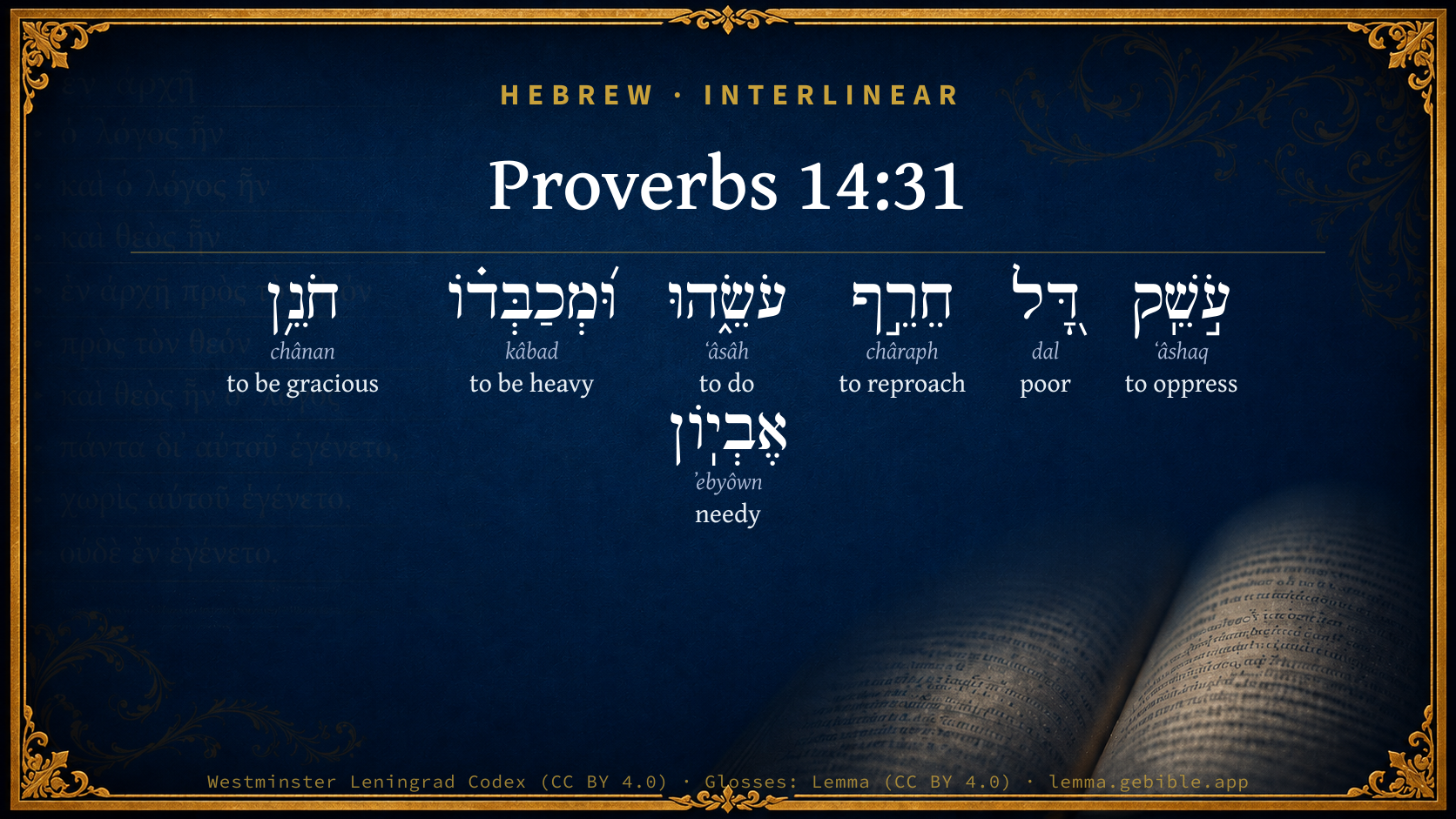
Hebrew (Westminster Leningrad Codex) Proverbs 14:31 appears in the Hebrew Old Testament. The text above is from the Westminster Leningrad Codex. Each word links to its Strong’s number, a concise gloss, and parsing drawn from the Open Scriptures Hebrew Bible morphology. Click any word for its full Brown-Driver-Briggs (BDB) entry.
Download image
Cite this verse

Proverbs 14:31 (World English Bible). Public Domain. Lemma interlinear Bible study tool, https://lemma.gebible.app/v/proverbs/14/31.

Show BibTeX & RIS
BibTeX
RIS
English Translation
He who oppresses the poor shows contempt for his Maker, But he who is kind to the needy honors him.
World English Bible · Public Domain
Download a study sheet

One document with this verse’s original text, its word-by-word gloss line, the meaning frame, cross-references with their text, attributed commentary, and full source and license credits — printable, and it pastes into notes with its structure intact.

This verse Autodidact and up

Study sheet (.html) Plain text (.txt)

A passage Seminary Student

Up to 50 verses in one chapter. A passage sheet keeps up to 6 commentary sources and 12 cross-references per verse, in the order this page ranks them, and says so on the sheet whenever that leaves anything out. Ask for a single verse and you get the Autodidact verse sheet above.

Everything on this page stays free to read, with no account — the sheet is a download of what is already on screen, not access to it.

Want to remove ads? Support Godless Engineer
Compare translations 3

The same verse in 3 English versions, stacked beneath the original-language interlinear above. Click any original word for its lexicon entry.

Each is an independent rendering of the whole verse — the interlinear is not word-aligned to these translations.

Highlighted words mark where these versions differ — a whole-verse word diff, not a word-by-word alignment.

  • World English Bible Public Domain
    He who oppresses the poor shows contempt for his Maker, But he who is kind to the needy honors him.
  • King James Version Public Domain
    He that oppresseth the poor reproacheth his Maker: but he that honoureth him hath mercy on the poor.
  • unfoldingWord Literal Text CC BY-SA 4.0
    An oppressor of a lowly one taunts his maker, but one showing favor to a needy one honors him.

unfoldingWord Literal Text — © unfoldingWord, licensed CC BY-SA 4.0. Word-aligned USFM3 via Door43 (git.door43.org/unfoldingWord/en_ult).

Versions to compare (up to 4)

3 of 4 selected

Show all 18 translations

Every available English version of this verse, each an independent rendering of the whole verse.

  • World English Bible Public Domain
    He who oppresses the poor shows contempt for his Maker, But he who is kind to the needy honors him.
  • Berean Standard Bible Public Domain
    Whoever oppresses the poor taunts their Maker, but whoever is kind to the needy honors Him.
  • Majority Standard Bible Public Domain
    Whoever oppresses the poor taunts their Maker, but whoever is kind to the needy honors Him.
  • King James Version Public Domain
    He that oppresseth the poor reproacheth his Maker: but he that honoureth him hath mercy on the poor.
  • American Standard Version (1901) Public Domain
    He that oppresseth the poor reproacheth his Maker; But he that hath mercy on the needy honoreth him.
  • Revised Version (1885) Public Domain
    He that oppresseth the poor reproacheth his Maker: but he that hath mercy on the needy honoureth him.
  • Geneva Bible (1599) Public Domain
    He that oppresseth the poore, reprooueth him that made him: but hee honoureth him, that hath mercie on the poore.
  • Douay-Rheims (1899) Public Domain
    He that oppresseth the poor, upbraideth his Maker: but he that hath pity on the poor, honoureth him.
  • Young's Literal Translation Public Domain
    An oppressor of the poor reproacheth his Maker, And whoso is honouring Him Is favouring the needy.
  • Literal Standard Version CC BY-SA 4.0
    An oppressor of the poor reproaches his Maker, || And whoever is honoring Him || Is favoring the needy.
  • Unlocked Literal Bible CC BY-SA 4.0
    The one who oppresses the poor curses his Maker, but the one who shows favor to the needy honors him.
  • unfoldingWord Literal Text CC BY-SA 4.0
    An oppressor of a lowly one taunts his maker, but one showing favor to a needy one honors him.
  • Darby Bible Public Domain
    He that oppresseth the poor reproacheth his Maker; but he that honoureth Him is gracious to the needy.
  • World Messianic Bible Public Domain
    He who oppresses the poor shows contempt for his Maker, but he who is kind to the needy honors him.
  • Webster's Bible Public Domain
    He that oppresseth the poor reproacheth his Maker: but he that honoreth him hath mercy on the poor.
  • Free Bible Version CC BY-SA 4.0
    Anyone who oppresses the poor insults their Maker, but anyone who is kind to the needy honors him.
  • Bible in Basic English Public Domain
    He who is hard on the poor puts shame on his Maker; but he who has mercy on those who are in need gives him honour.
  • JPS Tanakh (1917) Public Domain
    He that oppresseth the poor blasphemeth his Maker; but he that is gracious unto the needy honoureth Him.

Literal Standard Version (2020), Covenant Press — licensed CC BY-SA 4.0. Text via the HelloAO Bible API (eBible.org). Unlocked Literal Bible (unfoldingWord) — licensed CC BY-SA 4.0. Text via the HelloAO Bible API (eBible.org). unfoldingWord Literal Text — © unfoldingWord, licensed CC BY-SA 4.0. Word-aligned USFM3 via Door43 (git.door43.org/unfoldingWord/en_ult). Free Bible Version, Dr. Jonathan Gallagher — licensed CC BY-SA 4.0. Text via the HelloAO Bible API (eBible.org).

Word by word

More ways to search: Search by grammar → Find every occurrence → Compare this word →

Practice this passage: Drill this verse → Learn its vocabulary →

עֹ֣שֵֽׁק
ʻâshaq
H6231
“oppressing”
Verb, Qal, Participle Active, Masculine, Singular, Absolute
Part of Speech
Verb
Stem
Qal
Form
Participle Active
Gender
Masculine
Number
Singular
State
Absolute
Full BDB Definition

Origin: a primitive root (comp. H6229 )

TWOT: 1713

to press upon, oppress, violate, defraud, do violence, get deceitfully, wrong, extort - (Qal) - to oppress, wrong, extort - to oppress - (Pual) to be exploited, be crushed
  1. דָּ֭ל dal H1800 “poor” Adjective, Adjective, Masculine, Singular, Absolute
  2. חֵרֵ֣ף châraph H2778 “to reproach” Verb, Piel, Perfect, 3rd Person, Masculine, Singular
  3. עֹשֵׂ֑הוּ ʻâsâh H6213 “doing · him” Verb, Qal, Participle Active, Masculine, Singular, Construct + Suffix, Personal, 3rd Person, Masculine, Singular
  4. וּ֝מְכַבְּד֗וֹ kâbad H3513 “and · being heavy · him” Conjunction + Verb, Piel, Participle Active, Masculine, Singular, Construct + Suffix, Personal, 3rd Person, Masculine, Singular
  5. חֹנֵ֥ן chânan H2603 “being gracious” Verb, Qal, Participle Active, Masculine, Singular, Absolute
  6. אֶבְיֽוֹן ʼebyôwn H34 “needy” Adjective, Adjective, Masculine, Singular, Absolute

About this verse

These counts appear in no published source. They are computed here, from the morphology-tagged text and Lemma’s own curated glosses. What Lemma adds →

7
words
7
distinct lemmas
Wisdom
section

Shared distinctive vocabulary

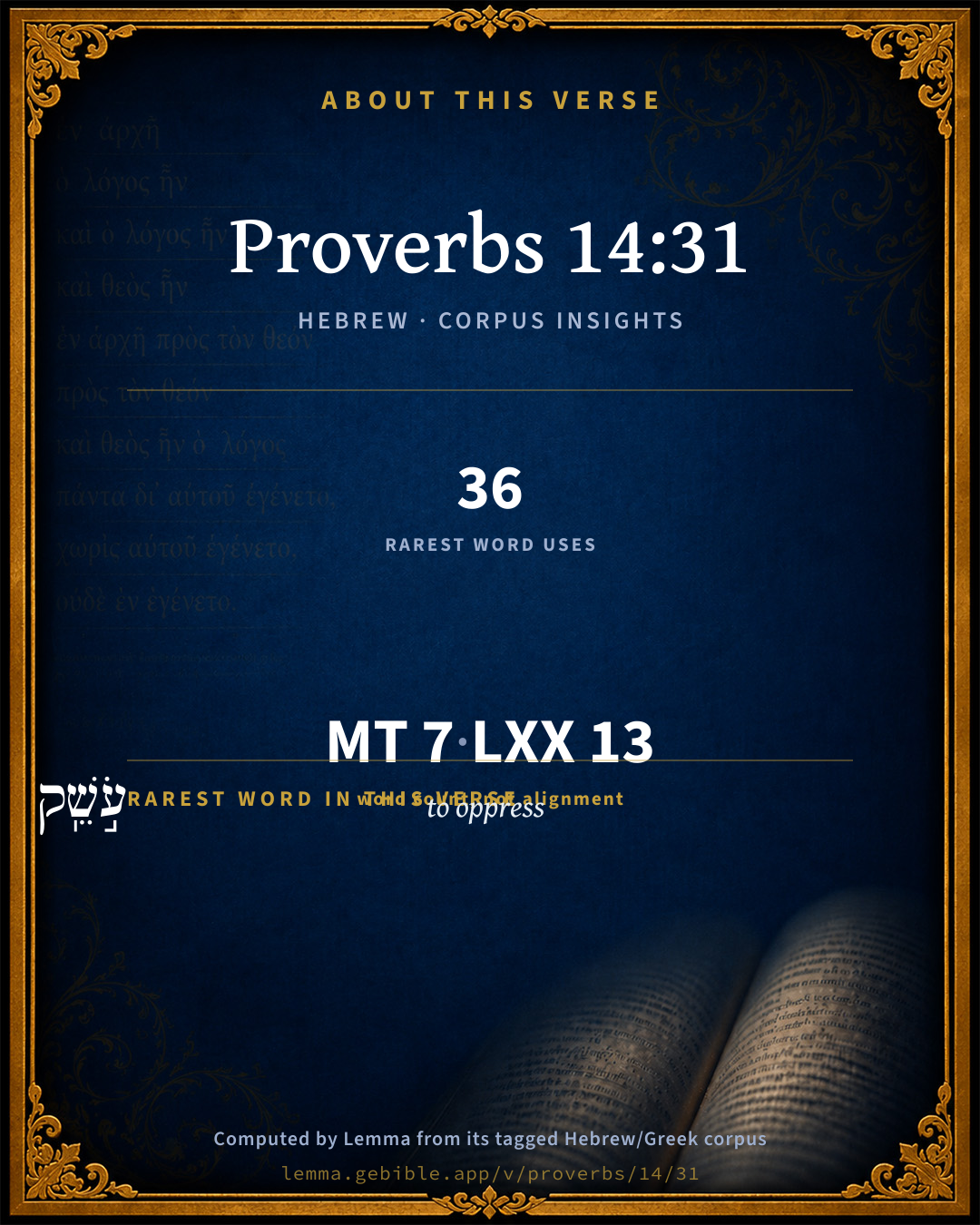
עֹ֣שֵֽׁק to oppress H6231 occurs in 35 verses of the Hebrew Bible. Also found in:

Grammatical profile

  • 5 verbs
  • 2 adjectives

Verb forms

  • עֹ֣שֵֽׁק Qal · Participle Active
  • חֵרֵ֣ף Piel · Perfect
  • עֹשֵׂ֑הוּ Qal · Participle Active
  • וּ֝מְכַבְּד֗וֹ Piel · Participle Active
  • חֹנֵ֥ן Qal · Participle Active

Hebrew & Septuagint length

In English translation the verse runs 20 words from the Hebrew and 18 from the Septuagint (LXX English) — closely comparable.

A rough comparison of the two English renderings, which tokenize alike — not a word-level alignment.

Word counts can differ between the Hebrew and the Greek without any difference in meaning — e.g. the Hebrew direct-object marker אֵת has no separate Greek word, and Greek often adds the article ὁ.

In the original languages it is 7 Hebrew tokens and 13 Greek tokens — but the two are counted differently (Hebrew bundles its prefixes and suffixes into one token; the Greek is in lemma form), so that isn’t a like-for-like length.

Cross-references

14

Topical passages linked to Proverbs 14:31 in the Treasury of Scripture Knowledge — connected by theme and wording, ordered by reader-vote popularity; previews shown in the World English Bible.

  • Proverbs 22:2 The rich and the poor have this in common: Yahweh is the maker of them all.
  • Proverbs 17:5 Whoever mocks the poor reproaches his Maker. He who is glad at calamity shall not be unpunished.
  • Proverbs 22:16 Whoever oppresses the poor for his own increase and whoever gives to the rich, Both come to poverty.
  • Proverbs 19:17 He who has pity on the poor lends to Yahweh; He will reward him.
  • 1 John 4:21 This commandment we have from him, that he who loves God should also love his brother.
  • Ecclesiastes 5:8 If you see the oppression of the poor, and the violent taking away of justice and righteousness in a district, don't marvel at the matter: for one official is eyed by a higher one; and there are officials over them.
  • Psalms 12:5 "Because of the oppression of the weak and because of the groaning of the needy, I will now arise," says Yahweh; "I will set him in safety from those who malign him."
  • 2 Corinthians 8:7–9 But as you abound in everything, in faith, utterance, knowledge, all earnestness, and in your love to us, see that you also abound in this grace.
  • 1 John 3:17–21 But whoever has the world's goods, and sees his brother in need, and closes his heart of compassion against him, how does the love of God remain in him?
  • Job 31:13–16 "If I have despised the cause of my man-servant Or of my maid-servant, When they contended with me;
  • Proverbs 14:21 He who despises his neighbor sins, But blessed is he who has pity on the poor.
  • Proverbs 22:22–23 Don't exploit the poor, because he is poor; And don't crush the needy in court;
  • Matthew 25:40–46 "The King will answer them, 'Most assuredly I tell you, inasmuch as you did it to one of the least of these my brothers, you did it to me.'
  • John 12:8 For you always have the poor with you, but you don't always have me."

Cross-references courtesy of OpenBible.info (CC BY 4.0).

Hebrew and Greek witnesses Masoretic Hebrew ↔ Greek Septuagint

The same verse in the two great witnesses to the Old Testament, shown verse-for-verse.

These are two independent witnesses, not word-aligned to each other, and the Septuagint is shown in lemma (dictionary) form.

Hebrew Proverbs 14:31 Masoretic · Westminster Leningrad Codex

עֹ֣שֵֽׁק דָּ֭ל חֵרֵ֣ף עֹשֵׂ֑הוּ וּ֝מְכַבְּד֗וֹ חֹנֵ֥ן אֶבְיֽוֹן

He who oppresses the poor shows contempt for his Maker, But he who is kind to the needy honors him.

World English Bible · Public Domain

Greek LXX Proverbs 14:31 Septuagint · lemma form

ὁ συκοφάντης πένης παραὀξύνω ὁ ποιέω αὐτός ὁ δέ τιμάω αὐτός ἐλεάω πτωχός

He that oppresses the needy provokes his Maker: but he that honors him has pity upon the poor.

LXX2012 (modern English Septuagint) · Public Domain

On this verse, The Pulpit Commentary discusses the Septuagint’s reading. Read the note in Commentary ↓

Hebrew: Westminster Leningrad Codex (CC BY 4.0). Greek: Septuagint (public domain); English from LXX2012 (modern English Septuagint) (Public Domain). How the Septuagint differs from the Hebrew →

Commentary

Notes on Proverbs 14:31 from classic Christian and Jewish commentators (each source and its license shown beneath its notes). The classic Christian expositions comment on the surrounding passage and are grouped to its opening verse, so a note may address several verses; the Jewish commentaries on the Tanakh (Rashi and others) are per-verse, so they appear only where the commentator wrote on this verse.

Lemma curates 59 commentaries, every one of them public domain or Creative Commons licensed, each selected and text-cleaned for this edition rather than reprinted as found. About our sources →

Trapp's Complete Commentary

John Trapp

Pro 14:31 He that oppresseth the poor reproacheth his Maker: but he that honoureth him hath mercy on the poor.

Ver. 31. He that oppresseth the poor reproacheth his Maker.] Since it is he that "maketh poor, and that maketh rich, and thereby killeth and maketh alive." {1Sa 2:6-7} Rich men only seem to be alive. Hence David, sending his servants to that Pamphagus, that rich curmudgeon, Nabal, speaketh on this sort, "Thus shall ye say to him that liveth" {1Sa 25:6} - there is no more in the original - as if rich men only were alive. Poor people are "free among the dead" {Psa 88:5} - free of that company, as David was, when they are crushed and oppressed, especially by rich cormorants and cannibals. {Psa 14:4} A poor man’s livelihood is his life, {Luk 8:43} for a poor man in his house is like a snail in his shell - crush that, and you kill him. This reflects very much upon God, the poor man’s king, as James IV of Scotland was called, who will not suffer it to pass unpunished, "for he is gracious." As unskilful hunters may shoot at a beast, but kill a man, so do these oppressors hit God, the poor man’s maker.

But he honoureth him that hath mercy on the poor.] Quibus verbis nihil gravius, nihil efficaciu dici potuit. God takes it for an honour; how should this prevail with us! "Honour the Lord with thy substance," {Pro 3:9} and take it for a singular honour that he will vouchsafe to be thus honoured by thee, as David did. How exceedingly shall such be honoured in that great Panegyris {a} at the last day, when the Judge shall say, "Come, ye blessed of my Father: I was an hungered, and ye gave me meat," &c. {Mat 25:34-35}

{a} πανηγυρις, Heb 12:23.

John Trapp, A Commentary or Exposition upon All the Books of the Old and New Testament (1647–1656) — public domain. Text from a community e-Sword module.

The Biblical Illustrator

Joseph S. Exell

Pro_14:31

He that oppresseth the poor reproacheth his Maker.

Oppression of the poor a reproach to their Maker

Every man acting his part in his social capacity is a spectacle. Society is an organisation of rational creatures, acting together for some good. Society is a commonwealth of human nature in close connection with God. And so every man becomes his brothers keeper.

I. Human nature, as involving a crime--oppressing the poor.

1. By political injustice. When they have no proper organ for expressing their wants, or have a voice in the representation of their country, or a free agency in all the enactments of their country.

2. By social neglect. When the state, as a body, allows vast masses of accumulating distress and ignorance and misery to grow up around it.

3. By mental debasement. Real, true, solid Christian education consists in three things--in giving the mind great truths, in imparting to the mind great motives, in the bestowment of great principles.

II. The consequence--the maker is reproached. The poor cannot but think ill of God, when society, which assumes to be His arrangement, presses so heavily upon them. (R. Montgomery, M.A.)

Godliness and humanity

Piety and philanthropy are essentially one. Wherever there is piety or godliness, there is philanthropy. Philanthropy is the offspring of all true religion. The text teaches--

I. That inhumanity is ungodliness. There is a great deal of inhumanity in the world, the poor have to endure a great deal of oppression. Superior force is exerted to exact their labours for the most inadequate remuneration, and thus to grind their faces. All this oppression of the poor is a reproach of God; he who does it reproacheth his Maker. He reproaches his Maker--

1. By disregarding that identity of nature with which our Maker has endowed all classes.

2. By disregarding those laws which our Maker has enjoined concerning the poor (Lev_25:35-36; Deu_15:11).

II. True humanity is godliness. He that honoureth Him, hath mercy on the poor. He that honoureth God, by loving Him supremely, and serving Him, will have mercy on the poor. There is, it is true, a fickle, sentimental, natural mercifulness for the poor, which has no connection with godliness, but this is not true humanity. True humanity is that which sympathises with man, as the offspring of God, the victim of moral evil, the child of immortality, and which consecrates itself in the Spirit of Christ to ameliorate his woes and redeem his soul, and this is godliness in its practical development (Isa_58:6-7). (Homilist.)

The Biblical Illustrator, edited by Joseph S. Exell (c. 1880s–1900s) — public domain. Text from a community e-Sword module.

Joseph Benson's Commentary

Pro 14:31. He that oppresseth the poor — That uses the poor man hardly, as the Syriac renders it: that withholdeth from him that which is his due, either by the rules of strict justice, or by the great law of charity, of which see Pro 3:27; reproacheth his Maker — Whose image the poor man bears, by whose counsel and providence he is made poor, and who hath declared himself to be the protector and avenger of the poor; but he that honoureth him — That honoureth God’s image, and works, and laws; hath mercy on the poor — Does not only forbear oppressing or injuring the poor man, but affords him his pity and help.

Joseph Benson's Commentary on the Old and New Testaments (1811–1818) — public domain. Text from a community e-Sword module.

The Preacher's Complete Homiletical Commentary

Joseph S. Exell (gen. ed.)

MAIN HOMILETICS OF Pro_14:31

THE OPPRESSED AND THEIR OPPRESSORS

I. Those who are objects of oppression—“The poor.” They are made up of three classes.

1. Those who have never known their supplies to be equal to their positive needs—who have not only always lived from hand to mouth, but whose hands have never been able to obtain a sufficient supply for the mouth. Such poor ones have this advantage, they have never known better days—their life is like a river whose shallow waters have never overflowed its banks—whose channel has always been much deeper than the stream. There is no force of contrast to add to the present bitterness.

2. Those who have been reduced from sufficiency to want. To such poverty is a greater hardship than to those just mentioned. The light and comfort of the past makes the darkness and misery of the present harder to bear. If their own wrong-doing or mistakes have been the cause of their fall, the trial is all the heavier.

3. There are those whom we call poor who, though not actually in want, have to toil hard and unceasingly for the necessaries of life, and who know nothing of the luxuries of wealth and ease.

II. The oppression of any or all of these is an insult to God. To oppress the first is to oppress men for what they cannot help—for that for which they are as irresponsible as for the colour of their skin, and therefore it is to reproach Him who appointed them to their lot in life. To oppress the second is to insult God, by afflicting them beyond the affliction which He has permitted to fall upon them. Whether their present condition is retribution or chastisement, its measure has been appointed by the hand of the All-wise Ruler of men, and it is “reproaching” Him to add to it by oppression. If a child is being corrected by its parent, or a criminal is paying the penalty which the judge has awarded to him for his crimes, it is an impeachment of their judgment to add in any way to the punishment that has been decreed. Those who oppress the third class are guilty of a sin against those who have always been special objects of His favour, and who make up a large proportion of the members of His kingdom. (See Homiletics and Comments on Pro_14:21.)

III. Mercifulness to the poor reveals reverence for God.

1. It shows that the man regulates his conduct by Divine laws. God, as we have seen in considering the 21st verse, has been most explicit in the revelation of His will in this matter.

2. He sees in every man some trace of his divine Creator.

“Man is God’s image; but a poor man is

Christ’s stamp to boot.”

—Herbert.

OUTLINES AND SUGGESTIVE COMMENTS

“Oppression” means something more than the contempt and neglect dealt with in Pro_14:21. He who acts such a part “reproacheth His Maker.” For, first, he acts as if the poor were of another species—an inferior order of beings; whereas they have all the attributes of the same manhood with him by whom they are condemned. Second, he acts as if the circumstances in which the poor are placed were a warrant for him to imitate the Divine conduct and depress them still further, which is a reproach of God, as if He dealt with the poor in a spirit of unkindness or partiality.… A man may have mercy on the poor who does not “honour God.” Humanity may, and often does, exist without godliness; but godliness cannot exist without humanity.—Wardlaw.

We treat God with no respect

(1) when “the poor” who are His children, are not treated as such;

(2) when the poor, who are his dependents, are left unhelped, so as to seem to bring Him into discredit, but (as is most intended, judging from the whole drift of this part of the chapter)

(3) when the poor, who are His instruments, and are sent to exercise our virtues, are not treated as such, but our “Maker” thwarted in the work of making us better by these needy visitants. Life moves by such sort of influences.—Miller.

God takes it for an honour, how should this prevail with us? How exceedingly shall such be honoured in that great panegyris at the last day, when the Judge shall say, “Come, ye blessed of My Father, I was an hungered, and ye gave me meat.”—Trapp.

He that reproacheth the poor reproacheth his own Maker, and showeth himself unworthy to have been made by Him; reproacheth the Maker of the poor, as if either He could not help him, or else as if He had made him to be oppressed by making him poor. But God, who suffereth thee to oppress the poor, will not suffer thee to be unpunished for it, and seeing thou sparest not to reproach Himself, will not spare to scourge thee. Tully saith, “Men in nothing come nearer God than in giving,” and Gregory Nazianzen goes further, and tells us, “Thou mayest even by no labour be made God, do not, therefore, neglect the opportunity of obtaining a Deity. Make thyself God to the miserable, by imitating the mercy of God.”—Jermin.

The ancient Church possessed in full the glorious truth, that of all the real compassion which flows through human channels, the fountain-head is on high. He who gets mercy shows it.—Arnot.

The Preacher's Complete Homiletical Commentary (gen. ed. Joseph S. Exell; Funk & Wagnalls, c. 1892) — public domain (pre-1929). A full-Bible homiletical/sermon-outline anthology covering 65 of 66 books (2 John is absent from the source module). Text from a community e-Sword module.

Tyndale Open Study Notes

Tyndale Open Resources

14:31 Wise people help the poor (cp. 11:24-26; 28:27; see Lev 19:9-10; Deut 15:11; 24:10-15; Isa 3:14-15; Jer 2:34; see also Jas 2:1-13). • insult their Maker: See also Prov 17:5.

Tyndale Open Study Notes — © Tyndale Open Resources, licensed CC BY-SA 4.0. Text via the HelloAO Bible API.

Matthew Henry's Commentary

God is here pleased to interest himself more than one would imagine in the treatment given to the poor. 1. He reckons himself affronted in the injuries that are done them. Whosoever he be that wrongs a poor man, taking advantage against him because he is poor and cannot help himself, let him know that he puts an affront upon his Maker. God made him, and gave him his being, the same that is the author of our being; we have all one Father, one Maker; see how Job considered this, Job 31:15. God made him poor, and appointed him his lot, so that, if we deal hardly with any because they are poor, we reflect upon God as dealing hardly with them in laying them low, that they might be trampled upon. 2. He reckons himself honoured in the kindnesses that are done them; he takes them as done to himself, and will show himself accordingly pleased with them. I was hungry, and you gave me meat. Those therefore that have any true honour for God will show it by compassion to the poor, whom he has undertaken in a special manner to protect and patronise.

Matthew Henry's Commentary on the Whole Bible (1708–1710) — public domain (CC PDM 1.0). Text via the HelloAO Bible API.

Jamieson, Fausset & Brown

Robert Jamieson, A. R. Fausset & David Brown

reproacheth his Maker--who is the God of such, as well as of the rich (Pro 22:2; Job 31:15; and specially Sa1 2:8; Psa 113:7).

Jamieson, Fausset & Brown — Commentary Critical and Explanatory on the Whole Bible (1871) — public domain (CC PDM 1.0). Text via the HelloAO Bible API.

Adam Clarke's Commentary

Verse 31. He that oppresseth the poor reproacheth his Maker] Because the poor, or comparatively poor, are, in the order of God, a part of the inhabitants of the earth; and every man who loves God will show mercy to the poor, for with this God is peculiarly delighted. The poor have we ever with us, for the excitement and exercise of those benevolent, compassionate, and merciful feelings, without which men had been but little better than brutes.

Adam Clarke's Commentary on the Bible (1810–1826) — public domain. Text from a community e-Sword/MySword module.

Ellicott's Commentary for English Readers

(31) Reproacheth his Maker.—For having placed him in such a lowly condition. The equality of all men, as being all of them the work of God, is taught by Gen_1:27; Job_31:15; Pro_22:2. The duty of aiding the poor is in Mat_25:40 based on the still higher ground of the union of Christ with His people, which makes Him regard good done to them as done to Himself.

But he that honoureth him . . .—This would be better rendered, but he that hath mercy on the poor honoureth Him.

A Bible Commentary for English Readers, edited by Charles John Ellicott (1878–1897) — public domain. Text from a community e-Sword module.

The Cambridge Bible for Schools and Colleges

gen. ed. J. J. S. Perowne

31. he that honoureth &c.] Rather, he that hath mercy on the needy honoureth him, R.V. Comp. Pro_17:5; Mat_25:40.

The Cambridge Bible for Schools and Colleges (gen. ed. J. J. S. Perowne; Cambridge University Press, 1878–1918) — public domain. Text from a community e-Sword module.

John Gill's Exposition

He that oppresseth the poor reproacheth his Maker,.... That does him any injury, either by scoffing at him, and reproaching him for his poverty; or by vexatious law suits; or by withholding from him his wages; or not giving him that relief which he ought: such an one not only injures the poor man; but reproaches God that made him, not only a man, but a poor man; and who is the Maker of the rich man also, Pro 22:2;

but he that honoureth him hath mercy on the poor; he that is desirous of honouring God, and glorifying him, will give of his substance to the poor; having compassion on him in his necessitous circumstances, will relieve him; and in so doing he honours God, whose image the poor man bears, and who has commanded him so to do. The words may be rendered, "he that hath mercy on the poor honoureth him"; that is, his Maker: so the Targum,

"he that hath mercy on him that suffers injury honoureth him.''

John Gill's Exposition of the Whole Bible (1746–1763) — public domain (CC PDM 1.0). Text via the HelloAO Bible API.

Albert Barnes' Notes on the Bible

Honoureth him - i. e., God, who is the Maker of poor and rich alike.

Albert Barnes' Notes on the Bible (1834–1885) — public domain. Text from a community e-Sword/MySword module.

Haydock's Catholic Bible Commentary

Him. God takes the poor under his special protection, (Matthew xxv. 40.) and is the distributor of all riches. What would the rich do without the poor? (Calmet)

George Leo Haydock (1774–1849), Haydock's Catholic Family Bible and Commentary, 1859 edition — public domain. Excludes Psalms (Douay-Rheims chapter numbering differs from Protestant) and Deuterocanonical books (Catholic canon only).

Matthew Poole's English Annotations

He that oppresseth the poor; that useth him hardly, as the Syriac renders it; that withholdeth from him that which is his due, either by the rules of strict justice, or by the great law of charity, of which see Pro 3:27, and so it is opposed to having mercy in the next clause.

Reproacheth his Maker; whose image the poor man bears, which might challenge respect, Job 31:15; by whose counsel and providence he is made poor, 1Sa 2:7; Pro 22:2, and who hath declared himself to be their protector and avenger.

He that honoureth him, his image, and works, and laws,

hath mercy on the poor; doth not only forbear oppressing or injuring of him, but affords him his pity and help.

Matthew Poole's English Annotations on the Holy Bible (1683–1685) — public domain. Text from a community e-Sword/MySword module.

Whedon's Commentary on the Bible

Daniel D. Whedon

31. Oppresseth… reproacheth — God is the maker, patron, and friend of the poor, and whose “oppresseth” such, because of his poverty, “reproacheth,” or injuriously reflects on, God, who assigned him his lot.

That honoureth him — Better, he honoureth him (God) that hath mercy on the poor, the needy. Two Hebrew words in the verse are rendered by one word, poor. This is often the case in these proverbs. It is probable, indeed, that the words in the original are nearly synonymous, and are used merely for variety of expression. It is a pity that our translators had not more closely imitated the elegance of the original, as they might oftener have done. Compare Pro_5:21; Pro_17:5; Pro_19:17; Job_31:15-16; Mat_25:40; 1Jn_3:17; Deu_15:7; Luk_3:11; Pro_22:2.

Daniel D. Whedon (gen. ed.), Commentary on the Old and New Testaments (1874–1909) — public domain. Text from a community e-Sword module.

The Pulpit Commentary

He that oppresseth the poor reproacheth his Maker, even God. who hath placed men in their several conditions. (Pro_17:5 Pro_22:2) "The poor shall never cease out of the land"; (Deu_15:11) "The poor ye have always with you," said Christ; (Mat_26:11) therefore to harass and oppress the poor because he is in this lowly condition, is virtually to arraign the providence of God, who is the Father of all, and has made all men brothers, however differing in worldly position. Christ puts the duty of aiding the poor on the high ground of his solidarity with his people, (Mat_25:40, Mat_25:45) how that in ministering unto the least of these his brethren men are ministering unto him. "Prosperity and adversity, life and death, poverty and riches, come of the Lord" (Ecc 11:14). Even the heathen could say Aei nomizony oi penhtev twn Yewn . "Deem ever that the poor are God"s own gift.

Septuagint, "He that calumniates (sukofanwn ; calumniatur, Vulgate) the poor angers him who made him." This version refers to oppression of the poor by means of calumny or false and frivolous accusation. But he that honoureth him the Lordhath mercy on the poor; or, better, he that hath mercy upon the poor honoureth him; for he shows that he has proper regard to God"s ordinance, acts on high motives, and is not led astray by worldly considerations. Christ himself has consecrated poverty by coming in low estate, (2Co_8:9) and they who love and honour him are glad to minister to his brethren in their poverty and distress. (comp. Jam_1:27)

The Pulpit Commentary (1880–1919), ed. H.D.M. Spence-Jones & Joseph S. Exell — public domain. Text from a community e-Sword module.

John Wesley's Explanatory Notes

His maker - Whose image the poor man bears, by whose providence he is made poor, and who hath declared himself to be their protector and avenger.

John Wesley, Explanatory Notes Upon the Whole Bible (1754–1765) — public domain. Text via the GEBible commentary corpus.

Keil & Delitzsch

C. F. Keil & F. Delitzsch

31 He who oppresseth the poor reproacheth his Maker;

And whosoever is merciful to the poor, it is an honour to him.

Line first is repeated in Pro 17:5 somewhat varied, and the relation of the idea in 31b is as Pro 19:17, according to which וּמכבּדו is the predicate and חונן אביון the subject (Symmachus, Targ., Jerome, Venet., Luther), not the reverse (Syr.); חונן is thus not the 3 per. Po. (lxx), but the part. Kal (for which 21b has the part. Po. מחונן). The predicates חרף עשׂהוּ (vid., regarding the perf. Gesen. 126, 3) and ומכבדו follow one another after the scheme of the Chiasmus. עשׁק has Munach on the first syllable, on which the tone is thrown back, and on the second the העמדה sign (vid., Torath Emeth, p. 21), as e.g., פּוטר, Pro 17:14, and אהב, Pro 17:19. The showing of forbearance and kindness to the poor arising from a common relation to one Creator, and from respect towards a personality bearing the image of God, is a conception quite in the spirit of the Chokma, which, as in the Jahve religion it becomes the universal religion, so in the national law it becomes the human. Thus also Job 31:15, cf. Pro 3:9 of the Epistle of James, which in many respects has its roots in the Book of Proverbs. Mat 25:40 is a New Testament side-piece to 31b.

Keil & Delitzsch — Biblical Commentary on the Old Testament (1861–1891) — public domain (CC PDM 1.0). Text via the HelloAO Bible API. (Old Testament only.)

Bridges on Proverbs

Charles Bridges

Are not the poor no less than the rich "made in the image of God"? (Gen 9:6 .) Both "meet together" before the Maker without respect of persons. (Pro 22:2 . Job 31:15 .) Both carry the same undying principle in their bosom. Both sink to the same humiliating level of death. Both rise to the same eminence of immortality. Besides — have not the poor a special interest in the Gospel?†1 Was not the Gospel first spread by the poor?†2 Has not the voluntary poverty of the Son of God for us put high honour upon the lowly condition?†3 Then what ground is there to oppress the poor, as if they were of a lower grade than ourselves? This involves the guilt of reproaching our Maker. (Pro 17:5 .) It is slighting his own work; despising his own ordinance (Deu 15:11 ), and charging him with injustice, as if he had formed the poor to be the footstool of their oppressors. (1Sa 2:7 .) Would we honour God? We must not only refrain from oppressing; but we must have mercy on the poor. Sure and large is the interest of this mercy (Pro 19:17 . Psa 41:1 ) in the case of the Lord’s poor. High indeed is the privilege, and everlasting the recompense, of honouring the Savior in his own person. (Mat 25:40 .)

Footnotes:

†1 Mat 11:5. Jas 2:5 . Psa 68:10 .

†2 Mat 28:19-20. Act 4:13 .

†3 Luk 2:7. Php 2:7 . 2Co 8:9 . Mat 8:20 .

Charles Bridges, An Exposition of the Book of Proverbs (1846) — public domain. Text from a community e-Sword module.

Kretzmann's Popular Commentary

Paul E. Kretzmann

v. 31. He that oppresseth the poor reproacheth his Maker, mocks God Himself, who is the Champion of the poor and downtrodden; but he that honoreth Him, having the proper regard for the Lord, hath mercy on the poor, this being the natural result of the fear and love of Jehovah. Pro 17:5; Pro 19:17.

Paul E. Kretzmann, Popular Commentary of the Bible (1921–1924) — public domain. Text from a community e-Sword module.

Lesson kit

Teaching starters — assembled from the data on this page, not authored interpretation. Every prompt links to the verse data it draws on. Edit before teaching.

Proverbs, in the Wisdom, opens this verse with 7 words (7 distinct Hebrew lemmas). Its most distinctive word is ʻâshaq (“to oppress”). A historical commentator’s framing appears above. Read the whole chapter for the surrounding context.

Discussion questions

  1. How does “to oppress” (ʻâshaq) shape what this verse is saying?
  2. Leviticus 6:2 shares the word «to oppress» with this verse. How do the two illuminate each other?
  3. These translations render this verse differently. What is at stake in choosing one wording over another?
  4. The verb «עֹ֣שֵֽׁק» is Qal Participle Active. How does its form color the action?
  5. Reading how Trapp's Complete Commentary and The Biblical Illustrator read this verse, where do the two commentators agree and where do they part?

Things to notice

Reading settings

Reading text

Shown beneath each verse's original-language words.

Old Testament
Old Testament edition

Read the OT as the Masoretic Hebrew (MT) or the Greek Septuagint (LXX).

English shown for the Greek Septuagint (in the Hebrew ↔ Greek comparison).

Comparing translations? Open the Compare panel on any verse page to stack up to four side by side.