

Psalms 140:12

Hebrew (Westminster Leningrad Codex) Psalms 140:12 appears in the Hebrew Old Testament. The text above is from the Westminster Leningrad Codex. Each word links to its Strong’s number, a concise gloss, and parsing drawn from the Open Scriptures Hebrew Bible morphology. Click any word for its full Brown-Driver-Briggs (BDB) entry.
Download image
Cite this verse

Psalms 140:12 (World English Bible). Public Domain. Lemma interlinear Bible study tool, https://lemma.gebible.app/v/psalms/140/12.

Show BibTeX & RIS
BibTeX
RIS
English Translation
I know that Yahweh will maintain the cause of the afflicted, And justice for the needy.
World English Bible · Public Domain
Download a study sheet

One document with this verse’s original text, its word-by-word gloss line, the meaning frame, cross-references with their text, attributed commentary, and full source and license credits — printable, and it pastes into notes with its structure intact.

This verse Autodidact and up

Study sheet (.html) Plain text (.txt)

A passage Seminary Student

Up to 50 verses in one chapter. A passage sheet keeps up to 6 commentary sources and 12 cross-references per verse, in the order this page ranks them, and says so on the sheet whenever that leaves anything out. Ask for a single verse and you get the Autodidact verse sheet above.

Everything on this page stays free to read, with no account — the sheet is a download of what is already on screen, not access to it.

Want to remove ads? Support Godless Engineer
Compare translations 3

The same verse in 3 English versions, stacked beneath the original-language interlinear above. Click any original word for its lexicon entry.

Each is an independent rendering of the whole verse — the interlinear is not word-aligned to these translations.

Highlighted words mark where these versions differ — a whole-verse word diff, not a word-by-word alignment.

  • World English Bible Public Domain
    I know that Yahweh will maintain the cause of the afflicted, And justice for the needy.
  • King James Version Public Domain
    I know that the LORD will maintain the cause of the afflicted, and the right of the poor.
  • unfoldingWord Literal Text CC BY-SA 4.0
    I know that Yahweh will do the cause of the poor, the justice of the needy.

unfoldingWord Literal Text — © unfoldingWord, licensed CC BY-SA 4.0. Word-aligned USFM3 via Door43 (git.door43.org/unfoldingWord/en_ult).

Versions to compare (up to 4)

3 of 4 selected

Show all 18 translations

Every available English version of this verse, each an independent rendering of the whole verse.

  • World English Bible Public Domain
    I know that Yahweh will maintain the cause of the afflicted, And justice for the needy.
  • Berean Standard Bible Public Domain
    I know that the LORD upholds justice for the poor and defends the cause of the needy.
  • Majority Standard Bible Public Domain
    I know that the LORD upholds justice for the poor and defends the cause of the needy.
  • King James Version Public Domain
    I know that the LORD will maintain the cause of the afflicted, and the right of the poor.
  • American Standard Version (1901) Public Domain
    I know that Jehovah will maintain the cause of the afflicted, And justice for the needy.
  • Revised Version (1885) Public Domain
    I know that the LORD will maintain the cause of the afflicted, and the right of the needy.
  • Geneva Bible (1599) Public Domain
    I know that the Lord will auenge the afflicted, and iudge the poore.
  • Douay-Rheims (1899) Public Domain
    But darkness shall not be dark to thee, and night shall be light as day: the darkness thereof, and the light thereof are alike to thee.
  • Young's Literal Translation Public Domain
    I have known that Jehovah doth execute The judgment of the afflicted, The judgment of the needy.
  • Literal Standard Version CC BY-SA 4.0
    I have known that YHWH executes || The judgment of the afflicted, || The judgment of the needy.
  • Unlocked Literal Bible CC BY-SA 4.0
    I know that Yahweh will judge in favor of the afflicted, and that he will give justice to the needy.
  • unfoldingWord Literal Text CC BY-SA 4.0
    I know that Yahweh will do the cause of the poor, the justice of the needy.
  • Darby Bible Public Domain
    I know that Jehovah will maintain the cause of the afflicted one, the right of the needy.
  • World Messianic Bible Public Domain
    I know that the LORD will maintain the cause of the afflicted, and justice for the needy.
  • Webster's Bible Public Domain
    \\140:11\\Let not an evil speaker be established on the earth: evil shall hunt the violent man to overthrow him.
  • Free Bible Version CC BY-SA 4.0
    Yet I know the Lord defends the rights of those who are persecuted, and gives justice to the poor.
  • Bible in Basic English Public Domain
    I am certain that the Lord will take care of the cause of the poor, and of the rights of those who are troubled.
  • JPS Tanakh (1917) Public Domain
    (140-13) I know that the LORD will maintain the cause of the poor, and the right of the needy.

Literal Standard Version (2020), Covenant Press — licensed CC BY-SA 4.0. Text via the HelloAO Bible API (eBible.org). Unlocked Literal Bible (unfoldingWord) — licensed CC BY-SA 4.0. Text via the HelloAO Bible API (eBible.org). unfoldingWord Literal Text — © unfoldingWord, licensed CC BY-SA 4.0. Word-aligned USFM3 via Door43 (git.door43.org/unfoldingWord/en_ult). Free Bible Version, Dr. Jonathan Gallagher — licensed CC BY-SA 4.0. Text via the HelloAO Bible API (eBible.org).

Word by word

More ways to search: Search by grammar → Find every occurrence → Compare this word →

Practice this passage: Drill this verse → Learn its vocabulary →

About this verse

These counts appear in no published source. They are computed here, from the morphology-tagged text and Lemma’s own curated glosses. What Lemma adds →

9
words
8
distinct lemmas
Wisdom
section

Notable vocabulary

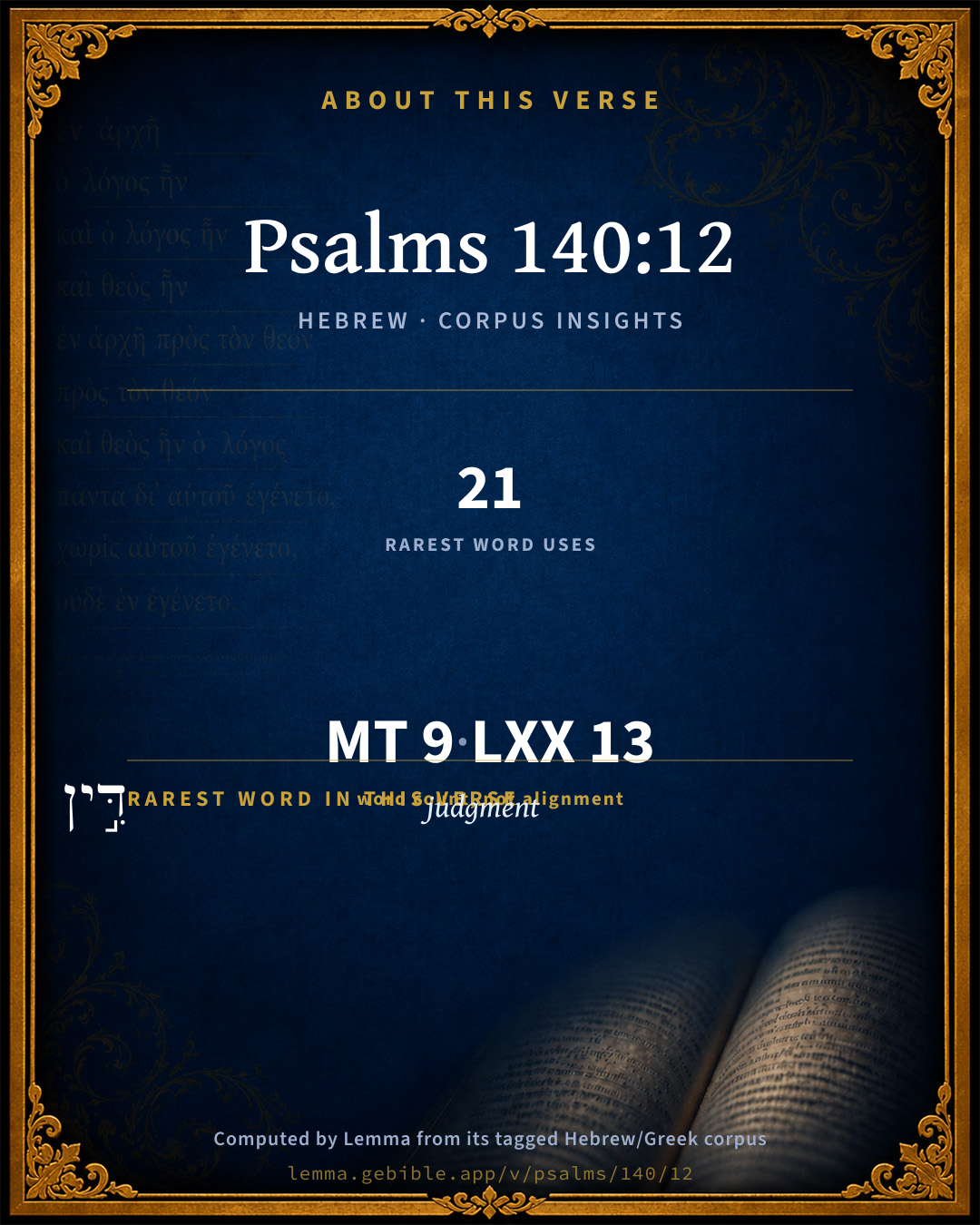
The rarest word here is דִּ֣ין judgment H1779 — appearing just 21 times in the whole Hebrew Bible.

Shared distinctive vocabulary

דִּ֣ין judgment H1779 occurs in 17 verses of the Hebrew Bible. Also found in:

Grammatical profile

  • 3 verbs
  • 3 nouns
  • 2 adjectives
  • 1 conjunction

Verb forms

  • ידעת Qal · Perfect
  • יָדַ֗עְתִּי Qal · Perfect
  • יַעֲשֶׂ֣ה Qal · Imperfect

Repetition

A word recurs within this verse — often emphatic in Hebrew:

  • ידעת to know H3045 ×2

Hebrew & Septuagint length

In English translation the verse runs 16 words from the Hebrew and 19 from the Septuagint (LXX English) — closely comparable.

A rough comparison of the two English renderings, which tokenize alike — not a word-level alignment.

Word counts can differ between the Hebrew and the Greek without any difference in meaning — e.g. the Hebrew direct-object marker אֵת has no separate Greek word, and Greek often adds the article ὁ.

In the original languages it is 9 Hebrew tokens and 13 Greek tokens — but the two are counted differently (Hebrew bundles its prefixes and suffixes into one token; the Greek is in lemma form), so that isn’t a like-for-like length.

Cross-references

14

Topical passages linked to Psalms 140:12 in the Treasury of Scripture Knowledge — connected by theme and wording, ordered by reader-vote popularity; previews shown in the World English Bible.

  • Psalms 9:4 For you have maintained my just cause. You sit on the throne judging righteously.
  • 1 Kings 8:49 then hear you their prayer and their supplication in heaven, your dwelling-place, and maintain their cause;
  • 1 Kings 8:45 then hear in heaven their prayer and their supplication, and maintain their cause.
  • Proverbs 23:10–11 Don't move the ancient boundary stone. Don't encroach on the fields of the fatherless:
  • Jeremiah 22:16 He judged the cause of the poor and needy; then it was well. Wasn't this to know me? says Yahweh.
  • Psalms 35:10 All my bones shall say, "Yahweh, who is like you, Who delivers the poor from him who is too strong for him, Yes, the poor and the needy from him who robs him?"
  • Psalms 102:17 He has responded to the prayer of the destitute, And has not despised their prayer.
  • Matthew 11:5 the blind receive their sight, the lame walk, the lepers are cleansed, the deaf hear, the dead are raised up, and the poor have good news preached to them.
  • Psalms 10:17–18 Yahweh, you have heard the desire of the humble. You will prepare their heart. You will cause your ear to hear,
  • Psalms 22:24 For he has not despised nor abhorred the affliction of the afflicted, Neither has he hidden his face from him; But when he cried to him, he heard.
  • Psalms 72:4 He will judge the poor of the people. He will save the children of the needy, And will break the oppressor in pieces.
  • Psalms 72:12–14 For he will deliver the needy when he cries; The poor, who has no helper.
  • Proverbs 22:22 Don't exploit the poor, because he is poor; And don't crush the needy in court;
  • Isaiah 11:4 but with righteousness shall he judge the poor, and decide with equity for the humble of the earth; and he shall strike the earth with the rod of his mouth; and with the breath of his lips shall he kill the wicked.

Cross-references courtesy of OpenBible.info (CC BY 4.0).

Hebrew and Greek witnesses Masoretic Hebrew ↔ Greek Septuagint

The same verse in the two great witnesses to the Old Testament, shown verse-for-verse.

You’re reading Greek Psalm 139 (Hebrew Psalm 140). The Septuagint counts the superscription, so verse numbers can differ from the Hebrew — chapter-level alignment, not verse-by-verse. Numbering follows Rahlfs.

These are two independent witnesses, not word-aligned to each other, and the Septuagint is shown in lemma (dictionary) form.

Hebrew Psalms 140:12 Masoretic · Westminster Leningrad Codex

ידעת יָדַ֗עְתִּי כִּֽי יַעֲשֶׂ֣ה יְ֭הוָה דִּ֣ין עָנִ֑י מִ֝שְׁפַּ֗ט אֶבְיֹנִֽים

I know that Yahweh will maintain the cause of the afflicted, And justice for the needy.

World English Bible · Public Domain

Greek LXX Greek Psalm 139:12 Septuagint · lemma form

ἀνήρ γλωσσώδης οὐ καταεὐθύνω ἐπί ὁ γῆ ἀνήρ ἄδικος κακός θηρεύσω εἰς διαφθορά

I know that the Lord will maintain the cause of the poor, and the right of the needy ones.

LXX2012 (modern English Septuagint) · Public Domain

Hebrew: Westminster Leningrad Codex (CC BY 4.0). Greek: Septuagint (public domain); English from LXX2012 (modern English Septuagint) (Public Domain). How the Septuagint differs from the Hebrew →

Commentary

Notes on Psalms 140:12 from classic Christian and Jewish commentators (each source and its license shown beneath its notes). The classic Christian expositions comment on the surrounding passage and are grouped to its opening verse, so a note may address several verses; the Jewish commentaries on the Tanakh (Rashi and others) are per-verse, so they appear only where the commentator wrote on this verse.

Lemma curates 59 commentaries, every one of them public domain or Creative Commons licensed, each selected and text-cleaned for this edition rather than reprinted as found. About our sources →

Trapp's Complete Commentary

John Trapp

Psa 140:12 I know that the LORD will maintain the cause of the afflicted, [and] the right of the poor.

Ver. 12. I know] For I have a promise for it, and that is infallible.

John Trapp, A Commentary or Exposition upon All the Books of the Old and New Testament (1647–1656) — public domain. Text from a community e-Sword module.

The Biblical Illustrator

Joseph S. Exell

Psa_140:12

I know that the Lord will maintain the cause of the afflicted, and the right of the poor.

God and the poor

We read in the text that God maintains the cause of the afflicted and the right of the poor, and we may think that there is not much evidence of this. If society is under Gods control how is it that it is such a chaos? There seems to be no order. Yet in the midst of the apparent confusion God is ruling. He holds the winds in His fists, and the water in the hollow of His hand. What gave the psalmist this assurance?

I. His knowledge of Gods character. We read of the pity of God, of the compassion and mercy of God in the Old Testament. Hence the numerous passages relating to God and the poor. He delivereth the poor in their affliction. Thou hast prepared of Thy goodness for the poor. Whoso mocketh the poor reproveth his Maker. Thou hast been a strength to the poor. Break off sins by showing mercy to the poor. Hence also the provision made for the poor. The gleanings of the fields and of the vineyards and oliveyards were always to be left for them. The spontaneous productions of the sabbatical year were also to form a part of their provision. Kindness to them was enjoined as a sacred duty and as a precious privilege.

II. His sense of justice. The psalmist speaks of the right of the poor. Some would assert that the poor have no rights, except the right to starve, or get out of the way. The wealthy classes have rights. Oh yes. The sacredness of property is more inviolate than the sacredness of the Sabbath. The rich mans wealth is his strong city, and around this strong city there are walls built by legislators. Let wealth have its rights; and let poverty have its rights too. If it is right to strengthen the weak, to lift up the feeble, to comfort the sorrowful, to heal the afflicted, to provide for the poor, then God will maintain that right. He that implanted in man this sense of justice, shall He not be just? Justice may appear tardy, but ever the right comes uppermost, and justice shall be done. I know that the Lord will, etc. If they have no other friend, the afflicted and poor have a Friend in heaven, whose righteousness is like the great mountains, whose mercy endureth for ever.

III. His knowledge that God raised helpers for the feeble and oppressed. Charity was exercised then. It was a part of the Jewish religion. The rites of hospitality were then observed, and are in a large measure observed now in the East, with great care and faithfulness. Not an enemy was betrayed who had come into a tent for hospitality. There is a fountain of sympathy in the human heart. God has made the heart, and kindled in it the emotions of love and pity. Love God, and you will be constrained to love man. Keep the first table of the law, and you will be impelled to observe the second. God is not poor, and needing our alms. But around us are men, made in the similitude of God, capable of holding fellowship with God, of thinking upon His name, and loving Him, and love to God can express itself in service to men. This is the essence of religion--love. The apostle says that all is vain without this. (J. Owen.)

.

Psa_141:1-10

The Biblical Illustrator, edited by Joseph S. Exell (c. 1880s–1900s) — public domain. Text from a community e-Sword module.

The Treasury of David

Charles H. Spurgeon

Ver. 12. I know that the Lord will maintain the cause of the afflicted, and, the right of the poor. All through the Psalm the writer is bravely confident, and speaks of things about which he had no doubt: in fact, no Psalm can be more grandly positive than this protest against slander. The slandered saint knew Jehovah's care for the afflicted, for lie had received actual proofs of it himself. "I will maintain it" is the motto of the great Defender of the rights of the needy. What confidence this should create within the bosoms of the persecuted and poverty stricken! The prosperous and wealthy can maintain their own cause, but those who are otherwise shall find that God helps those who cannot help themselves. Many talk as if the poor had no rights worth noticing, but they will sooner or later find out their mistake when the Judge of all the earth begins to plead with them.

Ver. 12. I know. For I have a promise of it, and that's infallible. John Trapp.

Ver. 12-13. I know that the Lord will maintain the cause, etc. Why, how comes the Psalmist so confident? "Surely the righteous shall give thanks unto thy name": as if he had said, Thou hast a name for a gracious and faithful God in thy promise, and this thou wilt never suffer to be blotted by failing in thy work. Christian, thou mayest venture all thou art worth on the public faith of Heaven: "His words are pure, as silver tried seven times in a furnace." He that will not suffer a liar or covenant breaker to set foot on his holy hill, will much less suffer any one thought of falseness or unfaithfulness to enter into his own most holy heart. William Gurnall.

Ver. 12.

1. The known fact.

2. The reasons for being so assured of it.

3. The conduct arising out of the knowledge.

Ver. 12. Something worth knowing.

1. By the afflicted and the poor who trust in the Lord.

2. By the oppressors who afflict and do the wrong.

3. By all men, that they may trust in the Lord, and praise him for his compassion towards the needy, and for his even handed justice. J. F.

Ver. 12-13.

1. Trust under all circumstances (Ps 140:12).

2. Gratitude for all things: "The righteous shall give thanks unto thy name."

3. Safety at all times: "The upright shall dwell in thy presence." G. R.

Psalms 140:13*

Charles H. Spurgeon's The Treasury of David (1869–1885) — public domain. Psalms only. Text from a community e-Sword/MySword module.

Joseph Benson's Commentary

Psa 140:12-13. I know, &c. — Both by God’s word, who hath promised it, and by my own experience of it in the course of God’s providence; that the Lord will maintain the cause of the afflicted, &c. — That he will not suffer might always to prevail against right, though it be but the right of the poor. God is, and will be, the patron of oppressed innocence, much more of persecuted piety; they that know him at all cannot but know this. Surely the righteous shall give thanks — Shall have occasion to praise thee for their deliverance; the upright shall dwell in thy presence — Shall constantly enjoy thy gracious and powerful presence, protection, and assistance.

Joseph Benson's Commentary on the Old and New Testaments (1811–1818) — public domain. Text from a community e-Sword module.

J. A. Alexander on Psalms

Joseph Addison Alexander

13. (Psa 140:12) I know that Jehovah will do justice to the sufferer, and judgment for the poor. Compare Psa 9:4; Psa 9:16. Literally, the right of the sufferer, the judgment of the poor.

Joseph Addison Alexander, The Psalms Translated and Explained (1850) — public domain. Text from a community e-Sword module.

Adam Clarke's Commentary

Verse 12. The cause of the afflicted] Every person who is persecuted for righteousness' sake has God for his peculiar help and refuge; and the persecutor has the same God for his especial enemy.

Adam Clarke's Commentary on the Bible (1810–1826) — public domain. Text from a community e-Sword/MySword module.

John Calvin's Commentaries

12. I have known; that God, etc. There can be no question that David here seals or corroborates his prayer by turning his thoughts and discourse to the providential judgments of God, for, as I have already said, doubtful prayer is no prayer at all. He declares it to be a thing known and ascertained that God cannot but deliver the afflicted. As he may connive for a time, however, and suffer good and upright persons to be grievously tried, David suggests as consideration which may meet this temptation, that God does so advisedly, that he may relieve those who are in affliction, and recover those who are oppressed. He accordingly says in express words that he will be the judge of the poor and the afflicted. In this way does he encourage both others and himself under continued troubles, till the time proper for deliverance arrive, intimating that though he might be universally considered an object of pity in being exposed to the fury of the wicked, and in not being immediately delivered by the hand of God, he would not give way to despair, but remember that it was the very part of God to undertake the cause of the poor. It were to weaken the passage if we considered David merely to be speaking of his own individual case.

He infers (Psalm 140:13) that the righteous would give thanks to God, and be safe under his help. For the particle אך, ach, which is often adversative in the Hebrew, is here affirmative, and denotes inference or consequence from what was formerly stated. Though the godly may be silenced for a time, and through the force of trouble may not raise the praises of God, David expresses his conviction that what was taken away would be speedily restored, and they would celebrate the loving kindness of the Lord with joy and alacrity. As this is not easily believed in circumstances of trial, the already referred to is inserted. We must endeavor, though with a struggle, to rise to a confident persuasion, that however low they may be brought, the Lord’s people will be restored to prosperity, and will soon sing his praises. The second clause of the verse gives the reason of their thanksgiving’s. He speaks of this as being the ground of the praises of the righteous, that they experience God’s care of them, and concern for their salvation. For to dwell before God’s face is to be cherished and sustained by his fatherly regards.

John Calvin's Commentaries (1540-1563) — public domain. Text from the Calvin Translation Society English edition (1840s-50s) via the Christian Classics Ethereal Library (ccel.org). Calvin's coverage is partial (roughly two-thirds of the Bible); uncommented books and verses are honest gaps, never fabricated. The 19th-century editor's footnotes and remarks are omitted so the notes are faithfully Calvin's own voice.

Ellicott's Commentary for English Readers

(12) Comp. Psa_9:4; Psa_9:16.

A Bible Commentary for English Readers, edited by Charles John Ellicott (1878–1897) — public domain. Text from a community e-Sword module.

The Cambridge Bible for Schools and Colleges

gen. ed. J. J. S. Perowne

12. Jehovah is the Judge Who rights the weak and oppressed. Cp. Psa_7:8-9; Psa_9:4; &c.

12, 13. The destiny of the righteous contrasted with the fate of the wicked.

The Cambridge Bible for Schools and Colleges (gen. ed. J. J. S. Perowne; Cambridge University Press, 1878–1918) — public domain. Text from a community e-Sword module.

John Gill's Exposition

I know,.... Here is a double reading: the "Keri", or marginal reading, is, "thou knowest"; an appeal of the psalmist to God, who knew the thoughts of the wicked concerning him, and their devices against him; as Kimchi: but the Scripture reading is, I know; expressing his full persuasion and assurance

that the Lord will maintain the cause of the afflicted, and the right of the poor; of his poor and afflicted people, that are afflicted within and without, by men and devils; and who are poor as to the things of this world, and poor in spirit, and sensible of their spiritual poverty, but rich in grace: the cause of these God will maintain against their oppressors, and right their wrongs, and avenge their injuries; this the psalmist knew, and was assured of from the word of God, from instances and examples in former times, and from his own experience, Psa 9:4.

John Gill's Exposition of the Whole Bible (1746–1763) — public domain (CC PDM 1.0). Text via the HelloAO Bible API.

Albert Barnes' Notes on the Bible

I know that the Lord will maintain the cause of the afflicted - See the notes at Psa 9:4. The psalmist here doubtless refers primarily to himself, as having a confident belief that the Lord would maintain “his” cause, or would defend “him.” At the same time he makes the statement general, implying that what would be done to him would be done to all in similar circumstances. The idea is that God, in all his attributes, in all his providential arrangements, in all his interpositions on earth, would be found to be on the side of the oppressed, the afflicted, and the wronged. He has no attribute that can take part with an oppressor or a wrong doer. The wicked cannot come to him with the belief that he will be on their side: the righteous - the oppressed - the afflicted - can.

And the right of the poor - He will defend the right of the poor. Literally, “The judgment of the poor.” That which will be just and right in their case.

Albert Barnes' Notes on the Bible (1834–1885) — public domain. Text from a community e-Sword/MySword module.

Matthew Poole's English Annotations

I know, both by God’s word, which hath promised it, and by my own experience of it in the course of God’s providence.

Matthew Poole's English Annotations on the Holy Bible (1683–1685) — public domain. Text from a community e-Sword/MySword module.

Whedon's Commentary on the Bible

Daniel D. Whedon

12, 13. A more calm and confident tone marks the closing of this psalm.

Maintain the cause of the afflicted—The language is forensic. A suffering Church appeals to God against the wrongs and persecutions of the world, and faith assures that God will maintain the right. Afflicted…

poor—These terms, often rendered “poor and needy” in the psalms and the prophets, denote not merely the temporally destitute and suffering, but commonly take the implied adsignification of humble, “poor in spirit,” as Mat_5:3, such as despair of self-help, and put their trust in God only. Such only are dear to God, and he will vindicate them.

Surely— Answering to the New Testament verily.

The righteous shall give thanks—Both for the results reached and the methods of Providence to secure them.

Dwell in thy presence—Literally, Dwell before thy face. To abide “before the face of God”—to “behold his face”—to “be glad in his countenance”—are phrases always denoting the conscious enjoyment of the favour of God, here and hereafter. See on Psa_16:11; Psa_17:15; Psa_21:6; and compare Mat_5:8; 1Jn_3:2.A Psalm of David.

Daniel D. Whedon (gen. ed.), Commentary on the Old and New Testaments (1874–1909) — public domain. Text from a community e-Sword module.

The Pulpit Commentary

I know that the Lord will maintain the cause of the afflicted. The psalmist is confident, not only that the wicked will be punished, but also that the righteous, whatever sufferings may come upon them, will ultimately be delivered out of their afflictions. (comp. Psa_9:4, Psa_9:9, Psa_9:12, Psa_9:18, etc.) And the right of the poor. It is not to be supposed that "the right" is always with "the poor;" but, when it is, God will assuredly be their champion.

The Pulpit Commentary (1880–1919), ed. H.D.M. Spence-Jones & Joseph S. Exell — public domain. Text from a community e-Sword module.

Keil & Delitzsch

C. F. Keil & F. Delitzsch

With Psa 140:13 the mood and language now again become cheerful, the rage has spent itself; therefore the style and tone are now changed, and the Psalm trips along merrily as it were to the close. With reference to ידעת for ידעתי (as in Job 42:2), vid., Psa 16:2. That which David in Psa 9:5 confidently expects on his own behalf is here generalized into the certain prospect of the triumph of the good cause in the person of all its representatives at that time oppressed. אך, like ידעתּי, is an expression of certainty. After seeming abandonment God again makes Himself known to His own, and those whom they wanted to sweep away out of the land of the living have an ever sure dwelling-place with His joyful countenance (Psa 16:11).

Keil & Delitzsch — Biblical Commentary on the Old Testament (1861–1891) — public domain (CC PDM 1.0). Text via the HelloAO Bible API. (Old Testament only.)

unfoldingWord translationNotes

Door43 World Missions Community

he will give justice to the needy

The abstract noun "justice" can be stated as "just." AT: "He will act in a just manner to help the needy" (See: Abstract Nouns)

to your name

This represents Yahweh. AT: "to you" (See: Metonymy)

translationWords

afflicted

just

righteous

righteous

unfoldingWord translationNotes — © Distant Shores Media and the Door43 World Missions Community, licensed CC BY-SA 4.0. Source: git.door43.org/Door43/en_tn.

Rashi

Rabbi Shlomo Yitzchaki (Rashi)

A slanderer Esau, who would trap with his mouth.

will trap him The evil that he does will trap him.

Rashi on the Tanakh — English translations: “The Judaica Press complete Tanach with Rashi, translated by A. J. Rosenberg” (CC BY 4.0); “Pentateuch with Rashi's commentary by M. Rosenbaum and A.M. Silbermann, 1929-1934” (public domain); “The Metsudah Tanach series, Lakewood, N.J” (CC BY 4.0); and “The Book of Joshua, Metsudah Publications, 1997” (CC BY 4.0). Text via Sefaria.

Lesson kit

Teaching starters — assembled from the data on this page, not authored interpretation. Every prompt links to the verse data it draws on. Edit before teaching.

Psalms, in the Wisdom, opens this verse with 9 words (8 distinct Hebrew lemmas). Its most distinctive word is dîyn (“judgment”). A historical commentator’s framing appears above. Read the whole chapter for the surrounding context.

Discussion questions

  1. What does “judgment” (dîyn) contribute to the verse as a whole?
  2. Deuteronomy 17:8 shares the word «judgment» with this verse. How do the two illuminate each other?
  3. “to know” occurs 2× in this one verse. What is the effect of the repetition?
  4. The translations on this page render this verse differently — a whole-verse word diff, not a word-by-word alignment. What might account for the different wordings?
  5. The verb «ידעת» is Qal Perfect. How does its form color the action?
  6. Reading how Trapp's Complete Commentary and The Biblical Illustrator read this verse, where do the two commentators agree and where do they part?

Things to notice

Reading settings

Reading text

Shown beneath each verse's original-language words.

Old Testament
Old Testament edition

Read the OT as the Masoretic Hebrew (MT) or the Greek Septuagint (LXX).

English shown for the Greek Septuagint (in the Hebrew ↔ Greek comparison).

Comparing translations? Open the Compare panel on any verse page to stack up to four side by side.