
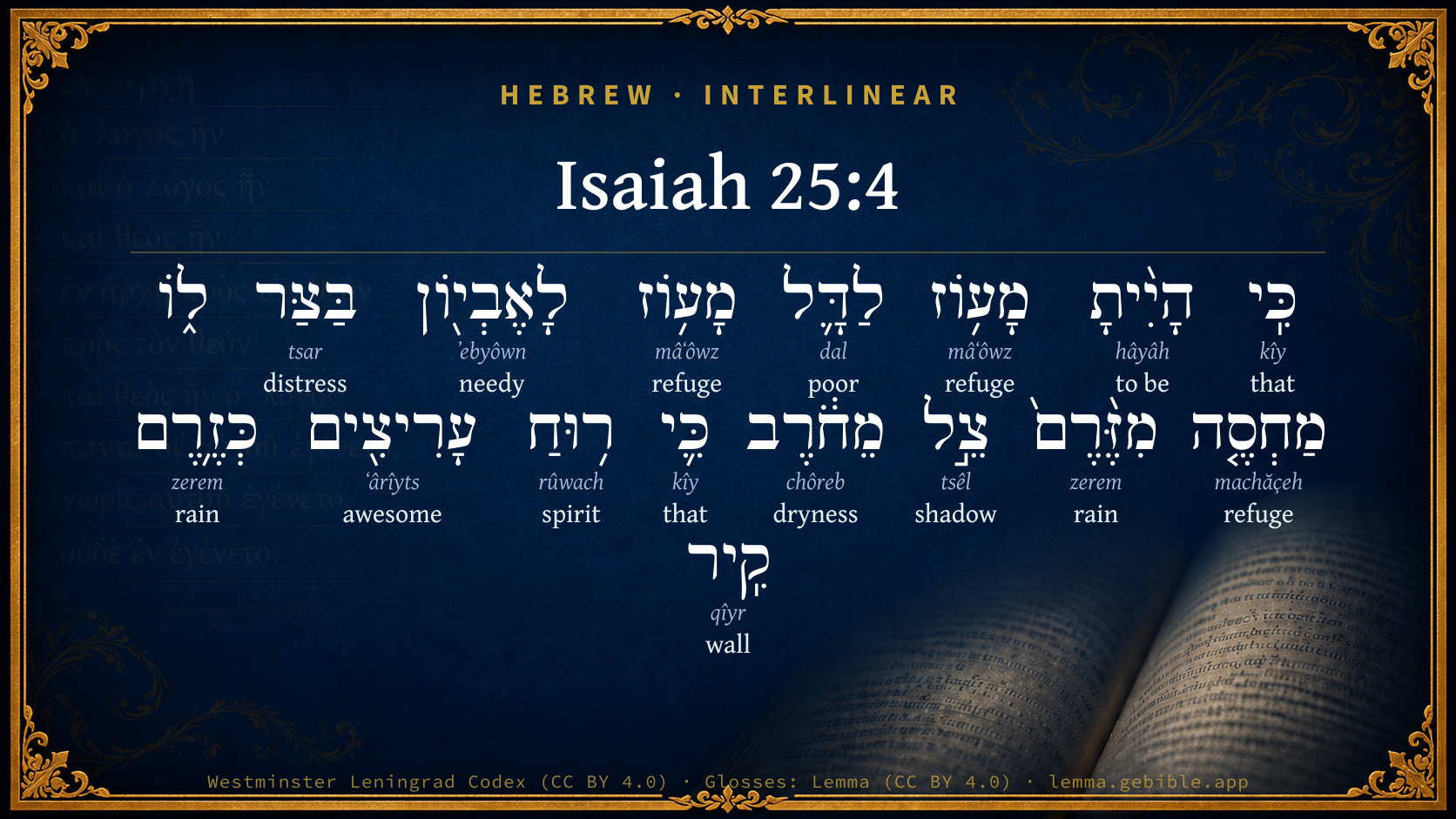
Isaiah 25:4

Hebrew (Westminster Leningrad Codex) Isaiah 25:4 appears in the Hebrew Old Testament. The text above is from the Westminster Leningrad Codex. Each word links to its Strong’s number, a concise gloss, and parsing drawn from the Open Scriptures Hebrew Bible morphology. Click any word for its full Brown-Driver-Briggs (BDB) entry.
Download image
Cite this verse

Isaiah 25:4 (World English Bible). Public Domain. Lemma interlinear Bible study tool, https://lemma.gebible.app/v/isaiah/25/4.

Show BibTeX & RIS
BibTeX
RIS
English Translation
For you have been a stronghold to the poor, a stronghold to the needy in his distress, a refuge from the storm, a shade from the heat, when the blast of the awesome ones is as a storm against the wall.
World English Bible · Public Domain
Download a study sheet

One document with this verse’s original text, its word-by-word gloss line, the meaning frame, cross-references with their text, attributed commentary, and full source and license credits — printable, and it pastes into notes with its structure intact.

This verse Autodidact and up

Study sheet (.html) Plain text (.txt)

A passage Seminary Student

Up to 50 verses in one chapter. A passage sheet keeps up to 6 commentary sources and 12 cross-references per verse, in the order this page ranks them, and says so on the sheet whenever that leaves anything out. Ask for a single verse and you get the Autodidact verse sheet above.

Everything on this page stays free to read, with no account — the sheet is a download of what is already on screen, not access to it.

Want to remove ads? Support Godless Engineer
Compare translations 3

The same verse in 3 English versions, stacked beneath the original-language interlinear above. Click any original word for its lexicon entry.

Each is an independent rendering of the whole verse — the interlinear is not word-aligned to these translations.

Highlighted words mark where these versions differ — a whole-verse word diff, not a word-by-word alignment.

  • World English Bible Public Domain
    For you have been a stronghold to the poor, a stronghold to the needy in his distress, a refuge from the storm, a shade from the heat, when the blast of the awesome ones is as a storm against the wall.
  • King James Version Public Domain
    For thou hast been a strength to the poor, a strength to the needy in his distress, a refuge from the storm, a shadow from the heat, when the blast of the terrible ones is as a storm against the wall.
  • unfoldingWord Literal Text CC BY-SA 4.0
    For you have been a fortress for the poor, a fortress for the needy in distress to him, a shelter from the storm, a shade from the heat, for the breath of the terrible like a storm a wall,

unfoldingWord Literal Text — © unfoldingWord, licensed CC BY-SA 4.0. Word-aligned USFM3 via Door43 (git.door43.org/unfoldingWord/en_ult).

Versions to compare (up to 4)

3 of 4 selected

Show all 17 translations

Every available English version of this verse, each an independent rendering of the whole verse.

  • World English Bible Public Domain
    For you have been a stronghold to the poor, a stronghold to the needy in his distress, a refuge from the storm, a shade from the heat, when the blast of the awesome ones is as a storm against the wall.
  • Berean Standard Bible Public Domain
    For You have been a refuge for the poor, a stronghold for the needy in distress, a refuge from the storm, a shade from the heat. For the breath of the ruthless is like rain against a wall,
  • Majority Standard Bible Public Domain
    For You have been a refuge for the poor, a stronghold for the needy in distress, a refuge from the storm, a shade from the heat. For the breath of the ruthless is like rain against a wall,
  • King James Version Public Domain
    For thou hast been a strength to the poor, a strength to the needy in his distress, a refuge from the storm, a shadow from the heat, when the blast of the terrible ones is as a storm against the wall.
  • American Standard Version (1901) Public Domain
    For thou hast been a stronghold to the poor, a stronghold to the needy in his distress, a refuge from the storm, a shade from the heat, when the blast of the terrible ones is as a storm against the wall.
  • Revised Version (1885) Public Domain
    For thou hast been a strong hold to the poor, a strong hold to the needy in his distress, a refuge from the storm, a shadow from the heat, when the blast of the terrible ones is as a storm against the wall.
  • Geneva Bible (1599) Public Domain
    For thou hast bene a strength vnto the poore, euen a strength to the needie in his trouble, a refuge against the tempest, a shadow against the heate: for the blaste of the mightie is like a storme against the wall.
  • Young's Literal Translation Public Domain
    For Thou hast been a stronghold for the poor, A stronghold for the needy in his distress, A refuge from storm, a shadow from heat, When the spirit of the terrible `is' as a storm -- a wall.
  • Literal Standard Version CC BY-SA 4.0
    For You have been a stronghold for the poor, || A stronghold for the needy in his distress, || A refuge from storm, a shadow from heat, || When the spirit of the terrible [is] as a storm—a wall.
  • Unlocked Literal Bible CC BY-SA 4.0
    For you have been a place of safety for the one who is poor, a shelter for the one who is needy in his distress— a shelter from the storm and a shade from the heat. When the breath of the ruthless was like a storm against a wall,
  • unfoldingWord Literal Text CC BY-SA 4.0
    For you have been a fortress for the poor, a fortress for the needy in distress to him, a shelter from the storm, a shade from the heat, for the breath of the terrible like a storm a wall,
  • Darby Bible Public Domain
    For thou hast been a fortress to the poor, a fortress for the needy in his distress, a refuge from the storm, a shadow from the heat: for the blast of the terrible ones [has been] as the storm [against] a wall.
  • World Messianic Bible Public Domain
    For you have been a stronghold to the poor, a stronghold to the needy in his distress, a refuge from the storm, a shade from the heat, when the blast of the dreaded ones is like a storm against the wall.
  • Webster's Bible Public Domain
    For thou hast been a defense to the poor, a defense to the needy in his distress, a refuge from the storm, a shade from the heat, when the blast of the terrible ones is as a storm against the wall.
  • Free Bible Version CC BY-SA 4.0
    But you have protected the poor and needy when they were in trouble, you shielded them from storms and shaded them from the heat. For the actions of brutal people are like rain beating against a wall,
  • Bible in Basic English Public Domain
    For you have been a strong place for the poor and the crushed in their trouble, a safe place from the storm, a shade from the heat, when the wrath of the cruel ones is like a winter storm.
  • JPS Tanakh (1917) Public Domain
    For Thou hast been a stronghold to the poor, a stronghold to the needy in his distress, a refuge from the storm, a shadow from the heat; for the blast of the terrible ones was as a storm against the wall.

Literal Standard Version (2020), Covenant Press — licensed CC BY-SA 4.0. Text via the HelloAO Bible API (eBible.org). Unlocked Literal Bible (unfoldingWord) — licensed CC BY-SA 4.0. Text via the HelloAO Bible API (eBible.org). unfoldingWord Literal Text — © unfoldingWord, licensed CC BY-SA 4.0. Word-aligned USFM3 via Door43 (git.door43.org/unfoldingWord/en_ult). Free Bible Version, Dr. Jonathan Gallagher — licensed CC BY-SA 4.0. Text via the HelloAO Bible API (eBible.org).

Word by word

More ways to search: Search by grammar → Find every occurrence → Compare this word →

Practice this passage: Drill this verse → Learn its vocabulary →

מִזֶּ֨רֶם֙
zerem
H2230
“from · rain”
Preposition + Noun, Common, Masculine, Singular, Absolute
Part of Speech
Preposition + Noun
Type
Common
Gender
Masculine
Number
Singular
State
Absolute
Full BDB Definition

Origin: from H2229

TWOT: 581a

rain-shower, thunderstorm, flood of rain, downpour, rain-storm
  1. כִּֽי kîy H3588 “that” Conjunction
  2. הָיִ֨יתָ hâyâh H1961 “to be” Verb, Qal, Perfect, 2nd Person, Masculine, Singular
  3. מָע֥וֹז mâʻôwz H4581 “refuge” Noun, Common, Masculine, Singular, Absolute
  4. לַדָּ֛ל dal H1800 “to/for the · poor” Preposition, Determined + Adjective, Adjective, Masculine, Singular, Absolute
  5. מָע֥וֹז mâʻôwz H4581 “refuge” Noun, Common, Masculine, Singular, Absolute
  6. לָאֶבְי֖וֹן ʼebyôwn H34 “to/for the · needy” Preposition, Determined + Adjective, Adjective, Masculine, Singular, Absolute
  7. בַּצַּר tsar H6862 “in/at the · distress” Preposition, Determined + Adjective, Adjective, Masculine, Singular, Absolute
  8. מַחְסֶ֤ה machăçeh H4268 “refuge” Noun, Common, Masculine, Singular, Absolute
  9. צֵ֣ל tsêl H6738 “shadow” Noun, Common, Masculine, Singular, Absolute
  10. מֵחֹ֔רֶב chôreb H2721 “from · dryness” Preposition + Noun, Common, Masculine, Singular, Absolute
  11. כִּ֛י kîy H3588 “that” Conjunction
  12. ר֥וּחַ rûwach H7307 “spirit of” Noun, Common, Both, Singular, Construct
  13. עָרִיצִ֖ים ʻârîyts H6184 “awesome” Adjective, Adjective, Masculine, Plural, Absolute
  14. כְּזֶ֥רֶם zerem H2230 “like/as · rain of” Preposition + Noun, Common, Masculine, Singular, Construct
  15. קִֽיר qîyr H7023 “wall” Noun, Common, Masculine, Singular, Absolute

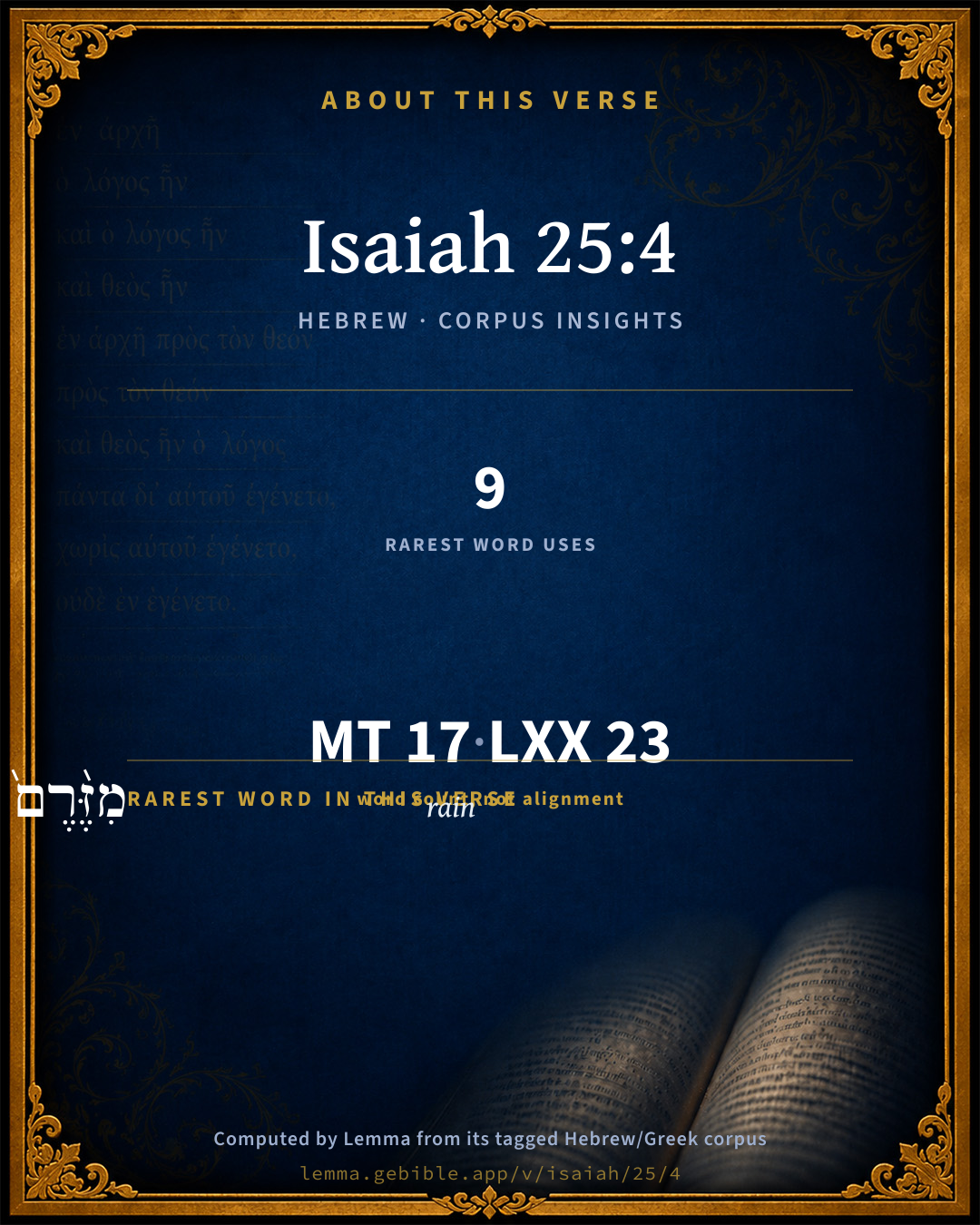
About this verse

These counts appear in no published source. They are computed here, from the morphology-tagged text and Lemma’s own curated glosses. What Lemma adds →

17
words
13
distinct lemmas
Prophets
section

Notable vocabulary

The rarest word here is מִזֶּ֨רֶם֙ rain H2230 — appearing just 9 times in the whole Hebrew Bible.

Shared distinctive vocabulary

מִזֶּ֨רֶם֙ rain H2230 occurs in 7 verses of the Hebrew Bible. Also found in:

Grammatical profile

  • 1 verb
  • 9 nouns
  • 4 adjectives
  • 1 preposition
  • 2 conjunctions

Verb forms

  • הָיִ֨יתָ Qal · Perfect

Repetition

Words recur within this verse — often emphatic in Hebrew:

  • מָע֥וֹז refuge H4581 ×2
  • מִזֶּ֨רֶם֙ rain H2230 ×2
  • כִּֽי that H3588 ×2

Hebrew & Septuagint length

In English translation the verse runs 41 words from the Hebrew and 45 from the Septuagint (LXX English) — closely comparable.

A rough comparison of the two English renderings, which tokenize alike — not a word-level alignment.

Word counts can differ between the Hebrew and the Greek without any difference in meaning — e.g. the Hebrew direct-object marker אֵת has no separate Greek word, and Greek often adds the article ὁ.

In the original languages it is 17 Hebrew tokens and 23 Greek tokens — but the two are counted differently (Hebrew bundles its prefixes and suffixes into one token; the Greek is in lemma form), so that isn’t a like-for-like length.

Cross-references

26

Topical passages linked to Isaiah 25:4 in the Treasury of Scripture Knowledge — connected by theme and wording, ordered by reader-vote popularity; previews shown in the World English Bible.

  • Zephaniah 3:12 But I will leave in the midst of you an afflicted and poor people, and they will take refuge in the name of Yahweh.
  • James 2:5 Listen, my beloved brothers. Didn't God choose those who are poor in this world to be rich in faith, and heirs of the Kingdom which he promised to those who love him?
  • Isaiah 32:2 A man shall be as a hiding-place from the wind, and a covert from the tempest, as streams of water in a dry place, as the shade of a great rock in a weary land.
  • Matthew 7:25–27 The rain came down, the floods came, and the winds blew, and beat on that house; and it didn't fall, for it was founded on the rock.
  • Job 5:15–16 But he saves from the sword of their mouth, Even the needy from the hand of the mighty.
  • Psalms 12:5 "Because of the oppression of the weak and because of the groaning of the needy, I will now arise," says Yahweh; "I will set him in safety from those who malign him."
  • Psalms 107:41 Yet he lifts the needy out of their affliction, And increases their families like a flock.
  • Isaiah 33:16 He shall dwell on high; his place of defense shall be the munitions of rocks; his bread shall be given [him]; his waters shall be sure.
  • Isaiah 4:5–6 Yahweh will create over the whole habitation of Mount Zion, and over her assemblies, a cloud and smoke by day, and the shining of a flaming fire by night; for over all the glory will be a canopy.
  • Isaiah 29:19 The humble also shall increase their joy in Yahweh, and the poor among men shall rejoice in the Holy One of Israel.
  • Isaiah 32:18–19 My people shall abide in a peaceable habitation, and in safe dwellings, and in quiet resting-places.
  • Isaiah 49:25 But thus says Yahweh, Even the captives of the mighty shall be taken away, and the prey of the terrible shall be delivered; for I will contend with him who contends with you, and I will save your children.
  • Isaiah 66:2 For all these things has my hand made, and [so] all these things came to be, says Yahweh: but to this man will I look, even to him who is poor and of a contrite spirit, and who trembles at my word.
  • Psalms 72:4 He will judge the poor of the people. He will save the children of the needy, And will break the oppressor in pieces.
  • Psalms 72:13 He will have pity on the poor and needy. He will save the souls of the needy.
  • Psalms 119:31 I cling to your statutes, Yahweh. Don't let me be disappointed.
  • Isaiah 11:4 but with righteousness shall he judge the poor, and decide with equity for the humble of the earth; and he shall strike the earth with the rod of his mouth; and with the breath of his lips shall he kill the wicked.
  • Isaiah 14:32 What then shall one answer the messengers of the nation? That Yahweh has founded Zion, and in her shall the afflicted of his people take refuge.
  • Isaiah 17:10 For you have forgotten the God of your salvation, and have not been mindful of the rock of your strength; therefore you plant pleasant plants, and set it with strange slips.
  • Isaiah 27:5 Or else let him take hold of my strength, that he may make peace with me; [yes], let him make peace with me.
  • Isaiah 29:5 But the multitude of your foes shall be like small dust, and the multitude of the awesome ones as chaff that passes away: yes, it shall be in an instant suddenly.
  • Isaiah 33:2 Yahweh, be gracious to us; we have waited for you: be our arm every morning, our salvation also in the time of trouble.
  • Isaiah 37:36 The angel of Yahweh went forth, and struck in the camp of the Assyrians one hundred and eighty-five thousand; and when men arose early in the morning, behold, these were all dead bodies.
  • Psalms 35:10 All my bones shall say, "Yahweh, who is like you, Who delivers the poor from him who is too strong for him, Yes, the poor and the needy from him who robs him?"
  • Isaiah 37:3–4 They said to him, Thus says Hezekiah, This day is a day of trouble, and of rebuke, and of rejection; for the children have come to the birth, and there is no strength to bring forth.
  • Ezekiel 13:11–13 tell those who daub it with whitewash, that it shall fall: there shall be an overflowing shower; and you, great hailstones, shall fall; and a stormy wind shall tear it.

Cross-references courtesy of OpenBible.info (CC BY 4.0).

Hebrew and Greek witnesses Masoretic Hebrew ↔ Greek Septuagint

The same verse in the two great witnesses to the Old Testament, shown verse-for-verse.

These are two independent witnesses, not word-aligned to each other, and the Septuagint is shown in lemma (dictionary) form.

Hebrew Isaiah 25:4 Masoretic · Westminster Leningrad Codex

כִּֽי הָיִ֨יתָ מָע֥וֹז לַדָּ֛ל מָע֥וֹז לָאֶבְי֖וֹן בַּצַּר ל֑וֹ מַחְסֶ֤ה מִזֶּ֨רֶם֙ צֵ֣ל מֵחֹ֔רֶב כִּ֛י ר֥וּחַ עָרִיצִ֖ים כְּזֶ֥רֶם קִֽיר

For you have been a stronghold to the poor, a stronghold to the needy in his distress, a refuge from the storm, a shade from the heat, when the blast of the awesome ones is as a storm against the wall.

World English Bible · Public Domain

Greek LXX Isaiah 25:4 Septuagint · lemma form

γίγνομαι γάρ πᾶς πόλις ταπεινός βοηθός καί ὁ ἀθυμέω διά ἔνδεια σκέπης ἀπό ἄνθρωπος πονηρός ῥύομαι αὐτός σκέπης διψάω καί πνεῦμα ἄνθρωπος ἀδικέω

For you have been a helper to every lowly city, and a shelter to them that were disheartened by reason of poverty: you shall deliver them from wicked men: you have been a shelter of them that thirst, and a refreshing air to injured men.

LXX2012 (modern English Septuagint) · Public Domain

Hebrew: Westminster Leningrad Codex (CC BY 4.0). Greek: Septuagint (public domain); English from LXX2012 (modern English Septuagint) (Public Domain). How the Septuagint differs from the Hebrew →

Targum (Aramaic paraphrase)

1

The Targum is the ancient Jewish Aramaic paraphrase of the Hebrew Scriptures — an interpretive translation, not the Hebrew text itself. Onkelos (literal) and Pseudo-Jonathan (expansive) render the Torah, and Jonathan the Prophets. Coverage is partial: where no permissively-licensed English translation exists for a verse, only the Aramaic is shown. This is verse-level text, not a word-by-word alignment to the Hebrew.

  1. Targum Jonathan Prophets (Joshua–Malachi)
    אֲרֵי הֲוֵיתָא תְקוֹף לְמִסְכַּן סְעֵיד לַחֲשִׁיךְ בְּעִדַן עָקָא כְּמָא דְמִטַמְרָן מִן קֳדָם זַרְמִית כִּטְלַל מִשְׁרָב כֵּן מִלֵי רַשִׁיעַיָא לְצַדִיקַיָא כְּזַרְמִית בְּשָׁקְפָא בְּכוֹתֵל:

    For thou hast been a strength to the poor, a help to the needy in the time of distress; as those who are protected from before a storm, or who are protected as in a shade from the scorching heat; thus the words of the wicked against the righteous are as a storm that beats against the wall.

    Targum Jonathan — Aramaic: “Mikraot Gedolot” (public domain). English: “Sefaria Community Translation” (CC0 1.0 (public-domain dedication)); “London "Chaldee Paraphrase," 1871” (public domain). Text via Sefaria.

Commentary

Notes on Isaiah 25:4 from classic Christian and Jewish commentators (each source and its license shown beneath its notes). The classic Christian expositions comment on the surrounding passage and are grouped to its opening verse, so a note may address several verses; the Jewish commentaries on the Tanakh (Rashi and others) are per-verse, so they appear only where the commentator wrote on this verse.

Lemma curates 59 commentaries, every one of them public domain or Creative Commons licensed, each selected and text-cleaned for this edition rather than reprinted as found. About our sources →

Trapp's Complete Commentary

John Trapp

Isa 25:4 For thou hast been a strength to the poor, a strength to the needy in his distress, a refuge from the storm, a shadow from the heat, when the blast of the terrible ones [is] as a storm [against] the wall.

Ver. 4. For thou hast been a strength to the poor,] &c. That is, thou hast protected thy poor people from the persecution of the Antichristian rout, saith Piscator. Great is God’s mercy in succouring his oppressed ones. This is here set forth by a double comparison: first,

A refuge from the storm, a shadow {a} from the heat, &c.] Where the Church’s enemies are compared to raging waters, that bear down all before them; God to a place of refuge to fly unto. Secondly,

{a} Christ is a shadow, &c., whereas all worldly comforts are but as so many burning glasses to scorch the soul more.

John Trapp, A Commentary or Exposition upon All the Books of the Old and New Testament (1647–1656) — public domain. Text from a community e-Sword module.

The Biblical Illustrator

Joseph S. Exell

Isa_25:4

For Thou hast been a strength to the poor

Poor and needy

Among the names applied to Gods people there are three which were destined to play an enormous part in the history of religion.

In the English version these appear as two: poor and needy; but in the original they are three. In Isa_25:4 : Thou has been astronghold to the poor and a stronghold to the needy, poor renders a Hebrew word, dal, literally, wavering, tottering, infirm, then slender or lean, then poor in fortune and estate; needy literally renders the Hebrew ebhyon, Latin egenus. In Isa_26:6 : The foot of thepoor and the steps of the needy, needy renders dal, while poor renders ani, a passive form--forced, afflicted, oppressed, then wretched, whether under persecution, poverty, loneliness, or exile, and so tamed, mild, meek. These three words, in their root ideas of infirmity, need, and positive affliction, cover among them every aspect of physical poverty and distress. (Prof. G. A. Smith, D. D.)

Poverty in the East

In the East poverty scarcely ever means physical disadvantage alone; in its train there follow higher disabilities. A poor Eastern cannot be certain of fair play in the courts of the land. He is very often a wronged man, with a fire of righteous anger burning in his breast. Again, and more important, misfortune is to the quick, religious instinct of the Oriental a sign of Gods estrangement. With us misfortune is so often only the cruelty, sometimes real, sometimes imagined, of the rich; the unemployed vents his wrath at the capitalist, the tramp shakes his fist after the carriage on the highway. In the East they do not forget to curse the rich, but they remember as well to humble themselves beneath the hand of God. With an unfortunate Oriental the conviction is supreme, God is angry with me; I have lost His favour. His soul eagerly longs for God. (Prof. G. A. Smith, D. D.)

Israels poverty of heart

These were four aspects of Israels poverty of heart, a hunger for pardon, a hunger for justice, a hunger for home, and a hunger for God. (Prof. G. A. Smith, D. D.)

A refuge from the storm

A refuge from the storm

The conditions of our earth, and its varied phenomena, are employed by the sacred writers to represent many circumstances of human life. Troubles, especially when heavy and expressive of Divine displeasure, are represented in Holy Scripture as storms.

I. THIS IS A WORLD WHERE STORMS OFTEN GATHER AND TEMPESTS ON THIS PLANET ARE NEVER OUT OF PLACE. The storm has its mission as well as the calm. Among men, adversity of all kinds is a powerful agent in accomplishing necessary spiritual operations.

II. THIS IS A TIME OF STORMS AND TEMPESTS HERE ARE NOT OUT OF SEASON. The days of man upon earth are as the winter of his life. Death is the seed time, and immortality is the spring and summer and harvest. When the spring and summer have come, snow and hail are out of season; but during the winter of our being, hail and snow and rain are in season.

III. EVERY STORM IS RAISED AND GUIDED UNDER THE EYE AND HAND OF GOD. The stormy wind does not surprise Him. He determined that it should blow at such a moment, from such a quarter, with such a force, and with particular effects. Neither does it master Him. The stormy wind simply accomplishes His word.

IV. THE OBJECT OF EVERY STORM IS GOOD, ALTHOUGH THE PRESENT EXPERIENCE OF IT IS NOT JOYOUS, BUT GRIEVOUS. Hence the need of a refuge to the man of God. Have you marked how frequently God is spoken of as a refuge?

V. A PLACE TO BE A REFUGE MUST BE OUT OF THE STORM, OR, IF IN THE MIDST OF IT, MUST BE STRONGER THAN THE STORM. But how is it that we children of men come to take refuge in God? The Gospel reaches us with its wooing voice. In the mediation of Jesus, in His sympathy, love, and power we find refuge. And we come to make all the covenants and promises of God distinct refuges. There is a harbour or haven at every point of danger. Do you come to poverty? There are promises to the poor. Are you a widow? There are promises to the widow. And all the hopes which these covenants awaken become in turn so many refuges. In this world, quietness of mind and heart is a thing utterly impossible to a man who does not rest in his God. If you feel the need of a refuge, you may in that sorrow which another professes to despise find the very refuge which you seek in your God. And why? Say that your sensitiveness springs from weakness. Well, God has sympathy with your weakness. (S. Martin.)

The Biblical Illustrator, edited by Joseph S. Exell (c. 1880s–1900s) — public domain. Text from a community e-Sword module.

Geneva Bible (1599)

Geneva Bible translators

The rage of the wicked is furious, till God break the force thereof.

Geneva Bible (1599) marginal notes — public domain. Text via Bolls.life.

Jamieson, Fausset & Brown

Robert Jamieson, A. R. Fausset & David Brown

the poor . . . needy--the Jews, exiles from their country (Isa 26:6; Isa 41:17).

heat--calamity (Isa 4:6; Isa 32:2).

blast--that is, wrath.

storm--a tempest of rain, a winter flood, rushing against and overthrowing the wall of a house.

Jamieson, Fausset & Brown — Commentary Critical and Explanatory on the Whole Bible (1871) — public domain (CC PDM 1.0). Text via the HelloAO Bible API.

Adam Clarke's Commentary

Verse 4. As a storm against the wall - "Like a winter - storm."] For קיר kir, read קור kor: or, as עיר ir from ערר arar, קיר kir from קרר karar. - Capellus.

Adam Clarke's Commentary on the Bible (1810–1826) — public domain. Text from a community e-Sword/MySword module.

Ellicott's Commentary for English Readers

(4) Thou hast been a strength . . .—Literally, a fortress. The fierceness of the oppressor is represented by the intolerable heat, and the fierce tornado of an eastern storm, dashing against the wall, threatening it with destruction. From that storm the faithful servants of the Lord should find shelter as in the castle of the great King.

A Bible Commentary for English Readers, edited by Charles John Ellicott (1878–1897) — public domain. Text from a community e-Sword module.

The Cambridge Bible for Schools and Colleges

gen. ed. J. J. S. Perowne

4, 5. Its happy consequences nor Israel. The “for” may refer back to Isa_25:1 or to Isa_25:3; in either case the judgment on the oppressive city is regarded as a signal proof of Jehovah’s protecting care over His people.

For strength render stronghold, as in R.V.

when the blast … wall] Lit., “for the blast of the terrible ones is as rain of a wall.” The construction is too condensed to be natural. A better rendering would be “as rain of winter” (reading qôr for qîr). But the whole clause is justly suspected by some critics of being a gloss, on account of its prosaic character, and its doubtful appropriateness in the context.

The Cambridge Bible for Schools and Colleges (gen. ed. J. J. S. Perowne; Cambridge University Press, 1878–1918) — public domain. Text from a community e-Sword module.

John Gill's Exposition

For thou hast been a strength to the poor, a strength to the needy in his distress,.... The people of God, who are poor and needy, both in a literal and in a spiritual sense; and especially when under afflicted circumstances, in times of desertion, temptation, bodily affliction, and persecution from men, which may be here chiefly intended; to whom the Lord is a strength: he strengthens their hearts, and his own grace in them; he sheds abroad his love in their hearts, which makes their mountain to stand strong; he directs them to Christ, in whom is strength, as well as righteousness; he strengthens them by his Spirit, his promises, word, and ordinances. Christ may be more especially meant; and it may refer to the strength and power he will give to his people in the latter day; when a small one shall be a strong nation; when the feeble shall be as David, and the house of David as the angel of the Lord; when they shall have got the victory over the beast, his mark and image, Isa 60:21,

a refuge from the storm; or tempestuous rain, or overflowing flood; as Christ is a refuge from the tempest and storm of divine wrath and vengeance, by his satisfaction and righteousness, Isa 32:2 so from the flood of persecution, by his power and providence, Rev 12:15,

a shadow from the heat; which gives refreshment and rest, and is a protection from the scorching beams of the sun. Christ, as he is the shadow from the heat of a fiery law, from the flaming sword of justice, from the wrath of God, and the fiery darts of Satan's temptations; so from the violence of persecution, which heat shall now be no more, antichrist being destroyed, Rev 7:15,

when blast of the terrible ones is as a storm against the wall; these terrible ones are either Satan and his principalities, who are very terrible to the Lord's people; and whose temptations are like a strong wind, which beat against them as against a wall, but they stand, the Lord being their strength, refuge, and shadow; see Isa 49:24 or rather antichrist and his persecuting princes, the kings of the earth, that have joined him, and persecuted the saints, and have been terrible to them; and whose persecutions have been like a blustering strong wind, threatening to carry all before them; but the Lord has been their protection, and made them to stand as a wall, firm and immovable, against them. The Targum is,

"so the words of the wicked are to the righteous, as a storm that dasheth against a wall.''

John Gill's Exposition of the Whole Bible (1746–1763) — public domain (CC PDM 1.0). Text via the HelloAO Bible API.

Albert Barnes' Notes on the Bible

For thou hast been a strength to the poor - Thou hast sustained and upheld them in their trials, and hast delivered them. God is often spoken of as the strength of his people. Isa 26:4 : ‘In the Lord Yahweh is everlasting strength.’ Psa 27:1 : ‘The Lord is the strength of my life, of whom shall I be afraid?’ Psa 28:8; Psa 29:11; Psa 31:2; Psa 46:1; Isa 45:24. By the ‘poor’ and the ‘needy’ here undoubtedly are mean; the captive Jews who had been stripped of their wealth, and carried from their homes, and confined in Babylon.

A refuge - A place of safety; a retreat; a protection. God is often spoken of as such a refuge; Deu 33:27 : ‘The eternal God is thy refuge.’ 2Sa 22:3; Psa 9:9; Psa 14:6; Psa 46:1, Psa 46:7, Psa 46:11; Psa 57:1; Psa 59:16)

From the storm - This word (זרם zerem) usually denotes a tempest of wind and rain. Here it is put for calamity and affliction. The figure is common in all languages.

A shadow from the heat - (See Isa 4:6, note; Isa 16:3, note; compare Isa 32:2.)

When the blast of the terrible ones - Of the fierce, mighty, invading enemies. When they sweep down all before them as a furious tempest does.

Is as a storm against the wall - For ‘wall’ here (קיר qiyr), Lowth proposes to read קוּר qûr, from קרר qârar, to be cold or cool, and supposes that this means a winters storm. In this interpretation also Vitringa and Cappellus coincide. But there is no need of supposing an error in the text. The idea is, probably, that of a fierce driving storm that would prostrate walls and houses; meaning a violent tempest, and intending to describe in a striking manner the severity of the calamities that had come upon the nation.

Albert Barnes' Notes on the Bible (1834–1885) — public domain. Text from a community e-Sword/MySword module.

Haydock's Catholic Bible Commentary

Poor; Juda, whom Nabuchodonosor’s fury could not exterminate.

George Leo Haydock (1774–1849), Haydock's Catholic Family Bible and Commentary, 1859 edition — public domain. Excludes Psalms (Douay-Rheims chapter numbering differs from Protestant) and Deuterocanonical books (Catholic canon only).

Matthew Poole's English Annotations

For thou hast been a strength to the poor, & c.; for thou hast defended thy poor and helpless people against the fiercest assaults of their enemies.

When the blast of the terrible one is as a storm against the wall; or, for (as this particle commonly signifies; or rather, therefore, as it is frequently used, because thou art their defender)

the blast of the terrible, or strong, or violent one, was like a storm (of hail, or rain, or wind) against a wall, which makes a great and terrible noise, but without any effect, for the wall stands firm in spite of it. It is probable the prophet in these words had a special respect to that miraculous deliverance of Jerusalem from the rage and attempt of Sennacherib; although the words be general, and include other deliverances of a like nature.

Matthew Poole's English Annotations on the Holy Bible (1683–1685) — public domain. Text from a community e-Sword/MySword module.

Whedon's Commentary on the Bible

Daniel D. Whedon

4. For — Another reason for a song of triumph is, that God came down to the low estate of his own suffering people. Of this, also, shall the nations take note. The people of God in captivity are the poor and the needy. The figures of heat and the storm are used to indicate persecutions which God’s people suffered.

Blast of the terrible ones — These words express the violence of the persecutions from Chaldea’s tyrants.

Daniel D. Whedon (gen. ed.), Commentary on the Old and New Testaments (1874–1909) — public domain. Text from a community e-Sword module.

The Pulpit Commentary

The poor... the needy. The "poor and needy" are especially the afflicted saints, whom the ungodly of the earth have so long injured and oppressed. God is ever a "Strength" and "Refuge" to such. (comp. Isa_14:30 Isa_29:19; and see also Psa_72:12-14) A Refuge from the storm. (comp. Isa_4:6; and the Psalms passim) A Shadow from the heat. The idea is a little enlarged in Isa_32:2. Its germ is, perhaps, to be found in Psa_121:5, Psa_121:6. No writer accumulates striking images with such force and beauty as Isaiah. Primarily, the entire imagery has reference to what God will have done for his people when the final consummation arrives. Secondarily, a precious encouragement is held out to all who are undergoing their earthly trial and probation, who are taught where to look for a sure refuge in time of trouble.

God our Shadow.

"For thou hast been... a Shadow from the heat." The prophet sees, in God"s mercifulness to his people, a reason why the nations around, the masses of the people, should fear him. We man understand why the word "fear" is employed. God"s deliverings and defendings of his people involve judgments on the great kingdoms that were oppressing Israel; and judgments are striking and impressive to masses of people, who must act upon fear rather than upon love, or even upon a sense of duty, for they are like children who are only learning the superior power of moral motives, and meanwhile must be subject to force, and put into right ways. The figures in this verse are very forcible. The storm" is in the original a "storm which overthrows a wall," or a storm so violent that it sweeps down walls before it (Matthew Arnold). In Eastern countries the value of a shade from the blazing sunshine is well understood; anti Thomson tells of a terrible boated day when he escaped from the burning highway into a dark vaulted room at the lower Beth-heron, and realized what Isaiah pictured. Another traveler says, "About midday, when the heat was very oppressive, a small cloud, scarcely observable by the eye, passed over the disc of the burning sun. Immediately the intense heat abated, a gentle breeze sprang up, and we felt refreshed." As a figure for God this may be variously applied and illustrated. We suggest three lines of illustration.

I GOD IN HISTORY HAS OFTEN PROVED A SHADOW. Points may be obtained from such reviews of history as are given in Ps 105 Ps 106 Ps 107. The key-note is, "Then they cried unto the Lord in their trouble, and he saved them out of their distresses.

II GOD NEEDS TO BE A SHADOW IN OUR TIMES OF PROSPERITY. For then all that is good and great in us is in grave danger of being burned up in the blazing heat. Few of us can stand long in the sun of prosperity. Woe unto us when all men speak well of us! and woe unto us when all things go well with us! It is most gracious in God that he flings his shadow across, and gives us times of quietness and peace; bumbling times they must be, when self is put down from his boastful place.

III GOD IS SURE TO BE A SHADOW IN OUR TIMES OF ADVERSITY. So David found, and when new trouble came he could say, "I flee unto thee to hide me." Our earthly anxieties come in part from circumstances, in part from enemies, and in part from our own evil selves. It may be shown that, for each kind of trouble, the only true shelter is in God. Close with this idea where the shadow is, God, who throws it, must be near; then, if we keep well within the shadow, we must be close to God, and so quiet and safe. R.T.

The Pulpit Commentary (1880–1919), ed. H.D.M. Spence-Jones & Joseph S. Exell — public domain. Text from a community e-Sword module.

John Wesley's Explanatory Notes

For - For thou hast defended thy poor and helpless people. As a storm - Makes a great noise, but without any effect.

John Wesley, Explanatory Notes Upon the Whole Bible (1754–1765) — public domain. Text via the GEBible commentary corpus.

J. A. Alexander on Isaiah

Joseph Addison Alexander

“For Thou hast been a strength (or stronghold) to the weak, a strength (or stronghold) to the poor in his distress, a refuge from the storm, a shadow from the heat, when the blast of the terrible (or of the tyrants) was like a storm against a wall.” The nations shall reverence Jehovah, not merely as the destroyer of Babylon, but as the deliverer of His people, for whose sake that catastrophe was brought about. ‘Weak’ and ‘poor’ are epithets often applied to Israel considered as a sufferer. The two figures of extreme heat and a storm of rain are combined to express the idea of persecution or affliction. The last phrase in the Hebrew naturally signifies precisely what the English Version has expressed, to wit, a storm against a wall, denoting the direction and the object of the violence, but not its issue. As a storm of rain beats upon a wall, so the Babylonian persecution beat upon the captive Jews.

Joseph Addison Alexander, The Prophecies of Isaiah (1846–1847; New York: Scribner, 1870–1878) — public domain. Text from a community e-Sword module.

unfoldingWord translationNotes

Door43 World Missions Community

you have been a place of safety ... a shelter ... a shelter from the storm ... a shade from the heat

Yahweh protecting his people is spoken of as if he were a place that the people could go to be safe and comforted. (See: Metaphor)

When the breath of the ruthless was like a storm against a wall

Ruthless people oppressing the people of God is spoken of as if they were a storm beating against a wall. (See: Simile)

When the breath

"When the wind" or "When the blast"

the ruthless

This is a nominal adjective. AT: "ruthless people" or "those who are ruthless" (See: Nominal Adjectives)

like heat in a dry land

This compares the enemies of God's people to the heat that dries up the land. This emphasizes how much the enemies cause the people of God to suffer. (See: Simile)

as the heat is subdued ... ruthless ones is answered

Yahweh stopping ruthless people from singing and boasting is compared to a cloud providing shade on a hot day. This emphasizes that Yahweh comforts his people by stopping those who cause them to suffer. (See: Simile)

as the heat is subdued by the shade of a cloud

This can be stated in active form. AT: "just like when a cloud passes overhead and subdues the heat" (See: Active or Passive)

the song of the ruthless ones is answered

This can be stated in active form. AT: "you will stop the ruthless people from singing" (See: Active or Passive)

translationWords

refuge

unfoldingWord translationNotes — © Distant Shores Media and the Door43 World Missions Community, licensed CC BY-SA 4.0. Source: git.door43.org/Door43/en_tn.

Rashi

Rabbi Shlomo Yitzchaki (Rashi)

a shelter from pouring rain a covering of a tent to save from pouring rain and a shade to protect from heat. Now, what is that pouring rain? A spirit of tyrants, for their spirit is like a stream that floods the wall and causes it to fall.

Rashi on the Tanakh — English translations: “The Judaica Press complete Tanach with Rashi, translated by A. J. Rosenberg” (CC BY 4.0); “Pentateuch with Rashi's commentary by M. Rosenbaum and A.M. Silbermann, 1929-1934” (public domain); “The Metsudah Tanach series, Lakewood, N.J” (CC BY 4.0); and “The Book of Joshua, Metsudah Publications, 1997” (CC BY 4.0). Text via Sefaria.

Ibn Ezra

Rabbi Abraham ibn Ezra

For thou hast been, etc. It is wonderful how all well fortified towns were taken, and the city of the poor, that is, Jerusalem, escaped. A refuge from the showers, from the enemy who is compared to showers of water.

For the blast of the terrible ones is as showers against the wall. This phrase is to explain the expression from the showers.

Ibn Ezra on the Tanakh — English translations: “Sefaria Community Translation” (CC0 1.0 (public-domain dedication)); “Yalkut, Sifsei Chachomim Chumash, Metsudah Publications, 2009” (CC BY 4.0); and “Commentary of Ibn Ezra on Isaiah - trans. by M. Friedlander, 1873” (public domain). Text via Sefaria.

Lesson kit

Teaching starters — assembled from the data on this page, not authored interpretation. Every prompt links to the verse data it draws on. Edit before teaching.

Isaiah, in the Prophets, opens this verse with 17 words (13 distinct Hebrew lemmas). Its most distinctive word is zerem (“rain”). A historical commentator’s framing appears above. Read the whole chapter for the surrounding context.

Discussion questions

  1. The word zerem carries the sense “rain.” How does it shape the verse?
  2. Job 24:8 shares the word «rain» with this verse. How do the two illuminate each other?
  3. “refuge” occurs 2× in this one verse. What is the effect of the repetition?
  4. The translations on this page render this verse differently — a whole-verse word diff, not a word-by-word alignment. What might account for the different wordings?
  5. The verb «הָיִ֨יתָ» is Qal Perfect. How does its form color the action?
  6. Reading how Trapp's Complete Commentary and The Biblical Illustrator read this verse, where do the two commentators agree and where do they part?

Things to notice

Reading settings

Reading text

Shown beneath each verse's original-language words.

Old Testament
Old Testament edition

Read the OT as the Masoretic Hebrew (MT) or the Greek Septuagint (LXX).

English shown for the Greek Septuagint (in the Hebrew ↔ Greek comparison).

Comparing translations? Open the Compare panel on any verse page to stack up to four side by side.