Jeremiah 2:34

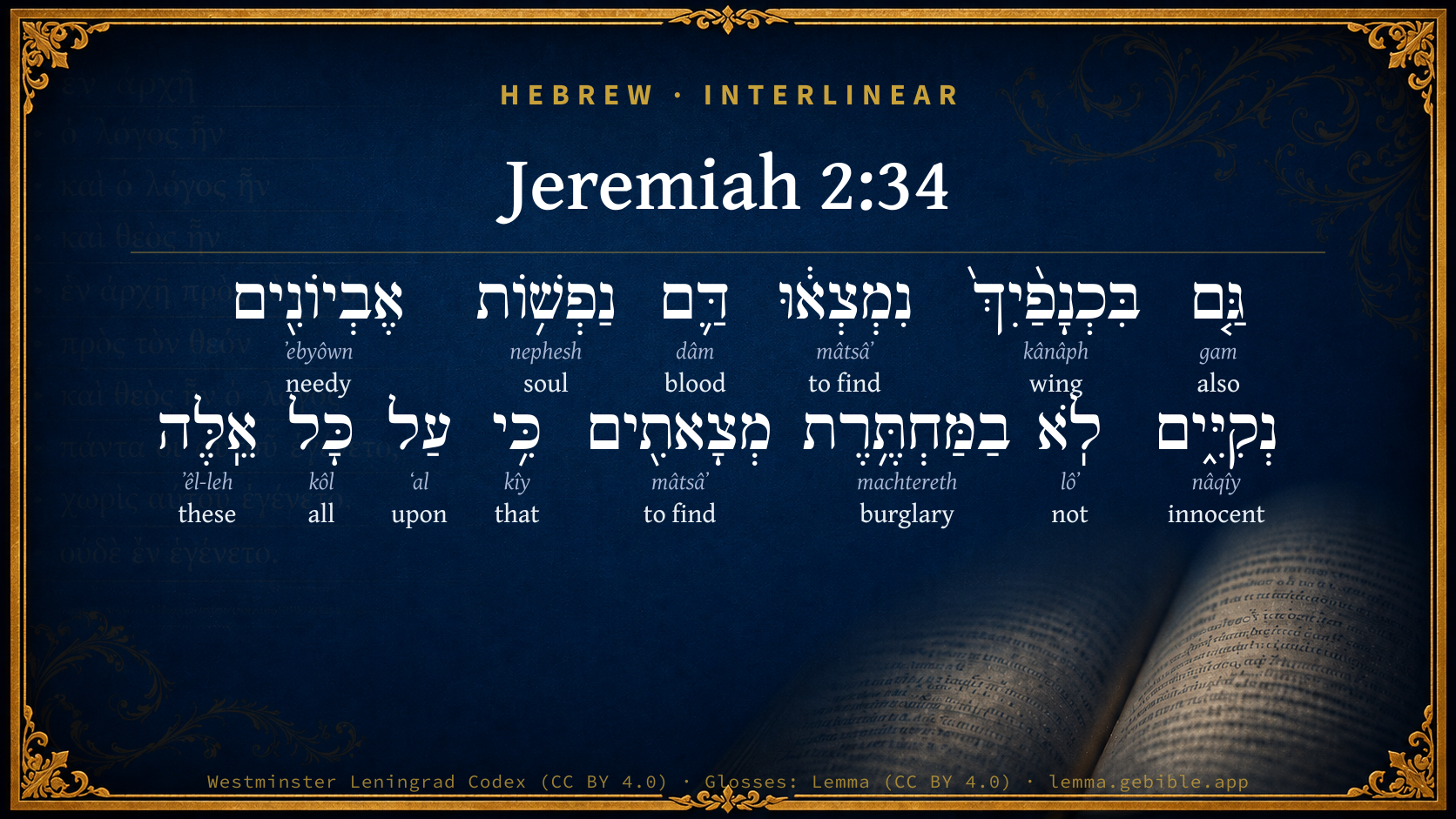
Hebrew (Westminster Leningrad Codex) Jeremiah 2:34 appears in the Hebrew Old Testament. The text above is from the Westminster Leningrad Codex. Each word links to its Strong’s number, a concise gloss, and parsing drawn from the Open Scriptures Hebrew Bible morphology. Click any word for its full Brown-Driver-Briggs (BDB) entry.
Download image
Cite this verse

Jeremiah 2:34 (World English Bible). Public Domain. Lemma interlinear Bible study tool, https://lemma.gebible.app/v/jeremiah/2/34.

Show BibTeX & RIS
BibTeX
RIS
English Translation
Also in your skirts is found the blood of the souls of the innocent poor: you did not find them breaking in; but it is because of all these things.
World English Bible · Public Domain
Download a study sheet

One document with this verse’s original text, its word-by-word gloss line, the meaning frame, cross-references with their text, attributed commentary, and full source and license credits — printable, and it pastes into notes with its structure intact.

This verse Autodidact and up

Study sheet (.html) Plain text (.txt)

A passage Seminary Student

Up to 50 verses in one chapter. A passage sheet keeps up to 6 commentary sources and 12 cross-references per verse, in the order this page ranks them, and says so on the sheet whenever that leaves anything out. Ask for a single verse and you get the Autodidact verse sheet above.

Everything on this page stays free to read, with no account — the sheet is a download of what is already on screen, not access to it.

Want to remove ads? Support Godless Engineer
Compare translations 3

The same verse in 3 English versions, stacked beneath the original-language interlinear above. Click any original word for its lexicon entry.

Each is an independent rendering of the whole verse — the interlinear is not word-aligned to these translations.

Highlighted words mark where these versions differ — a whole-verse word diff, not a word-by-word alignment.

  • World English Bible Public Domain
    Also in your skirts is found the blood of the souls of the innocent poor: you did not find them breaking in; but it is because of all these things.
  • King James Version Public Domain
    Also in thy skirts is found the blood of the souls of the poor innocents: I have not found it by secret search, but upon all these.
  • unfoldingWord Literal Text CC BY-SA 4.0
    Also on your skirts has been found the blood of the lives of the poor innocent ones. They were not discovered in burglary. But despite all these,

unfoldingWord Literal Text — © unfoldingWord, licensed CC BY-SA 4.0. Word-aligned USFM3 via Door43 (git.door43.org/unfoldingWord/en_ult).

Versions to compare (up to 4)

3 of 4 selected

Show all 18 translations

Every available English version of this verse, each an independent rendering of the whole verse.

  • World English Bible Public Domain
    Also in your skirts is found the blood of the souls of the innocent poor: you did not find them breaking in; but it is because of all these things.
  • Berean Standard Bible Public Domain
    Moreover, your skirts are stained with the blood of the innocent poor, though you did not find them breaking in. But in spite of all these things
  • Majority Standard Bible Public Domain
    Moreover, your skirts are stained with the blood of the innocent poor, though you did not find them breaking in. But in spite of all these things
  • King James Version Public Domain
    Also in thy skirts is found the blood of the souls of the poor innocents: I have not found it by secret search, but upon all these.
  • American Standard Version (1901) Public Domain
    Also in thy skirts is found the blood of the souls of the innocent poor: thou didst not find them breaking in; but it is because of all these things.
  • Revised Version (1885) Public Domain
    Also, in thy skirts is found the blood of the souls of the innocent poor: I have not found it at the place of breaking in, but upon all these.
  • Geneva Bible (1599) Public Domain
    Also in thy wings is founde the bloud of the soules of ye poore innocents: I haue not found it in holes, but vpon all these places.
  • Douay-Rheims (1899) Public Domain
    And in thy skirts is found the blood of the souls of the poor and innocent? not in ditches have I found them, but in all places, which I mentioned before.
  • Young's Literal Translation Public Domain
    Also in thy skirts hath been found the blood of innocent needy souls, Not by digging have I found them, but upon all these.
  • Literal Standard Version CC BY-SA 4.0
    Also the blood of innocent needy souls || Has been found on your skirts, || I have not found them by digging, || But on all these.
  • Unlocked Literal Bible CC BY-SA 4.0
    The blood that was the life of innocent, poor people has been found on your clothes. These people were not discovered in acts of burglary.
  • unfoldingWord Literal Text CC BY-SA 4.0
    Also on your skirts has been found the blood of the lives of the poor innocent ones. They were not discovered in burglary. But despite all these,
  • Darby Bible Public Domain
    Yea, in thy skirts is found the blood of the souls of the innocent poor, whom thou didst not encounter breaking in, but [it is found] upon all these.
  • World Messianic Bible Public Domain
    Also the blood of the souls of the innocent poor is found in your skirts. You didn’t find them breaking in, but it is because of all these things.
  • Webster's Bible Public Domain
    Also in thy skirts is found the blood of the souls of the poor innocents: I have not found it by secret search, but upon all these.
  • Free Bible Version CC BY-SA 4.0
    On top of that, your clothes are stained with the blood of the poor and the innocent. It's not like you killed them breaking into your homes. Despite all this,
  • Bible in Basic English Public Domain
    And in the skirts of your robe may be seen the life-blood of those who have done no wrong:...
  • JPS Tanakh (1917) Public Domain
    Also in thy skirts is found the blood of the souls of the innocent poor; thou didst not find them breaking in; yet for all these things

Literal Standard Version (2020), Covenant Press — licensed CC BY-SA 4.0. Text via the HelloAO Bible API (eBible.org). Unlocked Literal Bible (unfoldingWord) — licensed CC BY-SA 4.0. Text via the HelloAO Bible API (eBible.org). unfoldingWord Literal Text — © unfoldingWord, licensed CC BY-SA 4.0. Word-aligned USFM3 via Door43 (git.door43.org/unfoldingWord/en_ult). Free Bible Version, Dr. Jonathan Gallagher — licensed CC BY-SA 4.0. Text via the HelloAO Bible API (eBible.org).

Word by word

More ways to search: Search by grammar → Find every occurrence → Compare this word →

Practice this passage: Drill this verse → Learn its vocabulary →

בַמַּחְתֶּ֥רֶת
machtereth
H4290
“in/at the · burglary”
Preposition, Determined + Noun, Common, Feminine, Singular, Absolute
Part of Speech
Preposition + Noun
Type
Common
Gender
Feminine
Number
Singular
State
Absolute
Full BDB Definition

Origin: from H2864

TWOT: 783a

a breaking in, burglary
  1. גַּ֤ם gam H1571 “also” Particle, Accusative
  2. בִּכְנָפַ֨יִךְ֙ kânâph H3671 “in/at · wings · your” Preposition + Noun, Common, Feminine, Dual, Construct + Suffix, Personal, 2nd Person, Feminine, Singular
  3. נִמְצְא֔וּ mâtsâʼ H4672 “to find” Verb, Niphal, Perfect, 3rd Person, Common, Plural
  4. דַּ֛ם dâm H1818 “blood of” Noun, Common, Masculine, Singular, Construct
  5. נַפְשׁ֥וֹת nephesh H5315 “souls of” Noun, Common, Both, Plural, Construct
  6. אֶבְיוֹנִ֖ים ʼebyôwn H34 “needy” Adjective, Adjective, Masculine, Plural, Absolute
  7. נְקִיִּ֑ים nâqîy H5355 “innocent” Adjective, Adjective, Masculine, Plural, Absolute
  8. לֹֽא lôʼ H3808 “not” Particle, Negative
  9. מְצָאתִ֖ים mâtsâʼ H4672 “to find · them” Verb, Qal, Perfect, 2nd Person, Feminine, Singular + Suffix, Personal, 3rd Person, Masculine, Plural
  10. כִּ֥י kîy H3588 “that” Conjunction
  11. עַל ʻal H5921 “upon” Preposition
  12. כָּל kôl H3605 “all of” Noun, Common, Masculine, Singular, Construct
  13. אֵֽלֶּה ʼêl-leh H428 “these” Pronoun, Demonstrative, Common, Plural

About this verse

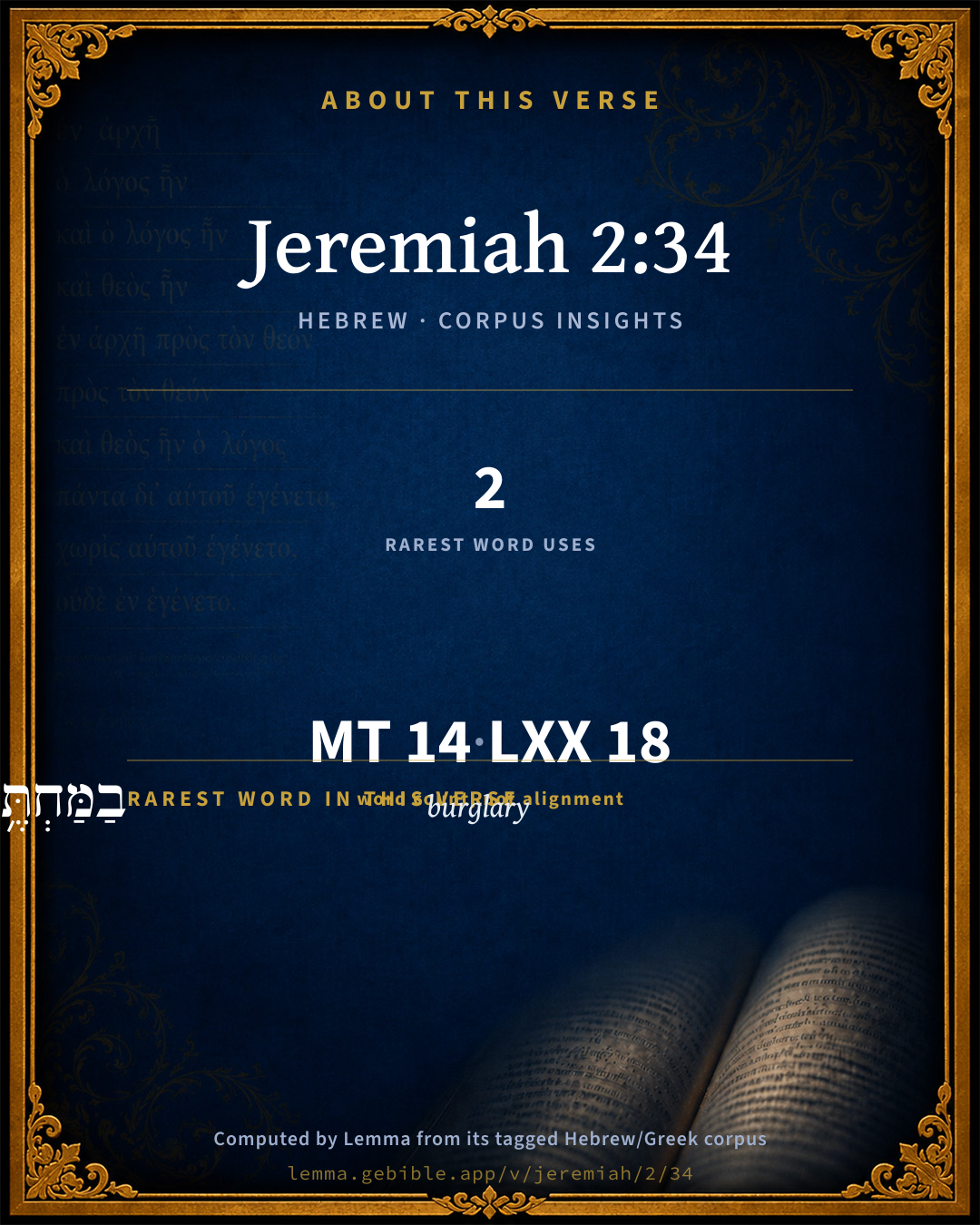
These counts appear in no published source. They are computed here, from the morphology-tagged text and Lemma’s own curated glosses. What Lemma adds →

14
words
13
distinct lemmas
Prophets
section

Notable vocabulary

The rarest word here is בַמַּחְתֶּ֥רֶת burglary H4290 — appearing just 2 times in the whole Hebrew Bible.

Shared distinctive vocabulary

בַמַּחְתֶּ֥רֶת burglary H4290 occurs in 2 verses of the Hebrew Bible. Also found in:

Grammatical profile

  • 2 verbs
  • 5 nouns
  • 2 adjectives
  • 1 pronoun
  • 1 preposition
  • 1 conjunction
  • 2 particles

Verb forms

  • נִמְצְא֔וּ Niphal · Perfect
  • מְצָאתִ֖ים Qal · Perfect

Repetition

A word recurs within this verse — often emphatic in Hebrew:

  • נִמְצְא֔וּ to find H4672 ×2

Hebrew & Septuagint length

In the original languages it is 14 Hebrew tokens and 18 Greek tokens — but the two are counted differently (Hebrew bundles its prefixes and suffixes into one token; the Greek is in lemma form), so that isn’t a like-for-like length.

Cross-references

13

Topical passages linked to Jeremiah 2:34 in the Treasury of Scripture Knowledge — connected by theme and wording, ordered by reader-vote popularity; previews shown in the World English Bible.

  • 2 Kings 21:16 Moreover Manasseh shed innocent blood very much, until he had filled Jerusalem from one end to another; besides his sin with which he made Judah to sin, in doing that which was evil in the sight of Yahweh.
  • 2 Kings 24:4 and also for the innocent blood that he shed; for he filled Jerusalem with innocent blood: and Yahweh would not pardon.
  • Jeremiah 19:4 Because they have forsaken me, and have estranged this place, and have burned incense in it to other gods, that they didn't know, they and their fathers and the kings of Judah; and have filled this place with the blood of innocents,
  • Exodus 22:2 If the thief is found breaking in, and is struck so that he dies, there shall be no guilt of bloodshed for him.
  • Psalms 106:37–38 Yes, they sacrificed their sons and their daughters to demons.
  • Isaiah 57:5 you who inflame yourselves among the oaks, under every green tree; who kill the children in the valleys, under the clefts of the rocks?
  • Isaiah 59:7 Their feet run to evil, and they make haste to shed innocent blood: their thoughts are thoughts of iniquity; desolation and destruction are in their paths.
  • Jeremiah 6:15 Were they ashamed when they had committed abomination? nay, they were not at all ashamed, neither could they blush: therefore they shall fall among those who fall; at the time that I visit them they shall be cast down, says Yahweh.
  • Jeremiah 7:31 They have built the high places of Topheth, which is in the valley of the son of Hinnom, to burn their sons and their daughters in the fire; which I didn't command, neither came it into my mind.
  • Ezekiel 16:20–21 Moreover you have taken your sons and your daughters, whom you have borne to me, and these have you sacrificed to them to be devoured. Were your prostitution a small matter,
  • Ezekiel 20:31 and when you offer your gifts, when you make your sons to pass through the fire, do you pollute yourselves with all your idols to this day? and shall I be inquired of by you, house of Israel? As I live, says the Lord Yahweh, I will not be inquired of by you;
  • Ezekiel 24:7 For her blood is in the midst of her; she set it on the bare rock; she didn't pour it on the ground, to cover it with dust.
  • Jeremiah 8:12 Were they ashamed when they had committed abomination? nay, they were not at all ashamed, neither could they blush: therefore shall they fall among those who fall; in the time of their visitation they shall be cast down, says Yahweh.

Cross-references courtesy of OpenBible.info (CC BY 4.0).

Hebrew and Greek witnesses Masoretic Hebrew ↔ Greek Septuagint

The same verse in the two great witnesses to the Old Testament, shown verse-for-verse.

These are two independent witnesses, not word-aligned to each other, and the Septuagint is shown in lemma (dictionary) form.

Hebrew Jeremiah 2:34 Masoretic · Westminster Leningrad Codex

גַּ֤ם בִּכְנָפַ֨יִךְ֙ נִמְצְא֔וּ דַּ֛ם נַפְשׁ֥וֹת אֶבְיוֹנִ֖ים נְקִיִּ֑ים לֹֽא בַמַּחְתֶּ֥רֶת מְצָאתִ֖ים כִּ֥י עַל כָּל אֵֽלֶּה

Also in your skirts is found the blood of the souls of the innocent poor: you did not find them breaking in; but it is because of all these things.

World English Bible · Public Domain

Greek LXX Structure differs

In the Septuagint, Jeremiah is about an eighth shorter than the Hebrew and arranges its material differently — the Oracles Against the Nations (Hebrew chapters 46–51) appear in the middle of the Greek book, after 25:13. Because the chapter and verse boundaries do not line up, a verse-for-verse comparison with the Hebrew is not shown.

A verse-for-verse comparison isn’t shown here because the chapters and verses don’t line up. Switch to the LXX edition with the MT / LXX toggle above to read the Greek directly.

On this verse, The Cambridge Bible for Schools and Colleges discusses the Septuagint’s reading. Read the note in Commentary ↓

Hebrew: Westminster Leningrad Codex (CC BY 4.0). Greek: Septuagint (public domain); English from a public-domain English Septuagint. How the Septuagint differs from the Hebrew →

Targum (Aramaic paraphrase)

1

The Targum is the ancient Jewish Aramaic paraphrase of the Hebrew Scriptures — an interpretive translation, not the Hebrew text itself. Onkelos (literal) and Pseudo-Jonathan (expansive) render the Torah, and Jonathan the Prophets. Coverage is partial: where no permissively-licensed English translation exists for a verse, only the Aramaic is shown. This is verse-level text, not a word-by-word alignment to the Hebrew.

  1. Targum Jonathan Prophets (Joshua–Malachi)
    אַף בְּסִתְרָא אִשְׁתַּכַחְתְּ דַאֲשַׁדְתְּ דַם זַכַּאי דָם נַפְשַׁת דִמְסְכְּנִין זַכָּאִין לָא כְּמָא דְמַשְׁכְּחִין בְּמַחְתַּרְתָּא אֱלָהֵין עַל כָּל אִלֵין עֲבַדְתְּ:

    (no public-domain English translation for this verse)

    Targum Jonathan — Aramaic: “Mikraot Gedolot” (public domain). English: “Sefaria Community Translation” (CC0 1.0 (public-domain dedication)); “London "Chaldee Paraphrase," 1871” (public domain). Text via Sefaria.

Commentary

Notes on Jeremiah 2:34 from classic Christian and Jewish commentators (each source and its license shown beneath its notes). The classic Christian expositions comment on the surrounding passage and are grouped to its opening verse, so a note may address several verses; the Jewish commentaries on the Tanakh (Rashi and others) are per-verse, so they appear only where the commentator wrote on this verse.

Lemma curates 59 commentaries, every one of them public domain or Creative Commons licensed, each selected and text-cleaned for this edition rather than reprinted as found. About our sources →

Trapp's Complete Commentary

John Trapp

Jer 2:34 Also in thy skirts is found the blood of the souls of the poor innocents: I have not found it by secret search, but upon all these.

Ver. 34. Also in thy skirts.] In the skirts of thy garments. Heb., In thy wings - an allusion, say some, to birds of prey, which stain their wings with the blood of lesser fowls.

Is the blood of the souls.] The life blood of innocent poor ones, of prophets especially. {Jer 2:30}

I have not found it by secret search.] Non in suffosione, as Calvin rendereth it, as an allusion to Exo 22:2.

But upon all these.] That is, In propatulo, in public view. Or, Super haec omnia, because they told thee of thy faults.

John Trapp, A Commentary or Exposition upon All the Books of the Old and New Testament (1647–1656) — public domain. Text from a community e-Sword module.

Geneva Bible (1599)

Geneva Bible translators

The Prophets and the faithful are slain in every corner of your country.

Geneva Bible (1599) marginal notes — public domain. Text via Bolls.life.

Jamieson, Fausset & Brown

Robert Jamieson, A. R. Fausset & David Brown

Also--not only art thou polluted with idolatry, but also with the guilt of shedding innocent blood [MAURER]. ROSENMULLER not so well translates, "even in thy skirts," &c.; that is, there is no part of thee (not even thy skirts) that is not stained with innocent blood (Jer 19:4; Kg2 21:16; Psa 106:38). See as to innocent blood shed, not as here in honor of idols, but of prophets for having reproved them (Jer 2:30; Jer 26:20-23).

souls--that is, persons.

search--I did not need to "search deep" to find proof of thy guilt; for it was "upon all these" thy skirts. Not in deep caverns didst thou perpetrate these atrocities, but openly in the vale of Hinnom and within the precincts of the temple.

Jamieson, Fausset & Brown — Commentary Critical and Explanatory on the Whole Bible (1871) — public domain (CC PDM 1.0). Text via the HelloAO Bible API.

Adam Clarke's Commentary

Verse 34. The blood of the souls of the poor innocents] We find from the sacred history that Manasseh had filled Jerusalem with innocent blood; see 2Kg 21:16, and Eze 34:10.

I have not found it by secret search, but upon all these.] Such deeds of darkness and profligacy are found only in Israel. Dr. Blayney translates, "I have not found it in a digged hole, but upon every oak." Others cover the blood that it may not appear; but ye have shed it openly, and sprinkled it upon your consecrated oaks, and gloried in it.

Adam Clarke's Commentary on the Bible (1810–1826) — public domain. Text from a community e-Sword/MySword module.

John Calvin's Commentaries

The Prophet repeats, as I think, what he had before said, — that the wickedness of his nation was incorrigible; for they repented not when warned, but on the contrary raged like wild beasts against the Prophets and religious teachers. Those interpreters are mistaken who think that the savage cruelty of the Jews in general is here condemned; and all are of this opinion. But the Prophet no doubt enhances this evil, by saying, that the Jews were not only obstinate in their vices, but also raged furiously against the Prophets. Hence he shews again, that God had used all remedies to heal the Jews, but without effect, for what better medicine could have been offered than for the Prophets to reprove the people and to shew to them how wickedly they had departed from God? God then wished thus to correct the vices of his own people; but so far was he from effecting anything, that at Jerusalem and through the whole of Judea, the Prophets were slaughtered, and the whole land was filled with and polluted by their blood.

Hence he says, Even in thy wings has been found the blood of the souls of the poor innocents. He calls the borders of garments wings. He seems to say, that these slaughters were not hid, for the Jews were besprinkled with blood to the very extremities of their garment; as though he had said, “There is no cause for me to deal sharply with you in this instance; for your filthiness is most apparent: ye have not only been rebellious against my teaching, but ye have also cruelly murdered my prophets. If ye ask, Where these slaughters are to be found? Even in your wings, on the borders of your garments; so that your crimes are fully known.” We now perceive what the Prophet means.

We must also notice the import of the particle גם, gam, also, or even. Their cruelty was worse and more nefarious, because they thus rose up against their own physicians; for the prophets, as it has been said, were the ministers of their safety. As then they thus raged against God’s favor so as to murder his prophets, it became still more evident, that they were utterly irreclaimable.

He afterwards adds what serves for a confirmation. They have not been found in digging under Some give another explanation; but their opinion is right who think, that the Prophet alludes to what is said by Moses in Exodus 22:2, — that if a thief should be found in digging under, (or undermining,) he might be killed with impunity: for he who thus breaks through into the houses of others, is equal to a robber in audacity; and he ought to be counted not only a thief, but also as one guilty of manslaughter and felony. God then says, that the Prophets, who had been slain by the Jews, had not been found in digging up, that is, had not been found guilty of any crime, either of robbery or of murder: for he mentions a particular act, instead of the general crime. But it has been on account of all these things; that is, “because they boldly dared to reprove you, because they severely condemned your vices, because they discovered your baseness, because they were enemies to your perfidy and to your sins: as then the prophets had thus by the divine Spirit carried on war with your sins, they have on this account been murdered by you.

We see how well the whole passage reads, provided it be applied to the prophets only. It was not indeed the object of Jeremiah to condemn murders generally among the Jews, but to shew that they were the enemies of the prophets, because they were opposed to every good and sound counsel, and were incapable of receiving instruction. The mistake of other expounders is hereby made evident: for in the last clause they touch neither heaven nor earth. It follows —

John Calvin's Commentaries (1540-1563) — public domain. Text from the Calvin Translation Society English edition (1840s-50s) via the Christian Classics Ethereal Library (ccel.org). Calvin's coverage is partial (roughly two-thirds of the Bible); uncommented books and verses are honest gaps, never fabricated. The 19th-century editor's footnotes and remarks are omitted so the notes are faithfully Calvin's own voice.

Ellicott's Commentary for English Readers

(34) Also in thy skirts . . .—The general meaning is clear, and points to the guilt of Israel in offering her children—the “poor innocents”—in horrid sacrifice to Molech; perhaps, also, to her maltreatment of the prophets. Their “blood” is on the “skirts” of her raiment; perhaps, if we take another reading, on the “palms” of her hands. The last clause is, however, obscure enough. We have to choose, according to variations of reading and construction, between (1) I have not found it as by secret search (literally, by digging, as men dig through the wall of a house in search of plunder), but under every oak or terebinth, or, more probably, as in the Authorised version, upon all these—i.e., the sin was patent, flagrant, everywhere; and (2) Thou didst not find them (those who had been put to death) in the place of breaking through—i.e., in the act of the robber that would have deserved death (Exo_22:2; Job_24:16); but because of all this—i.e., thou didst slay them through thy passion for idolatry. Of these (1) commends itself most.

A Bible Commentary for English Readers, edited by Charles John Ellicott (1878–1897) — public domain. Text from a community e-Sword module.

The Cambridge Bible for Schools and Colleges

gen. ed. J. J. S. Perowne

34. blood, etc.] “The allusion may be to deaths due to miscarriage of justice or the result of exaction (Jer_7:6, Jer_22:3 end, 17; cf. Mic_3:10; Psa_94:21), or to the sacrifice of children (see Jer_19:4; cf. Psa_106:38) or possibly to the martyrdoms under Manasseh (2Ki_21:16; 2Ki_24:4).” Dr.

I have not found it at the place of breaking in] or perhaps not at house-breaking didst thou catch them. The allusion is to the law (Exo_22:2) by which it was permitted to slay a thief caught in the act of breaking into a house. The persons whom Israel had thus treated were in no such position, but such was nevertheless their fate.

but upon all these] The words are obscure and probably the text of the whole verse is corrupt. As it stands, “these” must refer to the misdeeds indicated or to the (bloodstained) “skirts” incriminating the offenders. By a slight modification of the MT. we get the LXX rendering of “all these,” viz. every oak. This, however, can hardly be defended.

The Cambridge Bible for Schools and Colleges (gen. ed. J. J. S. Perowne; Cambridge University Press, 1878–1918) — public domain. Text from a community e-Sword module.

John Gill's Exposition

Yet thou sayest, because I am innocent,.... Or, "that I am innocent"; though guilty of such flagrant and notorious crimes, acting like the adulterous woman, Pro 30:20 to whom the Jews are all along compared in this chapter; which shows the hardness of their hearts, and their impudence in sinning:

surely his anger shall turn from me; the anger of God, since innocent; or, "let his anger be turned from me", as the Septuagint and Arabic versions; pleading for the removing of judgments upon the foot of innocency, which is pretended:

behold, I will plead with thee; enter into judgment with thee, and examine the case closely and thoroughly:

because thou sayest, I have not sinned; it would have been much better to have acknowledged sin, and pleaded for mercy, than to insist upon innocence, when the proof was so evident; nothing can be got by entering into judgment with God, upon such a foundation; and to sin, and deny it, is an aggravation of it: the denial of sin is a double sin, as the wise man says, whom Kimchi cites.

John Gill's Exposition of the Whole Bible (1746–1763) — public domain (CC PDM 1.0). Text via the HelloAO Bible API.

Albert Barnes' Notes on the Bible

I have not found it ... - Rather, thou didst not find them breaking into thy house. The meaning is, that these poor innocents had committed no crime: they were not thieves caught in the act, whom the Law permitted men to slay Exo 22:2, and therefore Israel in killing them was guilty of murder. The one crime here of theft is put for crime generally.

Upon all these - Or, because of all this. Thou killedst the poor innocents, not for any crime, but because of this thy lust for idolatry.

Albert Barnes' Notes on the Bible (1834–1885) — public domain. Text from a community e-Sword/MySword module.

Haydock's Catholic Bible Commentary

Innocent children, immolated to Moloc, or people murdered, whose blood thou hast not concealed, 4 Kings xxi. 16.

George Leo Haydock (1774–1849), Haydock's Catholic Family Bible and Commentary, 1859 edition — public domain. Excludes Psalms (Douay-Rheims chapter numbering differs from Protestant) and Deuterocanonical books (Catholic canon only).

Matthew Poole's English Annotations

In thy skirts, viz. of thy garments; a synecdoche of the kind; the tokens of thy cruelty may be seen openly there: or, in thy hands, as the LXX.: or a metaphor from birds of rapine, whose wings are bloody with their prey; but not so well. Is found the blood of the souls of the poor innocents, i.e. in thee is found the murders expressed here by blood of innocent persons, meant here by souls, comprising both their sacrificing of their little children to their idols, Psa 106:37,38; Eze 16:20,21,36, murdering souls as well as bodies; and also all those cruelties, oppressions, and murders that they executed upon poor innocent persons, which were not a few in what Manasseh did, 2Ki 21:16; Eze 7:23; 9:9, and in special the prophets, Jer 2:30, that came in God’s name to reclaim them; which notes their desperate malice as well as cruelty, to slay their physicians.

By secret search, Heb. by digging; as if the earth had covered the blood, or as if they had committed their wickedness in some obscure places.

But upon all these; upon thy garments openly enough, as exposed to public view. There needs no such strict scrutiny to be made.

Matthew Poole's English Annotations on the Holy Bible (1683–1685) — public domain. Text from a community e-Sword/MySword module.

Whedon's Commentary on the Bible

Daniel D. Whedon

34. Secret search — Rather, at housebreaking. The meaning is, Thou didst not kill the poor for crime, but this is innocent blood upon thy skirts.

But upon all these — Rather, on account of all these, the wicked lusts of idolatry. But the passage is difficult, and this sense, which is favoured by Keil, Hitzig, R. Payne Smith, and others, is far from satisfactory.

Daniel D. Whedon (gen. ed.), Commentary on the Old and New Testaments (1874–1909) — public domain. Text from a community e-Sword module.

The Pulpit Commentary

Also in thy skirts, etc.; or, there is even fennel in thy skirts (or, perhaps, in thy sleeves the wide sleeves of an Eastern mantle). The fact which follows is adduced as the crowning evidence of wickedness. Blood of the souls is explained by the statement in Lev_17:11, "The soul of the flesh i.e. of the body is in the blood;" hence the importance of the blood in the Mosaic sacrifices. The historical reference of this passage of Jeremiah may well be to the persecution of Manasseh, who is said to have "shed innocent blood very much". (2Ki_21:16) It is Judah, no doubt, who is addressed, but the prophets mostly assume the "solidarity" of king and people (analogous to that of a forefather and his posterity); Manasseh, moreover, probably had the support of a large section of the population, at any rate in so far as he favored the inveterate cultus of the high places or local sanctuaries. I have not found it by secret search; rather, thou hast not found them breaking through (houses). The phraseology agrees with that of Exo_22:2, the law against "breaking through;" it suggests that the houses of all but the highest class in ancient as well as often in modern Palestine, were made of mere sun-dried brick, which could be easily "dug into". (comp. Mat_6:19, Mat_6:20, in the Greek) Lieut. Conder states, it is true, that in hilly districts of Palestine the houses of the villages are built of stone, but he adds that the stone is simply taken from the ruins of the ancient towns. Burglars caught in the act might be killed, (Exo_22:2) but the innocent victims of persecution could not be brought under this category, and hence those who slew them were really guilty of murder. But upon all these; rather, but because of all these things; i.e. not for any crime, but because of thine things,"; (as in Jer_3:7) so Hitzig, Keil Payne Smith; less naturally De Dieu, "because of those false gods"

The Pulpit Commentary (1880–1919), ed. H.D.M. Spence-Jones & Joseph S. Exell — public domain. Text from a community e-Sword module.

John Wesley's Explanatory Notes

Skirts - Of thy garments: the tokens of cruelty may be seen openly there. Innocents - In thee is found the murder expressed here by blood of innocent persons, murdering souls as well as bodies. Search - Hebrew. by digging; as if the earth had covered the blood, or as if they had committed their wickedness in some obscure places. These - Upon thy garments, exposed openly to publick view.

John Wesley, Explanatory Notes Upon the Whole Bible (1754–1765) — public domain. Text via the GEBible commentary corpus.

Rashi

Rabbi Shlomo Yitzchaki (Rashi)

you did not find them breaking in You did not find them breaking in when you slew them.

you did not find them So does Scripture say for a feminine second person singular, and there are many such examples in the Book of Ezekiel (16:58), “You bore them (נשאתים).”

but for all these i.e., because they were reproving you for all these things.

Rashi on the Tanakh — English translations: “The Judaica Press complete Tanach with Rashi, translated by A. J. Rosenberg” (CC BY 4.0); “Pentateuch with Rashi's commentary by M. Rosenbaum and A.M. Silbermann, 1929-1934” (public domain); “The Metsudah Tanach series, Lakewood, N.J” (CC BY 4.0); and “The Book of Joshua, Metsudah Publications, 1997” (CC BY 4.0). Text via Sefaria.

Lesson kit

Teaching starters — assembled from the data on this page, not authored interpretation. Every prompt links to the verse data it draws on. Edit before teaching.

Jeremiah, in the Prophets, opens this verse with 14 words (13 distinct Hebrew lemmas). Its most distinctive word is machtereth (“burglary”). A historical commentator’s framing appears above. Read the whole chapter for the surrounding context.

Discussion questions

  1. The word machtereth carries the sense “burglary.” How does it shape the verse?
  2. Exodus 22:2 shares the word «burglary» with this verse. How do the two illuminate each other?
  3. “to find” occurs 2× in this one verse. What is the effect of the repetition?
  4. The translations on this page render this verse differently — a whole-verse word diff, not a word-by-word alignment. What might account for the different wordings?
  5. The verb «נִמְצְא֔וּ» is Niphal Perfect. How does its form color the action?
  6. Reading how Trapp's Complete Commentary and Geneva Bible (1599) read this verse, where do the two commentators agree and where do they part?

Things to notice

Reading settings

Reading text

Shown beneath each verse's original-language words.

Old Testament
Old Testament edition

Read the OT as the Masoretic Hebrew (MT) or the Greek Septuagint (LXX).

English shown for the Greek Septuagint (in the Hebrew ↔ Greek comparison).

Comparing translations? Open the Compare panel on any verse page to stack up to four side by side.