Psalms 70:5

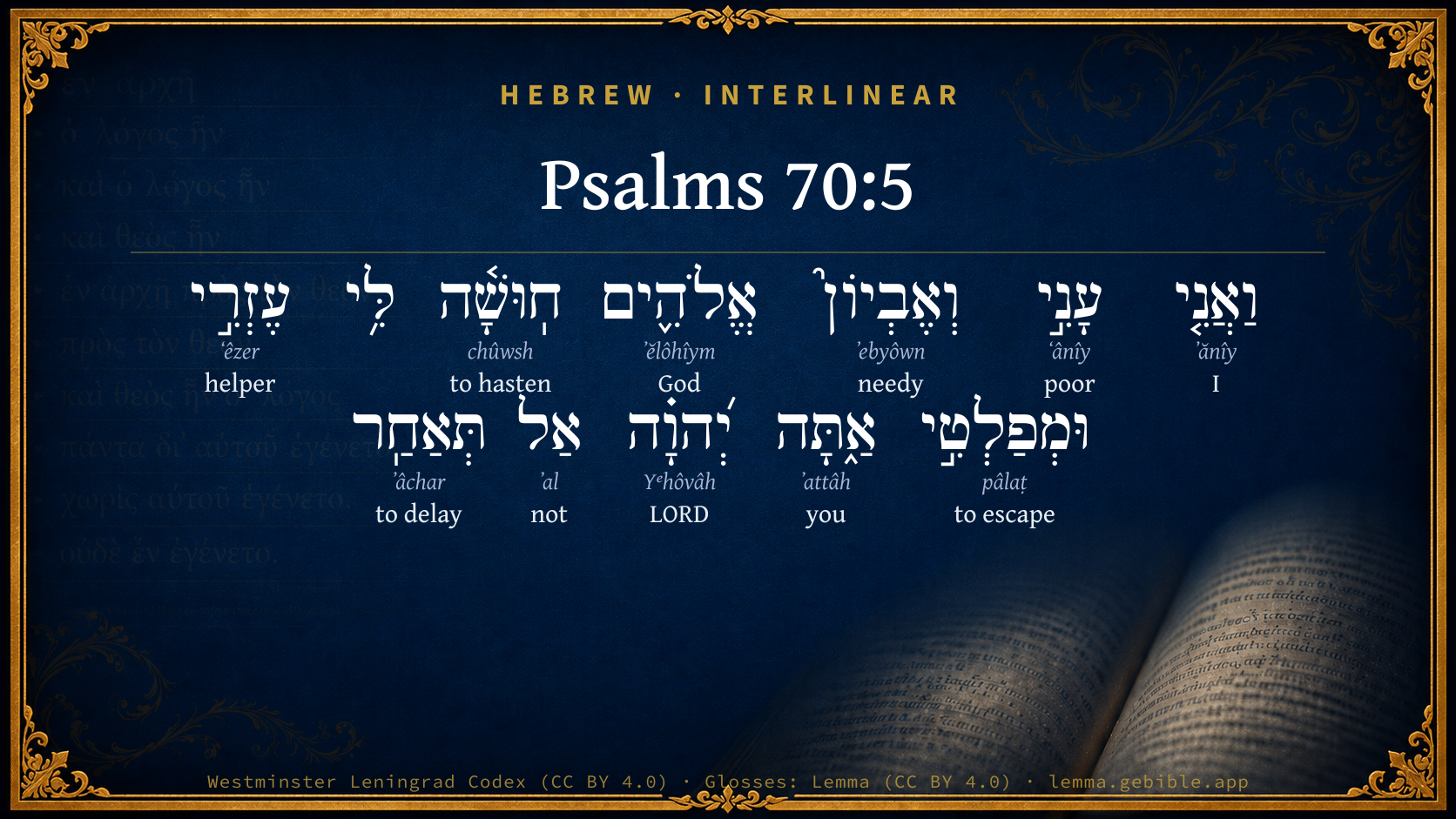
Hebrew (Westminster Leningrad Codex) Psalms 70:5 appears in the Hebrew Old Testament. The text above is from the Westminster Leningrad Codex. Each word links to its Strong’s number, a concise gloss, and parsing drawn from the Open Scriptures Hebrew Bible morphology. Click any word for its full Brown-Driver-Briggs (BDB) entry.
Download image
Cite this verse

Psalms 70:5 (World English Bible). Public Domain. Lemma interlinear Bible study tool, https://lemma.gebible.app/v/psalms/70/5.

Show BibTeX & RIS
BibTeX
RIS
English Translation
But I am poor and needy. Come to me quickly, God. You are my help and my deliverer. Yahweh, don't delay.
World English Bible · Public Domain
Download a study sheet

One document with this verse’s original text, its word-by-word gloss line, the meaning frame, cross-references with their text, attributed commentary, and full source and license credits — printable, and it pastes into notes with its structure intact.

This verse Autodidact and up

Study sheet (.html) Plain text (.txt)

A passage Seminary Student

Up to 50 verses in one chapter. A passage sheet keeps up to 6 commentary sources and 12 cross-references per verse, in the order this page ranks them, and says so on the sheet whenever that leaves anything out. Ask for a single verse and you get the Autodidact verse sheet above.

Everything on this page stays free to read, with no account — the sheet is a download of what is already on screen, not access to it.

Want to remove ads? Support Godless Engineer
Compare translations 3

The same verse in 3 English versions, stacked beneath the original-language interlinear above. Click any original word for its lexicon entry.

Each is an independent rendering of the whole verse — the interlinear is not word-aligned to these translations.

Highlighted words mark where these versions differ — a whole-verse word diff, not a word-by-word alignment.

  • World English Bible Public Domain
    But I am poor and needy. Come to me quickly, God. You are my help and my deliverer. Yahweh, don't delay.
  • King James Version Public Domain
    But I am poor and needy: make haste unto me, O God: thou art my help and my deliverer; O LORD, make no tarrying.
  • unfoldingWord Literal Text CC BY-SA 4.0
    But I poor and needy; God, hurry to me! You my help and my deliverer; Yahweh, do not delay!

unfoldingWord Literal Text — © unfoldingWord, licensed CC BY-SA 4.0. Word-aligned USFM3 via Door43 (git.door43.org/unfoldingWord/en_ult).

Versions to compare (up to 4)

3 of 4 selected

Show all 18 translations

Every available English version of this verse, each an independent rendering of the whole verse.

  • World English Bible Public Domain
    But I am poor and needy. Come to me quickly, God. You are my help and my deliverer. Yahweh, don't delay.
  • Berean Standard Bible Public Domain
    But I am poor and needy; hurry to me, O God. You are my help and my deliverer; O LORD, do not delay.
  • Majority Standard Bible Public Domain
    But I am poor and needy; hurry to me, O God. You are my help and my deliverer; O LORD, do not delay.
  • King James Version Public Domain
    But I am poor and needy: make haste unto me, O God: thou art my help and my deliverer; O LORD, make no tarrying.
  • American Standard Version (1901) Public Domain
    But I am poor and needy; Make haste unto me, O God: Thou art my help and my deliverer; O Jehovah, make no tarrying.
  • Revised Version (1885) Public Domain
    But I am poor and needy; make haste unto me, O God: thou art my help and my deliverer; O LORD, make no tarrying.
  • Geneva Bible (1599) Public Domain
    Nowe I am poore and needie: O God, make haste to me: thou art mine helper, and my deliuerer: O Lord, make no tarying.
  • Douay-Rheims (1899) Public Domain
    Let all that seek thee rejoice and be glad in thee; and let such as love thy salvation say always: The Lord be magnified.
  • Young's Literal Translation Public Domain
    And I `am' poor and needy, O God, haste to me, My help and my deliverer `art' Thou, O Jehovah, tarry Thou not!
  • Literal Standard Version CC BY-SA 4.0
    And I [am] poor and needy, O God, hurry to me, || You [are] my help and my deliverer, || O YHWH, do not linger!
  • Unlocked Literal Bible CC BY-SA 4.0
    But I am poor and needy; hurry to me, God; you are my help and you rescue me. Yahweh, do not delay.
  • unfoldingWord Literal Text CC BY-SA 4.0
    But I poor and needy; God, hurry to me! You my help and my deliverer; Yahweh, do not delay!
  • Darby Bible Public Domain
    But I am afflicted and needy: make haste unto me, O God. Thou art my help and my deliverer: O Jehovah, make no delay.
  • World Messianic Bible Public Domain
    But I am poor and needy. Come to me quickly, God. You are my help and my deliverer. LORD, don’t delay.
  • Webster's Bible Public Domain
    \\70:4\\Let all those that seek thee rejoice and be glad in thee: and let such as love thy salvation say continually, Let God be magnified.
  • Free Bible Version CC BY-SA 4.0
    As for me, I am poor and needy. Hurry, God, help me! Save me! Lord, don't wait!
  • Bible in Basic English Public Domain
    But I am poor and in need; come to me quickly, O God; you are my help and my saviour; let there be no waiting, O Lord.
  • JPS Tanakh (1917) Public Domain
    But I am poor and needy; O God, make haste unto me; Thou art my help and my deliverer; O LORD, tarry not.

Literal Standard Version (2020), Covenant Press — licensed CC BY-SA 4.0. Text via the HelloAO Bible API (eBible.org). Unlocked Literal Bible (unfoldingWord) — licensed CC BY-SA 4.0. Text via the HelloAO Bible API (eBible.org). unfoldingWord Literal Text — © unfoldingWord, licensed CC BY-SA 4.0. Word-aligned USFM3 via Door43 (git.door43.org/unfoldingWord/en_ult). Free Bible Version, Dr. Jonathan Gallagher — licensed CC BY-SA 4.0. Text via the HelloAO Bible API (eBible.org).

Word by word

More ways to search: Search by grammar → Find every occurrence → Compare this word →

Practice this passage: Drill this verse → Learn its vocabulary →

תְּאַחַֽר
ʼâchar
H309
“to delay”
Verb, Piel, Jussive, 2nd Person, Masculine, Singular
Part of Speech
Verb
Stem
Piel
Form
Jussive
Person
2nd Person
Gender
Masculine
Number
Singular
Full BDB Definition

Origin: a primitive root

TWOT: 68

to delay, hesitate, tarry, defer, remain behind - (Qal) - to delay, tarry (intensive) - to cause one to delay, hinder, keep back - (Piel) to delay, wait, stay behind (but not in hope)
  1. וַאֲנִ֤י ʼănîy H589 “and · I” Conjunction + Pronoun, Personal, 1st Person, Common, Singular
  2. עָנִ֣י ʻânîy H6041 “poor” Adjective, Adjective, Masculine, Singular, Absolute
  3. וְאֶבְיוֹן֮ ʼebyôwn H34 “and · needy” Conjunction + Adjective, Adjective, Masculine, Singular, Absolute
  4. אֱלֹהִ֪ים ʼĕlôhîym H430 “God(s)” Noun, Common, Masculine, Plural, Absolute
  5. חֽוּשָׁ֫ה chûwsh H2363 “hasten” Verb, Qal, Imperative, 2nd Person, Masculine, Singular + Suffix, h
  6. עֶזְרִ֣י ʻêzer H5828 “helper · my” Noun, Common, Masculine, Singular, Construct + Suffix, Personal, 1st Person, Common, Singular
  7. וּמְפַלְטִ֣י pâlaṭ H6403 “and · escaping · me” Conjunction + Verb, Piel, Participle Active, Masculine, Singular, Construct + Suffix, Personal, 1st Person, Common, Singular
  8. אַ֑תָּה ʼattâh H859 “you” Pronoun, Personal, 2nd Person, Masculine, Singular
  9. יְ֝הוָ֗ה Yᵉhôvâh H3068 “LORD” Noun, Proper
  10. אַל ʼal H408 “not” Particle, Negative

About this verse

These counts appear in no published source. They are computed here, from the morphology-tagged text and Lemma’s own curated glosses. What Lemma adds →

12
words
11
distinct lemmas
Wisdom
section

Notable vocabulary

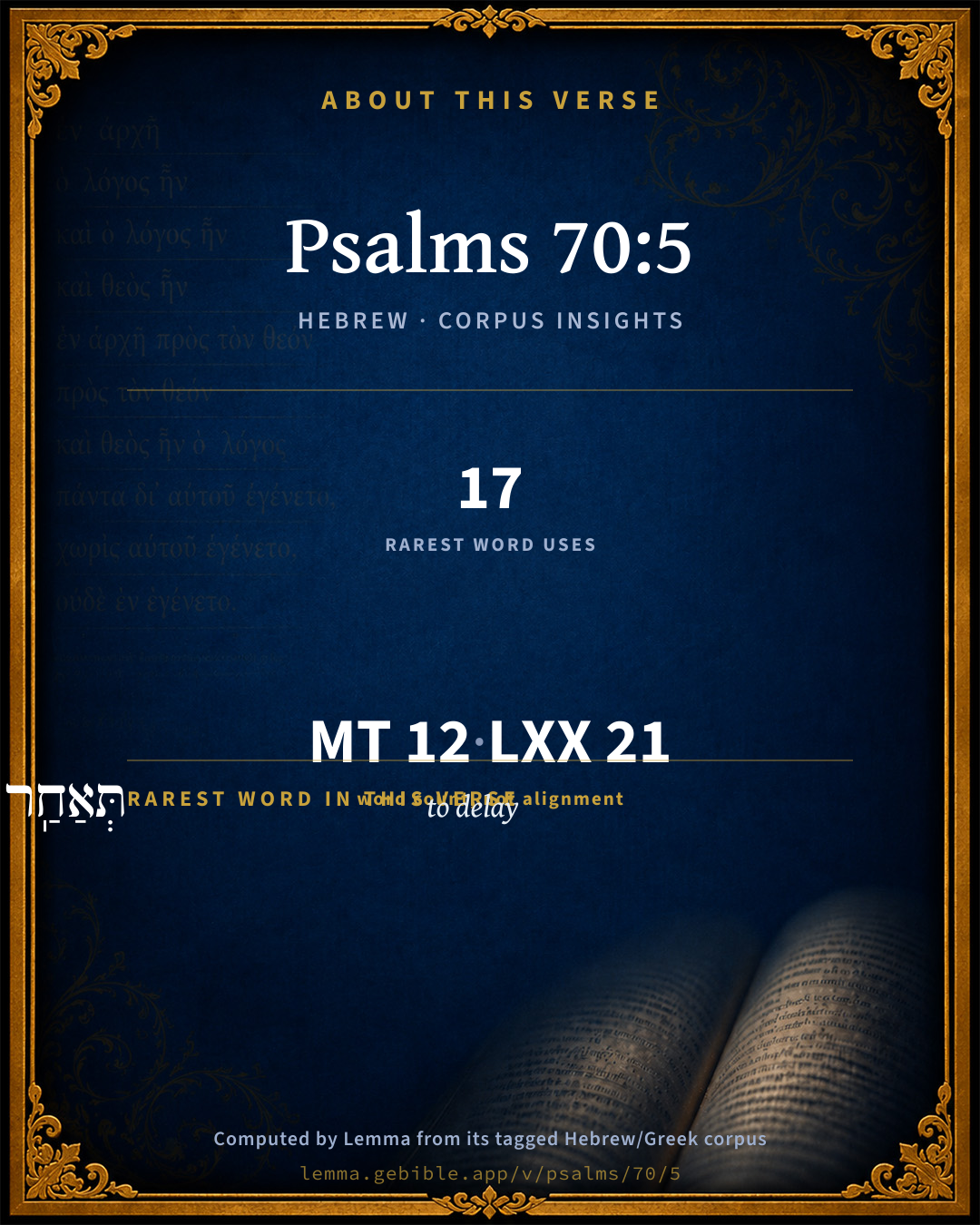
The rarest word here is תְּאַחַֽר to delay H309 — appearing just 17 times in the whole Hebrew Bible.

Shared distinctive vocabulary

תְּאַחַֽר to delay H309 occurs in 17 verses of the Hebrew Bible. Also found in:

Grammatical profile

  • 3 verbs
  • 3 nouns
  • 2 adjectives
  • 2 pronouns
  • 1 preposition
  • 1 particle

Verb forms

  • חֽוּשָׁ֫ה Qal · Imperative
  • וּמְפַלְטִ֣י Piel · Participle Active
  • תְּאַחַֽר Piel · Jussive

Hebrew & Septuagint length

In English translation the verse runs 21 words from the Hebrew and 20 from the Septuagint (LXX English) — closely comparable.

A rough comparison of the two English renderings, which tokenize alike — not a word-level alignment.

Word counts can differ between the Hebrew and the Greek without any difference in meaning — e.g. the Hebrew direct-object marker אֵת has no separate Greek word, and Greek often adds the article ὁ.

In the original languages it is 12 Hebrew tokens and 21 Greek tokens — but the two are counted differently (Hebrew bundles its prefixes and suffixes into one token; the Greek is in lemma form), so that isn’t a like-for-like length.

Cross-references

7

Topical passages linked to Psalms 70:5 in the Treasury of Scripture Knowledge — connected by theme and wording, ordered by reader-vote popularity; previews shown in the World English Bible.

  • Psalms 40:17 But I am poor and needy; May the Lord think about me. You are my help and my deliverer. Don't delay, my God.
  • Psalms 141:1 Yahweh, I have called on you. Come to me quickly! Listen to my voice when I call to you.
  • Revelation 22:20 He who testifies these things says, "Yes, I come quickly." Amen! Yes, come, Lord Jesus.
  • Psalms 69:29 But I am in pain and distress. Let your salvation, God, protect me.
  • Hebrews 10:37 "In a very little while, He who comes will come, and will not wait.
  • Psalms 13:1–2 How long, Yahweh? Will you forget me forever? How long will you hide your face from me?
  • Psalms 109:22 For I am poor and needy. My heart is wounded within me.

Cross-references courtesy of OpenBible.info (CC BY 4.0).

Hebrew and Greek witnesses Masoretic Hebrew ↔ Greek Septuagint

The same verse in the two great witnesses to the Old Testament, shown verse-for-verse.

You’re reading Greek Psalm 69 (Hebrew Psalm 70). The Septuagint counts the superscription, so verse numbers can differ from the Hebrew — chapter-level alignment, not verse-by-verse. Numbering follows Rahlfs.

These are two independent witnesses, not word-aligned to each other, and the Septuagint is shown in lemma (dictionary) form.

Hebrew Psalms 70:5 Masoretic · Westminster Leningrad Codex

וַאֲנִ֤י עָנִ֣י וְאֶבְיוֹן֮ אֱלֹהִ֪ים חֽוּשָׁ֫ה לִּ֥י עֶזְרִ֣י וּמְפַלְטִ֣י אַ֑תָּה יְ֝הוָ֗ה אַל תְּאַחַֽר

But I am poor and needy. Come to me quickly, God. You are my help and my deliverer. Yahweh, don't delay.

World English Bible · Public Domain

Greek LXX Greek Psalm 69:5 Septuagint · lemma form

ἀγαλλιάομαι καί εὐφραίνω ἐπί σύ πᾶς ὁ ζητέω σύ καί λέγω διά πᾶς μεγαλύνω ὁ θεός ὁ ἀγαπάω ὁ σωτήριον σύ

But I am poor and needy; O God, help me: you are my helper and deliverer, O Lord, delay not.

LXX2012 (modern English Septuagint) · Public Domain

Hebrew: Westminster Leningrad Codex (CC BY 4.0). Greek: Septuagint (public domain); English from LXX2012 (modern English Septuagint) (Public Domain). How the Septuagint differs from the Hebrew →

Commentary

Notes on Psalms 70:5 from classic Christian and Jewish commentators (each source and its license shown beneath its notes). The classic Christian expositions comment on the surrounding passage and are grouped to its opening verse, so a note may address several verses; the Jewish commentaries on the Tanakh (Rashi and others) are per-verse, so they appear only where the commentator wrote on this verse.

Lemma curates 59 commentaries, every one of them public domain or Creative Commons licensed, each selected and text-cleaned for this edition rather than reprinted as found. About our sources →

Adam Clarke's Commentary

Verse 5. But I am poor and needy] עני ואביון ani veebyon, I am a poor man, and a beggar - an afflicted beggar; a sense of my poverty causes me to beg.

Thou art my help] I know thou hast enough, and to spare; and therefore I come to thee.

Make no tarrying.] My wants are many, my danger great, my time short. O God, delay not!

ANALYSIS OF THE SEVENTIETH PSALM

The contents of this Psalm are the following: -

I. The prayer of David for himself, that he may be freed from his enemies, Ps 70:1, repeated Ps 70:5.

II. For the speedy overthrow of the wicked Ps 70:2-3.

III. For the prosperity of the godly, Ps 70:4.

IV. The arguments he uses to induce God to answer his prayer.

1. His miserable condition: "I am poor and needy."

2. God's office: "Thou art my Helper and Redeemer."

For a farther analysis, see at the end of the fortieth Psalm. See Clarke on Ps 40:17.

Adam Clarke's Commentary on the Bible (1810–1826) — public domain. Text from a community e-Sword/MySword module.

The Cambridge Bible for Schools and Colleges

gen. ed. J. J. S. Perowne

5. But I &c.] But as for me, who am afflicted and needy. Cp. Psa_69:29; Psa_69:33; Psa_9:18; Psa_35:10; Psa_37:14; Psa_86:1; Psa_109:22.

make haste unto me, O God] So Psa_141:1. “The text of Psa_40:17, “The Lord will take thought for me,” glancing back at “thy thoughts to us-ward” in Psa_70:5, is probably the original reading. The variation here may have been introduced for the sake of closer parallelism to make no tarrying. my help, as Psa_33:20 : my deliverer, as Psa_18:2; Psa_18:48, a different word from that used in Psa_70:1.

O Lord] In Psa_40:17, O my God. make no tarrying] Cp. Daniel’s prayer (Dan_9:19, A.V. defer not), and the promise in Isa_46:13.

The Cambridge Bible for Schools and Colleges (gen. ed. J. J. S. Perowne; Cambridge University Press, 1878–1918) — public domain. Text from a community e-Sword module.

Trapp's Complete Commentary

John Trapp

Psa 70:5 But I [am] poor and needy: make haste unto me, O God: thou [art] my help and my deliverer; O LORD, make no tarrying.

Ver. 5. But I am poor and needy] See Psa 69:29, {See Trapp on "Psa 69:29"}

John Trapp, A Commentary or Exposition upon All the Books of the Old and New Testament (1647–1656) — public domain. Text from a community e-Sword module.

The Biblical Illustrator

Joseph S. Exell

Psa_70:5

But I am poor and needy; make haste unto me, O God: Thou art my help and my deliverer; O Lord, make no tarrying,

Pleading

Young painters were anxious, in the olden times, to study under the great masters.

They concluded that they should more easily attain to excellence if they entered the schools of eminent men. At this present time, men will pay large premiums that their sons may be apprenticed or articled to those who best understand their trades or professions; now, if any of us would learn the sacred art and mystery of prayer, it is well for Us to study the productions of the greatest masters of that science. I am unable to point out one who understood it better than did the psalmist.

I. A soul confessing. The wrestler strips before he enters upon the contest, and confession does the like for the man who is about to plead with God. A racer on the plains of prayer cannot hope to win, unless, by confession, repentance, and faith, he lays aside every weight of sin. Now, let it be ever remembered that confession is absolutely needful to the sinner when he first seeks a Saviour. It is not possible for thee, O seeker, to obtain peace for thy troubled heart, till thou shalt have acknowledged thy transgression and thine iniquity before the Lord. If thou wilt condemn thyself, God will acquit thee. But never expect that the King of heaven will pardon a traitor, if he will not confess and forsake his treason. Even the tenderest father expects that the child should humble himself when he has offended, and he will not withdraw his frown from him till with tears he has said, Father, I have sinned. Darest thou expect God to humble Himself to thee, and would it not be so if He did not constrain thee to humble thyself to Him? Wouldst thou have Him connive at thy faults and wink at thy transgressions? He will have mercy, but He must, be holy. He is ready to forgive, but not to tolerate sin. The same principle applies to the Church of God. We must own that we are powerless in this business. The Spirit of God is treasured up in Christ, and we must seek Him of the great head of the Church. We cannot command the Spirit, and yet we can do nothing without him. He bloweth where he listeth. We must deeply feel and honestly acknowledge this.

II. A soul pleading. I am poor and needy, make haste unto me, O God. Thou art my help and my deliverer; O Lord, make no tarrying. The careful reader will perceive four pleas in this single verse. Upon this topic I would remark that it is the habit of faith, when she is praying, to use pleas. Mere prayer sayers, who do not pray at all, forget to argue with God; but those who would prevail bring forth their reasons and their strong arguments, and they debate the question with the Lord. Faiths art of wrestling is to plead with God, and say with holy boldness, Let it be thus and thus, for these reasons. Faiths pleas are plentiful, and this is welt, for faith is placed in divers positions, and needs them all. Faith will plead all the attributes of God. Thou art just, therefore spare Thou the soul for whom the Saviour died. Thou art merciful, blot out my transgressions. Thou art good, reveal Thy bounty to Thy servant. Thou art immutable--Thou hast done thus and thus to others of Thy servants, do thus unto me. Thou art faithful, caner Thou break Thy promise, caner Thou turn away from Thy covenant? Sometimes, however, faiths pleas are very singular. As in this text, it is by no means according to the proud rule of human nature to plead--I am poor and needy, make haste unto me, O God. It is like another prayer of David: Have mercy upon my iniquity, for it is great. It is not the manner of men to plead so, they say, Lord, have mercy on me, for I am not so bad a sinner as some. But faith reads things in a truer light, and bases her pleas on truth. Lord, because my sin is great, and Thou art a great God, let Thy great mercy be magnified in me. Faiths pleas are singular, but, let me add, faiths pleas are always sound; for after all, it is a very telling plea to urge that we are poor and needy. Is not the main argument with mercy? Necessity is the very best plea with benevolence, either human or divine. Is not our need the best reason we can urge? If we would have a physician come quickly to a sick man, Sir, we say, it is no common case, he is on the point of death, come to him, come quickly! If we wanted our city firemen to rush to a fire, we should not say to them, Make haste, for it is only a small fire; but, on the contrary, we urge that it is an old house, full of combustible materials, and there are rumours of petroleum and gunpowder on the premises; besides, it is near a timber yard, hosts of wooden cottages are close by, and before long we shall have half the city in a blaze. We put the case as badly as we can. Oh for wisdom to be equally wise in pleading with God, to find arguments everywhere, but especially to find them in our necessities.

III. A soul urgent. Make haste unto me, etc. Jesus has said, men ought always to pray and not to faint. You land on the shores of a foreign country with the greatest confidence when you carry a passport with you, and God has issued passports to His children, by which they come boldly to His mercy-seat; He has invited you, He has encouraged you, He has bidden you come to Him, and has promised that whatsoever ye ask in prayer, believing, ye shall receive. Come, then, come urgently, come importunately, come with this plea, I am poor and needy; make no tarrying, O my God, and a blessing shall surely come; it will not tarry. God grant we may see it, and give Him the glory of it.

IV. Here is another part of the art and mystery of prayer--the soul grasping God. She has pleaded, and she has been urgent, but now she comes to close quarters; she grasps the covenant angel with one hand, Thou art my help, and with the other, Thou art my deliverer. Oh, those blessed mys, those potent mys. The sweetness of the Bible lies in the possessive pronouns, and he who is taught to use them as the psalmist did, shall come off a conqueror with the eternal God. Oh, you that are saved and, therefore, love Christ, I want you, as the saints of God, to practise this last part of my subject; and be sure to lay hold upon God in prayer. Thou art my help and my deliverer. (C. H. Spurgeon.)

.

Psa_71:1-24

The Biblical Illustrator, edited by Joseph S. Exell (c. 1880s–1900s) — public domain. Text from a community e-Sword module.

J. A. Alexander on Psalms

Joseph Addison Alexander

6. (Psa 70:5). And I am afflicted and poor--0 God, hasten unto me! My help and my deliverer (art) thou-0 Jehovah, linger not, do not delay! See above, on Psa 40:17. Instead of God, the parallel passage has Jehovah, and instead of Jehovah, in the second clause, my God. Another variation is that the significant expression, he will think of me (or for me), is exchanged for the petition hasten to me, thus bringing back the prayer to the point from which it started.

Joseph Addison Alexander, The Psalms Translated and Explained (1850) — public domain. Text from a community e-Sword module.

Geneva Bible (1599)

Geneva Bible translators

Because he had felt God’s help before, he groundeth on experience, and boldly seeketh unto him for succor.

Geneva Bible (1599) marginal notes — public domain. Text via Bolls.life.

Ellicott's Commentary for English Readers

(5) Make haste unto me, O God.—In Psa_40:17, “The Lord (Adonai) thinketh on me.”

A Bible Commentary for English Readers, edited by Charles John Ellicott (1878–1897) — public domain. Text from a community e-Sword module.

John Gill's Exposition

But I am poor and needy,.... In Psa 40:17 it follows, yet "the Lord thinketh on me"; instead of which it is here; see Gill on Psa 40:17;

make haste unto me, O God; which repeats for sense the same petition as in Psa 71:1;

thou art my help and my deliverer; O Lord, make no tarrying; in Psa 40:17 it is, "O my God".

Next: Psalms Chapter 71

John Gill's Exposition of the Whole Bible (1746–1763) — public domain (CC PDM 1.0). Text via the HelloAO Bible API.

Albert Barnes' Notes on the Bible

But I am poor and needy - This is the same as in Psa 40:17.

Make haste unto me, O God - Hebrew, אלהים 'Elohiym. In the parallel place in Psa 40:17, this is, “The Lord thinketh upon me,” - where the Hebrew word is not אלהים 'Elohiym, but אדני tub ,my 'Adonāy (Lord). The word “make haste” seems to have been introduced here by design - thus carrying out the main idea in Ps. 40, but turning here to “petition” what is there stated as a “fact.”

Thou art my help and my deliverer ... - The close of the psalm is the same as the close of Ps. 40, except that the word Lord (Yahweh) is used here instead of “God” (אלהים 'Elohiym). It is not possible to ascertain whether these changes were mere matters of taste, or whether they were designed to adapt the psalm to some new circumstance, or to the special feelings of the psalmist at the time. There is no evidence that they are mere errors of transcribers, and indeed the changes are so made that this cannot be supposed. The change of the names אלהים 'Elohiym, יהוה Yahweh, and אדני 'Adonāy, for example, is such as must have been by design, and could not have been made by copyists. But what that design was must remain unknown. The alterations do not in any way, as far as we can understand, affect the sense.

Albert Barnes' Notes on the Bible (1834–1885) — public domain. Text from a community e-Sword/MySword module.

The Treasury of David

Charles H. Spurgeon

Ver. 5. But I am poor and needy. Just the same plea as in the preceding Psalm, Ps 69:29: it seems to be a favourite argument with tried saints; evidently our poverty is our wealth, even as our weakness is our strength. May we learn well this riddle.

Make haste unto me, O God. This is written instead of "yet the Lord thinketh upon me, "in Psalm 40: and there is a reason for the change, since the key note of the Psalm frequently dictates its close. Psalm 40 sings of God's thoughts, and, therefore, ends therewith; but the peculiar note of Psalm 70 is "Make haste, "and, therefore, so it concludes.

Thou art my help and my deliverer. My help in trouble, my deliverer out of it.

O Lord, make no tarrying. Here is the name of "Jehovah" instead of "my God." We are warranted in using all the various names of God, for each has its own beauty and majesty, and we must reverence each by its holy use as well as by abstaining from taking it in vain. I have presumed to close this recapitulatory exposition with an original hymn, suggested by the watchword of this Psalm, "MAKE HASTE."

Make haste, O God, my soul to bless!

My help and my deliverer thou;

Make haste, for I am in deep distress,

My case is urgent; help me now.

Make haste, O God! make haste to save!

For time is short, and death is nigh;

Make haste ere yet I am in my grave,

And with the lost forever lie.

Make haste, for I am poor and low;

And Satan mocks my prayers and tears;

O God, in mercy be not slow,

But snatch me from my horrid fears.

Make haste, O God, and hear my cries;

Then with the souls who seek thy face,

And those who thy salvation prize,

I will magnify thy matchless grace.

Ver. 5. But I am poor and needy. He had been rich, but for our sake he had become poor, that we, through his poverty, might be rich. Out of the fulness of his grace he had voluntarily entered, for our sakes, into a state in which he had experience, and most bitter experience, of the want of the means of enjoyment... But the word here rendered poor is often elsewhere, translated afflicted; in various ways he was afflicted. He was despised and rejected of men, a man of sorrows, and the acquaintance of grief. He was reproached, and "reproach broke his heart." James Frame.

Ver. 5. I am poor and needy. By this I hold to be meant the chastisements, and fiery trials that come from God the Father; the temptations and bitter assaults of that foul and fell fiend, Satan; the persecutions and vexations inflicted by the hands of unreasonable and wicked men; and (but in this following Christ must be exempted) the inward corruptions, disordered motions, unsettled affections, and the original pollutions brought from the mother's womb; with the soul and body's inaptness and unableness with cheerfulness and constancy to run the direct and just paths of God's commandments. Many of these made the Head, all of these (and more, too) the members, poor and needy. John Barlow. 1618.

Ver. 5. O Lord, make no tarrying. His prayer for himself, like his prayer for his foes and for his friends, was answered. The Lord made no tarrying. Ere four and twenty hours had rolled past, his rescued spirit was in Paradise, and the crucified thief was with him. O, what a change! The morning saw him condemned at the bar of an earthly tribunal, sentenced to death, and nailed to the bitter tree; before the evening shadowed the hill of Calvary, he was nestling in the bosom of God, and had become the great centre of attraction and of admiration to all the holy intelligences of the universe. The morning saw him led out through the gate of the Jerusalem below, surrounded by a ribald crowd, whose hootings rung in his ear; but ere the night fell, he had passed through the gate of the Jerusalem above, and his tread was upon the streets of gold, and angel anthems rose high through the dome of heaven, and joy filled the heart of God. James Frame.

Ver. 5. (third clause). Helper, in all good works; Deliverer, from all evil ones. Make no long tarrying: it is the cry of the individual sinner. Dionysius the Carthusian (1471) quoted in Neale and Littledale's Commentary.

Ver. 5.

I. Who needs help?

II. Who renders help?

III. What it comes to: "deliver."

IV. What prayer it suggests.

Ver. 5.

I. Confession! I am poor and needy.

II. Profession: Thou art my help, etc.

III. Supplication: Make haste; Make no tarrying.

Charles H. Spurgeon's The Treasury of David (1869–1885) — public domain. Psalms only. Text from a community e-Sword/MySword module.

Whedon's Commentary on the Bible

Daniel D. Whedon

5. But I am poor and needy—Compare Psa_69:29.

Make haste unto me, O God—For this Psa_40:17 has, “Yet the Lord (Adonai) thinketh upon me.” O Lord, (Jehovah,) make no tarrying—For this Eloheem, God, is used Psa_40:17.We have traced the verbal variations of this psalm from its original, but for further notes, see Psa_40:13-17.

Daniel D. Whedon (gen. ed.), Commentary on the Old and New Testaments (1874–1909) — public domain. Text from a community e-Sword module.

The Pulpit Commentary

But I am poor and needy: make haste unto me, O God. Instead of this last clause, Psa_40:17 has, "Yet the Lord thinketh upon me," which cannot be ascribed to a corruption, but must be an alteration made deliberately. Thou art my Help and my Deliverer; O Lord, make no tarrying. Identical with Psa_40:17, except that here once more "Jehovah" replaces "Elohim."

The Pulpit Commentary (1880–1919), ed. H.D.M. Spence-Jones & Joseph S. Exell — public domain. Text from a community e-Sword module.

Lesson kit

Teaching starters — assembled from the data on this page, not authored interpretation. Every prompt links to the verse data it draws on. Edit before teaching.

Psalms, in the Wisdom, opens this verse with 12 words (11 distinct Hebrew lemmas). Its most distinctive word is ʼâchar (“to delay”). A historical commentator’s framing appears above. Read the whole chapter for the surrounding context.

Discussion questions

  1. What does “to delay” (ʼâchar) contribute to the verse as a whole?
  2. Genesis 24:56 shares the word «to delay» with this verse. How do the two illuminate each other?
  3. These translations render this verse differently; the difference is in the English rendering, not the original. What questions does that raise?
  4. The verb «חֽוּשָׁ֫ה» is Qal Imperative. How does its form color the action?
  5. Reading how Adam Clarke's Commentary and The Cambridge Bible for Schools and Colleges read this verse, where do the two commentators agree and where do they part?

Things to notice

Reading settings

Reading text

Shown beneath each verse's original-language words.

Old Testament
Old Testament edition

Read the OT as the Masoretic Hebrew (MT) or the Greek Septuagint (LXX).

English shown for the Greek Septuagint (in the Hebrew ↔ Greek comparison).

Comparing translations? Open the Compare panel on any verse page to stack up to four side by side.