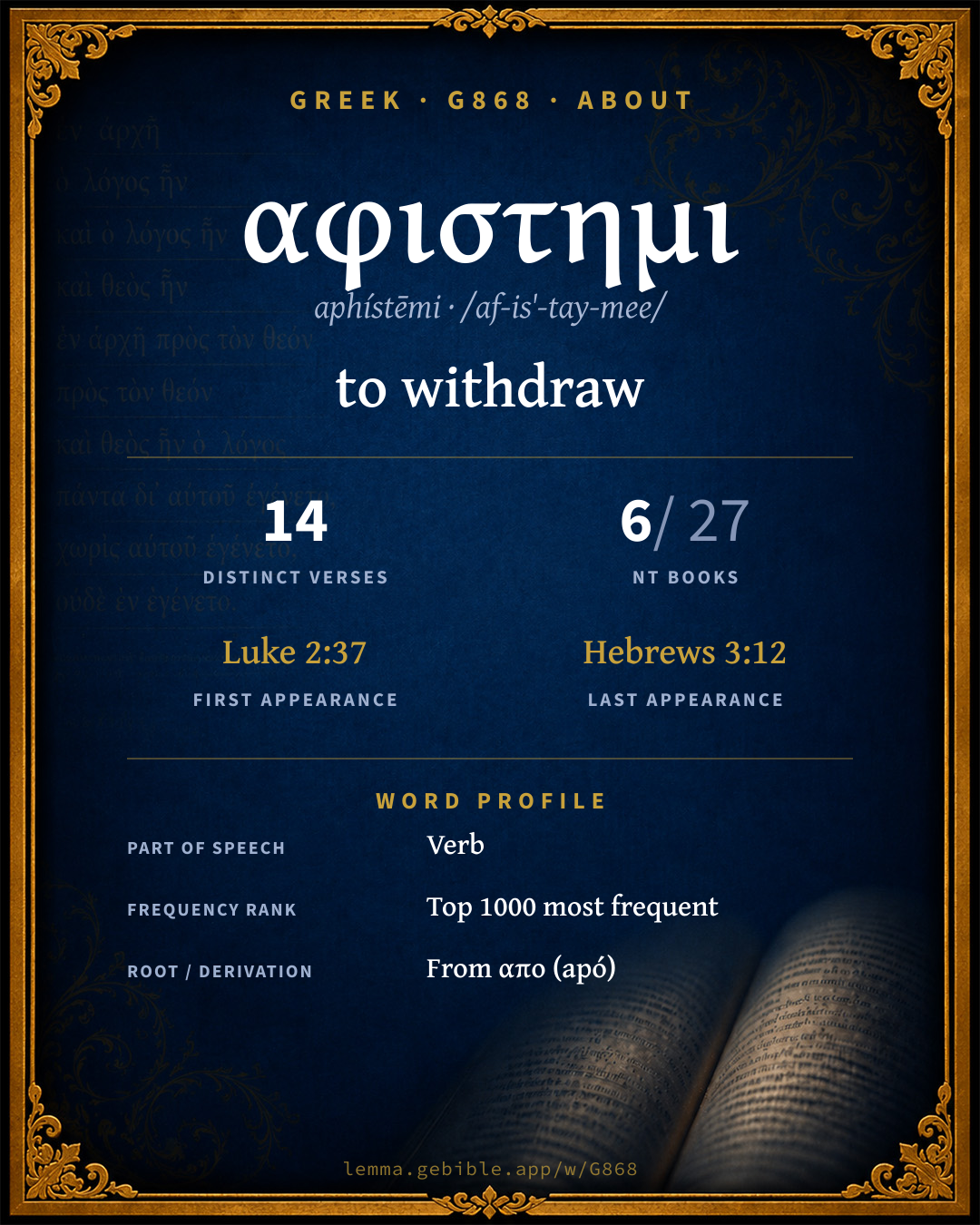
ἀφίστημι
to withdraw
‘to withdraw’ is one of 2 main senses fuller range ↓
Full lexicon entry — Thayer's Greek Lexicon
From Thayer's Greek Lexicon
Where this word appears
See every Aorist-tense verb in the Greek New Testament →
Grammar key — what these labels mean
Part of speech
- Verb
- An action or state-of-being word.
Tense
- Aorist
- Action viewed as a simple whole, without regard to duration — often past (perfective aspect).
- Future
- Action expected in future time.
- Imperfect
- Continuous or repeated action in past time (“was writing”).
- Present
- Ongoing or general action in present time (imperfective aspect).
Voice
- Active
- The subject performs the action.
- Middle deponent
- Middle in form but active in meaning.
- Middle or Passive deponent
- Middle/passive in form but active in meaning.
Mood
- Indicative
- States a fact or asks a factual question (the mood of reality).
- Imperative
- Expresses a command or request.
- Infinitive
- A verbal noun (“to write”), unmarked for person or number.
- Participle
- A verbal adjective (“writing,” “having written”).
- Subjunctive
- Expresses probability, purpose, or possibility (the mood of contingency).
Case
- Accusative
- The case of the direct object and of extent.
- Nominative
- The case of the subject (and the predicate nominative).
Person
- 3rd person
- The one spoken about (“he / she / it / they”).
- 2nd person
- The one addressed (“you”).
Gender
- Masculine
- Grammatically masculine.
Number
- Singular
- One.
- Plural
- More than one.
Grammatical forms 11 distinct
- Verb, Aorist, Active, Indicative, 3rd person, Singular 3 times (21%)
- Verb, Aorist, Active, Imperative, 2nd person, Plural 2 times (14%)
- Verb, Aorist, Active, Indicative, 3rd person, Plural 1 time (7%)
- Verb, Aorist, Active, Imperative, 3rd person, Singular 1 time (7%)
- Verb, Aorist, Active, Infinitive 1 time (7%)
- Verb, Aorist, Active, Participle, Accusative, Singular, Masculine 1 time (7%)
- Verb, Aorist, Active, Participle, Nominative, Singular, Masculine 1 time (7%)
- Verb, Aorist, Active, Subjunctive, 3rd person, Singular 1 time (7%)
+3 more forms (3 occurrences)
Parsed forms decoded from the imported morphology (Robinson–Tischendorf, public domain), counted across 14 parsed occurrences — not distinct verses.
Every verse where G868 appears — 14 distinct verses across 6 books. Click any verse to open its interlinear word-by-word view. Verse text shown in the World English Bible for context — . Each verse’s Greek form is shown with its reference; the English is not keyword-highlighted, since the data carries no word-level English alignment. Use “Compare translations” on any verse to read it across multiple English versions. This concordance covers the Greek New Testament; Septuagint (Greek Old Testament) occurrences of this word are not indexed here.
Luke 4 verses
- Luke 2:37 ἀφίστατο impf mid/pass.dep ind 3sg and she had been a widow for about eighty-four years), who didn't depart from the temple, worshipping with fastings and petitions night and day.
- Luke 4:13 ἀπέστη aor act ind 3sg When the devil had completed every temptation, he departed from him until another time.
- Luke 8:13 ἀφίστανται pres mid/pass.dep ind 3pl Those on the rock are they who, when they hear, receive the word with joy; but these have no root, who believe for a while, then fall away in time of temptation.
- Luke 13:27 ἀπόστητε aor act impv 2pl He will say, 'I tell you, I don't know where you come from. Depart from me, all you workers of iniquity.'
Acts 6 verses
- Acts 5:37 ἀπέστησεν aor act ind 3sg After this man, Judas of Galilee rose up in the days of the enrollment, and drew away some people after him. He also perished, and all, as many as obeyed him, were scattered abroad.
- Acts 5:38 ἀπόστητε aor act impv 2pl Now I tell you, withdraw from these men, and leave them alone. For if this counsel or this work is of men, it will be overthrown.
- Acts 12:10 ἀπέστη aor act ind 3sg When they were past the first and the second guard, they came to the iron gate that leads into the city, which opened to them by itself. They went out, and went down one street, and immediately the angel departed from him.
- Acts 15:38 ἀποστάντα aor act ptcp acc sg masc But Paul didn't think that it was a good idea to take with them someone who had withdrawn from them in Pamphylia, and didn't go with them to do the work.
- Acts 19:9 ἀποστὰς aor act ptcp nom sg masc But when some were hardened and disobedient, speaking evil of the Way before the multitude, he departed from them, and separated the disciples, reasoning daily in the school of Tyrannus.
- Acts 22:29 ἀπέστησαν aor act ind 3pl Immediately those who were about to examine him departed from him, and the commanding officer also was afraid when he realized that he was a Roman, because he had bound him.
2 Corinthians 1 verse
1 Timothy 1 verse
2 Timothy 1 verse
Hebrews 1 verse
About this entry
At a glance — auto-summarized from this page’s data, not written by a person. Every figure links to its source below. This summary describes the numbers; it doesn’t interpret them.
“to withdraw” is the headline sense of the Greek verb αφιστημι (aphístēmi). It first appears in Luke 2:37. The Greek New Testament uses it across 14 verses — uncommon. More than a third of its appearances fall in Acts. Its lexical range runs to 2 senses. The sections below give every sense, occurrence, and version rendering.
Gloss history
Strong's 1890 vs modern scholarship

About this word
Strong's G868 catalogs a Greek word from the Greek New Testament.
These counts are not copied from any lexicon or concordance. They are computed here, from the morphology-tagged Greek New Testament. What Lemma adds →
- 14
- distinct verses
- The word appears in 14 distinct verses.
- 6 / 27
- NT books
- The word appears in 6 of 27 New Testament books.
- #814
- by frequency
- Top 1000 most frequent Greek words (rank 814 of 5,347 Greek words by occurrence).
View all 14 occurrences in the concordance →
Most concentrated in
- Acts 6 verses 43%
- Luke 4 verses 29%
- 2 Corinthians 1 verse 7%
By section of the New Testament
By traditional corpus
Conventional, traditional groupings — biblical authorship is debated, so this is a traditional corpus grouping, not an authorship claim. Some books belong to more than one corpus (Luke is in both the Gospels and the Lukan corpus, and so on), so these shares overlap and need not total 100%. Each figure is a share of the word’s 14 distinct verses.
- Lukan (Luke–Acts) 10 verses · 71%
- Gospels 4 verses · 29%
- Pauline corpus 3 verses · 21%
- Hebrews 1 verse · 7%
How translations render this word
Counts come from each version’s own published word-to-Strong’s tagging or interlinear alignment — an approximate guide to how each version renders this word, not a word-level alignment the data otherwise carries. Because each total is that version’s own tagged count, the per-version totals vary from one another and need not match the appearance or distinct-verse counts above. These counts may also differ from a printed concordance because Lemma counts each distinctly tagged rendering and does not collapse phrase taggings into a single head-word total. This is a fixed set of word-tagged versions (KJV, ASV, BSB, ULT) and does not change with the reading translation you choose elsewhere. Each version’s license is shown beside its name below (and on Sources).
- King James Version: Departed 3×, Depart 2×, He departed 2×
- American Standard Version: Departed 3×, Depart 2×, He departed 2×
- Berean Standard Bible: Left 2×
- unfoldingWord Literal Text: Went away 2×
King James Version Public Domain
Renders G868 across 16 tagged occurrences — most commonly:
Plus 9 renderings that appear only once — usually multi-word phrases or single function words the recovered tagging swept in, not distinct renderings.
American Standard Version Public Domain
Renders G868 across 15 tagged occurrences — most commonly:
Plus 8 renderings that appear only once — usually multi-word phrases or single function words the recovered tagging swept in, not distinct renderings.
Berean Standard Bible Public Domain
Renders G868 across 14 tagged occurrences — most commonly:
Plus 12 renderings that appear only once — usually multi-word phrases or single function words the recovered tagging swept in, not distinct renderings.
unfoldingWord Literal Text CC BY-SA 4.0
Renders G868 across 16 tagged occurrences — most commonly:
Plus 14 renderings that appear only once — usually multi-word phrases or single function words the recovered tagging swept in, not distinct renderings.
Senses in Thayer's
The 2 senses Thayer's distinguishes for this word, in lexicon order (not ranked by frequency or importance). The full entry — with sub-senses — is in the Lexicon Entry tab.
- to make stand off, cause to withdraw, to remove
- to stand off, to stand aloof
Word origin
Derived from απο (apó) (G575) — from.
Forms in the corpus
The 12 distinct written forms G868 takes in the Greek New Testament, most frequent first — each parse links to that tense’s occurrences in the concordance.
Same root — word family
Other Thayer's entries built from the same root as G868, grouped by Strong’s listed origin. These share a root / origin per the lexicon — not necessarily a shared meaning. Each links to that word’s own entry.
Derives from
Shares the same root
- απαγγελλω apangéllō G518 to report
- απαγχομαι apánchomai G519 to strangle
- απαγω apágō G520 to lead away
- απαιρω apaírō G522 to take away
- απαιτεω apaitéō G523 to demand back
- απαλγεω apalgéō G524 to cease grieving
- απαλλασσω apallássō G525 to depart
- απαλλοτριοω apallotrióō G526 to estrange
- απανταω apantáō G528 to meet
- απαρνεομαι aparnéomai G533 to deny
- απαρτι apárti G534 henceforth
- απαρχη aparchḗ G536 to offer firstfruits
- απαυγασμα apaúgasma G541 brightness
- απειδω apeídō G542 to look away
- απειμι ápeimi G548 to depart
- απειμι ápeimi G549 to depart
- απειπομην apeipómēn G550 to declare
- απεκδεχομαι apekdéchomai G553 waiting for
- απεκδυομαι apekdýomai G554 to despoil
- απελαυνω apelaúnō G556 to drive away
- απελεγμος apelegmós G557 censure
- απελευθερος apeleútheros G558 freedman
- απελπιζω apelpízō G560 not despairing
- απεναντι apénanti G561 opposite
+85 more words share this root (not shown).
Derived from this word
Compare all same-root words → Showing 4 of 112 — not the complete family. They share a root, not necessarily a meaning.
Septuagint usage
The same Greek word αφιστημι appears 161 times in the Greek Old Testament (Septuagint), across 147 verses in 24 books.
- 161
- LXX occurrences
- Tagged occurrences of this Greek word in the Septuagint.
- 147
- verses
- Distinct Septuagint verses containing this word.
- 24 / 39
- OT books
- The word appears in 24 of the 39 Old Testament books.
Sample Septuagint occurrences
- Genesis 12:8 ἀποἵστημι
- Exodus 23:7 ἀποἵστημι
- Leviticus 13:58 ἀποἵστημι
- Numbers 8:25 ἀποἵστημι
- Deuteronomy 1:28 ἀποἵστημι
- Joshua 1:8 ἀποἵστημι
- Judges 16:17 ἀποἵστημι
- 1 Samuel 6:3 ἀποἵστημι
- 2 Samuel 2:22 ἀποἵστημι
- 1 Kings 11:29 ἀποἵστημι
- 2 Kings 1:18 ἀποἵστημι
- 1 Chronicles 17:13 ἀποἵστημι
Septuagint occurrences (same lexeme)
Every verse where the same Strong’s number (G868) appears in the Greek Septuagint — showing the first 50 of 147. Verse text shown in the World English Bible for context; the Greek form is the matched word — the English is not keyword-highlighted.
- Genesis 12:8 ἀποἵστημι He left from there to the mountain on the east of Bethel, and pitched his tent, having Bethel on the west, and Ai on the east. There he built an altar to Yahweh, and called on the name of Yahweh.
- Genesis 14:4 ἀποἵστημι Twelve years they served Chedorlaomer, and in the thirteenth year, they rebelled.
- Genesis 19:9 ἀποἵστημι They said, "Stand back!" They said, "This one fellow came in to live as a foreigner, and he appoints himself a judge. Now will we deal worse with you, than with them!" They pressed hard on the man, even Lot, and drew near to break the door.
- Genesis 30:36 ἀποἵστημι He set three days' journey between himself and Jacob, and Jacob fed the rest of Laban's flocks.
- Genesis 31:40 ἀποἵστημι Thus I was; in the day the drought consumed me, and the frost by night; and my sleep fled from my eyes.
- Genesis 31:49 ἀποἵστημι and Mizpah, for he said, "Yahweh watch between me and you, when we are absent one from another.
- Exodus 23:7 ἀποἵστημι "Keep far from a false charge, and don't kill the innocent and righteous: for I will not justify the wicked.
- Leviticus 13:58 ἀποἵστημι The garment, either the warp, or the woof, or whatever thing of skin it is, which you shall wash, if the plague has departed from them, then it shall be washed the second time, and it will be clean."
- Numbers 8:25 ἀποἵστημι and from the age of fifty years they shall cease waiting on the work, and shall serve no more,
- Numbers 12:10 ἀποἵστημι The cloud removed from over the Tent; and, behold, Miriam was leprous, as [white as] snow: and Aaron looked at Miriam, and, behold, she was leprous.
- Numbers 14:9 ἀποἵστημι Only don't rebel against Yahweh, neither fear the people of the land; for they are bread for us: their defense is removed from over them, and Yahweh is with us: don't fear them.
- Numbers 14:31 ἀποἵστημι But your little ones, that you said should be a prey, them will I bring in, and they shall know the land which you have rejected.
- Numbers 16:27 ἀποἵστημι So they got them up from the tent of Korah, Dathan, and Abiram, on every side: and Dathan and Abiram came out, and stood at the door of their tents, and their wives, and their sons, and their little ones.
- Numbers 31:16 ἀποἵστημι Behold, these caused the children of Israel, through the counsel of Balaam, to commit trespass against Yahweh in the matter of Peor, and so the plague was among the congregation of Yahweh.
- Numbers 32:9 ἀποἵστημι For when they went up to the valley of Eshcol, and saw the land, they discouraged the heart of the children of Israel, that they should not go into the land which Yahweh had given them.
- Deuteronomy 1:28 ἀποἵστημι Where are we going up? our brothers have made our heart to melt, saying, The people are greater and taller than we; the cities are great and fortified up to the sky; and moreover we have seen the sons of the Anakim there.
- Deuteronomy 4:9 ἀποἵστημι Only take heed to yourself, and keep your soul diligently, lest you forget the things which your eyes saw, and lest they depart from your heart all the days of your life; but make them known to your children and your children's children;
- Deuteronomy 7:4 ἀποἵστημι For he will turn away your son from following me, that they may serve other gods: so will the anger of Yahweh be kindled against you, and he will destroy you quickly.
- Deuteronomy 13:11 ἀποἵστημι All Israel shall hear, and fear, and shall not do any more such wickedness as this is in the midst of you.
- Deuteronomy 13:14 ἀποἵστημι then shall you inquire, and make search, and ask diligently; and, behold, if it be truth, and the thing certain, that such abomination is done in the midst of you,
- Deuteronomy 32:15 ἀποἵστημι But Jeshurun grew fat, and kicked: You have grown fat, you are grown thick, you are become sleek; Then he forsook God who made him, Lightly esteemed the Rock of his salvation.
- Joshua 1:8 ἀποἵστημι This book of the law shall not depart out of your mouth, but you shall meditate thereon day and night, that you may observe to do according to all that is written therein: for then you shall make your way prosperous, and then you shall have good success.
- Joshua 3:16 ἀποἵστημι that the waters which came down from above stood, and rose up in one heap, a great way off, at Adam, the city that is beside Zarethan; and those that went down toward the sea of the Arabah, even the Salt Sea, were wholly cut off: and the people passed over right against Jericho.
- Joshua 8:16 ἀποἵστημι All the people who were in the city were called together to pursue after them: and they pursued after Joshua, and were drawn away from the city.
- Joshua 22:18 ἀποἵστημι that you must turn away this day from following Yahweh? and it will be, seeing you rebel today against Yahweh, that tomorrow he will be angry with the whole congregation of Israel.
- Joshua 22:19 ἀποἵστημι However, if the land of your possession be unclean, then pass over to the land of the possession of Yahweh, in which Yahweh's tent dwells, and take possession among us: but don't rebel against Yahweh, nor rebel against us, in building you an altar besides the altar of Yahweh our God.
- Joshua 22:23 ἀποἵστημι that we have built us an altar to turn away from following Yahweh; or if to offer thereon burnt offering or meal-offering, or if to offer sacrifices of peace-offerings thereon, let Yahweh himself require it;
- Joshua 22:29 ἀποἵστημι Far be it from us that we should rebel against Yahweh, and turn away this day from following Yahweh, to build an altar for burnt-offering, for meal-offering, or for sacrifice, besides the altar of Yahweh our God that is before his tent.
- Judges 16:17 ἀποἵστημι He told her all his heart, and said to her, "No razor has ever come on my head; for I have been a Nazirite to God from my mother's womb. If I am shaved, then my strength will go from me, and I will become weak, and be like any other man."
- Judges 16:19 ἀποἵστημι She made him sleep on her knees; and she called for a man, and shaved off the seven locks of his head; and she began to afflict him, and his strength went from him.
- Judges 16:20 ἀποἵστημι She said, The Philistines are on you, Samson. He awoke out of his sleep, and said, I will go out as at other times, and shake myself free. But he didn't know that Yahweh had departed from him.
- 1 Samuel 6:3 ἀποἵστημι They said, "If you send away the ark of the God of Israel, don't send it empty; but by all means return him a trespass-offering: then you shall be healed, and it shall be known to you why his hand is not removed from you."
- 1 Samuel 14:9 ἀποἵστημι If they say thus to us, Wait until we come to you; then we will stand still in our place, and will not go up to them.
- 1 Samuel 16:14 ἀποἵστημι Now the Spirit of Yahweh departed from Saul, and an evil spirit from Yahweh troubled him.
- 1 Samuel 16:23 ἀποἵστημι It happened, when the [evil] spirit from God was on Saul, that David took the harp, and played with his hand: so Saul was refreshed, and was well, and the evil spirit departed from him.
- 1 Samuel 18:6 ἀποἵστημι It happened as they came, when David returned from the slaughter of the Philistine, that the women came out of all the cities of Israel, singing and dancing, to meet king Saul, with tambourines, with joy, and with instruments of music.
- 1 Samuel 19:10 ἀποἵστημι Saul sought to strike David even to the wall with the spear; but he slipped away out of Saul's presence, and he struck the spear into the wall: and David fled, and escaped that night.
- 1 Samuel 28:15 ἀποἵστημι Samuel said to Saul, Why have you disquieted me, to bring me up? Saul answered, I am sore distressed; for the Philistines make war against me, and God is departed from me, and answers me no more, neither by prophets, nor by dreams: therefore I have called you, that you may make known to me what I shall do.
- 1 Samuel 28:16 ἀποἵστημι Samuel said, Why then do you ask of me, seeing Yahweh is departed from you, and is become your adversary?
- 2 Samuel 2:22 ἀποἵστημι Abner said again to Asahel, Turn you aside from following me: why should I strike you to the ground? how then should I hold up my face to Joab your brother?
- 2 Samuel 2:23 ἀποἵστημι However he refused to turn aside: therefore Abner with the hinder end of the spear struck him in the body, so that the spear came out behind him; and he fell down there, and died in the same place: and it happened, that as many as came to the place where Asahel fell down and died stood still.
- 2 Samuel 2:28 ἀποἵστημι So Joab blew the trumpet; and all the people stood still, and pursued after Israel no more, neither fought they any more.
- 2 Samuel 7:15 ἀποἵστημι but my loving kindness shall not depart from him, as I took it from Saul, whom I put away before you.
- 2 Samuel 12:10 ἀποἵστημι Now therefore the sword will never depart from your house, because you have despised me, and have taken the wife of Uriah the Hittite to be your wife.'
- 2 Samuel 22:23 ἀποἵστημι For all his ordinances were before me; As for his statutes, I did not depart from them.
- 1 Kings 11:29 ἀποἵστημι It happened at that time, when Jeroboam went out of Jerusalem, that the prophet Ahijah the Shilonite found him in the way; now [Ahijah] had clad himself with a new garment; and they two were alone in the field.
- 1 Kings 21:24 ἀποἵστημι Him who dies of Ahab in the city the dogs shall eat; and him who dies in the field shall the birds of the sky eat.
- 2 Kings 1:18 ἀποἵστημι Now the rest of the acts of Ahaziah which he did, aren't they written in the book of the chronicles of the kings of Israel?
- 2 Kings 3:3 ἀποἵστημι Nevertheless he cleaved to the sins of Jeroboam the son of Nebat, with which he made Israel to sin; he didn't depart from it.
- 2 Kings 10:29 ἀποἵστημι However from the sins of Jeroboam the son of Nebat, with which he made Israel to sin, Jehu didn't depart from after them, [to wit], the golden calves that were in Bethel, and that were in Dan.
These are occurrences of the same Greek lexeme (G868) in the Septuagint — not a translation of any one Hebrew word. The store carries no word-level Hebrew↔Greek alignment, so no Hebrew original is asserted here. Counts come from the recovered LXX Strong's tagging — high-frequency vocabulary is well covered, while rare or late forms may be untagged — so they reflect tagged occurrences and may slightly undercount.