
Joshua 22:18

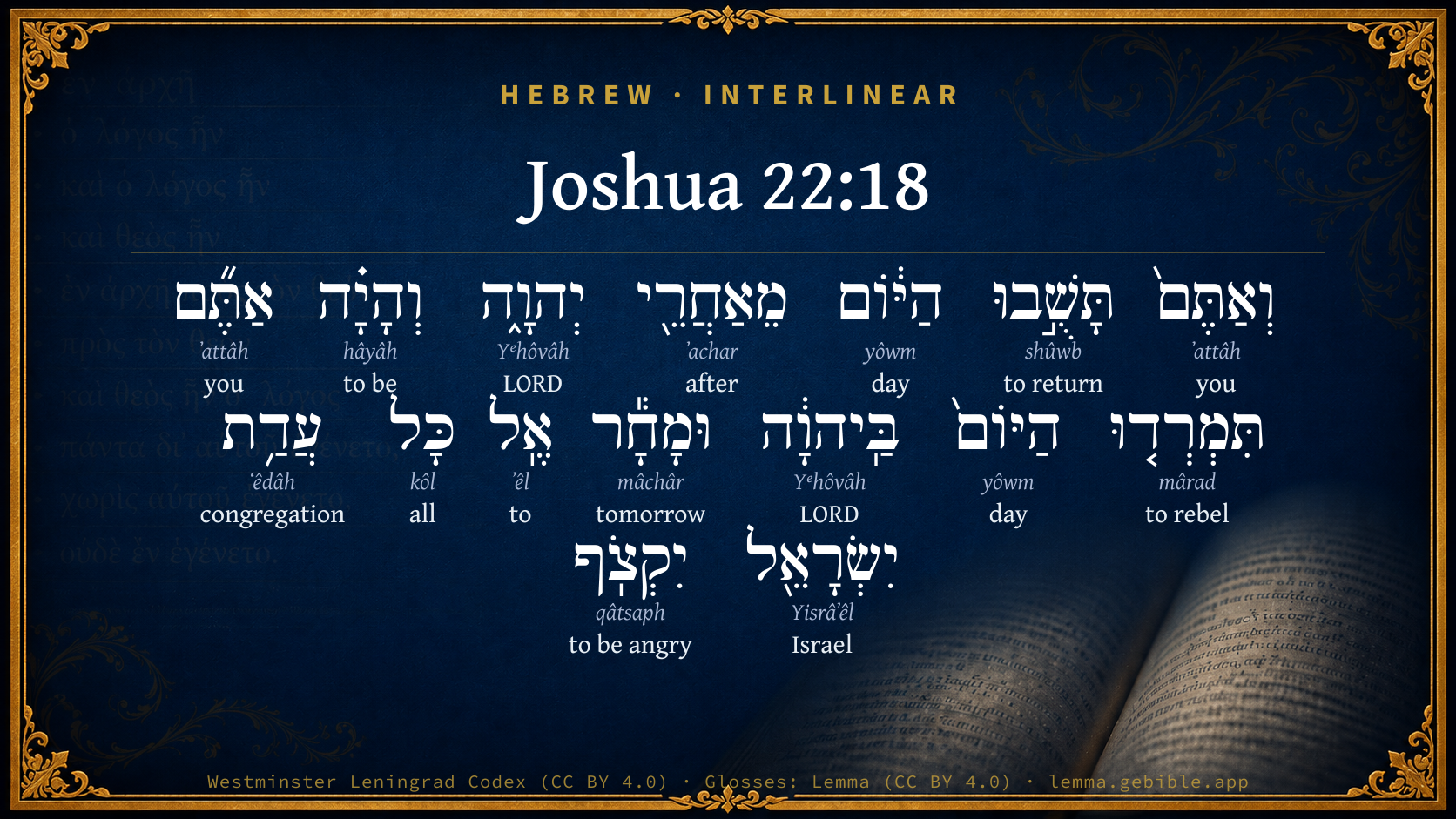
Hebrew (Westminster Leningrad Codex) Joshua 22:18 appears in the Hebrew Old Testament. The text above is from the Westminster Leningrad Codex. Each word links to its Strong’s number, a concise gloss, and parsing drawn from the Open Scriptures Hebrew Bible morphology. Click any word for its full Brown-Driver-Briggs (BDB) entry.
Download image
Cite this verse

Joshua 22:18 (World English Bible). Public Domain. Lemma interlinear Bible study tool, https://lemma.gebible.app/v/joshua/22/18.

Show BibTeX & RIS
BibTeX
RIS
English Translation
that you must turn away this day from following Yahweh? and it will be, seeing you rebel today against Yahweh, that tomorrow he will be angry with the whole congregation of Israel.
World English Bible · Public Domain
Download a study sheet

One document with this verse’s original text, its word-by-word gloss line, the meaning frame, cross-references with their text, attributed commentary, and full source and license credits — printable, and it pastes into notes with its structure intact.

This verse Autodidact and up

Study sheet (.html) Plain text (.txt)

A passage Seminary Student

Up to 50 verses in one chapter. A passage sheet keeps up to 6 commentary sources and 12 cross-references per verse, in the order this page ranks them, and says so on the sheet whenever that leaves anything out. Ask for a single verse and you get the Autodidact verse sheet above.

Everything on this page stays free to read, with no account — the sheet is a download of what is already on screen, not access to it.

Want to remove ads? Support Godless Engineer
Compare translations 3

The same verse in 3 English versions, stacked beneath the original-language interlinear above. Click any original word for its lexicon entry.

Each is an independent rendering of the whole verse — the interlinear is not word-aligned to these translations.

Highlighted words mark where these versions differ — a whole-verse word diff, not a word-by-word alignment.

  • World English Bible Public Domain
    that you must turn away this day from following Yahweh? and it will be, seeing you rebel today against Yahweh, that tomorrow he will be angry with the whole congregation of Israel.
  • King James Version Public Domain
    But that ye must turn away this day from following the LORD? and it will be, seeing ye rebel to day against the LORD, that to morrow he will be wroth with the whole congregation of Israel.
  • unfoldingWord Literal Text CC BY-SA 4.0
    And will you yourselves turn today from after Yahweh? And it will happen, you yourselves rebel against Yahweh today, then tomorrow he will be furious toward all of the congregation of Israel.

unfoldingWord Literal Text — © unfoldingWord, licensed CC BY-SA 4.0. Word-aligned USFM3 via Door43 (git.door43.org/unfoldingWord/en_ult).

Versions to compare (up to 4)

3 of 4 selected

Show all 18 translations

Every available English version of this verse, each an independent rendering of the whole verse.

  • World English Bible Public Domain
    that you must turn away this day from following Yahweh? and it will be, seeing you rebel today against Yahweh, that tomorrow he will be angry with the whole congregation of Israel.
  • Berean Standard Bible Public Domain
    And now, would you turn away from the LORD? If you rebel today against the LORD, tomorrow He will be angry with the whole congregation of Israel.
  • Majority Standard Bible Public Domain
    And now, would you turn away from the LORD? If you rebel today against the LORD, tomorrow He will be angry with the whole congregation of Israel.
  • King James Version Public Domain
    But that ye must turn away this day from following the LORD? and it will be, seeing ye rebel to day against the LORD, that to morrow he will be wroth with the whole congregation of Israel.
  • American Standard Version (1901) Public Domain
    that ye must turn away this day from following Jehovah? and it will be, seeing ye rebel to-day against Jehovah, that to-morrow he will be wroth with the whole congregation of Israel.
  • Revised Version (1885) Public Domain
    that ye must turn away this day from following the LORD? and it will be, seeing ye rebel today against the LORD, that tomorrow he will be wroth with the whole congregation of Israel.
  • Geneva Bible (1599) Public Domain
    Ye also are turned away this day from the Lord: and seeing ye rebell to day against ye Lord, euen to morowe he will be wroth with all the Congregation of Israel.
  • Douay-Rheims (1899) Public Domain
    And you have forsaken the Lord to day, and to morrow his wrath will rage against all Israel.
  • Young's Literal Translation Public Domain
    that ye turn back to-day from after Jehovah? and it hath been -- ye rebel to-day against Jehovah -- and to-morrow against all the company of Israel He is wroth.
  • Literal Standard Version CC BY-SA 4.0
    that you turn back today from after YHWH? And it has been [that] you rebel against YHWH today, and tomorrow He is angry against all the congregation of Israel.
  • Unlocked Literal Bible CC BY-SA 4.0
    Must you also turn away from following Yahweh at this present day? If you also rebel against Yahweh today, tomorrow he will be angry with the whole assembly of Israel.
  • unfoldingWord Literal Text CC BY-SA 4.0
    And will you yourselves turn today from after Yahweh? And it will happen, you yourselves rebel against Yahweh today, then tomorrow he will be furious toward all of the congregation of Israel.
  • Darby Bible Public Domain
    And ye turn away this day from following Jehovah; and it will be, that since ye rebel this day against Jehovah, to-morrow he will be wroth with the whole assembly of Israel.
  • World Messianic Bible Public Domain
    that you must turn away today from following the LORD? It will be, since you rebel today against the LORD, that tomorrow he will be angry with the whole congregation of Israel.
  • Webster's Bible Public Domain
    But that ye must turn away this day from following the LORD? and it will be, seeing ye rebel to-day against the LORD, that to-morrow he will be wroth with the whole congregation of Israel.
  • Free Bible Version CC BY-SA 4.0
    So why are you turning away from the Lord now? If you rebel against the Lord today, he will be angry with all of us tomorrow!
  • Bible in Basic English Public Domain
    That now you are turned back from the Lord? and, because you are false to him today, tomorrow his wrath will be let loose on all the people of Israel.
  • JPS Tanakh (1917) Public Domain
    that ye must turn away this day from following the LORD? and it will be, seeing ye rebel to-day against the LORD, that to-morrow He will be wroth with the whole congregation of Israel.

Literal Standard Version (2020), Covenant Press — licensed CC BY-SA 4.0. Text via the HelloAO Bible API (eBible.org). Unlocked Literal Bible (unfoldingWord) — licensed CC BY-SA 4.0. Text via the HelloAO Bible API (eBible.org). unfoldingWord Literal Text — © unfoldingWord, licensed CC BY-SA 4.0. Word-aligned USFM3 via Door43 (git.door43.org/unfoldingWord/en_ult). Free Bible Version, Dr. Jonathan Gallagher — licensed CC BY-SA 4.0. Text via the HelloAO Bible API (eBible.org).

Word by word

More ways to search: Search by grammar → Find every occurrence → Compare this word →

Practice this passage: Drill this verse → Learn its vocabulary →

תִּמְרְד֤וּ
mârad
H4775
“to rebel”
Verb, Qal, Imperfect, 2nd Person, Masculine, Plural
Part of Speech
Verb
Stem
Qal
Form
Imperfect
Person
2nd Person
Gender
Masculine
Number
Plural
Full BDB Definition

Origin: a primitive root

TWOT: 1240

to rebel, revolt, be rebellious - (Qal) to rebel, revolt - against human king - against God - against light (poetic)
  1. וְאַתֶּם֙ ʼattâh H859 “and · you” Conjunction + Pronoun, Personal, 2nd Person, Masculine, Plural
  2. תָּשֻׁ֣בוּ shûwb H7725 “to return” Verb, Qal, Imperfect, 2nd Person, Masculine, Plural
  3. הַיּ֔וֹם yôwm H3117 “the · day” Particle, Definite Article + Noun, Common, Masculine, Singular, Absolute
  4. מֵאַחֲרֵ֖י ʼachar H310 “from · after” Preposition + Preposition
  5. יְהוָ֑ה Yᵉhôvâh H3068 “LORD” Noun, Proper
  6. וְהָיָ֗ה hâyâh H1961 “and · to be” Conjunction + Verb, Qal, Sequential Perfect, 3rd Person, Masculine, Singular
  7. אַתֶּ֞ם ʼattâh H859 “you” Pronoun, Personal, 2nd Person, Masculine, Plural
  8. הַיּוֹם֙ yôwm H3117 “the · day” Particle, Definite Article + Noun, Common, Masculine, Singular, Absolute
  9. בַּֽיהוָ֔ה Yᵉhôvâh H3068 “in/at · LORD” Preposition + Noun, Proper
  10. וּמָחָ֕ר mâchâr H4279 “and · tomorrow” Conjunction + Noun, Common, Masculine, Singular, Absolute
  11. אֶֽל ʼêl H413 “to” Preposition
  12. כָּל kôl H3605 “all of” Noun, Common, Masculine, Singular, Construct
  13. עֲדַ֥ת ʻêdâh H5712 “congregation of” Noun, Common, Feminine, Singular, Construct
  14. יִשְׂרָאֵ֖ל Yisrâʼêl H3478 “Israel” Noun, Proper
  15. יִקְצֹֽף qâtsaph H7107 “to be angry” Verb, Qal, Imperfect, 3rd Person, Masculine, Singular

About this verse

These counts appear in no published source. They are computed here, from the morphology-tagged text and Lemma’s own curated glosses. What Lemma adds →

16
words
13
distinct lemmas
Historical
section

Notable vocabulary

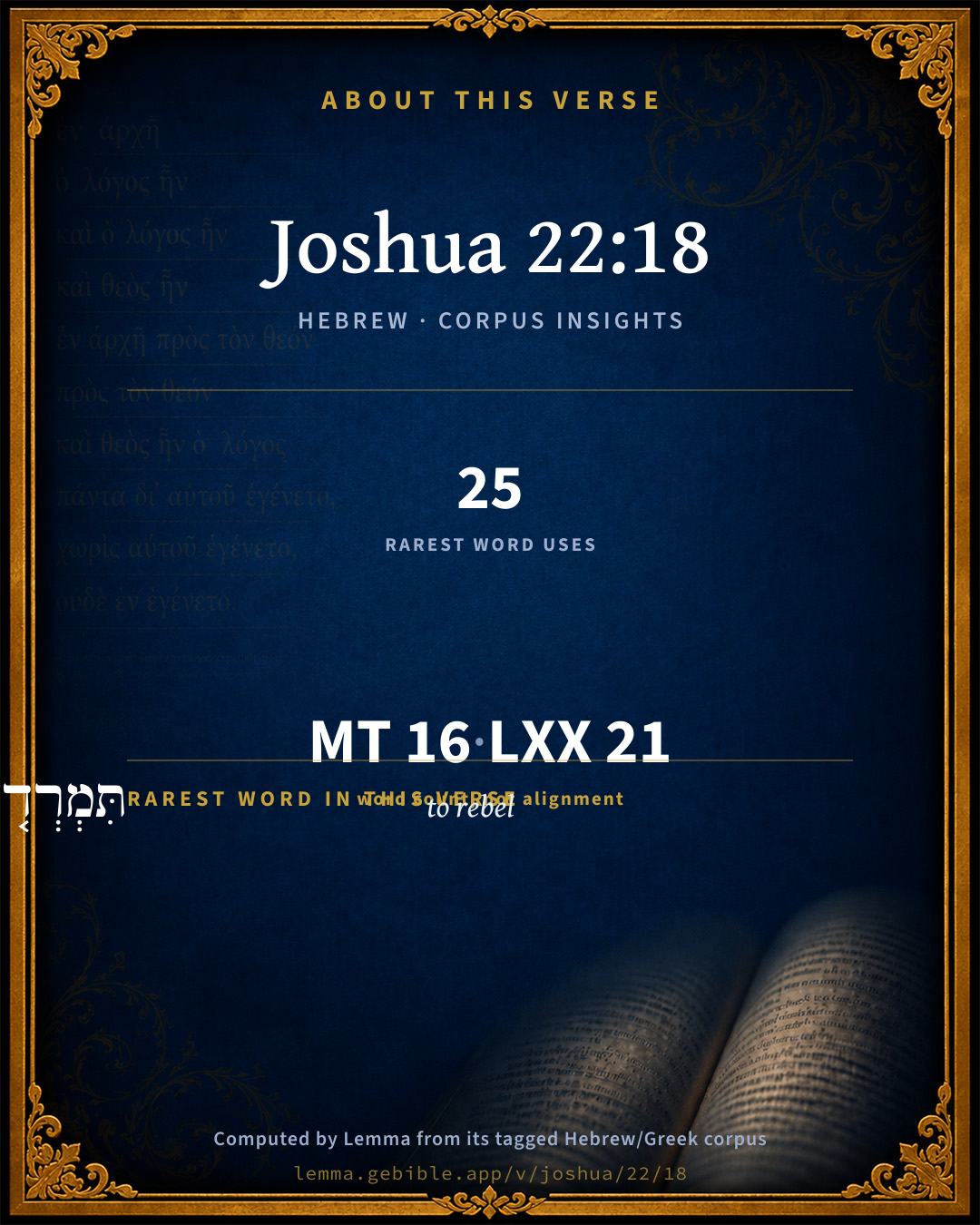
The rarest word here is תִּמְרְד֤וּ to rebel H4775 — appearing just 25 times in the whole Hebrew Bible.

Shared distinctive vocabulary

תִּמְרְד֤וּ to rebel H4775 occurs in 23 verses of the Hebrew Bible. Also found in:

Grammatical profile

  • 4 verbs
  • 8 nouns
  • 2 pronouns
  • 2 prepositions

Verb forms

  • תָּשֻׁ֣בוּ Qal · Imperfect
  • וְהָיָ֗ה Qal · Sequential Perfect
  • תִּמְרְד֤וּ Qal · Imperfect
  • יִקְצֹֽף Qal · Imperfect

Repetition

Words recur within this verse — often emphatic in Hebrew:

  • הַיּ֔וֹם day H3117 ×2
  • יְהוָ֑ה LORD H3068 ×2
  • וְאַתֶּם֙ you H859 ×2

Hebrew & Septuagint length

In English translation the verse runs 32 words from the Hebrew and 32 from the Septuagint (LXX English) — the same length.

A rough comparison of the two English renderings, which tokenize alike — not a word-level alignment.

Word counts can differ between the Hebrew and the Greek without any difference in meaning — e.g. the Hebrew direct-object marker אֵת has no separate Greek word, and Greek often adds the article ὁ.

In the original languages it is 16 Hebrew tokens and 21 Greek tokens — but the two are counted differently (Hebrew bundles its prefixes and suffixes into one token; the Greek is in lemma form), so that isn’t a like-for-like length.

Cross-references

17

Topical passages linked to Joshua 22:18 in the Treasury of Scripture Knowledge — connected by theme and wording, ordered by reader-vote popularity; previews shown in the World English Bible.

  • Numbers 16:22 They fell on their faces, and said, God, the God of the spirits of all flesh, shall one man sin, and will you be angry with all the congregation?
  • Joshua 22:16 Thus says the whole congregation of Yahweh, What trespass is this that you have committed against the God of Israel, to turn away this day from following Yahweh, in that you have built you an altar, to rebel this day against Yahweh?
  • Deuteronomy 7:4 For he will turn away your son from following me, that they may serve other gods: so will the anger of Yahweh be kindled against you, and he will destroy you quickly.
  • Joshua 7:1 But the children of Israel committed a trespass in the devoted thing; for Achan, the son of Carmi, the son of Zabdi, the son of Zerah, of the tribe of Judah, took of the devoted thing: and the anger of Yahweh was kindled against the children of Israel.
  • Joshua 7:11 Israel has sinned; yes, they have even transgressed my covenant which I commanded them: yes, they have even taken of the devoted thing, and have also stolen, and dissembled also; and they have even put it among their own stuff.
  • Joshua 7:21 when I saw among the spoil a goodly Babylonian mantle, and two hundred shekels of silver, and a wedge of gold of fifty shekels weight, then I coveted them, and took them; and, behold, they are hid in the earth in the midst of my tent, and the silver under it.
  • Joshua 22:20 Didn't Achan the son of Zerah commit a trespass in the devoted thing, and wrath fell on all the congregation of Israel? and that man didn't perish alone in his iniquity.
  • 1 Samuel 12:14 If you will fear Yahweh, and serve him, and listen to his voice, and not rebel against the commandment of Yahweh, and both you and also the king who reigns over you are followers of Yahweh your God, [well]:
  • 1 Samuel 12:20 Samuel said to the people, "Don't be afraid; you have indeed done all this evil; yet don't turn aside from following Yahweh, but serve Yahweh with all your heart:
  • 2 Samuel 24:1 Again the anger of Yahweh was kindled against Israel, and he moved David against them, saying, Go, number Israel and Judah.
  • 1 Kings 9:6 But if you shall turn away from following me, you or your children, and not keep my commandments and my statutes which I have set before you, but shall go and serve other gods, and worship them;
  • 2 Kings 17:21 For he tore Israel from the house of David; and they made Jeroboam the son of Nebat king: and Jeroboam drove Israel from following Yahweh, and made them sin a great sin.
  • 1 Chronicles 21:1 Satan stood up against Israel, and moved David to number Israel.
  • 1 Chronicles 21:14 So Yahweh sent a pestilence on Israel; and there fell of Israel seventy thousand men.
  • 2 Chronicles 25:27 Now from the time that Amaziah did turn away from following Yahweh they made a conspiracy against him in Jerusalem; and he fled to Lachish: but they sent after him to Lachish, and killed him there.
  • 2 Chronicles 34:33 Josiah took away all the abominations out of all the countries that pertained to the children of Israel, and made all who were found in Israel to serve, even to serve Yahweh their God. All his days they didn't depart from following Yahweh, the God of their fathers.
  • Ezra 9:13–14 After all that is come on us for our evil deeds, and for our great guilt, seeing that you our God have punished us less than our iniquities deserve, and have given us such a remnant,

Cross-references courtesy of OpenBible.info (CC BY 4.0).

Hebrew and Greek witnesses Masoretic Hebrew ↔ Greek Septuagint

The same verse in the two great witnesses to the Old Testament, shown verse-for-verse.

These are two independent witnesses, not word-aligned to each other, and the Septuagint is shown in lemma (dictionary) form.

Hebrew Joshua 22:18 Masoretic · Westminster Leningrad Codex

וְאַתֶּם֙ תָּשֻׁ֣בוּ הַיּ֔וֹם מֵאַחֲרֵ֖י יְהוָ֑ה וְהָיָ֗ה אַתֶּ֞ם תִּמְרְד֤וּ הַיּוֹם֙ בַּֽיהוָ֔ה וּמָחָ֕ר אֶֽל כָּל עֲדַ֥ת יִשְׂרָאֵ֖ל יִקְצֹֽף

that you must turn away this day from following Yahweh? and it will be, seeing you rebel today against Yahweh, that tomorrow he will be angry with the whole congregation of Israel.

World English Bible · Public Domain

Greek LXX Joshua 22:18 Septuagint · lemma form

καί σύ ἀποστρέφω σήμερον ἀπό κύριος καί εἰμί ἐάν ἀποἵστημι σήμερον ἀπό κύριος καί αὔριον ἐπί πᾶς ἰσραήλ εἰμί ὁ ὀργή

And you⌃ have this day revolted from the Lord; and it shall come to pass if you⌃ revolt this day from the Lord, that to-morrow there shall be wrath upon all Israel.

LXX2012 (modern English Septuagint) · Public Domain

Hebrew: Westminster Leningrad Codex (CC BY 4.0). Greek: Septuagint (public domain); English from LXX2012 (modern English Septuagint) (Public Domain). How the Septuagint differs from the Hebrew →

Targum (Aramaic paraphrase)

1

The Targum is the ancient Jewish Aramaic paraphrase of the Hebrew Scriptures — an interpretive translation, not the Hebrew text itself. Onkelos (literal) and Pseudo-Jonathan (expansive) render the Torah, and Jonathan the Prophets. Coverage is partial: where no permissively-licensed English translation exists for a verse, only the Aramaic is shown. This is verse-level text, not a word-by-word alignment to the Hebrew.

  1. Targum Jonathan Prophets (Joshua–Malachi)
    וְאַתּוּן תְּתוּבוּן יוֹמָא דֵין מִבָּתַר פּוּלְחָנָא דַייָ וִיהֵי אַתּוּן תִּמְרְדוּן יוֹמָא דֵין בְּמֵימְרָא דַייָ וּמְחַר עַל כָּל כְּנִשְׁתָּא דְיִשְׂרָאֵל יְהֵי רוּגְזָא:

    (no public-domain English translation for this verse)

    Targum Jonathan — Aramaic: “Mikraot Gedolot” (public domain). English: “Sefaria Community Translation” (CC0 1.0 (public-domain dedication)); “London "Chaldee Paraphrase," 1871” (public domain). Text via Sefaria.

Commentary

Notes on Joshua 22:18 from classic Christian and Jewish commentators (each source and its license shown beneath its notes). The classic Christian expositions comment on the surrounding passage and are grouped to its opening verse, so a note may address several verses; the Jewish commentaries on the Tanakh (Rashi and others) are per-verse, so they appear only where the commentator wrote on this verse.

Lemma curates 59 commentaries, every one of them public domain or Creative Commons licensed, each selected and text-cleaned for this edition rather than reprinted as found. About our sources →

Trapp's Complete Commentary

John Trapp

Jos 22:18 But that ye must turn away this day from following the LORD? and it will be, [seeing] ye rebel to day against the LORD, that to morrow he will be wroth with the whole congregation of Israel.

Ver. 18. That tomorrow he will be wroth,] i.e., Ere long: punishment treadeth upon the heels of sin. Peccantes sequitur ultor a tergo Deus.

John Trapp, A Commentary or Exposition upon All the Books of the Old and New Testament (1647–1656) — public domain. Text from a community e-Sword module.

Joseph Benson's Commentary

Jos 22:18. But ye must turn away this day — Commit more sins of that nature. For whether they intended to worship other gods, or to worship the God of Israel in a manner he did not allow, it was idolatry, in the judgment of Phinehas. Ye rebel to-day, to-morrow he will be wroth — That is, soon and suddenly, as the expression often signifies. With the whole congregation — With you for doing so, and with us for suffering or not punishing it.

Joseph Benson's Commentary on the Old and New Testaments (1811–1818) — public domain. Text from a community e-Sword module.

John Gill's Exposition

Notwithstanding, if the land of your possession be unclean,.... That is, if it was judged to be so by them, because not cleansed from the sins of the former inhabitants of it by sacrifice, or because there was no altar in it to offer up sacrifice for the expiation of sin:

then pass ye over unto the land of the possession of the Lord,

wherein the Lord's tabernacle dwelleth; if you repent of the choice you have made of a country to dwell in, quit it, and come over into the land of Canaan, which the Lord has taken possession of, and residence in, and where his tabernacle is fixed, the place of his presence and worship, and where an altar is erected to sacrifice upon:

and take possession among us; they were willing to quit possession of their own, and make room for them in each of their tribes, and even though they straitened themselves, and parted with much of their estates, rather than they should make a schism, or go into idolatrous practices; which was a brave, noble, spirit indeed, and showed their great concern for the honour and glory of God, and his worship, and their love to their brethren, and affectionate regard for their spiritual welfare, above their own private, personal, and temporal good:

but rebel not against the Lord: the Word of the Lord, as the Targum, either Christ the essential Word, the Angel of Jehovah's presence, or his word of command:

nor rebel against us; by breaking off from us, and setting up another religion or form of worship:

in building you an altar beside the altar of the Lord our God: which ought to be common to both, and no other to be set up against it, or used beside it.

John Gill's Exposition of the Whole Bible (1746–1763) — public domain (CC PDM 1.0). Text via the HelloAO Bible API.

Matthew Poole's English Annotations

To-morrow, i.e. suddenly, as that word is oft used, as Mat 6:30; 1Co 15:32.

He will be wroth with the whole congregation of Israel; with you for doing so, and with us for suffering, or not punishing it.

Matthew Poole's English Annotations on the Holy Bible (1683–1685) — public domain. Text from a community e-Sword/MySword module.

Whedon's Commentary on the Bible

Daniel D. Whedon

18. To-morrow he will be wroth — The moral universe is pervaded by laws as inflexible as those of the physical world, or, rather, more certain in their consequences; for the physical laws may be suspended for moral ends.

With the whole congregation — And not with you eastern tribes only. Such are our social and political relations that the crimes of a part are punished on the whole of the nation.

Daniel D. Whedon (gen. ed.), Commentary on the Old and New Testaments (1874–1909) — public domain. Text from a community e-Sword module.

The Pulpit Commentary

But that ye must turn. The original has the imperfect, of an action not completed, and ye are turning." There is no need to give the adversative sense to! The ye also is emphatic. Ye are turning against the Lord today, tomorrow ye will involve the whole congregation in calamity." That tomorrow he will be wroth with the whole congregation of Israel. This passage also is quite consistent with the circumstances and with the position of the speaker. Not merely anger but fear is visible throughout fear of His wrath who had manifested His power so signally of late. There was no longer any temptation to rebel against Him. The Israelites were no longer suffering the daily pressure of comparative privation and distress, such as it was impossible to avoid in the wilderness. While, on the contrary, there was every reason to remember His power Who had driven the heathen out before them and planted them in, Who had not failed to punish them when they deserved it, and Who, by the fate of their enemies, had made it clear that His hands were not waxen short. Thus the heads of the tribes, and Phinehas especially, were alarmed lest Israel should forfeit the prosperity they at present enjoyed, and exchange it for those terrible woes that God had shown He could inflict when His people rebelled against Him.

The Pulpit Commentary (1880–1919), ed. H.D.M. Spence-Jones & Joseph S. Exell — public domain. Text from a community e-Sword module.

John Wesley's Explanatory Notes

Tomorrow - That is, suddenly, as that word is often used. Congregation - With you for doing so, and with us for suffering, or not punishing it.

John Wesley, Explanatory Notes Upon the Whole Bible (1754–1765) — public domain. Text via the GEBible commentary corpus.

Keil & Delitzsch

C. F. Keil & F. Delitzsch

"And to-day ye turn away from the Lord again," and are about to bring His wrath upon the whole congregation again through a fresh rebellion.

Keil & Delitzsch — Biblical Commentary on the Old Testament (1861–1891) — public domain (CC PDM 1.0). Text via the HelloAO Bible API. (Old Testament only.)

Lesson kit

Teaching starters — assembled from the data on this page, not authored interpretation. Every prompt links to the verse data it draws on. Edit before teaching.

Joshua, in the Historical, opens this verse with 16 words (13 distinct Hebrew lemmas). Its most distinctive word is mârad (“to rebel”). A historical commentator’s framing appears above. Read the whole chapter for the surrounding context.

Discussion questions

  1. What does “to rebel” (mârad) contribute to the verse as a whole?
  2. How does Genesis 14:4, which shares the word «to rebel», read alongside this verse?
  3. What does the repetition of “day” (2× in this one verse) do in this verse?
  4. These translations render this verse differently. What is at stake in choosing one wording over another?
  5. «תָּשֻׁ֣בוּ» is a Qal Imperfect verb. How does that grammatical form shape the action described?
  6. Compare how Trapp's Complete Commentary and Joseph Benson's Commentary read this verse. Where do they agree or differ?

Things to notice

Reading settings

Reading text

Shown beneath each verse's original-language words.

Old Testament
Old Testament edition

Read the OT as the Masoretic Hebrew (MT) or the Greek Septuagint (LXX).

English shown for the Greek Septuagint (in the Hebrew ↔ Greek comparison).

Comparing translations? Open the Compare panel on any verse page to stack up to four side by side.