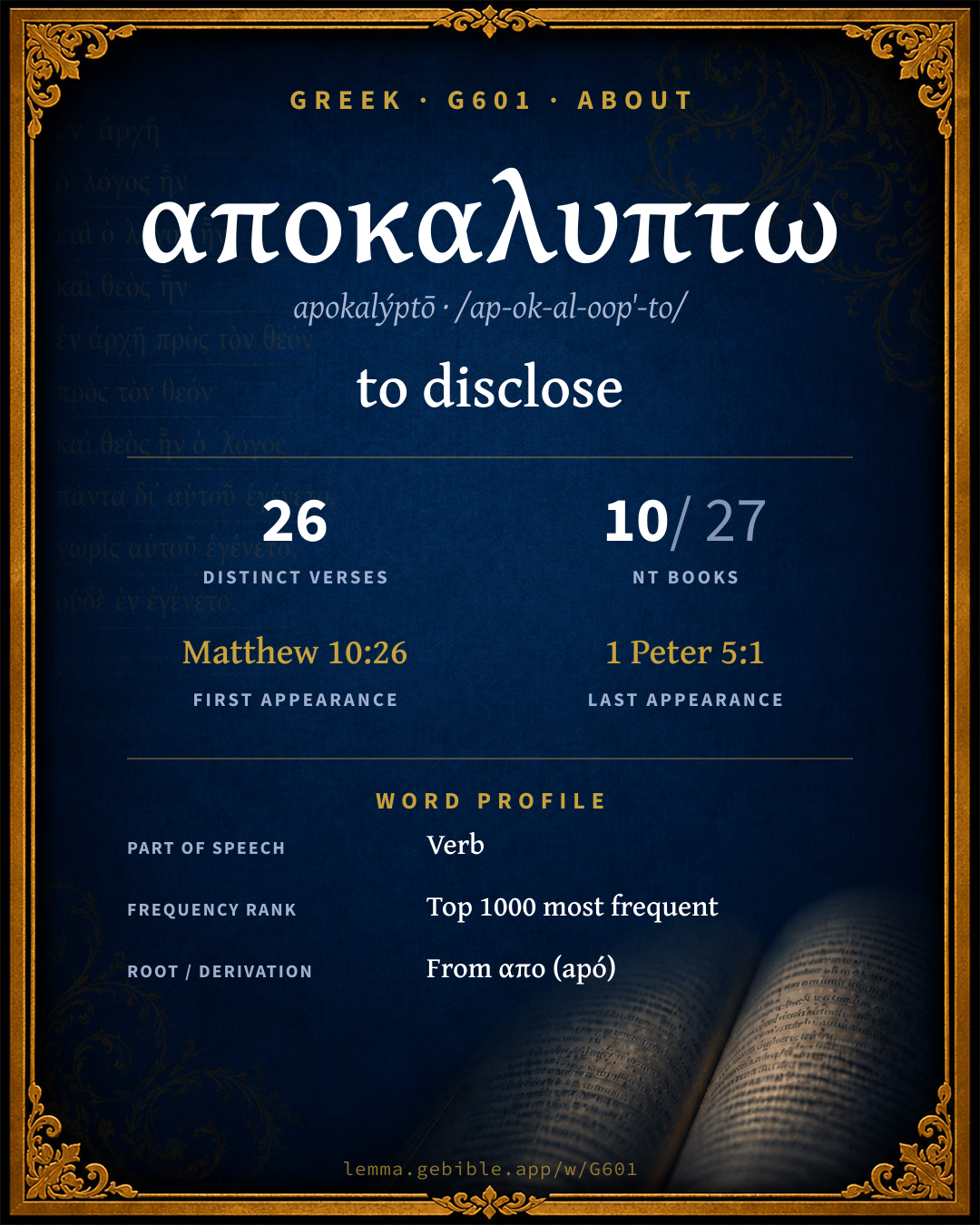
ἀποκαλύπτω
to disclose
‘to disclose’ is one of 2 main senses fuller range ↓
Full lexicon entry — Thayer's Greek Lexicon
From Thayer's Greek Lexicon
Where this word appears
See every Aorist-tense verb in the Greek New Testament →
Grammar key — what these labels mean
Part of speech
- Verb
- An action or state-of-being word.
Tense
- Aorist
- Action viewed as a simple whole, without regard to duration — often past (perfective aspect).
- Present
- Ongoing or general action in present time (imperfective aspect).
- Future
- Action expected in future time.
Voice
- Passive
- The subject receives the action.
- Active
- The subject performs the action.
Mood
- Infinitive
- A verbal noun (“to write”), unmarked for person or number.
- Indicative
- States a fact or asks a factual question (the mood of reality).
- Subjunctive
- Expresses probability, purpose, or possibility (the mood of contingency).
Person
- 3rd person
- The one spoken about (“he / she / it / they”).
- 2nd person
- The one addressed (“you”).
Number
- Singular
- One.
- Plural
- More than one.
Grammatical forms 11 distinct
- Verb, Aorist, Passive, Infinitive 4 times (15%)
- Verb, Present, Passive, Indicative, 3rd person, Singular 4 times (15%)
- Verb, Aorist, Active, Infinitive 3 times (12%)
- Verb, Aorist, Passive, Indicative, 3rd person, Singular 3 times (12%)
- Verb, Future, Passive, Indicative, 3rd person, Singular 3 times (12%)
- Verb, Aorist, Active, Indicative, 2nd person, Singular 2 times (8%)
- Verb, Aorist, Active, Indicative, 3rd person, Singular 2 times (8%)
- Verb, Aorist, Passive, Subjunctive, 3rd person, Singular 2 times (8%)
+3 more forms (3 occurrences)
Parsed forms decoded from the imported morphology (Robinson–Tischendorf, public domain), counted across 26 parsed occurrences — not distinct verses.
Every verse where G601 appears — 26 distinct verses across 10 books. Click any verse to open its interlinear word-by-word view. Verse text shown in the World English Bible for context — . Each verse’s Greek form is shown with its reference; the English is not keyword-highlighted, since the data carries no word-level English alignment. Use “Compare translations” on any verse to read it across multiple English versions. This concordance covers the Greek New Testament; Septuagint (Greek Old Testament) occurrences of this word are not indexed here.
Matthew 4 verses
- Matthew 10:26 ἀποκαλυφθήσεται fut pass ind 3sg Therefore don't be afraid of them, for there is nothing covered that will not be revealed; and hidden that will not be known.
- Matthew 11:25 ἀπεκάλυψας aor act ind 2sg At that time, Jesus answered, "I thank you, Father, Lord of heaven and earth, that you hid these things from the wise and understanding, and revealed them to infants.
- Matthew 11:27 ἀποκαλύψαι aor act inf All things have been delivered to me by my Father. No one knows the Son, except the Father; neither does anyone know the Father, except the Son, and he to whom the Son desires to reveal him.
- Matthew 16:17 ἀπεκάλυψέν aor act ind 3sg Jesus answered him, "Blessed are you, Simon Bar Jonah, for flesh and blood has not revealed this to you, but my Father who is in heaven.
Luke 5 verses
- Luke 2:35 ἀποκαλυφθῶσιν aor pass subj 3pl Yes, a sword will pierce through your own soul, that the thoughts of many hearts may be revealed."
- Luke 10:21 ἀπεκάλυψας aor act ind 2sg In that same hour Jesus rejoiced in the Holy Spirit, and said, "I thank you, O Father, Lord of heaven and earth, that you have hidden these things from the wise and understanding, and revealed them to little children. Yes, Father, for so it was well-pleasing in your sight."
- Luke 10:22 ἀποκαλύψαι aor act inf Turning to the disciples, he said, "All things have been delivered to me by my Father. No one knows who the Son is, except the Father, and who the Father is, except the Son, and he to whomever the Son desires to reveal him."
- Luke 12:2 ἀποκαλυφθήσεται fut pass ind 3sg But there is nothing covered up, that will not be revealed, nor hidden, that will not be known.
- Luke 17:30 ἀποκαλύπτεται pres pass ind 3sg It will be the same way in the day that the Son of Man is revealed.
John 1 verse
Romans 3 verses
- Romans 1:17 ἀποκαλύπτεται pres pass ind 3sg For in it is revealed God's righteousness from faith to faith. As it is written, "But the righteous shall live by faith."
- Romans 1:18 Ἀποκαλύπτεται pres pass ind 3sg For the wrath of God is revealed from heaven against all ungodliness and unrighteousness of men, who suppress the truth in unrighteousness,
- Romans 8:18 ἀποκαλυφθῆναι aor pass inf For I consider that the sufferings of this present time are not worthy to be compared with the glory which will be revealed toward us.
1 Corinthians 3 verses
- 1 Corinthians 2:10 ἀπεκάλυψεν aor act ind 3sg But to us, God revealed them through the Spirit. For the Spirit searches all things, yes, the deep things of God.
- 1 Corinthians 3:13 ἀποκαλύπτεται pres pass ind 3sg each man's work will be revealed. For the Day will declare it, because it is revealed in fire; and the fire itself will test what sort of work each man's work is.
- 1 Corinthians 14:30 ἀποκαλυφθῇ aor pass subj 3sg But if a revelation is made to another sitting by, let the first keep silent.
Galatians 2 verses
- Galatians 1:16 ἀποκαλύψαι aor act inf to reveal his Son in me, that I might preach him among the Gentiles, I didn't immediately confer with flesh and blood,
- Galatians 3:23 ἀποκαλυφθῆναι aor pass inf But before faith came, we were kept in custody under the law, shut up to the faith which should afterwards be revealed.
Ephesians 1 verse
Philippians 1 verse
2 Thessalonians 3 verses
- 2 Thessalonians 2:3 ἀποκαλυφθῇ aor pass subj 3sg Let no one deceive you in any way. For it will not be, unless the departure comes first, and the man of sin is revealed, the son of destruction,
- 2 Thessalonians 2:6 ἀποκαλυφθῆναι aor pass inf Now you know what is restraining him, to the end that he may be revealed in his own season.
- 2 Thessalonians 2:8 ἀποκαλυφθήσεται fut pass ind 3sg Then the lawless one will be revealed, whom the Lord will kill with the breath of his mouth, and bring to nothing by the brightness of his coming;
1 Peter 3 verses
- 1 Peter 1:5 ἀποκαλυφθῆναι aor pass inf who by the power of God are guarded through faith for a salvation ready to be revealed in the last time.
- 1 Peter 1:12 ἀπεκαλύφθη aor pass ind 3sg To them it was revealed, that not to themselves, but to you, did they minister these things, which now have been announced to you through those who preached the Gospel to you by the Holy Spirit sent out from heaven; which things angels desire to look into.
- 1 Peter 5:1 ἀποκαλύπτεσθαι pres pass inf I exhort the elders among you, as a fellow elder, and a witness of the sufferings of Christ, and who will also share in the glory that will be revealed.
About this entry
At a glance — auto-summarized from this page’s data, not written by a person. Every figure links to its source below. This summary describes the numbers; it doesn’t interpret them.
αποκαλυπτω (apokalýptō) is a Greek verb most often rendered “to disclose.” It first appears in Matthew 10:26. With 26 verses in 10 books, it is a moderately common word in the Greek New Testament. Ranging over 2 senses, it is not a single-sense word. It clusters with απο, απαγγελλω and απαγχομαι under a shared root. For the data behind this summary, explore the sense tree and the renderings breakdown below.
Gloss history
Strong's 1890 vs modern scholarship

About this word
Strong's G601 catalogs a Greek word from the Greek New Testament.
These counts are not copied from any lexicon or concordance. They are computed here, from the morphology-tagged Greek New Testament. What Lemma adds →
- 26
- distinct verses
- The word appears in 26 distinct verses.
- 10 / 27
- NT books
- The word appears in 10 of 27 New Testament books.
- #513
- by frequency
- Top 1000 most frequent Greek words (rank 513 of 5,347 Greek words by occurrence).
View all 26 occurrences in the concordance →
By section of the New Testament
By traditional corpus
Conventional, traditional groupings — biblical authorship is debated, so this is a traditional corpus grouping, not an authorship claim. Some books belong to more than one corpus (Luke is in both the Gospels and the Lukan corpus, and so on), so these shares overlap and need not total 100%. Each figure is a share of the word’s 26 distinct verses.
- Pauline corpus 13 verses · 50%
- Gospels 10 verses · 38%
- Lukan (Luke–Acts) 5 verses · 19%
- General (Catholic) Epistles 3 verses · 12%
- Johannine 1 verse · 4%
How translations render this word
Counts come from each version’s own published word-to-Strong’s tagging or interlinear alignment — an approximate guide to how each version renders this word, not a word-level alignment the data otherwise carries. Because each total is that version’s own tagged count, the per-version totals vary from one another and need not match the appearance or distinct-verse counts above. These counts may also differ from a printed concordance because Lemma counts each distinctly tagged rendering and does not collapse phrase taggings into a single head-word total. This is a fixed set of word-tagged versions (KJV, ASV, BSB, ULT) and does not change with the reading translation you choose elsewhere. Each version’s license is shown beside its name below (and on Sources).
- King James Version: Be revealed 8×, Reveal 3×, Revealed 3×
- American Standard Version: Be revealed 8×, Hath 3×, Revealed 3×
- Berean Standard Bible: Revealed 4×, Reveal 3×, Will be revealed 3×
- unfoldingWord Literal Text: Be revealed 6×, Is revealed 5×, Will 3×
King James Version Public Domain
Renders G601 across 32 tagged occurrences — most commonly:
Plus 9 renderings that appear only once — usually multi-word phrases or single function words the recovered tagging swept in, not distinct renderings.
American Standard Version Public Domain
Renders G601 across 32 tagged occurrences — most commonly:
Plus 9 renderings that appear only once — usually multi-word phrases or single function words the recovered tagging swept in, not distinct renderings.
Berean Standard Bible Public Domain
Renders G601 across 26 tagged occurrences — most commonly:
Plus 10 renderings that appear only once — usually multi-word phrases or single function words the recovered tagging swept in, not distinct renderings.
unfoldingWord Literal Text CC BY-SA 4.0
Renders G601 across 32 tagged occurrences — most commonly:
Plus 12 renderings that appear only once — usually multi-word phrases or single function words the recovered tagging swept in, not distinct renderings.
Senses in Thayer's
The 2 senses Thayer's distinguishes for this word, in lexicon order (not ranked by frequency or importance). The full entry — with sub-senses — is in the Lexicon Entry tab.
- to uncover, lay open what has been veiled or covered up
- to make known, make manifest, disclose what before was unknown
Word origin
Derived from απο (apó) (G575) — from.
Forms in the corpus
The 13 distinct written forms G601 takes in the Greek New Testament, most frequent first — each parse links to that tense’s occurrences in the concordance.
Same root — word family
Other Thayer's entries built from the same root as G601, grouped by Strong’s listed origin. These share a root / origin per the lexicon — not necessarily a shared meaning. Each links to that word’s own entry.
Derives from
Shares the same root
- απαγγελλω apangéllō G518 to report
- απαγχομαι apánchomai G519 to strangle
- απαγω apágō G520 to lead away
- απαιρω apaírō G522 to take away
- απαιτεω apaitéō G523 to demand back
- απαλγεω apalgéō G524 to cease grieving
- απαλλασσω apallássō G525 to depart
- απαλλοτριοω apallotrióō G526 to estrange
- απανταω apantáō G528 to meet
- απαρνεομαι aparnéomai G533 to deny
- απαρτι apárti G534 henceforth
- απαρχη aparchḗ G536 to offer firstfruits
- απαυγασμα apaúgasma G541 brightness
- απειδω apeídō G542 to look away
- απειμι ápeimi G548 to depart
- απειμι ápeimi G549 to depart
- απειπομην apeipómēn G550 to declare
- απεκδεχομαι apekdéchomai G553 waiting for
- απεκδυομαι apekdýomai G554 to despoil
- απελαυνω apelaúnō G556 to drive away
- απελεγμος apelegmós G557 censure
- απελευθερος apeleútheros G558 freedman
- απελπιζω apelpízō G560 not despairing
- απεναντι apénanti G561 opposite
+85 more words share this root (not shown).
Derived from this word
Compare all same-root words → Showing 4 of 112 — not the complete family. They share a root, not necessarily a meaning.
Septuagint usage
The same Greek word αποκαλυπτω appears 90 times in the Greek Old Testament (Septuagint), across 78 verses in 22 books.
- 90
- LXX occurrences
- Tagged occurrences of this Greek word in the Septuagint.
- 78
- verses
- Distinct Septuagint verses containing this word.
- 22 / 39
- OT books
- The word appears in 22 of the 39 Old Testament books.
Sample Septuagint occurrences
- Genesis 8:13 ἀποκαλύπτω
- Exodus 20:26 ἀποκαλύπτω
- Leviticus 18:6 ἀποκαλύπτω
- Numbers 5:18 ἀποκαλύπτω
- Deuteronomy 23:1 ἀποκαλύπτω
- Joshua 2:20 ἀποκαλύπτω
- Judges 5:2 ἀποκαλύπτω
- Ruth 3:4 ἀποκαλύπτω
- 1 Samuel 2:27 ἀποκαλύπτω
- 2 Samuel 6:20 ἀποκαλύπτω
- Job 41:5 ἀποκαλύπτω
- Psalms 28:9 ἀποκαλύπτω
Septuagint occurrences (same lexeme)
Every verse where the same Strong’s number (G601) appears in the Greek Septuagint — showing the first 50 of 78. Verse text shown in the World English Bible for context; the Greek form is the matched word — the English is not keyword-highlighted.
- Genesis 8:13 ἀποκαλύπτω It happened in the six hundred first year, in the first month, the first day of the month, the waters were dried up from off the earth. Noah removed the covering of the ark, and looked. He saw that the surface of the ground was dried.
- Exodus 20:26 ἀποκαλύπτω Neither shall you go up by steps to my altar, that your nakedness may not be exposed to it.'
- Leviticus 18:6 ἀποκαλύπτω "'None of you shall approach anyone who are his close relatives, to uncover their nakedness: I am Yahweh.
- Leviticus 18:7 ἀποκαλύπτω "'You shall not uncover the nakedness of your father, nor the nakedness of your mother: she is your mother. You shall not uncover her nakedness.
- Leviticus 18:8 ἀποκαλύπτω "'You shall not uncover the nakedness of your father's wife: it is your father's nakedness.
- Leviticus 18:9 ἀποκαλύπτω "'You shall not uncover the nakedness of your sister, the daughter of your father, or the daughter of your mother, whether born at home, or born abroad.
- Leviticus 18:10 ἀποκαλύπτω "'You shall not uncover the nakedness of your son's daughter, or of your daughter's daughter, even their nakedness: for theirs is your own nakedness.
- Leviticus 18:11 ἀποκαλύπτω "'You shall not uncover the nakedness of your father's wife's daughter, conceived by your father, since she is your sister. "'
- Leviticus 18:12 ἀποκαλύπτω You shall not uncover the nakedness of your father's sister: she is your father's near kinswoman.
- Leviticus 18:13 ἀποκαλύπτω "'You shall not uncover the nakedness of your mother's sister: for she is your mother's near kinswoman.
- Leviticus 18:14 ἀποκαλύπτω "'You shall not uncover the nakedness of your father's brother, you shall not approach his wife: she is your aunt.
- Leviticus 18:15 ἀποκαλύπτω "'You shall not uncover the nakedness of your daughter-in-law: she is your son's wife. You shall not uncover her nakedness.
- Leviticus 18:16 ἀποκαλύπτω "'You shall not uncover the nakedness of your brother's wife: it is your brother's nakedness.
- Leviticus 18:17 ἀποκαλύπτω "'You shall not uncover the nakedness of a woman and her daughter. You shall not take her son's daughter, or her daughter's daughter, to uncover her nakedness; they are near kinswomen: it is wickedness.
- Leviticus 18:18 ἀποκαλύπτω "'You shall not take a wife to her sister, to be a rival, to uncover her nakedness, while her sister is yet alive.
- Leviticus 18:19 ἀποκαλύπτω "'You shall not approach a woman to uncover her nakedness, as long as she is impure by her uncleanness.
- Leviticus 20:11 ἀποκαλύπτω The man who lies with his father's wife has uncovered his father's nakedness: both of them shall surely be put to death; their blood shall be upon them.
- Leviticus 20:17 ἀποκαλύπτω "'If a man takes his sister, his father's daughter, or his mother's daughter, and sees her nakedness, and she sees his nakedness; it is a shameful thing; and they shall be cut off in the sight of the children of their people: he has uncovered his sister's nakedness; he shall bear his iniquity.
- Leviticus 20:18 ἀποκαλύπτω "'If a man lies with a woman having her monthly period, and uncovers her nakedness; he has made naked her fountain, and she has uncovered the fountain of her blood: and both of them shall be cut off from among their people.
- Leviticus 20:19 ἀποκαλύπτω "'You shall not uncover the nakedness of your mother's sister, nor of your father's sister; for he has made naked his close relative: they shall bear their iniquity.
- Leviticus 20:20 ἀποκαλύπτω If a man lies with his uncle's wife, he has uncovered his uncle's nakedness: they shall bear their sin; they shall die childless.
- Leviticus 20:21 ἀποκαλύπτω "'If a man takes his brother's wife, it is an impurity: he has uncovered his brother's nakedness; they shall be childless.
- Numbers 5:18 ἀποκαλύπτω The priest shall set the woman before Yahweh, and let the hair of the woman's head go loose, and put the meal offering of memorial in her hands, which is the meal offering of jealousy. The priest shall have in his hand the water of bitterness that brings a curse.
- Numbers 22:31 ἀποκαλύπτω Then Yahweh opened the eyes of Balaam, and he saw the angel of Yahweh standing in the way, with his sword drawn in his hand; and he bowed his head, and fell on his face.
- Numbers 24:4 ἀποκαλύπτω He says, who hears the words of God, Who sees the vision of the Almighty, Falling down, and having his eyes open:
- Numbers 24:16 ἀποκαλύπτω He says, who hears the words of God, Knows the knowledge of the Most High, Who sees the vision of the Almighty, Falling down, and having his eyes open:
- Deuteronomy 23:1 ἀποκαλύπτω He who is wounded in the stones, or has his privy member cut off, shall not enter into the assembly of Yahweh.
- Deuteronomy 27:20 ἀποκαλύπτω Cursed be he who lies with his father's wife, because he has uncovered his father's skirt. All the people shall say, Amen.
- Joshua 2:20 ἀποκαλύπτω But if you utter this our business, then we shall be guiltless of your oath which you have made us to swear.
- Judges 5:2 ἀποκαλύπτω For that the leaders took the lead in Israel, For that the people offered themselves willingly, Bless you Yahweh.
- Ruth 3:4 ἀποκαλύπτω It shall be, when he lies down, that you shall mark the place where he shall lie, and you shall go in, and uncover his feet, and lay you down; and he will tell you what you shall do.
- Ruth 3:7 ἀποκαλύπτω When Boaz had eaten and drunk, and his heart was merry, he went to lie down at the end of the heap of grain: and she came softly, and uncovered his feet, and laid her down.
- Ruth 4:4 ἀποκαλύπτω I thought to disclose it to you, saying, Buy it before those who sit here, and before the elders of my people. If you will redeem it, redeem it: but if you will not redeem it, then tell me, that I may know; for there is none to redeem it besides you; and I am after you. He said, I will redeem it.
- 1 Samuel 2:27 ἀποκαλύπτω There came a man of God to Eli, and said to him, Thus says Yahweh, Did I reveal myself to the house of your father, when they were in Egypt [in bondage] to Pharaoh's house?
- 1 Samuel 3:7 ἀποκαλύπτω Now Samuel didn't yet know Yahweh, neither was the word of Yahweh yet revealed to him.
- 1 Samuel 3:21 ἀποκαλύπτω Yahweh appeared again in Shiloh; for Yahweh revealed himself to Samuel in Shiloh by the word of Yahweh.
- 1 Samuel 9:15 ἀποκαλύπτω Now Yahweh had revealed to Samuel a day before Saul came, saying,
- 1 Samuel 20:2 ἀποκαλύπτω He said to him, "Far from it; you shall not die: behold, my father does nothing either great or small, but that he discloses it to me; and why should my father hide this thing from me? It is not so."
- 1 Samuel 20:13 ἀποκαλύπτω Yahweh do so to Jonathan, and more also, should it please my father to do you evil, if I don't disclose it to you, and send you away, that you may go in peace: and Yahweh be with you, as he has been with my father.
- 1 Samuel 22:8 ἀποκαλύπτω that all of you have conspired against me, and there is none who discloses to me when my son makes a league with the son of Jesse, and there is none of you who is sorry for me, or discloses to me that my son has stirred up my servant against me, to lie in wait, as at this day?
- 1 Samuel 22:17 ἀποκαλύπτω The king said to the guard who stood about him, Turn, and kill the priests of Yahweh; because their hand also is with David, and because they knew that he fled, and didn't disclose it to me. But the servants of the king wouldn't put forth their hand to fall on the priests of Yahweh.
- 2 Samuel 6:20 ἀποκαλύπτω Then David returned to bless his household. Michal the daughter of Saul came out to meet David, and said, How glorious was the king of Israel today, who uncovered himself today in the eyes of the handmaids of his servants, as one of the vain fellows shamelessly uncovers himself!
- 2 Samuel 6:22 ἀποκαλύπτω I will be yet more vile than this, and will be base in my own sight: but of the handmaids of whom you have spoken, they shall honor me.
- 2 Samuel 7:27 ἀποκαλύπτω For you, Yahweh of Hosts, the God of Israel, have revealed to your servant, saying, I will build you a house: therefore has your servant found in his heart to pray this prayer to you.
- 2 Samuel 22:16 ἀποκαλύπτω Then the channels of the sea appeared, The foundations of the world were laid bare, By the rebuke of Yahweh, At the blast of the breath of his nostrils.
- Job 41:5 ἀποκαλύπτω Will you play with him as with a bird? Or will you bind him for your girls?
- Psalms 28:9 ἀποκαλύπτω Save your people, And bless your inheritance. Be their shepherd also, And bear them up forever.
- Psalms 36:5 ἀποκαλύπτω Your loving kindness, Yahweh, is in the heavens. Your faithfulness reaches to the skies.
- Psalms 97:2 ἀποκαλύπτω Clouds and darkness are around him. Righteousness and justice are the foundation of his throne.
- Psalms 118:18 ἀποκαλύπτω Yah has punished me severely, But he has not given me over to death.
These are occurrences of the same Greek lexeme (G601) in the Septuagint — not a translation of any one Hebrew word. The store carries no word-level Hebrew↔Greek alignment, so no Hebrew original is asserted here. Counts come from the recovered LXX Strong's tagging — high-frequency vocabulary is well covered, while rare or late forms may be untagged — so they reflect tagged occurrences and may slightly undercount.