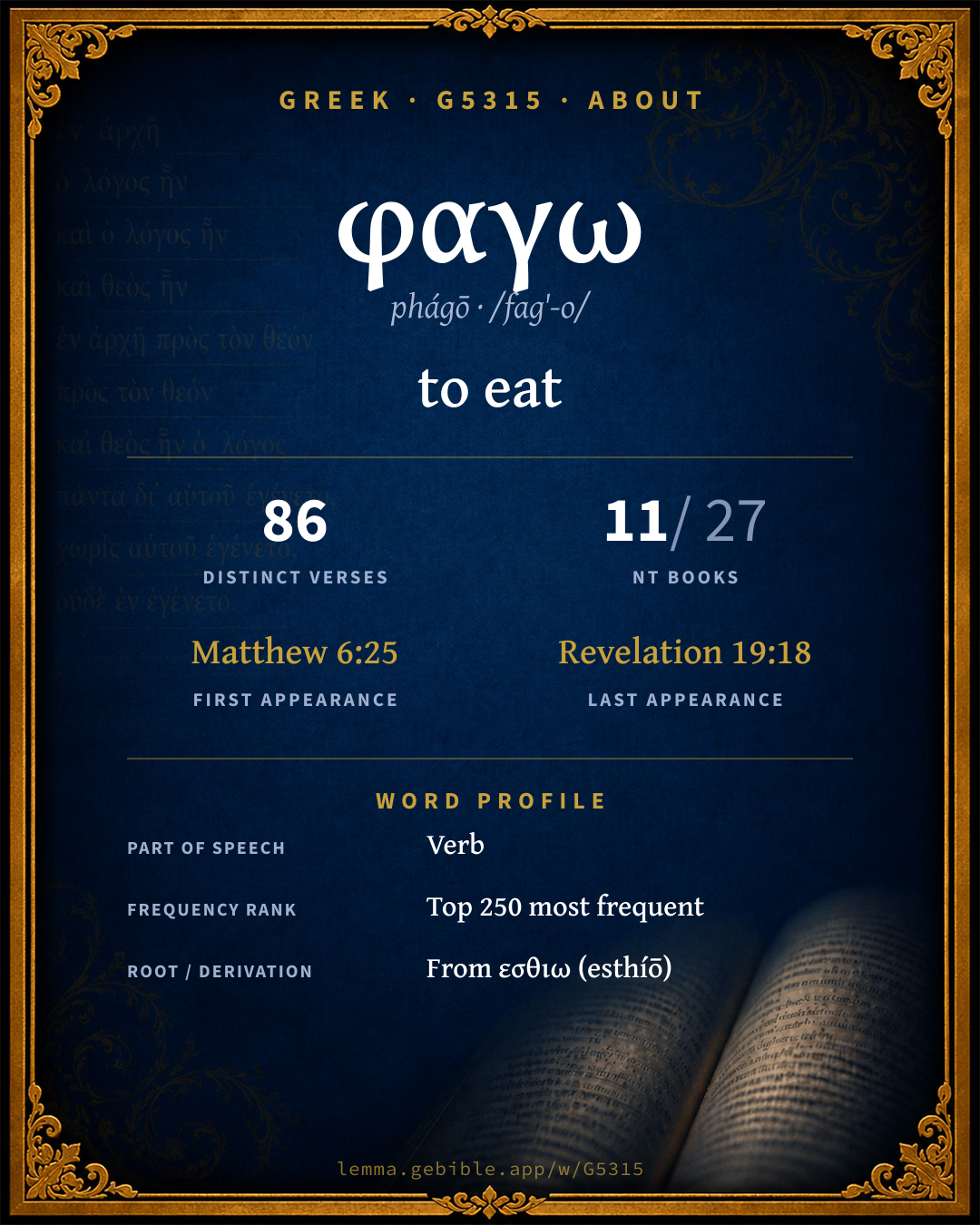
φάγω
to eat
‘to eat’ is one of 3 main senses fuller range ↓
Full lexicon entry — Thayer's Greek Lexicon
From Thayer's Greek Lexicon
Where this word appears
Grammar key — what these labels mean
Part of speech
- Verb
- An action or state-of-being word.
Tense
- Aorist
- Action viewed as a simple whole, without regard to duration — often past (perfective aspect).
- Future
- Action expected in future time.
Voice
- Active
- The subject performs the action.
- Middle deponent
- Middle in form but active in meaning.
Mood
- Infinitive
- A verbal noun (“to write”), unmarked for person or number.
- Indicative
- States a fact or asks a factual question (the mood of reality).
- Subjunctive
- Expresses probability, purpose, or possibility (the mood of contingency).
- Imperative
- Expresses a command or request.
- Participle
- A verbal adjective (“writing,” “having written”).
- Optative
- Expresses a wish or a remote possibility.
Case
- Nominative
- The case of the subject (and the predicate nominative).
Person
- 3rd person
- The one spoken about (“he / she / it / they”).
- 1st person
- The speaker (“I / we”).
- 2nd person
- The one addressed (“you”).
Gender
- Masculine
- Grammatically masculine.
Number
- Plural
- More than one.
- Singular
- One.
Every verse where G5315 appears in the Book of Mark — 14 distinct verses. Click any verse to open its interlinear word-by-word view. Verse text shown in the World English Bible for context — . Each verse’s Greek form is shown with its reference; the English is not keyword-highlighted, since the data carries no word-level English alignment. Use “Compare translations” on any verse to read it across multiple English versions. This concordance covers the Greek New Testament; Septuagint (Greek Old Testament) occurrences of this word are not indexed here.
Mark
- Mark 2:26 ἔφαγεν φαγεῖν aor act ind 3sg aor act inf How he entered into the house of God when Abiathar was high priest, and ate the show bread, which it is not lawful to eat except for the priests, and gave also to those who were with him?"
- Mark 3:20 φαγεῖν aor act inf The multitude came together again, so that they could not so much as eat bread.
- Mark 5:43 φαγεῖν aor act inf He strictly ordered them that no one should know this, and commanded that something should be given to her to eat.
- Mark 6:31 φαγεῖν aor act inf He said to them, "You come apart into a deserted place, and rest awhile." For there were many coming and going, and they had no leisure so much as to eat.
- Mark 6:36 φάγωσιν aor act subj 3pl Send them away, that they may go into the surrounding country and villages, and buy themselves bread, for they have nothing to eat."
- Mark 6:37 φαγεῖν φαγεῖν aor act inf aor act inf But he answered them, "You give them something to eat." They asked him, "Shall we go and buy two hundred denarii worth of bread, and give them something to eat?"
- Mark 6:42 ἔφαγον aor act ind 3pl They all ate, and were filled.
- Mark 6:44 φαγόντες aor act ptcp nom pl masc Those who ate the loaves were five thousand men.
- Mark 8:1 φάγωσιν aor act subj 3pl In those days, when there was a very great multitude, and they had nothing to eat, Jesus called his disciples to himself, and said to them,
- Mark 8:2 φάγωσιν aor act subj 3pl "I have compassion on the multitude, because they have stayed with me now three days, and have nothing to eat.
- Mark 8:8 ἔφαγον aor act ind 3pl They ate, and were filled. They took up seven baskets of broken pieces that were left over.
- Mark 11:14 φάγοι aor act opt 3sg Jesus told it, "May no one ever eat fruit from you again!" and his disciples heard it.
- Mark 14:12 φάγῃς aor act subj 2sg On the first day of unleavened bread, when they sacrificed the Passover, his disciples asked him, "Where do you want us to go and make ready that you may eat the Passover?"
- Mark 14:14 φάγω aor act subj 1sg and wherever he enters in, tell the master of the house, 'The Teacher says, "Where is the guest room, where I may eat the Passover with my disciples?"'
About this entry
At a glance — auto-summarized from this page’s data, not written by a person. Every figure links to its source below. This summary describes the numbers; it doesn’t interpret them.
The Greek verb φαγω centers on the idea of “to eat.” Its earliest occurrence is Matthew 6:25. Spanning 86 verses in 11 books, it ranks among the moderately common words of the Greek New Testament. Lexicons map it across 3 senses. Related forms include εσθιω, νηστις and οδους. For the data behind this summary, explore the sense tree and the renderings breakdown below.
Gloss history
Strong's 1890 vs modern scholarship
About this word
Strong's G5315 catalogs a Greek word from the Greek New Testament.
These counts are not copied from any lexicon or concordance. They are computed here, from the morphology-tagged Greek New Testament. What Lemma adds →
- 86
- distinct verses
- The word appears in 86 distinct verses.
- 11 / 27
- NT books
- The word appears in 11 of 27 New Testament books.
- #186
- by frequency
- Top 250 most frequent Greek words (rank 186 of 5,347 Greek words by occurrence).
View all 86 occurrences in the concordance →
By section of the New Testament
By traditional corpus
Conventional, traditional groupings — biblical authorship is debated, so this is a traditional corpus grouping, not an authorship claim. Some books belong to more than one corpus (Luke is in both the Gospels and the Lukan corpus, and so on), so these shares overlap and need not total 100%. Each figure is a share of the word’s 86 distinct verses.
- Gospels 59 verses · 69%
- Lukan (Luke–Acts) 25 verses · 29%
- Johannine 20 verses · 23%
- Pauline corpus 13 verses · 15%
- Revelation 6 verses · 7%
- Hebrews 1 verse · 1%
- General (Catholic) Epistles 1 verse · 1%
How translations render this word
Counts come from each version’s own published word-to-Strong’s tagging or interlinear alignment — an approximate guide to how each version renders this word, not a word-level alignment the data otherwise carries. Because each total is that version’s own tagged count, the per-version totals vary from one another and need not match the appearance or distinct-verse counts above. These counts may also differ from a printed concordance because Lemma counts each distinctly tagged rendering and does not collapse phrase taggings into a single head-word total. This is a fixed set of word-tagged versions (KJV, ASV, BSB, ULT) and does not change with the reading translation you choose elsewhere. Each version’s license is shown beside its name below (and on Sources).
- King James Version: Eat 48×, Did eat 7×, Meat 3×
- American Standard Version: Eat 45×, Ate 10×, Shall eat 3×
- Berean Standard Bible: Eat 40×, Ate 11×, You eat 3×
King James Version Public Domain
Renders G5315 across 105 tagged occurrences — most commonly:
Plus 27 renderings that appear only once — usually multi-word phrases or single function words the recovered tagging swept in, not distinct renderings.
American Standard Version Public Domain
Renders G5315 across 99 tagged occurrences — most commonly:
Plus 25 renderings that appear only once — usually multi-word phrases or single function words the recovered tagging swept in, not distinct renderings.
Berean Standard Bible Public Domain
Renders G5315 across 92 tagged occurrences — most commonly:
Plus 25 renderings that appear only once — usually multi-word phrases or single function words the recovered tagging swept in, not distinct renderings. Not rendered by a distinct English word in 1 further occurrence.
Senses in Thayer's
The 3 senses Thayer's distinguishes for this word, in lexicon order (not ranked by frequency or importance). The full entry — with sub-senses — is in the Lexicon Entry tab.
- to eat
- to take food, eat a meal
- metaph. to devour, consume
Word origin
Derived from εσθιω (esthíō) (G2068) — to eat.
A primary verb (used as an alternate of G2068 in certain tenses); to eat (literally or figuratively): - eat meat.
— Strong’s Exhaustive Concordance (1890), public domain.
Forms in the corpus
The 18 distinct written forms G5315 takes in the Greek New Testament, most frequent first — each parse links to that tense’s occurrences in the concordance.
Same root — word family
Other Thayer's entries built from the same root as G5315, grouped by Strong’s listed origin. These share a root / origin per the lexicon — not necessarily a shared meaning. Each links to that word’s own entry.
Derives from
Shares the same root
Derived from this word
Compare all same-root words → Showing 4 of 5 — not the complete family. They share a root, not necessarily a meaning.