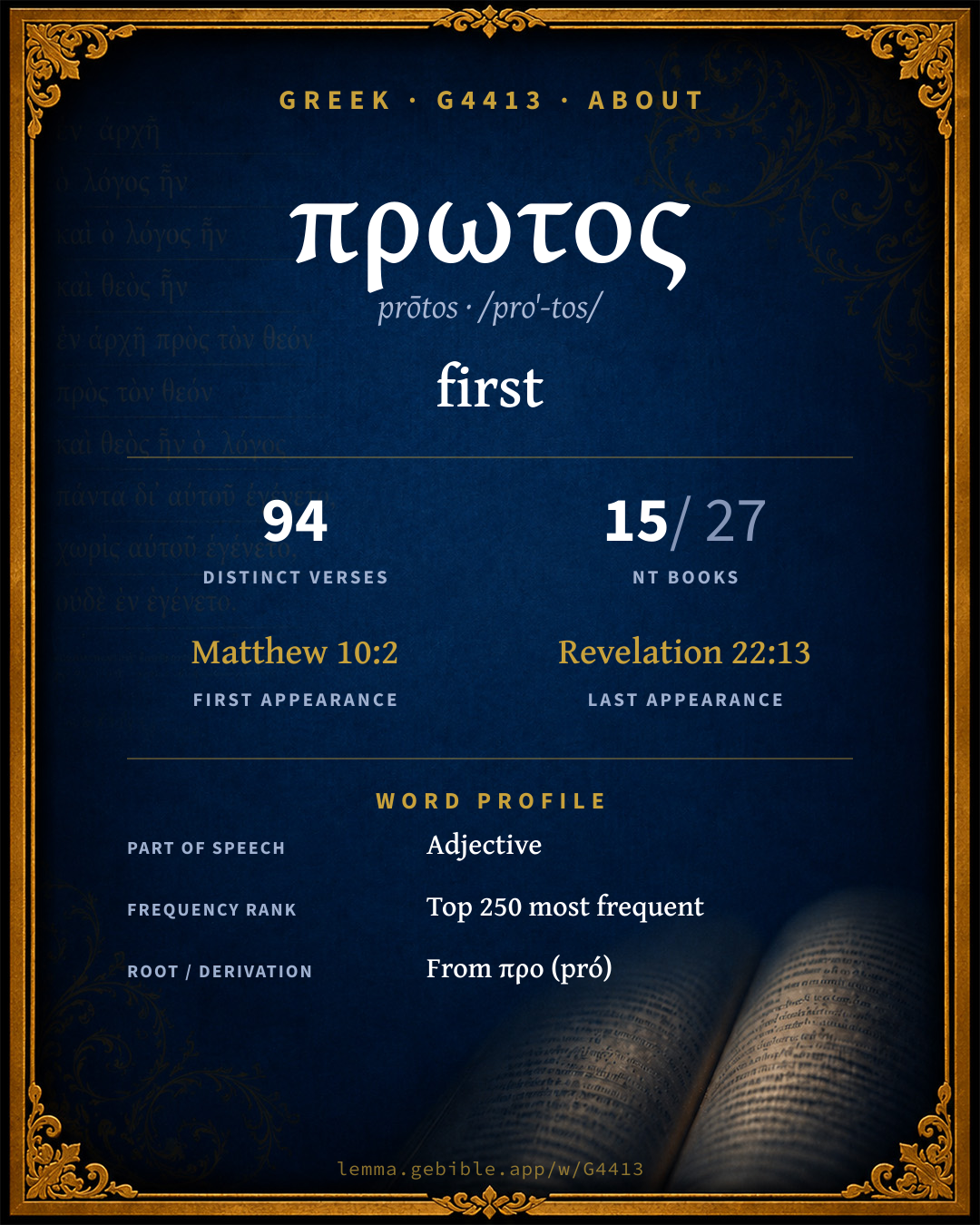
πρῶτος
first
‘first’ is one of 3 main senses fuller range ↓
Full lexicon entry — Thayer's Greek Lexicon
From Thayer's Greek Lexicon
Where this word appears
See every Nominative-case word in the Greek New Testament →
Grammar key — what these labels mean
Part of speech
- Adjective
- A word that describes or qualifies a noun.
- Adverb
- A word that modifies a verb, adjective, or other adverb.
Case
- Nominative
- The case of the subject (and the predicate nominative).
- Accusative
- The case of the direct object and of extent.
- Dative
- The case of the indirect object, means, or location — “to / for / with / in.”
- Genitive
- The case of source, possession, or “of” — answers “whose / from what.”
Gender
- Masculine
- Grammatically masculine.
- Feminine
- Grammatically feminine.
- Neuter
- Grammatically neuter.
Number
- Singular
- One.
- Plural
- More than one.
Degree
- Superlative
- Expresses the greatest degree (“greatest,” “most”).
1 verse where G4413 appears in the Accusative case in the Book of Luke. Filtered view — show all forms. Click any verse to open its interlinear word-by-word view. Verse text shown in the World English Bible for context — . Each verse’s Greek form is shown with its reference; the English is not keyword-highlighted, since the data carries no word-level English alignment. Use “Compare translations” on any verse to read it across multiple English versions. This concordance covers the Greek New Testament; Septuagint (Greek Old Testament) occurrences of this word are not indexed here.
Luke
About this entry
At a glance — auto-summarized from this page’s data, not written by a person. Every figure links to its source below. This summary describes the numbers; it doesn’t interpret them.
“first” is the headline sense of the Greek adjective πρωτος (prōtos). Its earliest occurrence is Matthew 10:2. It turns up in 94 verses across 15 books, a moderately common footprint. Lexicons map it across 3 senses. It clusters with προ, πορρω and πρηνης under a shared root. The sections below give every sense, occurrence, and version rendering.
Gloss history
Strong's 1890 vs modern scholarship

About this word
Strong's G4413 catalogs a Greek word from the Greek New Testament.
These counts are not copied from any lexicon or concordance. They are computed here, from the morphology-tagged Greek New Testament. What Lemma adds →
- 94
- distinct verses
- The word appears in 94 distinct verses.
- 15 / 27
- NT books
- The word appears in 15 of 27 New Testament books.
- #165
- by frequency
- Top 250 most frequent Greek words (rank 165 of 5,347 Greek words by occurrence).
View all 94 occurrences in the concordance →
Most concentrated in
- Revelation 16 verses 17%
- Matthew 14 verses 15%
- Acts 13 verses 14%
By section of the New Testament
By traditional corpus
Conventional, traditional groupings — biblical authorship is debated, so this is a traditional corpus grouping, not an authorship claim. Some books belong to more than one corpus (Luke is in both the Gospels and the Lukan corpus, and so on), so these shares overlap and need not total 100%. Each figure is a share of the word’s 94 distinct verses.
- Gospels 42 verses · 45%
- Johannine 27 verses · 29%
- Lukan (Luke–Acts) 22 verses · 23%
- Revelation 16 verses · 17%
- Pauline corpus 12 verses · 13%
- Hebrews 9 verses · 10%
- General (Catholic) Epistles 2 verses · 2%
How translations render this word
Counts come from each version’s own published word-to-Strong’s tagging or interlinear alignment — an approximate guide to how each version renders this word, not a word-level alignment the data otherwise carries. Because each total is that version’s own tagged count, the per-version totals vary from one another and need not match the appearance or distinct-verse counts above. These counts may also differ from a printed concordance because Lemma counts each distinctly tagged rendering and does not collapse phrase taggings into a single head-word total. This is a fixed set of word-tagged versions (KJV, ASV, BSB, ULT) and does not change with the reading translation you choose elsewhere. Each version’s license is shown beside its name below (and on Sources).
- King James Version: First 72×, Chief 8×, Are first 2×
- American Standard Version: First 71×, Than the first 5×, Chief 4×
- Berean Standard Bible: First 75×, Leaders 3×, Leading 3×
- unfoldingWord Literal Text: First 88×, Covenant 3×, Before 2×
King James Version Public Domain
Renders G4413 across 97 tagged occurrences — most commonly:
Plus 9 renderings that appear only once — usually multi-word phrases or single function words the recovered tagging swept in, not distinct renderings. Not rendered by a distinct English word in 2 further occurrences.
American Standard Version Public Domain
Renders G4413 across 98 tagged occurrences — most commonly:
Plus 14 renderings that appear only once — usually multi-word phrases or single function words the recovered tagging swept in, not distinct renderings.
Berean Standard Bible Public Domain
Renders G4413 across 94 tagged occurrences — most commonly:
Plus 7 renderings that appear only once — usually multi-word phrases or single function words the recovered tagging swept in, not distinct renderings. Not rendered by a distinct English word in 3 further occurrences.
unfoldingWord Literal Text CC BY-SA 4.0
Renders G4413 across 104 tagged occurrences — most commonly:
Plus 5 renderings that appear only once — usually multi-word phrases or single function words the recovered tagging swept in, not distinct renderings.
Senses in Thayer's
The 3 senses Thayer's distinguishes for this word, in lexicon order (not ranked by frequency or importance). The full entry — with sub-senses — is in the Lexicon Entry tab.
- first in time or place
- first in rank
- first, at the first
Word origin
Derived from προ (pró) (G4253) — before.
Contracted superlative of G4253 ; foremost (in time place order or importance): - before beginning best chief (-est) first (of all) former.
— Strong’s Exhaustive Concordance (1890), public domain.
Forms in the corpus
The 15 distinct written forms G4413 takes in the Greek New Testament, most frequent first — each parse links to that case’s occurrences in the concordance.
Same root — word family
Other Thayer's entries built from the same root as G4413, grouped by Strong’s listed origin. These share a root / origin per the lexicon — not necessarily a shared meaning. Each links to that word’s own entry.
Derives from
Shares the same root
- πορρω pórrhō G4206 far
- πρηνης prēnḗs G4248 headlong
- πριν prín G4250 before
- προαγω proágō G4254 to lead forward
- προαιρεομαι proairéomai G4255 to choose before
- προαιτιαομαι proaitiáomai G4256 to charge previously
- προακουω proakoúō G4257 to hear before
- προαμαρτανω proamartánō G4258 to sin before
- προαυλιον proaúlion G4259 porch
- προβαινω probaínō G4260 to go forward
- προβαλλω probállō G4261 to throw forward
- προβιβαζω probibázō G4264 to drag forward
- προβλεπω problépō G4265 to foresee
- προγινομαι progínomai G4266 to come before
- προγινωσκω proginṓskō G4267 to foreknow
- προγραφω prográphō G4270 to write before
- προδηλος pródēlos G4271 manifest
- προδιδωμι prodídōmi G4272 to give before
- προειδω proeídō G4275 to foresee
- προελπιζω proelpízō G4276 to hope before
- προεπω proépō G4277 to say before
- προεναρχομαι proenárchomai G4278 to begin before
- προεπαγγελλομαι proepangéllomai G4279 to promise before
- προερεω proeréō G4280 to say before
+47 more words share this root (not shown).
Derived from this word
- πρωτευω prōteúō G4409 to be first
- πρωτοκαθεδρια prōtokathedría G4410 to sit first
- πρωτοκλισια prōtoklisía G4411 first seat
- πρωτον prōton G4412 first
- πρωτοστατης prōtostátēs G4414 front-rank soldier
- πρωτοτοκος prōtótokos G4416 firstborn
Proper names from this root
People and places named from this root — a name, not an additional meaning of the word.
Compare all same-root words → Showing 4 of 80 — not the complete family. 1 of the same-root words is a proper name (a person or place). They share a root, not necessarily a meaning.
Septuagint usage
The same Greek word πρωτος appears 177 times in the Greek Old Testament (Septuagint), across 168 verses in 30 books.
- 177
- LXX occurrences
- Tagged occurrences of this Greek word in the Septuagint.
- 168
- verses
- Distinct Septuagint verses containing this word.
- 30 / 39
- OT books
- The word appears in 30 of the 39 Old Testament books.
Sample Septuagint occurrences
- Genesis 8:5 πρῶτος
- Exodus 4:8 πρῶτος
- Leviticus 9:15 πρῶτος
- Numbers 2:3 πρῶτος
- Deuteronomy 10:1 πρῶτος
- Joshua 4:19 πρῶτος
- Judges 20:22 πρῶτος
- Ruth 3:10 πρῶτος
- 1 Samuel 2:16 πρῶτος
- 2 Samuel 13:16 πρῶτος
- 1 Kings 2:35 πρῶτος
- 2 Kings 1:14 πρῶτος
Septuagint occurrences (same lexeme)
Every verse where the same Strong’s number (G4413) appears in the Greek Septuagint — showing the first 50 of 168. Verse text shown in the World English Bible for context; the Greek form is the matched word — the English is not keyword-highlighted.
- Genesis 8:5 πρῶτος The waters receded continually until the tenth month. In the tenth month, on the first day of the month, the tops of the mountains were seen.
- Genesis 8:13 πρῶτος It happened in the six hundred first year, in the first month, the first day of the month, the waters were dried up from off the earth. Noah removed the covering of the ark, and looked. He saw that the surface of the ground was dried.
- Genesis 32:18 πρῶτος Then you shall say, 'They are your servant, Jacob's. It is a present sent to my lord, Esau. Behold, he also is behind us.'"
- Genesis 32:20 πρῶτος You shall say, 'Not only that, but behold, your servant, Jacob, is behind us.'" For, he said, "I will appease him with the present that goes before me, and afterward I will see his face. Perhaps he will accept me."
- Genesis 33:2 πρῶτος He put the handmaids and their children in front, Leah and her children after, and Rachel and Joseph at the rear.
- Genesis 41:20 πρῶτος The lean and ill-favored cattle ate up the first seven fat cattle,
- Exodus 4:8 πρῶτος "It will happen, if they will neither believe you nor listen to the voice of the first sign, that they will believe the voice of the latter sign.
- Exodus 12:2 πρῶτος "This month shall be to you the beginning of months. It shall be the first month of the year to you.
- Exodus 12:15 πρῶτος Seven days shall you eat unleavened bread; even the first day you shall put away yeast out of your houses, for whoever eats leavened bread from the first day until the seventh day, that soul shall be cut off from Israel.
- Exodus 12:16 πρῶτος In the first day there shall be to you a holy convocation, and in the seventh day a holy convocation; no manner of work shall be done in them, except that which every man must eat, that only may be done by you.
- Exodus 12:18 πρῶτος In the first month, on the fourteenth day of the month at evening, you shall eat unleavened bread, until the twenty first day of the month at evening.
- Exodus 34:1 πρῶτος Yahweh said to Moses, "Chisel two stone tablets like the first: and I will write on the tablets the words that were on the first tablets, which you broke.
- Exodus 34:4 πρῶτος He chiseled two tablets of stone like the first; and Moses rose up early in the morning, and went up to Mount Sinai, as Yahweh had commanded him, and took in his hand two stone tablets.
- Exodus 40:2 πρῶτος "On the first day of the first month you shall raise up the tent of the Tent of Meeting.
- Exodus 40:17 πρῶτος It happened in the first month in the second year, on the first day of the month, that the tent was raised up.
- Leviticus 9:15 πρῶτος He presented the people's offering, and took the goat of the sin offering which was for the people, and killed it, and offered it for sin, like the first.
- Leviticus 23:5 πρῶτος In the first month, on the fourteenth day of the month in the evening, is Yahweh's Passover.
- Leviticus 23:7 πρῶτος In the first day you shall have a holy convocation. You shall do no regular work.
- Leviticus 23:11 πρῶτος and he shall wave the sheaf before Yahweh, to be accepted for you. On the next day after the Sabbath the priest shall wave it.
- Leviticus 23:35 πρῶτος On the first day shall be a holy convocation: you shall do no regular work.
- Leviticus 23:39 πρῶτος "'So on the fifteenth day of the seventh month, when you have gathered in the fruits of the land, you shall keep the feast of Yahweh seven days: on the first day shall be a solemn rest, and on the eighth day shall be a solemn rest.
- Leviticus 23:40 πρῶτος You shall take on the first day the fruit of goodly trees, branches of palm trees, and boughs of thick trees, and willows of the brook; and you shall rejoice before Yahweh your God seven days.
- Numbers 2:3 πρῶτος Those who encamp on the east side toward the sunrise shall be of the standard of the camp of Judah, according to their divisions: and the prince of the children of Judah shall be Nahshon the son of Amminadab.
- Numbers 2:9 πρῶτος All who were numbered of the camp of Judah were one hundred eighty-six thousand four hundred, according to their divisions. They shall set out first.
- Numbers 7:12 πρῶτος He who offered his offering the first day was Nahshon the son of Amminadab, of the tribe of Judah,
- Numbers 9:1 πρῶτος Yahweh spoke to Moses in the wilderness of Sinai, in the first month of the second year after they had come out of the land of Egypt, saying,
- Numbers 9:3 πρῶτος On the fourteenth day of this month, at evening, you shall keep it in its appointed season-- according to all its statutes, and according to all its ordinances, you shall keep it."
- Numbers 10:13 πρῶτος They first took their journey according to the commandment of Yahweh by Moses.
- Numbers 10:14 πρῶτος In the first [place] the standard of the camp of the children of Judah set forward according to their hosts: and over his host was Nahshon the son of Amminadab.
- Numbers 20:1 πρῶτος The children of Israel, even the whole congregation, came into the wilderness of Zin in the first month: and the people abode in Kadesh; and Miriam died there, and was buried there.
- Numbers 28:16 πρῶτος In the first month, on the fourteenth day of the month, is Yahweh's Passover.
- Numbers 28:18 πρῶτος In the first day shall be a holy convocation: you shall do no servile work;
- Numbers 29:13 πρῶτος and you shall offer a burnt offering, an offering made by fire, of a sweet savor to Yahweh; thirteen young bulls, two rams, fourteen he-lambs a year old; they shall be without blemish;
- Numbers 33:3 πρῶτος They traveled from Rameses in the first month, on the fifteenth day of the first month; on the next day after the Passover the children of Israel went out with a high hand in the sight of all the Egyptians,
- Deuteronomy 10:1 πρῶτος At that time Yahweh said to me, Hew you two tables of stone like the first, and come up to me onto the mountain, and make an ark of wood.
- Deuteronomy 10:2 πρῶτος I will write on the tables the words that were on the first tables which you broke, and you shall put them in the ark.
- Deuteronomy 10:3 πρῶτος So I made an ark of acacia wood, and hewed two tables of stone like the first, and went up onto the mountain, having the two tables in my hand.
- Deuteronomy 10:4 πρῶτος He wrote on the tables, according to the first writing, the ten commandments, which Yahweh spoke to you on the mountain out of the midst of the fire in the day of the assembly: and Yahweh gave them to me.
- Deuteronomy 13:10 πρῶτος You shall stone him to death with stones, because he has sought to draw you away from Yahweh your God, who brought you out of the land of Egypt, out of the house of bondage.
- Deuteronomy 16:4 πρῶτος There shall be no yeast seen with you in all your borders seven days; neither shall any of the flesh, which you sacrifice the first day at even, remain all night until the morning.
- Deuteronomy 17:7 πρῶτος The hand of the witnesses shall be first on him to put him to death, and afterward the hand of all the people. So you shall put away the evil from the midst of you.
- Joshua 4:19 πρῶτος The people came up out of the Jordan on the tenth day of the first month, and encamped in Gilgal, on the east border of Jericho.
- Joshua 9:2 πρῶτος that they gathered themselves together, to fight with Joshua and with Israel, with one accord.
- Joshua 15:21 πρῶτος The uttermost cities of the tribe of the children of Judah toward the border of Edom in the South were Kabzeel, and Eder, and Jagur,
- Joshua 18:11 πρῶτος The lot of the tribe of the children of Benjamin came up according to their families: and the border of their lot went out between the children of Judah and the children of Joseph.
- Judges 20:22 πρῶτος The people, the men of Israel, encouraged themselves, and set the battle again in array in the place where they set themselves in array the first day.
- Judges 20:32 πρῶτος The children of Benjamin said, They are struck down before us, as at the first. But the children of Israel said, Let us flee, and draw them away from the city to the highways.
- Judges 20:39 πρῶτος The men of Israel turned in the battle, and Benjamin began to strike and kill of the men of Israel about thirty persons; for they said, Surely they are struck down before us, as in the first battle.
- Ruth 3:10 πρῶτος He said, Blessed are you by Yahweh, my daughter: you have shown more kindness in the latter end than at the beginning, inasmuch as you didn't follow young men, whether poor or rich.
- 1 Samuel 2:16 πρῶτος If the man said to him, They will surely burn the fat first, and then take as much as your soul desires; then he would say, No, but you shall give it me now: and if not, I will take it by force.
These are occurrences of the same Greek lexeme (G4413) in the Septuagint — not a translation of any one Hebrew word. The store carries no word-level Hebrew↔Greek alignment, so no Hebrew original is asserted here. Counts come from the recovered LXX Strong's tagging — high-frequency vocabulary is well covered, while rare or late forms may be untagged — so they reflect tagged occurrences and may slightly undercount.