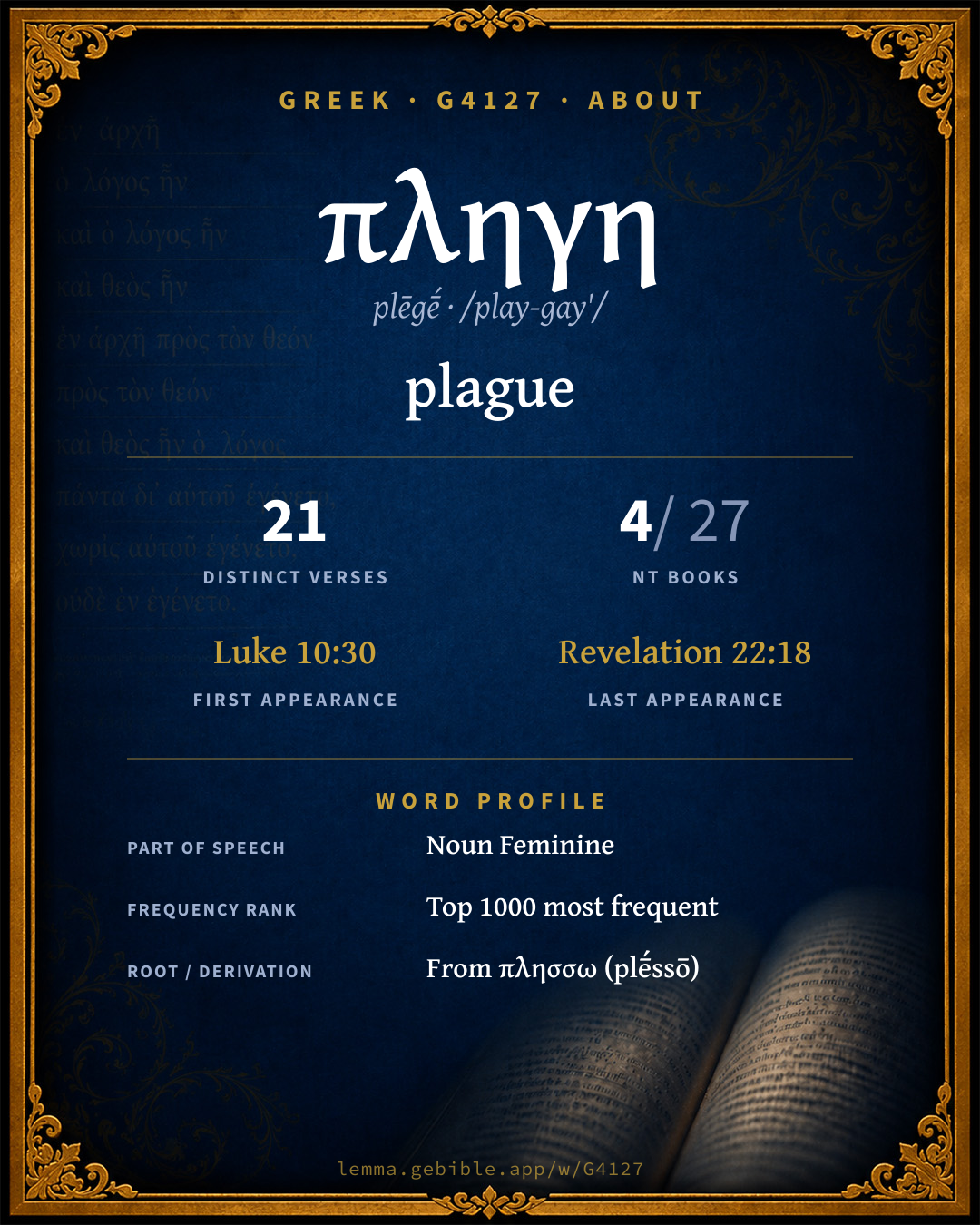
πληγή
plague
‘plague’ is one of 2 main senses fuller range ↓
Full lexicon entry — Thayer's Greek Lexicon
From Thayer's Greek Lexicon
Where this word appears
See every Accusative-case word in the Greek New Testament →
Grammar key — what these labels mean
Part of speech
- Noun
- A naming word — a person, place, thing, or idea.
Case
- Accusative
- The case of the direct object and of extent.
- Genitive
- The case of source, possession, or “of” — answers “whose / from what.”
- Dative
- The case of the indirect object, means, or location — “to / for / with / in.”
- Nominative
- The case of the subject (and the predicate nominative).
Gender
- Feminine
- Grammatically feminine.
Number
- Plural
- More than one.
- Singular
- One.
Grammatical forms
- Noun, Accusative, Plural, Feminine 6 times (27%)
- Noun, Genitive, Plural, Feminine 5 times (23%)
- Noun, Dative, Plural, Feminine 3 times (14%)
- Noun, Nominative, Singular, Feminine 3 times (14%)
- Noun, Nominative, Plural, Feminine 2 times (9%)
- Noun, Accusative, Singular, Feminine 1 time (5%)
- Noun, Dative, Singular, Feminine 1 time (5%)
- Noun, Genitive, Singular, Feminine 1 time (5%)
Parsed forms decoded from the imported morphology (Robinson–Tischendorf, public domain), counted across 22 parsed occurrences — not distinct verses.
Every verse where G4127 appears — 21 distinct verses across 4 books. Click any verse to open its interlinear word-by-word view. Verse text shown in the World English Bible for context — . Each verse’s Greek form is shown with its reference; the English is not keyword-highlighted, since the data carries no word-level English alignment. Use “Compare translations” on any verse to read it across multiple English versions. This concordance covers the Greek New Testament; Septuagint (Greek Old Testament) occurrences of this word are not indexed here.
Luke 2 verses
- Luke 10:30 πληγὰς n acc pl fem Jesus answered, "A certain man was going down from Jerusalem to Jericho, and he fell among robbers, who both stripped him and beat him, and departed, leaving him half dead.
- Luke 12:48 πληγῶν n gen pl fem but he who didn't know, and did things worthy of stripes, will be beaten with few stripes. To whoever much is given, of him will much be required; and to whom much was entrusted, of him more will be asked.
Acts 2 verses
2 Corinthians 2 verses
- 2 Corinthians 6:5 πληγαῖς n dat pl fem in beatings, in imprisonments, in riots, in labors, in watchings, in fastings;
- 2 Corinthians 11:23 πληγαῖς n dat pl fem Are they servants of Christ? (I speak as one beside himself) I am more so; in labors more abundantly, in prisons more abundantly, in stripes above measure, in deaths often.
Revelation 15 verses
- Revelation 9:18 πληγῶν n gen pl fem By these three plagues were one third of mankind killed: by the fire, the smoke, and the sulfur, which proceeded out of their mouths.
- Revelation 9:20 πληγαῖς n dat pl fem The rest of mankind, who were not killed with these plagues, didn't repent of the works of their hands, that they wouldn't worship demons, and the idols of gold, and of silver, and of brass, and of stone, and of wood; which can neither see, nor hear, nor walk.
- Revelation 11:6 πληγῇ n dat sg fem These have the power to shut up the sky, that it may not rain during the days of their prophecy. They have power over the waters, to turn them into blood, and to strike the earth with every plague, as often as they desire.
- Revelation 13:3 πληγὴ n nom sg fem One of his heads looked like it had been wounded fatally. His fatal wound was healed, and the whole earth marveled at the beast.
- Revelation 13:12 πληγὴ n nom sg fem He exercises all the authority of the first beast in his presence. He makes the earth and those who dwell in it to worship the first beast, whose fatal wound was healed.
- Revelation 13:14 πληγὴν n acc sg fem He deceives my own people who dwell on the earth because of the signs he was granted to do in front of the beast; saying to those who dwell on the earth, that they should make an image to the beast who had the sword wound and lived.
- Revelation 15:1 πληγὰς n acc pl fem I saw another great and marvelous sign in the sky: seven angels having the seven last plagues, for in them God's wrath is finished.
- Revelation 15:6 πληγὰς n acc pl fem The seven angels who had the seven plagues came out, clothed with pure, bright linen, and wearing golden sashes around their breasts.
- Revelation 15:8 πληγαὶ n nom pl fem The temple was filled with smoke from the glory of God, and from his power. No one was able to enter into the temple, until the seven plagues of the seven angels would be finished.
- Revelation 16:9 πληγὰς n acc pl fem People were scorched with great heat, and people blasphemed the name of God who has the power over these plagues. They didn't repent and give him glory.
- Revelation 16:21 πληγῆς πληγὴ n gen sg fem n nom sg fem Great hailstones, about the weight of a talent, came down out of the sky on people. People blasphemed God because of the plague of the hail, for this plague is exceedingly severe.
- Revelation 18:4 πληγῶν n gen pl fem I heard another voice from heaven, saying, "Come out of her, my people, that you have no participation in her sins, and that you don't receive of her plagues,
- Revelation 18:8 πληγαὶ n nom pl fem Therefore in one day her plagues will come: death, mourning, and famine; and she will be utterly burned with fire; for the Lord God who has judged her is strong.
- Revelation 21:9 πληγῶν n gen pl fem One of the seven angels who had the seven bowls, who were loaded with the seven last plagues came, and he spoke with me, saying, "Come here. I will show you the wife, the Lamb's bride."
- Revelation 22:18 πληγὰς n acc pl fem I testify to everyone who hears the words of the prophecy of this book, if anyone adds to them, may God add to him the plagues which are written in this book.
About this entry
At a glance — auto-summarized from this page’s data, not written by a person. Every figure links to its source below. This summary describes the numbers; it doesn’t interpret them.
The Greek noun πληγη centers on the idea of “plague.” The word gravitates to Revelation (71%), then Luke and Acts. It appears 21 verses across 4 books of the Greek New Testament, among its uncommon vocabulary. Its earliest occurrence is Luke 10:30. Lexicons map it across 2 senses. For the data behind this summary, explore the sense tree and the renderings breakdown below.
Gloss history
Strong's 1890 vs modern scholarship

About this word
Strong's G4127 catalogs a Greek word from the Greek New Testament.
These counts are not copied from any lexicon or concordance. They are computed here, from the morphology-tagged Greek New Testament. What Lemma adds →
- 21
- distinct verses
- The word appears in 21 distinct verses.
- 4 / 27
- NT books
- The word appears in 4 of 27 New Testament books.
- #586
- by frequency
- Top 1000 most frequent Greek words (rank 586 of 5,347 Greek words by occurrence).
View all 21 occurrences in the concordance →
Most concentrated in
- Revelation 15 verses 71%
- Luke 2 verses 10%
- Acts 2 verses 10%
By section of the New Testament
By traditional corpus
Conventional, traditional groupings — biblical authorship is debated, so this is a traditional corpus grouping, not an authorship claim. Some books belong to more than one corpus (Luke is in both the Gospels and the Lukan corpus, and so on), so these shares overlap and need not total 100%. Each figure is a share of the word’s 21 distinct verses.
- Johannine 15 verses · 71%
- Revelation 15 verses · 71%
- Lukan (Luke–Acts) 4 verses · 19%
- Gospels 2 verses · 10%
- Pauline corpus 2 verses · 10%
How translations render this word
Counts come from each version’s own published word-to-Strong’s tagging or interlinear alignment — an approximate guide to how each version renders this word, not a word-level alignment the data otherwise carries. Because each total is that version’s own tagged count, the per-version totals vary from one another and need not match the appearance or distinct-verse counts above. These counts may also differ from a printed concordance because Lemma counts each distinctly tagged rendering and does not collapse phrase taggings into a single head-word total. This is a fixed set of word-tagged versions (KJV, ASV, BSB, ULT) and does not change with the reading translation you choose elsewhere. Each version’s license is shown beside its name below (and on Sources).
- King James Version: Plagues 10×, Stripes 4×, Wound 3×
- American Standard Version: Plagues 9×, Stripes 5×, Plague 3×
- Berean Standard Bible: Plagues 10×, Beatings 2×, Plague 2×
- unfoldingWord Literal Text: Plagues 10×, Blows 4×, Plague 3×
King James Version Public Domain
Renders G4127 across 20 tagged occurrences — most commonly:
Plus 1 rendering that appears only once — usually multi-word phrases or single function words the recovered tagging swept in, not distinct renderings. Not rendered by a distinct English word in 1 further occurrence.
American Standard Version Public Domain
Renders G4127 across 19 tagged occurrences — most commonly:
Plus 2 renderings that appear only once — usually multi-word phrases or single function words the recovered tagging swept in, not distinct renderings.
Berean Standard Bible Public Domain
Renders G4127 across 20 tagged occurrences — most commonly:
Plus 4 renderings that appear only once — usually multi-word phrases or single function words the recovered tagging swept in, not distinct renderings. Not rendered by a distinct English word in 2 further occurrences.
unfoldingWord Literal Text CC BY-SA 4.0
Renders G4127 across 23 tagged occurrences — most commonly:
Plus 1 rendering that appears only once — usually multi-word phrases or single function words the recovered tagging swept in, not distinct renderings.
Senses in Thayer's
The 2 senses Thayer's distinguishes for this word, in lexicon order (not ranked by frequency or importance). The full entry — with sub-senses — is in the Lexicon Entry tab.
- a blow, stripe, a wound
- a public calamity, heavy affliction, plague,
Word origin
Derived from πλησσω (plḗssō) (G4141) — to strike.
From G4141 ; a stroke ; by implication a wound ; figuratively a calamity : - plague stripe wound (-ed).
— Strong’s Exhaustive Concordance (1890), public domain.
Forms in the corpus
The 8 distinct written forms G4127 takes in the Greek New Testament, most frequent first — each parse links to that case’s occurrences in the concordance.
| Form | Parsing | Example | Uses |
|---|---|---|---|
| πληγὰς plēgàs | Noun, Accusative, Plural, Feminine | Luke 10:30 | 6 |
| πληγῶν plēgō̂n | Noun, Genitive, Plural, Feminine | Luke 12:48 | 5 |
| πληγαῖς plēgaîs | Noun, Dative, Plural, Feminine | 2 Corinthians 6:5 | 3 |
| πληγὴ plēgḕ | Noun, Nominative, Singular, Feminine | Revelation 13:3 | 3 |
| πληγαὶ plēgaì | Noun, Nominative, Plural, Feminine | Revelation 15:8 | 2 |
| πληγὴν plēgḕn | Noun, Accusative, Singular, Feminine | Revelation 13:14 | 1 |
| πληγῆς plēgē̂s | Noun, Genitive, Singular, Feminine | Revelation 16:21 | 1 |
| πληγῇ plēgē̂ | Noun, Dative, Singular, Feminine | Revelation 11:6 | 1 |
Same root — word family
Other Thayer's entries built from the same root as G4127, grouped by Strong’s listed origin. These share a root / origin per the lexicon — not necessarily a shared meaning. Each links to that word’s own entry.
Derives from
Shares the same root
Compare all same-root words → They share a root, not necessarily a meaning.
Septuagint usage
The same Greek word πληγη appears 70 times in the Greek Old Testament (Septuagint), across 67 verses in 19 books.
- 70
- LXX occurrences
- Tagged occurrences of this Greek word in the Septuagint.
- 67
- verses
- Distinct Septuagint verses containing this word.
- 19 / 39
- OT books
- The word appears in 19 of the 39 Old Testament books.
Sample Septuagint occurrences
- Exodus 11:1 πληγή
- Leviticus 26:21 πληγή
- Numbers 11:33 πληγή
- Deuteronomy 25:2 πληγή
- Joshua 22:17 πληγή
- Judges 11:33 πληγή
- 1 Samuel 4:8 πληγή
- 1 Kings 21:21 πληγή
- 2 Kings 8:29 πληγή
- 1 Chronicles 21:22 πληγή
- 2 Chronicles 6:28 πληγή
- Job 2:13 πληγή
Septuagint occurrences (same lexeme)
Every verse where the same Strong’s number (G4127) appears in the Greek Septuagint — showing the first 50 of 67. Verse text shown in the World English Bible for context; the Greek form is the matched word — the English is not keyword-highlighted.
- Exodus 11:1 πληγή Yahweh said to Moses, "Yet one plague more will I bring on Pharaoh, and on Egypt; afterwards he will let you go. When he lets you go, he will surely thrust you out altogether.
- Exodus 12:13 πληγή The blood shall be to you for a token on the houses where you are: and when I see the blood, I will pass over you, and there shall no plague be on you to destroy you, when I strike the land of Egypt.
- Exodus 33:5 πληγή Yahweh said to Moses, "Tell the children of Israel, 'You are a stiff-necked people. If I were to go up into your midst for one moment, I would consume you. Therefore now take off your jewelry from you, that I may know what to do to you."
- Leviticus 26:21 πληγή "'If you walk contrary to me, and won't listen to me, then I will bring seven times more plagues on you according to your sins.
- Numbers 11:33 πληγή While the flesh was yet between their teeth, before it was chewed, the anger of Yahweh was kindled against the people, and Yahweh struck the people with a very great plague.
- Numbers 14:37 πληγή even those men who did bring up an evil report of the land, died by the plague before Yahweh.
- Numbers 25:8 πληγή and he went after the man of Israel into the pavilion, and thrust both of them through, the man of Israel, and the woman through her body. So the plague was stayed from the children of Israel.
- Numbers 25:9 πληγή Those who died by the plague were twenty-four thousand.
- Numbers 25:18 πληγή for they vex you with their wiles, with which they have deceived you in the matter of Peor, and in the matter of Cozbi, the daughter of the prince of Midian, their sister, who was slain on the day of the plague in the matter of Peor.
- Numbers 26:1 πληγή It happened after the plague, that Yahweh spoke to Moses and to Eleazar the son of Aaron the priest, saying,
- Numbers 31:16 πληγή Behold, these caused the children of Israel, through the counsel of Balaam, to commit trespass against Yahweh in the matter of Peor, and so the plague was among the congregation of Yahweh.
- Deuteronomy 25:2 πληγή and it shall be, if the wicked man be worthy to be beaten, that the judge shall cause him to lie down, and to be beaten before his face, according to his wickedness, by number.
- Deuteronomy 25:3 πληγή Forty stripes he may give him, he shall not exceed; lest, if he should exceed, and beat him above these with many stripes, then your brother should seem vile to you.
- Deuteronomy 28:59 πληγή then Yahweh will make your plagues wonderful, and the plagues of your seed, even great plagues, and of long continuance, and sore sicknesses, and of long continuance.
- Deuteronomy 28:61 πληγή Also every sickness, and every plague, which is not written in the book of this law, them will Yahweh bring on you, until you are destroyed.
- Deuteronomy 29:21 πληγή Yahweh will set him apart to evil out of all the tribes of Israel, according to all the curses of the covenant that is written in this book of the law.
- Joshua 22:17 πληγή Is the iniquity of Peor too little for us, from which we have not cleansed ourselves to this day, although there came a plague on the congregation of Yahweh,
- Judges 11:33 πληγή He struck them from Aroer until you come to Minnith, even twenty cities, and to Abelcheramim, with a very great slaughter. So the children of Ammon were subdued before the children of Israel.
- Judges 15:8 πληγή He struck them hip and thigh with a great slaughter: and he went down and lived in the cleft of the rock of Etam.
- 1 Samuel 4:8 πληγή Woe to us! who shall deliver us out of the hand of these mighty gods? these are the gods that struck the Egyptians with all manner of plagues in the wilderness.
- 1 Samuel 4:10 πληγή The Philistines fought, and Israel was struck, and they fled every man to his tent: and there was a very great slaughter; for there fell of Israel thirty thousand footmen.
- 1 Samuel 4:17 πληγή He who brought the news answered, Israel is fled before the Philistines, and there has been also a great slaughter among the people, and your two sons also, Hophni and Phinehas, are dead, and the ark of God is taken.
- 1 Samuel 6:19 πληγή He struck of the men of Beth-shemesh, because they had looked into the ark of Yahweh, he struck of the people fifty thousand seventy men; and the people mourned, because Yahweh had struck the people with a great slaughter.
- 1 Samuel 14:14 πληγή That first slaughter, which Jonathan and his armor bearer made, was about twenty men, within as it were half a furrow's length in an acre of land.
- 1 Samuel 14:30 πληγή How much more, if haply the people had eaten freely today of the spoil of their enemies which they found? for now has there been no great slaughter among the Philistines.
- 1 Samuel 19:8 πληγή There was war again: and David went out, and fought with the Philistines, and killed them with a great slaughter; and they fled before him.
- 1 Samuel 23:5 πληγή David and his men went to Keilah, and fought with the Philistines, and brought away their cattle, and killed them with a great slaughter. So David saved the inhabitants of Keilah.
- 1 Kings 21:21 πληγή Behold, I will bring evil on you, and will utterly sweep you away and will cut off from Ahab every man-child, and him who is shut up and him who is left at large in Israel:
- 1 Kings 22:35 πληγή The battle increased that day: and the king was stayed up in his chariot against the Syrians, and died at even; and the blood ran out of the wound into the bottom of the chariot.
- 2 Kings 8:29 πληγή King Joram returned to be healed in Jezreel of the wounds which the Syrians had given him at Ramah, when he fought against Hazael king of Syria. Ahaziah the son of Jehoram king of Judah went down to see Joram the son of Ahab in Jezreel, because he was sick.
- 2 Kings 9:15 πληγή but king Joram was returned to be healed in Jezreel of the wounds which the Syrians had given him, when he fought with Hazael king of Syria.) Jehu said, If this be your mind, then let none escape and go forth out of the city, to go to tell it in Jezreel.
- 1 Chronicles 21:22 πληγή Then David said to Ornan, Give me the place of this threshing floor, that I may build thereon an altar to Yahweh: for the full price shall you give it me, that the plague may be stayed from the people.
- 2 Chronicles 6:28 πληγή If there be in the land famine, if there be pestilence, if there be blasting or mildew, locust or caterpillar; if their enemies besiege them in the land of their cities; whatever plague or whatever sickness there be;
- 2 Chronicles 13:17 πληγή Abijah and his people killed them with a great slaughter: so there fell down slain of Israel five hundred thousand chosen men.
- 2 Chronicles 21:14 πληγή behold, Yahweh will strike with a great plague your people, and your children, and your wives, and all your substance;
- 2 Chronicles 22:6 πληγή He returned to be healed in Jezreel of the wounds which they had given him at Ramah, when he fought against Hazael king of Syria. Azariah the son of Jehoram king of Judah went down to see Jehoram the son of Ahab in Jezreel, because he was sick.
- 2 Chronicles 28:5 πληγή Therefore Yahweh his God delivered him into the hand of the king of Syria; and they struck him, and carried away of his a great multitude of captives, and brought them to Damascus. He was also delivered into the hand of the king of Israel, who struck him with a great slaughter.
- Job 2:13 πληγή So they sat down with him on the ground seven days and seven nights, and none spoke a word to him, for they saw that his grief was very great.
- Job 42:16 πληγή After this Job lived one hundred forty years, and saw his sons, and his sons' sons, to four generations.
- Psalms 63:8 πληγή My soul stays close to you. Your right hand holds me up.
- Psalms 101:5 πληγή I will silence whoever secretly slanders his neighbor. I won't tolerate one who is haughty and conceited.
- Proverbs 20:21 πληγή An inheritance quickly gained at the beginning, Won't be blessed in the end.
- Proverbs 22:8 πληγή He who sows wickedness reaps trouble, And the rod of his fury will be destroyed.
- Proverbs 29:15 πληγή The rod of correction gives wisdom, But a child left to himself causes shame to his mother.
- Isaiah 1:6 πληγή From the sole of the foot even to the head there is no soundness in it: Wounds, welts, and open sores. They haven't been closed, neither bandaged, neither soothed with oil.
- Isaiah 10:24 πληγή Therefore thus says the Lord, Yahweh of Hosts, my people who dwell in Zion, don't be afraid of the Assyrian, though he strike you with the rod, and lift up his staff against you, after the manner of Egypt.
- Isaiah 10:26 πληγή Yahweh of Hosts will stir up against him a scourge, as in the slaughter of Midian at the rock of Oreb: and his rod will be over the sea, and he will lift it up after the manner of Egypt.
- Isaiah 14:6 πληγή who struck the peoples in wrath with a continual stroke, who ruled the nations in anger, with a persecution that none restrained.
- Isaiah 19:22 πληγή Yahweh will strike Egypt, smiting and healing; and they shall return to Yahweh, and he will be entreated of them, and will heal them.
- Isaiah 30:26 πληγή Moreover the light of the moon shall be as the light of the sun, and the light of the sun shall be sevenfold, as the light of seven days, in the day that Yahweh binds up the hurt of his people, and heals the stroke of their wound.
These are occurrences of the same Greek lexeme (G4127) in the Septuagint — not a translation of any one Hebrew word. The store carries no word-level Hebrew↔Greek alignment, so no Hebrew original is asserted here. Counts come from the recovered LXX Strong's tagging — high-frequency vocabulary is well covered, while rare or late forms may be untagged — so they reflect tagged occurrences and may slightly undercount.