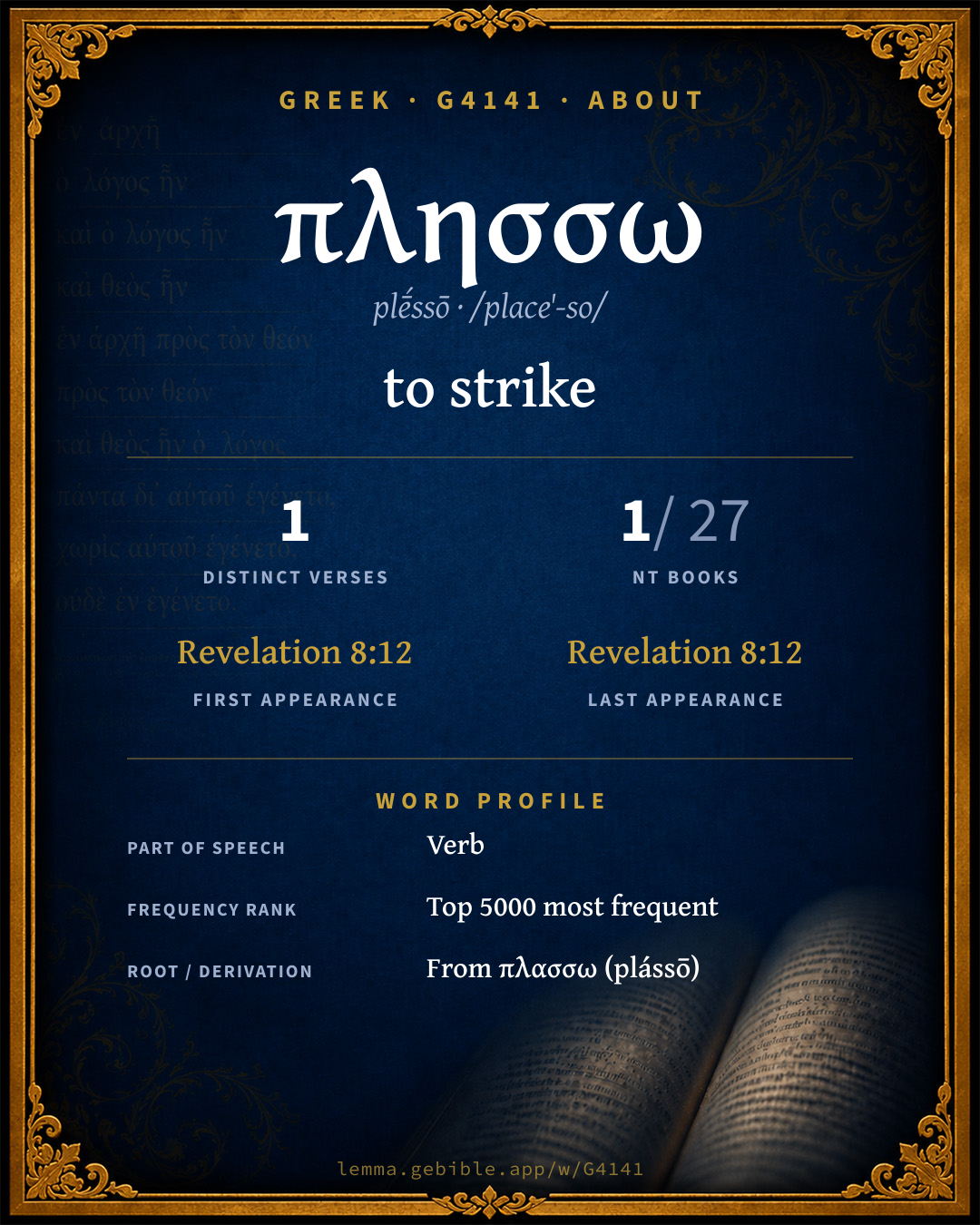
πλήσσω
to strike
Full lexicon entry — Thayer's Greek Lexicon
From Thayer's Greek Lexicon
Where this word appears
Grammar key — what these labels mean
Part of speech
- Verb
- An action or state-of-being word.
Tense
- Aorist
- Action viewed as a simple whole, without regard to duration — often past (perfective aspect).
Voice
- Passive
- The subject receives the action.
Mood
- Indicative
- States a fact or asks a factual question (the mood of reality).
Person
- 3rd person
- The one spoken about (“he / she / it / they”).
Number
- Singular
- One.
Every verse where G4141 appears — 1 distinct verse across 1 book. Click any verse to open its interlinear word-by-word view. Verse text shown in the World English Bible for context — . Each verse’s Greek form is shown with its reference; the English is not keyword-highlighted, since the data carries no word-level English alignment. Use “Compare translations” on any verse to read it across multiple English versions. This concordance covers the Greek New Testament; Septuagint (Greek Old Testament) occurrences of this word are not indexed here.
Revelation 1 verse
About this entry
At a glance — auto-summarized from this page’s data, not written by a person. Every figure links to its source below. This summary describes the numbers; it doesn’t interpret them.
“to strike” is the headline sense of the Greek verb πλησσω (plḗssō). The Greek New Testament uses it only 1 verse. It clusters heavily in Revelation, which alone accounts for 100% of its uses. A true hapax — its single appearance is Revelation 8:12. From the same root come πλασσω, πλαξ and πλασμα. See the sense tree, 1-verse concordance, and the renderings breakdown below.
Gloss history
Strong's 1890 vs modern scholarship

About this word
Strong's G4141 catalogs a Greek word from the Greek New Testament.
These counts are not copied from any lexicon or concordance. They are computed here, from the morphology-tagged Greek New Testament. What Lemma adds →
- 1
- distinct verses
- The word appears in 1 distinct verse.
- 1 / 27
- NT books
- The word appears in 1 of 27 New Testament books.
- #3,503
- by frequency
- Top 5000 most frequent Greek words (rank 3,503 of 5,347 Greek words by occurrence).
View all 1 occurrence in the concordance →
Most concentrated in
- Revelation 1 verse 100%
By section of the New Testament
By traditional corpus
Conventional, traditional groupings — biblical authorship is debated, so this is a traditional corpus grouping, not an authorship claim. Some books belong to more than one corpus (Luke is in both the Gospels and the Lukan corpus, and so on), so these shares overlap and need not total 100%. Each figure is a share of the word’s 1 distinct verse.
- Johannine 1 verse · 100%
- Revelation 1 verse · 100%
How translations render this word
Counts come from each version’s own published word-to-Strong’s tagging or interlinear alignment — an approximate guide to how each version renders this word, not a word-level alignment the data otherwise carries. Because each total is that version’s own tagged count, the per-version totals vary from one another and need not match the appearance or distinct-verse counts above. These counts may also differ from a printed concordance because Lemma counts each distinctly tagged rendering and does not collapse phrase taggings into a single head-word total. This is a fixed set of word-tagged versions (KJV, ASV, BSB, ULT) and does not change with the reading translation you choose elsewhere. Each version’s license is shown beside its name below (and on Sources).
- King James Version: Was smitten 1×
- American Standard Version: Was smitten 1×
- Berean Standard Bible: Were struck 1×
- unfoldingWord Literal Text: Was struck 1×
King James Version Public Domain
Renders G4141 across 1 tagged occurrence — most commonly:
American Standard Version Public Domain
Renders G4141 across 1 tagged occurrence — most commonly:
Berean Standard Bible Public Domain
Renders G4141 across 1 tagged occurrence — most commonly:
unfoldingWord Literal Text CC BY-SA 4.0
Renders G4141 across 1 tagged occurrence — most commonly:
Senses in Thayer's
The 1 sense Thayer's distinguishes for this word, in lexicon order (not ranked by frequency or importance). The full entry — with sub-senses — is in the Lexicon Entry tab.
- to strike, smite
Word origin
Derived from πλασσω (plássō) (G4111) — to form.
Same root — word family
Other Thayer's entries built from the same root as G4141, grouped by Strong’s listed origin. These share a root / origin per the lexicon — not necessarily a shared meaning. Each links to that word’s own entry.
Derives from
Shares the same root
- πλαξ pláx G4109 flat surface
- πλασμα plásma G4110 formed object
- πλαστος plastós G4112 formed
- πλατυς platýs G4116 broad
Derived from this word
Compare all same-root words → Showing 4 of 9 — not the complete family. They share a root, not necessarily a meaning.
Septuagint usage
The same Greek word πλησσω appears 22 times in the Greek Old Testament (Septuagint), across 21 verses in 8 books.
- 22
- LXX occurrences
- Tagged occurrences of this Greek word in the Septuagint.
- 21
- verses
- Distinct Septuagint verses containing this word.
- 8 / 39
- OT books
- The word appears in 8 of the 39 Old Testament books.
Sample Septuagint occurrences
- Exodus 9:31 πλήσσω
- Numbers 25:14 πλήσσω
- Judges 20:36 πλήσσω
- 1 Samuel 4:2 πλήσσω
- 2 Samuel 1:12 πλήσσω
- Proverbs 7:23 πλήσσω
- Isaiah 1:5 πλήσσω
- Zechariah 13:6 πλήσσω
Septuagint occurrences (same lexeme)
Every verse where the same Strong’s number (G4141) appears in the Greek Septuagint. Verse text shown in the World English Bible for context; the Greek form is the matched word — the English is not keyword-highlighted.
- Exodus 9:31 πλήσσω The flax and the barley were struck, for the barley was in the ear, and the flax was in bloom.
- Exodus 9:32 πλήσσω But the wheat and the spelt were not struck, for they had not grown up.
- Exodus 16:3 πλήσσω and the children of Israel said to them, "We wish that we had died by the hand of Yahweh in the land of Egypt, when we sat by the flesh-pots, when we ate our fill of bread, for you have brought us out into this wilderness, to kill this whole assembly with hunger."
- Exodus 22:1 πλήσσω "If a man steals an ox or a sheep, and kills it, or sells it; he shall pay five oxen for an ox, and four sheep for a sheep.
- Numbers 25:14 πλήσσω Now the name of the man of Israel that was slain, who was slain with the Midianite woman, was Zimri, the son of Salu, a prince of a fathers' house among the Simeonites.
- Numbers 25:15 πλήσσω The name of the Midianite woman who was slain was Cozbi, the daughter of Zur; he was head of the people of a fathers' house in Midian.
- Numbers 25:18 πλήσσω for they vex you with their wiles, with which they have deceived you in the matter of Peor, and in the matter of Cozbi, the daughter of the prince of Midian, their sister, who was slain on the day of the plague in the matter of Peor.
- Judges 20:36 πλήσσω So the children of Benjamin saw that they were struck; for the men of Israel gave place to Benjamin, because they trusted to the liers-in-wait whom they had set against Gibeah.
- 1 Samuel 4:2 πλήσσω The Philistines put themselves in array against Israel: and when they joined battle, Israel was struck before the Philistines; and they killed of the army in the field about four thousand men.
- 1 Samuel 5:12 πλήσσω The men who didn't die were struck with the tumors; and the cry of the city went up to heaven.
- 2 Samuel 1:12 πλήσσω and they mourned, and wept, and fasted until even, for Saul, and for Jonathan his son, and for the people of Yahweh, and for the house of Israel; because they were fallen by the sword.
- 2 Samuel 4:4 πλήσσω Now Jonathan, Saul's son, had a son who was lame of his feet. He was five years old when the news came of Saul and Jonathan out of Jezreel; and his nurse took him up, and fled: and it happened, as she made haste to flee, that he fell, and became lame. His name was Mephibosheth.
- 2 Samuel 9:3 πλήσσω The king said, Is there not yet any of the house of Saul, that I may show the kindness of God to him? Ziba said to the king, Jonathan has yet a son, who is lame of his feet.
- 2 Samuel 11:15 πλήσσω He wrote in the letter, saying, Set Uriah in the forefront of the hottest battle, and retire you from him, that he may be struck, and die.
- 2 Samuel 11:22 πλήσσω So the messenger went, and came and shown David all that Joab had sent him for.
- Proverbs 7:23 πλήσσω Until an arrow strikes through his liver, As a bird hurries to the snare, And doesn't know that it will cost his life.
- Proverbs 23:32 πλήσσω In the end, it bites like a snake, And poisons like a viper.
- Isaiah 1:5 πλήσσω Why should you be beaten more, That you revolt more and more? The whole head is sick, And the whole heart faint.
- Isaiah 9:12 πλήσσω the Syrians before, and the Philistines behind; and they shall devour Israel with open mouth. For all this his anger is not turned away, but his hand is stretched out still.
- Isaiah 27:7 πλήσσω Has he struck them as he struck those who struck them? or are they slain according to the slaughter of those who were slain by them?
- Zechariah 13:6 πλήσσω One will say to him, 'What are these wounds between your arms?' Then he will answer, 'Those with which I was wounded in the house of my friends.'
These are occurrences of the same Greek lexeme (G4141) in the Septuagint — not a translation of any one Hebrew word. The store carries no word-level Hebrew↔Greek alignment, so no Hebrew original is asserted here. Counts come from the recovered LXX Strong's tagging — high-frequency vocabulary is well covered, while rare or late forms may be untagged — so they reflect tagged occurrences and may slightly undercount.