
Numbers 25:8

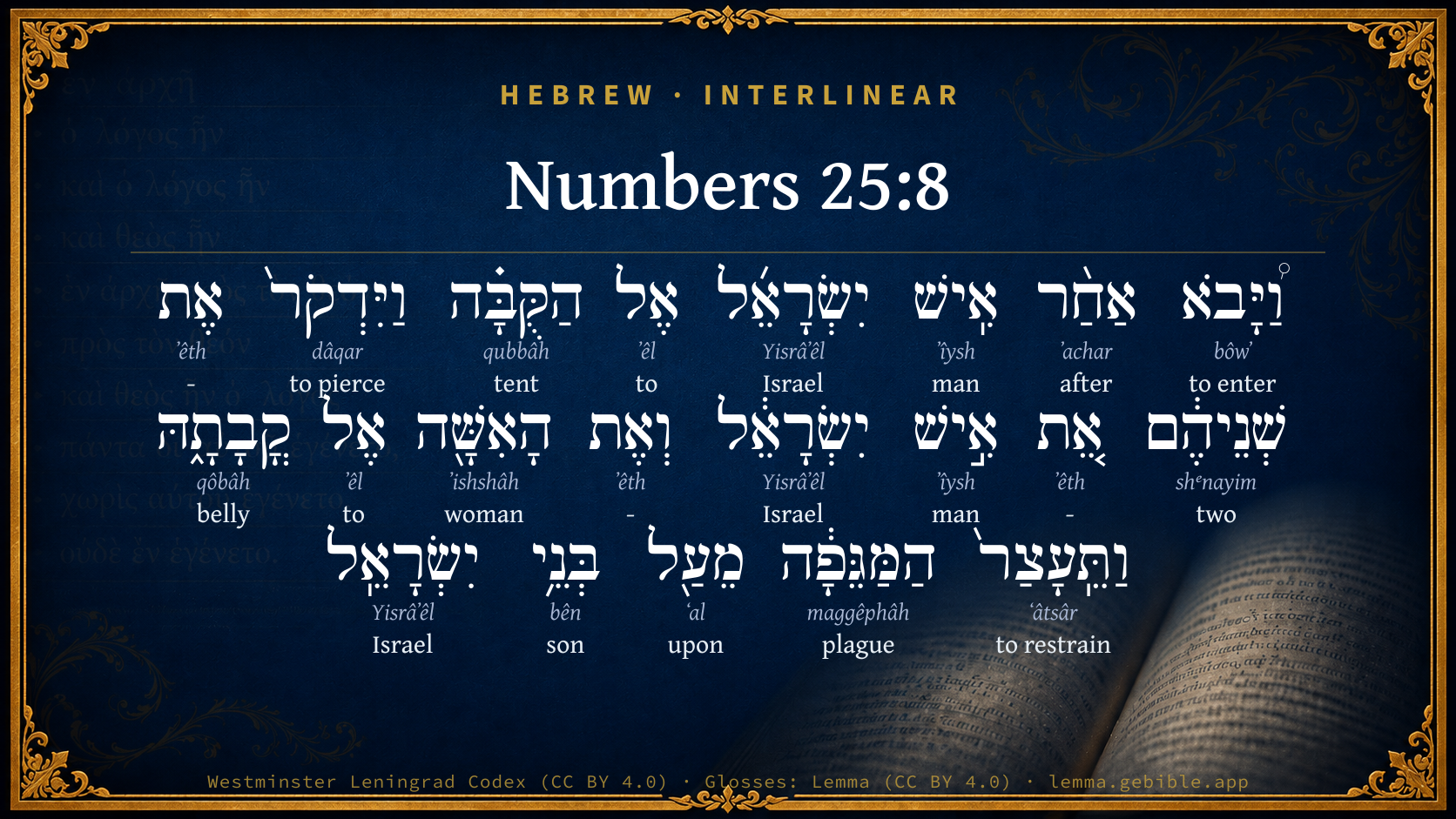
Hebrew (Westminster Leningrad Codex) Numbers 25:8 appears in the Hebrew Old Testament. The text above is from the Westminster Leningrad Codex. Each word links to its Strong’s number, a concise gloss, and parsing drawn from the Open Scriptures Hebrew Bible morphology. Click any word for its full Brown-Driver-Briggs (BDB) entry.
Download image
Cite this verse

Numbers 25:8 (World English Bible). Public Domain. Lemma interlinear Bible study tool, https://lemma.gebible.app/v/numbers/25/8.

Show BibTeX & RIS
BibTeX
RIS
English Translation
and he went after the man of Israel into the pavilion, and thrust both of them through, the man of Israel, and the woman through her body. So the plague was stayed from the children of Israel.
World English Bible · Public Domain
Highlights
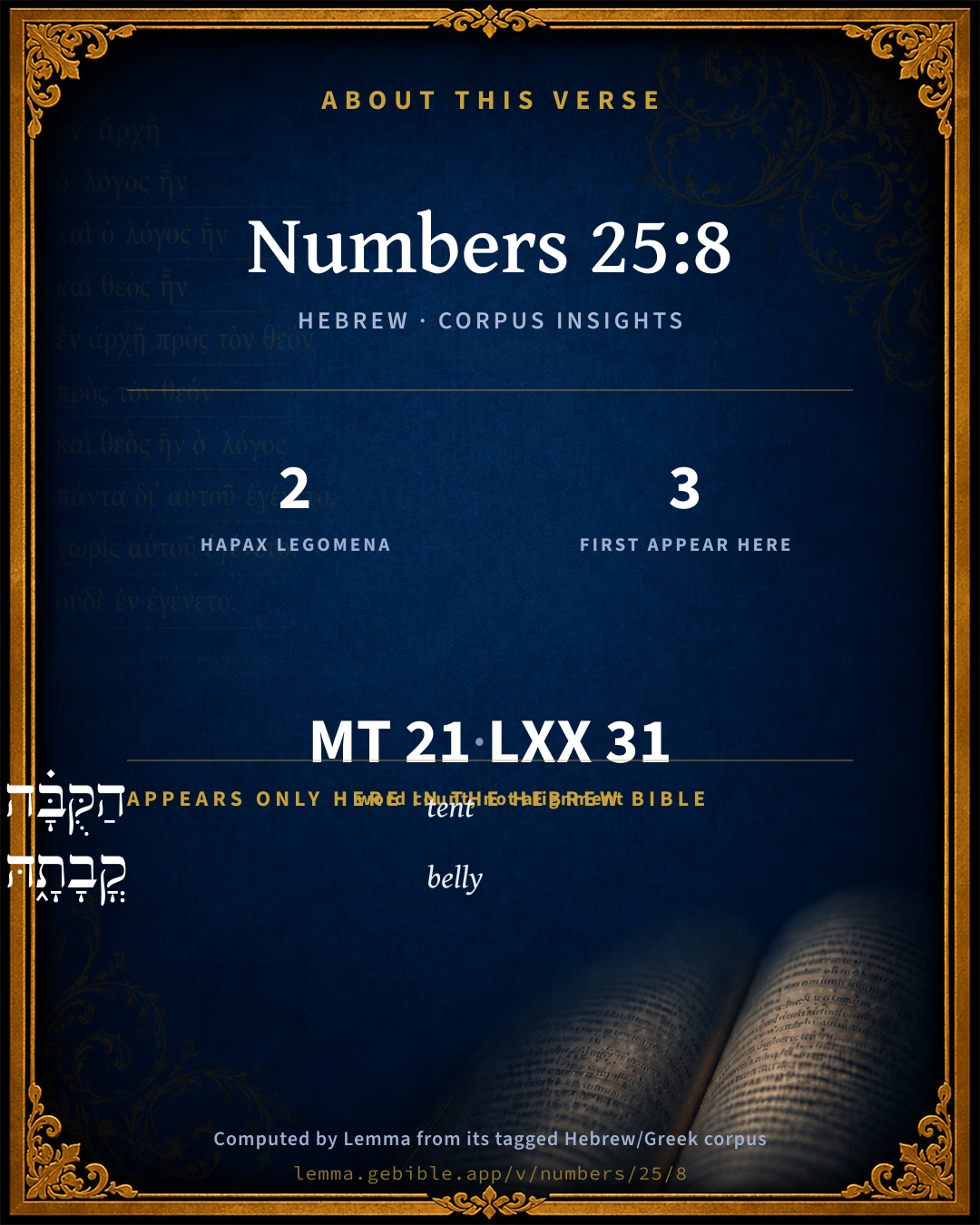
  • 2 hapax legomena — only here in the Hebrew Bible
  • 3 first appearances in the Hebrew Bible
Full analysis ↓
Download a study sheet

One document with this verse’s original text, its word-by-word gloss line, the meaning frame, cross-references with their text, attributed commentary, and full source and license credits — printable, and it pastes into notes with its structure intact.

This verse Autodidact and up

Study sheet (.html) Plain text (.txt)

A passage Seminary Student

Up to 50 verses in one chapter. A passage sheet keeps up to 6 commentary sources and 12 cross-references per verse, in the order this page ranks them, and says so on the sheet whenever that leaves anything out. Ask for a single verse and you get the Autodidact verse sheet above.

Everything on this page stays free to read, with no account — the sheet is a download of what is already on screen, not access to it.

Want to remove ads? Support Godless Engineer
Compare translations 3

The same verse in 3 English versions, stacked beneath the original-language interlinear above. Click any original word for its lexicon entry.

Each is an independent rendering of the whole verse — the interlinear is not word-aligned to these translations.

Highlighted words mark where these versions differ — a whole-verse word diff, not a word-by-word alignment.

  • World English Bible Public Domain
    and he went after the man of Israel into the pavilion, and thrust both of them through, the man of Israel, and the woman through her body. So the plague was stayed from the children of Israel.
  • King James Version Public Domain
    And he went after the man of Israel into the tent, and thrust both of them through, the man of Israel, and the woman through her belly. So the plague was stayed from the children of Israel.
  • unfoldingWord Literal Text CC BY-SA 4.0
    And he came after the man of Israel into the domed tent, and he pierced the two of them, the man of Israel and the woman in her stomach. And the plague was stopped from on the sons of Israel.

unfoldingWord Literal Text — © unfoldingWord, licensed CC BY-SA 4.0. Word-aligned USFM3 via Door43 (git.door43.org/unfoldingWord/en_ult).

Versions to compare (up to 4)

3 of 4 selected

Show all 18 translations

Every available English version of this verse, each an independent rendering of the whole verse.

  • World English Bible Public Domain
    and he went after the man of Israel into the pavilion, and thrust both of them through, the man of Israel, and the woman through her body. So the plague was stayed from the children of Israel.
  • Berean Standard Bible Public Domain
    followed the Israelite into his tent, and drove the spear through both of them—through the Israelite and on through the belly of the woman. So the plague against the Israelites was halted,
  • Majority Standard Bible Public Domain
    followed the Israelite into his tent, and drove the spear through both of them—through the Israelite and on through the belly of the woman. So the plague against the Israelites was halted,
  • King James Version Public Domain
    And he went after the man of Israel into the tent, and thrust both of them through, the man of Israel, and the woman through her belly. So the plague was stayed from the children of Israel.
  • American Standard Version (1901) Public Domain
    and he went after the man of Israel into the pavilion, and thrust both of them through, the man of Israel, and the woman through her body. So the plague was stayed from the children of Israel.
  • Revised Version (1885) Public Domain
    and he went after the man of Israel into the pavilion, and thrust both of them through, the man of Israel, and the woman through her belly. So the plague was stayed from the children of Israel.
  • Geneva Bible (1599) Public Domain
    And followed ye man of Israel into the tent, and thrust them both through: to wit, the man of Israel, and the woman, through her belly: so the plague ceased from the children of Israel.
  • Douay-Rheims (1899) Public Domain
    Went in after the Israelite into the brothel house, and thrust both of them through together, to wit, the man and the woman in the genital parts. And the scourge ceased from the children of Israel:
  • Young's Literal Translation Public Domain
    and goeth in after the man of Israel unto the hollow place, and pierceth them both, the man of Israel and the woman -- unto her belly, and the plague is restrained from the sons of Israel;
  • Literal Standard Version CC BY-SA 4.0
    and goes in after the man of Israel to the hollow place, and pierces them both, the man of Israel and the woman—to her belly, and the plague is restrained from the sons of Israel;
  • Unlocked Literal Bible CC BY-SA 4.0
    He followed the Israelite man into the tent and thrust the spear through both of their bodies, both the Israelite man and the woman. So a plague that God had sent on the people of Israel stopped.
  • unfoldingWord Literal Text CC BY-SA 4.0
    And he came after the man of Israel into the domed tent, and he pierced the two of them, the man of Israel and the woman in her stomach. And the plague was stopped from on the sons of Israel.
  • Darby Bible Public Domain
    and he went after the man of Israel into the tent-chamber, and thrust both of them through, the man of Israel and the woman through her belly. And the plague was stayed from the children of Israel.
  • World Messianic Bible Public Domain
    He went after the man of Israel into the pavilion, and thrust both of them through, the man of Israel, and the woman through her body. So the plague was stopped among the children of Israel.
  • Webster's Bible Public Domain
    And he went after the man of Israel into the tent, and thrust both of them through, the man of Israel, and the woman through her belly: So the plague was stayed from the children of Israel.
  • Free Bible Version CC BY-SA 4.0
    and followed the man into his tent. There Phinehas drove the spear through both of them, through the Israelite and on into the woman's stomach. This action stopped the plague that had started to kill the Israelites,
  • Bible in Basic English Public Domain
    And went after the man of Israel into the tent, driving the spear through the two of them, through the man of Israel and through the stomach of the woman. So the disease was stopped among the children of Israel.
  • JPS Tanakh (1917) Public Domain
    And he went after the man of Israel into the chamber, and thrust both of them through, the man of Israel, and the woman through her belly. So the plague was stayed from the children of Israel.

Literal Standard Version (2020), Covenant Press — licensed CC BY-SA 4.0. Text via the HelloAO Bible API (eBible.org). Unlocked Literal Bible (unfoldingWord) — licensed CC BY-SA 4.0. Text via the HelloAO Bible API (eBible.org). unfoldingWord Literal Text — © unfoldingWord, licensed CC BY-SA 4.0. Word-aligned USFM3 via Door43 (git.door43.org/unfoldingWord/en_ult). Free Bible Version, Dr. Jonathan Gallagher — licensed CC BY-SA 4.0. Text via the HelloAO Bible API (eBible.org).

Word by word

More ways to search: Search by grammar → Find every occurrence → Compare this word →

Practice this passage: Drill this verse → Learn its vocabulary →

הַקֻּבָּ֗ה
qubbâh
H6898
“the · tent”
Particle, Definite Article + Noun, Common, Feminine, Singular, Absolute
Part of Speech
Particle + Noun
Type
Common
Gender
Feminine
Number
Singular
State
Absolute
Full BDB Definition

Origin: from H6895

TWOT: 1977b

large vaulted tent, tent
  1. וַ֠יָּבֹא bôwʼ H935 “and · to enter” Conjunction + Verb, Qal, Sequential Imperfect, 3rd Person, Masculine, Singular
  2. אַחַ֨ר ʼachar H310 “after” Preposition
  3. אִֽישׁ ʼîysh H376 “man of” Noun, Common, Masculine, Singular, Construct
  4. יִשְׂרָאֵ֜ל Yisrâʼêl H3478 “Israel” Noun, Proper
  5. אֶל ʼêl H413 “to” Preposition
  6. וַיִּדְקֹר֙ dâqar H1856 “and · to pierce” Conjunction + Verb, Qal, Sequential Imperfect, 3rd Person, Masculine, Singular
  7. אֶת ʼêth H853 “-” Particle, Direct Object
  8. שְׁנֵיהֶ֔ם shᵉnayim H8147 “two · their” Adjective, Cardinal number, Masculine, Dual, Construct + Suffix, Personal, 3rd Person, Masculine, Plural
  9. אֵ֚ת ʼêth H853 “-” Particle, Direct Object
  10. אִ֣ישׁ ʼîysh H376 “man of” Noun, Common, Masculine, Singular, Construct
  11. יִשְׂרָאֵ֔ל Yisrâʼêl H3478 “Israel” Noun, Proper
  12. וְאֶת ʼêth H853 “and · -” Conjunction + Particle, Direct Object
  13. הָאִשָּׁ֖ה ʼishshâh H802 “the · woman” Particle, Definite Article + Noun, Common, Feminine, Singular, Absolute
  14. אֶל ʼêl H413 “to” Preposition
  15. קֳבָתָ֑הּ qôbâh H6897 “belly · her” Noun, Common, Feminine, Singular, Construct + Suffix, Personal, 3rd Person, Feminine, Singular
  16. וַתֵּֽעָצַר֙ ʻâtsâr H6113 “and · to restrain” Conjunction + Verb, Niphal, Sequential Imperfect, 3rd Person, Feminine, Singular
  17. הַמַּגֵּפָ֔ה maggêphâh H4046 “the · plague” Particle, Definite Article + Noun, Common, Feminine, Singular, Absolute
  18. מֵעַ֖ל ʻal H5921 “from · upon” Preposition + Preposition
  19. בְּנֵ֥י bên H1121 “sons of” Noun, Common, Masculine, Plural, Construct
  20. יִשְׂרָאֵֽל Yisrâʼêl H3478 “Israel” Noun, Proper

About this verse

These counts appear in no published source. They are computed here, from the morphology-tagged text and Lemma’s own curated glosses. What Lemma adds →

21
words
15
distinct lemmas
Pentateuch
section

Notable vocabulary

2 hapax legomena — words that appear only here in the entire Hebrew Bible:

  • הַקֻּבָּ֗ה tent H6898
  • קֳבָתָ֑הּ belly H6897

First appearance in Scripture

These words make their first canonical appearance in the Hebrew Bible here:

  • הַקֻּבָּ֗ה tent H6898
  • וַיִּדְקֹר֙ to pierce H1856
  • קֳבָתָ֑הּ belly H6897

Shared distinctive vocabulary

וַיִּדְקֹר֙ to pierce H1856 occurs in 10 verses of the Hebrew Bible. Also found in:

Grammatical profile

  • 3 verbs
  • 10 nouns
  • 1 adjective
  • 4 prepositions
  • 3 particles

Verb forms

  • וַ֠יָּבֹא Qal · Sequential Imperfect
  • וַיִּדְקֹר֙ Qal · Sequential Imperfect
  • וַתֵּֽעָצַר֙ Niphal · Sequential Imperfect

Repetition

Words recur within this verse — often emphatic in Hebrew:

  • יִשְׂרָאֵ֜ל Israel H3478 ×3
  • אִֽישׁ man H376 ×2
  • אֶל to H413 ×2

Hebrew & Septuagint length

In English translation the verse runs 37 words from the Hebrew and 35 from the Septuagint (LXX English) — closely comparable.

A rough comparison of the two English renderings, which tokenize alike — not a word-level alignment.

Word counts can differ between the Hebrew and the Greek without any difference in meaning — e.g. the Hebrew direct-object marker אֵת has no separate Greek word, and Greek often adds the article ὁ.

In the original languages it is 21 Hebrew tokens and 31 Greek tokens — but the two are counted differently (Hebrew bundles its prefixes and suffixes into one token; the Greek is in lemma form), so that isn’t a like-for-like length.

Cross-references

6

Topical passages linked to Numbers 25:8 in the Treasury of Scripture Knowledge — connected by theme and wording, ordered by reader-vote popularity; previews shown in the World English Bible.

  • Numbers 16:46–48 Moses said to Aaron, Take your censer, and put fire therein from off the altar, and lay incense thereon, and carry it quickly to the congregation, and make atonement for them: for there is wrath gone out from Yahweh; the plague is begun.
  • Psalms 106:29–31 Thus they provoked him to anger with their deeds. The plague broke in on them.
  • Numbers 25:5 Moses said to the judges of Israel, Kill you everyone his men who have joined themselves to Baal Peor.
  • Numbers 25:11 Phinehas, the son of Eleazar, the son of Aaron the priest, has turned my wrath away from the children of Israel, in that he was jealous with my jealousy among them, so that I didn't consume the children of Israel in my jealousy.
  • 2 Samuel 24:25 David built there an altar to Yahweh, and offered burnt offerings and peace-offerings. So Yahweh was entreated for the land, and the plague was stayed from Israel.
  • 1 Chronicles 21:22 Then David said to Ornan, Give me the place of this threshing floor, that I may build thereon an altar to Yahweh: for the full price shall you give it me, that the plague may be stayed from the people.

Cross-references courtesy of OpenBible.info (CC BY 4.0).

Hebrew and Greek witnesses Masoretic Hebrew ↔ Greek Septuagint

The same verse in the two great witnesses to the Old Testament, shown verse-for-verse.

These are two independent witnesses, not word-aligned to each other, and the Septuagint is shown in lemma (dictionary) form.

Hebrew Numbers 25:8 Masoretic · Westminster Leningrad Codex

וַ֠יָּבֹא אַחַ֨ר אִֽישׁ יִשְׂרָאֵ֜ל אֶל הַקֻּבָּ֗ה וַיִּדְקֹר֙ אֶת שְׁנֵיהֶ֔ם אֵ֚ת אִ֣ישׁ יִשְׂרָאֵ֔ל וְאֶת הָאִשָּׁ֖ה אֶל קֳבָתָ֑הּ וַתֵּֽעָצַר֙ הַמַּגֵּפָ֔ה מֵעַ֖ל בְּנֵ֥י יִשְׂרָאֵֽל

and he went after the man of Israel into the pavilion, and thrust both of them through, the man of Israel, and the woman through her body. So the plague was stayed from the children of Israel.

World English Bible · Public Domain

Greek LXX Numbers 25:8 Septuagint · lemma form

εἰςἔρχομαι ὀπίσω ὁ ἄνθρωπος ὁ ἰσραηλίτης εἰς ὁ κάμινος καί ἀποκεντέω ἀμφότεροι ὁ τε ἄνθρωπος ὁ ἰσραηλίτης καί ὁ γυνή διά ὁ μήτρα αὐτός καί παύω ὁ πληγή ἀπό υἱός ἰσραήλ

and went in after the Israelitish man into the chamber, and pierced them both through, both the Israelitish man, and the woman through her womb; and the plague was stayed from the children of Israel.

LXX2012 (modern English Septuagint) · Public Domain

On this verse, Ellicott's Commentary for English Readers discusses the Septuagint’s reading. Read the note in Commentary ↓

Hebrew: Westminster Leningrad Codex (CC BY 4.0). Greek: Septuagint (public domain); English from LXX2012 (modern English Septuagint) (Public Domain). How the Septuagint differs from the Hebrew →

Targum (Aramaic paraphrase)

2

The Targum is the ancient Jewish Aramaic paraphrase of the Hebrew Scriptures — an interpretive translation, not the Hebrew text itself. Onkelos (literal) and Pseudo-Jonathan (expansive) render the Torah, and Jonathan the Prophets. Coverage is partial: where no permissively-licensed English translation exists for a verse, only the Aramaic is shown. This is verse-level text, not a word-by-word alignment to the Hebrew.

  1. Targum Onkelos Torah (Genesis–Deuteronomy)
    וְעַל בָּתַר גַבְרָא בַּר יִשְׂרָאֵל לְקוּבָּתָא וּבְזַע יַת תַּרְוֵיהוֹן יַת גַבְרָא בַּר יִשְׂרָאֵל וְיַת אִתְּתָא לִמְעָהָא וְאִתְכְּלִי מוֹתָנָא מֵעַל בְּנֵי יִשְׂרָאֵל

    (no public-domain English translation for this verse)

    Targum Onkelos — Aramaic: “Onkelos Genesis” (public domain); “Onkelos Exodus” (public domain); “Onkelos Leviticus” (public domain); “Onkelos Numbers” (public domain); “Onkelos Deuteronomy” (public domain). English: “Sefaria Community Translation” (CC0 1.0 (public-domain dedication)); “J.W. Etheridge. The Targums of Onkelos and Jonathan Ben Uzziel on the Pentateuch. London: Longmans, Green, 1862” (public domain). Text via Sefaria.

  2. Targum Pseudo-Jonathan Torah (Genesis–Deuteronomy)
    תְּרֵיסְרֵי נִיסִין אִתְעֲבִידוּ לְפִּינְחָס בִּזְמַן דְעַל בָּתַר גַבְרָא בַּר יִשְרָאֵל לְוַת מִדְיָנֵיתָא. נֵס קַדְמָאֵי דַהֲוָה לֵיהּ לְמִפְרַשׁ יַתְהוֹן וְלָא פֵּירַשׁ. נֵס תִּנְיָן דְאִסְתַּתָּם פּוּמְהוֹן וְלָא צַוְוחִין דְאִילוּ הֲווֹן צַוְוחִין הֲווֹן מִשְׁתֵּזְבִין. נֵס תְּלִיתָאֵי דְכַוִון בְּרוּמְחָא וּבַרְזִינוּן כַּחֲדָא יַת גַבְרָא בַּר יִשְרָאֵל בְּבֵית גוּבְרֵיהּ וְיַת מִדְיָנֵיתָא בְּבֵית בַּהֲתַת תּוּרְפָהּ. נֵס רְבִיעָאֵי דְקָם רוּמְחָא בַּאֲתַר בִּרְוָוזָא וְלָא אִשְׁתַּמֵיט. נֵס חֲמִישָׁאֵי כַּד סוֹבַר יַתְהוֹן אִזְדְקַף שִׁיקְפָא נְטַל מִינֵיהּ עַד דְנָפֵק. נֵס שְׁתִיתָאֵי סוֹבַר יַתְהוֹן בְּכָל מַשִׁרְיָיתָא דְיִשְרָאֵל דַהֲוָה שִׁיתָּא פַרְסֵי וְלָא אִשְׁתַּלְהִי. נֵס שְׁבִיעָאֵי זַקִיפִנוּן בִּדְרַע יְמִינֵיהּ לְמֶחֱמֵי כּוּלְהוֹן קְרֵבוֹי וְלָא יָכִילוּ לְהַנְזָקוּתֵיהּ. נֵס תְּמִינָאֵי דְאִתְעֲשַׁן אָע רוּמְחָא וְלָא אִתְבַּר מִן מְטוּלָא. נֵס תְּשִׁיעָאֵי דְאִתְנְגִיד פַּרְזְלָא כְּשִׁיעוּר תַּרְוֵיהוֹן וְלָא אִשְׁתַּלִיפוּ מִנֵיהּ. נֵס עֲשִירָאֵי אָתָא מַלְאָכָא וְהָפַךְ אִתְּתָא מִלְרַע וְגַבְרָא מִלְעֵיל דְיֶחֱמוּן כָּל בֵּית יִשְרָאֵל יַת חִיסוּדֵיהוֹן. נֵס חַדְסְרָאֵי דְאִתְנַטְרוּ כַּד חַיָין עַד זְמַן דַהֲלִיךְ יַתְהוֹן בְּכָל מַשִׁרְיָיתָא מִן בִּגְלַל דְלָא יִסְתָּאָב כַּהֲנָא בְּאָהֳלֵי דְמִיתָא. נֵס תְּרֵיסְרָאֵי דְאִתְקַרִישׁ אַדְמֵיהוֹן וְלָא נָפִיל עִילַוֵיהּ כֵּיוַן דְאוֹבִיל יַתְהוֹן בְּמַשְׁרִיתָא חַבַט שַׁדַנְהִי וּמִיתוּ עָנֵי וַאֲמַר קֳדָם רִבּוֹן עַלְמָא אֶפְשַׁר דִמְטוֹל אִלְיֵין יְמוּתוּן עַשְרִין וְאַרְבַּע אַלְפִין מִיִשְרָאֵל וּמִן יַד אִתְגוֹלְלוּ רַחֲמֵי שְׁמַיָא וְאִתְכַּלְיַית מוֹתָנָא מֵעִלַוֵי בְּנֵי יִשְרָאֵל

    Twelve miracles were wrought for Phinehas at the time that he went in after the man of Israel with the Midianitha. The first sign was, He would have parted them but could not. 2. Their mouth was closed, that they could not cry out; for had they cried out, they would have been rescued. 3. He drave the lance through both of them. 4. The lance remained fixed in the wound. 5. When he bare them aloft, the lintel was uplifted for him until he had gone forth. 6. He carried them through the whole camp, six miles, without fatigue. 7. He held them up by his right arm, in sight of their kindred, who had no power to hurt him. 8. The lance was made strong so as not to be broken with the load. 9. The iron transpierced them, but was not withdrawn. 10. An angel came and made bare their corpses in sight of the people. 11. They lingered alive till they had been carried through the entire camp, lest the priest in the tabernacle should be defiled by the dead. 12. Their blood thickened so as not to flow upon him; but when he had borne them through the camp, it brake forth, and they died. Answering, he said before the Lord of the world, Can it be that, on account of these, twenty and four thousands of Israel shall die? Immediately the compassions of Heaven were moved, and the plague was stayed from the children of Israel.

    Targum Pseudo-Jonathan — Aramaic: “Targum Jonathan on Genesis” (public domain); “Targum Jonathan on Exodus” (public domain); “Targum Jonathan on Leviticus” (public domain); “Targum Jonathan on Numbers” (public domain); “Targum Jonathan on Deuteronomy” (public domain). English: “The Targum of Jonathan ben Uzziel, trans. J. W. Etheridge, London, 1862” (public domain). Text via Sefaria.

Commentary

Notes on Numbers 25:8 from classic Christian and Jewish commentators (each source and its license shown beneath its notes). The classic Christian expositions comment on the surrounding passage and are grouped to its opening verse, so a note may address several verses; the Jewish commentaries on the Tanakh (Rashi and others) are per-verse, so they appear only where the commentator wrote on this verse.

Lemma curates 59 commentaries, every one of them public domain or Creative Commons licensed, each selected and text-cleaned for this edition rather than reprinted as found. About our sources →

Trapp's Complete Commentary

John Trapp

Num 25:8 And he went after the man of Israel into the tent, and thrust both of them through, the man of Israel, and the woman through her belly. So the plague was stayed from the children of Israel.

Ver. 8. And thrust both of them through.] So they died in the flagrancy of their lust; as did likewise one of the Popes, taken in the act, and slain together with his harlot, by the husband of the adulteress. Mention is likewise made by William Malmesbury, of one Walter, bishop of Hereford, A. D. 1060, his offering to force his seamstress; she resisted what she might, but finding him too strong for her, thrust her shears into his belly, and gave him his deathly wound. {a}

{a} Godw., Catal.

John Trapp, A Commentary or Exposition upon All the Books of the Old and New Testament (1647–1656) — public domain. Text from a community e-Sword module.

Joseph Benson's Commentary

Num 25:8. Thrust them both through — Phinehas was himself a man in great authority, and did this after the command given by Moses to the rulers to slay these transgressors, and in the very sight, and no doubt by the consent of Moses himself, and also by the special direction of God’s Spirit.

Joseph Benson's Commentary on the Old and New Testaments (1811–1818) — public domain. Text from a community e-Sword module.

Geneva Bible (1599)

Geneva Bible translators

Or, in her tent. Chalde and Greek, in her secrets.

Geneva Bible (1599) marginal notes — public domain. Text via Bolls.life.

Jamieson, Fausset & Brown

Robert Jamieson, A. R. Fausset & David Brown

the plague--some sudden and widespread mortality.

Jamieson, Fausset & Brown — Commentary Critical and Explanatory on the Whole Bible (1871) — public domain (CC PDM 1.0). Text via the HelloAO Bible API.

Adam Clarke's Commentary

Verse 8. Thrust both of them through] Inspired undoubtedly by the Spirit of the God of justice to do this act, which can never be a precedent on any common occasion. An act something similar occurs in our own history. In 1381, in the minority of Richard II., a most formidable insurrection took place in Kent and Essex; about 100,000 men, chiefly under the direction of Wat Tyler, seized on London, massacred multitudes of innocent people, and were proceeding to the greatest enormities, when the king requiring a conference in Smithfield with the rebel leader, Sir William Walworth, then mayor of London, provoked at the insolence with which Tyler behaved to his sovereign, knocked him off his horse with his mace, after which he was instantly despatched. While his partisans were bending their bows to revenge the death of their leader, Richard, then only sixteen years of age, rode up to them, and with great courage and presence of mind thus addressed them: "What, my people, will you kill your king! be not concerned for the death of your leader; follow me, and I will be your general." They were suddenly appeased, and the rebellion terminated. The action of Sir William Walworth was that of a zealot, of essential benefit at the time, and justified only by the pressing exigencies of the case.

Adam Clarke's Commentary on the Bible (1810–1826) — public domain. Text from a community e-Sword/MySword module.

Ellicott's Commentary for English Readers

(8) Into the tent.—The word kubbah (tent, or alcove) occurs only in this place. The reference may be to the inner part of the ordinary tent which was occupied by the women; or it may denote an arched or vaulted tent (probably of skins), which the Israelites had erected whilst joining with the Moabites and Midianites in the lascivious worship of Baal-peor. The LXX. has kaminos, the Vulgate lupanar.

Through her belly.—Or, within her tent. It is thought by some that the word which is here used was originally the same word which occurs in the earlier part of the verse, and which is there rendered tent.

So the plague was stayed . . . —It is probable that the judges were not duly obedient to the command of Moses, and, consequently, that a plague broke out from the Lord upon the people.

A Bible Commentary for English Readers, edited by Charles John Ellicott (1878–1897) — public domain. Text from a community e-Sword module.

The Cambridge Bible for Schools and Colleges

gen. ed. J. J. S. Perowne

8. the pavilion] Heb. ḳubbâh; a large vaulted tent; ‘alcove’ (R.V. marg.) has gained a different significance, but it is only the Arabic equivalent to the Heb. word with the article al prefixed. The word is not found elsewhere in the O.T. and its meaning is doubtful.

And the plague was stayed] The expression is quoted in Psa_106:30 where the incident is referred to.

The Cambridge Bible for Schools and Colleges (gen. ed. J. J. S. Perowne; Cambridge University Press, 1878–1918) — public domain. Text from a community e-Sword module.

John Gill's Exposition

And he went after the man of Israel into the tent,.... Into which he went with his harlot; the word here used is different from what is commonly used for a tent: Aben Ezra observes that in the Kedarene or Arabic language there is a word near to it, which Bochart, putting the article "al" to it, says (a), is "alkobba", from whence is the word "alcove" with us; and Aben Ezra says, there was some little difference between the form of a tent and this, as well as others observe (b) there was in the matter of it, this being of skins and leather, and the other of hair, boughs of trees, &c. the author of Aruch (c) says, it was short, or narrow above and broad below, and interprets it a place in which whores were put; and so it is used in the Talmud (d) for a brothel house, and is so translated here by some interpreters (e):

and thrust both of them through; with his javelin, spear, or pike:

the man of Israel, and the woman through her belly; by which, it seems, they were killed in the very act of uncleanness; this was an extraordinary action, done by a person of public authority, and under a more than common emotion of spirit, and not to be drawn into an example by persons of a private character:

so the plague was stayed from the children of Israel; which had broke out among them and carried off many; even a disease, the pestilence, according to Josephus (f); it ceasing upon this fact of Phinehas, shows that that was approved of by the Lord.

(a) "conclave est camerati operis, quo lectus circumdatur", Hierozoic. par. 1. l. 4. c. 8. col. 1092. Vid. Schultens Animadv. Philolog. in Job. p. 183. (b) Castel. Lex. Heptaglot. col. 3261. (c) Baal Aruch, fol. 133. 4. (d) T. Bab. Avoda Zara, fol. 17. 2. (e) "in lupanar", V. L. "ad lupanar", Montanus; "in lupanar ipsum", Junius & Tremellius; "in fornicem", Tigurine version. (f) Ut supra. (Antiqu. l. 4. c. 6. sect. 12.)

John Gill's Exposition of the Whole Bible (1746–1763) — public domain (CC PDM 1.0). Text via the HelloAO Bible API.

Albert Barnes' Notes on the Bible

Into the tent - The inner recess in the tent, fashioned archwise, and appropriated as the sleeping-chamber and women’s apartment.

Albert Barnes' Notes on the Bible (1834–1885) — public domain. Text from a community e-Sword/MySword module.

Haydock's Catholic Bible Commentary

Parts. Ovid says, Lethifer ille locus, "That place where wounds so often deadly prove." Hebrew kubbak, means brothel-house just before, a bead, vault, cistern, belly, &c. Septuagint translate, "through her womb." The plague, inflicted by God, instantly ceased, to shew the divine approbation of this exemplary punishment, and all were so much filled with terror and repentance, that it was no longer necessary for the judges to sentence any more to death. An effectual stop was also put to the spreading disorder of both carnal and spiritual fornication. (Haydock)

George Leo Haydock (1774–1849), Haydock's Catholic Family Bible and Commentary, 1859 edition — public domain. Excludes Psalms (Douay-Rheims chapter numbering differs from Protestant) and Deuterocanonical books (Catholic canon only).

Matthew Poole's English Annotations

Into the tent, or brothel house; for since they gave way to such lewd practices, no doubt they singled out convenient places for their wickedness.

Thrust both of them through; which is no warrant for private persons to take upon them the execution of justice upon any, though the greatest malefactors, because Phinehas was himself a man in great authority and power, and did this after the command given by Moses to the rulers to slay these transgressors, and in the very sight, and no doubt by the consent of Moses himself, and also by the special instinct and direction of God’s Spirit.

Through her belly, or in her brothel house, for the word is the same before used, and translated tent, and it may be called hers, because she chose or used that place for her wicked purposes, as the rest doubtless hid other places of like nature. The

plague; either the pestilence, or some other sudden and grievous mortality.

Matthew Poole's English Annotations on the Holy Bible (1683–1685) — public domain. Text from a community e-Sword/MySword module.

The Pulpit Commentary

Into the tent. hBQuhAla. Septuagint, eiv thminon . The word signifies an arched recess (cf. the Arabic "alcove," from the same root, and the Latin fornix), and means probably the inner division which served as the women"s room in the larger tents of the wealthier Israelites.

There is no sufficient ground for supposing that a special place had been erected for this evil purpose; if it had been, it would surely have been destroyed. Through her belly. HtbqAla. Septuagint, dia thv mhtrav authv . So the plague was stayed. No plague has been mentioned, but the narrative evidently deals with an episode the details of which were very fresh in the memory of all, and is extremely concise. That a plague would follow such an apostasy might be certainly expected from the previous experiences at Kibroth-hattaavah, at Kadesh, and after the rebellion of Korah.

The Pulpit Commentary (1880–1919), ed. H.D.M. Spence-Jones & Joseph S. Exell — public domain. Text from a community e-Sword module.

John Wesley's Explanatory Notes

Thrust them thro' - Phineas was himself a man in great authority, and did this after the command given by Moses to the rulers to slay these transgressors, and in the very sight, and no doubt by the consent of Moses himself, and also by the special direction of God's spirit.

John Wesley, Explanatory Notes Upon the Whole Bible (1754–1765) — public domain. Text via the GEBible commentary corpus.

Keil & Delitzsch

C. F. Keil & F. Delitzsch

Through this judgment, which was executed by Phinehas with holy zeal upon the daring sinners, the plague was restrained, so that it came to an end. The example which Phinehas had made of these sinners was an act of intercession, by which the high priest appeased the wrath of God, and averted the judgment of destruction from the whole congregation ("he was zealous for his God," ויכפּר, Num 25:13). The thought upon which this expression is founded is, that the punishment which was inflicted as a purifying chastisement served as a "covering" against the exterminating judgment (see Herzog's Cyclopaedia).

(Note: Upon this act of Phinehas, and the similar examples of Samuel (Sa1 15:33) and Mattathias (1 Macc. 2:24), the later Jews erected the so-called "zealot right," jus zelotarum, according to which any one, even though not qualified by his official position, possessed the right, in cases of any daring contempt of the theocratic institutions, or any daring violation of the honour of God, to proceed with vengeance against the criminals. (See Salden, otia theol. pp. 609ff., and Buddeus, de jure zelotarum apud Hebr. 1699, and in Oelrich's collect. T. i. Diss. 5.) The stoning of Stephen furnishes an example of this.)

Num 25:9

Twenty-four thousand men were killed by this plague. The Apostle Paul deviates from this statement in Co1 10:8, and gives the number of those that fell as twenty-three thousand, probably from a traditional interpretation of the schools of the scribes, according to which a thousand were deducted from the twenty-four thousand who perished, as being the number of those who were hanged by the judges, so that only twenty-three thousand would be killed by the plague; and it is to these alone that Paul refers.

Keil & Delitzsch — Biblical Commentary on the Old Testament (1861–1891) — public domain (CC PDM 1.0). Text via the HelloAO Bible API. (Old Testament only.)

unfoldingWord translationNotes

Door43 World Missions Community

He followed

"Phinehas followed"

translationWords

tent

body

plague

God

send

die

unfoldingWord translationNotes — © Distant Shores Media and the Door43 World Missions Community, licensed CC BY-SA 4.0. Source: git.door43.org/Door43/en_tn.

Rashi

Rabbi Shlomo Yitzchaki (Rashi)

אל הקבה means TO THE TENT.

אל קבתה means IN HER STOMACH, similar to (Deut 18:3): “And the two cheeks and the maw (והקיבה)”. He miraculously struck exactly at Zimri’s male and her female parts so that everyone could plainly perceive that he had not killed them without just cause. Many other miracles, too, were wrought for him, as is related there (Sanhedrin 82b).

Rashi on the Tanakh — English translations: “The Judaica Press complete Tanach with Rashi, translated by A. J. Rosenberg” (CC BY 4.0); “Pentateuch with Rashi's commentary by M. Rosenbaum and A.M. Silbermann, 1929-1934” (public domain); “The Metsudah Tanach series, Lakewood, N.J” (CC BY 4.0); and “The Book of Joshua, Metsudah Publications, 1997” (CC BY 4.0). Text via Sefaria.

Lesson kit

Teaching starters — assembled from the data on this page, not authored interpretation. Every prompt links to the verse data it draws on. Edit before teaching.

Numbers, in the Pentateuch, opens this verse with 21 words (15 distinct Hebrew lemmas). Its most distinctive word is qubbâh (“tent”). A historical commentator’s framing appears above. Read the whole chapter for the surrounding context.

Discussion questions

  1. How does “tent” (qubbâh) shape what this verse is saying?
  2. 2 words here appear nowhere else in the Hebrew Bible. Why might the author reach for such rare wording?
  3. 3 words make their first appearance in Scripture here. What does this debut establish?
  4. How does Judges 9:54, which shares the word «to pierce», read alongside this verse?
  5. What does the repetition of “Israel” (3× in this one verse) do in this verse?
  6. The translations on this page render this verse differently — a whole-verse word diff, not a word-by-word alignment. What might account for the different wordings?
  7. «וַ֠יָּבֹא» is a Qal Sequential Imperfect verb. How does that grammatical form shape the action described?
  8. Compare how Trapp's Complete Commentary and Joseph Benson's Commentary read this verse. Where do they agree or differ?

Things to notice

  • 2 words in this verse appear nowhere else in the Hebrew Bible.
  • 3 words make their first canonical appearance in Scripture here.
  • This verse counts 21 Hebrew ↔ 31 Greek words.
  • These translations choose different wording for 17 words in this verse.
  • “Israel” occurs 3× in this single verse.

Reading settings

Reading text

Shown beneath each verse's original-language words.

Old Testament
Old Testament edition

Read the OT as the Masoretic Hebrew (MT) or the Greek Septuagint (LXX).

English shown for the Greek Septuagint (in the Hebrew ↔ Greek comparison).

Comparing translations? Open the Compare panel on any verse page to stack up to four side by side.