
Revelation 16:21

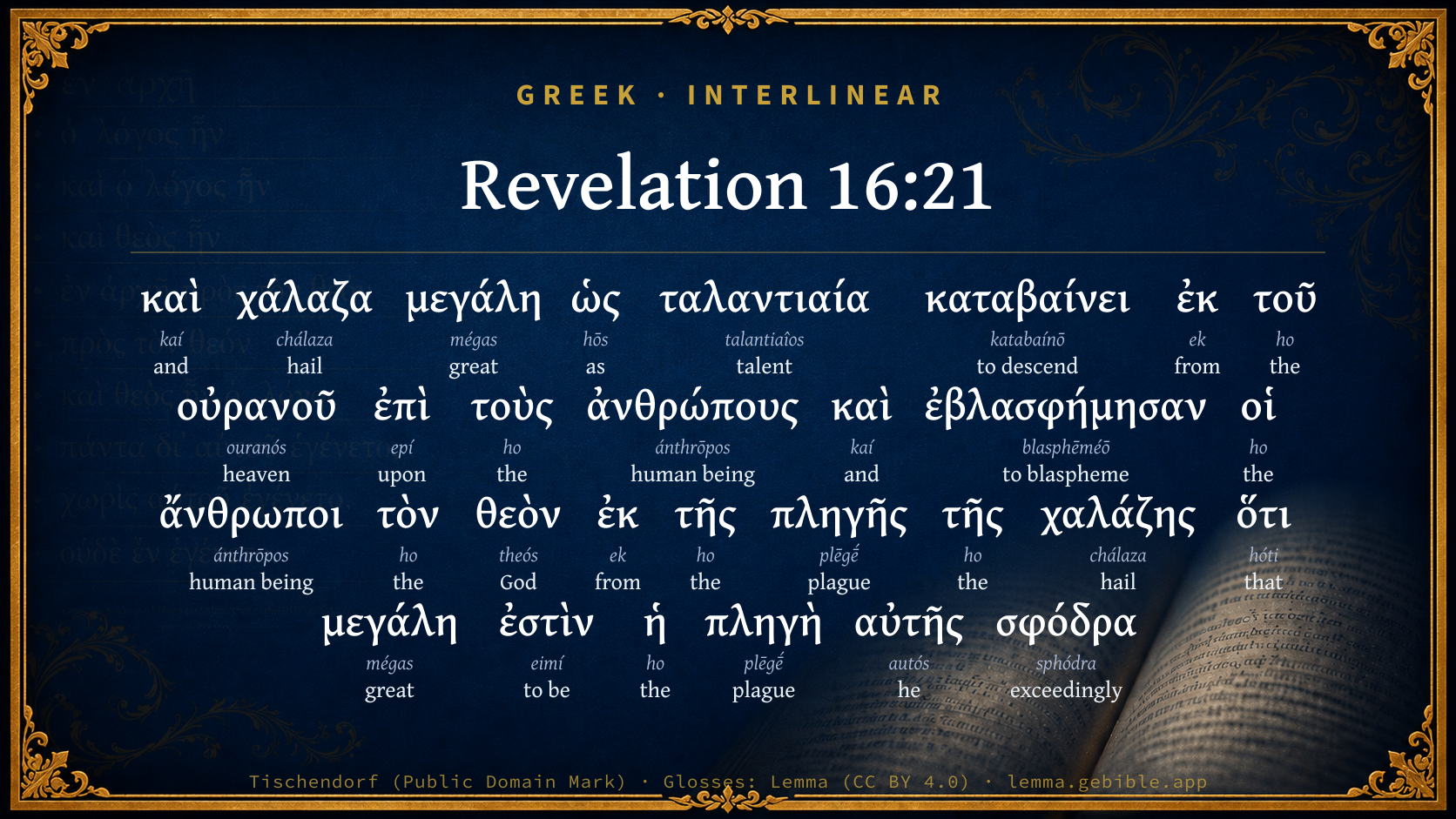
Greek (Tischendorf 8th ed.) Revelation 16:21 appears in the Greek New Testament. The text above is from the Tischendorf 8th edition. Each word links to its Strong’s number and a concise gloss. Click any word for its full Thayer’s Greek Lexicon entry.
Download image
Cite this verse

Revelation 16:21 (World English Bible). Public Domain. Lemma interlinear Bible study tool, https://lemma.gebible.app/v/revelation/16/21.

Show BibTeX & RIS
BibTeX
RIS
English Translation
Great hailstones, about the weight of a talent, came down out of the sky on people. People blasphemed God because of the plague of the hail, for this plague is exceedingly severe.
World English Bible · Public Domain
Highlights
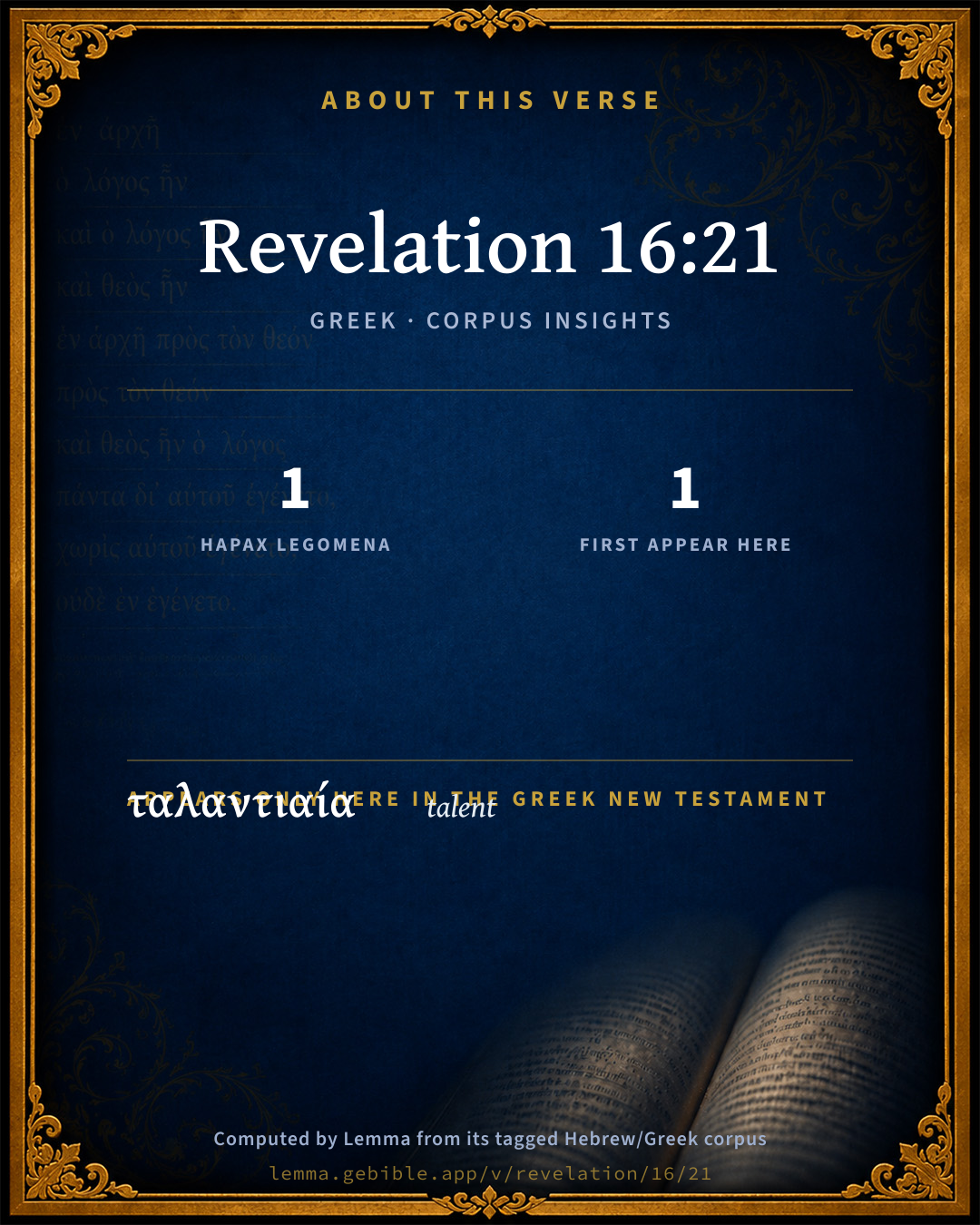
  • 1 hapax legomenon — only here in the Greek New Testament
  • 1 first appearance in the Greek New Testament
Full analysis ↓
Download a study sheet

One document with this verse’s original text, its word-by-word gloss line, the meaning frame, cross-references with their text, attributed commentary, and full source and license credits — printable, and it pastes into notes with its structure intact.

This verse Autodidact and up

Study sheet (.html) Plain text (.txt)

A passage Seminary Student

Up to 50 verses in one chapter. A passage sheet keeps up to 6 commentary sources and 12 cross-references per verse, in the order this page ranks them, and says so on the sheet whenever that leaves anything out. Ask for a single verse and you get the Autodidact verse sheet above.

Everything on this page stays free to read, with no account — the sheet is a download of what is already on screen, not access to it.

Want to remove ads? Support Godless Engineer
Compare translations 3

The same verse in 3 English versions, stacked beneath the original-language interlinear above. Click any original word for its lexicon entry.

Each is an independent rendering of the whole verse — the interlinear is not word-aligned to these translations.

Highlighted words mark where these versions differ — a whole-verse word diff, not a word-by-word alignment.

  • World English Bible Public Domain
    Great hailstones, about the weight of a talent, came down out of the sky on people. People blasphemed God because of the plague of the hail, for this plague is exceedingly severe.
  • King James Version Public Domain
    And there fell upon men a great hail out of heaven, every stone about the weight of a talent: and men blasphemed God because of the plague of the hail; for the plague thereof was exceeding great.
  • unfoldingWord Literal Text CC BY-SA 4.0
    And great hail, about a talent in weight, comes down from heaven upon men, and men blasphemed God because of the plague of hail, because that plague is exceedingly great.

unfoldingWord Literal Text — © unfoldingWord, licensed CC BY-SA 4.0. Word-aligned USFM3 via Door43 (git.door43.org/unfoldingWord/en_ult).

Versions to compare (up to 4)

3 of 4 selected

Show all 19 translations

Every available English version of this verse, each an independent rendering of the whole verse.

  • World English Bible Public Domain
    Great hailstones, about the weight of a talent, came down out of the sky on people. People blasphemed God because of the plague of the hail, for this plague is exceedingly severe.
  • Berean Standard Bible Public Domain
    And great hailstones weighing almost a hundred pounds each rained down on them from above. And men cursed God for the plague of hail, because it was so horrendous.
  • Majority Standard Bible Public Domain
    And great hailstones weighing almost a hundred pounds each rained down on them from above. And men cursed God for the plague of hail, because it was so horrendous.
  • King James Version Public Domain
    And there fell upon men a great hail out of heaven, every stone about the weight of a talent: and men blasphemed God because of the plague of the hail; for the plague thereof was exceeding great.
  • American Standard Version (1901) Public Domain
    And great hail, `every stone' about the weight of a talent, cometh down out of heaven upon men: and men blasphemed God because of the plague of the hail; for the plague thereof is exceeding great.
  • Revised Version (1885) Public Domain
    And great hail, every stone about the weight of a talent, cometh down out of heaven upon men: and men blasphemed God because of the plague of the hail; for the plague thereof is exceeding great.
  • Geneva Bible (1599) Public Domain
    And there fell a great haile, like talents, out of heauen vpon the men, and men blasphemed God, because of the plague of the haile: for the plague thereof was exceeding great.
  • Douay-Rheims (1899) Public Domain
    And great hail, like a talent, came down from heaven upon men: and men blasphemed God for the plague of the hail: because it was exceeding great.
  • Young's Literal Translation Public Domain
    and great hail (as of talent weight) doth come down out of the heaven upon men, and men did speak evil of God because of the plague of the hail, because its plague is very great.
  • Literal Standard Version CC BY-SA 4.0
    and great hail (as of talent weight) comes down out of the sky on men, and men slandered God because of the plague of the hail, because its plague is very great.
  • Unlocked Literal Bible CC BY-SA 4.0
    Great hailstones, weighing about a talent, came down from the sky upon the people. They cursed God for the plague of hail because that plague was so terrible.
  • unfoldingWord Literal Text CC BY-SA 4.0
    And great hail, about a talent in weight, comes down from heaven upon men, and men blasphemed God because of the plague of hail, because that plague is exceedingly great.
  • Darby Bible Public Domain
    and a great hail, as of a talent weight, comes down out of the heaven upon men; and men blasphemed God because of the plague of hail, for the plague of it is exceeding great.
  • World Messianic Bible Public Domain
    Great hailstones, about the weight of a talent, came down out of the sky on people. People blasphemed God because of the plague of the hail, for this plague was exceedingly severe.
  • Webster's Bible Public Domain
    And there fell upon men a great hail out of heaven, every stone about the weight of a talent: and men blasphemed God because of the plague of the hail; for the plague of it was exceeding great.
  • Free Bible Version CC BY-SA 4.0
    Huge hailstones, each one weighing one hundred pounds, rained down from the sky on people. The people cursed God because the plague of hail was so terrible.
  • Bible in Basic English Public Domain
    And great drops of ice, every one about the weight of a talent, came down out of heaven on men: and men said evil things against God because of the punishment of the ice-drops; for it is very great.
  • Text-Critical English NT CC BY 4.0
    And great hailstones, about the weight of a talent, fell on people from heaven, and they blasphemed God for the plague of hail, because the plague was so severe.
  • Tyndale New Testament (1534) Public Domain
    And ther fell a gret hayle as it had bene talentes out of heven apon the men and the men blasphemed God be cause of the plage of the hayle for it was grett and the plage of it sore.

Literal Standard Version (2020), Covenant Press — licensed CC BY-SA 4.0. Text via the HelloAO Bible API (eBible.org). Unlocked Literal Bible (unfoldingWord) — licensed CC BY-SA 4.0. Text via the HelloAO Bible API (eBible.org). unfoldingWord Literal Text — © unfoldingWord, licensed CC BY-SA 4.0. Word-aligned USFM3 via Door43 (git.door43.org/unfoldingWord/en_ult). Free Bible Version, Dr. Jonathan Gallagher — licensed CC BY-SA 4.0. Text via the HelloAO Bible API (eBible.org).

Word by word

More ways to search: Search by grammar → Find every occurrence → Compare this word →

Practice this passage: Drill this verse → Learn its vocabulary →

ταλαντιαία
talantiaîos
G5006
“talent”
Adjective, Nominative, Singular, Feminine
Part of Speech
Adjective
Case
Nominative
Number
Singular
Gender
Feminine
Full Thayer's Definition

Origin: from G5007

TDNT: None

1. a weight or worth of a talent a. a talent of silver weighed about 100 pounds (45 kg) b. a talent of gold, 200 pounds (91 kg)
  1. καὶ kaí G2532 “and” Conjunction
  2. χάλαζα chálaza G5464 “hail” Noun, Nominative, Singular, Feminine
  3. μεγάλη mégas G3173 “great” Adjective, Nominative, Singular, Feminine
  4. ὡς hōs G5613 “as” Adverb
  5. καταβαίνει katabaínō G2597 “to descend” Verb, Present, Active, Indicative, 3rd person, Singular
  6. ἐκ ek G1537 “from” Preposition
  7. τοῦ ho G3588 “the” Article, Genitive, Singular, Masculine
  8. οὐρανοῦ ouranós G3772 “heaven” Noun, Genitive, Singular, Masculine
  9. ἐπὶ epí G1909 “upon” Preposition
  10. τοὺς ho G3588 “the” Article, Accusative, Plural, Masculine
  11. ἀνθρώπους ánthrōpos G444 “human being” Noun, Accusative, Plural, Masculine
  12. καὶ kaí G2532 “and” Conjunction
  13. ἐβλασφήμησαν blasphēméō G987 “to blaspheme” Verb, Aorist, Active, Indicative, 3rd person, Plural
  14. οἱ ho G3588 “the” Article, Nominative, Plural, Masculine
  15. ἄνθρωποι ánthrōpos G444 “human being” Noun, Nominative, Plural, Masculine
  16. τὸν ho G3588 “the” Article, Accusative, Singular, Masculine
  17. θεὸν theós G2316 “God” Noun, Accusative, Singular, Masculine
  18. ἐκ ek G1537 “from” Preposition
  19. τῆς ho G3588 “the” Article, Genitive, Singular, Feminine
  20. πληγῆς plēgḗ G4127 “plague” Noun, Genitive, Singular, Feminine
  21. τῆς ho G3588 “the” Article, Genitive, Singular, Feminine
  22. χαλάζης chálaza G5464 “hail” Noun, Genitive, Singular, Feminine
  23. ὅτι hóti G3754 “that” Conjunction
  24. μεγάλη mégas G3173 “great” Adjective, Nominative, Singular, Feminine
  25. ἐστὶν eimí G1510 “to be” Verb, Present, Active, Indicative, 3rd person, Singular
  26. ἡ ho G3588 “the” Article, Nominative, Singular, Feminine
  27. πληγὴ plēgḗ G4127 “plague” Noun, Nominative, Singular, Feminine
  28. αὐτῆς autós G846 “he” Personal pronoun, Genitive, Singular, Feminine
  29. σφόδρα sphódra G4970 “exceedingly” Adverb

About this verse

These counts appear in no published source. They are computed here, from the morphology-tagged text and Lemma’s own curated glosses. What Lemma adds →

30
words
18
distinct lemmas
Revelation
section

Notable vocabulary

1 hapax legomenon — a word that appears only here in the entire Greek New Testament:

  • ταλαντιαία talent G5006

First appearance in Scripture

This word makes its first canonical appearance in the Greek New Testament here:

  • ταλαντιαία talent G5006

Shared distinctive vocabulary

χάλαζα hail G5464 occurs in 3 verses of the Greek New Testament. Also found in:
Repetition

Words recur within this verse:

  • χάλαζα hail G5464 ×2
  • μεγάλη great G3173 ×2
  • ἀνθρώπους human being G444 ×2
  • πληγῆς plague G4127 ×2
  • τοῦ the G3588 ×7
  • καὶ and G2532 ×2
  • ἐκ from G1537 ×2

Cross-references

11

Topical passages linked to Revelation 16:21 in the Treasury of Scripture Knowledge — connected by theme and wording, ordered by reader-vote popularity; previews shown in the World English Bible.

  • Revelation 11:19 God's temple that is in heaven was opened, and the ark of the Lord's covenant was seen in his temple. Lightnings, sounds, thunders, an earthquake, and great hail followed.
  • Joshua 10:11 It happened, as they fled from before Israel, while they were at the descent of Beth Horon, that Yahweh cast down great stones from the sky on them to Azekah, and they died: they were more who died with the hailstones than they whom the children of Israel killed with the sword.
  • Revelation 16:9 People were scorched with great heat, and people blasphemed the name of God who has the power over these plagues. They didn't repent and give him glory.
  • Revelation 8:7 The first sounded, and there followed hail and fire, mixed with blood, and they were thrown to the earth. One third of the earth was burnt up, and one third of the trees were burnt up, and all green grass was burnt up.
  • Revelation 16:11 and they blasphemed the God of heaven because of their pains and their sores. They didn't repent of their works.
  • Exodus 9:23–26 Moses stretched forth his rod toward the heavens, and Yahweh sent thunder, hail, and lightning flashed down to the earth. Yahweh rained hail on the land of Egypt.
  • Isaiah 8:21 They shall pass through it, sore distressed and hungry; and it shall happen that when they shall be hungry, they shall fret themselves, and curse by their king and by their God, and turn their faces upward:
  • Ezekiel 13:11 tell those who daub it with whitewash, that it shall fall: there shall be an overflowing shower; and you, great hailstones, shall fall; and a stormy wind shall tear it.
  • Ezekiel 13:13 Therefore thus says the Lord Yahweh: I will even tear it with a stormy wind in my wrath; and there shall be an overflowing shower in my anger, and great hailstones in wrath to consume it.
  • Ezekiel 38:21–22 I will call for a sword against him to all my mountains, says the Lord Yahweh: every man's sword shall be against his brother.
  • Isaiah 30:30 Yahweh will cause his glorious voice to be heard, and will show the lighting down of his arm, with the indignation of [his] anger, and the flame of a devouring fire, with a blast, and tempest, and hailstones.

Cross-references courtesy of OpenBible.info (CC BY 4.0).

Commentary

Notes on Revelation 16:21 from classic Christian and Jewish commentators (each source and its license shown beneath its notes). The classic Christian expositions comment on the surrounding passage and are grouped to its opening verse, so a note may address several verses; the Jewish commentaries on the Tanakh (Rashi and others) are per-verse, so they appear only where the commentator wrote on this verse.

Lemma curates 59 commentaries, every one of them public domain or Creative Commons licensed, each selected and text-cleaned for this edition rather than reprinted as found. About our sources →

Tyndale Open Study Notes

Tyndale Open Resources

16:21 Despite the severity of these plagues, the people of the world again cursed God rather than recognizing his reason for the judgments (see 9:20; 16:9, 11). • The terrible hailstorm is a reminder of the seventh plague on Egypt (Exod 9:23-24).

Tyndale Open Study Notes — © Tyndale Open Resources, licensed CC BY-SA 4.0. Text via the HelloAO Bible API.

Bengel's Gnomon

Johann Albrecht Bengel

Rev 16:21. [186] Ὡς ΤΑΛΑΝΤΙΑΊΑ, as it were of the weight of a talent) Of many pounds singly. I take it in its proper sense, at the beginning of the Non-being of the beast.

[186] Ver. 19. ἡ πόλις ἡ μεγάλη, the great city) Jerusalem; ch. Rev 11:8.—V. g.

Bengel's Gnomon of the New Testament — English translation (T&T Clark, Edinburgh, 1860) — public domain. Text from a community e-Sword module.

Expositor's Greek Testament

ed. W. Robertson Nicoll

Rev 16:21 . Even an abnormal hail-ahower ( cf. the fourth Egyptian plague) fails to bring pagans to their senses. ὡς ταλ , i.e. , literally about sixty times the weight of even the enormous hailstones ( μνααῖαι ) which Diodorus Siculus (19:45) records. In En. lx. 17 the “spirit of the hail is a good angel,” i.e. , amenable to God’s orders.

The obscurity of chapter 17 springs mainly from the differences of tradition and outlook which are reflected in the canonical text. The threefold interpretation of the Beast as the Imperial power (so 13), as Nero redivivus (Rev 16:8 ) and as (11) the eighth king (the two latter being applications of the same idea) is accompanied by a twofold explanation of the seven heads (geographical = 9, historical =10), and of the woman’s support (Rev 16:1 ; Rev 16:3 ; Rev 16:15 ). The eschatological tradition of Babylon as the supreme anti-divine world-power is applied to Rome, and this involves the reinterpretation of some details ( e.g. 15, 18), while the tradition of the Beast as antichrist is further overlaid by the special tradition of Nero redivivus in that capacity. This dual Beast (as Völtei first recognised; cf. Charles’s Ascensio Isaiæ , pp. lx. lxi.) is not merely the Imperial power (as in Rev 13:3 ) but incarnate in an Imperial personality of infernal and supernatural character, which attacks not only the Christian messiah (14) but Rome itself (Rev 16:16-17 ). The latter trait is unmistakably due to the legend of Nero redivivus, apart from which the oracle is unintelligible. Such variations have left traces in the structure of the passage, which point to some process of editorial revision, but it is difficult to disentangle the original source or sources, or even to determine their precise character and period. Rev 16:14 is certainly out of place, for the allies of the Beast could not destroy Rome after they themselves had been destroyed by the messiah and his allies. It is thus either proleptic or inserted by the Christian writer in his (Jewish) source (so e.g. , Vischer, Charles, Briggs, von Soden). Other traces of this editor might be found in 6 b, 8 (9 a?), and 15, and the Jewish character of the source (so Vischer, Weyland, Schmidt, Sabatier, Ménégoz, etc.), would be confirmed by the absence of any polemic against the Imperial cultus. It would be a Vespasianic oracle, inspired by a passion for revenge on Rome for her cruel, recent treatment of the Jewish people. When the source is regarded as Christian (as e.g. , by Erbes, Völter, and Schön), Rev 16:11 would be an addition inserted under Domitian to bring it up to date (so Harnack, Texte u. Unters. II. iii. 134 f.; Chronologie , 245, 246, followed by Briggs, Gunkel, J. Weiss, etc.; cf. Introd. § 7). But even so, the structure of the passage is involved. Rev 16:9-11 are not vision but calculation or exposition ( cf. Rev 13:18 ). The waters of Rev 16:15 are never seen (cf. Rev 16:1 ; Rev 16:3 ), and the professed explanation (Rev 16:7 ) follows a loose order (beast = 8, heads = 9 11, horns=12 14, waters = 15, horns again = 16 17, and finally the woman = 18). The reference to the woman, however, is thrown late in order to introduce the following doom-song ( cf. kings in 18, Rev 18:3 ; Rev 18:9 , and great in 18, Rev 18:2 ), and a similar motive accounts for the irregular position of 16 17 after 14, Rome’s fall, though viewed from different angles, being the main object before the writer’s mind at the moment. The defeat of 14 is taken up, in its true position, afterwards (Rev 19:11-21 ). Rev 16:15 (an echo of Rev 16:19 b) is probably thrown in at this point, to contrast dramatically the revolt [16] of Rome’s supporters against her. Thus, except for 9 11, there are sufficient psychological reasons to account partially for the order and contents of the oracle; but source-criticism is required to clear up the passage, in the more or less extensive theories of one source (edited in 6, 9 a , 14 15, so J. Weiss; or variously in 8, 12 14, with some words in 6, 9, 11, so e.g. Pfleiderer, Baljon, Bousset and Forbes) or even two sources (Jewish, A = 3 4, 6 7 b , 10, [919] =11 13, 16 b 17, Wellhausen’s Analyse , 26 f.), for which the linguistic idiosyncrasies (double use of γέμειν , 3 4, precedence of object over verb 13, 16, 18, οἱ κ . τ . γ . 2, and the construction βλ . τ . θ . ὅτι ἦν , 8) afford some basis. The main problem is to explain how the various strata of tradition overlap; e.g. , in 8, 12 f., the beast is Nero redivivus, an infernal power of evil, whereas in 11 Domitian seems identified with Nero the beast. It is hard to believe that one and the same writer could simultaneously regard Domitian as a second Nero and expect Nero redivivus as a semi-supernatural power. In any case the stress falls on the Beast rather than on the woman, and on the eschatological prediction, not on the historical application. It is a fairly open question whether 8 or 11 is the editorial mortar super-imposed upon the earlier tradition. Upon the whole, one of the least unsatisfactory solutions is to take 11 as a Domitianic gloss by the Christian editor, who has also added 6 b (if not all of 6) and 14 to a Vespasianic oracle (possibly of Jewish origin) in Rev 17:4 f. which anticipated the downfall of persecuting Rome at the hands of Nero redivivus and his Eastern allies. No hypothesis is free from difficulties. But the general Domitianic reference of the Apocalypse and the presence of the Nero redivivus saga must be worked in somehow, and some hypothesis on the above lines seems to do most justice to the literary structure of this chapter as well as to the data of the book in general. It is impossible to determine how far the Christian editor worked over his source. That the difficulties of the oracle arise mainly from the presence of an earlier source ( cf. Introd. § 7), which John has revised slightly and brought up to date, is axiomatic, however.

[919] Codex Vaticanus (sæc. iv.), published in photographic facsimile in 1889 under the care of the Abbate Cozza-Luzi.

The double object of the oracle is ( a ), by a re-editing of the tradition of 13 to represent Rome in her Imperial pride, before describing her downfall, and ( b ) to define more precisely the final appearance of the last foe. The chapter could readily be spared as isolated (Simcox), but this only proves that the author is again working upon disparate materials which he inherited. The oracle contains (Rev 16:1-6 ) a vision of the Harlot (by way of foil to Rev 12:1-6 and especially Rev 21:9 f.) and the Beast, with (Rev 16:7-18 ) an explanation of the vision.

The Expositor's Greek Testament, edited by W. Robertson Nicoll (1897–1910) — public domain. Text from a community e-Sword module.

Geneva Bible (1599)

Geneva Bible translators

The manner of the particular execution, most evidently testifying the wrath of God by the original and greatness thereof: the event whereof is the same with that which is, Rev. 9:12, and that which hath been mentioned in this Chapter, from the execution of the fourth Angel hitherto, that is to say, an incorrigible pertinency of the world in their rebellion, and an heart that cannot repent, verses 9 and 11.

As it were about the weight of a talent was threescore pound, that is, six hundred groats, whereby is signified a marvelous and strange kind of weight.

Geneva Bible (1599) marginal notes — public domain. Text via Bolls.life.

Jamieson, Fausset & Brown

Robert Jamieson, A. R. Fausset & David Brown

fell--Greek, "descends."

upon men--Greek, "the men."

and men blasphemed God--not those struck who died, but the rest. Unlike the result in the case of Jerusalem (Rev 11:13), where "the remnant . . . affrighted . . . gave glory to the God of heaven."

was--Greek, "is."

Next: Revelation Chapter 17

Jamieson, Fausset & Brown — Commentary Critical and Explanatory on the Whole Bible (1871) — public domain (CC PDM 1.0). Text via the HelloAO Bible API.

Adam Clarke's Commentary

Verse 21. A great hail-about the weight of a talent] Has this any reference to cannon balls and bombs? It is very doubtful; we are all in the dark in these matters.

The words ως ταλαντιαια, as a talent, are used to express something great, excessively oppressive; as νοσηματων ταλαντιαιων, terrible diseases, not diseases of the weight of a talent. See Rosenmuller.

Adam Clarke's Commentary on the Bible (1810–1826) — public domain. Text from a community e-Sword/MySword module.

Ellicott's Commentary for English Readers

(21) And there fell. . . .—And a great hail, as of a talent in weight, descends from the heaven on men. There is again a reference to the Egyptian plagues. But we may also call to mind the great defeat of the enemies of Israel at Beth-horon (Jos_10:1-11), when “the Lord cast down great stones from heaven.” Such an overthrow awaits every confederacy that sets itself in array against the kingdom of the righteous King. The discomfiture and the plague works no repentance; the men blaspheme God because of the hail, for great is its plague exceedingly. The proud, hard spirit which still hates the good remains: thus is sin its own worst penalty. As an illustration of this hard, unsubdued spirit, we may call to mind Capaneus, in Dante’s Inferno, and the words in which Virgil addresses him:—

“Thou art more punished, in that this thy pride

Lives yet unquenched; no torment save thy rage

Were to thy fury pain proportioned full.

The unrepentant state of those upon whom the vials are poured is to be contrasted with the different result of the earthquake in Rev_11:13, when men gave glory to the God of heaven.

A Bible Commentary for English Readers, edited by Charles John Ellicott (1878–1897) — public domain. Text from a community e-Sword module.

Trapp's Complete Commentary

John Trapp

21 And there fell upon men a great hail out of heaven, every stone about the weight of a talent: and men blasphemed God because of the plague of the hail; for the plague thereof was exceeding great.

Ver. 21. A great hail] Bigger than that which brained the kings of Canaan, Jos 10:11; perhaps this shall be fulfilled according to the letter. Howsoever, the elements shall melt like scalding lead upon Antichristians and other atheists; and they shall answer for all with flames about their ears.

John Trapp, A Commentary or Exposition upon All the Books of the Old and New Testament (1647–1656) — public domain. Text from a community e-Sword module.

Albert Barnes' Notes on the Bible

And there fell upon men a great hail out of heaven - Perhaps this is an allusion to one of the plagues of Egypt, Exo 9:22-26. Compare the notes on Rev 11:19. For a graphic description (by Com. Porter) of the effects of a hailstorm, see the notes on Isa 30:30. Compare the notes on Job 38:22.

Every stone about the weight of a talent - The Attic talent was equal to about 55 lbs. or 56 lbs. Troy weight; the Jewish talent to about 113 lbs. Troy. Whichever weight is adopted, it is easy to conceive what must be the horror of such a storm, and what destruction it must cause. We are not, of course, to suppose necessarily, that this would literally occur; it is a frightful image to denote the terrible and certain destruction that would come upon Babylon - that is, upon the papal power.

And men blasphemed God - See the notes on Rev 16:9.

Because of the plague of the hail - Using the word “plague” in allusion to the plagues of Egypt.

For the plague thereof was exceeding great - The calamity was great and terrible. The design of the whole is to show that the destruction would be complete and awful.

This finishes the summary statement of the final destruction of this formidable anti-Christian power. The details and the consequences of that overthrow are more fully stated in the subsequent chapters. The fulfillment of what is here stated will be found, according to the method of interpretation proposed, in the ultimate overthrow of the papacy. The process described in this chapter is that of successive calamities that would weaken it and prepare it for its fall; then a rallying of its dying strength; and then some tremendous judgment that is compared with a storm of hail, accompanied with lightning, and thunder, and an earthquake, that would completely overthrow all that was connected with it, We are not, indeed, to suppose that this will literally occur; but the fair interpretation of prophecy leads us to suppose that that formidable power will, at no very distant period, be overthrown in a manner that would be well represented by such a fearful storm.

Albert Barnes' Notes on the Bible (1834–1885) — public domain. Text from a community e-Sword/MySword module.

Haydock's Catholic Bible Commentary

And great hail like a talent came down, &c.[1] Which need not be taken literally, but only metaphorically, to signify the heavy weight of God’s judgments upon sinners. (Witham)

===============================

[BIBLIOGRAPHY]

Et grando magna sicut talentum, Greek: os talantiaia, quasi talentaris. The Protestant and Mr. N. translate hail about the weight of a talent, as if every hailstone were of that weight.

====================

George Leo Haydock (1774–1849), Haydock's Catholic Family Bible and Commentary, 1859 edition — public domain. Excludes Psalms (Douay-Rheims chapter numbering differs from Protestant) and Deuterocanonical books (Catholic canon only).

Matthew Poole's English Annotations

The hail was another of the Egyptian plagues, Exo 9:22-25. The allusion also may be to the hailstones by which God fought against the five Canaanitish kings, Jos 10:11. It signifies only further great judgments with which God will pursue the beast and his party, until they all be destroyed. The latter words only show the continued hardness of heart of the beast, and all his party; wherein also they answered Pharaoh and the Egyptians, (their type), who would relent with no steadiness and certainty, until they were all ruined by the waters of the Red Sea. In all this prediction of the final ruin of the papacy, Pharaoh and the Egyptians are apparently made the type of the pope and all his party:

1. As to their sins, which were idolatry, and the oppression of God’s Israel.

2. In the plagues by which they were destroyed gradually; turning waters into blood, boils and blains, darkness, hail.

3. In their impenitency, and hardness of heart; only with these two differences, by which the antitype exceeded the type in wickedness:

(1.) We read of Pharaoh oft relenting, though his goodness was like a morning dew, and he returned to his former stubbornness.

(2.) We read nothing of the Egyptians blaspheming God, because of their plagues, which is often said of these Egyptians.

Matthew Poole's English Annotations on the Holy Bible (1683–1685) — public domain. Text from a community e-Sword/MySword module.

Whedon's Commentary on the Bible

Daniel D. Whedon

21. Fell… out of heaven—As if to leave a full, last impression that the destruction was from Jehovah, a new form of judgment came out of heaven. These were icebergs, sixty pounds in weight, hailed down from the sky. These fell upon men, crushing them with their cold, solid, remorseless weight. Note Rev_18:21. Yet, though the divine hand was so apparent, the survivors repented not, but blasphemed God. They persisted in their adherence to antichrist until the battle of Rev_19:11-21.

By our interpretation of this triad of chapters thus closed, it may be truly said that “we are living under the period of the vials;” apparently under the fifth. The Roman spiritual world-power, which succeeded the imperial Roman world-power, is smitten with serial plagues, and declines. Yet it grows spiritually more impenitent, self-asserting, and defiant with every successive smite. This world-wide Babylon presents itself before us here in America, claiming absolute supremacy over us, and ready for the battle; moral battle as long as the physical battle is not in its power; physical battle as soon as a sufficiency of the moral battle is won. How long this vial-period will endure we have no chronometer or almanac that can tell us. But every man of us would do well to be alert in duty so long as the contest lasts.

Daniel D. Whedon (gen. ed.), Commentary on the Old and New Testaments (1874–1909) — public domain. Text from a community e-Sword module.

The Pulpit Commentary

And there fell upon men a great hail out of heaven, every stone about the weight of a talent; cometh down upon, the present tense, rendering the description more graphic. Commentators usually quote "Diodorus Siculus" (19:45), who mentions. as something marvellous, hailstones of a mina in weight; the mina being one-sixtieth of a talent; and also the account of Josephus, who speaks of stones a talent in weight being thrown by machines at the siege of Jerusalem (see Wetstein, ad loc. ). "The men," though not pointing to any particular group of men who have been definitely mentioned, nevertheless necessarily refers to the wicked, were are the object of this punishment. "Hail" is frequently mentioned as a judgment of God and is added here to heighten the general effect of the description. (cf. Ex 9 Jos_10:11 Psa_78:47 Psa_105:32 Isa_28:2 Isa_30:30 Eze_13:11 Eze_38:22 Hag_2:17; also Rev_8:7 Rev_11:19) And men blasphemed God because of the plague of the hail; for the plague thereof was exceeding great; is exceeding great (vide supra). As in ver. 9, men repent not. Like Pharaoh, their hearts are hardened. These words end the general description of the vial judgments, but the events alludes to under the seventh vial are elaborated and particularized in the chapters which follow; the whole concluding at the end of Re 19.

The Pulpit Commentary (1880–1919), ed. H.D.M. Spence-Jones & Joseph S. Exell — public domain. Text from a community e-Sword module.

John Wesley's Explanatory Notes

And a great hail falleth out of heaven - From which there was no defense. From the earthquake men would fly into the fields; but here also they are met by the hail: nor were they secure if they returned into the houses, when each hail-stone weighed sixty pounds.

John Wesley, Explanatory Notes Upon the Whole Bible (1754–1765) — public domain. Text via the GEBible commentary corpus.

The People's New Testament

B. W. Johnson

21. There fell upon men a great hail out of heaven. Upon the men who were judged and punished. Hail is a symbol of God's judgment. Hailstones of such weight signify awful judgments. The men blasphemed God. Not all men, but the men punished. In verse 9 and 11 it is declared that they repented not, and here it is again implied that they were incorrigible. The thought is that they perish in impenitence.

It might be added that Robert Flemming, who in 1701 so accurately forecasted the fate of the Papacy (see statement in notes on the fifth vial) places the seventh in a.d. 1900.

B. W. Johnson's The People's New Testament with Notes (1889–1891) — public domain. Electronic text from the Christian Classics Ethereal Library (CCEL) ThML edition.

Cambridge Greek Testament for Schools and Colleges

21. ἡ πληγὴ αὐτῆς. Vg[569] omits these words. B2 omits αὐτῆς.

[569] Vulgate.

21. χάλαζα μεγάλη. Rev 8:7, Rev 11:19.

ὡς ταλαντιαία. While natural hailstones weighing the sixtieth part of a talent are noticed as extraordinary. Some notice that the stones thrown by the engines at the siege of Jerusalem are said to have been of a talent weight: but it would be far-fetched to suppose these referred to. In this verse at least, the judgement described cannot be on Jerusalem—see on Rev 11:13 fin.

Cambridge Greek Testament for Schools and Colleges (Cambridge University Press, 1896; 21 vols, various authors incl. Carr, Maclear, Plummer, Farrar, Lumby, Moule, M. R. James, Simcox) — public domain. Text from a community e-Sword module.

Vincent's Word Studies in the New Testament

Marvin R. Vincent

Hail. See Exo 9:18.

Every stone about the weight of a talent [ως ταλαντιαια] . The adjective, meaning of a talent 's weight, agrees with hail; hail of a talent 's weight; i e., having each stone of that weight. Every stone is therefore explanatory, and not in the text. Hailstones are a symbol of divine wrath. See Isa 30:30; Eze 13:11. Compare Jos 10:11.

Marvin R. Vincent, Word Studies in the New Testament (1887–1900) — public domain. Text from a community e-Sword/MySword module.

Lesson kit

Teaching starters — assembled from the data on this page, not authored interpretation. Every prompt links to the verse data it draws on. Edit before teaching.

Revelation, in the Revelation, opens this verse with 30 words (18 distinct Greek lemmas). Its most distinctive word is talantiaîos (“talent”). A historical commentator’s framing appears above. Read the whole chapter for the surrounding context.

Discussion questions

  1. How does “talent” (talantiaîos) shape what this verse is saying?
  2. 1 word here appears nowhere else in the Greek New Testament. Why might the author reach for such rare wording?
  3. This is the first place “talent” appears in Scripture (first appears here). What does its debut here establish?
  4. How does Revelation 8:7, which shares the word «hail», read alongside this verse?
  5. What does the repetition of “hail” (2× in this one verse) do in this verse?
  6. These translations render this verse differently; the difference is in the English rendering, not the original. What questions does that raise?
  7. Compare how Tyndale Open Study Notes and Bengel's Gnomon read this verse. Where do they agree or differ?

Things to notice

  • 1 word in this verse appears nowhere else in the Greek New Testament.
  • 1 word makes its first canonical appearance in Scripture here.
  • These translations choose different wording for 18 words in this verse.
  • “hail” occurs 2× in this single verse.
  • 18 distinct Greek lemmas span 30 words in this verse.

Reading settings

Reading text

Shown beneath each verse's original-language words.

Old Testament
Old Testament edition

Read the OT as the Masoretic Hebrew (MT) or the Greek Septuagint (LXX).

English shown for the Greek Septuagint (in the Hebrew ↔ Greek comparison).

Comparing translations? Open the Compare panel on any verse page to stack up to four side by side.