
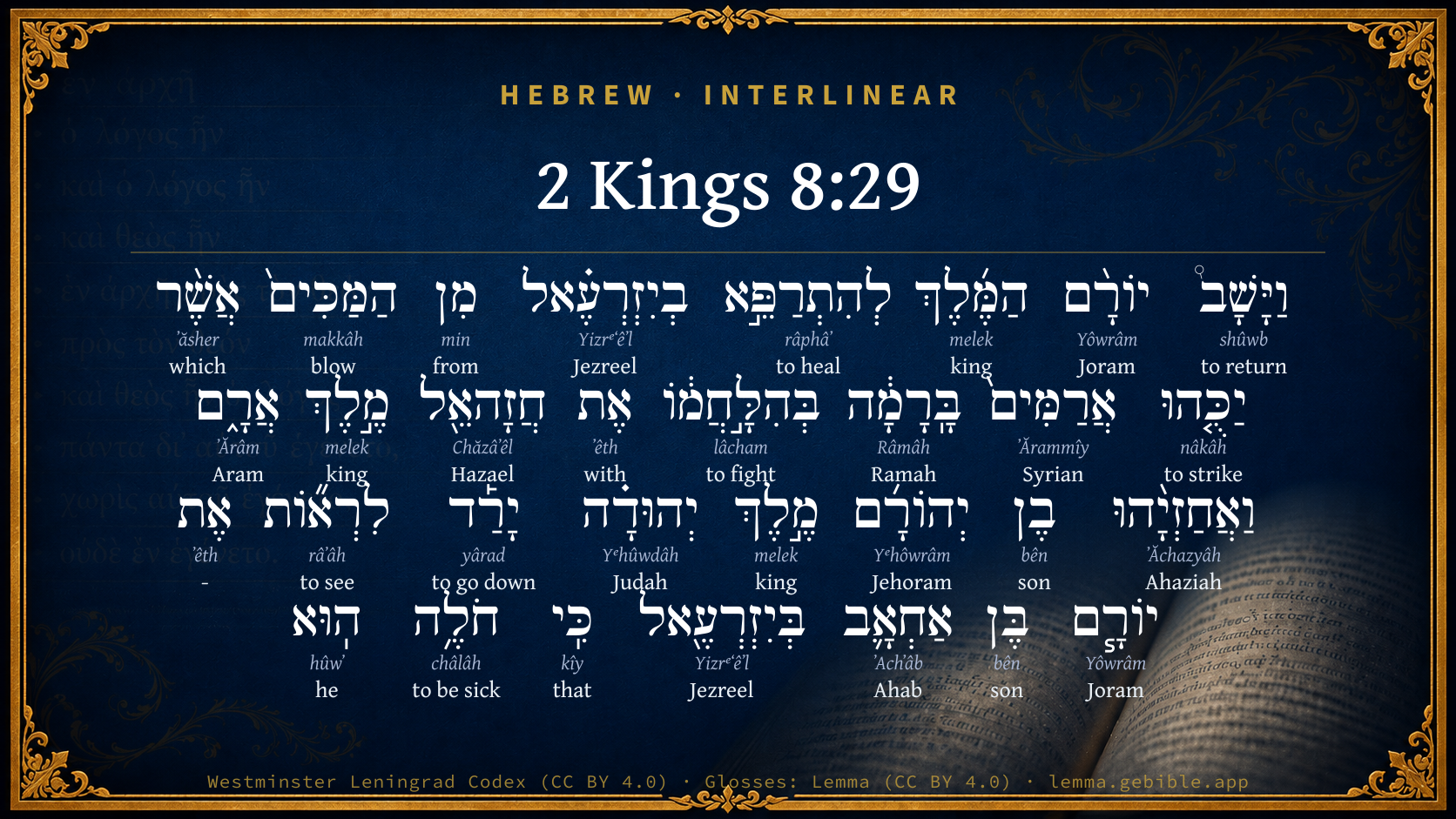
2 Kings 8:29

Hebrew (Westminster Leningrad Codex) 2 Kings 8:29 appears in the Hebrew Old Testament. The text above is from the Westminster Leningrad Codex. Each word links to its Strong’s number, a concise gloss, and parsing drawn from the Open Scriptures Hebrew Bible morphology. Click any word for its full Brown-Driver-Briggs (BDB) entry.
Download image
Cite this verse

2 Kings 8:29 (World English Bible). Public Domain. Lemma interlinear Bible study tool, https://lemma.gebible.app/v/2-kings/8/29.

Show BibTeX & RIS
BibTeX
RIS
English Translation
King Joram returned to be healed in Jezreel of the wounds which the Syrians had given him at Ramah, when he fought against Hazael king of Syria. Ahaziah the son of Jehoram king of Judah went down to see Joram the son of Ahab in Jezreel, because he was sick.
World English Bible · Public Domain
Download a study sheet

One document with this verse’s original text, its word-by-word gloss line, the meaning frame, cross-references with their text, attributed commentary, and full source and license credits — printable, and it pastes into notes with its structure intact.

This verse Autodidact and up

Study sheet (.html) Plain text (.txt)

A passage Seminary Student

Up to 50 verses in one chapter. A passage sheet keeps up to 6 commentary sources and 12 cross-references per verse, in the order this page ranks them, and says so on the sheet whenever that leaves anything out. Ask for a single verse and you get the Autodidact verse sheet above.

Everything on this page stays free to read, with no account — the sheet is a download of what is already on screen, not access to it.

Want to remove ads? Support Godless Engineer
Compare translations 3

The same verse in 3 English versions, stacked beneath the original-language interlinear above. Click any original word for its lexicon entry.

Each is an independent rendering of the whole verse — the interlinear is not word-aligned to these translations.

Highlighted words mark where these versions differ — a whole-verse word diff, not a word-by-word alignment.

  • World English Bible Public Domain
    King Joram returned to be healed in Jezreel of the wounds which the Syrians had given him at Ramah, when he fought against Hazael king of Syria. Ahaziah the son of Jehoram king of Judah went down to see Joram the son of Ahab in Jezreel, because he was sick.
  • King James Version Public Domain
    And king Joram went back to be healed in Jezreel of the wounds which the Syrians had given him at Ramah, when he fought against Hazael king of Syria. And Ahaziah the son of Jehoram king of Judah went down to see Joram the son of Ahab in Jezreel, because he was sick.
  • unfoldingWord Literal Text CC BY-SA 4.0
    And King Joram returned to be healed in Jezreel from the wounds which the Arameans had struck him at Ramah when he fought with Hazael, the king of Aram. And Ahaziah, the son of Jehoram, the king of Judah, went down to see Joram, the son of Ahab, in Jezreel because he was infirm.

unfoldingWord Literal Text — © unfoldingWord, licensed CC BY-SA 4.0. Word-aligned USFM3 via Door43 (git.door43.org/unfoldingWord/en_ult).

Versions to compare (up to 4)

3 of 4 selected

Show all 18 translations

Every available English version of this verse, each an independent rendering of the whole verse.

  • World English Bible Public Domain
    King Joram returned to be healed in Jezreel of the wounds which the Syrians had given him at Ramah, when he fought against Hazael king of Syria. Ahaziah the son of Jehoram king of Judah went down to see Joram the son of Ahab in Jezreel, because he was sick.
  • Berean Standard Bible Public Domain
    So King Joram returned to Jezreel to recover from the wounds that the Arameans had inflicted on him at Ramah when he fought against Hazael king of Aram. Then Ahaziah son of Jehoram king of Judah went down to Jezreel to visit Joram son of Ahab, because Joram had been wounded.
  • Majority Standard Bible Public Domain
    So King Joram returned to Jezreel to recover from the wounds that the Arameans had inflicted on him at Ramah when he fought against Hazael king of Aram. Then Ahaziah son of Jehoram king of Judah went down to Jezreel to visit Joram son of Ahab, because Joram had been wounded.
  • King James Version Public Domain
    And king Joram went back to be healed in Jezreel of the wounds which the Syrians had given him at Ramah, when he fought against Hazael king of Syria. And Ahaziah the son of Jehoram king of Judah went down to see Joram the son of Ahab in Jezreel, because he was sick.
  • American Standard Version (1901) Public Domain
    And king Joram returned to be healed in Jezreel of the wounds which the Syrians had given him at Ramah, when he fought against Hazael king of Syria. And Ahaziah the son of Jehoram king of Judah went down to see Joram the son of Ahab in Jezreel, because he was sick.
  • Revised Version (1885) Public Domain
    And king Joram returned to be healed in Jezreel of the wounds which the Syrians had given him at Ramah, when he fought against Hazael king of Syria. And Ahaziah the son of Jehoram king of Judah went down to see Joram the son of Ahab in Jezreel, because he was sick.
  • Geneva Bible (1599) Public Domain
    And King Ioram returned to bee healed in Izreel of the wounds which ye Aramites had giuen him at Ramah, whe he fought against Hazael King of Aram. And Ahaziah the sonne of Iehoram King of Iudah went downe to see Ioram the sonne of Ahab in Izreel, because he was sicke.
  • Douay-Rheims (1899) Public Domain
    And he went back to be healed, in Jezrahel: because the Syrians had wounded him in Ramoth when he fought against Hazael king of Syria. And Ochozias the son of Joram king of Juda, went down to visit Joram the son of Achab in Jezrahel, because he was sick there.
  • Young's Literal Translation Public Domain
    and Joram the king turneth back to be healed in Jezreel of the wounds with which the Arameans smite him in Ramah, in his fighting with Hazael king of Aram, and Ahaziah son of Jehoram king of Judah hath gone down to see Joram son of Ahab in Jezreel, for he is sick.
  • Literal Standard Version CC BY-SA 4.0
    and Joram the king turns back to be healed in Jezreel of the wounds with which the Arameans strike him in Ramah, in his fighting with Hazael king of Aram, and Ahaziah son of Jehoram, king of Judah, has gone down to see Joram son of Ahab in Jezreel, for he is sick.
  • Unlocked Literal Bible CC BY-SA 4.0
    King Joram returned to be healed in Jezreel of the wounds that the Arameans had given him at Ramah, when he fought against Hazael king of Aram. So Ahaziah son of Jehoram, king of Judah, went down to Jezreel to see Joram son of Ahab, because Joram had been wounded.
  • unfoldingWord Literal Text CC BY-SA 4.0
    And King Joram returned to be healed in Jezreel from the wounds which the Arameans had struck him at Ramah when he fought with Hazael, the king of Aram. And Ahaziah, the son of Jehoram, the king of Judah, went down to see Joram, the son of Ahab, in Jezreel because he was infirm.
  • Darby Bible Public Domain
    And king Joram returned to be healed in Jizreel of the wounds that the Syrians had given him at Ramah, when he fought with Hazael king of Syria. And Ahaziah the son of Jehoram, king of Judah, went down to see Joram the son of Ahab at Jizreel, for he was sick.
  • World Messianic Bible Public Domain
    King Joram returned to be healed in Jezreel from the wounds which the Syrians had given him at Ramah, when he fought against Hazael king of Syria. Ahaziah the son of Jehoram, king of Judah, went down to see Joram the son of Ahab in Jezreel, because he was sick.
  • Webster's Bible Public Domain
    And king Joram went back to be healed in Jezreel of the wounds which the Syrians had given him at Ramah, when he fought against Hazael king of Syria. And Ahaziah the son of Jehoram king of Judah went down to see Joram the son of Ahab in Jezreel, because he was sick.
  • Free Bible Version CC BY-SA 4.0
    and he returned to Jezreel to recover from the wounds he'd received in Ramah fighting against Hazael king of Aram. Ahaziah, son of Jehoram, king of Judah, went to Jezreel to visit Joram, son of Ahab, because Joram was wounded.
  • Bible in Basic English Public Domain
    So King Joram went back to Jezreel to get well from the wounds which the bowmen had given him at Ramah, when he was fighting against Hazael, king of Aram. And Ahaziah, the son of Jehoram, king of Judah, went down to see Joram, the son of Ahab, in Jezreel, because he was ill.
  • JPS Tanakh (1917) Public Domain
    And king Joram returned to be healed in Jezreel of the wounds which the Arameans had given him at Ramah, when he fought against Hazael king of Aram. And Ahaziah the son of Jehoram king of Judah went down to see Joram the son of Ahab in Jezreel, because he was sick.

Literal Standard Version (2020), Covenant Press — licensed CC BY-SA 4.0. Text via the HelloAO Bible API (eBible.org). Unlocked Literal Bible (unfoldingWord) — licensed CC BY-SA 4.0. Text via the HelloAO Bible API (eBible.org). unfoldingWord Literal Text — © unfoldingWord, licensed CC BY-SA 4.0. Word-aligned USFM3 via Door43 (git.door43.org/unfoldingWord/en_ult). Free Bible Version, Dr. Jonathan Gallagher — licensed CC BY-SA 4.0. Text via the HelloAO Bible API (eBible.org).

Word by word

More ways to search: Search by grammar → Find every occurrence → Compare this word →

Practice this passage: Drill this verse → Learn its vocabulary →

אֲרַמִּים֙
ʼĂrammîy
H761
“Syrians”
Noun, Gentilic, Masculine, Plural, Absolute
Part of Speech
Noun
Type
Gentilic
Gender
Masculine
Number
Plural
State
Absolute
Full BDB Definition

Origin: patrial from H758

TWOT: None

Syrian or Aramean = "exalted" - a thing or a person from Syria or Aram
  1. וַיָּשָׁב֩ shûwb H7725 “and · to return” Conjunction + Verb, Qal, Sequential Imperfect, 3rd Person, Masculine, Singular
  2. יוֹרָ֨ם Yôwrâm H3141 “Joram” Noun, Proper
  3. הַמֶּ֜לֶךְ melek H4428 “the · king” Particle, Definite Article + Noun, Common, Masculine, Singular, Absolute
  4. לְהִתְרַפֵּ֣א râphâʼ H7495 “to heal” Preposition + Verb, Hithpael, Infinitive Construct
  5. בְיִזְרְעֶ֗אל Yizrᵉʻêʼl H3157 “in/at · Jezreel” Preposition + Noun, Proper
  6. מִן min H4480 “from” Preposition
  7. הַמַּכִּים֙ makkâh H4347 “the · blows” Particle, Definite Article + Noun, Common, Feminine, Plural, Absolute
  8. אֲשֶׁ֨ר ʼăsher H834 “which” Particle, Relative
  9. יַכֻּ֤הוּ nâkâh H5221 “to strike · him” Verb, Hiphil, Imperfect, 3rd Person, Masculine, Plural + Suffix, Personal, 3rd Person, Masculine, Singular
  10. בָּֽרָמָ֔ה Râmâh H7414 “in/at the · Ramah” Preposition, Determined + Noun, Proper
  11. בְּהִלָּ֣חֲמ֔וֹ lâcham H3898 “in/at · to fight · him” Preposition + Verb, Niphal, Infinitive Construct + Suffix, Personal, 3rd Person, Masculine, Singular
  12. אֶת ʼêth H854 “with” Preposition
  13. חֲזָהאֵ֖ל Chăzâʼêl H2371 “Hazael” Noun, Proper
  14. מֶ֣לֶךְ melek H4428 “king of” Noun, Common, Masculine, Singular, Construct
  15. אֲרָ֑ם ʼĂrâm H758 “Aram” Noun, Proper
  16. וַאֲחַזְיָ֨הוּ ʼĂchazyâh H274 “and · Ahaziah” Conjunction + Noun, Proper
  17. בֶן bên H1121 “son of” Noun, Common, Masculine, Singular, Construct
  18. יְהוֹרָ֜ם Yᵉhôwrâm H3088 “Jehoram” Noun, Proper
  19. מֶ֣לֶךְ melek H4428 “king of” Noun, Common, Masculine, Singular, Construct
  20. יְהוּדָ֗ה Yᵉhûwdâh H3063 “Judah” Noun, Proper
  21. יָרַ֡ד yârad H3381 “to go down” Verb, Qal, Perfect, 3rd Person, Masculine, Singular
  22. לִרְא֞וֹת râʼâh H7200 “to see” Preposition + Verb, Qal, Infinitive Construct
  23. אֶת ʼêth H853 “-” Particle, Direct Object
  24. יוֹרָ֧ם Yôwrâm H3141 “Joram” Noun, Proper
  25. בֶּן bên H1121 “son of” Noun, Common, Masculine, Singular, Construct
  26. אַחְאָ֛ב ʼAchʼâb H256 “Ahab” Noun, Proper
  27. בְּיִזְרְעֶ֖אל Yizrᵉʻêʼl H3157 “in/at · Jezreel” Preposition + Noun, Proper
  28. כִּֽי kîy H3588 “that” Conjunction
  29. חֹלֶ֥ה châlâh H2470 “being sick” Verb, Qal, Participle Active, Masculine, Singular, Absolute
  30. הֽוּא hûwʼ H1931 “he” Pronoun, Personal, 3rd Person, Masculine, Singular

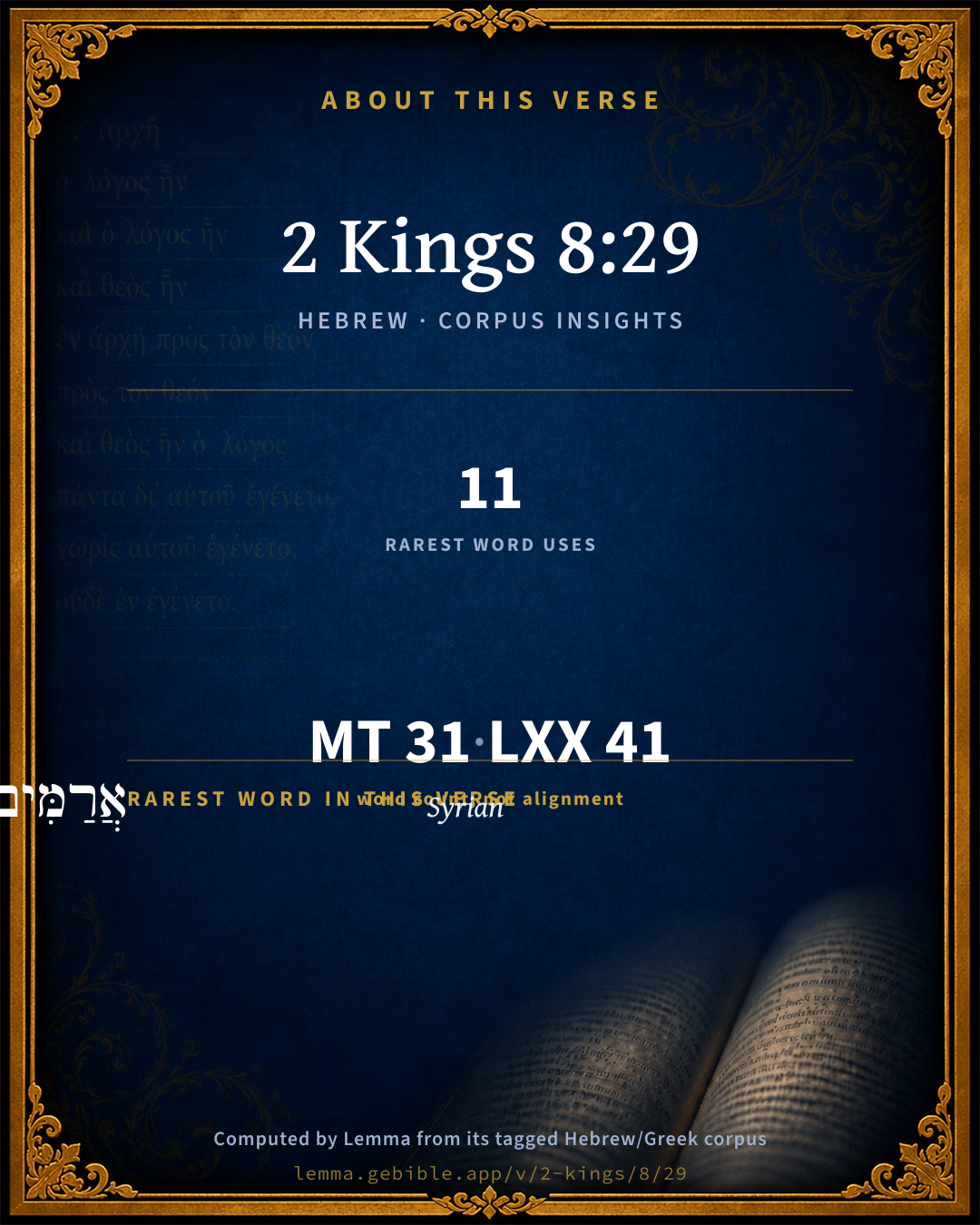
About this verse

These counts appear in no published source. They are computed here, from the morphology-tagged text and Lemma’s own curated glosses. What Lemma adds →

31
words
26
distinct lemmas
Historical
section

Notable vocabulary

The rarest word here is אֲרַמִּים֙ Syrian H761 — appearing just 11 times in the whole Hebrew Bible.

Shared distinctive vocabulary

אֲרַמִּים֙ Syrian H761 occurs in 10 verses of the Hebrew Bible. Also found in:

Grammatical profile

  • 7 verbs
  • 18 nouns
  • 1 pronoun
  • 2 prepositions
  • 1 conjunction
  • 2 particles

Verb forms

  • וַיָּשָׁב֩ Qal · Sequential Imperfect
  • לְהִתְרַפֵּ֣א Hithpael · Infinitive Construct
  • יַכֻּ֤הוּ Hiphil · Imperfect
  • בְּהִלָּ֣חֲמ֔וֹ Niphal · Infinitive Construct
  • יָרַ֡ד Qal · Perfect
  • לִרְא֞וֹת Qal · Infinitive Construct
  • חֹלֶ֥ה Qal · Participle Active

Repetition

Words recur within this verse — often emphatic in Hebrew:

  • הַמֶּ֜לֶךְ king H4428 ×3
  • יוֹרָ֨ם Joram H3141 ×2
  • בְיִזְרְעֶ֗אל Jezreel H3157 ×2
  • בֶן son H1121 ×2

Hebrew & Septuagint length

In English translation the verse runs 50 words from the Hebrew and 47 from the Septuagint (LXX English) — closely comparable.

A rough comparison of the two English renderings, which tokenize alike — not a word-level alignment.

Word counts can differ between the Hebrew and the Greek without any difference in meaning — e.g. the Hebrew direct-object marker אֵת has no separate Greek word, and Greek often adds the article ὁ.

In the original languages it is 31 Hebrew tokens and 41 Greek tokens — but the two are counted differently (Hebrew bundles its prefixes and suffixes into one token; the Greek is in lemma form), so that isn’t a like-for-like length.

Cross-references

4

Topical passages linked to 2 Kings 8:29 in the Treasury of Scripture Knowledge — connected by theme and wording, ordered by reader-vote popularity; previews shown in the World English Bible.

  • 2 Kings 9:15–16 but king Joram was returned to be healed in Jezreel of the wounds which the Syrians had given him, when he fought with Hazael king of Syria.) Jehu said, If this be your mind, then let none escape and go forth out of the city, to go to tell it in Jezreel.
  • 1 Kings 22:34 A certain man drew his bow at a venture, and struck the king of Israel between the joints of the armor: therefore he said to the driver of his chariot, Turn your hand, and carry me out of the host; for I am severely wounded.
  • 2 Kings 8:28 He went with Joram the son of Ahab to war against Hazael king of Syria at Ramoth-gilead: and the Syrians wounded Joram.
  • 2 Chronicles 22:5–7 He walked also after their counsel, and went with Jehoram the son of Ahab king of Israel to war against Hazael king of Syria at Ramoth-gilead: and the Syrians wounded Joram.

Cross-references courtesy of OpenBible.info (CC BY 4.0).

Hebrew and Greek witnesses Masoretic Hebrew ↔ Greek Septuagint

The same verse in the two great witnesses to the Old Testament, shown verse-for-verse.

These are two independent witnesses, not word-aligned to each other, and the Septuagint is shown in lemma (dictionary) form.

Hebrew 2 Kings 8:29 Masoretic · Westminster Leningrad Codex

וַיָּשָׁב֩ יוֹרָ֨ם הַמֶּ֜לֶךְ לְהִתְרַפֵּ֣א בְיִזְרְעֶ֗אל מִן הַמַּכִּים֙ אֲשֶׁ֨ר יַכֻּ֤הוּ אֲרַמִּים֙ בָּֽרָמָ֔ה בְּהִלָּ֣חֲמ֔וֹ אֶת חֲזָהאֵ֖ל מֶ֣לֶךְ אֲרָ֑ם וַאֲחַזְיָ֨הוּ בֶן יְהוֹרָ֜ם מֶ֣לֶךְ יְהוּדָ֗ה יָרַ֡ד לִרְא֞וֹת אֶת יוֹרָ֧ם בֶּן אַחְאָ֛ב בְּיִזְרְעֶ֖אל כִּֽי חֹלֶ֥ה הֽוּא

King Joram returned to be healed in Jezreel of the wounds which the Syrians had given him at Ramah, when he fought against Hazael king of Syria. Ahaziah the son of Jehoram king of Judah went down to see Joram the son of Ahab in Jezreel, because he was sick.

World English Bible · Public Domain

Greek LXX 2 Kings 8:29 Septuagint · lemma form

καί ἐπιστρέφω ὁ βασιλεύς ιωραμ ὁ ἰατρεύω ἐν ιεζραελ ἀπό ὁ πληγή ὅς πατάσσω αὐτός ἐν ρεμμωθ ἐν ὁ πολεμέω αὐτός μετά αζαηλ βασιλεύς συρία καί οχοζιας υἱός ιωραμ καταβαίνω ὁ ὁράω ὁ ιωραμ υἱός αχααβ ἐν ιεζραελ ὅτι ἀρρωστέω αὐτός

And king Joram returned to be healed in Jezrael of the wounds with which they wounded him in Remmoth, when he fought with Azael king of Syria. And Ochozias son of Joram went down to see Joram the son of Achaab in Jezrael, because he was sick.

LXX2012 (modern English Septuagint) · Public Domain

Hebrew: Westminster Leningrad Codex (CC BY 4.0). Greek: Septuagint (public domain); English from LXX2012 (modern English Septuagint) (Public Domain). How the Septuagint differs from the Hebrew →

Targum (Aramaic paraphrase)

1

The Targum is the ancient Jewish Aramaic paraphrase of the Hebrew Scriptures — an interpretive translation, not the Hebrew text itself. Onkelos (literal) and Pseudo-Jonathan (expansive) render the Torah, and Jonathan the Prophets. Coverage is partial: where no permissively-licensed English translation exists for a verse, only the Aramaic is shown. This is verse-level text, not a word-by-word alignment to the Hebrew.

  1. Targum Jonathan Prophets (Joshua–Malachi)
    וְתַב יוֹרָם מַלְכָּא לְאִתַּסָאָה בְיִזְרְעֶאל מִן מְחָתָא דִמְחוֹהִי אֱנַשׁ אֲרָם בְרָמָתָא כַּד אַגִיחַ קְרָבָא עִם חֲזָאֵל מַלְכָּא דַאֲרָם וַאֲחַזְיָהוּ בַּר יְהוֹרָם מֶלֶךְ שִׁבְטָא דְבֵית יְהוּדָה נְחַת לְמִסְעָד יַת יוֹרָם בַּר אַחְאָב בְּיִזְרְעֶאל אֲרֵי מְרַע הוּא:

    (no public-domain English translation for this verse)

    Targum Jonathan — Aramaic: “Mikraot Gedolot” (public domain). English: “Sefaria Community Translation” (CC0 1.0 (public-domain dedication)); “London "Chaldee Paraphrase," 1871” (public domain). Text via Sefaria.

Commentary

Notes on 2 Kings 8:29 from classic Christian and Jewish commentators (each source and its license shown beneath its notes). The classic Christian expositions comment on the surrounding passage and are grouped to its opening verse, so a note may address several verses; the Jewish commentaries on the Tanakh (Rashi and others) are per-verse, so they appear only where the commentator wrote on this verse.

Lemma curates 59 commentaries, every one of them public domain or Creative Commons licensed, each selected and text-cleaned for this edition rather than reprinted as found. About our sources →

Trapp's Complete Commentary

John Trapp

2Ki 8:29 And king Joram went back to be healed in Jezreel of the wounds which the Syrians had given him at Ramah, when he fought against Hazael king of Syria. And Ahaziah the son of Jehoram king of Judah went down to see Joram the son of Ahab in Jezreel, because he was sick.

Ver. 29. To be healed in Jezreel.] Which is said to be twenty-four miles from Ramothgilead, and was looked upon as a place of more security.

John Trapp, A Commentary or Exposition upon All the Books of the Old and New Testament (1647–1656) — public domain. Text from a community e-Sword module.

Geneva Bible (1599)

Geneva Bible translators

This is a city belonging to the tribe of Issachar.

Geneva Bible (1599) marginal notes — public domain. Text via Bolls.life.

Adam Clarke's Commentary

Verse 29. Went back to be healed in Jezreel] And there he continued till Jehu conspired against and slew him there. And thus the blood of the innocents, which had been shed by Ahab and his wife Jezebel, was visited on them in the total extinction of their family. See the following chapters, where the bloody tale of Jehu's conspiracy is told at large.

I HAVE already had to remark on the chronological difficulties which occur in the historical books; difficulties for which copyists alone are responsible. To remove them by the plan of reconciliation, is in many cases impracticable; to conjectural criticism we must have recourse. And is there a single ancient author of any kind, but particularly those who have written on matters of history and chronology, whose works have been transmitted to us free of similar errors, owing to the negligence of transcribers?

Adam Clarke's Commentary on the Bible (1810–1826) — public domain. Text from a community e-Sword/MySword module.

Ellicott's Commentary for English Readers

(29) Joram went back.—With a few personal attendants. He left the army at Ramoth (2Ki_9:14) under the command of the generals, and perhaps of Ahaziah.

In Jezreel.—The seat of the court at this time. (Comp. 2Ki_10:11; 2Ki_10:13.) To reach Samaria, moreover, Joram would have had to cross a mountainous country, while he could be carried to Jezreel by an easier route through the valley of the Jordan.

Which the Syrians had gύven.—The verb is imperfect. Ewald suggests that the Hebrew letters may indicate a dialectic pronunciation of the perfect. It is more likely that the imperfect is here used in the sense of repetition, implying that Joram was wounded on more than one occasion.

Ramah.—Height. The same as Ramoth, heights.

And Ahaziah . . . went down.—Or, now Ahaziah had gone down—scil., when the following events happened. The Hebrew construction indicates the beginning of a new paragraph. The division of chapters is again at fault, there being no real break in the narrative between this verse and what follows in chapter 9.

Ahaziah went down either from Ramoth or from Jerusalem; probably from the former, as no mention is made of his having left the seat of war and returned to Jerusalem.

Because he was sick.—The same verb as in 2Ki_1:2. The margin here is wrong.

A Bible Commentary for English Readers, edited by Charles John Ellicott (1878–1897) — public domain. Text from a community e-Sword module.

The Cambridge Bible for Schools and Colleges

gen. ed. J. J. S. Perowne

29. And king Joram went back [R.V. returned] to be healed in Jezreel] The verb is changed to conform to the translation in Chronicles. Jezreel was one of the capital cities of the northern kingdom, where was a royal palace, and where all attendance could be procured.

Ramah] This is put for Ramoth-gilead, both here and in the parallel passage in Chronicles, but nowhere else. Ramah is a singular noun meaning ‘high land’ and Ramoth is the plural of it, and Ramah is used for the name of two or three other places, one in the tribe of Benjamin and one in the hill country of Ephraim, all no doubt distinguished by their elevated situation. The land of Gilead was all mountainous, and the town of Ramoth was perhaps built on more than one hill though the engagement where Joram was wounded may have taken place on one special height.

Ahaziah … went down to see Joram] After the battle Ahaziah at first returned, probably with his portion of the allied army, to Jerusalem. But the friendship between the two royal houses was so close that he presently went northward to Jezreel to pay a visit to his wounded ally and kinsman. The Chronicler says ‘the destruction of Ahaziah was of God by coming to Joram.’

The Cambridge Bible for Schools and Colleges (gen. ed. J. J. S. Perowne; Cambridge University Press, 1878–1918) — public domain. Text from a community e-Sword module.

Matthew Poole's English Annotations

The same place with Ramoth, or Ramoth-gilead.

Matthew Poole's English Annotations on the Holy Bible (1683–1685) — public domain. Text from a community e-Sword/MySword module.

Whedon's Commentary on the Bible

Daniel D. Whedon

29. Joram went back to be healed — Not, however, until after he had taken possession of Ramoth, which he left in charge of Jehu.

Ramah — The same with Ramoth-gilead.

Ahaziah… went down to see Joram… in Jezreel — He was led there by a punitive arrangement of Divine Providence to meet his doom. Compare 2Ki_9:27, and 2Ch_22:7.

Daniel D. Whedon (gen. ed.), Commentary on the Old and New Testaments (1874–1909) — public domain. Text from a community e-Sword module.

The Pulpit Commentary

And King Joram went back to be healed in Jezreel. Jezreel was more accessible from Ramoth-Gilead than Samaria. It lay in the plain, and could be reached without traveling over any rough or mountainous country. It was also the usual place to which the court retired for rest and refreshment-the Versailles or Windsor of Samaria, as it has been called. Of the wounds which the Syrians had given him at Ramah, when he fought against Hazael wing of Syria. "Ramah" is another name for "Ramoth-Gilead" or "Ramoth in Gilead," which is the full name of the place. The word means "high," "elevated," and is cognate to Aram. And Ahaziah the son of Jehoram King of Judah went down to see Joram the son of Ahab in Jezreel. Ahaziah would probably take the route by way of Jericho, the Jordan valley, and the Wata el Jalud, and would consequently begin his journey by the rapid descent from Jerusalem to Jericho. Because he was sick; i.e. unwell, wounded.

The Pulpit Commentary (1880–1919), ed. H.D.M. Spence-Jones & Joseph S. Exell — public domain. Text from a community e-Sword module.

John Wesley's Explanatory Notes

Ramah - The same place with Ramoth, or Ramoth-Gilead.

John Wesley, Explanatory Notes Upon the Whole Bible (1754–1765) — public domain. Text via the GEBible commentary corpus.

Lesson kit

Teaching starters — assembled from the data on this page, not authored interpretation. Every prompt links to the verse data it draws on. Edit before teaching.

2 Kings, in the Historical, opens this verse with 31 words (26 distinct Hebrew lemmas). Its most distinctive word is ʼĂrammîy (“Syrian”). A historical commentator’s framing appears above. Read the whole chapter for the surrounding context.

Discussion questions

  1. What does “Syrian” (ʼĂrammîy) contribute to the verse as a whole?
  2. How does Genesis 25:20, which shares the word «Syrian», read alongside this verse?
  3. What does the repetition of “king” (3× in this one verse) do in this verse?
  4. These translations render this verse differently. What is at stake in choosing one wording over another?
  5. «וַיָּשָׁב֩» is a Qal Sequential Imperfect verb. How does that grammatical form shape the action described?
  6. Compare how Trapp's Complete Commentary and Geneva Bible (1599) read this verse. Where do they agree or differ?

Things to notice

Reading settings

Reading text

Shown beneath each verse's original-language words.

Old Testament
Old Testament edition

Read the OT as the Masoretic Hebrew (MT) or the Greek Septuagint (LXX).

English shown for the Greek Septuagint (in the Hebrew ↔ Greek comparison).

Comparing translations? Open the Compare panel on any verse page to stack up to four side by side.