2 Corinthians 6:5

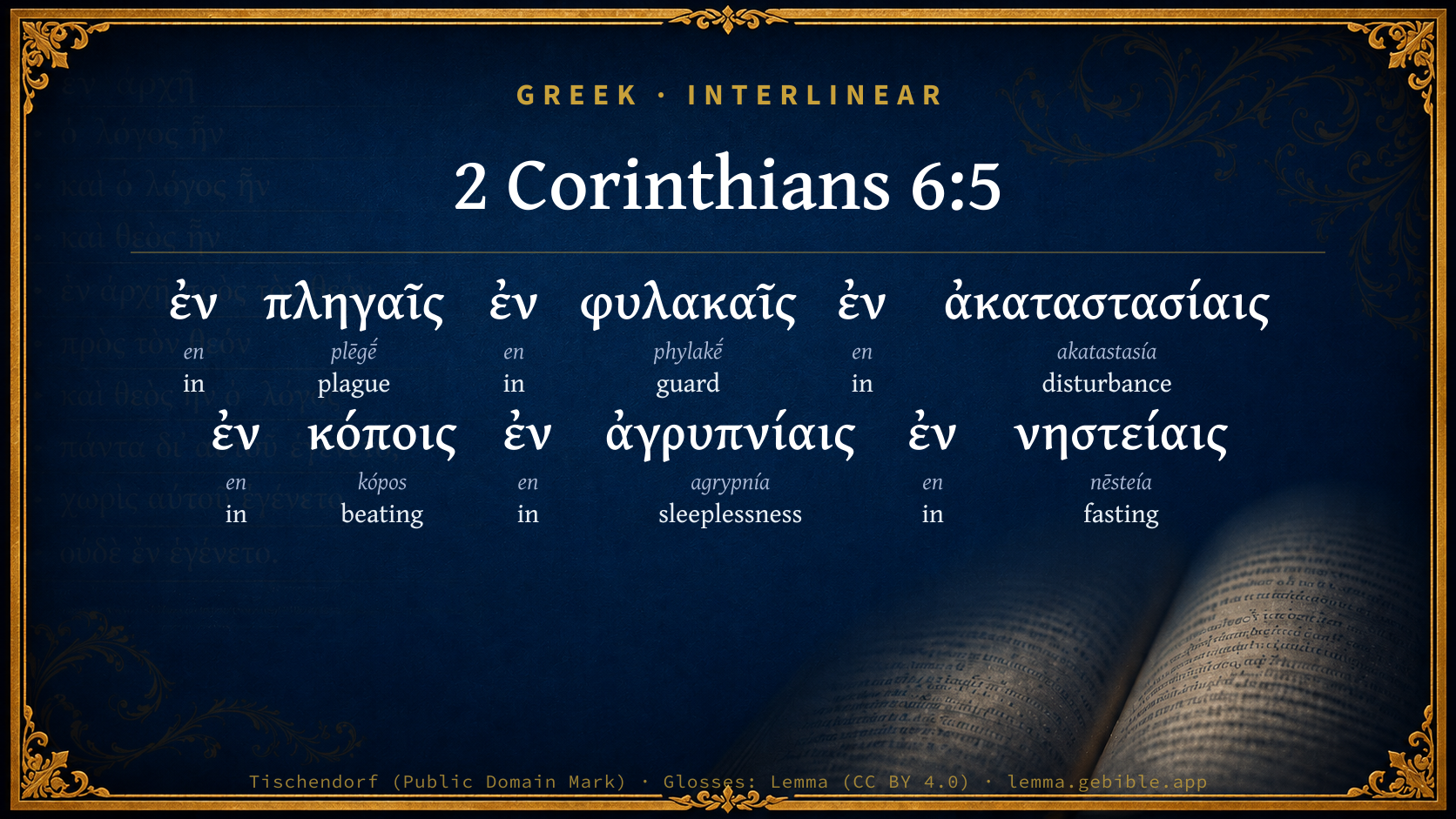
Greek (Tischendorf 8th ed.) 2 Corinthians 6:5 appears in the Greek New Testament. The text above is from the Tischendorf 8th edition. Each word links to its Strong’s number and a concise gloss. Click any word for its full Thayer’s Greek Lexicon entry.
Download image
Cite this verse

2 Corinthians 6:5 (World English Bible). Public Domain. Lemma interlinear Bible study tool, https://lemma.gebible.app/v/2-corinthians/6/5.

Show BibTeX & RIS
BibTeX
RIS
English Translation
in beatings, in imprisonments, in riots, in labors, in watchings, in fastings;
World English Bible · Public Domain
Highlights
  • 1 first appearance in the Greek New Testament
Full analysis ↓
Download a study sheet

One document with this verse’s original text, its word-by-word gloss line, the meaning frame, cross-references with their text, attributed commentary, and full source and license credits — printable, and it pastes into notes with its structure intact.

This verse Autodidact and up

Study sheet (.html) Plain text (.txt)

A passage Seminary Student

Up to 50 verses in one chapter. A passage sheet keeps up to 6 commentary sources and 12 cross-references per verse, in the order this page ranks them, and says so on the sheet whenever that leaves anything out. Ask for a single verse and you get the Autodidact verse sheet above.

Everything on this page stays free to read, with no account — the sheet is a download of what is already on screen, not access to it.

Want to remove ads? Support Godless Engineer
Compare translations 3

The same verse in 3 English versions, stacked beneath the original-language interlinear above. Click any original word for its lexicon entry.

Each is an independent rendering of the whole verse — the interlinear is not word-aligned to these translations.

Highlighted words mark where these versions differ — a whole-verse word diff, not a word-by-word alignment.

  • World English Bible Public Domain
    in beatings, in imprisonments, in riots, in labors, in watchings, in fastings;
  • King James Version Public Domain
    In stripes, in imprisonments, in tumults, in labours, in watchings, in fastings;
  • unfoldingWord Literal Text CC BY-SA 4.0
    in beatings, in imprisonments, in riots, in hard labors, in sleeplessness, in hungers,

unfoldingWord Literal Text — © unfoldingWord, licensed CC BY-SA 4.0. Word-aligned USFM3 via Door43 (git.door43.org/unfoldingWord/en_ult).

Versions to compare (up to 4)

3 of 4 selected

Show all 19 translations

Every available English version of this verse, each an independent rendering of the whole verse.

  • World English Bible Public Domain
    in beatings, in imprisonments, in riots, in labors, in watchings, in fastings;
  • Berean Standard Bible Public Domain
    in beatings, imprisonments, and riots; in labor, sleepless nights, and hunger;
  • Majority Standard Bible Public Domain
    in beatings, imprisonments, and riots; in labor, sleepless nights, and hunger;
  • King James Version Public Domain
    In stripes, in imprisonments, in tumults, in labours, in watchings, in fastings;
  • American Standard Version (1901) Public Domain
    in stripes, in imprisonments, in tumults, in labors, in watchings, in fastings;
  • Revised Version (1885) Public Domain
    in stripes, in imprisonments, in tumults, in labours, in watchings, in fastings;
  • Geneva Bible (1599) Public Domain
    In stripes, in prisons, in tumults, in labours,
  • Douay-Rheims (1899) Public Domain
    In stripes, in prisons, in seditions, in labours, in watchings, in fastings,
  • Young's Literal Translation Public Domain
    in stripes, in imprisonments, in insurrections, in labours, in watchings, in fastings,
  • Literal Standard Version CC BY-SA 4.0
    in stripes, in imprisonments, in insurrections, in labors, in watchings, in fastings,
  • Unlocked Literal Bible CC BY-SA 4.0
    beatings, imprisonments, riots, in hard work, in sleepless nights, in hunger,
  • unfoldingWord Literal Text CC BY-SA 4.0
    in beatings, in imprisonments, in riots, in hard labors, in sleeplessness, in hungers,
  • Darby Bible Public Domain
    in stripes, in prisons, in riots, in labours, in watchings, in fastings,
  • World Messianic Bible Public Domain
    in beatings, in imprisonments, in riots, in labors, in watchings, in fastings,
  • Webster's Bible Public Domain
    In stripes, in imprisonments, in tumults, in labors, in watchings, in fastings;
  • Free Bible Version CC BY-SA 4.0
    We have been beaten up, thrown into prison, and attacked by mobs. We have been worked to the bone, suffering sleepless nights and hunger.
  • Bible in Basic English Public Domain
    In blows, in prisons, in attacks, in hard work, in watchings, in going without food;
  • Text-Critical English NT CC BY 4.0
    in beatings, in imprisonments, in riots, in labors, in sleepless nights, in hunger,
  • Tyndale New Testament (1534) Public Domain
    in strypes in presonmet in stryfe in laboure in watchinge in fastyng

Literal Standard Version (2020), Covenant Press — licensed CC BY-SA 4.0. Text via the HelloAO Bible API (eBible.org). Unlocked Literal Bible (unfoldingWord) — licensed CC BY-SA 4.0. Text via the HelloAO Bible API (eBible.org). unfoldingWord Literal Text — © unfoldingWord, licensed CC BY-SA 4.0. Word-aligned USFM3 via Door43 (git.door43.org/unfoldingWord/en_ult). Free Bible Version, Dr. Jonathan Gallagher — licensed CC BY-SA 4.0. Text via the HelloAO Bible API (eBible.org).

Word by word

More ways to search: Search by grammar → Find every occurrence → Compare this word →

Practice this passage: Drill this verse → Learn its vocabulary →

About this verse

These counts appear in no published source. They are computed here, from the morphology-tagged text and Lemma’s own curated glosses. What Lemma adds →

12
words
7
distinct lemmas
Pauline Epistles
section

Notable vocabulary

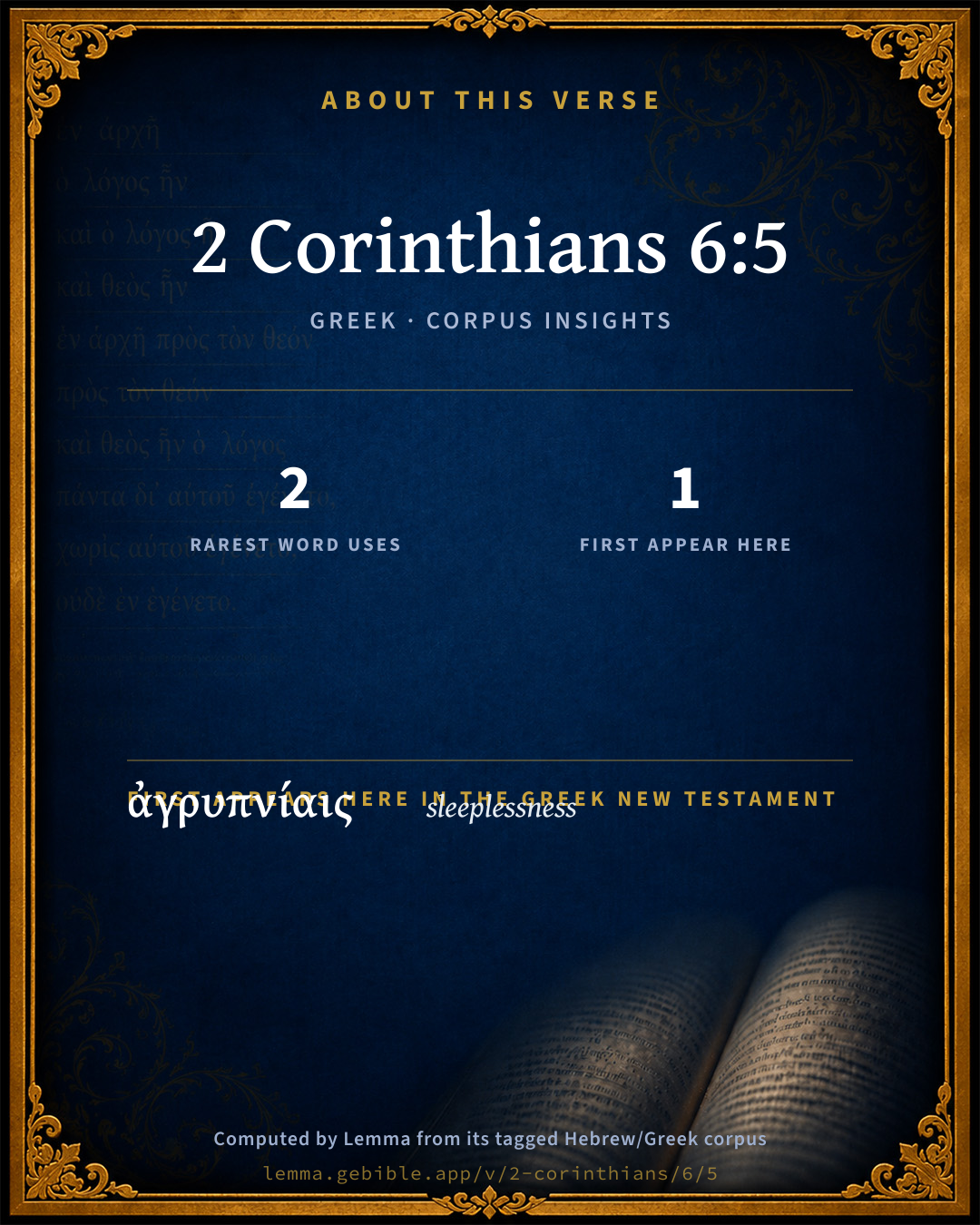
The rarest word here is ἀγρυπνίαις sleeplessness G70 — appearing just 2 times in the whole Greek New Testament.

First appearance in Scripture

This word makes its first canonical appearance in the Greek New Testament here:

  • ἀγρυπνίαις sleeplessness G70

Shared distinctive vocabulary

ἀγρυπνίαις sleeplessness G70 occurs in 2 verses of the Greek New Testament. Also found in:

Repetition

A word recurs within this verse:

Cross-references

48

Topical passages linked to 2 Corinthians 6:5 in the Treasury of Scripture Knowledge — connected by theme and wording, ordered by reader-vote popularity; previews shown in the World English Bible.

  • 2 Corinthians 11:23–25 Are they servants of Christ? (I speak as one beside himself) I am more so; in labors more abundantly, in prisons more abundantly, in stripes above measure, in deaths often.
  • 2 Corinthians 11:27 in labor and travail, in watchings often, in hunger and thirst, in fastings often, and in cold and nakedness.
  • Acts 17:5 But the unpersuaded Jews took along some wicked men from the marketplace, and gathering a crowd, set the city in an uproar. Assaulting the house of Jason, they sought to bring them out to the people.
  • Acts 19:23–34 About that time there arose no small stir concerning the Way.
  • Hebrews 11:36 Others were tried by mocking and scourging, yes, moreover by bonds and imprisonment.
  • Deuteronomy 25:3 Forty stripes he may give him, he shall not exceed; lest, if he should exceed, and beat him above these with many stripes, then your brother should seem vile to you.
  • 1 Kings 22:27 and say, Thus says the king, Put this fellow in the prison, and feed him with bread of affliction and with water of affliction, until I come in peace.
  • 2 Chronicles 16:10 Then Asa was angry with the seer, and put him in the prison-house; for he was in a rage with him because of this thing. Asa oppressed some of the people at the same time.
  • Isaiah 53:5 But he was pierced for our transgressions, he was crushed for our iniquities; the punishment that brought our peace was on him; and by his wounds we are healed.
  • Jeremiah 33:1 Moreover the word of Yahweh came to Jeremiah the second time, while he was yet shut up in the court of the guard, saying,
  • Jeremiah 37:15–16 The princes were angry with Jeremiah, and struck him, and put him in prison in the house of Jonathan the scribe; for they had made that the prison.
  • Jeremiah 38:6 Then took they Jeremiah, and cast him into the dungeon of Malchijah the king's son, that was in the court of the guard: and they let down Jeremiah with cords. In the dungeon there was no water, but mire; and Jeremiah sank in the mire.
  • Ezekiel 3:17 Son of man, I have made you a watchman to the house of Israel: therefore hear the word at my mouth, and give them warning from me.
  • Matthew 9:15 Jesus said to them, "Can the friends of the bridegroom mourn, as long as the bridegroom is with them? But the days will come when the bridegroom will be taken away from them, and then they will fast.
  • Matthew 14:3 For Herod had laid hold of John, and bound him, and put him in prison for the sake of Herodias, his brother Philip's wife.
  • Matthew 14:10 and he sent and beheaded John in the prison.
  • Mark 13:34–37 "It is like a man, traveling to another country, having left his house, and given authority to his servants, and to each one his work, and also commanded the doorkeeper to keep watch.
  • Acts 5:18 and laid hands on the apostles, and put them in public custody.
  • Acts 12:4–5 When he had arrested him, he put him in prison, and delivered him to four squads of four soldiers each to guard him, intending to bring him out to the people after the Passover.
  • Acts 13:3 Then, when they had fasted and prayed and laid their hands on them, they sent them away.
  • Acts 14:19 But some Jews from Antioch and Iconium came there, and having persuaded the multitudes, they stoned Paul, and dragged him out of the city, supposing that he was dead.
  • Acts 14:23 When they had appointed elders for them in every assembly, and had prayed with fasting, they commended them to the Lord, on whom they had believed.
  • Acts 16:23–24 When they had laid many stripes on them, they threw them into prison, charging the jailer to keep them safely,
  • Acts 18:12–17 But when Gallio was proconsul of Achaia, the Jews with one accord rose up against Paul and brought him before the judgment seat,
  • Acts 20:31 Therefore watch, remembering that for a period of three years I didn't cease to admonish everyone night and day with tears.
  • Acts 21:27–35 When the seven days were almost completed, the Jews from Asia, when they saw him in the temple, stirred up all the multitude and laid hands on him,
  • Acts 22:23–24 As they cried out, and threw off their cloaks, and threw dust into the air,
  • Acts 23:10 When a great argument arose, the commanding officer, fearing that Paul would be torn in pieces by them, commanded the soldiers to go down and take him by force from among them, and bring him into the barracks.
  • Acts 23:35 "I will hear you fully when your accusers also arrive." He commanded that he be kept in Herod's palace.
  • Acts 24:27 But when two years were fulfilled, Felix was succeeded by Porcius Festus, and desiring to gain favor with the Jews, Felix left Paul in bonds.
  • Acts 26:10 This I also did in Jerusalem. I both shut up many of the saints in prisons, having received authority from the chief priests, and when they were put to death I gave my vote against them.
  • Acts 26:29 Paul said, "I pray to God, that whether with little or with much, not only you, but also all that hear me this day, might become such as I am, except for these bonds."
  • Acts 28:16–17 When we entered into Rome, the centurion delivered the prisoners to the captain of the guard, but Paul was allowed to stay by himself with the soldier who guarded him.
  • Acts 28:30 Paul stayed two whole years in his own rented house, and received all who were coming to him,
  • 1 Corinthians 4:11 Even to this present hour we hunger, thirst, are naked, are beaten, and have no certain dwelling place.
  • 1 Corinthians 7:5 Don't deprive one another, unless it is by consent for a season, that you may give yourselves to fasting and prayer, and may be together again, that Satan doesn't tempt you because of your lack of self-control.
  • 1 Corinthians 15:10 But by the grace of God I am what I am. His grace which was bestowed on me was not futile, but I worked more than all of them; yet not I, but the grace of God which was with me.
  • 2 Corinthians 1:8–10 For we don't desire to have you uninformed, brothers, concerning our affliction which happened to us in Asia, that we were weighed down exceedingly, beyond our power, so much that we despaired even of life.
  • Ephesians 3:1 For this cause I, Paul, am the prisoner of Christ Jesus on behalf of you Gentiles,
  • Philippians 1:13 so that it became evident to the whole praetorian guard, and to all the rest, that my bonds are in Christ;
  • 1 Thessalonians 2:9 For you remember, brothers, our labor and travail; for working night and day, that we might not burden any of you, we preached to you the Gospel of God.
  • 1 Timothy 4:10 For to this end we both labor and suffer reproach, because we have set our trust in the living God, who is the Savior of all men, especially of those who believe.
  • 2 Timothy 1:8 Therefore don't be ashamed of the testimony of our Lord, nor of me his prisoner; but endure hardship for the Gospel according to the power of God,
  • 2 Timothy 2:9 in which I suffer hardship to the point of chains as a criminal. But God's word isn't chained.
  • 2 Timothy 4:5 But you be sober in all things, suffer hardship, do the work of an evangelist, and fulfill your ministry.
  • Hebrews 13:17 Obey your leaders and submit to them, for they watch on behalf of your souls, as those who will give account, that they may do this with joy, and not with groaning, for that would be unprofitable for you.
  • Hebrews 13:23 Know that our brother Timothy has been freed, with whom, if he comes shortly, I will see you.
  • Revelation 2:10 Don't be afraid of the things which you are about to suffer. Behold, the devil is about to throw some of you into prison, that you may be tested; and you will have oppression for ten days. Be faithful to death, and I will give you the crown of life.

Cross-references courtesy of OpenBible.info (CC BY 4.0).

Commentary

Notes on 2 Corinthians 6:5 from classic Christian and Jewish commentators (each source and its license shown beneath its notes). The classic Christian expositions comment on the surrounding passage and are grouped to its opening verse, so a note may address several verses; the Jewish commentaries on the Tanakh (Rashi and others) are per-verse, so they appear only where the commentator wrote on this verse.

Lemma curates 59 commentaries, every one of them public domain or Creative Commons licensed, each selected and text-cleaned for this edition rather than reprinted as found. About our sources →

Bengel's Gnomon

Johann Albrecht Bengel

2Co 6:5. Ἀκαταστασίαις, in tumults) either for, or against us.

Bengel's Gnomon of the New Testament — English translation (T&T Clark, Edinburgh, 1860) — public domain. Text from a community e-Sword module.

Expositor's Greek Testament

ed. W. Robertson Nicoll

2Co 6:5 . ( b ) These outward hardships are next more definitely exemplified from the opposition and persecution which St. Paul encountered from opponents during his missionary experiences. ἐν πληγαῖς , ἐν φυλακαῖς , ἐν ἀκαταστασίαις : in stripes (see reff. and cf. Act 22:24 ), in imprisonments (see on 2Co 11:23 ), in tumults ( cf. Act 13:50 ; Act 14:5 ; Act 14:19 ; Act 16:22 ; Act 17:5 ; Act 18:12 ; Act 19:29 ; Act 21:30 ). ἀκαταστασία might mean inward disorder , rather than external tumult (see reff., LXX, and cf. 1Co 4:11 ), but the latter meaning best suits the context here. ( c ) Next the Apostle enumerates the bodily hardships, voluntarily undertaken, which his work made it necessary to endure. ἐν κόποις , ἐν ἀγρυπνίαις , ἐν νηστείαις : in labours, sc. , probably his labours in preaching the Gospel (see reff., but cf. 1Th 2:9 , 2Th 3:8 , where κόπος is used of the manual labour he underwent in working for a livelihood; see also 1Co 4:11 ἀστατοῦμεν καὶ κοπιῶμεν ), in watchings, sc. , in nights rendered wakeful by anxiety or press of work (Act 20:31 ) or urgency of prayer (Act 16:25 and cf. Eph 6:18 ἀγρυπνοῦντες ), in fastings . Some expositors explain these νηστεῖαι as the voluntary fastings of religion (so Hooker, Eccl. Pol. , v., lxxii., 8; and cf. Act 13:2-3 ). And it is true that νηστεία (see reff.) and νηστεύω are always (outside this Epistle) used of fasting as a devotional observance. But in the parallel passage 2Co 11:27 νηστεῖαι is clearly used of involuntary abstinences from food; and this meaning seems better to suit the context here also ( cf. 1Co 4:11 , Phi 4:12 ) (§ 23). The triplet ( c ), then, means “in toil, in sleeplessness, in hunger”.

The Expositor's Greek Testament, edited by W. Robertson Nicoll (1897–1910) — public domain. Text from a community e-Sword module.

Geneva Bible (1599)

Geneva Bible translators

In tossing to and fro, finding no place of rest and quietness.

Geneva Bible (1599) marginal notes — public domain. Text via Bolls.life.

Jamieson, Fausset & Brown

Robert Jamieson, A. R. Fausset & David Brown

stripes-- (Co2 11:23-24; Act 16:23).

imprisonments-- (Co2 11:23). He had been, doubtless, elsewhere imprisoned besides at Philippi when he wrote this Epistle.

tumults-- (Act 13:50; Act 14:5, Act 14:19; Act 16:22; and recently Acts 19:23-41).

labours--in the cause of Christ (Co2 11:23; Rom 16:12).

watchings-- (Co2 11:27). Sleepless nights.

fastings--The context here refers to his trials, rather than devotional exercises (compare Co2 11:27). Thus "foodlessness" would seem to be the sense (compare Co1 4:11; Phi 4:12). But the usual sense of the Greek is fasts, in the strict sense; and in Co2 11:27 it is spoken of independently of "hunger and thirst." (Compare Luk 2:37; Act 10:30; Act 14:23). However, Mat 15:32; Mar 8:3, justify the sense, more favored by the context, foodlessness, though a rare use of the word. GAUSSEN remarks "The apostles combine the highest offices with the humblest exterior: as everything in the Church was to be cast in the mould of death and resurrection, the cardinal principle throughout Christianity."

Jamieson, Fausset & Brown — Commentary Critical and Explanatory on the Whole Bible (1871) — public domain (CC PDM 1.0). Text via the HelloAO Bible API.

Adam Clarke's Commentary

Verse 5. In stripes, in imprisonments] Of these the history of the Acts of the Apostles gives ample testimony; and there were doubtless many instances of persecution in various forms which are not on record.

In tumults] ακαταστασιαις. Insurrections raised against them because of the Gospel. It is more natural to understand the word thus, than of agitations, or tossings to and fro in consequence of their unsettled state of life; or because of persecution, which obliged them to flee from place to place.

In labours] Both with our own hands to provide for ourselves the necessaries of life, that we might not be chargeable to others; and in labours to spread the Gospel of God through all countries where his providence opened our way.

In watchings] Passing many nights without sleep or rest.

In fastings] Partly constrained through want of food; and partly voluntary, as a means of obtaining an increase of grace both for ourselves and for the Churches.

Adam Clarke's Commentary on the Bible (1810–1826) — public domain. Text from a community e-Sword/MySword module.

John Calvin's Commentaries

5. In tumults In proportion to the calmness and gentleness of Paul’s disposition was there the greater excellence displayed in his standing undaunted in the face of tumults; and he takes praise to himself on this account — that while he regarded tumults with abhorrence, he nevertheless encountered them with bravery. Nor does the praise simply consist in his being unmoved by tumults, (this being commonly found among all riotous persons, ) but in his being thrown into no alarm by tumults that had been stirred up through the fault of others. And, unquestionably, two things are required on the part of ministers of the Gospel — that they should endeavor to the utmost of their power to maintain peace, and yet on the other hand go forward, undaunted, through the midst of commotions, so as not to turn aside from the right course, though heaven and earth should be mingled. Chrysostom, however, prefers to understand ἀκαταστασίαις to mean — frequent expulsions, inasmuch as there afforded him a place of rest. In fastings He does not mean — hunger arising from destitution, but a voluntary exercise of abstinence.

John Calvin's Commentaries (1540-1563) — public domain. Text from the Calvin Translation Society English edition (1840s-50s) via the Christian Classics Ethereal Library (ccel.org). Calvin's coverage is partial (roughly two-thirds of the Bible); uncommented books and verses are honest gaps, never fabricated. The 19th-century editor's footnotes and remarks are omitted so the notes are faithfully Calvin's own voice.

Ellicott's Commentary for English Readers

(5) In stripes . . .—The list becomes more specific. “Stripes” we have seen at Philippi (Act_16:23), and 2Co_11:23-24 show that there were other instances. Of “imprisonment?,” that at Philippi is, so far, the only recorded instance (Act_16:24); but there may well have been others, as in 2Co_11:23. “Tumults” (the same word as in Luk_21:9) at Antioch in Pisidia (Act_13:50), Lystra (Act_14:5-19), Thessalonica (Act_17:5), Corinth itself (Act_18:12), and Ephesus (Act_19:23-41). “Labours” describe the usual tenor of his life, the daily work of his calling as a tent-maker, as well as that connected with his ministry. “Watchings” and “fastings” are, probably, both of them (comp. 2Co_11:27) to be referred to voluntary acts—nights of vigil and self-imposed abstinence—rather than to privations incidental to his work.

A Bible Commentary for English Readers, edited by Charles John Ellicott (1878–1897) — public domain. Text from a community e-Sword module.

The Cambridge Bible for Schools and Colleges

gen. ed. J. J. S. Perowne

5. in stripes] Cf. ch. 2Co_11:23-24; Act_16:23.

in imprisonments] Cf. ch. 2Co_11:23. The Acts of the Apostles, up to this date, records only one such, namely that at Philippi, Act_16:23-40. But the Acts is far from recording all the events of St Paul’s life. See notes on ch. 11:and on ch. 2Co_1:8.

in tumults] The word in the original signifies primarily unsettlement. Cf. margin of A. V., tossings to and fro. St Chrysostom would interpret it of the uncertain dwelling-place of the Apostle. But the word came to mean disorder or tumult. See Luk_21:9; 1Co_14:33; Jas_3:16, as well as ch 2Co_12:20, where the word occurs. In these passages moral disorder, not local unsettlement, is clearly implied. For the tumults which the Apostle went through see Act_13:50; Act_14:5; Act_14:19; Act_16:22; Act_17:5; Act_18:12; Act_19:23-41.

in labours] i.e. (1) the toils by which he supported himself (cf. Act_18:3; Act_20:34; 1Th_2:9; 2Th_3:8); and (2) his labours for the cause of Christ (cf Rom_16:12; 1Ti_4:10).

in watchings] Literally, sleeplessnesses, caused by “manual labour, teaching, travelling, meditating, praying, cares and the like.” Meyer.

in fastings] Since St Paul himself distinguished these fastings from ordinary hunger and thirst (ch. 2Co_11:27) we must do so also. “Not fasting from want, but a voluntary exercise of abstinence.” Calvin. Fasting, we know, was practised under the new Covenant as well as the old. See Act_13:2-3; Act_14:23.

The Cambridge Bible for Schools and Colleges (gen. ed. J. J. S. Perowne; Cambridge University Press, 1878–1918) — public domain. Text from a community e-Sword module.

John Gill's Exposition

By pureness,.... The apostle having observed how he, and other ministers of God, showed themselves to be such by patiently bearing everything that was afflictive and distressing to the outward man, proceeds to show how they approved themselves in other respects; and which more chiefly regard the inward man, the exercise of grace, and a spiritual behaviour: "by pureness"; of doctrine and conversation, chastity of body and mind, sincerity of heart, and integrity of life:

by knowledge; of the Scriptures of truth, the mysteries of grace; or by a prudent conduct, a walking in wisdom with caution and circumspection:

by longsuffering: not easily provoked to wrath, but bearing with patience every indignity and affront:

by kindness; gentleness, sweetness of temper and manners, affability and courteousness:

by the Holy Ghost; influencing and assisting in the exercise of every grace, and the discharge of every duty, or by the gifts of the Holy Ghost, ordinary and extraordinary:

by love unfeigned; without dissimulation, being not in word only, but in deed and in truth towards the brethren, and to all men.

John Gill's Exposition of the Whole Bible (1746–1763) — public domain (CC PDM 1.0). Text via the HelloAO Bible API.

Trapp's Complete Commentary

John Trapp

5 In stripes, in imprisonments, in tumults, in labours, in watchings, in fastings;

Ver. 5. In imprisonment] Chrysostom saith, he had rather be Paul cast into a prison than Paul rapped up into Paradise.

John Trapp, A Commentary or Exposition upon All the Books of the Old and New Testament (1647–1656) — public domain. Text from a community e-Sword module.

Albert Barnes' Notes on the Bible

In stripes - In this verse, Paul proceeds to specifications of what he had been called to endure. In the previous verse, he had spoken of his afflictions in general terms. In this expression, he refers to the fact that he and his fellow-laborers were scourged in the synagogues and cities as if they had been the worst of people. In 2Co 11:23-25, Paul says that he had been scourged five times by the Jews, and had been thrice beaten with rods. See the notes on that place.

In imprisonments - As at Philippi; Act 16:24 ff. It was no uncommon thing for the early preachers of Christianity to be imprisoned.

In tumults - Margin, “Tossing to and fro.” The Greek word (ἀκαταστασία akatastasia) denotes properly “instability,” thence disorder, tumult, commotion. Here it means that in the various tumults and commotions which were produced by the preaching of the gospel, Paul endeavored to act as became a minister of God. Such tumults were excited at Corinth Act 18:6; at Philippi Act 16:19-20; at Lystra and Derbe Act 14:19; at Ephesus Acts 19, and in various other places. The idea is, that if the ministers of religion are assailed by a lawless mob, they are to endeavor to show the spirit of Christ there, and to evince all patience, and to do good even in such a scene. Patience and the Christian spirit may often do more good in such scenes than much preaching would do elsewhere.

In labors - Referring probably to the labors of the ministry, and its incessant duties, and perhaps also to the labors which they performed for their own support, as it is well known that Paul and probably also the other apostles, labored often to support themselves.

In watchings - In wakefulness, or lack of sleep. He probably refers to the fact that in these arduous duties, and in his travels, and in anxious cares for the churches, and for the advancement of religion, he was often deprived of his ordinary rest. He refers to this again in 2Co 11:27.

In fastings - Referring probably not only to the somewhat frequent fasts to which he voluntarily submitted as acts of devotion, but also to the fact that in his travels, when abroad and among strangers, he was often destitute of food. To such trials, those who traveled as Paul did, among strangers, and without property, would be often compelled to submit; and such trials, almost without number, the religion which we now enjoy has cost. It at first cost the painful life, the toils, the anxieties, and the sufferings of the Redeemer; and it has been propagated and perpetuated amidst the deep sorrows, the sacrifices, and the tears and blood of those who have contributed to perpetuate it on earth. For such a religion, originated, extended, and preserved in such a manner, we can never express suitable gratitude to God. Such a religion we cannot overestimate in value; and for the extension and perpetuity of such a religion, we also should be willing to practice unwearied self denial.

Albert Barnes' Notes on the Bible (1834–1885) — public domain. Text from a community e-Sword/MySword module.

Matthew Poole's English Annotations

In stripes: the apostle, 2Co 11:23, tells us he was in stripes above measure; and 2Co 11:24, that of the Jews he five times received forty stripes save one: we read of his many stripes, Act 16:23.

In imprisonments; of the imprisonment of him and Silas, Act 16:23, which was not the only time before the writing of this Epistle, as appeareth by this verse.

In tumults, or seditions raised by the Jews and the heathens; we have a record of one at Ephesus, Act 19:21-41, caused by Demetrius: others, by tumults, here, understand unfixed and uncertain habitations, tossing to and fro, so as they could be quiet in no place; but the former seemeth rather the sense of the word, as Luk 21:9; 1Co 14:33.

In labours; he either means labours with his hands, (which Paul was sometimes put to, as Act 18:3; 20:34), or travels and journeys. The word is a general word, significative of any pains that men take.

In watchings; religious watching, 2Co 11:27.

In fastings, as acts of discipline, by which he kept under his body, and brought it into subjection, as he told us, 1Co 9:27.

Matthew Poole's English Annotations on the Holy Bible (1683–1685) — public domain. Text from a community e-Sword/MySword module.

Whedon's Commentary on the Bible

Daniel D. Whedon

5. Stripes—See note 2Co_11:24.

Imprisonments—As at Philippi; narrated in Acts. Alford says: “He may have been imprisoned in Antioch in Pisidia, Act_13:50; and at Lystra, Act_14:19; and at Corinth, Act_18:12; Act_18:14; and we cannot tell what may have befallen him during his journeys, Act_15:41; Act_16:6; Act_18:23.”

Tumults—Excitements and mobs raised against him. Luke’s history in Acts abounds with narratives of such movements wherever Paul went.

Labours—The travellings, the toils for self-support, and the arduous preachings and cares for the Churches.

Watchings—Sleeplessnesses.

Fastings—Not voluntary religious fastings—for he is here enumerating severities necessarily suffered—but compulsory hungers. The thus far enumerated sufferings Alford holds to be properly embraced under the term patience, or endurance, with which the catalogue commences.

Daniel D. Whedon (gen. ed.), Commentary on the Old and New Testaments (1874–1909) — public domain. Text from a community e-Sword module.

The Pulpit Commentary

In stripes. (comp. 2Co_11:23-28) The stripes were of two kinds from Jewish whips and Roman rods. But of the five scourgings with Jewish whips not one is mentioned in the Acts, and only one of the three scourgings with Roman rods. (Act_16:23) Nothing, therefore, is more clear than that the Acts only furnishes us with a fragmentary and incomplete record, in which, as we gather from the Epistles, either the agonies of St. Paul"s lifelong martyrdom are for some reason intentionally minimized, or else (which is, perhaps, mere probable) St. Paul was, as his rule and habit, so reticent about his own sufferings in the cause of Christ that St. Luke was only vaguely, if at all, aware of many scenes of trial through which he had passed. In imprisonments. St. Paul was frequently in prison, but St. Luke only tells us of one of these occasions (Act_16:24) at Philippi; the Roman imprisonment and that at Caesarea were subsequent to this Epistle. In tumults. These were a normal incident of St. Paul"s life, both up to this time and for years afterwards (Act_13:50 Act_14:19 Act_16:22 Act_17:4, 5 18:12 19:28, 29 21:27-39 22:22, 23 23:9, 10 27:42, etc.) The word akatastasiai might also mean "insecurities," i.e. homelessness, wanderings, uncertainties; (1Co_4:11) but New Testament usage seems decisive in favour of the frowner meaning (2Co_12:20; 1Co_14:33; Jam_3:15) In labours (2Co_11:28; 1Co_4:12 1Co_15:10; Act_20:34; 1Th_2:9; 2Th_3:8) In watchings. "Spells of sleeplessness" were a necessary incident of such a life; and an eminently nervous nature like that of St. Paul is rarely capable of the habitual relief of sound steep. Hence he again refers to this in 2Co_11:27. His "sleeplessness" was sometimes the necessary result of labours "night and day" (Act_20:31; 1Th_2:9, etc.) In fastings. St. Paul never inculcates the practice of voluntary fasting as a duty (for the reading in 1Co_7:5 is more than dubious); but it is probable that he found it personallyuseful at times. (Act_13:2, 3 14:23 9:9) The nine forms of suffering hitherto mentioned three general, three specific, and three voluntary are all physical sufferings borne with "much endurance."

The Pulpit Commentary (1880–1919), ed. H.D.M. Spence-Jones & Joseph S. Exell — public domain. Text from a community e-Sword module.

John Wesley's Explanatory Notes

In tumults - The Greek word implies such attacks as a man cannot stand against, but which bear him hither and thither by violence.

John Wesley, Explanatory Notes Upon the Whole Bible (1754–1765) — public domain. Text via the GEBible commentary corpus.

McGarvey & Pendleton's Commentaries

J. W. McGarvey

in stripes, in imprisonments, in tumults, in labors, in watchings, in fastings [Instead of weakening his ministry by making it blameworthy, Paul had striven to make it commendable by the patient endurance of all manner of trials. Had he shrunk from enduring these trials, he would have been ill qualified to prescribe for others those rules of duty which called for self-sacrifice, one of which rules he is about to lay down for the Corinthians. Paul specifies three classes of sufferings which he endured, and each class contained three members. In the first three the idea of hindrance predominates, and in the second that of violent opposition, and in the third that of hardship. For a sample of Paul's afflictions see 2Co_1:4-11 . For necessities arising from his poverty, etc., see Act_20:34 ; and compare with incidents in his later life; as, Phi_4:12 and 2Ti_4:13 . The word "distresses," which forms the climax of the first triplet, means "extreme pressure" and is used to describe one who is jammed in a corner, or so pressed upon by the multitude that he can not move: it is found at 2Co_4:8 . For the "stripes" see 2Co_11:23-28 . The only instance of imprisonment of which Luke tells us is found at Act_16:24 . The imprisonments at Jerusalem, Cæsarea and Rome took place after this was written. As to the tumults, they were the normal incidents of Paul's daily life ( Act_13:50 ; Act_14:19 ; Act_26:22 ; Act_17:4-5 ; Act_18:12 ; Act_19:28 ; Act_19:29 ; Act_21:27-39 ; Act_22:22-23 ; Act_23:9-10 ; Act_27:42 ; etc.). As to Paul's wasting labors, see 2Co_11:28 ; 1Co_4:12 ; 1Co_15:10 ; Act_20:34 ; 1Th_2:9 ; 2Th_3:8 ; Rom_16:12 . We may well imagine that so many tumults and such incessant labor would result in many sleepless nights or painful watchings ( 2Co_11:27 ); but Paul also labored at night (Acts 20:31; 1Th_2:9 ; etc.). The fastings mentioned were not voluntary, but indicate the unavoidable hunger which came upon him by reason of his incessant ministry. Having rehearsed the sufferings which he endured, the apostle next names six especial gifts or virtues which he manifested while thus enduring];

J. W. McGarvey (with Philip Y. Pendleton), Commentaries on the New Testament (The Fourfold Gospel, 1914; Acts; and the epistles) — public domain. Text from a community e-Sword/MySword module.

The People's New Testament

B. W. Johnson

5. In stripes. See 11:23, 24. In imprisonments. He was imprisoned at Philippi, Jerusalem, Cæsarea, and Rome, at least. In tumults. See Acts 14:19; 16:22; 19:29; 21:30.

B. W. Johnson's The People's New Testament with Notes (1889–1891) — public domain. Electronic text from the Christian Classics Ethereal Library (CCEL) ThML edition.

Cambridge Greek Testament for Schools and Colleges

5. ἐν πληγαῖς, ἐν φυλακαῖς, ἐν ἀκαταστασίαις. Another field in which the ὑπομονή is manifested. These are the troubles which are inflicted on him by men. The πληγαί refer to scourgings or beatings from Jews or Rom 11:23-25; Act 16:23. We know of only one imprisonment of the Apostle previous to this letter, viz. the one at Philippi; but evidently there had been others (2Co 11:23). He was expelled from Antioch in Pisidia, and was stoned at Lystra; and he may have been put in prison previous to these indignities. What might be called ἀκαταστασίαι (2Co 12:20; Luk 21:9; Pro 26:28) are frequent in Acts (Act 13:50; Act 14:5; Act 14:19; Act 16:19; Act 16:22; Act 17:5; Act 18:12; Act 19:23).

ἐν κόποις, ἐν ἀγρυπνίαις, ἐν νηστείαις. The third field in which ὑπομονή is exhibited;—the troubles which he laid upon himself as a necessary part of his work. By κόποι (2Co 11:23; 2Co 11:27; 1Co 15:28) is meant all that involves great toil and weariness; by ἀγρυπνίαι (2Co 11:27; often in Ecclus.) all that interferes with sleep. The two cover all his energy, working with his hands, travelling, teaching, praying, ‘anxiety about all the Churches.’ Usage (Luk 2:37; Act 14:23; Act 27:9) almost requires us to understand νηστεῖαι of voluntary abstinence, rather than of inability to obtain food. In 2Co 11:27 he distinguishes νηστεῖαι from hunger and thirst (1Co 4:11). We pass on from the fields in which ὑπομονή is manifested to characteristics which are coordinate with ὑπομονή: but ἐν must still be rendered ‘in,’ not ‘by.’

Cambridge Greek Testament for Schools and Colleges (Cambridge University Press, 1896; 21 vols, various authors incl. Carr, Maclear, Plummer, Farrar, Lumby, Moule, M. R. James, Simcox) — public domain. Text from a community e-Sword module.

Alford’s Greek Testament

Henry Alford

5.] On πληγ., see reff.

φυλακ.] At Philippi only as yet, as far as we know from the narrative of the Acts;—but there must have been many other occasions, see ch. 11:23. He may have been imprisoned at Antioch in Pisidia, Act 13:50, and at Lystra, 14:19 and at Corinth, 18:12, 14: and we cannot tell what may have befallen him during his journeys, Act 15:41; Act 16:6; Act 18:23.

ἐν ἀκαταστ.] in tumults, see Act 13:50; Act 14:5,Act 14:19; Act 16:22; Act 17:5; Act 18:12, and above all, 19:23-41. The sense given by Chrys. (p. 522), al., τὸ μηδαμοῦ δύνασθαι στῆναι ἐλαυνόμενον, is philologically allowable, cf. Demosth. 383. 7, ἀκατάστατον ὥσπερ ἐν θαλάττῃ πνεῦμα, and Jas 1:8, and Polyb. xxxi. 13. 6, ὑποδεικνύων αὐτοῖς τὴν ἀκαταστασίαν τῆς βασιλείας,—but not found in N. T.

ἐν κόποις] usually, and here, signifies ‘labour in the Lord,’ for his sake, see reff. So also κοπιάω, Rom 16:6, Rom 16:12 (bis), and reff. Chrys., al., interpret it of his manual work, 1Co 4:12; and ἀστατοῦμεν and κοπιῶμεν occurring there together certainly gives some semblance to the view: but see ch. 11:23, where this can hardly be; it is most probable that the weariness of his excessive apostolic labour was in his mind.

ἀγρυπνίαις] Chrys. says, p. 523, τὰς νύκτας ἐν αἷς ἐδίδασκεν. ἢ ὅτι καὶ ἐν αὐταῖς εἰργάζετο. But I would rather believe the ἀγρυπνίαι to have been watchings through anxiety for the churches.

ἐν νηστείαις] This is generally, and by De W. against Meyer, taken to refer to involuntary hunger and thirst. But, as the latter remarks, the word does not appear to be ever so used; and in ch. 11:27, Paul himself distinguishes ἐν νηστείαις from ἐν λιμῷ κ. δίψει. The meaning of fastings must therefore be retained. So Chrys., Theodoret, and Calvin.

Henry Alford, The Greek Testament (1849–1861) — public domain. Text from a community e-Sword module.

International Critical Commentary

5. ἐν πληγαῖς, ἐν φυλακαῖς, ἐν ἀκαταστασίαις. This triplet consists of troubles inflicted by men. It is doubtful whether there is any climax; but St Paul might think ‘stripes’ (11:23) less serious than ‘imprisonments’ (11:23), which stopped his work for a time, and imprisonments less serious than ‘tumults,’ which might force him to abandon work altogether in the place in which the tumult occurred. Clem. Rom. (Cor. 6) says of St Paul, ἑπτάκις δεσμὰ φορέσας, but the only imprisonment known to us prior to 2 Cor. is the one at Philippi. Popular tumults against St Paul are freq. in Acts (13:50, 14:5, 19, 17:5, 18:12, 19:23-41). In 1Co 4:11, the Apostle, in describing the experiences of Apostles, says κολαφιζόμεθα, ἀστατοῦμεν, ‘we are buffeted, are homeless,’ and some would give the meaning of ‘homelessness, vagrant life’ to ἀκαταστασία here. Chrys. seems to understand it in the sense of ‘being driven from pillar to post,’ but in N.T. the signification of the word is ‘disorder’ in one of two senses, viz. ‘want of order, confusion’ (1Co 14:33; Jas 3:16), and ‘breach of order, tumult’ (here and Luk 21:9). In LXX only twice, in the former sense (Pro 26:28; Tob. 4:13). In De Singularite Clericorum we again have two words in the Latin for one in the Greek; in seditionibus, in invocationibus. It is difficult to see what the latter can mean, and one might conjecture in concitationibus, the in being accidentally repeated, or in implicationibus, ‘in entanglements.’

ἐν κόποις, ἐν ἀγρυπνίαις, ἐν νηστείαις. This third triplet consists of those troubles which he took upon himself in the prosecution of his mission. Thdrt. groups the first two triplets together as τὰ ἔξωθεν ἐπίοντα. and ἀκούσια: προστίθησι δὲ τοῖς ἀκουσίοις καὶ τοὺς αὐθαιρέτους πόνους. There is order in this triplet also, and perhaps one may call it a climax; κόποι disturb the day, ἀγρυπνίαι the night, and νηστεῖαι both. St Paul repeatedly speaks of κόποι as a prevailing feature in his own life (11:23, 27; 1Th 2:9, 1Th 2:3:5; 2Th 3:8). While πόνος indicates the effort which was required, κόπος points to the fatigue which was incurred. Trench, § cii., suggests ‘toil’ for πόνος and ‘weariness’ for κόπος: but in the ordinary Greek of this period the difference between the two words was vanishing. Swete remarks that κόπος with its cognate κοπιᾷν is “almost a technical word for Christian work,” and that in Rev 2:2 τὸν κόπον and τὴν ὑπομονήν are “two notes of excellence, self-denying labour and perseverance.”

ἐν ἀγρυπνίαις. Here and 11:27 only in N.T. The word covers more than sleeplessness; it includes all that prevents one from sleeping. At Troas Paul preached until midnight and yet longer (Act 20:7, Act 20:9). In LXX the word is almost confined to Ecclus., where it is freq. and commonly means forgoing sleep in order to work. The Apostle no doubt often taught, and travelled, and worked with his hands to maintain himself, by night.

ἐν νηστείαις. Not ‘fasts’ in the religious sense; * but, just as ἀγρυπνία is voluntary forgoing of sleep in order to get more work done, so νηστεῖαι is voluntary forgoing of food for the same reason. St Paul often neglected his meals, having ‘no leisure so much as to eat’ (Mar 6:31). We infer from 11:27 that νηστεῖαι are voluntary abstentions from food, for there they are distinguished from involuntary hunger and thirst. Here the meaning might be that he neglected the handicraft by which he earned his bread (1Co 4:11, 1Co 4:12), or that he refused the maintenance which he might have claimed (1Co 9:4). But omitting meals in order to gain time is simpler. These sufferings, voluntarily undertaken, form an easy transition to the virtues which are evidence that he is one of God’s ambassadors and fellow-workers.

International Critical Commentary — older volumes (1896–1929), various authors — public domain. Text from a community e-Sword module.

Vincent's Word Studies in the New Testament

Marvin R. Vincent

Imprisonments [φυλακαις] . See on Act 5:21.

Tumults [ακαταστασιαις] . See on Luk 21:9, and compare ajkatastatov unstable, Jas 1:8. This is one of the words which show the influence of political changes. From the original meaning of unsettledness, it developed, through the complications in Greece and in the East after the death of Alexander, into the sense which it has in Luke - political instability. One of the Greek translators of the Old Testament uses it in the sense of dread or anxious care.

Watchings [αγρυπνιαις] . Only here and ch. 11 27. See on the kindred verb, Mr 13:33. For the historical facts, see Act 16:25; Act 20:7 - 11, 31; 2Th 3:8.

Fastings [νηστειαις] . Mostly of voluntary fasting, as Mt 17:21; Act 14:23; but voluntary fasting would be out of place in an enumeration of hardships.

Marvin R. Vincent, Word Studies in the New Testament (1887–1900) — public domain. Text from a community e-Sword/MySword module.

Lesson kit

Teaching starters — assembled from the data on this page, not authored interpretation. Every prompt links to the verse data it draws on. Edit before teaching.

2 Corinthians, in the Pauline Epistles, opens this verse with 12 words (7 distinct Greek lemmas). Its most distinctive word is agrypnía (“sleeplessness”). A historical commentator’s framing appears above. Read the whole chapter for the surrounding context.

Discussion questions

  1. The word agrypnía carries the sense “sleeplessness.” How does it shape the verse?
  2. This is the first place “sleeplessness” appears in Scripture (first appears here). What does its debut here establish?
  3. How does 2 Corinthians 11:27, which shares the word «sleeplessness», read alongside this verse?
  4. What does the repetition of “in” (6× in this one verse) do in this verse?
  5. The translations on this page render this verse differently — a whole-verse word diff, not a word-by-word alignment. What might account for the different wordings?
  6. Compare how Bengel's Gnomon and Expositor's Greek Testament read this verse. Where do they agree or differ?

Things to notice

  • 1 word makes its first canonical appearance in Scripture here.
  • These translations choose different wording for 11 words in this verse.
  • “in” occurs 6× in this single verse.
  • 7 distinct Greek lemmas span 12 words in this verse.

Reading settings

Reading text

Shown beneath each verse's original-language words.

Old Testament
Old Testament edition

Read the OT as the Masoretic Hebrew (MT) or the Greek Septuagint (LXX).

English shown for the Greek Septuagint (in the Hebrew ↔ Greek comparison).

Comparing translations? Open the Compare panel on any verse page to stack up to four side by side.