2 Chronicles 21:14

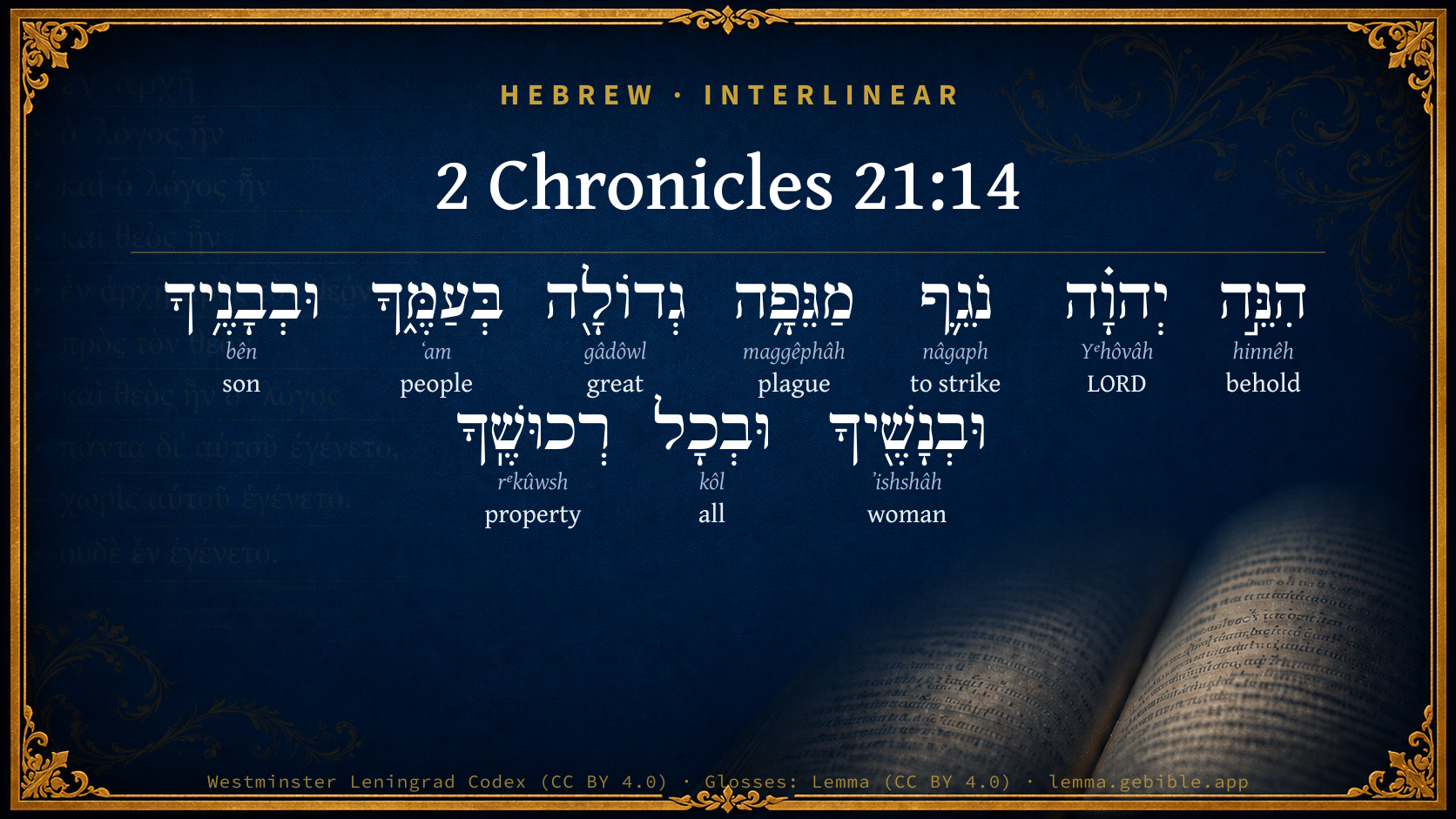
Hebrew (Westminster Leningrad Codex) 2 Chronicles 21:14 appears in the Hebrew Old Testament. The text above is from the Westminster Leningrad Codex. Each word links to its Strong’s number, a concise gloss, and parsing drawn from the Open Scriptures Hebrew Bible morphology. Click any word for its full Brown-Driver-Briggs (BDB) entry.
Download image
Cite this verse

2 Chronicles 21:14 (World English Bible). Public Domain. Lemma interlinear Bible study tool, https://lemma.gebible.app/v/2-chronicles/21/14.

Show BibTeX & RIS
BibTeX
RIS
English Translation
behold, Yahweh will strike with a great plague your people, and your children, and your wives, and all your substance;
World English Bible · Public Domain
Download a study sheet

One document with this verse’s original text, its word-by-word gloss line, the meaning frame, cross-references with their text, attributed commentary, and full source and license credits — printable, and it pastes into notes with its structure intact.

This verse Autodidact and up

Study sheet (.html) Plain text (.txt)

A passage Seminary Student

Up to 50 verses in one chapter. A passage sheet keeps up to 6 commentary sources and 12 cross-references per verse, in the order this page ranks them, and says so on the sheet whenever that leaves anything out. Ask for a single verse and you get the Autodidact verse sheet above.

Everything on this page stays free to read, with no account — the sheet is a download of what is already on screen, not access to it.

Want to remove ads? Support Godless Engineer
Compare translations 3

The same verse in 3 English versions, stacked beneath the original-language interlinear above. Click any original word for its lexicon entry.

Each is an independent rendering of the whole verse — the interlinear is not word-aligned to these translations.

Highlighted words mark where these versions differ — a whole-verse word diff, not a word-by-word alignment.

  • World English Bible Public Domain
    behold, Yahweh will strike with a great plague your people, and your children, and your wives, and all your substance;
  • King James Version Public Domain
    Behold, with a great plague will the LORD smite thy people, and thy children, and thy wives, and all thy goods:
  • unfoldingWord Literal Text CC BY-SA 4.0
    Behold, Yahweh is striking a great striking among your people, and among your sons, and among your wives, and among all your goods,

unfoldingWord Literal Text — © unfoldingWord, licensed CC BY-SA 4.0. Word-aligned USFM3 via Door43 (git.door43.org/unfoldingWord/en_ult).

Versions to compare (up to 4)

3 of 4 selected

Show all 18 translations

Every available English version of this verse, each an independent rendering of the whole verse.

  • World English Bible Public Domain
    behold, Yahweh will strike with a great plague your people, and your children, and your wives, and all your substance;
  • Berean Standard Bible Public Domain
    So behold, the LORD is about to strike your people, your sons, your wives, and all your possessions with a serious blow.
  • Majority Standard Bible Public Domain
    So behold, the LORD is about to strike your people, your sons, your wives, and all your possessions with a serious blow.
  • King James Version Public Domain
    Behold, with a great plague will the LORD smite thy people, and thy children, and thy wives, and all thy goods:
  • American Standard Version (1901) Public Domain
    behold, Jehovah will smite with a great plague thy people, and thy children, and thy wives, and all thy substance;
  • Revised Version (1885) Public Domain
    behold, the LORD will smite with a great plague thy people, and thy children, and thy wives, and all thy substance:
  • Geneva Bible (1599) Public Domain
    Beholde, with a great plague will the Lord smite thy people, and thy children, and thy wiues, and all thy substance,
  • Douay-Rheims (1899) Public Domain
    Behold the Lord will strike thee with a great plague, with all thy people, and thy children, and thy wives, and all thy substance.
  • Young's Literal Translation Public Domain
    lo, Jehovah is smiting -- a great smiting -- among thy people, and among thy sons, and among thy wives, and among all thy goods --
  • Literal Standard Version CC BY-SA 4.0
    behold, YHWH is striking [with] a great striking among your people, and among your sons, and among your wives, and among all your goods—
  • Unlocked Literal Bible CC BY-SA 4.0
    see, Yahweh will strike with a great plague your people, your children, your wives, and all your possessions.
  • unfoldingWord Literal Text CC BY-SA 4.0
    Behold, Yahweh is striking a great striking among your people, and among your sons, and among your wives, and among all your goods,
  • Darby Bible Public Domain
    behold, Jehovah will smite with a great stroke thy people, and thy children, and thy wives, and all thy substance,
  • World Messianic Bible Public Domain
    behold, the LORD will strike your people with a great plague, including your children, your wives, and all your possessions;
  • Webster's Bible Public Domain
    Behold, with a great plague will the LORD smite thy people, and thy children, and thy wives, and all thy goods:
  • Free Bible Version CC BY-SA 4.0
    Watch out, for the Lord is going to hit your people hard—your sons, your wives, and all that you own.
  • Bible in Basic English Public Domain
    Now, truly, the Lord will send a great destruction on your people and your children and your wives and everything which is yours:
  • JPS Tanakh (1917) Public Domain
    behold, the LORD will smite with a great plague thy people, and thy children, and thy wives, and all thy substance;

Literal Standard Version (2020), Covenant Press — licensed CC BY-SA 4.0. Text via the HelloAO Bible API (eBible.org). Unlocked Literal Bible (unfoldingWord) — licensed CC BY-SA 4.0. Text via the HelloAO Bible API (eBible.org). unfoldingWord Literal Text — © unfoldingWord, licensed CC BY-SA 4.0. Word-aligned USFM3 via Door43 (git.door43.org/unfoldingWord/en_ult). Free Bible Version, Dr. Jonathan Gallagher — licensed CC BY-SA 4.0. Text via the HelloAO Bible API (eBible.org).

Word by word

More ways to search: Search by grammar → Find every occurrence → Compare this word →

Practice this passage: Drill this verse → Learn its vocabulary →

מַגֵּפָ֥ה
maggêphâh
H4046
“plague”
Noun, Common, Feminine, Singular, Absolute
Part of Speech
Noun
Type
Common
Gender
Feminine
Number
Singular
State
Absolute
Full BDB Definition

Origin: from H5062

TWOT: 1294b

blow, slaughter, plague, pestilence, strike, smite - blow (fatal stroke) - slaughter (of battle) - plague, pestilence (divine judgment)
  1. הִנֵּ֣ה hinnêh H2009 “behold” Particle, Demonstrative
  2. יְהוָ֗ה Yᵉhôvâh H3068 “LORD” Noun, Proper
  3. נֹגֵ֛ף nâgaph H5062 “striking” Verb, Qal, Participle Active, Masculine, Singular, Absolute
  4. גְדוֹלָ֖ה gâdôwl H1419 “great” Adjective, Adjective, Feminine, Singular, Absolute
  5. בְּעַמֶּ֑ךָ ʻam H5971 “in/at · people · your” Preposition + Noun, Common, Masculine, Singular, Construct + Suffix, Personal, 2nd Person, Masculine, Singular
  6. וּבְבָנֶ֥יךָ bên H1121 “and · in/at · sons · your” Conjunction + Preposition + Noun, Common, Masculine, Plural, Construct + Suffix, Personal, 2nd Person, Masculine, Singular
  7. וּבְנָשֶׁ֖יךָ ʼishshâh H802 “and · in/at · women · your” Conjunction + Preposition + Noun, Common, Feminine, Plural, Construct + Suffix, Personal, 2nd Person, Masculine, Singular
  8. וּבְכָל kôl H3605 “and · in/at · all of” Conjunction + Preposition + Noun, Common, Masculine, Singular, Construct
  9. רְכוּשֶֽׁךָ rᵉkûwsh H7399 “property · your” Noun, Common, Masculine, Singular, Construct + Suffix, Personal, 2nd Person, Masculine, Singular

About this verse

These counts appear in no published source. They are computed here, from the morphology-tagged text and Lemma’s own curated glosses. What Lemma adds →

10
words
10
distinct lemmas
Historical
section

Shared distinctive vocabulary

מַגֵּפָ֥ה plague H4046 occurs in 25 verses of the Hebrew Bible. Also found in:

Grammatical profile

  • 1 verb
  • 7 nouns
  • 1 adjective
  • 1 particle

Verb forms

  • נֹגֵ֛ף Qal · Participle Active

Hebrew & Septuagint length

In English translation the verse runs 20 words from the Hebrew and 23 from the Septuagint (LXX English) — closely comparable.

A rough comparison of the two English renderings, which tokenize alike — not a word-level alignment.

Word counts can differ between the Hebrew and the Greek without any difference in meaning — e.g. the Hebrew direct-object marker אֵת has no separate Greek word, and Greek often adds the article ὁ.

Cross-references

4

Topical passages linked to 2 Chronicles 21:14 in the Treasury of Scripture Knowledge — connected by theme and wording, ordered by reader-vote popularity; previews shown in the World English Bible.

  • Leviticus 26:21 "'If you walk contrary to me, and won't listen to me, then I will bring seven times more plagues on you according to your sins.
  • Exodus 20:5 you shall not bow yourself down to them, nor serve them, for I, Yahweh your God, am a jealous God, visiting the iniquity of the fathers on the children, on the third and on the fourth generation of those who hate me,
  • Hosea 5:11 Ephraim is oppressed, He is crushed in judgment; Because he is intent in his pursuit of idols.
  • Micah 6:16 For the statutes of Omri are kept, And all the works of the house of Ahab. You walk in their counsels, That I may make you a ruin, And her inhabitants a hissing; And you will bear the reproach of my people."

Cross-references courtesy of OpenBible.info (CC BY 4.0).

Hebrew and Greek witnesses Masoretic Hebrew ↔ Greek Septuagint

The same verse in the two great witnesses to the Old Testament, shown verse-for-verse.

These are two independent witnesses, not word-aligned to each other, and the Septuagint is shown in lemma (dictionary) form.

Hebrew 2 Chronicles 21:14 Masoretic · Westminster Leningrad Codex

הִנֵּ֣ה יְהוָ֗ה נֹגֵ֛ף מַגֵּפָ֥ה גְדוֹלָ֖ה בְּעַמֶּ֑ךָ וּבְבָנֶ֥יךָ וּבְנָשֶׁ֖יךָ וּבְכָל רְכוּשֶֽׁךָ

behold, Yahweh will strike with a great plague your people, and your children, and your wives, and all your substance;

World English Bible · Public Domain

Greek LXX 2 Chronicles 21:14 Septuagint · lemma form

ἰδού κύριος πατάσσω σύ πληγή μέγας ἐν ὁ λαός σύ καί ἐν ὁ υἱός σύ καί ἐν γυνή σύ καί ἐν πᾶς ὁ ἀποσκευή σύ

behold, the Lord shall strike you with a great plague among your people, and your sons, and your wives, and all your store:

LXX2012 (modern English Septuagint) · Public Domain

Hebrew: Westminster Leningrad Codex (CC BY 4.0). Greek: Septuagint (public domain); English from LXX2012 (modern English Septuagint) (Public Domain). How the Septuagint differs from the Hebrew →

Commentary

Notes on 2 Chronicles 21:14 from classic Christian and Jewish commentators (each source and its license shown beneath its notes). The classic Christian expositions comment on the surrounding passage and are grouped to its opening verse, so a note may address several verses; the Jewish commentaries on the Tanakh (Rashi and others) are per-verse, so they appear only where the commentator wrote on this verse.

Lemma curates 59 commentaries, every one of them public domain or Creative Commons licensed, each selected and text-cleaned for this edition rather than reprinted as found. About our sources →

Trapp's Complete Commentary

John Trapp

2Ch 21:14 Behold, with a great plague will the LORD smite thy people, and thy children, and thy wives, and all thy goods:

Ver. 14. Smite thy people.] Because too flexible to thy will.

And thy children] For a just punishment of thy fratricide.

John Trapp, A Commentary or Exposition upon All the Books of the Old and New Testament (1647–1656) — public domain. Text from a community e-Sword module.

Joseph Benson's Commentary

2Ch 21:14. Behold, with a great plague, &c. — There was no calamity that could be thought of which did not befall this wicked prince: whose kingdom was destroyed and depopulated by the fiercest nations; his treasures ransacked; his wives carried into captivity; his children slain; and he himself laboured under a sore disease for two years; and when he was dead, had not the honour of royal sepulchre, such as his ancestors had. All which calamities were threatened in the writing sent him, that he might not think they came by chance, but by the special direction of Almighty God, as a punishment for his wickedness. But why should his people suffer, who are here threatened to be plagued? 1st, Because their base fear made them comply with him in his idolatry: and, 2d, Because he suffered in his people’s destruction: for as the honour, and safety, and strength of a king lie in the multitude and prosperity of his people; so when they are diminished, and destroyed, the king is very much weakened and endangered by it. And thy children, and thy wives — Whose lives shall go for the lives of thy brethren.

Joseph Benson's Commentary on the Old and New Testaments (1811–1818) — public domain. Text from a community e-Sword module.

Adam Clarke's Commentary

Verse 14. Will the Lord smite] "The WORD of the Lord will send a great mortality." - Targum.

Adam Clarke's Commentary on the Bible (1810–1826) — public domain. Text from a community e-Sword/MySword module.

Ellicott's Commentary for English Readers

(14) Behold, with a great plague will the Lord smite thy people.—Literally, Behold, Jehovah is about to smite a great smiting in thy people and in thy sons. The immediate object of the verb is not expressed. (Comp. 2Ch_21:18.) It was Jehoram himself who was smitten in his people, and in his sons, and in his wives, and in all his goods, as 2Ch_21:17 shows. The “smiting “—i.e., heaven-sent stroke, or Divine visitation—consisted in an invasion of Philistines and Arabs, who sacked Jerusalem and the royal palace.

A Bible Commentary for English Readers, edited by Charles John Ellicott (1878–1897) — public domain. Text from a community e-Sword module.

The Cambridge Bible for Schools and Colleges

gen. ed. J. J. S. Perowne

14. with a great plague will the Lord smite] R.V. the LORD will smite with a great plague (“stroke,” mg.). For “plague” cp. 2Ch_6:28-29. Jehoram’s “plague” is described in 2Ch_21:16-17.

thy goods] R.V. thy substance (Gen_12:5); the Heb. word includes both “goods” and “chattels” (i.e. live stock).

The Cambridge Bible for Schools and Colleges (gen. ed. J. J. S. Perowne; Cambridge University Press, 1878–1918) — public domain. Text from a community e-Sword module.

John Gill's Exposition

Moreover, the Lord stirred up against Jehoram the spirit of the Philistines,.... Which had been depressed in the times of Jehoshaphat, to whom they brought their presents and tribute willingly, Ch2 17:11.

and of the Arabians that were near the Ethiopians; not the Ethiopians of Africa, as the Targum, for the Arabians were not near them, but the Chusaean Arabs or Midianites, see Num 12:1. The Targum is, the Word of the Lord did this.

John Gill's Exposition of the Whole Bible (1746–1763) — public domain (CC PDM 1.0). Text via the HelloAO Bible API.

Albert Barnes' Notes on the Bible

The fulfillment of the threat is given in 2Ch 21:16-17.

Albert Barnes' Notes on the Bible (1834–1885) — public domain. Text from a community e-Sword/MySword module.

Haydock's Catholic Bible Commentary

Thee is not expressed in Heb., but it is in the Sept. and the king was not only afflicted with illness, but with the losses of his people and family. H.

George Leo Haydock (1774–1849), Haydock's Catholic Family Bible and Commentary, 1859 edition — public domain. Excludes Psalms (Douay-Rheims chapter numbering differs from Protestant) and Deuterocanonical books (Catholic canon only).

Matthew Poole's English Annotations

The Lord will smite thy people.

Quest. Why the people for his sin?

Answ. 1. Because the generality of them sinned in complying with his wicked and idolatrous commands through fear, 2Ch 21:11.

2. Because he suffered in his people’s destruction: for as the honour, and safety, and strength of a king lies in the multitude and prosperity of his people, Pro 14:28; so when they are diminished and destroyed, the king is very much weakened and endangered by it.

Thy children and thy wives; whose lives shall go for the lives of thy brethren, 2Ch 21:4.

Matthew Poole's English Annotations on the Holy Bible (1683–1685) — public domain. Text from a community e-Sword/MySword module.

Whedon's Commentary on the Bible

Daniel D. Whedon

14. A great plague — Margin, a great stroke. It was the judgment of disastrous war, as shown in 2Ch_21:16-17.

Daniel D. Whedon (gen. ed.), Commentary on the Old and New Testaments (1874–1909) — public domain. Text from a community e-Sword module.

The Pulpit Commentary

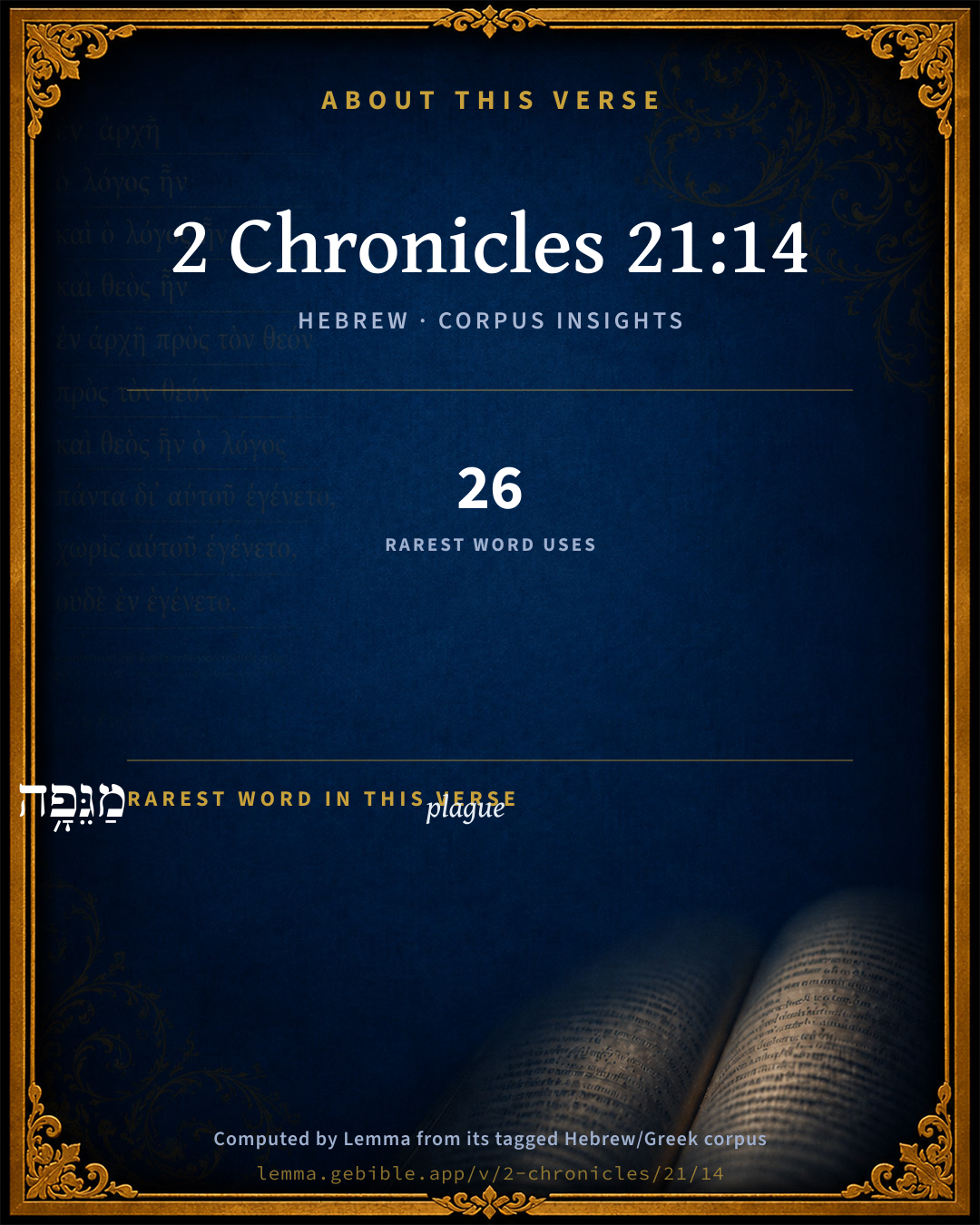
A great plague; Hebrew, hpGem. Out of the twenty-six occurrences of this word, it is rendered (Authorized Version) twenty-three times by the word "plague," twice by the word "slaughter", (2Sa_17:9 2Sa_18:7) and once "stroke". (Eze_24:16) It is not the word (gg) which about sixty times (chiefly in Leviticus) describes the physical plague, but both of the words are applied to the plagues, e.g. of Pharaoh, and to the suffering that came of any severe smiting of the people. As no physical affliction in the shape of disease visited, so far as we know, the people, wives, and children of the king, and as his goods are reckoned in for the great plague, the general opinion is probably the correct one, that the invasions spoken of (vers. 16, 17) fulfilled the punishment now announced.

The Pulpit Commentary (1880–1919), ed. H.D.M. Spence-Jones & Joseph S. Exell — public domain. Text from a community e-Sword module.

Lesson kit

Teaching starters — assembled from the data on this page, not authored interpretation. Every prompt links to the verse data it draws on. Edit before teaching.

2 Chronicles, in the Historical, opens this verse with 10 words (10 distinct Hebrew lemmas). Its most distinctive word is maggêphâh (“plague”). A historical commentator’s framing appears above. Read the whole chapter for the surrounding context.

Discussion questions

  1. How does “plague” (maggêphâh) shape what this verse is saying?
  2. Exodus 9:14 shares the word «plague» with this verse. How do the two illuminate each other?
  3. The translations on this page render this verse differently — a whole-verse word diff, not a word-by-word alignment. What might account for the different wordings?
  4. The verb «נֹגֵ֛ף» is Qal Participle Active. How does its form color the action?
  5. Reading how Trapp's Complete Commentary and Joseph Benson's Commentary read this verse, where do the two commentators agree and where do they part?

Things to notice

Reading settings

Reading text

Shown beneath each verse's original-language words.

Old Testament
Old Testament edition

Read the OT as the Masoretic Hebrew (MT) or the Greek Septuagint (LXX).

English shown for the Greek Septuagint (in the Hebrew ↔ Greek comparison).

Comparing translations? Open the Compare panel on any verse page to stack up to four side by side.