
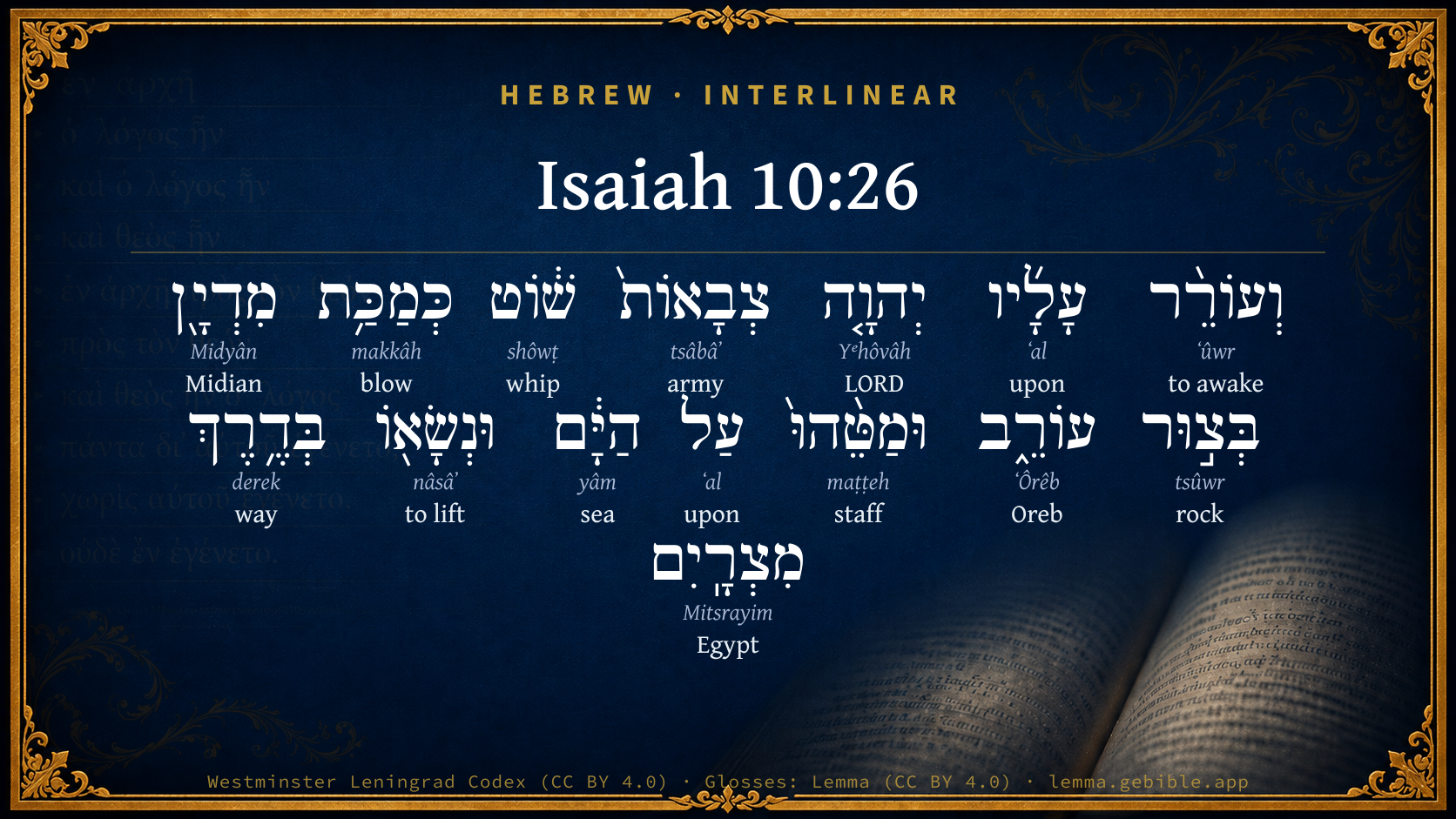
Isaiah 10:26

Hebrew (Westminster Leningrad Codex) Isaiah 10:26 appears in the Hebrew Old Testament. The text above is from the Westminster Leningrad Codex. Each word links to its Strong’s number, a concise gloss, and parsing drawn from the Open Scriptures Hebrew Bible morphology. Click any word for its full Brown-Driver-Briggs (BDB) entry.
Download image
Cite this verse

Isaiah 10:26 (World English Bible). Public Domain. Lemma interlinear Bible study tool, https://lemma.gebible.app/v/isaiah/10/26.

Show BibTeX & RIS
BibTeX
RIS
English Translation
Yahweh of Hosts will stir up against him a scourge, as in the slaughter of Midian at the rock of Oreb: and his rod will be over the sea, and he will lift it up after the manner of Egypt.
World English Bible · Public Domain
Download a study sheet

One document with this verse’s original text, its word-by-word gloss line, the meaning frame, cross-references with their text, attributed commentary, and full source and license credits — printable, and it pastes into notes with its structure intact.

This verse Autodidact and up

Study sheet (.html) Plain text (.txt)

A passage Seminary Student

Up to 50 verses in one chapter. A passage sheet keeps up to 6 commentary sources and 12 cross-references per verse, in the order this page ranks them, and says so on the sheet whenever that leaves anything out. Ask for a single verse and you get the Autodidact verse sheet above.

Everything on this page stays free to read, with no account — the sheet is a download of what is already on screen, not access to it.

Want to remove ads? Support Godless Engineer
Compare translations 3

The same verse in 3 English versions, stacked beneath the original-language interlinear above. Click any original word for its lexicon entry.

Each is an independent rendering of the whole verse — the interlinear is not word-aligned to these translations.

Highlighted words mark where these versions differ — a whole-verse word diff, not a word-by-word alignment.

  • World English Bible Public Domain
    Yahweh of Hosts will stir up against him a scourge, as in the slaughter of Midian at the rock of Oreb: and his rod will be over the sea, and he will lift it up after the manner of Egypt.
  • King James Version Public Domain
    And the LORD of hosts shall stir up a scourge for him according to the slaughter of Midian at the rock of Oreb: and as his rod was upon the sea, so shall he lift it up after the manner of Egypt.
  • unfoldingWord Literal Text CC BY-SA 4.0
    Then Yahweh of Armies will awaken a whip against him, like the striking of Midian at the rock of Oreb, and his staff over the sea, and he will lift it up in the way of Egypt.

unfoldingWord Literal Text — © unfoldingWord, licensed CC BY-SA 4.0. Word-aligned USFM3 via Door43 (git.door43.org/unfoldingWord/en_ult).

Versions to compare (up to 4)

3 of 4 selected

Show all 18 translations

Every available English version of this verse, each an independent rendering of the whole verse.

  • World English Bible Public Domain
    Yahweh of Hosts will stir up against him a scourge, as in the slaughter of Midian at the rock of Oreb: and his rod will be over the sea, and he will lift it up after the manner of Egypt.
  • Berean Standard Bible Public Domain
    And the LORD of Hosts will brandish a whip against them, as when He struck Midian at the rock of Oreb. He will raise His staff over the sea, as He did in Egypt.
  • Majority Standard Bible Public Domain
    And the LORD of Hosts will brandish a whip against them, as when He struck Midian at the rock of Oreb. He will raise His staff over the sea, as He did in Egypt.
  • King James Version Public Domain
    And the LORD of hosts shall stir up a scourge for him according to the slaughter of Midian at the rock of Oreb: and as his rod was upon the sea, so shall he lift it up after the manner of Egypt.
  • American Standard Version (1901) Public Domain
    And Jehovah of hosts will stir up against him a scourge, as in the slaughter of Midian at the rock of Oreb: and his rod will be over the sea, and he will lift it up after the manner of Egypt.
  • Revised Version (1885) Public Domain
    And the LORD of hosts shall stir up against him a scourge, as in the slaughter of Midian at the rock of Oreb: and his rod shall be over the sea, and he shall lift it up after the manner of Egypt.
  • Geneva Bible (1599) Public Domain
    And ye Lord of hostes shall raise vp a scourge for him, according to the plague of Midian in the rocke Oreb: and as his staffe was vpon the Sea, so he will lift it vp after the maner of Egypt.
  • Douay-Rheims (1899) Public Domain
    And the Lord of hosts shall raise up a scourge against him, according to the slaughter of Madian in the rock of Oreb, and his rod over the sea, and he shall lift it up in the way of Egypt.
  • Young's Literal Translation Public Domain
    And awaking for him is Jehovah of Hosts, A scourge like the smiting of Midian at the rock Oreb, And his rod `is' over the sea, And he hath lifted it in the way of Egypt.
  • Literal Standard Version CC BY-SA 4.0
    And YHWH of Hosts is awaking for him, || A scourge like the striking of Midian at the rock Oreb, || And his rod [is] over the sea, || And he has lifted it in the way of Egypt.
  • Unlocked Literal Bible CC BY-SA 4.0
    Then Yahweh of hosts will wield a whip against them, as when he defeated Midian at the rock of Oreb. He will raise his rod over the sea and lift it up as he did in Egypt.
  • unfoldingWord Literal Text CC BY-SA 4.0
    Then Yahweh of Armies will awaken a whip against him, like the striking of Midian at the rock of Oreb, and his staff over the sea, and he will lift it up in the way of Egypt.
  • Darby Bible Public Domain
    And Jehovah of hosts will stir up a scourge against him, according to the slaughter of Midian at the rock of Oreb; and his rod [shall be] upon the sea, and he will lift it up after the manner of Egypt.
  • World Messianic Bible Public Domain
    The LORD of Hosts will stir up a scourge against him, as in the slaughter of Midian at the rock of Oreb. His rod will be over the sea, and he will lift it up like he did against Egypt.
  • Webster's Bible Public Domain
    And the LORD of hosts will raise up a scourge for him according to the slaughter of Midian at the rock of Oreb: and as his rod was upon the sea, so shall he lift it up after the manner of Egypt.
  • Free Bible Version CC BY-SA 4.0
    The Lord Almighty will lash them with a whip, just as he did when he attacked the Midianites at the rock of Oreb. He will hold up his rod over the sea, just as he did in Egypt.
  • Bible in Basic English Public Domain
    And the Lord of armies will be shaking a whip against him, as when he overcame Midian at the rock of Oreb: and his rod will be lifted up against them as it was against the Egyptians.
  • JPS Tanakh (1917) Public Domain
    And the LORD of hosts shall stir up against him a scourge, as in the slaughter of Midian at the Rock of Oreb; and as His rod was over the sea, so shall He lift it up after the manner of Egypt.

Literal Standard Version (2020), Covenant Press — licensed CC BY-SA 4.0. Text via the HelloAO Bible API (eBible.org). Unlocked Literal Bible (unfoldingWord) — licensed CC BY-SA 4.0. Text via the HelloAO Bible API (eBible.org). unfoldingWord Literal Text — © unfoldingWord, licensed CC BY-SA 4.0. Word-aligned USFM3 via Door43 (git.door43.org/unfoldingWord/en_ult). Free Bible Version, Dr. Jonathan Gallagher — licensed CC BY-SA 4.0. Text via the HelloAO Bible API (eBible.org).

Word by word

More ways to search: Search by grammar → Find every occurrence → Compare this word →

Practice this passage: Drill this verse → Learn its vocabulary →

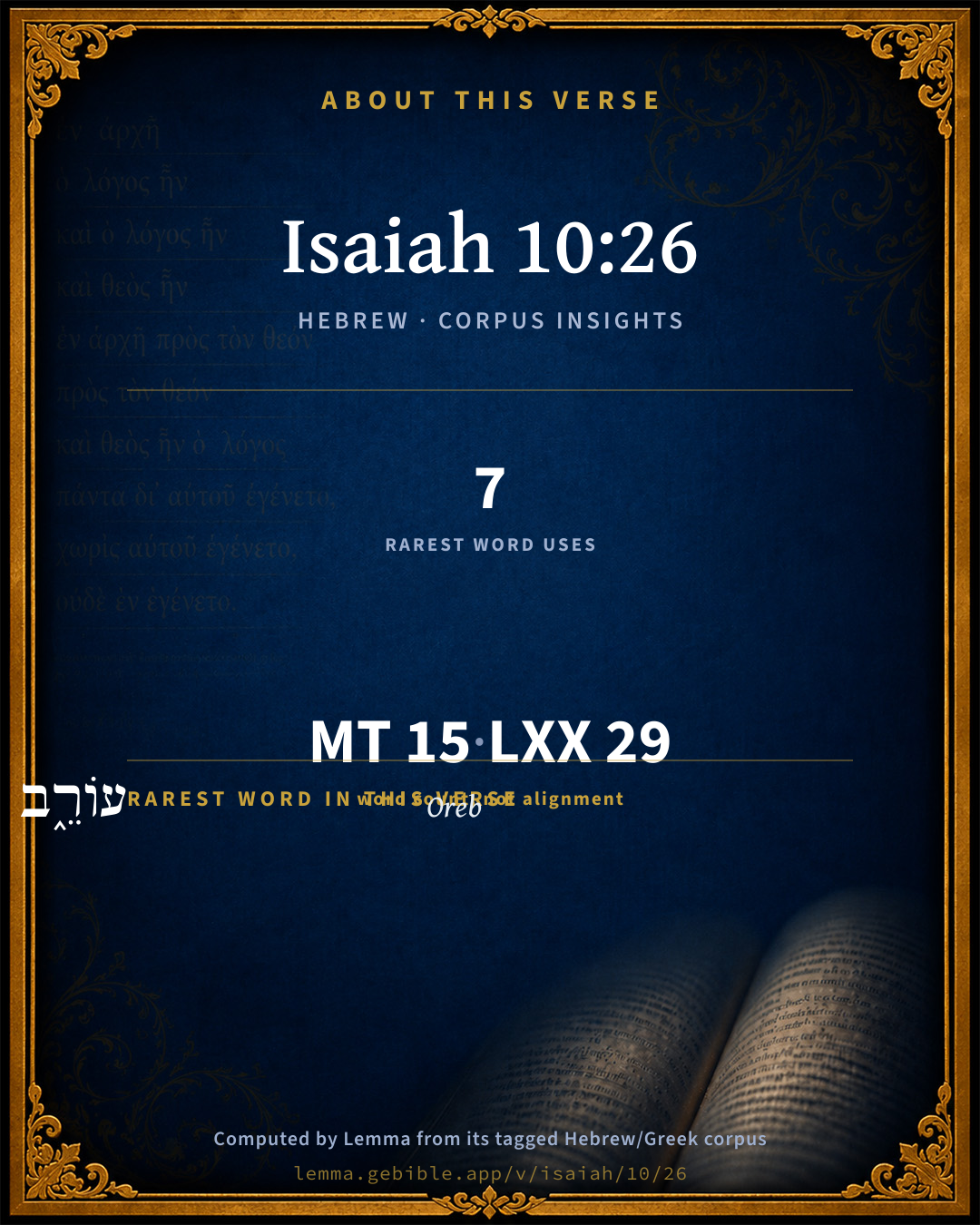
עוֹרֵ֑ב
ʻÔrêb
H6159
“Oreb”
Noun, Proper
Part of Speech
Noun
Type
Proper
Full BDB Definition

Origin: the same as H6158

TWOT: None

Oreb = "raven" - one of the chieftains of the Midianite army defeated by Gideon (noun proper masculine) - a rock east of the Jordan where Oreb and part of his army fell to the Ephraimites (noun proper locative)
  1. וְעוֹרֵ֨ר ʻûwr H5782 “and · to awake” Conjunction + Verb, Polel, Sequential Perfect, 3rd Person, Masculine, Singular
  2. עָלָ֜יו ʻal H5921 “upon · him” Preposition + Suffix, Personal, 3rd Person, Masculine, Singular
  3. יְהוָ֤ה Yᵉhôvâh H3068 “LORD” Noun, Proper
  4. צְבָאוֹת֙ tsâbâʼ H6635 “armies” Noun, Common, Both, Plural, Absolute
  5. שׁ֔וֹט shôwṭ H7752 “whip” Noun, Common, Masculine, Singular, Absolute
  6. כְּמַכַּ֥ת makkâh H4347 “like/as · blow of” Preposition + Noun, Common, Feminine, Singular, Construct
  7. מִדְיָ֖ן Midyân H4080 “Midian” Noun, Proper
  8. בְּצ֣וּר tsûwr H6697 “in/at · rock of” Preposition + Noun, Common, Masculine, Singular, Construct
  9. וּמַטֵּ֨הוּ֙ maṭṭeh H4294 “and · staff · his” Conjunction + Noun, Common, Masculine, Singular, Construct + Suffix, Personal, 3rd Person, Masculine, Singular
  10. עַל ʻal H5921 “upon” Preposition
  11. הַיָּ֔ם yâm H3220 “the · sea” Particle, Definite Article + Noun, Common, Masculine, Singular, Absolute
  12. וּנְשָׂא֖וֹ nâsâʼ H5375 “and · to lift · him” Conjunction + Verb, Qal, Sequential Perfect, 3rd Person, Masculine, Singular + Suffix, Personal, 3rd Person, Masculine, Singular
  13. בְּדֶ֥רֶךְ derek H1870 “in/at · way of” Preposition + Noun, Common, Both, Singular, Construct
  14. מִצְרָֽיִם Mitsrayim H4714 “Egypt” Noun, Proper

About this verse

These counts appear in no published source. They are computed here, from the morphology-tagged text and Lemma’s own curated glosses. What Lemma adds →

15
words
14
distinct lemmas
Prophets
section

Notable vocabulary

The rarest word here is עוֹרֵ֑ב Oreb H6159 — appearing just 7 times in the whole Hebrew Bible.

Shared distinctive vocabulary

עוֹרֵ֑ב Oreb H6159 occurs in 4 verses of the Hebrew Bible. Also found in:

Grammatical profile

  • 2 verbs
  • 11 nouns
  • 2 prepositions

Verb forms

  • וְעוֹרֵ֨ר Polel · Sequential Perfect
  • וּנְשָׂא֖וֹ Qal · Sequential Perfect

Repetition

A word recurs within this verse — often emphatic in Hebrew:

  • עָלָ֜יו upon H5921 ×2

Hebrew & Septuagint length

In English translation the verse runs 40 words from the Hebrew and 38 from the Septuagint (LXX English) — closely comparable.

A rough comparison of the two English renderings, which tokenize alike — not a word-level alignment.

Word counts can differ between the Hebrew and the Greek without any difference in meaning — e.g. the Hebrew direct-object marker אֵת has no separate Greek word, and Greek often adds the article ὁ.

In the original languages it is 15 Hebrew tokens and 29 Greek tokens — but the two are counted differently (Hebrew bundles its prefixes and suffixes into one token; the Greek is in lemma form), so that isn’t a like-for-like length.

Cross-references

17

Topical passages linked to Isaiah 10:26 in the Treasury of Scripture Knowledge — connected by theme and wording, ordered by reader-vote popularity; previews shown in the World English Bible.

  • Isaiah 9:4 For the yoke of his burden, and the staff of his shoulder, the rod of his oppressor, you have broken as in the day of Midian.
  • Judges 7:25 They took the two princes of Midian, Oreb and Zeeb; and they killed Oreb at the rock of Oreb, and Zeeb they killed at the winepress of Zeeb, and pursued Midian: and they brought the heads of Oreb and Zeeb to Gideon beyond the Jordan.
  • 2 Kings 19:35 It happened that night, that the angel of Yahweh went forth, and struck in the camp of the Assyrians one hundred eighty-five thousand: and when men arose early in the morning, behold, these were all dead bodies.
  • Exodus 14:16 Lift up your rod, and stretch out your hand over the sea, and divide it: and the children of Israel shall go into the midst of the sea on dry ground.
  • Exodus 14:25–27 He took off their chariot wheels, and they drove them heavily; so that the Egyptians said, "Let's flee from the face of Israel, for Yahweh fights for them against the Egyptians!"
  • Nehemiah 9:10–11 and shown signs and wonders on Pharaoh, and on all his servants, and on all the people of his land; for you knew that they dealt proudly against them, and did get you a name, as it is this day.
  • Psalms 35:23 Wake up! Rise up to defend me, my God! My Lord, contend for me!
  • Psalms 83:11 Make their nobles like Oreb and Zeeb; Yes, all their princes like Zebah and Zalmunna;
  • Psalms 106:10–11 He saved them from the hand of him who hated them, And redeemed them from the hand of the enemy.
  • Isaiah 10:16–19 Therefore will the Lord, Yahweh of Hosts, send among his fat ones leanness; and under his glory there shall be kindled a burning like the burning of fire.
  • Isaiah 10:24 Therefore thus says the Lord, Yahweh of Hosts, my people who dwell in Zion, don't be afraid of the Assyrian, though he strike you with the rod, and lift up his staff against you, after the manner of Egypt.
  • Isaiah 11:16 There shall be a highway for the remnant of his people, who shall remain, from Assyria; like as there was for Israel in the day that he came up out of the land of Egypt.
  • Isaiah 37:36–38 The angel of Yahweh went forth, and struck in the camp of the Assyrians one hundred and eighty-five thousand; and when men arose early in the morning, behold, these were all dead bodies.
  • Isaiah 51:9–10 Awake, awake, put on strength, arm of Yahweh; awake, as in the days of old, the generations of ancient times. Isn't it you who did cut Rahab in pieces, who pierced the monster?
  • Habakkuk 3:7–15 I saw the tents of Cushan in affliction. The dwellings of the land of Midian trembled.
  • Revelation 11:18 The nations were angry, and your wrath came, as did the time for the dead to be judged, and to give your bondservants the prophets, their reward, as well as to the saints, and those who fear your name, to the small and the great; and to destroy those who destroy the earth."
  • Revelation 19:15 Out of his mouth proceeds a sharp, double-edged sword, that with it he should strike the nations. He will rule them with a rod of iron. He treads the winepress of the fierceness of the wrath of God, the Almighty.

Cross-references courtesy of OpenBible.info (CC BY 4.0).

Hebrew and Greek witnesses Masoretic Hebrew ↔ Greek Septuagint

The same verse in the two great witnesses to the Old Testament, shown verse-for-verse.

These are two independent witnesses, not word-aligned to each other, and the Septuagint is shown in lemma (dictionary) form.

Hebrew Isaiah 10:26 Masoretic · Westminster Leningrad Codex

וְעוֹרֵ֨ר עָלָ֜יו יְהוָ֤ה צְבָאוֹת֙ שׁ֔וֹט כְּמַכַּ֥ת מִדְיָ֖ן בְּצ֣וּר עוֹרֵ֑ב וּמַטֵּ֨הוּ֙ עַל הַיָּ֔ם וּנְשָׂא֖וֹ בְּדֶ֥רֶךְ מִצְרָֽיִם

Yahweh of Hosts will stir up against him a scourge, as in the slaughter of Midian at the rock of Oreb: and his rod will be over the sea, and he will lift it up after the manner of Egypt.

World English Bible · Public Domain

Greek LXX Isaiah 10:26 Septuagint · lemma form

καί ἐπιἐγείρω ὁ θεός ἐπί αὐτός κατά ὁ πληγή ὁ μαδιαμ ἐν τόπος θλῖψις καί ὁ θυμός αὐτός ὁ ὁδός ὁ κατά θάλασσα εἰς ὁ ὁδός ὁ κατά αἴγυπτος

And God will stir up enemies against them, according to the stroke of Madiam in the place of affliction: and his wrath shall be by the way of the sea, even to the way that leads to Egypt.

LXX2012 (modern English Septuagint) · Public Domain

Hebrew: Westminster Leningrad Codex (CC BY 4.0). Greek: Septuagint (public domain); English from LXX2012 (modern English Septuagint) (Public Domain). How the Septuagint differs from the Hebrew →

Targum (Aramaic paraphrase)

1

The Targum is the ancient Jewish Aramaic paraphrase of the Hebrew Scriptures — an interpretive translation, not the Hebrew text itself. Onkelos (literal) and Pseudo-Jonathan (expansive) render the Torah, and Jonathan the Prophets. Coverage is partial: where no permissively-licensed English translation exists for a verse, only the Aramaic is shown. This is verse-level text, not a word-by-word alignment to the Hebrew.

  1. Targum Jonathan Prophets (Joshua–Malachi)
    וְיַיתֵי עֲלוֹהִי יְיָ צְבָאוֹת מְחָא כְּמָחַת מִדְיָן בִּשְׁקִיף עוֹרֵב וּמַרְוָתֵיהּ תֶּעְדֵי מִנְכוֹן כְּמָא דַעֲדַת מַרְוַת פַּרְעֹה עַל יַמָא וְיִתְעַבְדָן לְכוֹן גְבוּרָן כִּדְבְּאוֹרַח מִצְרָיִם:

    And the Lord of hosts shall bring upon him a stroke, as the stroke of Midian at the rock of Oreb: and his dominion shall depart from you, as the dominion of Pharaoh departed by the sea, and mighty works shall be done for you after the manner of Egypt.

    Targum Jonathan — Aramaic: “Mikraot Gedolot” (public domain). English: “Sefaria Community Translation” (CC0 1.0 (public-domain dedication)); “London "Chaldee Paraphrase," 1871” (public domain). Text via Sefaria.

Commentary

Notes on Isaiah 10:26 from classic Christian and Jewish commentators (each source and its license shown beneath its notes). The classic Christian expositions comment on the surrounding passage and are grouped to its opening verse, so a note may address several verses; the Jewish commentaries on the Tanakh (Rashi and others) are per-verse, so they appear only where the commentator wrote on this verse.

Lemma curates 59 commentaries, every one of them public domain or Creative Commons licensed, each selected and text-cleaned for this edition rather than reprinted as found. About our sources →

Jamieson, Fausset & Brown

Robert Jamieson, A. R. Fausset & David Brown

slaughter of--"stroke upon."

Midian-- (Isa 9:4; Jdg 7:25).

as his rod was upon the sea--rather, understanding "stroke" from the previous clause, "according to the stroke of His rod upon the Red Sea" (Exo 14:16, Exo 14:26). His "rod" on the Assyrian (Isa 10:24, Isa 10:26) stands in bold contrast to the Assyrian used as a "rod" to strike others (Isa 10:5).

after the manner of Egypt--as He lifted it up against Egypt at the Red Sea.

Jamieson, Fausset & Brown — Commentary Critical and Explanatory on the Whole Bible (1871) — public domain (CC PDM 1.0). Text via the HelloAO Bible API.

Trapp's Complete Commentary

John Trapp

Isa 10:26 And the LORD of hosts shall stir up a scourge for him according to the slaughter of Midian at the rock of Oreb: and [as] his rod [was] upon the sea, so shall he lift it up after the manner of Egypt.

Ver. 26. And the Lord of hosts shall stir up a scourge for him.] Far worse than that rod. {Isa 10:24} This scourge was that angel that slew so many Assyrians in a night, according to that "slaughter of Midian." {Jdg 7:22 Psa 83:9; Psa 83:11}

At the rock of Oreb.] Where Oreb was slain, like as was Sennacherib after this, in his temple at Nineveh.

And as his rod was upon the sea.] As Moses by his rod or staff held over the Red Sea made way for Israel, but brought destruction on the Egyptians. {Exo 14:26}

John Trapp, A Commentary or Exposition upon All the Books of the Old and New Testament (1647–1656) — public domain. Text from a community e-Sword module.

The Biblical Illustrator

Joseph S. Exell

Isa_10:26

According to the slaughter of Midian

Assyria and Midian

1.

As the hand of God was seen in the slaughter of the Midianites, so it was in the slaughter of the Assyrians.

2. As the Midianites were slain without loss of any of the Israelites, so were the Assyrians without any loss of the men of Judah.

3. As the whole army of the Midianites was overthrown, so was the whole army of the Assyrians.

4. As the Midianites were overthrown on a sudden, when their thoughts mind at the highest, so was the whole army of the Assyrians. (W. Day, M. A.)

The Biblical Illustrator, edited by Joseph S. Exell (c. 1880s–1900s) — public domain. Text from a community e-Sword module.

Tyndale Open Study Notes

Tyndale Open Resources

10:26 Gideon triumphed over the Midianites: See Judg 7:25.

Tyndale Open Study Notes — © Tyndale Open Resources, licensed CC BY-SA 4.0. Text via the HelloAO Bible API.

Geneva Bible (1599)

Geneva Bible translators

Read Isa. 9:4.

When the Israelites passed through by the lifting up of Moses’ rod, and the enemies were drowned, Exod. 14:28.

Geneva Bible (1599) marginal notes — public domain. Text via Bolls.life.

Adam Clarke's Commentary

Verse 26. And as his rod was upon the sea - "And like his rod which he lifted up over the sea"] The Jewish interpreters suppose here an ellipsis of כ ke, the particle of similitude, before מטהו mattehu, to be supplied from the line above; so that here are two similitudes, one comparing the destruction of the Assyrians to the slaughter of the Midianites at the rock of Oreb; the other to that of the Egyptians at the Red Sea. Aben Ezra, Kimchi, Sal. ben Melec.

Adam Clarke's Commentary on the Bible (1810–1826) — public domain. Text from a community e-Sword/MySword module.

Ellicott's Commentary for English Readers

(26) According to the slaughter of Midian.—The historical associations of Isa_9:4 are still in the prophet’s mind. In the history of Judges (Jdg_7:25), Oreb and Zeeb are the names at once of the Midianite chiefs and of the places where they were slain.

As his rod was upon the sea.—The italics spoil the sense. Better, His rod upon the sea . . . He shall lift it up after the manner of Egypt. The ambiguous formula which had been taken as primarily of evil boding in Isa_10:24, is repeated as an augury of good. There was another rod prominent in that Egyptian history besides that of the oppressor, and that rod had been wielded by the deliverer.

A Bible Commentary for English Readers, edited by Charles John Ellicott (1878–1897) — public domain. Text from a community e-Sword module.

John Gill's Exposition

And it shall come to pass in that day, that his burden shall be taken away from off thy shoulder,.... The tax or tribute imposed upon Hezekiah by the king of Assyria, Kg2 18:14,

and his yoke from off thy neck; the same with the burden; unless it means also the subjection of the cities of Judah, which were taken by the Assyrian; and indeed it may be extended further, and be considered as a prophecy not merely of deliverance from the present distress, but from the future captivity in Babylon; and which was a type of the deliverance and redemption by Christ, when the Lord's people were delivered from the burden of sin, the guilt and punishment of it; from the yoke of the law, the yoke of bondage; and from the tyranny of Satan, and out of the hand of every enemy; and this seems to be hinted at in the next clause:

and thy yoke shall be destroyed, because of the anointing; or, "be corrupted, because of fatness" (u); through the multitude of riches and honours, with which the Assyrian monarchy abounded; which fill with pride, introduce luxury, and so bring ruin, on a state. Jarchi and Kimchi interpret the anointing of Hezekiah, the anointed king of Israel, for whose sake the Assyrian yoke was destroyed. The Rabbins say, that this deliverance was wrought on account of the large quantity of oil which Hezekiah consumed in the schools and synagogues, for the study of the law, and the explanation of it; but the Targum much better refers it to the Messiah,

"the people shall be broken from before the Messiah;''

who was anointed with the oil of gladness above his fellows, and for whose sake, and by whom, the yoke of sin, Satan, and the law, has been destroyed. Vitringa interprets it of the Spirit of God, and his powerful operations, whose gifts and graces are often compared to oil and ointment; and makes the words parallel to Zac 4:6.

(u) "et corrumpetur jugum propter oleum", Cocceius; "prae pinguedine", Quidam in Munster.

John Gill's Exposition of the Whole Bible (1746–1763) — public domain (CC PDM 1.0). Text via the HelloAO Bible API.

Albert Barnes' Notes on the Bible

And the Lord of hosts shall stir up - Or shall raise up that which shall rove as a scourge to him.

A scourge for him - That is, that which shall punish him. The scourge, or rod, is used to denote severe punishment of any kind. The nature of this punishment is immediately specified.

According to the slaughter of Midian - That is, as the Midianites were discomfitcd and punished. There is reference here, doubtless, to the discomfiture and slaughter of the Midianites by Gideon, as recorded in Jdg 7:24-25. That was signal and entire; and the prophet means to say, that the destruction of the Assyrian would be also signal and total. The country of Midian, or Madian, was on the east side of the Elanitic branch of the Red Sea; but it extended also north along the desert of mount Seir to the country of the Moabites; see the note at Isa 60:6.

At the rock of Oreb - At this rock, Gideon killed the two princes of the Midianites, Oreb and Zeeb Jdg 7:25; and from this circumstance, probably, the name was given to the rock: Lev 11:15; Deu 14:14. It was on the east side of the Jordan.

And as his rod ... - That is, as God punished the Egyptians in the Red Sea.

So shall he lift it up after the manner of Egypt - As God overthrew the Egyptians in the Red Sea, so shall he overthrow and destroy the Assyrian. By these two comparisons, therefore, the prophet represents the complete destruction of the Assyrian army. In both of these cases, the enemies of the Jews had been completely overthrown, and so it would be in regard to the hosts of the Assyrian.

Albert Barnes' Notes on the Bible (1834–1885) — public domain. Text from a community e-Sword/MySword module.

Haydock's Catholic Bible Commentary

Oreb. Judges vii. 25. --- And his. Moses thus let loose the waters of the Red Sea on the Egyptians, by stretching forth his rod. (Calmet)

George Leo Haydock (1774–1849), Haydock's Catholic Family Bible and Commentary, 1859 edition — public domain. Excludes Psalms (Douay-Rheims chapter numbering differs from Protestant) and Deuterocanonical books (Catholic canon only).

Matthew Poole's English Annotations

Shall stir up a scourge; shall send a destroying angel, Isa 37:36.

According to the slaughter of Midian; whom God slew suddenly, and unexpectedly, and in the night, as he did the Assyrians.

At the rock of Oreb; upon which one of their chief princes was slain, and nigh unto which the Midianites were destroyed.

Was upon the sea, to smite and divide it, and so to make way both for thy deliverance, and for the destruction of the Egyptians.

After the manner of Egypt; as he did in Egypt, to bring his plagues upon that land and people.

Matthew Poole's English Annotations on the Holy Bible (1683–1685) — public domain. Text from a community e-Sword/MySword module.

Whedon's Commentary on the Bible

Daniel D. Whedon

26. The Lord shall stir up a scourge — When that “scourge” comes it shall be sudden, like that of the Midianites by Gideon, and like that of Pharaoh in the Red Sea.

The rock of Oreb — The place where the Ephraimites slew Oreb, a king of Midian. Jdg_7:25. Jehovah is imaged as swinging a whip over Assyria, and as stretching forth his staff or sceptre over the sea of troubles (such, no doubt, is its meaning) into which Israel and Judah were driven; and that sea is seen to divide for escape to Israel and for destruction to Assyria.

After the manner of Egypt — That is, just as Pharaoh was overwhelmed in the Red Sea. This is a judgment occurring in prophetic time.

Daniel D. Whedon (gen. ed.), Commentary on the Old and New Testaments (1874–1909) — public domain. Text from a community e-Sword module.

The Pulpit Commentary

The Lord... shall stir up a scourge for him; or, lift up a scourge over him. Isaiah uses the metaphor of the "scourge" again in Isa_28:16, Isa_28:18. It is rare in Scripture, though common among the Greek and Latin writers. According to the slaughter of Midian at the rock of Oreb. (comp. Isa_9:4) The "slaughter of Midian at the rock of Oreb" was that great destruction of the Midianites which was begun by the three hundred under Gideon, and completed by the men of Ephraim, whereof we have an account in Jud 7:19-25. Its counterpart in Assyrian history would seem to be the destruction of Sennacherib"s army, as related in 2Ki_19:35. As his rod was upon the sea. An allusion to the drowning of Pharaoh"s host in the Red Sea. This was a nearer parallel to the destruction of Sennacherib"s army than the slaughter of the Midianites, since it was wholly miraculous. By "his rod" we may understand the rod of Moses, endued by God with miraculous powers. (Exo_4:3, 4 14:16, 27) After the manner of Egypt; i.e. "after the manner of his action in Egypt."

The Pulpit Commentary (1880–1919), ed. H.D.M. Spence-Jones & Joseph S. Exell — public domain. Text from a community e-Sword module.

John Wesley's Explanatory Notes

Stir up - Shall send a destroying angel. Midian - Whom God slew suddenly and unexpectedly, in the night. Oreb - Upon which one of their chief princes was slain, and nigh unto which the Midianites were destroyed. The sea - To divide it, and make way for thy deliverance, and for the destruction of the Egyptians.

John Wesley, Explanatory Notes Upon the Whole Bible (1754–1765) — public domain. Text via the GEBible commentary corpus.

J. A. Alexander on Isaiah

Joseph Addison Alexander

The suddenness and completeness of the ruin threatened are expressed by a comparison with two remarkable events in sacred history, the slaughter of the Midianites by Gideon, and the overthrow of Pharaoh in the Red Sea. “And Jehovah of hosts shall raise up against him (the Assyrian) a scourge (or instrument of vengeance), like the smiting of Midian at the rock Oreb, and His rod (Jehovah’s) shall again be over the sea, and He shall lift it up (again) as He did in Egypt (literally, in the way of Egypt, as in v. 24).” The rock Oreb is particularly mentioned because one of the Midianitish princes, who had escaped from the field of battle, was there slain by Gideon; and so Sennacherib, although he should survive the slaughter of his host, was to be slain at home (Isaiah 37; Isaiah 38). In the last clause there is a beautiful allusion to v. 24. As the Assyrians lifted up the rod over Israel in the manner of Egypt, so God would lift up the rod over them in the manner of Egypt. As they were like the Egyptians in their sin, so should they now be like them in their punishment. The construction of the last clause in the English Bible ‘and (as) His rod was upon the sea, (so) shall He lift it up etc.’, puts an arbitrary meaning on the particles. According to the first construction given, His rod (shall be again) upon the sea is a poetical expression for ‘His power shall again be miraculously displayed.’

Joseph Addison Alexander, The Prophecies of Isaiah (1846–1847; New York: Scribner, 1870–1878) — public domain. Text from a community e-Sword module.

unfoldingWord translationNotes

Door43 World Missions Community

Yahweh of hosts

See how you translated this in Isaiah 1:9.

will wield a whip against them

"will beat the Assyrians with a whip." God will not really use a whip. This refers to God's power to punish the Assyrians severely. AT: "will punish the Assyrians severely as if with a whip" (See: Metaphor)

as when he defeated Midian at the rock of Oreb

This refers to when God helped a man named Gideon defeat the army of Midian. (See: How to Translate Names)

He will raise his rod over the sea and lift it up as he did in Egypt

This speaks of God rescuing the people from the Assyrians as if they were the Egyptian army. This refers to when God caused the water of the Red Sea to split so the people of Israel could escape from the Egyptian army and so that the Egyptian army would drown in it. AT: "He will help you escape from the army of Assyria as he helped your ancestors escape the army of Egypt" (See: Metaphor)

his burden is lifted from your shoulder and his yoke from off your neck

"Yahweh will lift the burden that Assyria has put on your shoulder, and he will remove the yoke that they have put on your neck." These two phrases mean basically the same thing. The words "burden" and "yoke" refer to slavery. This can be stated in active form. AT: "Yahweh will remove the Assyrians who oppress you and will stop them from making you their slaves" (See: Active or Passive and Parallelism and Metonymy)

the yoke will be destroyed because of fatness

This expression suggests that the neck of the animal that is wearing the yoke will become too fat to fit the yoke any longer. This is a metaphor for Israel becoming so strong that the Assyrians can no longer rule them. This can be stated in active form. AT: "your neck will become so fat that it will break the yoke" or "you will become so strong that you will no longer be the Assyrians' slaves" (See: Active or Passive and Metaphor)

translationWords

Yahweh of hosts

Midian

yoke

unfoldingWord translationNotes — © Distant Shores Media and the Door43 World Missions Community, licensed CC BY-SA 4.0. Source: git.door43.org/Door43/en_tn.

Rashi

Rabbi Shlomo Yitzchaki (Rashi)

And...shall stir up against him And to stir up.

a scourge A tortuous blow.

like the smiting of Midian who were slain in one night, and as for the kings who fled from them and escaped, Oreb was slain at the Rock of Oreb, and is related in the Book of Judges (7:25). This one, too, after he returns to his land, will die there by the sword.

and his staff on the sea And furthermore, He shall stir up against him, His staff, which was on the sea against Pharaoh and his army.

and He shall carry him off And He shall carry him away from the world after the manner that He carried off Egypt.

Rashi on the Tanakh — English translations: “The Judaica Press complete Tanach with Rashi, translated by A. J. Rosenberg” (CC BY 4.0); “Pentateuch with Rashi's commentary by M. Rosenbaum and A.M. Silbermann, 1929-1934” (public domain); “The Metsudah Tanach series, Lakewood, N.J” (CC BY 4.0); and “The Book of Joshua, Metsudah Publications, 1997” (CC BY 4.0). Text via Sefaria.

Ibn Ezra

Rabbi Abraham ibn Ezra

וכמכת מטהו═ומטהו. As he smote with his staff at the sea, when the water flowed back over the Egyptians.

So shall be lift up. This refers to the defeat of Sennacherib, after which he returned to his own country disappointed.

Ibn Ezra on the Tanakh — English translations: “Sefaria Community Translation” (CC0 1.0 (public-domain dedication)); “Yalkut, Sifsei Chachomim Chumash, Metsudah Publications, 2009” (CC BY 4.0); and “Commentary of Ibn Ezra on Isaiah - trans. by M. Friedlander, 1873” (public domain). Text via Sefaria.

Lesson kit

Teaching starters — assembled from the data on this page, not authored interpretation. Every prompt links to the verse data it draws on. Edit before teaching.

Isaiah, in the Prophets, opens this verse with 15 words (14 distinct Hebrew lemmas). Its most distinctive word is ʻÔrêb (“Oreb”). A historical commentator’s framing appears above. Read the whole chapter for the surrounding context.

Discussion questions

  1. How does “Oreb” (ʻÔrêb) shape what this verse is saying?
  2. Judges 7:25 shares the word «Oreb» with this verse. How do the two illuminate each other?
  3. “upon” occurs 2× in this one verse. What is the effect of the repetition?
  4. These translations render this verse differently. What is at stake in choosing one wording over another?
  5. The verb «וְעוֹרֵ֨ר» is Polel Sequential Perfect. How does its form color the action?
  6. Reading how Jamieson, Fausset & Brown and Trapp's Complete Commentary read this verse, where do the two commentators agree and where do they part?

Things to notice

Reading settings

Reading text

Shown beneath each verse's original-language words.

Old Testament
Old Testament edition

Read the OT as the Masoretic Hebrew (MT) or the Greek Septuagint (LXX).

English shown for the Greek Septuagint (in the Hebrew ↔ Greek comparison).

Comparing translations? Open the Compare panel on any verse page to stack up to four side by side.