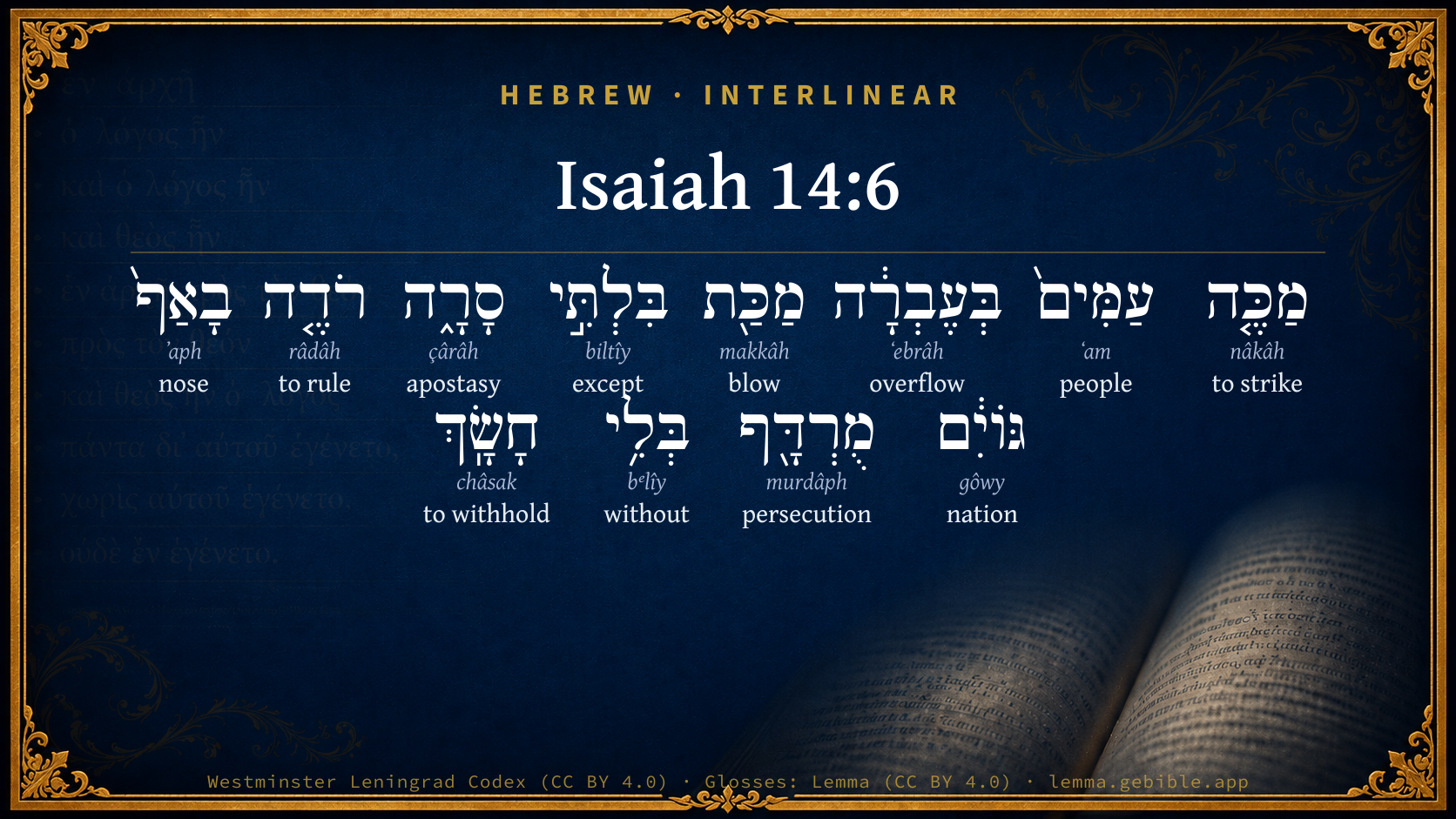
Isaiah 14:6

Hebrew (Westminster Leningrad Codex) Isaiah 14:6 appears in the Hebrew Old Testament. The text above is from the Westminster Leningrad Codex. Each word links to its Strong’s number, a concise gloss, and parsing drawn from the Open Scriptures Hebrew Bible morphology. Click any word for its full Brown-Driver-Briggs (BDB) entry.
Download image
Cite this verse

Isaiah 14:6 (World English Bible). Public Domain. Lemma interlinear Bible study tool, https://lemma.gebible.app/v/isaiah/14/6.

Show BibTeX & RIS
BibTeX
RIS
English Translation
who struck the peoples in wrath with a continual stroke, who ruled the nations in anger, with a persecution that none restrained.
World English Bible · Public Domain
Highlights
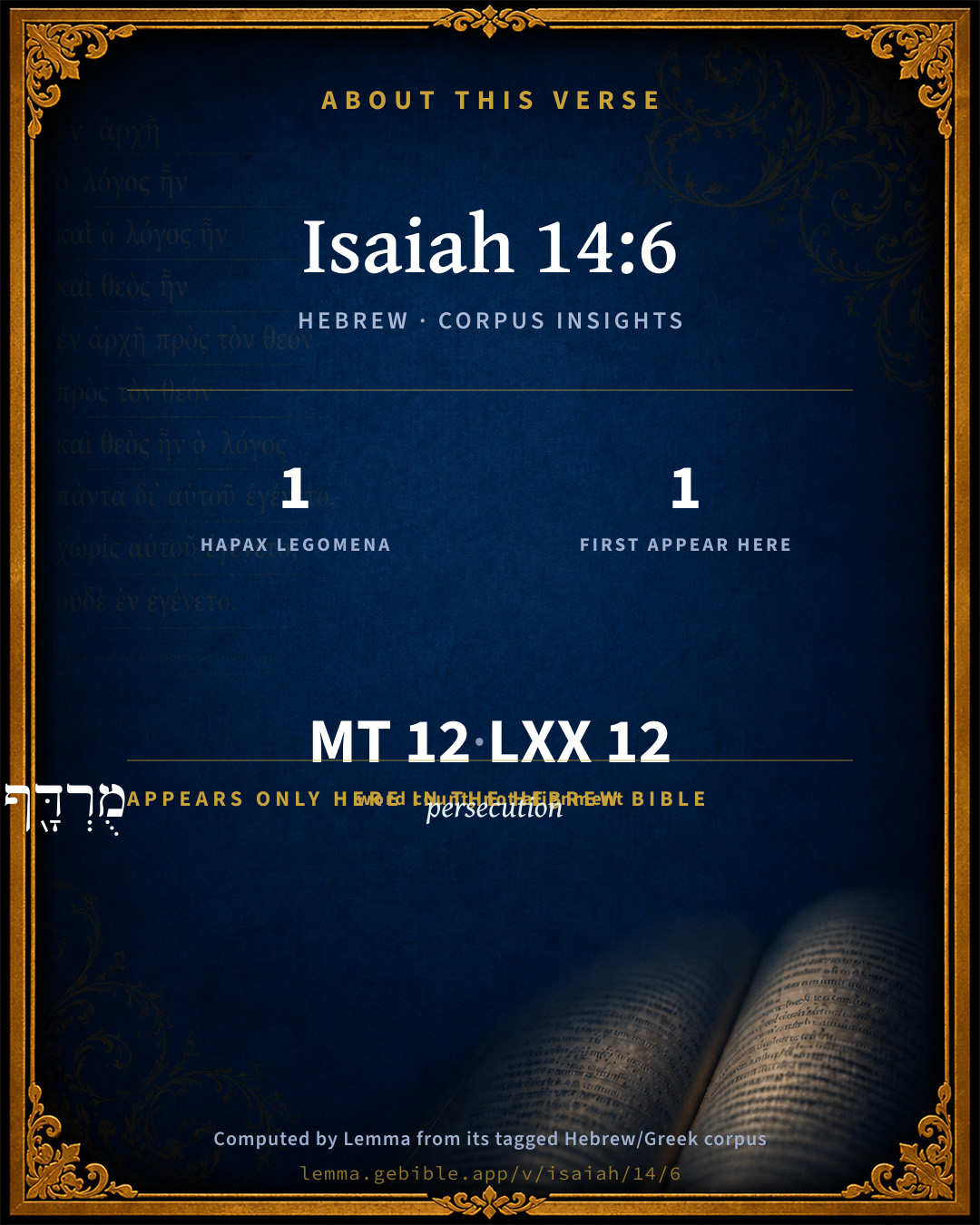
  • 1 hapax legomenon — only here in the Hebrew Bible
  • 1 first appearance in the Hebrew Bible
Full analysis ↓
Download a study sheet

One document with this verse’s original text, its word-by-word gloss line, the meaning frame, cross-references with their text, attributed commentary, and full source and license credits — printable, and it pastes into notes with its structure intact.

This verse Autodidact and up

Study sheet (.html) Plain text (.txt)

A passage Seminary Student

Up to 50 verses in one chapter. A passage sheet keeps up to 6 commentary sources and 12 cross-references per verse, in the order this page ranks them, and says so on the sheet whenever that leaves anything out. Ask for a single verse and you get the Autodidact verse sheet above.

Everything on this page stays free to read, with no account — the sheet is a download of what is already on screen, not access to it.

Want to remove ads? Support Godless Engineer
Compare translations 3

The same verse in 3 English versions, stacked beneath the original-language interlinear above. Click any original word for its lexicon entry.

Each is an independent rendering of the whole verse — the interlinear is not word-aligned to these translations.

Highlighted words mark where these versions differ — a whole-verse word diff, not a word-by-word alignment.

  • World English Bible Public Domain
    who struck the peoples in wrath with a continual stroke, who ruled the nations in anger, with a persecution that none restrained.
  • King James Version Public Domain
    He who smote the people in wrath with a continual stroke, he that ruled the nations in anger, is persecuted, and none hindereth.
  • unfoldingWord Literal Text CC BY-SA 4.0
    the one striking peoples in wrath, a striking without turning aside, the one ruling nations in nose, a persecution without restraint.

unfoldingWord Literal Text — © unfoldingWord, licensed CC BY-SA 4.0. Word-aligned USFM3 via Door43 (git.door43.org/unfoldingWord/en_ult).

Versions to compare (up to 4)

3 of 4 selected

Show all 18 translations

Every available English version of this verse, each an independent rendering of the whole verse.

  • World English Bible Public Domain
    who struck the peoples in wrath with a continual stroke, who ruled the nations in anger, with a persecution that none restrained.
  • Berean Standard Bible Public Domain
    It struck the peoples in anger with unceasing blows; it subdued the nations in rage with relentless persecution.
  • Majority Standard Bible Public Domain
    It struck the peoples in anger with unceasing blows; it subdued the nations in rage with relentless persecution.
  • King James Version Public Domain
    He who smote the people in wrath with a continual stroke, he that ruled the nations in anger, is persecuted, and none hindereth.
  • American Standard Version (1901) Public Domain
    that smote the peoples in wrath with a continual stroke, that ruled the nations in anger, with a persecution that none restrained.
  • Revised Version (1885) Public Domain
    that smote the peoples in wrath with a continual stroke, that ruled the nations in anger, with a persecution that none restrained.
  • Geneva Bible (1599) Public Domain
    Which smote the people in anger with a continuall plague, and ruled the nations in wrath: if any were persecuted, he did not let.
  • Douay-Rheims (1899) Public Domain
    That struck the people in wrath with an incurable wound, that brought nations under in fury, that persecuted in a cruel manner.
  • Young's Literal Translation Public Domain
    He who is smiting peoples in wrath, A smiting without intermission, He who is ruling in anger nations, Pursuing without restraint!
  • Literal Standard Version CC BY-SA 4.0
    He who is striking peoples in wrath, || A striking without intermission, || He who is ruling nations in anger, || Pursuing without restraint!
  • Unlocked Literal Bible CC BY-SA 4.0
    that struck the peoples in wrath with unceasing blows, that ruled the nations in anger, with an attack that was unrestrained.
  • unfoldingWord Literal Text CC BY-SA 4.0
    the one striking peoples in wrath, a striking without turning aside, the one ruling nations in nose, a persecution without restraint.
  • Darby Bible Public Domain
    He that smote the peoples in wrath with a relentless stroke, he that ruled the nations in anger, is persecuted unsparingly.
  • World Messianic Bible Public Domain
    who struck the peoples in wrath with a continual stroke, who ruled the nations in anger, with a persecution that no one restrained.
  • Webster's Bible Public Domain
    He who smote the people in wrath with a continual stroke, he that ruled the nations in anger, is persecuted, and none hindereth.
  • Free Bible Version CC BY-SA 4.0
    You kept on furiously hitting foreign peoples without stopping, and aggressively ruled nations with unrestrained persecution.
  • Bible in Basic English Public Domain
    He whose rod was on the peoples with an unending wrath, ruling the nations in passion, with an uncontrolled rule.
  • JPS Tanakh (1917) Public Domain
    That smote the peoples in wrath with an incessant stroke, that ruled the nations in anger, with a persecution that none restrained.

Literal Standard Version (2020), Covenant Press — licensed CC BY-SA 4.0. Text via the HelloAO Bible API (eBible.org). Unlocked Literal Bible (unfoldingWord) — licensed CC BY-SA 4.0. Text via the HelloAO Bible API (eBible.org). unfoldingWord Literal Text — © unfoldingWord, licensed CC BY-SA 4.0. Word-aligned USFM3 via Door43 (git.door43.org/unfoldingWord/en_ult). Free Bible Version, Dr. Jonathan Gallagher — licensed CC BY-SA 4.0. Text via the HelloAO Bible API (eBible.org).

Word by word

More ways to search: Search by grammar → Find every occurrence → Compare this word →

Practice this passage: Drill this verse → Learn its vocabulary →

מֻרְדָּ֖ף
murdâph
H4783
“persecution”
Noun, Common, Masculine, Singular, Absolute
Part of Speech
Noun
Type
Common
Gender
Masculine
Number
Singular
State
Absolute
Full BDB Definition

Origin: from H7291

TWOT: 2124a

persecution
  1. מַכֶּ֤ה nâkâh H5221 “striking” Verb, Hiphil, Participle Active, Masculine, Singular, Absolute
  2. עַמִּים֙ ʻam H5971 “peoples” Noun, Common, Masculine, Plural, Absolute
  3. בְּעֶבְרָ֔ה ʻebrâh H5678 “in/at · overflow” Preposition + Noun, Common, Feminine, Singular, Absolute
  4. מַכַּ֖ת makkâh H4347 “blow of” Noun, Common, Feminine, Singular, Construct
  5. בִּלְתִּ֣י biltîy H1115 “except” Conjunction
  6. סָרָ֑ה çârâh H5627 “apostasy” Noun, Common, Feminine, Singular, Absolute
  7. רֹדֶ֤ה râdâh H7287 “ruling” Verb, Qal, Participle Active, Masculine, Singular, Absolute
  8. בָאַף֙ ʼaph H639 “in/at the · nose” Preposition, Determined + Noun, Common, Masculine, Singular, Absolute
  9. גּוֹיִ֔ם gôwy H1471 “nations” Noun, Common, Masculine, Plural, Absolute
  10. בְּלִ֥י bᵉlîy H1097 “without” Particle, Negative
  11. חָשָֽׂךְ châsak H2820 “to withhold” Verb, Qal, Perfect, 3rd Person, Masculine, Singular

About this verse

These counts appear in no published source. They are computed here, from the morphology-tagged text and Lemma’s own curated glosses. What Lemma adds →

12
words
12
distinct lemmas
Prophets
section

Notable vocabulary

1 hapax legomenon — a word that appears only here in the entire Hebrew Bible:

  • מֻרְדָּ֖ף persecution H4783

First appearance in Scripture

This word makes its first canonical appearance in the Hebrew Bible here:

  • מֻרְדָּ֖ף persecution H4783

Shared distinctive vocabulary

סָרָ֑ה apostasy H5627 occurs in 8 verses of the Hebrew Bible. Also found in:

Grammatical profile

  • 3 verbs
  • 7 nouns
  • 1 conjunction
  • 1 particle

Verb forms

  • מַכֶּ֤ה Hiphil · Participle Active
  • רֹדֶ֤ה Qal · Participle Active
  • חָשָֽׂךְ Qal · Perfect

Hebrew & Septuagint length

In English translation the verse runs 22 words from the Hebrew and 25 from the Septuagint (LXX English) — closely comparable.

A rough comparison of the two English renderings, which tokenize alike — not a word-level alignment.

Word counts can differ between the Hebrew and the Greek without any difference in meaning — e.g. the Hebrew direct-object marker אֵת has no separate Greek word, and Greek often adds the article ὁ.

In the original languages it is 12 Hebrew tokens and 12 Greek tokens — but the two are counted differently (Hebrew bundles its prefixes and suffixes into one token; the Greek is in lemma form), so that isn’t a like-for-like length.

Cross-references

17

Topical passages linked to Isaiah 14:6 in the Treasury of Scripture Knowledge — connected by theme and wording, ordered by reader-vote popularity; previews shown in the World English Bible.

  • Daniel 7:19–21 Then I desired to know the truth concerning the fourth animal, which was diverse from all of them, exceedingly terrible, whose teeth were of iron, and its nails of brass; which devoured, broke in pieces, and stamped the residue with its feet;
  • Jeremiah 50:31 Behold, I am against you, you proud one, says the Lord, Yahweh of Hosts; for your day is come, the time that I will visit you.
  • James 2:13 For judgment is without mercy to him who has shown no mercy. Mercy triumphs over judgment.
  • Revelation 17:16–17 The ten horns which you saw, and the beast, these will hate the prostitute, and will make her desolate, and will make her naked, and will eat her flesh, and will burn her utterly with fire.
  • Revelation 18:8–10 Therefore in one day her plagues will come: death, mourning, and famine; and she will be utterly burned with fire; for the Lord God who has judged her is strong.
  • 2 Chronicles 36:17 Therefore he brought on them the king of the Chaldeans, who killed their young men with the sword in the house of their sanctuary, and had no compassion on young man or virgin, old man or gray-headed: he gave them all into his hand.
  • Job 9:13 "God will not withdraw his anger; The helpers of Rahab stoop under him.
  • Proverbs 21:30 There is no wisdom nor understanding Nor counsel against Yahweh.
  • Isaiah 10:14 and my hand has found as a nest the riches of the peoples; and as one gathers eggs that are forsaken, have I gathered all the earth: and there was none that moved the wing, or that opened the mouth, or chirped.
  • Isaiah 13:14–18 It shall happen, that as the chased roe, and as sheep that no man gathers, they shall turn every man to his own people, and shall flee every man to his own land.
  • Isaiah 21:1–10 The burden of the wilderness of the sea. As whirlwinds in the South sweep through, it comes from the wilderness, from an awesome land.
  • Isaiah 33:1 Woe to you who destroy, and you weren't destroyed; and deal treacherously, and they didn't deal treacherously with you! When you have ceased to destroy, you shall be destroyed; and when you have made an end of dealing treacherously, they shall deal treacherously with you.
  • Isaiah 46:10–11 declaring the end from the beginning, and from ancient times things that are not [yet] done; saying, My counsel shall stand, and I will do all my pleasure;
  • Isaiah 47:1–15 Come down, and sit in the dust, virgin daughter of Babylon; sit on the ground without a throne, daughter of the Chaldeans: for you shall no more be called tender and delicate.
  • Jeremiah 25:9 behold, I will send and take all the families of the north, says Yahweh, and [I will send] to Nebuchadrezzar the king of Babylon, my servant, and will bring them against this land, and against the inhabitants of it, and against all these nations round about; and I will utterly destroy them, and make them an astonishment, and a hissing, and perpetual desolations.
  • Jeremiah 25:26 and all the kings of the north, far and near, one with another; and all the kingdoms of the world, which are on the surface of the earth: and the king of Sheshach shall drink after them.
  • Daniel 4:35 All the inhabitants of the earth are reputed as nothing; and he does according to his will in the army of heaven, and among the inhabitants of the earth; and none can stay his hand, or tell him, What do you?

Cross-references courtesy of OpenBible.info (CC BY 4.0).

Hebrew and Greek witnesses Masoretic Hebrew ↔ Greek Septuagint

The same verse in the two great witnesses to the Old Testament, shown verse-for-verse.

These are two independent witnesses, not word-aligned to each other, and the Septuagint is shown in lemma (dictionary) form.

Hebrew Isaiah 14:6 Masoretic · Westminster Leningrad Codex

מַכֶּ֤ה עַמִּים֙ בְּעֶבְרָ֔ה מַכַּ֖ת בִּלְתִּ֣י סָרָ֑ה רֹדֶ֤ה בָאַף֙ גּוֹיִ֔ם מֻרְדָּ֖ף בְּלִ֥י חָשָֽׂךְ

who struck the peoples in wrath with a continual stroke, who ruled the nations in anger, with a persecution that none restrained.

World English Bible · Public Domain

Greek LXX Isaiah 14:6 Septuagint · lemma form

πατάσσω ἔθνος θυμός πληγή ἀνίατος παίω ἔθνος πληγή θυμός ὅς οὐ φείδομαι

Having struck a nation in wrath, with an incurable plague, striking a nation with a wrathful plague, which spared them not, he rested in quiet.

LXX2012 (modern English Septuagint) · Public Domain

On this verse, Albert Barnes' Notes on the Bible discusses the Septuagint’s reading. Read the note in Commentary ↓

Hebrew: Westminster Leningrad Codex (CC BY 4.0). Greek: Septuagint (public domain); English from LXX2012 (modern English Septuagint) (Public Domain). How the Septuagint differs from the Hebrew →

Targum (Aramaic paraphrase)

1

The Targum is the ancient Jewish Aramaic paraphrase of the Hebrew Scriptures — an interpretive translation, not the Hebrew text itself. Onkelos (literal) and Pseudo-Jonathan (expansive) render the Torah, and Jonathan the Prophets. Coverage is partial: where no permissively-licensed English translation exists for a verse, only the Aramaic is shown. This is verse-level text, not a word-by-word alignment to the Hebrew.

  1. Targum Jonathan Prophets (Joshua–Malachi)
    דַהֲוָה מָחֵי עַמְמִין בִּתְקוֹף מְחָא דִי לָא פְּסִיק מַפְלַח בִּתְקוֹף עַמְמִין מַפְלַח וְלָא מְנָע:

    Of him who was smiting the people in fury, with a perpetual stroke, of him who was ruling the nations in anger, ruling and none hindered.

    Targum Jonathan — Aramaic: “Mikraot Gedolot” (public domain). English: “Sefaria Community Translation” (CC0 1.0 (public-domain dedication)); “London "Chaldee Paraphrase," 1871” (public domain). Text via Sefaria.

Commentary

Notes on Isaiah 14:6 from classic Christian and Jewish commentators (each source and its license shown beneath its notes). The classic Christian expositions comment on the surrounding passage and are grouped to its opening verse, so a note may address several verses; the Jewish commentaries on the Tanakh (Rashi and others) are per-verse, so they appear only where the commentator wrote on this verse.

Lemma curates 59 commentaries, every one of them public domain or Creative Commons licensed, each selected and text-cleaned for this edition rather than reprinted as found. About our sources →

Trapp's Complete Commentary

John Trapp

Isa 14:6 He who smote the people in wrath with a continual stroke, he that ruled the nations in anger, is persecuted, [and] none hindereth.

Ver. 6. He that smote the people in wrath, &c.] This is the tyrant’s epitaph; there is at their death a general joy, as was the time when the world was well rid of Tiberius, Caligula, Nero, Heliogabalus, &c. When Domitian died, the senate decreed that his name should be erased, that all his acts should be rescinded, and his memorial abolished quite for ever. When Caligula was cut off, his monies were all melted by the decree of the senate; {a} like as King Richard III’s cognisance, the white boar, was torn from every sign, that his memory might perish. {b}

{a} Aurel. Victor.

{b} Speed.

John Trapp, A Commentary or Exposition upon All the Books of the Old and New Testament (1647–1656) — public domain. Text from a community e-Sword module.

Joseph Benson's Commentary

Isa 14:6-11. He that ruled the nations in anger — With rigour, and not with clemency; is persecuted and none hindereth — Neither the Babylonians themselves nor their confederates. The whole earth is at rest — The subjects of that vast empire who groaned under his cruel bondage. Yea, the cedars of Lebanon — Which were felled for the service of his pride and luxury, but are now suffered to stand and flourish. It is a figure usual in sacred and profane writers. Hell — The invisible world, or rather, the grave, as the same word is rendered Isa 14:11, and in innumerable other places; to which he elegantly ascribes sense and speech, as poets and orators frequently do; is moved to meet thee at thy coming — And to compliment thee on thy arrival in their dark regions. “This image of the state of the dead, or the Infernum Poeticum of the Hebrews, is taken from their custom of burying, those at least of the higher rank, in large sepulchral vaults hewn in the rock. Of this kind of sepulchres there are remains at Jerusalem now extant; and some that are said to be the sepulchres of the kings of Judah: see Maundrell, p. 76. You are to form to yourself an idea of an immense subterraneous vault, a vast gloomy cavern, all round the sides of which are cells to receive the dead bodies; here the deceased monarchs lie in a distinguished sort of state, suitable to their former rank, each on his own couch, with his arms beside him, his sword at his head, and the bodies of his chiefs and companions round about him: see Eze 32:27. These illustrious shades rise at once from their couches, as from their thrones; and advance to the entrance of the cavern to meet the king of Babylon, and to receive him with insults on his fall.” — Bishop Lowth. All they shall say, Art thou become weak as we? — Thou, who wast king of kings, and far superior to us in power and authority? that didst neither fear God nor reverence man, but rather didst rank thyself among the immortals; thou, before whom all people, nations, and languages trembled and feared, art thou come to take thy fate with us poor mortal men? Where now is thy power and thy glory? Thy pomp is brought down to the grave — Is lost and buried with thee; and the noise of thy viols — All thy musical instruments, which were much used in Babylon, and were doubtless used in Belshazzar’s solemn feasts, (Dan 5:1,) at which time the city was taken; to which possibly the prophet here alludes. The worm is spread under thee — Instead of those stately carpets upon which thou didst frequently tread.

Joseph Benson's Commentary on the Old and New Testaments (1811–1818) — public domain. Text from a community e-Sword module.

Geneva Bible (1599)

Geneva Bible translators

That is, he suffered all violence and injuries to be done.

Geneva Bible (1599) marginal notes — public domain. Text via Bolls.life.

Jamieson, Fausset & Brown

Robert Jamieson, A. R. Fausset & David Brown

people--the peoples subjected to Babylon.

is persecuted--the Hebrew is rather, active, "which persecuted them, without any to hinder him" [Vulgate, JEROME, and HORSLEY].

Jamieson, Fausset & Brown — Commentary Critical and Explanatory on the Whole Bible (1871) — public domain (CC PDM 1.0). Text via the HelloAO Bible API.

Ellicott's Commentary for English Readers

(6) He who smote . . .—Better, which smote, the whole verse being of the nature of a relative clause, with the “sceptre” for antecedent.

A continual stroke.—Literally, a stroke without ceasing.

Is persecuted, and none hindereth.—Better, completing the parallelism, with a trampling that is not stayed.

A Bible Commentary for English Readers, edited by Charles John Ellicott (1878–1897) — public domain. Text from a community e-Sword module.

The Cambridge Bible for Schools and Colleges

gen. ed. J. J. S. Perowne

6. He who] Better, as R.V., that; the antecedent being the staff,

is persecuted, and none hindereth] R.V. “with a persecution that none restrained.” The parallelism requires instead of “persecution” a noun cognate with the verb rendered “rule,” as in the preceding line. An easy emendation (mirdath for murdâph) supplies this; and this reading is almost universally accepted. The balance of clauses is then perfect:—

That struck the peoples in anger,—with incessant stroke;

That trod down the nations in wrath,—with unrelenting tread.

The Cambridge Bible for Schools and Colleges (gen. ed. J. J. S. Perowne; Cambridge University Press, 1878–1918) — public domain. Text from a community e-Sword module.

John Gill's Exposition

He who smote the people in wrath with a continual stroke,.... The king of Babylon, who made war with the people and nations of the earth, and conquered them, smote them with the edge of the sword to gratify his passions, and satiate his bloodthirsty mind; and those that were spared, he ruled with rigour, and oppressed them with tribute and hard bondage; and, when he had conquered one nation, attacked another, and so went on pursuing his victories without intermission, giving no respite neither to his army, nor to the people:

he that ruled the nations in anger; not with justice and clemency, but in a tyrannical and oppressive way, even his own nation, as well as the nations whom he subdued:

is persecuted; is, pursued by the justice of God, overtaken and seized, and brought to condign punishment;

and none hindereth; the execution of the righteous judgment upon him; none of the neighbouring kings and nations, either tributary to him, or in alliance with him, give him the least help or assistance, or attempt to ward off the blow upon him, given him, under the direction and appointment of God, by Cyrus the Persian. So the Romish antichrist, who has made war with the saints, and has smitten them with the sword, and gone on to do so without any intermission for ages together, and has tyrannised over them in a most cruel manner, he shall be persecuted, and taken, and brought to his end, and there shall be none to help him; see Rev 13:7.

John Gill's Exposition of the Whole Bible (1746–1763) — public domain (CC PDM 1.0). Text via the HelloAO Bible API.

Albert Barnes' Notes on the Bible

He who smote - This may either refer to the king of Babylon, or to the rod or scepter which he had used, and which was now broken. Herder refers it to the scepter, ‘that which smote the nations.’ (On the meaning of the word “smote,” see the notes at Isa 10:20)

The people - The nations that were subject to his authority.

With a continual stroke - Margin, ‘A stroke without removing.’ Vulgate, Plaga insanabili - ‘With an incurable plague.’ - Septuagint the same - Πληγῇ ἀνιάτῳ Plēgē aniatō. The Hebrew is, as in the margin, ‘A smiting without removing,’ or without cessation. There was no relaxation in its oppressions, it was always engaged in acts of tyranny.

He that ruled the nations - Babylon was the capital of a vast empire, and that empire was composed of many dependent nations.

Is persecuted - By those that make war upon it. Its turn had come to be oppressed, and overthrown.

And none hindereth - No nation opposes the invader. None of the dependent kingdoms of Babylon have any real attachment to it, but all rejoice at its downfall. The most mighty kingdom of the earth is helpless and ruined. What a change was this! How sudden and striking the revolution! And what a warning to proud and guilty cities!

Albert Barnes' Notes on the Bible (1834–1885) — public domain. Text from a community e-Sword/MySword module.

Haydock's Catholic Bible Commentary

Persecuted. The Jews read incorrectly, "is persecuted."

George Leo Haydock (1774–1849), Haydock's Catholic Family Bible and Commentary, 1859 edition — public domain. Excludes Psalms (Douay-Rheims chapter numbering differs from Protestant) and Deuterocanonical books (Catholic canon only).

Matthew Poole's English Annotations

In anger; with rigour, and not with clemency, as many conquerors have done.

Non hindereth; neither the Babylonians themselves, nor their confederates, could withstand the power of the Medes and Persians.

Matthew Poole's English Annotations on the Holy Bible (1683–1685) — public domain. Text from a community e-Sword/MySword module.

Whedon's Commentary on the Bible

Daniel D. Whedon

6. The oldest and the latest writers, with few exceptions, make this verse descriptive of the Babylonian tyranny.

He who smote the people — Nebuchadnezzar, no doubt, the loftiest king of Babylon, who “smote” not only the Jews, but other nations contiguous to his own territory.

Continual stroke — Never intermitted. The tyrant’s sceptre smote nations with incessant blows and persecution. The phrase, ruled the nations in anger, is persecuted, and none hindereth, is better rendered: Subdued nations in anger with a pursuit unrestrained. The expression refers to Babylonian tyranny, yielding to no pity, nor restraint of conscience.

Daniel D. Whedon (gen. ed.), Commentary on the Old and New Testaments (1874–1909) — public domain. Text from a community e-Sword module.

The Pulpit Commentary

He who smote the people; rather, which smote the peoples. The participle translated "he who smote" refers to "staff" or "scepter." With a continual stroke; i.e. incessantly, one war following another without pause or stop. He that ruled, etc.; rather, which ruled the nations in anger with a persecution that held not back.

The Pulpit Commentary (1880–1919), ed. H.D.M. Spence-Jones & Joseph S. Exell — public domain. Text from a community e-Sword module.

John Wesley's Explanatory Notes

Anger - With rigor and not with clemency. None - Neither the Babylonians themselves, nor their confederates.

John Wesley, Explanatory Notes Upon the Whole Bible (1754–1765) — public domain. Text via the GEBible commentary corpus.

J. A. Alexander on Isaiah

Joseph Addison Alexander

“Smiting nations in anger by a stroke without cessation, ruling nations in wrath by a rule without restraint,” literally, which he (or one indefinitely) did not restrain. The participles may agree grammatically either with the rod or with the king who wields it. The English Version applies the last clause only to the punishment. But the great majority both of the oldest and the latest writers make the whole descriptive of the Babylonian tyranny.

Joseph Addison Alexander, The Prophecies of Isaiah (1846–1847; New York: Scribner, 1870–1878) — public domain. Text from a community e-Sword module.

Rashi

Rabbi Shlomo Yitzchaki (Rashi)

pursued without relenting Every nation was pursued by him without his relenting from pursuing and chasing each nation.

Rashi on the Tanakh — English translations: “The Judaica Press complete Tanach with Rashi, translated by A. J. Rosenberg” (CC BY 4.0); “Pentateuch with Rashi's commentary by M. Rosenbaum and A.M. Silbermann, 1929-1934” (public domain); “The Metsudah Tanach series, Lakewood, N.J” (CC BY 4.0); and “The Book of Joshua, Metsudah Publications, 1997” (CC BY 4.0). Text via Sefaria.

Ibn Ezra

Rabbi Abraham ibn Ezra

מכת Stroke. It is the construct state; supply יד of the hand, or with the hand; comp. השותים במזרקי יין They that drink wine out of basons [of silver or gold] (Am. 6:6).

מורדף Persecuted. Participle Hophal. The meaning of the whole sentence is: Who ruled over him that was persecuted without intermission. The word מורדף might, however, be taken in the active sense persecuting.

Ibn Ezra on the Tanakh — English translations: “Sefaria Community Translation” (CC0 1.0 (public-domain dedication)); “Yalkut, Sifsei Chachomim Chumash, Metsudah Publications, 2009” (CC BY 4.0); and “Commentary of Ibn Ezra on Isaiah - trans. by M. Friedlander, 1873” (public domain). Text via Sefaria.

Lesson kit

Teaching starters — assembled from the data on this page, not authored interpretation. Every prompt links to the verse data it draws on. Edit before teaching.

Isaiah, in the Prophets, opens this verse with 12 words (12 distinct Hebrew lemmas). Its most distinctive word is murdâph (“persecution”). A historical commentator’s framing appears above. Read the whole chapter for the surrounding context.

Discussion questions

  1. The word murdâph carries the sense “persecution.” How does it shape the verse?
  2. This verse holds 1 word here found nowhere else in the Hebrew Bible. What might the rare word draw attention to?
  3. The word “persecution” first appears here in Scripture. What is being introduced at this debut?
  4. Deuteronomy 13:5 shares the word «apostasy» with this verse. How do the two illuminate each other?
  5. These translations render this verse differently. What is at stake in choosing one wording over another?
  6. The verb «מַכֶּ֤ה» is Hiphil Participle Active. How does its form color the action?
  7. Reading how Trapp's Complete Commentary and Joseph Benson's Commentary read this verse, where do the two commentators agree and where do they part?

Things to notice

Reading settings

Reading text

Shown beneath each verse's original-language words.

Old Testament
Old Testament edition

Read the OT as the Masoretic Hebrew (MT) or the Greek Septuagint (LXX).

English shown for the Greek Septuagint (in the Hebrew ↔ Greek comparison).

Comparing translations? Open the Compare panel on any verse page to stack up to four side by side.