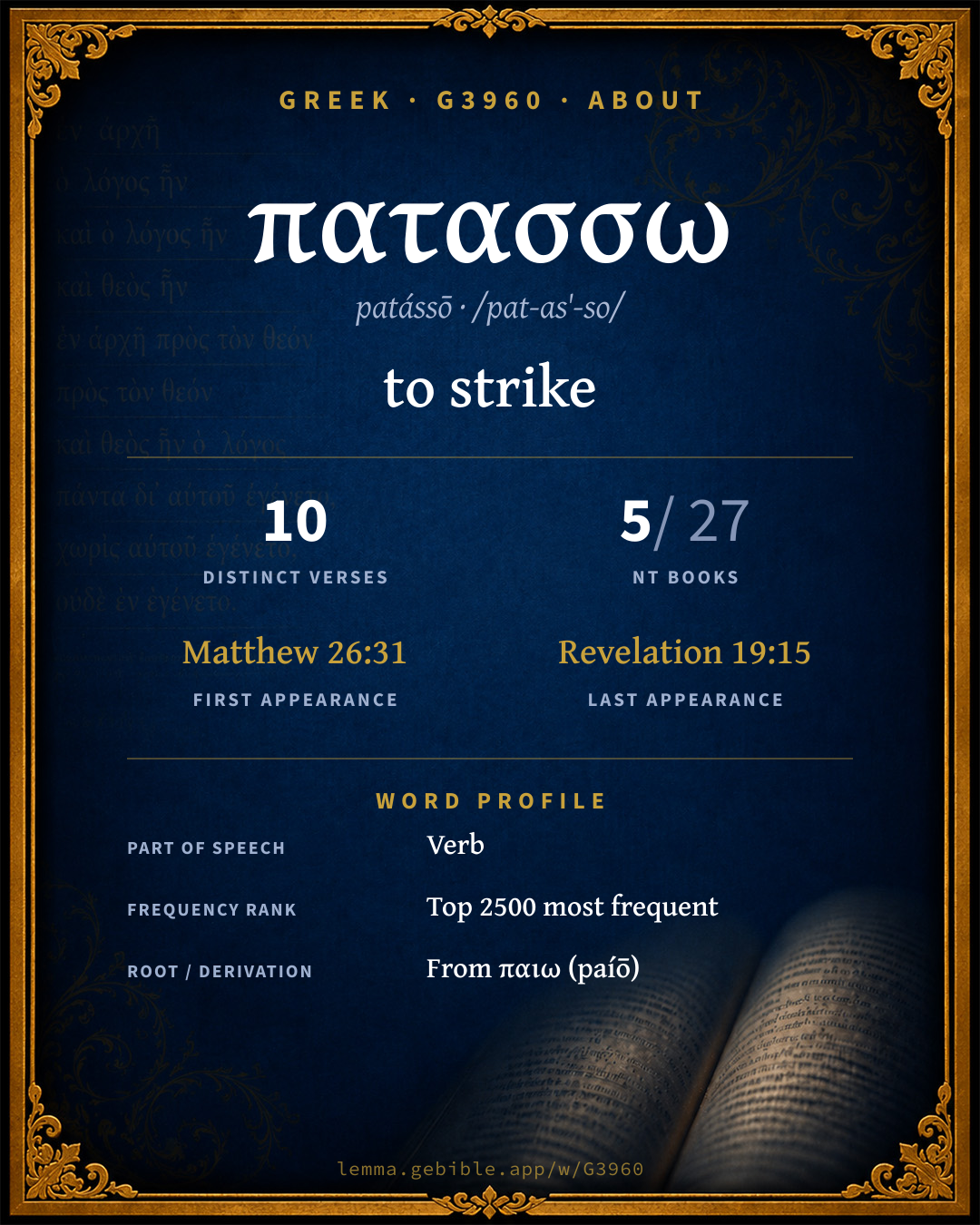
πατάσσω
to strike
‘to strike’ is one of 3 main senses fuller range ↓
Full lexicon entry — Thayer's Greek Lexicon
From Thayer's Greek Lexicon
Where this word appears
See every Aorist-tense verb in the Greek New Testament →
Grammar key — what these labels mean
Part of speech
- Verb
- An action or state-of-being word.
Tense
- Aorist
- Action viewed as a simple whole, without regard to duration — often past (perfective aspect).
- Future
- Action expected in future time.
Voice
- Active
- The subject performs the action.
Mood
- Participle
- A verbal adjective (“writing,” “having written”).
- Indicative
- States a fact or asks a factual question (the mood of reality).
- Infinitive
- A verbal noun (“to write”), unmarked for person or number.
- Subjunctive
- Expresses probability, purpose, or possibility (the mood of contingency).
Case
- Nominative
- The case of the subject (and the predicate nominative).
Person
- 3rd person
- The one spoken about (“he / she / it / they”).
- 1st person
- The speaker (“I / we”).
Gender
- Masculine
- Grammatically masculine.
Number
- Singular
- One.
- Plural
- More than one.
3 distinct verses where G3960 appears in the Future tense, across 3 books. Filtered view — show all forms. Click any verse to open its interlinear word-by-word view. Verse text shown in the World English Bible for context — . Each verse’s Greek form is shown with its reference; the English is not keyword-highlighted, since the data carries no word-level English alignment. Use “Compare translations” on any verse to read it across multiple English versions. This concordance covers the Greek New Testament; Septuagint (Greek Old Testament) occurrences of this word are not indexed here.
Matthew 1 verse
Mark 1 verse
Luke 1 verse
About this entry
At a glance — auto-summarized from this page’s data, not written by a person. Every figure links to its source below. This summary describes the numbers; it doesn’t interpret them.
“to strike” is the headline sense of the Greek verb πατασσω (patássō). Its earliest occurrence is Matthew 26:31. The Greek New Testament uses it across 10 verses — uncommon. More than a quarter of its appearances fall in Acts. Lexicons map it across 3 senses. The sections below give every sense, occurrence, and version rendering.
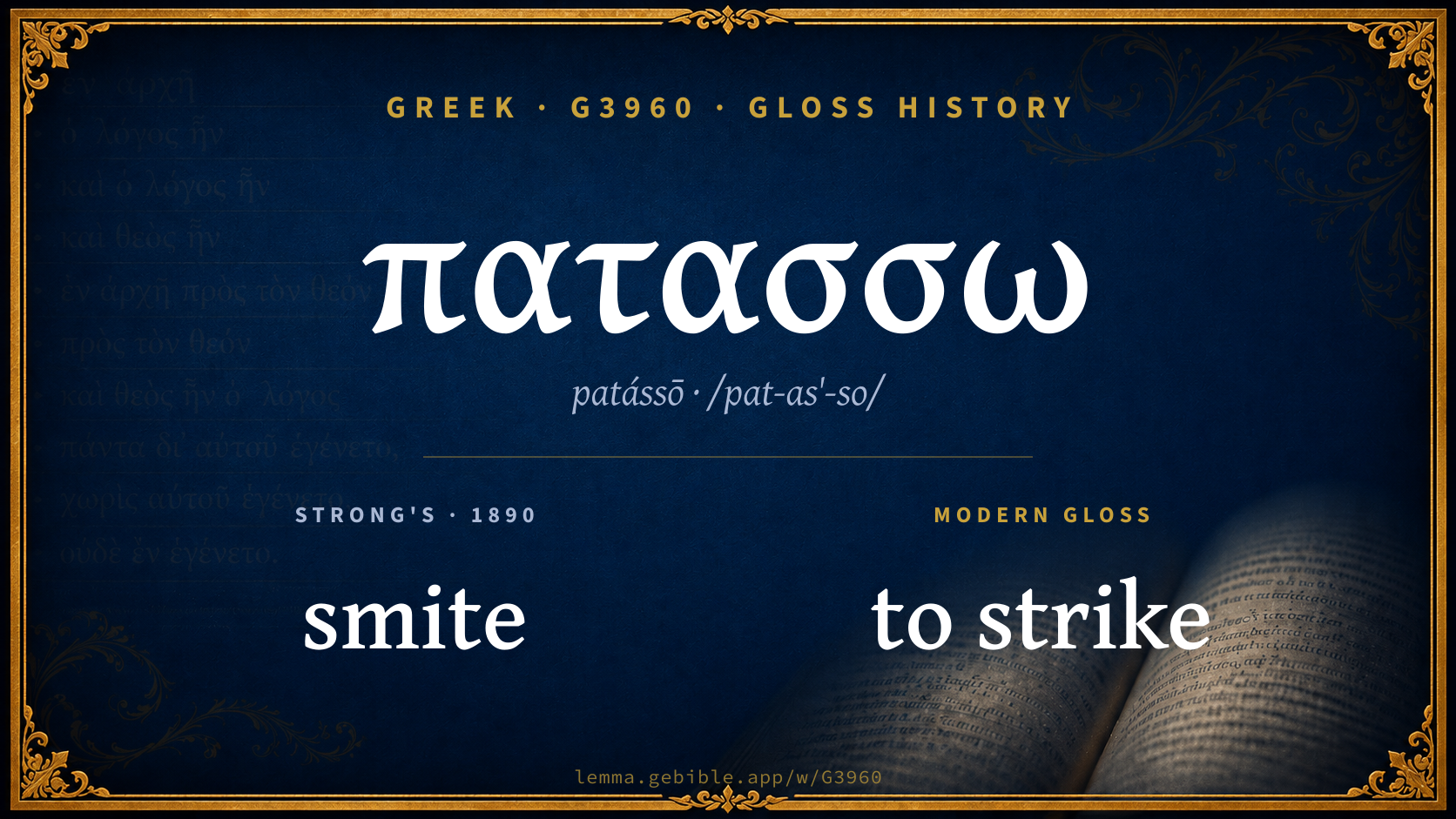
Gloss history
Strong's 1890 vs modern scholarship
About this word
Strong's G3960 catalogs a Greek word from the Greek New Testament.
These counts are not copied from any lexicon or concordance. They are computed here, from the morphology-tagged Greek New Testament. What Lemma adds →
- 10
- distinct verses
- The word appears in 10 distinct verses.
- 5 / 27
- NT books
- The word appears in 5 of 27 New Testament books.
- #1,056
- by frequency
- Top 2500 most frequent Greek words (rank 1,056 of 5,347 Greek words by occurrence).
View all 10 occurrences in the concordance →
By section of the New Testament
By traditional corpus
Conventional, traditional groupings — biblical authorship is debated, so this is a traditional corpus grouping, not an authorship claim. Some books belong to more than one corpus (Luke is in both the Gospels and the Lukan corpus, and so on), so these shares overlap and need not total 100%. Each figure is a share of the word’s 10 distinct verses.
- Gospels 5 verses · 50%
- Lukan (Luke–Acts) 5 verses · 50%
- Johannine 2 verses · 20%
- Revelation 2 verses · 20%
How translations render this word
Counts come from each version’s own published word-to-Strong’s tagging or interlinear alignment — an approximate guide to how each version renders this word, not a word-level alignment the data otherwise carries. Because each total is that version’s own tagged count, the per-version totals vary from one another and need not match the appearance or distinct-verse counts above. These counts may also differ from a printed concordance because Lemma counts each distinctly tagged rendering and does not collapse phrase taggings into a single head-word total. This is a fixed set of word-tagged versions (KJV, ASV, BSB, ULT) and does not change with the reading translation you choose elsewhere. Each version’s license is shown beside its name below (and on Sources).
- King James Version: Smote 3×, I will smite 2×
- American Standard Version: Smote 3×, Will smite 2×
- Berean Standard Bible: Struck 3×, I will strike 2×
- unfoldingWord Literal Text: I will strike 2×, Striking 2×, Struck 2×
King James Version Public Domain
Renders G3960 across 10 tagged occurrences — most commonly:
Plus 5 renderings that appear only once — usually multi-word phrases or single function words the recovered tagging swept in, not distinct renderings.
American Standard Version Public Domain
Renders G3960 across 10 tagged occurrences — most commonly:
Plus 5 renderings that appear only once — usually multi-word phrases or single function words the recovered tagging swept in, not distinct renderings.
Berean Standard Bible Public Domain
Renders G3960 across 10 tagged occurrences — most commonly:
Plus 5 renderings that appear only once — usually multi-word phrases or single function words the recovered tagging swept in, not distinct renderings.
unfoldingWord Literal Text CC BY-SA 4.0
Renders G3960 across 10 tagged occurrences — most commonly:
Plus 4 renderings that appear only once — usually multi-word phrases or single function words the recovered tagging swept in, not distinct renderings.
Senses in Thayer's
The 3 senses Thayer's distinguishes for this word, in lexicon order (not ranked by frequency or importance). The full entry — with sub-senses — is in the Lexicon Entry tab.
- to strike gently: as a part or a member of the body
- to stroke, smite: with the sword, to afflict, to visit with evils, etc. as with a deadly disease
- to smite down, cut down, to kill, slay
Word origin
Derived from παιω (paíō) (G3817) — to strike.
Forms in the corpus
The 6 distinct written forms G3960 takes in the Greek New Testament, most frequent first — each parse links to that tense’s occurrences in the concordance.
| Form | Parsing | Example | Uses |
|---|---|---|---|
| πατάξας patáxas | Verb, Aorist, Active, Participle, Nominative, Singular, Masculine | Matthew 26:51 | 3 |
| πατάξω patáxō | Verb, Future, Active, Indicative, 1st person, Singular | Matthew 26:31 | 2 |
| ἐπάταξεν epátaxen | Verb, Aorist, Active, Indicative, 3rd person, Singular | Luke 22:50 | 2 |
| πατάξαι patáxai | Verb, Aorist, Active, Infinitive | Revelation 11:6 | 1 |
| πατάξομεν patáxomen | Verb, Future, Active, Indicative, 1st person, Plural | Luke 22:49 | 1 |
| πατάξῃ patáxē | Verb, Aorist, Active, Subjunctive, 3rd person, Singular | Revelation 19:15 | 1 |
Same root — word family
Other Thayer's entries built from the same root as G3960, grouped by Strong’s listed origin. These share a root / origin per the lexicon — not necessarily a shared meaning. Each links to that word’s own entry.
Derives from
Shares the same root
Compare all same-root words → They share a root, not necessarily a meaning.
Septuagint usage
The same Greek word πατασσω appears 374 times in the Greek Old Testament (Septuagint), across 346 verses in 28 books.
- 374
- LXX occurrences
- Tagged occurrences of this Greek word in the Septuagint.
- 346
- verses
- Distinct Septuagint verses containing this word.
- 28 / 39
- OT books
- The word appears in 28 of the 39 Old Testament books.
Sample Septuagint occurrences
- Genesis 8:21 πατάσσω
- Exodus 2:12 πατάσσω
- Leviticus 24:17 πατάσσω
- Numbers 3:13 πατάσσω
- Deuteronomy 1:4 πατάσσω
- Joshua 8:21 πατάσσω
- Judges 1:8 πατάσσω
- 1 Samuel 2:14 πατάσσω
- 2 Samuel 1:15 πατάσσω
- 1 Kings 15:20 πατάσσω
- 2 Kings 2:8 πατάσσω
- 1 Chronicles 1:34 πατάσσω
Septuagint occurrences (same lexeme)
Every verse where the same Strong’s number (G3960) appears in the Greek Septuagint — showing the first 50 of 346. Verse text shown in the World English Bible for context; the Greek form is the matched word — the English is not keyword-highlighted.
- Genesis 8:21 πατάσσω Yahweh smelled the sweet savor. Yahweh said in his heart, "I will not again curse the ground any more for man's sake, because the imagination of man's heart is evil from his youth; neither will I ever again strike everything living, as I have done.
- Genesis 14:15 πατάσσω He divided himself against them by night, he and his servants, and struck them, and pursued them to Hobah, which is on the left hand of Damascus.
- Genesis 19:11 πατάσσω They struck the men who were at the door of the house with blindness, both small and great, so that they wearied themselves to find the door.
- Genesis 32:12 πατάσσω You said, 'I will surely do you good, and make your seed as the sand of the sea, which can't be numbered because there are so many.'"
- Genesis 37:21 πατάσσω Reuben heard it, and delivered him out of their hand, and said, "Let's not take his life."
- Exodus 2:12 πατάσσω He looked this way and that way, and when he saw that there was no one, he killed the Egyptian, and hid him in the sand.
- Exodus 3:20 πατάσσω I will put forth my hand and strike Egypt with all my wonders which I will do in the midst of it, and after that he will let you go.
- Exodus 7:20 πατάσσω Moses and Aaron did so, as Yahweh commanded; and he lifted up the rod, and struck the waters that were in the river, in the sight of Pharaoh, and in the sight of his servants; and all the waters that were in the river were turned to blood.
- Exodus 7:25 πατάσσω Seven days were fulfilled, after Yahweh had struck the river.
- Exodus 8:12 πατάσσω Moses and Aaron went out from Pharaoh, and Moses cried to Yahweh concerning the frogs which he had brought on Pharaoh.
- Exodus 8:13 πατάσσω Yahweh did according to the word of Moses, and the frogs died out of the houses, out of the courts, and out of the fields.
- Exodus 9:15 πατάσσω For now I would have put forth my hand, and struck you and your people with pestilence, and you would have been cut off from the earth;
- Exodus 9:25 πατάσσω The hail struck throughout all the land of Egypt all that was in the field, both man and animal; and the hail struck every herb of the field, and broke every tree of the field.
- Exodus 12:12 πατάσσω For I will go through the land of Egypt in that night, and will strike all the firstborn in the land of Egypt, both man and animal. Against all the gods of Egypt I will execute judgments: I am Yahweh.
- Exodus 12:23 πατάσσω For Yahweh will pass through to strike the Egyptians; and when he sees the blood on the lintel, and on the two side-posts, Yahweh will pass over the door, and will not allow the destroyer to come in to your houses to strike you.
- Exodus 12:27 πατάσσω that you shall say, 'It is the sacrifice of Yahweh's Passover, who passed over the houses of the children of Israel in Egypt, when he struck the Egyptians, and spared our houses.'" The people bowed their heads and worshiped.
- Exodus 12:29 πατάσσω It happened at midnight, that Yahweh struck all the firstborn in the land of Egypt, from the firstborn of Pharaoh who sat on his throne to the firstborn of the captive who was in the dungeon; and all the firstborn of cattle.
- Exodus 17:5 πατάσσω Yahweh said to Moses, "Walk on before the people, and take the elders of Israel with you, and take the rod in your hand with which you struck the Nile, and go.
- Exodus 17:6 πατάσσω Behold, I will stand before you there on the rock in Horeb. You shall strike the rock, and water will come out of it, that the people may drink." Moses did so in the sight of the elders of Israel.
- Exodus 21:12 πατάσσω "One who strikes a man so that he dies shall surely be put to death,
- Exodus 21:18 πατάσσω "If men quarrel and one strikes the other with a stone, or with his fist, and he doesn't die, but is confined to bed;
- Exodus 21:19 πατάσσω if he rises again and walks around with his staff, then he who struck him shall be cleared: only he shall pay for the loss of his time, and shall provide for his healing until he is thoroughly healed.
- Exodus 21:20 πατάσσω "If a man strikes his servant or his maid with a rod, and he dies under his hand, he shall surely be punished.
- Exodus 21:22 πατάσσω "If men fight and hurt a pregnant woman so that she gives birth prematurely, and yet no harm follows, he shall be surely fined as much as the woman's husband demands and the judges allow.
- Exodus 21:26 πατάσσω "If a man strikes his servant's eye, or his maid's eye, and destroys it, he shall let him go free for his eye's sake.
- Exodus 32:35 πατάσσω Yahweh struck the people, because they made the calf, which Aaron made.
- Leviticus 24:17 πατάσσω "'He who strikes any man mortally shall surely be put to death.
- Leviticus 24:18 πατάσσω He who strikes a animal mortally shall make it good, life for life.
- Leviticus 24:21 πατάσσω He who kills an animal shall make it good; and he who kills a man shall be put to death.
- Leviticus 26:24 πατάσσω then I will also walk contrary to you; and I will strike you, even I, seven times for your sins.
- Numbers 3:13 πατάσσω for all the firstborn are mine. On the day that I struck down all the firstborn in the land of Egypt I made holy to me all the firstborn in Israel, both man and animal. They shall be mine. I am Yahweh."
- Numbers 8:17 πατάσσω For all the firstborn among the children of Israel are mine, both man and animal. On the day that I struck all the firstborn in the land of Egypt, I sanctified them for myself.
- Numbers 11:33 πατάσσω While the flesh was yet between their teeth, before it was chewed, the anger of Yahweh was kindled against the people, and Yahweh struck the people with a very great plague.
- Numbers 14:12 πατάσσω I will strike them with the pestilence, and disinherit them, and will make of you a nation greater and mightier than they.
- Numbers 20:11 πατάσσω Moses lifted up his hand, and struck the rock with his rod twice: and water came forth abundantly, and the congregation drank, and their cattle.
- Numbers 21:24 πατάσσω Israel struck him with the edge of the sword, and possessed his land from the Arnon to the Jabbok, even to the children of Ammon; for the border of the children of Ammon was strong.
- Numbers 21:35 πατάσσω So they struck him, and his sons and all his people, until there was none left him remaining: and they possessed his land.
- Numbers 22:6 πατάσσω Please come now therefore curse me this people; for they are too mighty for me: peradventure I shall prevail, that we may strike them, and that I may drive them out of the land; for I know that he whom you bless is blessed, and he whom you curse is cursed.
- Numbers 22:11 πατάσσω Behold, the people that is come out of Egypt, it covers the surface of the earth: now, come curse me them; peradventure I shall be able to fight against them, and shall drive them out.
- Numbers 22:23 πατάσσω The donkey saw the angel of Yahweh standing in the way, with his sword drawn in his hand; and the donkey turned aside out of the way, and went into the field: and Balaam struck the donkey, to turn her into the way.
- Numbers 22:32 πατάσσω The angel of Yahweh said to him, Why have you struck your donkey these three times? behold, I am come forth for an adversary, because your way is perverse before me:
- Numbers 25:17 πατάσσω Vex the Midianites, and strike them;
- Numbers 33:4 πατάσσω while the Egyptians were burying all their firstborn, whom Yahweh had struck among them: on their gods also Yahweh executed judgments.
- Numbers 35:11 πατάσσω then you shall appoint you cities to be cities of refuge for you, that the manslayer who kills any person unwittingly may flee there.
- Numbers 35:15 πατάσσω For the children of Israel, and for the stranger and for the foreigner living among them, shall these six cities be for refuge; that everyone who kills any person unwittingly may flee there.
- Numbers 35:16 πατάσσω But if he struck him with an instrument of iron, so that he died, he is a murderer: the murderer shall surely be put to death.
- Numbers 35:17 πατάσσω If he struck him with a stone in the hand, by which a man may die, and he died, he is a murderer: the murderer shall surely be put to death.
- Numbers 35:18 πατάσσω Or if he struck him with a weapon of wood in the hand, by which a man may die, and he died, he is a murderer: the murderer shall surely be put to death.
- Numbers 35:21 πατάσσω or in enmity struck him with his hand, so that he died; he who struck him shall surely be put to death; he is a murderer: the avenger of blood shall put the murderer to death, when he meets him.
- Numbers 35:24 πατάσσω then the congregation shall judge between the striker and the avenger of blood according to these ordinances;
These are occurrences of the same Greek lexeme (G3960) in the Septuagint — not a translation of any one Hebrew word. The store carries no word-level Hebrew↔Greek alignment, so no Hebrew original is asserted here. Counts come from the recovered LXX Strong's tagging — high-frequency vocabulary is well covered, while rare or late forms may be untagged — so they reflect tagged occurrences and may slightly undercount.