
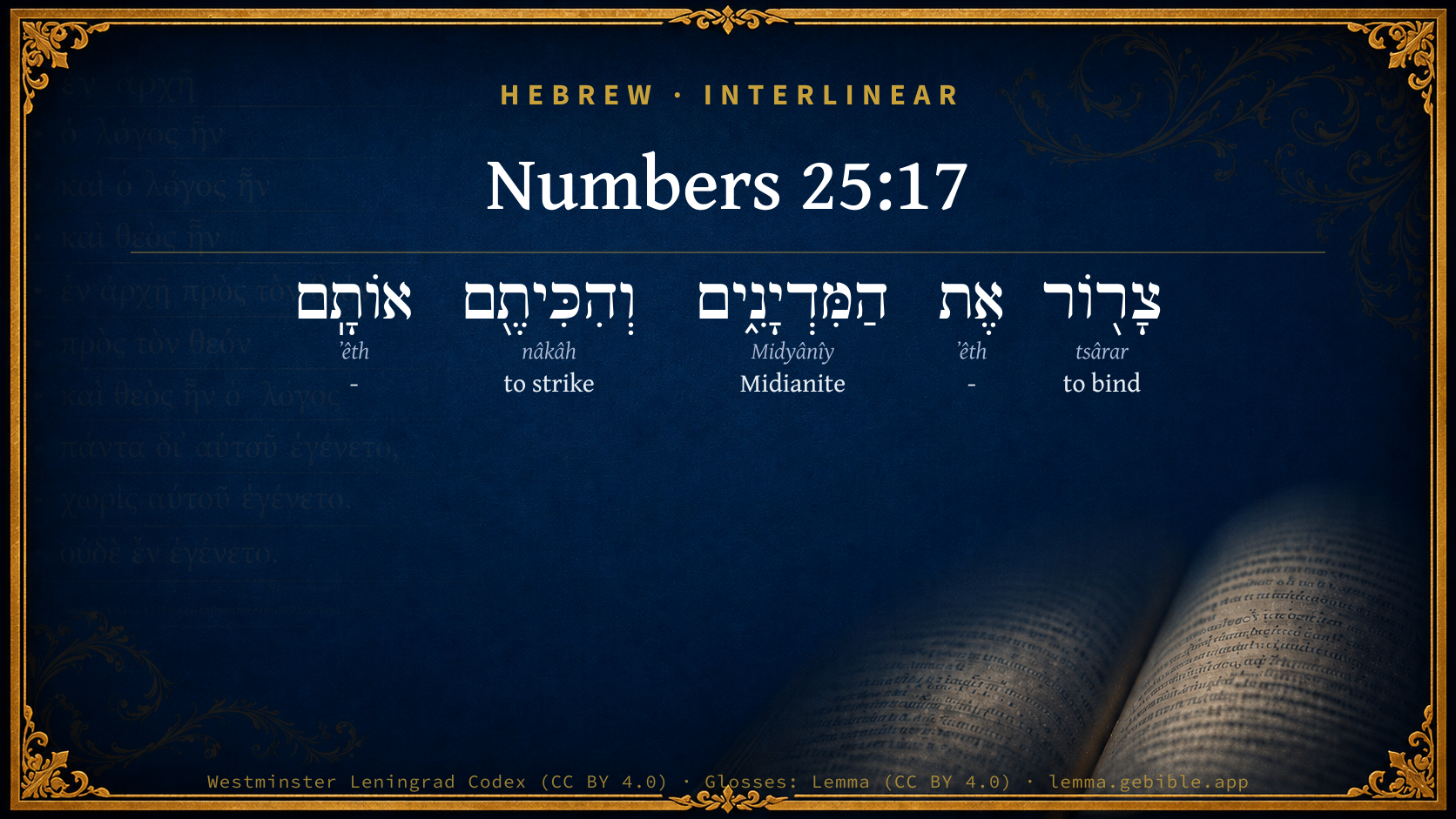
Numbers 25:17

Hebrew (Westminster Leningrad Codex) Numbers 25:17 appears in the Hebrew Old Testament. The text above is from the Westminster Leningrad Codex. Each word links to its Strong’s number, a concise gloss, and parsing drawn from the Open Scriptures Hebrew Bible morphology. Click any word for its full Brown-Driver-Briggs (BDB) entry.
Download image
Cite this verse

Numbers 25:17 (World English Bible). Public Domain. Lemma interlinear Bible study tool, https://lemma.gebible.app/v/numbers/25/17.

Show BibTeX & RIS
BibTeX
RIS
English Translation
Vex the Midianites, and strike them;
World English Bible · Public Domain
Download a study sheet

One document with this verse’s original text, its word-by-word gloss line, the meaning frame, cross-references with their text, attributed commentary, and full source and license credits — printable, and it pastes into notes with its structure intact.

This verse Autodidact and up

Study sheet (.html) Plain text (.txt)

A passage Seminary Student

Up to 50 verses in one chapter. A passage sheet keeps up to 6 commentary sources and 12 cross-references per verse, in the order this page ranks them, and says so on the sheet whenever that leaves anything out. Ask for a single verse and you get the Autodidact verse sheet above.

Everything on this page stays free to read, with no account — the sheet is a download of what is already on screen, not access to it.

Want to remove ads? Support Godless Engineer
Compare translations 3

The same verse in 3 English versions, stacked beneath the original-language interlinear above. Click any original word for its lexicon entry.

Each is an independent rendering of the whole verse — the interlinear is not word-aligned to these translations.

Highlighted words mark where these versions differ — a whole-verse word diff, not a word-by-word alignment.

  • World English Bible Public Domain
    Vex the Midianites, and strike them;
  • King James Version Public Domain
    Vex the Midianites, and smite them:
  • unfoldingWord Literal Text CC BY-SA 4.0
    “Vex the Midianites and you shall strike them down.

unfoldingWord Literal Text — © unfoldingWord, licensed CC BY-SA 4.0. Word-aligned USFM3 via Door43 (git.door43.org/unfoldingWord/en_ult).

Versions to compare (up to 4)

3 of 4 selected

Show all 18 translations

Every available English version of this verse, each an independent rendering of the whole verse.

  • World English Bible Public Domain
    Vex the Midianites, and strike them;
  • Berean Standard Bible Public Domain
    “Attack the Midianites and strike them dead.
  • Majority Standard Bible Public Domain
    “Attack the Midianites and strike them dead.
  • King James Version Public Domain
    Vex the Midianites, and smite them:
  • American Standard Version (1901) Public Domain
    Vex the Midianites, and smite them;
  • Revised Version (1885) Public Domain
    Vex the Midianites, and smite them:
  • Geneva Bible (1599) Public Domain
    Vexe the Midianites, and smite them:
  • Douay-Rheims (1899) Public Domain
    Let the Madianites find you enemies, and slay you them:
  • Young's Literal Translation Public Domain
    `Distress the Midianites, and ye have smitten them,
  • Literal Standard Version CC BY-SA 4.0
    “Distress the Midianites, and you have struck them,
  • Unlocked Literal Bible CC BY-SA 4.0
    “Treat the Midianites as enemies and attack them,
  • unfoldingWord Literal Text CC BY-SA 4.0
    “Vex the Midianites and you shall strike them down.
  • Darby Bible Public Domain
    Harass the Midianites, and smite them,
  • World Messianic Bible Public Domain
    “Harass the Midianites, and strike them;
  • Webster's Bible Public Domain
    Distress the Midianites, and smite them:
  • Free Bible Version CC BY-SA 4.0
    “Attack the Midianites and kill them,
  • Bible in Basic English Public Domain
    Take up arms against the Midianites and overcome them;
  • JPS Tanakh (1917) Public Domain
    'Harass the Midianites, and smite them;

Literal Standard Version (2020), Covenant Press — licensed CC BY-SA 4.0. Text via the HelloAO Bible API (eBible.org). Unlocked Literal Bible (unfoldingWord) — licensed CC BY-SA 4.0. Text via the HelloAO Bible API (eBible.org). unfoldingWord Literal Text — © unfoldingWord, licensed CC BY-SA 4.0. Word-aligned USFM3 via Door43 (git.door43.org/unfoldingWord/en_ult). Free Bible Version, Dr. Jonathan Gallagher — licensed CC BY-SA 4.0. Text via the HelloAO Bible API (eBible.org).

Word by word

More ways to search: Search by grammar → Find every occurrence → Compare this word →

Practice this passage: Drill this verse → Learn its vocabulary →

About this verse

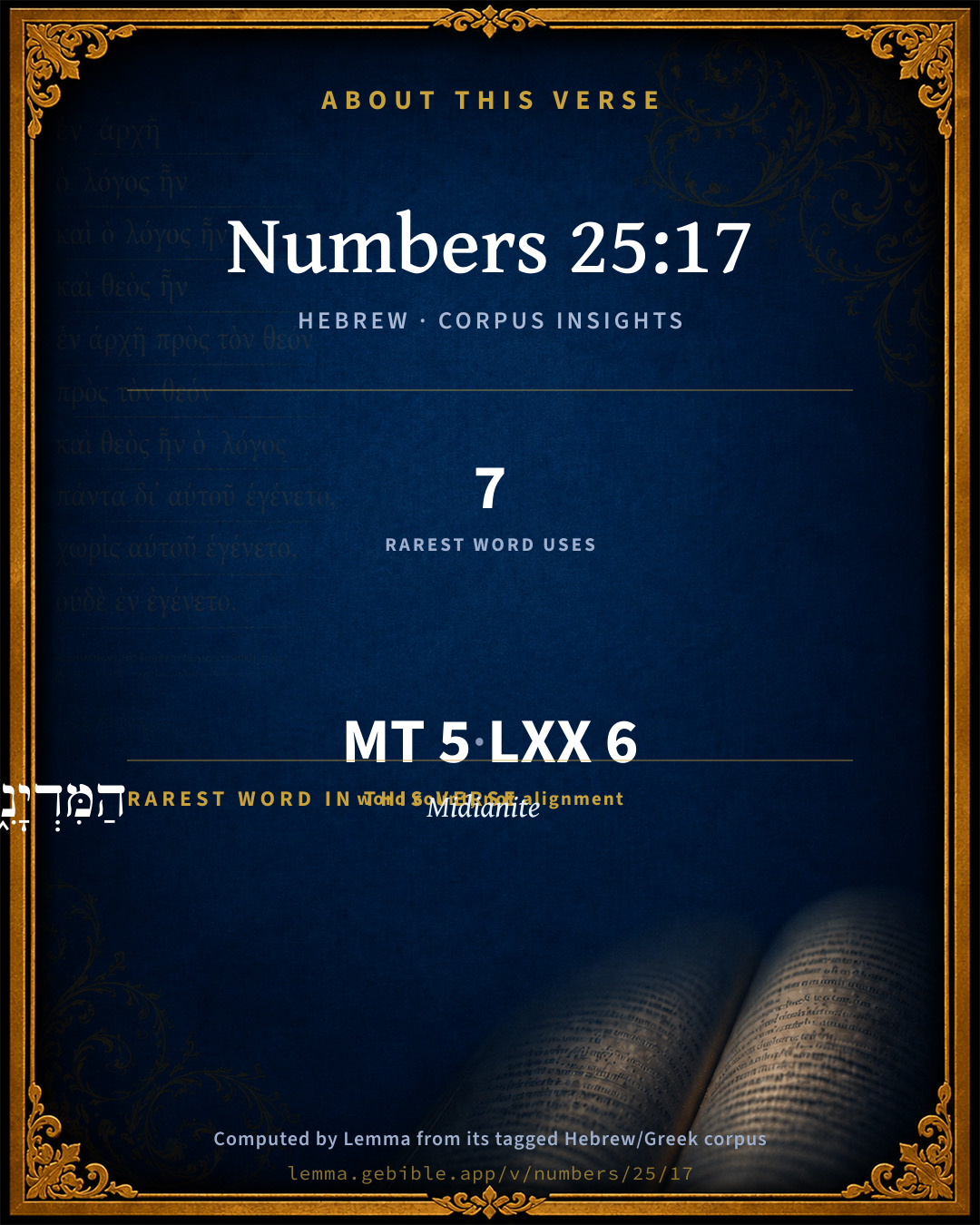
These counts appear in no published source. They are computed here, from the morphology-tagged text and Lemma’s own curated glosses. What Lemma adds →

5
words
4
distinct lemmas
Pentateuch
section

Notable vocabulary

The rarest word here is הַמִּדְיָנִ֑ים Midianite H4084 — appearing just 7 times in the whole Hebrew Bible.

Shared distinctive vocabulary

הַמִּדְיָנִ֑ים Midianite H4084 occurs in 7 verses of the Hebrew Bible. Also found in:

Grammatical profile

  • 2 verbs
  • 1 noun
  • 2 particles

Verb forms

  • צָר֖וֹר Qal · Infinitive Absolute
  • וְהִכִּיתֶ֖ם Hiphil · Sequential Perfect

Hebrew & Septuagint length

In English translation the verse runs 6 words from the Hebrew and 8 from the Septuagint (LXX English) — closely comparable.

A rough comparison of the two English renderings, which tokenize alike — not a word-level alignment.

Word counts can differ between the Hebrew and the Greek without any difference in meaning — e.g. the Hebrew direct-object marker אֵת has no separate Greek word, and Greek often adds the article ὁ.

In the original languages it is 5 Hebrew tokens and 6 Greek tokens — but the two are counted differently (Hebrew bundles its prefixes and suffixes into one token; the Greek is in lemma form), so that isn’t a like-for-like length.

Cross-references

2

Topical passages linked to Numbers 25:17 in the Treasury of Scripture Knowledge — connected by theme and wording, ordered by reader-vote popularity; previews shown in the World English Bible.

  • Numbers 31:1–3 Yahweh spoke to Moses, saying,
  • Revelation 18:6 Return to her just as she returned, and repay her double as she did, and according to her works. In the cup which she mixed, mix to her double.

Cross-references courtesy of OpenBible.info (CC BY 4.0).

Hebrew and Greek witnesses Masoretic Hebrew ↔ Greek Septuagint

The same verse in the two great witnesses to the Old Testament, shown verse-for-verse.

These are two independent witnesses, not word-aligned to each other, and the Septuagint is shown in lemma (dictionary) form.

Hebrew Numbers 25:17 Masoretic · Westminster Leningrad Codex

צָר֖וֹר אֶת הַמִּדְיָנִ֑ים וְהִכִּיתֶ֖ם אוֹתָֽם

Vex the Midianites, and strike them;

World English Bible · Public Domain

Greek LXX Numbers 25:17 Septuagint · lemma form

ἐχθραίνω ὁ μαδιηναῖος καί πατάσσω αὐτός

Plague the Madianites as enemies, and strike them,

LXX2012 (modern English Septuagint) · Public Domain

Hebrew: Westminster Leningrad Codex (CC BY 4.0). Greek: Septuagint (public domain); English from LXX2012 (modern English Septuagint) (Public Domain). How the Septuagint differs from the Hebrew →

Targum (Aramaic paraphrase)

2

The Targum is the ancient Jewish Aramaic paraphrase of the Hebrew Scriptures — an interpretive translation, not the Hebrew text itself. Onkelos (literal) and Pseudo-Jonathan (expansive) render the Torah, and Jonathan the Prophets. Coverage is partial: where no permissively-licensed English translation exists for a verse, only the Aramaic is shown. This is verse-level text, not a word-by-word alignment to the Hebrew.

  1. Targum Onkelos Torah (Genesis–Deuteronomy)
    אָעֵק יַת מִדְיָנָאֵי וְתִקְטְלוּן יָתְהוֹן

    (no public-domain English translation for this verse)

    Targum Onkelos — Aramaic: “Onkelos Genesis” (public domain); “Onkelos Exodus” (public domain); “Onkelos Leviticus” (public domain); “Onkelos Numbers” (public domain); “Onkelos Deuteronomy” (public domain). English: “Sefaria Community Translation” (CC0 1.0 (public-domain dedication)); “J.W. Etheridge. The Targums of Onkelos and Jonathan Ben Uzziel on the Pentateuch. London: Longmans, Green, 1862” (public domain). Text via Sefaria.

  2. Targum Pseudo-Jonathan Torah (Genesis–Deuteronomy)
    אָעֵיק יַת מִדְיָנָאֵי וְתִקְטוֹל יַתְהוֹן

    Trouble the Midianites and slay them,

    Targum Pseudo-Jonathan — Aramaic: “Targum Jonathan on Genesis” (public domain); “Targum Jonathan on Exodus” (public domain); “Targum Jonathan on Leviticus” (public domain); “Targum Jonathan on Numbers” (public domain); “Targum Jonathan on Deuteronomy” (public domain). English: “The Targum of Jonathan ben Uzziel, trans. J. W. Etheridge, London, 1862” (public domain). Text via Sefaria.

Commentary

Notes on Numbers 25:17 from classic Christian and Jewish commentators (each source and its license shown beneath its notes). The classic Christian expositions comment on the surrounding passage and are grouped to its opening verse, so a note may address several verses; the Jewish commentaries on the Tanakh (Rashi and others) are per-verse, so they appear only where the commentator wrote on this verse.

Lemma curates 59 commentaries, every one of them public domain or Creative Commons licensed, each selected and text-cleaned for this edition rather than reprinted as found. About our sources →

Trapp's Complete Commentary

John Trapp

Num 25:17 Vex the Midianites, and smite them:

Ver. 17. Vex the Midianites.] As more malicious and mischievous than the Moabites; as appears, (1.) By their detaining of Balaam, when the Moabites dismissed him in great displeasure; (2.) By the wickedness of their women, who by Cozbi may seem to have been meretrices meretricissimae, such as afterwards was Julia, Messalina, and that Romish Lucretia, concubine to Pope Alexander VI., of whom Pontanus, {a}

“ Hoc tumulo dormit Lucretia nomine, sed re

Thais, Alexandri filia, sponsa, nurus. ”

{a} Lib. ii. tum.

John Trapp, A Commentary or Exposition upon All the Books of the Old and New Testament (1647–1656) — public domain. Text from a community e-Sword module.

Joseph Benson's Commentary

Num 25:17. Vex the Midianites — It is probable, from Num 25:6, compared with Num 21:16, that the Midianites had had the principal hand in seducing the Israelites into this shameful revolt from the worship of God to the vile sacrifices of Baal-peor, and in causing this open and impudent affront to be put upon the professors of the true religion in the matter of Zimri, to whom they prostituted a daughter of one of their most honourable families, to procure the disgrace and destruction of the Israelites; therefore, in just retribution for their wickedness, God commands Moses to be ready at a time he should appoint to attack their country with his whole force, and give them a fatal overthrow.

Joseph Benson's Commentary on the Old and New Testaments (1811–1818) — public domain. Text from a community e-Sword module.

Jamieson, Fausset & Brown

Robert Jamieson, A. R. Fausset & David Brown

Vex the Midianites, and smite them--They seem to have been the most guilty parties. (Compare Num 22:4; Num 31:8).

Jamieson, Fausset & Brown — Commentary Critical and Explanatory on the Whole Bible (1871) — public domain (CC PDM 1.0). Text via the HelloAO Bible API.

Adam Clarke's Commentary

Verse 17. Vex the Midianites, &c.] See this order fulfilled, Nu 31:1-20. Twelve thousand Israelites attacked the Midianites, destroyed all their cities, slew their five kings, every male, and every grown up woman, and took all their spoils.

Adam Clarke's Commentary on the Bible (1810–1826) — public domain. Text from a community e-Sword/MySword module.

Ellicott's Commentary for English Readers

(17) Vex the Midianites, and smite them.—The Midianites appear to have been joint actors with the Moabites throughout the whole of the opposition which was offered to Israel, and the chief actors in the wiles by which the Israelites were seduced. As the descendants of Abraham, the father of the faithful, the Midianites ought to have feared and obeyed Abraham’s God, and to have shown brotherly kindness to His people, who were their own kindred. The special judgments of God are directed against the sins of apostacy and of seduction. (Comp. Rev_2:14; Rev_18:6.) Although the Moabites were not to be smitten with the Midianites (see Deu_2:9), nevertheless they did not escape punishment, but were shut out, even to the tenth generation, from the congregation of the Lord. (See Deu_23:3-4.) Their exemption at this time from the judgment executed upon the Midianites was probably due, not to their descent from Lot (for the Midianites were descended from Abraham), but to the fact that the measure of their sin was not yet full. (Comp. Gen_15:16.)

A Bible Commentary for English Readers, edited by Charles John Ellicott (1878–1897) — public domain. Text from a community e-Sword module.

John Gill's Exposition

For they vex you with their wiles,.... Not with wars, but with wiles, with cunning stratagems, and artful methods to draw them into sin, that thereby they might be exposed to the wrath of God:

wherewith they have beguiled you in the matter of Peor; the idol Peor, that is, Baalpeor; which seems to countenance the notion that Peor was the name of a man, some great personage, who was deified after his death; now the Midianites beguiled the Israelites, by sending their daughters among them, with whom they committed fornication, and by whom they were inveigled to worship the idol Peor:

and in the matter of Cozbi, the daughter of a prince of Midian, their sister; their countrywoman, as it was common with eastern people to call those of the same country with them their brethren and sisters: now the Midianites beguiled the Israelites, by prostituting a person of such quality to a prince of theirs, which was setting an example to other daughters of Midian to follow her, and so hereby many of the children of Israel were ensnared into whoredom, and into idolatry:

which was slain in the day of the plague, for Peor's sake: or for the business of Peor, as the Targum of Jonathan, because of the worship of that idol; not that Cozbi was slain upon that account, but the plague came upon Israel by reason of their worshipping of it, and it was on the day that the plague was that she was slain; by which it seems that the plague lasted but one day.

Next: Numbers Chapter 26

John Gill's Exposition of the Whole Bible (1746–1763) — public domain (CC PDM 1.0). Text via the HelloAO Bible API.

Haydock's Catholic Bible Commentary

Madianites. God spared the Moabites for the sake of Lot (Deuteronomy ii. 19,) and of Ruth, of whom David and Christ should be born. They were perhaps less guilty, but they did not escape due chastisement under David, 2 Kings viii. 2. (Menochius) --- The war against Madian was the last which the Hebrews waged in the lifetime of Moses, chap. xxxi. (Haydock)

George Leo Haydock (1774–1849), Haydock's Catholic Family Bible and Commentary, 1859 edition — public domain. Excludes Psalms (Douay-Rheims chapter numbering differs from Protestant) and Deuterocanonical books (Catholic canon only).

Matthew Poole's English Annotations

And why not the Moabites, who were as guilty, Num 25:1?

Answ. 1. Because God will reserve to himself a liberty of punishing or sparing, according to his own good pleasure.

2. God had a kindness for the Moabites for Lot’s sake, Deu 2:9.

3. God punished the Moabites in another manner, partly, by his own immediate hand, whereby it is probable he cut off those Moabitish women that were guilty of this fact; partly, by a particular and dreadful kind of excommunication, Deu 23:3; and partly, by impunity, which in its consequences is commonly worse and more pernicious than any or all temporal punishments, which none that believes the Bible can deny.

4. It is probable the Midianites were most guilty, as in persuading Balak to send for Balaam, as may be gathered from Num 22:4,7; so in the reception of Balaam after Balak had dismissed him, Num 31:8, and in further consultation with him, and in contriving the means for the executing of this wicked plot.

Smite them, i.e. kill them; in which words, as there is a command to war against them, so there is a promise of success.

Matthew Poole's English Annotations on the Holy Bible (1683–1685) — public domain. Text from a community e-Sword/MySword module.

Whedon's Commentary on the Bible

Daniel D. Whedon

WAR AGAINST MIDIAN COMMANDED, Num_25:16-18.

17. Vex the Midianites — Although Midian and Moab were united in bringing Balaam from the east, (Num_22:4; Num_22:7,) and the daughters of Moab were associated with those of Midian in seducing Israel, yet only Midian provoked Jehovah to a declaration of war at this time, possibly because Moab was not so forward in this iniquity. Says Ainsworth, “For though Baalam gave counsel to the king of Moab, (Rev_2:14,) and the Moabitish women were prostitute also unto whoredom, yet Balak at first did not much regard that counsel, but turned Balaam away with shame, but the Midianites retained him, and among them he was slain.”

Daniel D. Whedon (gen. ed.), Commentary on the Old and New Testaments (1874–1909) — public domain. Text from a community e-Sword module.

The Pulpit Commentary

Vex the Midianites. The Moabites, although the evil began with them, were passed over; perhaps because they were still protected by the Divine injunction (Deu_2:9) not to meddle with them; more probably because their sin had not the same studied and deliberate character as the sin of the Midianites. We may think of the women of Moab as merely indulging their individual passions after their wonted manner, but of the women of Midian as employed by their rulers, on the advice of Balsam, in a deliberate plot to entangle the Israelites in heathen rites and heathen sins which would alienate from them the favour of God.

The Pulpit Commentary (1880–1919), ed. H.D.M. Spence-Jones & Joseph S. Exell — public domain. Text from a community e-Sword module.

John Wesley's Explanatory Notes

The Midianites - And why not the Moabites. It is probable the Midianites were most guilty, as in persuading Balak to send for Balaam, chap. xxii, 4, 7. So in the reception of Balaam after Balak had dismissed him, chap. xxxi, 8, and in farther consultation with him, and in contriving the means for the executing of this wicked plot.

John Wesley, Explanatory Notes Upon the Whole Bible (1754–1765) — public domain. Text via the GEBible commentary corpus.

Rashi

Rabbi Shlomo Yitzchaki (Rashi)

צרור — This grammatical form is similar to זכור and שמור: it expresses the idea of continuous present action — You must [constantly] show enmity toward them.

Rashi on the Tanakh — English translations: “The Judaica Press complete Tanach with Rashi, translated by A. J. Rosenberg” (CC BY 4.0); “Pentateuch with Rashi's commentary by M. Rosenbaum and A.M. Silbermann, 1929-1934” (public domain); “The Metsudah Tanach series, Lakewood, N.J” (CC BY 4.0); and “The Book of Joshua, Metsudah Publications, 1997” (CC BY 4.0). Text via Sefaria.

Lesson kit

Teaching starters — assembled from the data on this page, not authored interpretation. Every prompt links to the verse data it draws on. Edit before teaching.

Numbers, in the Pentateuch, opens this verse with 5 words (4 distinct Hebrew lemmas). Its most distinctive word is Midyânîy (“Midianite”). A historical commentator’s framing appears above. Read the whole chapter for the surrounding context.

Discussion questions

  1. The word Midyânîy carries the sense “Midianite.” How does it shape the verse?
  2. How does Genesis 37:28, which shares the word «Midianite», read alongside this verse?
  3. These translations render this verse differently. What is at stake in choosing one wording over another?
  4. «צָר֖וֹר» is a Qal Infinitive Absolute verb. How does that grammatical form shape the action described?
  5. Compare how Trapp's Complete Commentary and Joseph Benson's Commentary read this verse. Where do they agree or differ?

Things to notice

Reading settings

Reading text

Shown beneath each verse's original-language words.

Old Testament
Old Testament edition

Read the OT as the Masoretic Hebrew (MT) or the Greek Septuagint (LXX).

English shown for the Greek Septuagint (in the Hebrew ↔ Greek comparison).

Comparing translations? Open the Compare panel on any verse page to stack up to four side by side.