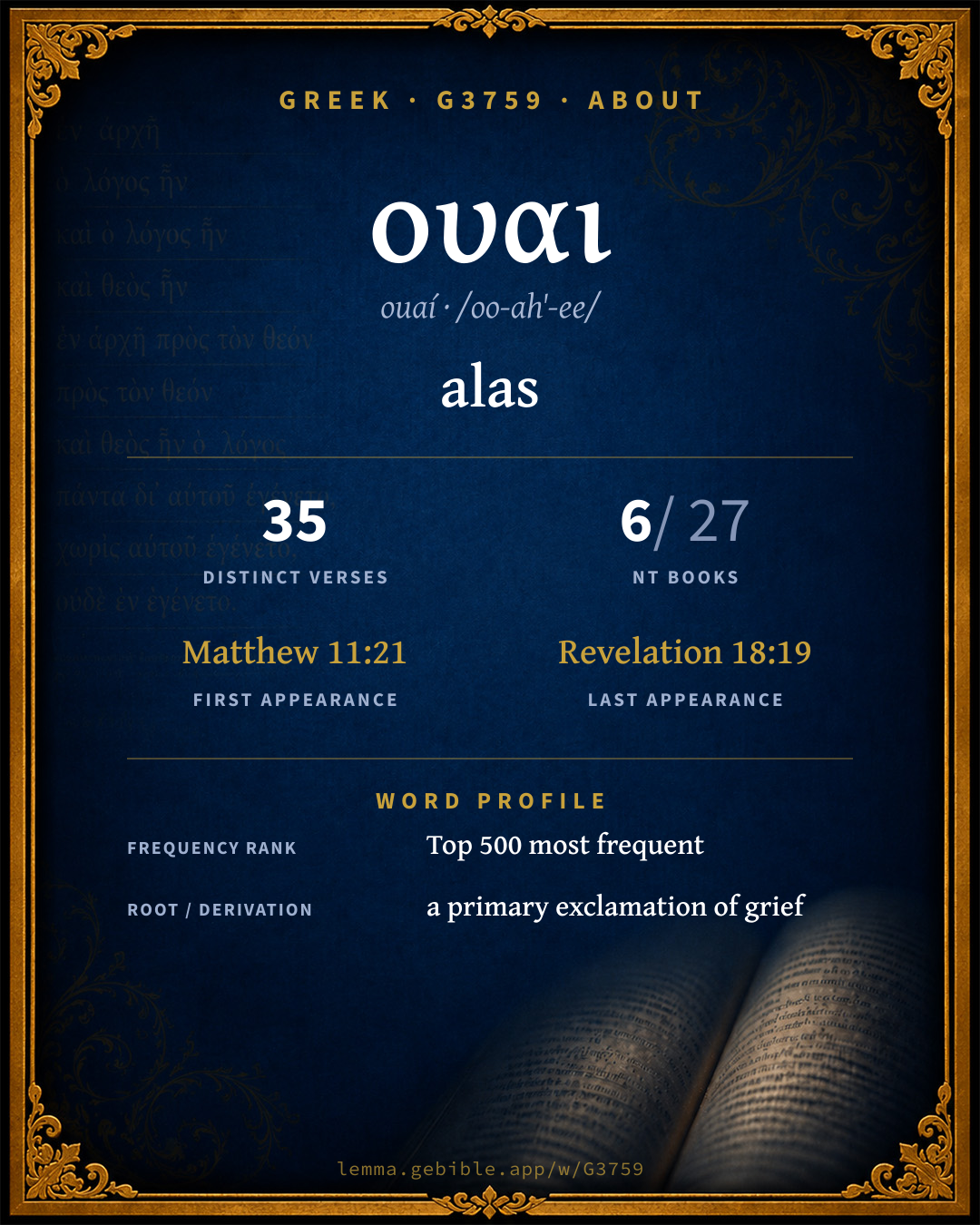
οὐαί
alas
Full lexicon entry — Thayer's Greek Lexicon
From Thayer's Greek Lexicon
Where this word appears
Grammar key — what these labels mean
Part of speech
- Interjection
- An exclamatory word (“behold!”, “O!”).
Grammatical forms
- Interjection 42 times (91%)
- Noun, Indeclinable 4 times (9%)
Parsed forms decoded from the imported morphology (Robinson–Tischendorf, public domain), counted across 46 parsed occurrences — not distinct verses.
Every verse where G3759 appears — 35 distinct verses across 6 books. Click any verse to open its interlinear word-by-word view. Verse text shown in the World English Bible for context — . Each verse’s Greek form is shown with its reference; the English is not keyword-highlighted, since the data carries no word-level English alignment. Use “Compare translations” on any verse to read it across multiple English versions. This concordance covers the Greek New Testament; Septuagint (Greek Old Testament) occurrences of this word are not indexed here.
Matthew 11 verses
- Matthew 11:21 οὐαί οὐαί intj intj "Woe to you, Chorazin! Woe to you, Bethsaida! For if the mighty works had been done in Tyre and Sidon which were done in you, they would have repented long ago in sackcloth and ashes.
- Matthew 18:7 Οὐαὶ οὐαὶ intj intj "Woe to the world because of occasions of stumbling! For it must be that the occasions come, but woe to that person through whom the occasion comes!
- Matthew 23:13 Οὐαὶ intj "Woe to you, scribes and Pharisees, hypocrites! For you devour widows' houses, and as a pretense you make long prayers. Therefore you will receive greater condemnation.
- Matthew 23:15 οὐαὶ intj Woe to you, scribes and Pharisees, hypocrites! For you travel around by sea and land to make one proselyte; and when he becomes one, you make him twice as much of a son of Gehenna as yourselves.
- Matthew 23:16 οὐαὶ intj "Woe to you, you blind guides, who say, 'Whoever swears by the temple, it is nothing; but whoever swears by the gold of the temple, he is obligated.'
- Matthew 23:23 οὐαὶ intj "Woe to you, scribes and Pharisees, hypocrites! For you tithe mint, dill, and cumin, and have left undone the weightier matters of the law: justice, mercy, and faith. But you ought to have done these, and not to have left the other undone.
- Matthew 23:25 οὐαὶ intj "Woe to you, scribes and Pharisees, hypocrites! For you clean the outside of the cup and of the platter, but within they are full of extortion and unrighteousness.
- Matthew 23:27 οὐαὶ intj "Woe to you, scribes and Pharisees, hypocrites! For you are like whitened tombs, which outwardly appear beautiful, but inwardly are full of dead men's bones, and of all uncleanness.
- Matthew 23:29 οὐαὶ intj "Woe to you, scribes and Pharisees, hypocrites! For you build the tombs of the prophets, and decorate the tombs of the righteous,
- Matthew 24:19 οὐαὶ intj But woe to those who are with child and to nursing mothers in those days!
- Matthew 26:24 οὐαὶ intj The Son of Man goes, even as it is written of him, but woe to that man through whom the Son of Man is betrayed! It would be better for that man if he had not been born."
Mark 2 verses
Luke 13 verses
- Luke 6:24 οὐαὶ intj "But woe to you who are rich! For you have received your consolation.
- Luke 6:25 οὐαὶ οὐαί intj intj Woe to you, you who are full now! For you will be hungry. Woe to you who laugh now! For you will mourn and weep.
- Luke 6:26 οὐαὶ intj Woe, when men speak well of you! For their fathers did the same thing to the false prophets.
- Luke 10:13 Οὐαί οὐαί intj intj "Woe to you, Chorazin! Woe to you, Bethsaida! For if the mighty works had been done in Tyre and Sidon which were done in you, they would have repented long ago, sitting in sackcloth and ashes.
- Luke 11:42 οὐαὶ intj But woe to you Pharisees! For you tithe mint and rue and every herb, but you bypass justice and the love of God. You ought to have done these, and not to have left the other undone.
- Luke 11:43 οὐαὶ intj Woe to you Pharisees! For you love the best seats in the synagogues, and the greetings in the marketplaces.
- Luke 11:44 οὐαὶ intj Woe to you, scribes and Pharisees, hypocrites! For you are like hidden graves, and the men who walk over them don't know it."
- Luke 11:46 οὐαί intj He said, "Woe to you lawyers also! For you load men with burdens that are difficult to carry, and you yourselves won't even lift one finger to help carry those burdens.
- Luke 11:47 οὐαὶ intj Woe to you! For you build the tombs of the prophets, and your fathers killed them.
- Luke 11:52 οὐαὶ intj Woe to you lawyers! For you took away the key of knowledge. You didn't enter in yourselves, and those who were entering in, you hindered."
- Luke 17:1 οὐαὶ intj He said to the disciples, "It is impossible that no occasions of stumbling should come, but woe to him through whom they come!
- Luke 21:23 οὐαὶ intj Woe to those who are pregnant and to those who nurse infants in those days! For there will be great distress in the land, and wrath to this people.
- Luke 22:22 οὐαὶ intj The Son of Man indeed goes, as it has been determined, but woe to that man through whom he is betrayed!"
1 Corinthians 1 verse
Jude 1 verse
Revelation 7 verses
- Revelation 8:13 οὐαὶ οὐαὶ οὐαὶ intj intj intj I saw, and I heard an eagle, flying in mid heaven, saying with a loud voice, "Woe! Woe! Woe for those who dwell on the earth, because of the other voices of the trumpets of the three angels, who are yet to sound!"
- Revelation 9:12 οὐαὶ οὐαὶ n indecl n indecl The first woe is past. Behold, there are still two woes coming after this.
- Revelation 11:14 οὐαὶ οὐαὶ n indecl n indecl The second woe is past. Behold, the third woe comes quickly.
- Revelation 12:12 οὐαὶ intj Therefore rejoice, heavens, and you who dwell in them. Woe to the earth and to the sea, because the devil has gone down to you, having great wrath, knowing that he has but a short time."
- Revelation 18:10 οὐαὶ οὐαί intj intj standing far away for the fear of her torment, saying, 'Woe, woe, the great city, Babylon, the strong city! For your judgment has come in one hour.'
- Revelation 18:16 οὐαὶ οὐαί intj intj saying, 'Woe, woe, the great city, she who was dressed in fine linen, purple, and scarlet, and decked with gold and precious stones and pearls!
- Revelation 18:19 οὐαὶ οὐαί intj intj They cast dust on their heads, and cried, weeping and mourning, saying, 'Woe, woe, the great city, in which all who had their ships in the sea were made rich by reason of her great wealth!' For in one hour is she made desolate.
About this entry
At a glance — auto-summarized from this page’s data, not written by a person. Every figure links to its source below. This summary describes the numbers; it doesn’t interpret them.
The Greek word ουαι centers on the idea of “alas.” Debuting at Matthew 11:21, it then recurs through the corpus. It appears 35 verses across 6 books of the Greek New Testament, among its moderately common vocabulary. The word gravitates to Luke (37%), then Matthew and Revelation. For the data behind this summary, explore the sense tree and the renderings breakdown below.
Gloss history
Strong's 1890 vs modern scholarship
About this word
Strong's G3759 catalogs a Greek word from the Greek New Testament.
These counts are not copied from any lexicon or concordance. They are computed here, from the morphology-tagged Greek New Testament. What Lemma adds →
- 35
- distinct verses
- The word appears in 35 distinct verses.
- 6 / 27
- NT books
- The word appears in 6 of 27 New Testament books.
- #334
- by frequency
- Top 500 most frequent Greek words (rank 334 of 5,347 Greek words by occurrence).
View all 35 occurrences in the concordance →
Most concentrated in
- Luke 13 verses 37%
- Matthew 11 verses 31%
- Revelation 7 verses 20%
By section of the New Testament
By traditional corpus
Conventional, traditional groupings — biblical authorship is debated, so this is a traditional corpus grouping, not an authorship claim. Some books belong to more than one corpus (Luke is in both the Gospels and the Lukan corpus, and so on), so these shares overlap and need not total 100%. Each figure is a share of the word’s 35 distinct verses.
- Gospels 26 verses · 74%
- Lukan (Luke–Acts) 13 verses · 37%
- Johannine 7 verses · 20%
- Revelation 7 verses · 20%
- Pauline corpus 1 verse · 3%
- General (Catholic) Epistles 1 verse · 3%
How translations render this word
Counts come from each version’s own published word-to-Strong’s tagging or interlinear alignment — an approximate guide to how each version renders this word, not a word-level alignment the data otherwise carries. Because each total is that version’s own tagged count, the per-version totals vary from one another and need not match the appearance or distinct-verse counts above. These counts may also differ from a printed concordance because Lemma counts each distinctly tagged rendering and does not collapse phrase taggings into a single head-word total. This is a fixed set of word-tagged versions (KJV, ASV, BSB, ULT) and does not change with the reading translation you choose elsewhere. Each version’s license is shown beside its name below (and on Sources).
- King James Version: Woe 40×, Alas 6×
- American Standard Version: Woe 45×
- Berean Standard Bible: Woe 39×, Miserable 2×, Woe to 2×
- unfoldingWord Literal Text: Woe 44×
King James Version Public Domain
Renders G3759 across 47 tagged occurrences — most commonly:
Plus 1 rendering that appears only once — usually multi-word phrases or single function words the recovered tagging swept in, not distinct renderings.
American Standard Version Public Domain
Renders G3759 across 46 tagged occurrences — most commonly:
Plus 1 rendering that appears only once — usually multi-word phrases or single function words the recovered tagging swept in, not distinct renderings.
Berean Standard Bible Public Domain
Renders G3759 across 46 tagged occurrences — most commonly:
Plus 3 renderings that appear only once — usually multi-word phrases or single function words the recovered tagging swept in, not distinct renderings.
unfoldingWord Literal Text CC BY-SA 4.0
Renders G3759 across 48 tagged occurrences — most commonly:
Plus 4 renderings that appear only once — usually multi-word phrases or single function words the recovered tagging swept in, not distinct renderings.
Senses in Thayer's
The 1 sense Thayer's distinguishes for this word, in lexicon order (not ranked by frequency or importance). The full entry — with sub-senses — is in the Lexicon Entry tab.
- alas, woe
Word origin
Origin: a primary exclamation of grief
A primary excamation of grief; woe : - alas woe.
— Strong’s Exhaustive Concordance (1890), public domain.
Forms in the corpus
The 4 distinct written forms G3759 takes in the Greek New Testament, most frequent first — each parse links to that case’s occurrences in the concordance.
| Form | Parsing | Example | Uses |
|---|---|---|---|
| οὐαὶ ouaì | Interjection | Matthew 18:7 | 35 |
| οὐαί ouaí | Interjection | Matthew 11:21 | 8 |
| Οὐαὶ Ouaì | Interjection | Matthew 18:7 | 2 |
| Οὐαί Ouaí | Interjection | Luke 10:13 | 1 |
Septuagint usage
The same Greek word ουαι appears 60 times in the Greek Old Testament (Septuagint), across 56 verses in 15 books.
- 60
- LXX occurrences
- Tagged occurrences of this Greek word in the Septuagint.
- 56
- verses
- Distinct Septuagint verses containing this word.
- 15 / 39
- OT books
- The word appears in 15 of the 39 Old Testament books.
Sample Septuagint occurrences
- Numbers 21:29 οὐαί
- 1 Samuel 4:7 οὐαί
- 1 Kings 12:24 οὐαί
- Proverbs 23:29 οὐαί
- Ecclesiastes 4:10 οὐαί
- Isaiah 1:4 οὐαί
- Jeremiah 4:13 οὐαί
- Lamentations 5:16 οὐαί
- Ezekiel 2:10 οὐαί
- Hosea 7:13 οὐαί
- Amos 5:16 οὐαί
- Micah 7:4 οὐαί
Septuagint occurrences (same lexeme)
Every verse where the same Strong’s number (G3759) appears in the Greek Septuagint — showing the first 50 of 56. Verse text shown in the World English Bible for context; the Greek form is the matched word — the English is not keyword-highlighted.
- Numbers 21:29 οὐαί Woe to you, Moab! You are undone, people of Chemosh: He has given his sons as fugitives, His daughters into captivity, To Sihon king of the Amorites.
- 1 Samuel 4:7 οὐαί The Philistines were afraid, for they said, God is come into the camp. They said, Woe to us! for there has not been such a thing heretofore.
- 1 Samuel 4:8 οὐαί Woe to us! who shall deliver us out of the hand of these mighty gods? these are the gods that struck the Egyptians with all manner of plagues in the wilderness.
- 1 Samuel 4:21 οὐαί She named the child Ichabod, saying, The glory is departed from Israel; because the ark of God was taken, and because of her father-in-law and her husband.
- 1 Kings 12:24 οὐαί Thus says Yahweh, You shall not go up, nor fight against your brothers the children of Israel: return every man to his house; for this thing is of me. So they listened to the word of Yahweh, and returned and went their way, according to the word of Yahweh.
- 1 Kings 13:30 οὐαί He laid his body in his own grave; and they mourned over him, [saying], Alas, my brother!
- Proverbs 23:29 οὐαί Who has woe? Who has sorrow? Who has strife? Who has complaints? Who has needless bruises? Who has bloodshot eyes?
- Ecclesiastes 4:10 οὐαί For if they fall, the one will lift up his fellow; but woe to him who is alone when he falls, and doesn't have another to lift him up.
- Ecclesiastes 10:16 οὐαί Woe to you, land, when your king is a child, And your princes eat in the morning!
- Isaiah 1:4 οὐαί Ah sinful nation, A people loaded with iniquity, A seed of evil-doers, Children who deal corruptly! They have forsaken Yahweh. They have despised the Holy One of Israel. They are estranged and backward.
- Isaiah 1:24 οὐαί Therefore the Lord, Yahweh of Hosts, The Mighty One of Israel, says: "Ah, I will get relief from my adversaries, And avenge myself of my enemies;
- Isaiah 3:9 οὐαί The look of their faces testify against them. They parade their sin like Sodom. They don't hide it. Woe to their soul! For they have brought disaster upon themselves.
- Isaiah 3:11 οὐαί Woe to the wicked! Disaster is upon them; For the deeds of his hands will be paid back to him.
- Isaiah 5:8 οὐαί Woe to those who join house to house, Who lay field to field, until there is no room, And you are made to dwell alone in the midst of the land!
- Isaiah 5:11 οὐαί Woe to those who rise up early in the morning, that they may follow strong drink; Who stay late into the night, until wine inflames them!
- Isaiah 5:18 οὐαί Woe to those who draw iniquity with cords of falsehood, And wickedness as with cart rope;
- Isaiah 5:20 οὐαί Woe to those who call evil good, and good evil; Who put darkness for light, And light for darkness; Who put bitter for sweet, And sweet for bitter!
- Isaiah 5:21 οὐαί Woe to those who are wise in their own eyes, And prudent in their own sight!
- Isaiah 5:22 οὐαί Woe to those who are mighty to drink wine, And champions at mixing strong drink;
- Isaiah 10:1 οὐαί Woe to those who decree unrighteous decrees, and to the writers who write perverseness;
- Isaiah 10:5 οὐαί Ho Assyrian, the rod of my anger, the staff in whose hand is my indignation!
- Isaiah 17:12 οὐαί Ah, the uproar of many peoples, who roar like the roaring of the seas; and the rushing of nations, that rush like the rushing of mighty waters!
- Isaiah 18:1 οὐαί Ah, the land of the rustling of wings, which is beyond the rivers of Ethiopia;
- Isaiah 24:16 οὐαί From the uttermost part of the earth have we heard songs: Glory to the righteous. But I said, I pine away, I pine away, woe is me! the treacherous have dealt treacherously; yes, the treacherous have dealt very treacherously.
- Isaiah 28:1 οὐαί Woe to the crown of pride of the drunkards of Ephraim, and to the fading flower of his glorious beauty, which is on the head of the fat valley of those who are overcome with wine!
- Isaiah 29:1 οὐαί Ho Ariel, Ariel, the city where David encamped! add you year to year; let the feasts come round:
- Isaiah 29:15 οὐαί Woe to those who hide deep their counsel from Yahweh, and whose works are in the dark, and who say, Who sees us? and who knows us?
- Isaiah 30:1 οὐαί Woe to the rebellious children, says Yahweh, who take counsel, but not of me; and who make a league, but not of my Spirit, that they may add sin to sin,
- Isaiah 31:1 οὐαί Woe to those who go down to Egypt for help, and rely on horses, and trust in chariots because they are many, and in horsemen because they are very strong, but they don't look to the Holy One of Israel, neither seek Yahweh!
- Isaiah 33:1 οὐαί Woe to you who destroy, and you weren't destroyed; and deal treacherously, and they didn't deal treacherously with you! When you have ceased to destroy, you shall be destroyed; and when you have made an end of dealing treacherously, they shall deal treacherously with you.
- Jeremiah 4:13 οὐαί Behold, he shall come up as clouds, and his chariots [shall be] as the whirlwind: his horses are swifter than eagles. Woe to us! for we are ruined.
- Jeremiah 6:4 οὐαί Prepare you war against her; arise, and let us go up at noon. Woe to us! for the day declines, for the shadows of the evening are stretched out.
- Jeremiah 10:19 οὐαί Woe is me because of my hurt! my wound is grievous: but I said, Truly this is [my] grief, and I must bear it.
- Jeremiah 13:27 οὐαί I have seen your abominations, even your adulteries, and your neighing, the lewdness of your prostitution, on the hills in the field. Woe to you, Jerusalem! you will not be made clean; how long shall it yet be?
- Jeremiah 22:18 οὐαί Therefore thus says Yahweh concerning Jehoiakim the son of Josiah, king of Judah: they shall not lament for him, [saying], Ah my brother! or, Ah sister! They shall not lament for him, [saying] Ah lord! or, Ah his glory!
- Jeremiah 26:19 οὐαί Did Hezekiah king of Judah and all Judah put him to death? Didn't he fear Yahweh, and entreat the favor of Yahweh, and Yahweh repented him of the evil which he had pronounced against them? Thus should we commit great evil against our own souls.
- Jeremiah 27:27 οὐαί
- Jeremiah 28:2 οὐαί Thus speaks Yahweh of Hosts, the God of Israel, saying, I have broken the yoke of the king of Babylon.
- Jeremiah 31:1 οὐαί At that time, says Yahweh, will I be the God of all the families of Israel, and they shall be my people.
- Lamentations 5:16 οὐαί The crown is fallen from our head: Woe to us! for we have sinned.
- Ezekiel 2:10 οὐαί He spread it before me: and it was written within and without; and there were written therein lamentations, and mourning, and woe.
- Ezekiel 7:26 οὐαί Mischief shall come on mischief, and rumor shall be on rumor; and they shall seek a vision of the prophet; but the law shall perish from the priest, and counsel from the elders.
- Ezekiel 13:3 οὐαί Thus says the Lord Yahweh, Woe to the foolish prophets, who follow their own spirit, and have seen nothing!
- Ezekiel 13:18 οὐαί and say, Thus says the Lord Yahweh: Woe to the women who sew pillows on all elbows, and make kerchiefs for the head of [persons of] every stature to hunt souls! Will you hunt the souls of my people, and save souls alive for yourselves?
- Hosea 7:13 οὐαί Woe to them! For they have wandered from me. Destruction to them! For they have trespassed against me. Though I would redeem them, Yet they have spoken lies against me.
- Hosea 9:12 οὐαί Though they bring up their children, Yet I will bereave them, so that not a man shall be left. Indeed, woe also to them when I depart from them!
- Amos 5:16 οὐαί Therefore thus says Yahweh, the God of hosts, the Lord: "Wailing will be in all the broad ways; And they will say in all the streets, 'Alas! Alas!' And they will call the farmer to mourning, And those who are skillful in lamentation to wailing.
- Amos 5:18 οὐαί "Woe to you who desire the day of Yahweh! Why do you long for the day of Yahweh? It is darkness, And not light.
- Amos 6:1 οὐαί Woe to those who are at ease in Zion, And to those who are secure on the mountain of Samaria, The notable men of the chief of the nations, To whom the house of Israel come!
- Micah 7:4 οὐαί The best of them is like a brier. The most upright is worse than a thorn hedge. The day of your watchmen, Even your visitation, has come; Now is the time of their confusion.
These are occurrences of the same Greek lexeme (G3759) in the Septuagint — not a translation of any one Hebrew word. The store carries no word-level Hebrew↔Greek alignment, so no Hebrew original is asserted here. Counts come from the recovered LXX Strong's tagging — high-frequency vocabulary is well covered, while rare or late forms may be untagged — so they reflect tagged occurrences and may slightly undercount.